TL;DR
- A flexible spending account is a United States benefit. It sits inside a section 125 cafeteria plan, is usually funded by a salary reduction, and comes in two separate kinds: a health FSA and a dependent care FSA.
- The election is annual and the money is tied to the plan year. IRS Notice 2013-71 describes the use-or-lose rule, and a plan may soften it with either a grace period of up to two months and 15 days or a carryover, but not both.
- There is no direct UK analogue of a health FSA, because the NHS covers the ground an American health FSA is built to pay for. The nearest UK mechanisms are salary sacrifice arrangements, including cycle to work and a workplace nursery.
Somebody in a UK HR team opens a benefits document from an American parent company and finds a line about electing an FSA before open enrollment closes. Nobody is sure what it is, whether it applies here, or what happens to the money if it is not spent.
It is worth saying plainly at the start: a flexible spending account is an American benefit, created by the United States tax code and administered under IRS rules. There is no British version of it, and the closest UK mechanisms work differently. This article explains what an FSA is, how the two kinds differ, how the annual election works, what the use-or-lose rule requires, the limits the IRS publishes, and what a UK employer should look at instead. It also untangles the two other organisations that go by the same initials.
Benefit elections usually land in somebody's first week, which is exactly when nobody knows what they have. See how New Dynamics onboarding puts each step, owner and deadline in one visible path.
This is general information about tax and benefits rules, not legal or tax advice. Take advice on your own plan before acting.
What a flexible spending account is

Jurisdiction: United States. A flexible spending account, also written flexible spending arrangement, is an employer benefit plan that lets an employee set aside part of their pay before income tax and employment taxes to be reimbursed for certain costs.
IRS Publication 969 puts the health version in one sentence: "A health FSA allows employees to be reimbursed for medical expenses. FSAs are usually funded through voluntary salary reduction agreements with your employer." The same publication adds that "Health FSAs are employer-established benefit plans", which is the point a UK reader most often misses. An FSA is not a product an individual opens at a bank. It only exists because an employer created a plan.
The container it sits in is a cafeteria plan under section 125 of the Internal Revenue Code. IRS Publication 15-B, the employer's guide to fringe benefits for 2026, defines one as "a written plan that allows your employees to choose between receiving cash or taxable benefits, instead of certain qualified benefits". The qualified benefits it may include are a short list: accident and health benefits, adoption assistance, dependent care assistance, group-term life insurance and health savings accounts.
The mechanism is a trade. An employee gives up an agreed slice of cash pay for the year and gets a pot that reimburses a defined category of spending. Publication 969 is explicit that you do not pay federal income tax or employment taxes on the salary you direct into the account.
FSA full form: the regulator, the food agency and the account
The initials do real damage to search results, so it is worth separating the three things that share them. All three are legitimate, and only one is a benefit.
Flexible spending account or arrangement. The United States benefit this article is about, governed by the Internal Revenue Code and IRS guidance.
Financial Services Authority. The former financial regulator of the United Kingdom. It no longer exists. The Financial Conduct Authority states on its own about page that "We were established on 1 April 2013, taking over conduct and relevant prudential regulation from the Financial Services Authority (FSA)." Prudential regulation of banks, insurers and major investment firms went to the Prudential Regulation Authority, which sits inside the Bank of England. If a document written before 2013 refers to the FSA as a regulator, read it as the FCA or the PRA depending on what is being regulated.
Food Standards Agency. Still very much in existence, and the answer to a surprising share of searches for "who are FSA" in the UK. GOV.UK describes it as "an independent, non-ministerial government department" that is "responsible for food safety and food hygiene in England, Wales and Northern Ireland", with additional responsibility for labelling policy in Wales and Northern Ireland and nutrition policy in Northern Ireland. Its about page sets out the remit.
A quick test. Money an employee elects means the benefit; authorisation or the FCA register means the old regulator; hygiene ratings, allergens or food recalls means the food agency.
Health FSA and dependent care FSA
Jurisdiction: United States. There are two common kinds and they are separate accounts with separate rules, separate limits and separate elections. Having one does not give you the other.
A health FSA reimburses qualified medical expenses. Publication 969 sets the boundary on what it can pay out: "Generally, distributions from a health FSA must be paid only to reimburse you for qualified medical expenses you incurred during the period of coverage." Two words in that sentence do most of the work. Incurred means the date the care happened, not the date the invoice was paid. Period of coverage means the stretch of the plan year during which the person was actually a participant.
A dependent care FSA, sometimes called a dependent care assistance program or DCAP, reimburses the cost of care that lets the employee work. It is not a medical account. IRS Publication 503 sets out who counts as a qualifying person, including "your qualifying child who is your dependent and who was under age 13 when the care was provided", and a spouse or other dependent who was not physically or mentally able to care for themselves and lived with the employee for more than half the year.
The practical differences matter more than the definitions:
- The money behaves differently during the year. A health FSA generally makes the whole annual election available from the start of the plan year, so somebody can be reimbursed in February for an amount they will finish contributing in December. A dependent care FSA reimburses only up to what has been paid in so far.
- The limits are different and set by different mechanisms. The health FSA limit is inflation-adjusted each year by the IRS. The dependent care exclusion is a statutory figure.
- The eligible costs barely overlap. Nursery fees are not a medical expense. Prescription charges are not childcare.
How the election works, and why it is annual
Jurisdiction: United States. Before the plan year starts, during a window usually called open enrollment, the employee decides a single figure for the year. Payroll then divides it across the pay periods and deducts it before tax. That figure is the election.
The annual nature of it is not an administrative preference, it follows from what a cafeteria plan is allowed to be. Section 125 plans generally cannot provide deferred compensation. IRS Notice 2013-71 explains that the proposed regulations under section 125 "generally have prohibited participants from using contributions made for one plan year to purchase a benefit that will be provided in a subsequent plan year". Money set aside for this year is for this year, and that single rule is the origin of almost every frustration people have with an FSA.
Once the plan year begins, the election is normally locked. An employee cannot usually raise or lower it because they guessed wrong, which is why the decision is uncomfortable: the employee is being asked in November to predict their family's medical or childcare spending for the following twelve months. Plans may allow a change on a qualifying change in status, such as a marriage, a birth or a change in employment, but the plan document decides what qualifies, not the employee's judgement.
For an HR team, the work is in the conversation before the deadline rather than the mechanics afterwards. People choose badly when the question arrives as a form with a number box and no explanation of what follows eleven months later.
Use it or lose it, and the two ways out of it

Jurisdiction: United States. This is the rule that gives FSAs their reputation. Notice 2013-71 states the default directly. The use-or-lose rule "requires that unused benefits or contributions remaining as of the end of the plan year (that is, amounts credited to a health FSA participant's account that remain unused, referred to below as 'unused amounts') be forfeited."
Forfeited means gone. Not refunded, not paid out, not rolled into a pension. It is the clearest reason to take the election conversation seriously.
Three mechanisms soften the edge, and they are easy to confuse because all three sit at the end of the plan year.
The run-out period. This is about paperwork, not spending. Notice 2013-71 describes it as "a period immediately following the end of a plan year during which a participant can submit a claim for reimbursement of expenses incurred for qualified benefits during the plan year". It buys time to file a claim for something that already happened inside the year. It does not let you spend the balance on anything new.
The grace period. This one does extend spending. Under the grace period rule, adopted in 2005, a section 125 cafeteria plan "may permit an employee to use amounts remaining from the previous year (including amounts remaining in a health FSA) to pay expenses incurred for certain qualified benefits during the period of up to two months and 15 days immediately following the end of the plan year". That is where the familiar "two and a half months" comes from. For a calendar-year plan it runs to 15 March.
The carryover. Notice 2013-71 created the alternative: an employer may amend its plan so that unused amounts carry into the immediately following plan year, where they can be used for medical expenses incurred across that whole year. The notice set the original figure at $500, and it is now inflation-adjusted.
Two things are worth pinning down. First, the grace period and the carryover are both optional. An employer chooses whether to offer either, so the only reliable answer to "what happens to my balance" is the one in the plan document. Second, you cannot have both at once: Notice 2013-71 states that "a § 125 cafeteria plan that incorporates a carryover provision may not also provide for a grace period in the plan year to which unused amounts may be carried over."
Eligible expenses, and the limitations that come with them
Jurisdiction: United States. A health FSA reimburses qualified medical expenses incurred during the period of coverage: in practice the costs an American household meets out of pocket even when insured, such as deductibles and copayments, prescription charges, dental and vision work, and medical supplies and equipment. The boundary is the IRS definition of a medical expense rather than any administrator's list, and a plan is free to be narrower than the IRS allows.
What it does not cover is where the limitations bite. Anything that is not a medical expense in the IRS sense is out, however reasonable it feels, and a dependent care FSA cannot be used for medical costs, or a health FSA for nursery fees, even though both are elected on the same form on the same afternoon.
The structural limitations, as opposed to the list of excluded items, are the ones employers should explain:
- The forfeiture risk is real. Guess high and the surplus is forfeited unless the plan offers a grace period or a carryover.
- The election is locked. Guess low and you usually cannot top it up mid-year.
- It is not portable. The account belongs to the employer's plan, not to the person.
- It requires substantiation. Claims have to be documented as qualified expenses, which is administration for the employee as well as the employer.
- It is unavailable to the self-employed. Publication 969 is clear that health FSAs are employer-established plans, so there is no route in for somebody without an employer.
The first two explain why the account is least popular with lower-paid staff. A modest forfeiture is a larger share of a smaller income, and the aversion is rational. Notice 2013-71 records that concern among the comments that led to the carryover, noting "the possibility that lower- and moderate-paid employees are more reluctant than others to participate because of aversion to even modest forfeitures of their salary reduction contributions."
The limits, and the tax year they belong to
Jurisdiction: United States. Quote these with the year attached, because they change annually and a figure without a year is close to useless.
For the health FSA, Revenue Procedure 2025-32 is the primary source. Under the heading "Cafeteria Plans" it states: "For taxable years beginning in 2026, the dollar limitation under § 125(i) on voluntary employee salary reductions for contributions to health flexible spending arrangements is $3,400. If the cafeteria plan permits the carryover of unused amounts, the maximum carryover amount is $680." The IRS publishes the procedure as a PDF on irs.gov. Publication 15-B carries the same limit in employer language: "For plan years beginning in 2026, a cafeteria plan may not allow an employee to request salary reduction contributions for a health FSA in excess of $3,400."
Publication 969 records the prior year for comparison: "For tax years beginning in 2025, the dollar limitation under Code section 125(i) on voluntary employee salary reductions for contributions to health flexible spending arrangements is $3,300", with a maximum carryover of $660.
For the dependent care FSA, Publication 15-B, which covers 2026, states that "an employee can generally exclude from gross income up to $7,500 ($3,750 if married filing separately) of benefits received under a DCAP each year". That is an increase on the previous position, which Publication 503 records: "For 2025, the maximum amount that can be excluded from an employee's income through a dependent care assistance program is $5,000 ($2,500 if married filing separately)."
Two cautions. The carryover maximum and the salary reduction limit are different numbers doing different jobs, and people routinely quote one for the other. And an employer's plan may set a lower limit than the IRS ceiling, so the plan document beats the tax code on "how much can I actually elect". If you are reading this after 2026, check the current IRS publication and quote the year it names rather than carrying these figures forward. For the wider picture on HR numbers worth tracking, see our HR statistics hub.
What happens when someone leaves
Jurisdiction: United States. This is the question a leaver asks on their last day, and the answer follows from one phrase already quoted: reimbursement is for qualified medical expenses "incurred during the period of coverage".
When employment ends, participation in the employer's plan normally ends with it. Expenses incurred after that point are outside the period of coverage, so they are not reimbursable from the account, even if there is a balance sitting in it. Expenses incurred before the end usually can still be claimed, within whatever run-out period the plan allows, which is why a leaver should be told the claim deadline rather than left to discover it.
There is an asymmetry worth naming in the exit conversation. Because a health FSA generally makes the full annual election available from the start of the plan year, somebody who leaves in March having already spent the whole year's amount is not normally asked to repay the difference, while somebody who leaves in March having spent nothing does not get their contributions back. Continuation after leaving is possible in limited circumstances under COBRA, the United States continuation-coverage regime, but whether it is available or worthwhile depends on the plan and the balance.
Put the FSA on the offboarding checklist alongside the final payslip and the equipment return, with the claim deadline written on it. Our post on employee offboarding covers the wider handover.
FSA, HSA and HRA: three accounts, three funders

Jurisdiction: United States. All three are described in Publication 969 and all three reimburse medical costs with a tax advantage, which is why they get used interchangeably when they should not be. The cleanest way to tell them apart is to ask who puts the money in.
FSA. Usually the employee, by salary reduction, inside the employer's cafeteria plan. Publication 969: "FSAs are usually funded through voluntary salary reduction agreements with your employer", although an employer may contribute too. Tied to the plan year, and tied to the job.
HSA. Publication 969 defines it as "a tax-exempt trust or custodial account you set up with a qualified HSA trustee to pay or reimburse certain medical expenses". The account belongs to the individual, not the employer, so it survives a change of job. The catch is eligibility: to make contributions a person must be "covered under a high deductible health plan (HDHP)" on the first day of the month, among other conditions. Unspent money stays put rather than being forfeited.
HRA. Employer money only. Publication 969 is blunt: "An HRA must receive contributions from the employer only. Employees may not contribute." Amounts left at the end of the year are generally carried over to the next year under the terms the employer sets.
So the test is three questions: who funds it, who owns it, and what happens on 1 January.
What a TPA is, and why an employer deals with one
Jurisdiction: United States, though the role exists in UK benefits too. TPA stands for third party administrator. It is the firm an employer appoints to run the day-to-day operation of a benefit plan that the employer itself sponsors.
For an FSA, a TPA typically handles the enrolment file, the participant records, the benefit card where there is one, claim substantiation against the plan's rules, reimbursements, the run-out period and the employer's reporting. The employer remains the plan sponsor and keeps the legal responsibility. The TPA does the work.
Employers use one for unglamorous reasons. The volume concentrates around open enrollment and the year end, the substantiation work sits close to employees' medical information, and the limit, the carryover figure and the plan amendments all change annually.
This is the point at which responsibility quietly slips. Outsourcing administration does not outsource accountability, the same principle that applies in the UK, where GOV.UK states that an employer is legally responsible for PAYE tasks even if it pays someone else to do them (see our post on what payroll is). And a TPA applies the plan document, so if employees are being told something the document does not say, the fix is the document rather than the administrator.
Net pay, gross pay, and where a pre-tax deduction shows up
Jurisdiction: general. The reason an FSA saves anybody money is a matter of where the deduction sits relative to tax, and that is a gross pay and net pay question.
Gross pay is everything earned in the period before deductions. Net pay, often written as one word in benefits documents and the usual meaning of "netpay", is what is left after deductions, and it is the figure that reaches the bank. A pre-tax deduction such as an FSA election comes out of gross pay before income tax and employment taxes are calculated, so it reduces taxable pay as well as take-home pay. A post-tax deduction comes out after, and does not.
That is the whole tax argument for an FSA, and it is why the UK comparison below turns on salary sacrifice. For the line-by-line breakdown, see our post on payroll and what it covers.
What the UK has instead
Jurisdiction: United Kingdom. The honest answer first: there is no direct UK equivalent of a health flexible spending account. The reason is structural rather than fiscal. A health FSA exists to let an American household meet medical costs it pays out of pocket, and in the UK most of that ground is covered by the National Health Service. An account built to reimburse deductibles and copayments has little to reimburse where treatment is free at the point of use. Where a UK employer does provide private medical cover, it is a reportable benefit in kind rather than a pre-tax spending account.
What the UK does have is salary sacrifice, and it is the closest mechanism in spirit, because it also exchanges cash pay for a non-cash benefit before tax. HMRC's guidance for employers defines it as "an agreement to reduce an employee's entitlement to cash pay, usually in return for a non-cash benefit". The differences from an FSA are the important part:
- It is a contract change, not an election. An employer sets one up "by changing the terms of your employee's employment contract", and "your employee needs to agree to this change". There is no annual election window in the American sense.
- There is a hard floor. The arrangement "must not reduce an employee's cash earnings below the National Minimum Wage (NMW) rates", and "employers must put procedures in place to cap salary sacrifice deduction and ensure NMW rates are maintained". No American FSA rule looks like this.
- There is no forfeiture. A sacrifice buys a benefit directly. There is no pot to under-spend and lose at the end of a plan year, so the use-or-lose problem does not arise.
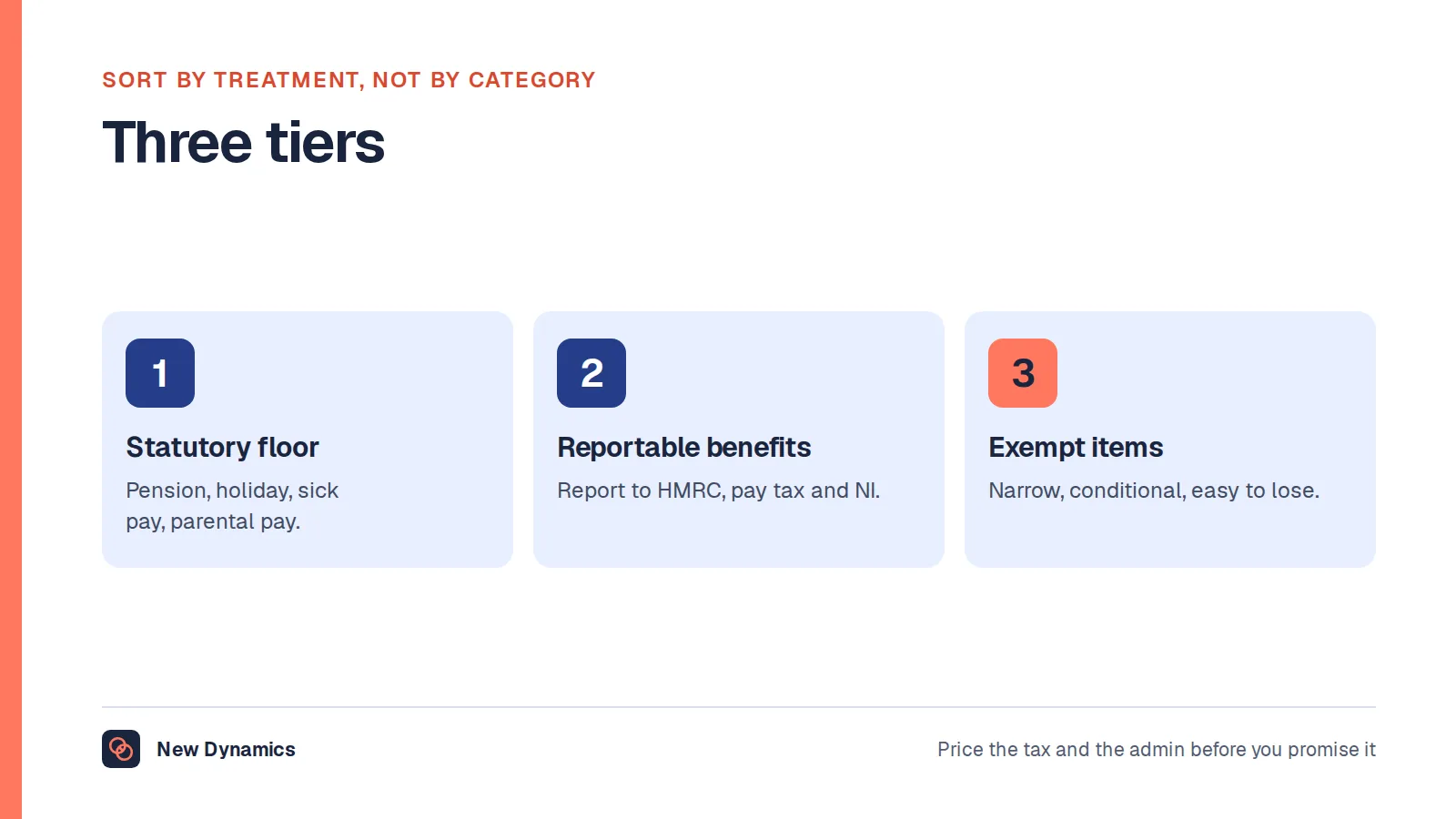
The benefits a UK employer is most likely to be asked about are the ones HMRC lists as exempt from reporting under a salary sacrifice arrangement: "payments into pension schemes", "employer provided pensions advice", "workplace nurseries", "bicycles and cycling safety equipment (including cycle to work)" and the closed legacy category of "childcare vouchers and directly contracted employer provided childcare that started on or before 4 October 2018".
Two of those are what people reach for when they want an FSA analogue:
A cycle to work scheme. GOV.UK's guidance on bikes for employees sets the condition: "lending or hiring bikes to employees doesn't count as an expense or benefit - as long as they're available to all employees and mainly used for getting to work". Where that holds, you do not report it to HMRC and do not deduct or pay tax and National Insurance on it. The availability condition is a design constraint, not a formality.
A workplace nursery. GOV.UK's guidance on childcare states that "most workplace nurseries and childcare voucher schemes are exempt", while noting that "childcare voucher and directly contracted childcare schemes have closed to new applicants". So a workplace nursery remains a live option, and childcare vouchers are not one for anybody joining now.
For the whole UK picture, sorted by how each benefit is treated rather than by how it sounds, see our employee benefits guide and our post on fringe benefits. None of this is tax advice, and the salary sacrifice rules reward checking the current GOV.UK page before you promise anything.
Frequently asked questions
What is a flexible spending account?
A United States employer benefit that lets an employee set aside part of their pay before income tax and employment taxes to be reimbursed for certain costs. IRS Publication 969 describes a health FSA as one that "allows employees to be reimbursed for medical expenses", usually funded through voluntary salary reduction agreements with the employer. It only exists where an employer has created a section 125 cafeteria plan.
What does FSA stand for?
Three answers are all correct, depending on context. In United States benefits it is a flexible spending account or arrangement. In UK financial regulation it was the Financial Services Authority, which the Financial Conduct Authority replaced on 1 April 2013, with prudential regulation passing to the Prudential Regulation Authority. In UK food law it is the Food Standards Agency, a non-ministerial government department responsible for food safety and hygiene in England, Wales and Northern Ireland.
What are the limitations of an FSA?
Five limitations matter in the United States. The annual election is normally locked once the plan year starts. Unused amounts are forfeited at the end of the plan year unless the plan offers a grace period or a carryover. The account is tied to the employer's plan, so it is not portable. Claims must be substantiated as qualified expenses. And self-employed people cannot use one, because a health FSA is an employer-established plan.
What is a TPA?
A third party administrator: the firm an employer appoints to run the day-to-day operation of a benefit plan it sponsors. For an FSA that usually means enrolment records, the benefit card, claim substantiation, reimbursements and reporting. The employer stays the plan sponsor and keeps the legal responsibility, so outsourcing the administration does not outsource the accountability.
Is there a UK equivalent of a health FSA?
No direct equivalent exists, because the NHS covers most of the out-of-pocket medical cost a health FSA is designed to reimburse. The nearest UK mechanism is a salary sacrifice arrangement, which HMRC defines as an agreement to reduce an employee's entitlement to cash pay in return for a non-cash benefit. Cycle to work and a workplace nursery are the two most commonly used examples, and neither involves a pot that can be forfeited.
What is the difference between an FSA and an HSA?
Funding, ownership and what happens at the year end. An FSA is usually funded by employee salary reduction inside the employer's cafeteria plan and mostly expires with the plan year. An HSA is, in Publication 969's words, "a tax-exempt trust or custodial account you set up with a qualified HSA trustee". It belongs to the individual, survives a change of job and does not forfeit unspent money, but it requires coverage under a high deductible health plan.
How much can be put into a flexible spending account?
Quote the figure with the year attached, because it is adjusted annually. Revenue Procedure 2025-32 states that "for taxable years beginning in 2026, the dollar limitation under § 125(i) on voluntary employee salary reductions for contributions to health flexible spending arrangements is $3,400", with a maximum carryover of $680 where the plan permits one. An employer's plan may set a lower limit, and after 2026 check the current IRS publication instead of reusing this number.
Your next step: get the election conversation right
- Decide which FSA you are dealing with. The benefit, the former regulator or the food agency. Most confusion ends here.
- Read the plan document, not the summary. It tells you whether there is a grace period, a carryover, neither, and what the employer's own limit is.
- Check the current year's figures at the publisher. The health FSA limit and the carryover maximum both change, and quoting last year's number in a benefits email is avoidable.
- Put the claim deadline on the leaver checklist, so somebody leaving in March is told before they go, not after.
- If you are a UK employer, map the UK mechanism properly. Salary sacrifice, cycle to work and a workplace nursery are not an FSA.
For a way of deciding pay and benefits that you can explain to the person affected, read and download our compensation policy guide. The guide is free to read, and the PDF uses our short download form.
Want new starters to see what they actually get, and by when they have to choose it? Book a New Dynamics demo and bring your current benefits list. You can also email contact@new-dynamics.com.