TL;DR
- Form 8233 goes to the withholding agent, not to the IRS. The employer reviews it, signs Part IV to accept it, and has 5 days from acceptance to forward a copy to the IRS at Philadelphia, PA 19255-0725, per the Instructions for Form 8233 revised 12/2025.
- The liability sits with the employer. IRS Publication 515 for use in 2026 states that as a withholding agent "you are personally liable for any tax required to be withheld", and that this liability is independent of the tax liability of the foreign person paid.
- A US taxpayer identification number is compulsory and is where most claims stall. The instructions say "You must furnish a U.S. taxpayer identification number (TIN) on this form", and Publication 515 removes the usual foreign-TIN substitute for anyone claiming on Form 8233.
A new hire from a treaty country asks payroll not to withhold federal income tax, because a treaty says the pay is exempt. The request is legitimate. The form that carries it is IRS Form 8233. What is easy to miss, and expensive to miss, is that the form is not really a request the employee makes to the government. It is a claim the employee hands to the employer, and the employer is the party the IRS holds to account for the answer.
This article is about the United States only. The rest of this site is mostly written for the United Kingdom, and none of the rules below have a British equivalent. It is general information, not tax or legal advice, and it is written for the HR and payroll team that has to accept, reject or forward one of these forms rather than for the individual filling it in.
Getting a new starter's paperwork to arrive, get checked and get filed is the whole problem here. See how New Dynamics onboarding keeps each required document attached to the person and the start date, so a missing form is visible before the first payroll run rather than after it.
What Form 8233 is
The IRS describes the form on its About Form 8233 page, last reviewed on 2 October 2026, in a single sentence: "This form is used by non resident alien individuals to claim exemption from withholding on compensation for personal services because of an income tax treaty or the personal exemption amount."
The full title is longer and more useful, because it marks out the boundary of the form: "Exemption From Withholding on Compensation for Independent (and Certain Dependent) Personal Services of a Nonresident Alien Individual".
The default against which the claim is made is set out in the Instructions for Form 8233, revised 12/2025: "In general, section 1441 requires 30% income tax withholding on compensation for independent personal services, defined later. Sections 1441, 3401, and 3402 require withholding, sometimes at 30% and sometimes at graduated rates, on compensation for dependent personal services, defined later. However, some payments may be exempt from withholding because of a tax treaty."
So the form covers two populations your organisation may be paying. Independent personal services means services performed as an independent contractor by a self-employed nonresident alien. Dependent personal services means services performed as an employee, and the instructions list what that includes: "wages, salaries, fees, bonuses, commissions, and similar designations for amounts paid to an employee."
Why this lands on the employer, not the employee
The employer paying a nonresident alien for work done in the United States is a withholding agent. The instructions define the term broadly: "Any person, U.S. or foreign, that has control, receipt, or custody of an amount subject to withholding or that can disburse or make payments of an amount subject to withholding is a withholding agent."
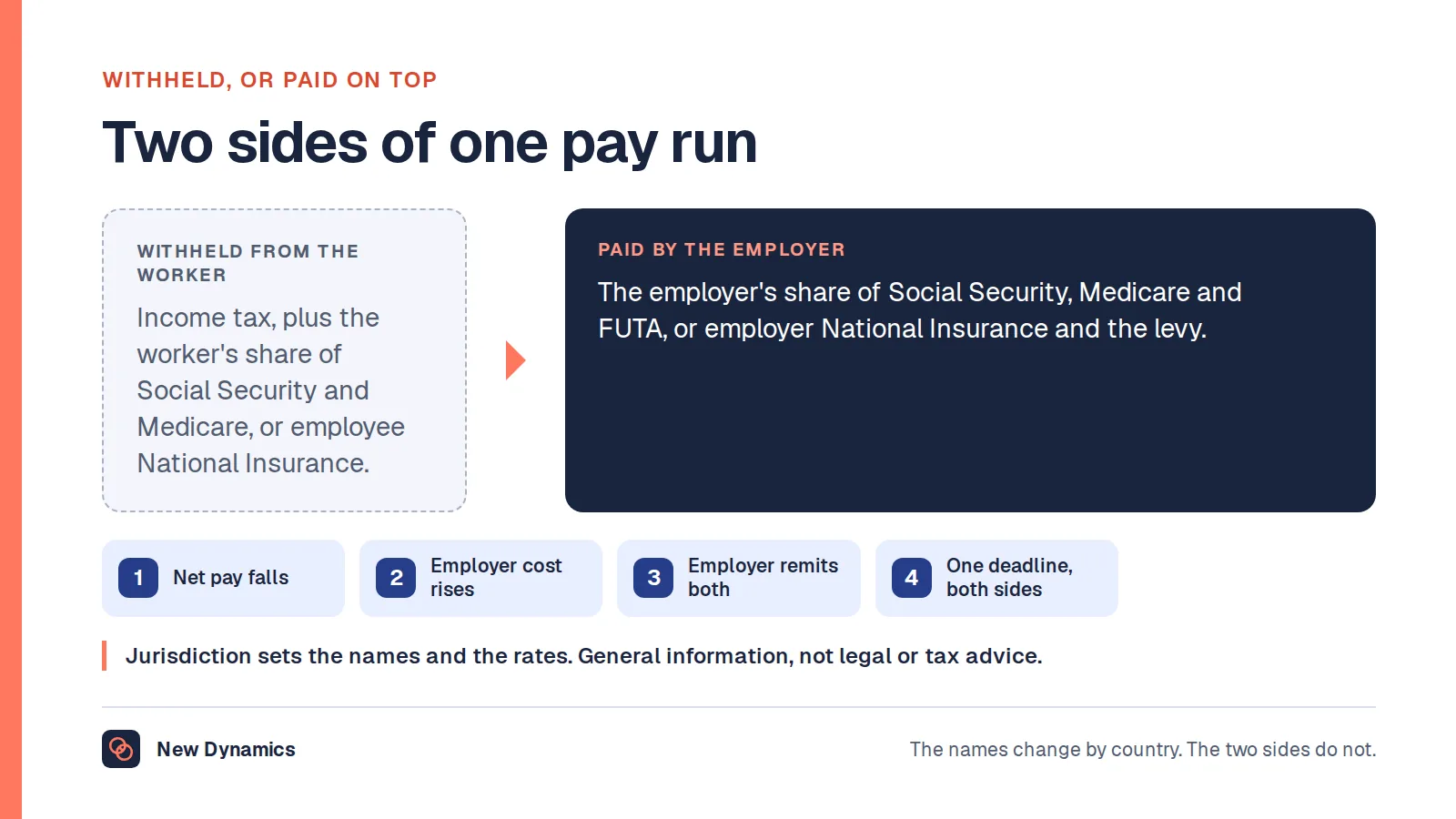
That status carries the exposure. IRS Publication 515, Withholding of Tax on Nonresident Aliens and Foreign Entities, for use in 2026, is direct about it under the heading Liability for tax: "As a withholding agent, you are personally liable for any tax required to be withheld. This liability is independent of the tax liability of the foreign person to whom the payment is made. If you fail to withhold and the foreign payee fails to satisfy its U.S. tax liability, then both you and the foreign person are liable for tax, as well as interest and any applicable penalties."
The same publication adds the part that removes the easy comfort: "The applicable tax will be collected only once. If the foreign person satisfies its U.S. tax liability, you are not liable for the tax but remain liable for any interest and penalties for failure to withhold."
Read those two passages together and the practical rule is simple. If payroll stops withholding on the strength of a Form 8233 that should not have been accepted, the employer does not get to point at the employee. Even in the best case, where the individual files and pays, the employer still owns the interest and the penalties.

Who completes it, and who receives it
The nonresident alien completes Parts I to III and signs the certification. The form then goes to the employer or payer, not to the IRS. The instructions are explicit, including in the small print at the very end: "Do not send the tax form to this address. Instead, give it to your withholding agent."
The employer's job comes next: "When the nonresident alien individual gives you Form 8233, review it to see if you are satisfied that the exemption from withholding is warranted. If you are satisfied, based on the facts presented, complete and sign the certification in Part IV."
Review is a real obligation, not a signature box. The instructions set two bars the employer must not cross: "You must not accept Form 8233, and you are required to withhold" if "You know, or have reason to know, that any of the facts or statements on Form 8233 may be false" or if "You know, or have reason to know, that the nonresident alien's eligibility for the exemption from withholding cannot be readily determined (for example, you know the nonresident alien has a fixed base or permanent establishment in the United States)."
The instructions also warn the person completing the form, which is worth repeating to any manager who assumes payroll will work the treaty out for them: "You must know the terms of the tax treaty between the United States and the treaty country to properly complete Form 8233."
The 5 days, and the 10 days
Two periods matter, they do different things, and payroll teams routinely merge them.
The first is the forwarding duty. The instructions say the employer will need three copies of the completed form, each including any attachments the individual submitted. One goes to the individual, one is kept for the employer's records, and "Within 5 days of your acceptance, forward one copy to: Department of the Treasury, Internal Revenue Service, Philadelphia, PA 19255-0725." The instructions give a fax alternative, 267-941-1365, and note "You are limited to 25 pages at one time." Publication 515 for use in 2026 repeats the duty in its own words: a withholding agent receiving the form "must review the form, sign to indicate its acceptance, and forward the form to the IRS within 5 days of its acceptance."
The second is the waiting period before the exemption can be relied on. The instructions state: "The exemption from withholding is effective for payments made retroactive to the date of the first payment covered by Form 8233, even though you must wait at least 10 days after you have properly mailed Form 8233 to the IRS to see whether the IRS has any objections to the Form 8233."
The practical reading for payroll is that the clock starts at your acceptance, the copy must be gone within 5 days, and you hold off acting on the exemption for at least 10 days after the form was properly mailed. Because the relief is retroactive to the first payment covered, a run processed during the wait is corrected rather than lost.
The taxpayer identification number, which is where most claims stop
This is the single most common reason a Form 8233 goes nowhere. The instructions for line 2 are unambiguous: "You must furnish a U.S. taxpayer identification number (TIN) on this form. In most cases, you must enter your SSN on line 2."
If there is no Social Security number and the person is not eligible for one, "you must get an ITIN", obtained by filing Form W-7. The instructions flag the ordering problem that catches new arrivals: an ITIN is normally applied for with a tax return, "However, if the reason for your ITIN request is because you need to provide Form 8233 to the withholding agent, you must file Form W-7 with the required documentation."
There is one piece of slack. "If you have applied for an SSN or ITIN but have not yet received it, you can attach a copy of a completed Form W-7 or SS-5 showing that a number has been applied for."
What there is not is the usual workaround. Publication 515 lists exceptions that let a withholding agent take a foreign TIN instead of a US one, then closes the door on this form: you may request a foreign TIN issued by the payee's country of residence "except when the payee is a nonresident alien individual claiming an exemption from withholding on Form 8233." A foreign tax number is not a substitute here.
An existing ITIN can also lapse. The instructions state that ITINs generally stay in effect as long as the holder filed a return, or was included as a dependent on one, "at least once in the last 3 tax years", and otherwise expire at the end of the third consecutive tax year without a return. A returning contractor's number from four years ago may no longer work.
One form per tax year, per payer, per type of income
The form does not roll forward. The instructions require a separate Form 8233 "For each tax year (be sure to specify the tax year in the space provided above Part I of the form), For each withholding agent, and For each type of income."
The IRS gives the example of a professor who is primarily present as a teacher at one institution and occasionally lectures elsewhere as self-employment: "For each tax year, the professor must complete and give a separate Form 8233 to the withholding agent at each institution in order to claim tax treaty benefits on the separate items of income, if the treaty so permits."
For payroll this is an annual diary item with a hard consequence. A new tax year with no new form means the exemption has not been claimed for that year, and the default withholding applies from the first payment.

What Form 8233 is not
Three confusions are worth settling in writing before they reach your inbox.
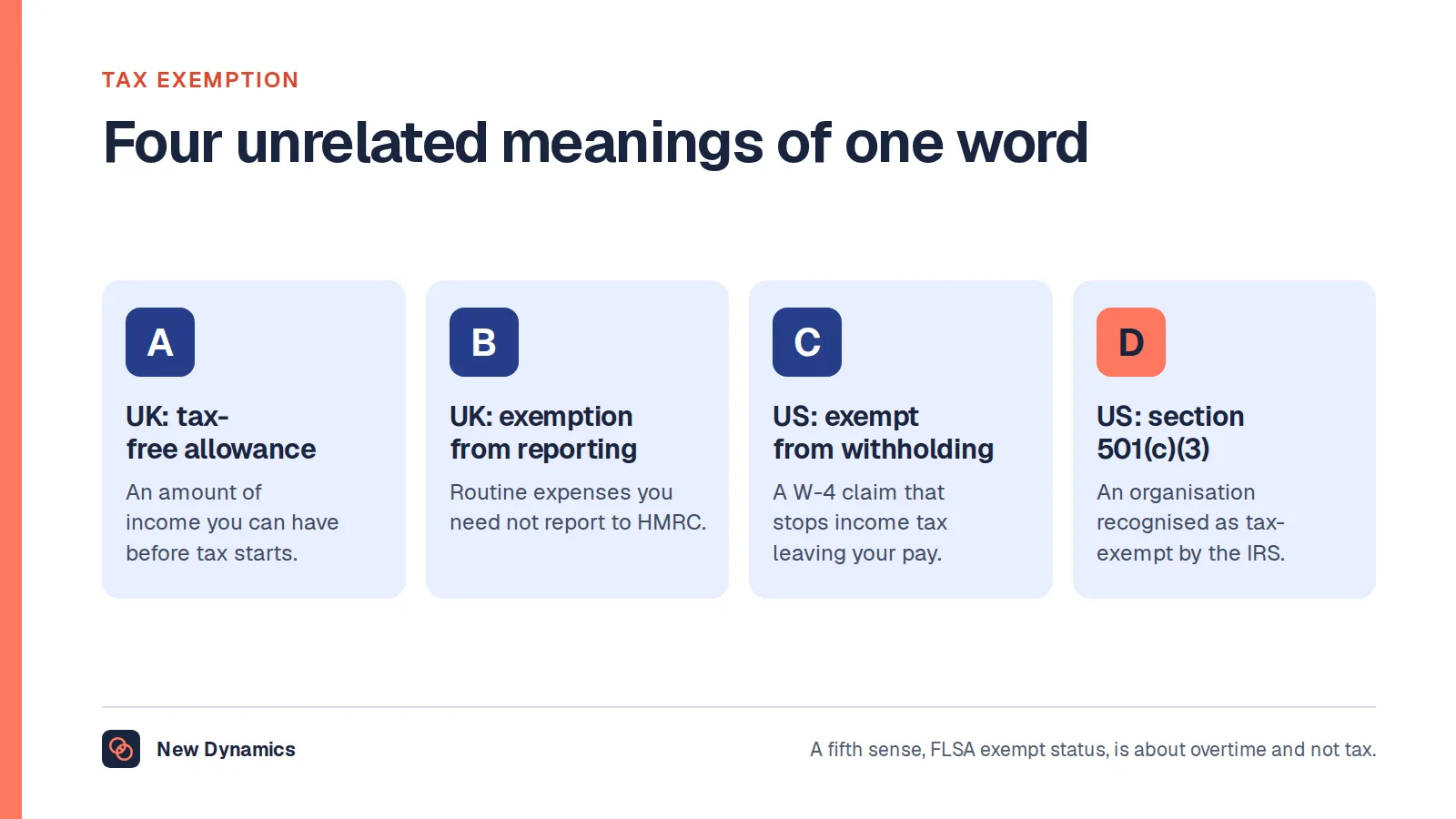
It is not a Form W-4 exemption. Publication 515 puts it flatly: "A nonresident alien cannot claim exemption from withholding on Form W-4. Use Form 8233 to claim a tax treaty exemption from withholding." The exempt box on a Form W-4 is a different claim with different conditions, covered in our post on what tax exemption actually means. A nonresident alien employee still gives a Form W-4 for any pay not covered by a treaty claim, following the special instructions in Notice 1392 rather than the ones printed on the form.
It is not a Form W-8BEN. The instructions route noncompensatory scholarship or fellowship income to Form W-8BEN, with one carve-out: Form 8233 can carry both "only if you are also claiming a tax treaty withholding exemption for compensation for personal services (including compensatory scholarship or fellowship income) received from the same withholding agent."
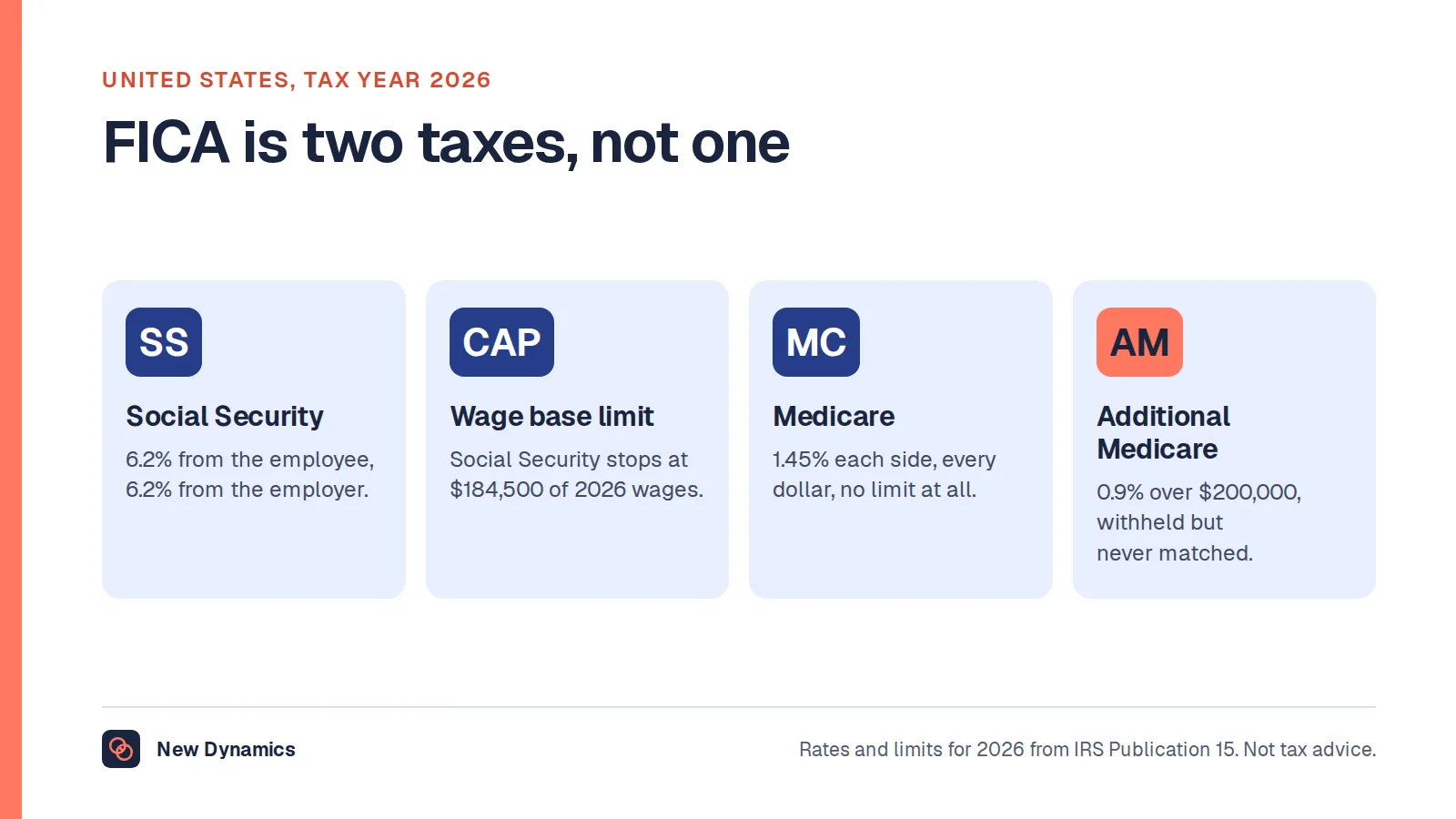
It does not touch Social Security and Medicare. An income tax treaty exemption is an income tax exemption. Publication 519, the U.S. Tax Guide for Aliens, for use in preparing 2025 returns, says that if you work as an employee in the United States "you must pay social security and Medicare taxes in most cases", with a separate statutory exclusion for certain F, J, M and Q nonimmigrants doing work that carries out the purpose of their admission. Those are different rules with different tests, and our post on how FICA is calculated sets out the rates and caps.
One more reporting consequence follows acceptance. Publication 515 states that if the employee submits Form 8233 to claim treaty exemption, "the wages are reported on Form 1042-S and not in box 1 of Form W-2." Treaty-exempt wages may still appear in the state and local boxes of Form W-2 where state and local tax applies.
When it is not accepted
The instructions list what makes a form incorrect: one that "claims a tax treaty benefit that does not exist or is obviously false", and one that "has not been completed in sufficient detail to allow determination of the correctness of the tax treaty benefit or exemption claimed." If an incorrect form is submitted, "the IRS will notify you that the form submitted is not acceptable and that you must begin withholding immediately."
The same applies if circumstances change after acceptance: the employer "must promptly notify the IRS" and "must begin withholding on any amounts not yet paid", and if the IRS says eligibility is in doubt, "you must begin withholding immediately."
The courtesy step is in the instructions too, and it is the one that keeps the relationship intact: "If the IRS rejects Form 8233, you should notify the individual who submitted it and allow the individual to submit a revised form if the individual still believes they are entitled to the exemption."
The IRS publishes its own estimate of what one of these forms costs in time, in the Paperwork Reduction Act notice to the 12/2025 instructions: recordkeeping 3 hours 44 minutes, learning about the law or the form 2 hours 39 minutes, and preparing and sending the form 2 hours 26 minutes. That is roughly a working day per form, per person, per year, which is worth knowing before you promise a two-day turnaround.
Where this leaves HR and payroll
Treat Form 8233 as a controlled document with an owner, a deadline and an audit trail, because the liability quoted above is yours and not the employee's.
- Name one person who accepts or declines these forms. Signing Part IV is a certification, so it should not be delegated to whoever opens the post.
- Ask for the US TIN at offer stage, not at first payroll. If the individual needs an ITIN, the Form W-7 has to be filed because of the Form 8233, and a copy of the completed W-7 or SS-5 can be attached meanwhile.
- Put a 5-day timer on acceptance, and record the date the copy went to Philadelphia or the fax confirmation. That date is the one you will be asked for.
- Do not release the exemption until at least 10 days after the form was properly mailed. Note in the record that relief is retroactive to the first payment covered, so an interim withheld run is not a problem.
- Diary every live claim for renewal in the new tax year, one per payer and per type of income.
- Keep the Form W-4, the FICA treatment and the Form 1042-S reporting as separate checks. None of them is answered by the Form 8233 on its file.
Frequently asked questions
What is IRS Form 8233 used for?
It is used by a nonresident alien individual to claim an exemption from withholding on compensation for personal services, where an income tax treaty gives that exemption. The IRS says on its About Form 8233 page, last reviewed on 2 October 2026, that it is used "to claim exemption from withholding on compensation for personal services because of an income tax treaty or the personal exemption amount."
Who do I send Form 8233 to?
Give it to your withholding agent, which is normally the employer or payer, not to the IRS. The Instructions for Form 8233 revised 12/2025 end with the line "Do not send the tax form to this address. Instead, give it to your withholding agent." The withholding agent then sends a copy on to the IRS.
How long does the employer have to send Form 8233 to the IRS?
Five days. The 12/2025 instructions say that within 5 days of your acceptance you forward one copy to the IRS at Department of the Treasury, Internal Revenue Service, Philadelphia, PA 19255-0725. A fax number, 267-941-1365, is given as an alternative, limited to 25 pages at one time.
When can we stop withholding after accepting a Form 8233?
Not immediately. The 12/2025 instructions say you must wait at least 10 days after you have properly mailed the form to the IRS to see whether the IRS has any objections. The exemption is then effective retroactive to the date of the first payment covered by the form, so an amount withheld during the wait can be corrected.
Does Form 8233 need a Social Security number or ITIN?
Yes. The 12/2025 instructions state that you must furnish a US taxpayer identification number on the form, usually a Social Security number on line 2, and that someone who is not eligible for one must obtain an ITIN by filing Form W-7. A foreign tax number issued by the country of residence is not accepted in place of it for this form.
Do we need a new Form 8233 every year?
Yes. A separate form is required for each tax year, for each withholding agent and for each type of income, and the tax year must be written in the space above Part I. An unrenewed claim means normal withholding applies from the first payment of the new year.
What is the difference between Form 8233 and Form W-8BEN?
Form 8233 covers personal services income. Form W-8BEN covers income that is not personal services income, including noncompensatory scholarship or fellowship income. One Form 8233 can carry both only where the individual is claiming a treaty exemption for personal services income from the same withholding agent.
What happens if the IRS rejects the form?
The IRS notifies the withholding agent that the form is not acceptable and that withholding must begin immediately. The instructions add that the withholding agent should notify the individual who submitted it and allow a revised form to be submitted if the individual still believes the exemption applies.
Does a treaty exemption also exempt the employee from FICA?
No. An income tax treaty exemption is an exemption from income tax withholding. Social Security and Medicare liability is decided by separate rules, including the statutory exclusion for certain F, J, M and Q nonimmigrants performing work that carries out the purpose of their admission.
Your next step: put an owner and a clock on it
- Write one internal page covering who accepts Form 8233, what they check, and what evidence is filed. Link the current Instructions for Form 8233 rather than a summary of them.
- Add the US taxpayer identification number to the pre-start checklist for every nonresident hire or contractor, with the Form W-7 route named for anyone without one.
- Build the two clocks into the process: forward within 5 days of acceptance, release the exemption no earlier than 10 days after proper mailing.
- Review every live claim each January and reissue the form, one per payer and per income type.
For the policy structure that sits behind pay decisions like these, read and download our compensation policy guide. The guide is free to read, and the PDF uses our short download form. For the wider split between what the employer owes and what the individual owes, see our posts on payroll tax vs income tax and Form 1040-ES.
Want every required document for a new starter tracked against their start date, with the deadline visible before payroll runs? Book a New Dynamics demo and bring your current nonresident onboarding checklist. You can also email contact@new-dynamics.com.