TL;DR
- No official UK source measures OKR adoption, how many goals an employee has, or goal attainment rates. Every percentage in circulation comes from a vendor or membership panel, usually without a stated sample.
- Two large official surveys do measure goal clarity. In the Civil Service People Survey 2025, 83.707% of staff agreed they understand how their work contributes to their organisation's objectives, and 77.449% agreed they have clear work objectives.
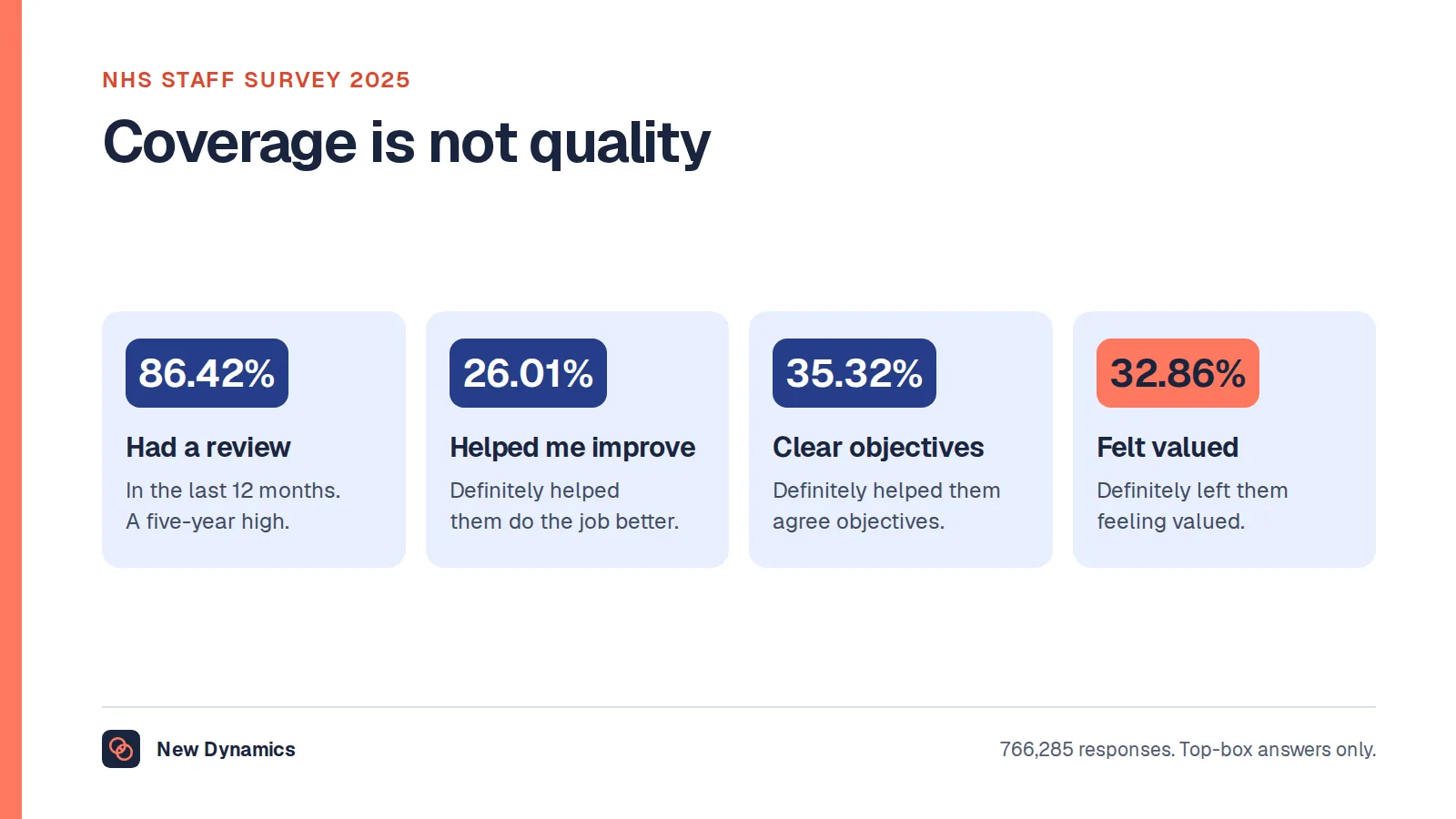
- Quality is the weaker half. In the 2025 NHS Staff Survey, only 35.32% of staff said their appraisal definitely helped them agree clear objectives for their work, a figure that has barely moved in four years.
Search for OKR adoption statistics and you will be handed a confident percentage within seconds. Look for who produced it and the trail usually ends at a company that sells goal-setting software. There is no official United Kingdom statistic for how many organisations use objectives and key results, and there is no official answer to how many goals an employee should have.
What does exist is better than it sounds. Two of the largest workforce surveys in the country ask people whether they understand the objectives, whether their own are clear, and whether the conversation that set them helped. Those are the questions that matter, and the answers are published every year.
Clear objectives are the product of a process, not a template. See how New Dynamics goals and OKRs keep objectives visible and current between review cycles.
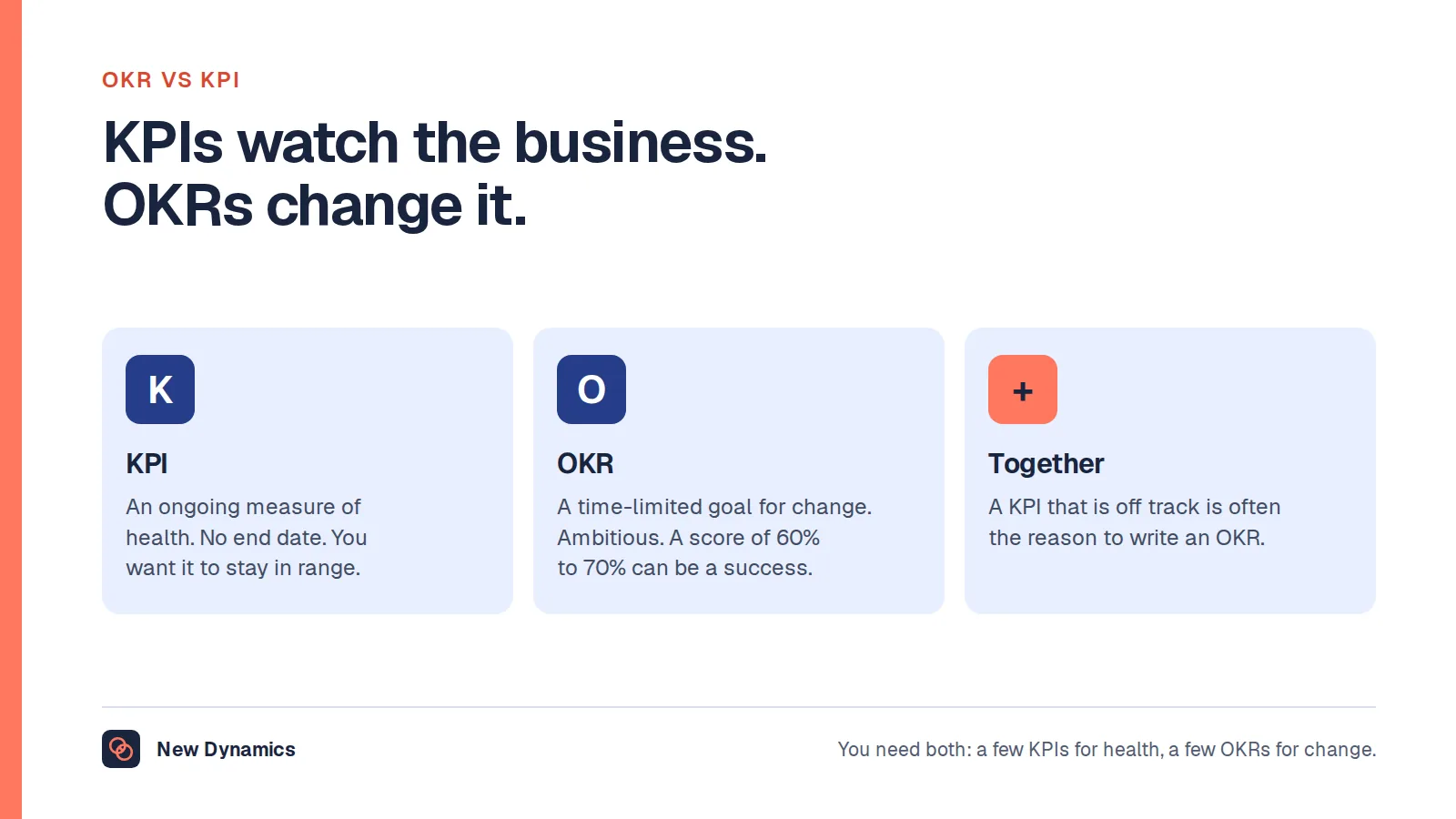
For the difference between the two things most goal statistics confuse, our post on OKR versus KPI draws the line.
There is no official statistic on OKR adoption
This is the honest starting point, and it is worth stating plainly rather than filling the gap.
No office of national or government statistics counts how many United Kingdom employers use OKRs. The framework appears on government websites as practice, not as measurement. The nearest thing in the official estate is the Office for National Statistics Management and Expectations Survey, which scores how targets are set, tracked and reviewed. It does not ask whether a business calls its method OKRs, and it would be a poor question to ask, because employers describe the same practice by half a dozen different names.
The same gap covers three neighbouring questions. Nobody publishes how many goals the average employee holds. Nobody publishes a national goal attainment rate. Nobody publishes how many employers cascade objectives from a company plan.
So when a figure such as a neat two thirds or four fifths appears beside the words "of companies use OKRs", the sample is the thing to ask about. If the panel is the publisher's own customers or members, the figure describes that panel. It does not describe the economy.
What is published on understanding company goals

The Civil Service People Survey is the largest regular survey in the country that asks about objectives at the question level, and it publishes the full question wording with the result. Fieldwork for the 2025 survey "opened on 23 September 2025 and was closed on 21 October 2025". The results highlights, updated on 28 May 2026, record that "343,961 civil servants from 102 organisations responded to the 2025 Civil Service People Survey, down from 354,962 in 2024. The overall response rate in 2025 was 59%, down compared with 2024 (61%)".
Three questions in the published benchmark workbook speak directly to goal clarity. Each score is the percentage selecting "Strongly agree" or "Agree", reported here as the Civil Service mean, which the workbook defines as "the percentage score for all responding staff within the Civil Service".
| Question | 2025 | 2024 |
|---|---|---|
| I understand how my work contributes to my organisation's objectives | 83.707% | 83.584% |
| I have a clear understanding of my organisation's objectives | 81.099% | 80.840% |
| I have clear work objectives | 77.449% | 77.358% |
Read the shape of that table rather than the individual numbers. More people understand the organisation's direction than can say their own objectives are clear. The gap between 83.707% and 77.449% is the gap between knowing where the ship is going and knowing what you are supposed to do about it. That is where most goal-setting effort should land.
At theme level the published summary reports "Organisational objectives and purpose" at 82%, unchanged on 2024, and "My work" at 79%, down one percentage point. Both are built from the questions above.
One caution before anyone quotes these as a national benchmark. They describe the Civil Service in 2025. They are not a United Kingdom figure, and they are not a private sector figure.
What is published on agreeing clear objectives
The 2025 NHS Staff Survey asks the better question. Not whether objectives exist, but whether the conversation that set them worked. Over 1.5 million NHS employees in England were invited to take part "between September and November 2025", 766,285 staff responded, and the national results briefing was published in March 2026.
On coverage, the briefing reports that "86.42% of staff say they have had an appraisal, annual review, development review, or Knowledge and Skills Framework development review in the last 12 months, which is a five-year high".
Then it asks those people what the appraisal did. The proportion saying it definitely "helped them to agree clear objectives for their work" was 35.32% in 2025, against 35.53% in 2024, 35.49% in 2023, 32.08% in 2022 and 30.95% in 2021.
Almost nine in ten people had the meeting. Around one in three came out of it certain that it had given them clear objectives. Read "definitely" carefully, because it is the top answer rather than the only positive one, so the rest were not all failures. It is a measure of how many people were sure, which is a fair standard for a conversation whose whole purpose is clarity.
The briefing's Appraisals sub-score is 4.90 out of 10, against 4.88 in 2024 and 4.25 in 2021. Four years of improvement, and still under half marks.
Two other NHS questions are worth keeping beside those. In 2025, 73.56% of staff said the team they work in has a set of shared objectives, against 73.58% in 2024. Only 53.73% said teams within their organisation work well together to achieve their objectives, down from 54.32%. Goals inside a team hold up. Goals across teams are where alignment is actually lost.
What the ONS measures about targets and KPIs

The Office for National Statistics Management and Expectations Survey is the closest official statistic to employer goal-setting practice. The bulletin covering 2016 to 2023 was released on 13 May 2024, covers businesses in production and services with employment of at least 10, and is labelled as official statistics in development. The "MES 2023 sample size was 53,433 and the response rate 27%".
Its score covers four dimensions, one of which is "targets, how targets are set, tracked and reviewed". Scores run from 0 to 1, so these are index values and not percentages of businesses. The bulletin reports that "continuous improvement continued to have the highest mean score at 0.80, but this was a slight fall on 2020 (0.82). Use of key performance indicators (KPIs) scored the lowest at 0.42, while employment practices saw the greatest improvement since 2020, from 0.52 to 0.64".
The accompanying dataset goes a level deeper, and one pair of rows is the most useful finding in this whole article. For the United Kingdom in 2023, the question "Approximately what proportion of managers are aware of these targets?" scores 0.73. The same question about non-managers scores 0.50.
Awareness of targets drops by roughly a third below management level. That is measured, it is official, and it is the best available evidence that the problem is not a shortage of goals. It is a shortage of goals that reach the people doing the work.
The targets dimension overall scores 0.49 for the United Kingdom in 2023, and the KPI dimension 0.42. Of four dimensions of management practice, the two about goals are the two scoring lowest.
How many goals should an employee have
No official statistic answers this, and it is worth being clear that the question has no published number behind it. The ONS does ask businesses "How many key performance indicators (KPIs) does this business monitor?", but it publishes a normalised score of 0.59 for 2023 rather than a count, so it cannot be quoted as an average number of KPIs.
What the evidence above does support is a direction. If 77.449% of a workforce can say their own objectives are clear while 83.707% understand the organisation's direction, the binding constraint is specificity at the individual level, not volume. And if target awareness halves below management, adding objectives without changing how they are communicated makes the gap wider, not smaller.
Practically, that argues for a number small enough that every holder can recite theirs without opening a system. Choose it from your own evidence rather than from a benchmark, because no benchmark exists.
For the wider set of United Kingdom figures on work, pay, absence and the workforce, our HR statistics hub collects them with the publisher and the period attached.
The goal statistics to produce yourself

None of these needs a national benchmark to be useful, and all of them are available inside your own cycle.
- The Civil Service question, asked of your own people. Do you understand how your work contributes to the organisation's objectives, and do you have clear work objectives? Two questions, directly comparable with a published figure.
- The NHS question, asked after your review cycle. Did the conversation definitely help you agree clear objectives for your work? Keep the wording, because changing it ends the trend.
- Target awareness by level. Ask managers and non-managers separately. The ONS gap of 0.73 against 0.50 is the reason to split it.
- Objectives per person, and the spread. The average hides the problem. The person holding three times the median is the finding.
- Objectives changed mid-cycle. A plan that never changes was not a plan, it was a forecast nobody revisited.
What usually goes wrong with goal statistics
- Quoting an adoption percentage with no sample. This is most OKR statistics in circulation.
- Treating a public sector figure as a national one. Both large surveys here cover one employer group each.
- Confusing an index score with a percentage. The ONS targets score of 0.49 is not 49% of businesses.
- Measuring whether objectives exist rather than whether they are clear. Coverage of 86.42% alongside 35.32% is the warning.
- Asking only managers. The one measured gap in this article is the one that opens below them.
- Rewriting the survey question each year, which leaves you with a figure and no trend.
Frequently asked questions
Are there official OKR adoption statistics for the UK?
No. No official United Kingdom source counts how many employers use objectives and key results. The percentages in circulation come from vendor and membership panels of self-selecting respondents, and they usually do not state the sample, so they describe the panel rather than the economy.
What percentage of employees understand company goals?
In the Civil Service People Survey 2025, 83.707% of staff agreed or strongly agreed that they understand how their work contributes to their organisation's objectives, and 81.099% agreed they have a clear understanding of the organisation's objectives. Both are Civil Service figures for 2025, not United Kingdom figures.
How many goals should an employee have?
No official statistic answers this. The ONS asks businesses how many KPIs they monitor but publishes a normalised score rather than a count. The published evidence points towards clarity and awareness mattering more than volume, so choose a number your people can recite without checking a system.
What proportion of employees say their objectives are clear?
The Civil Service People Survey 2025 reports 77.449% agreeing with "I have clear work objectives", against 77.358% in 2024. In the 2025 NHS Staff Survey, 35.32% of staff said their appraisal definitely helped them agree clear objectives for their work.
Do managers and employees know the targets equally well?
No, and this is measured. In the ONS Management and Expectations Survey for 2023, the question on what proportion of managers are aware of the business's targets scores 0.73 on a scale of 0 to 1, while the same question about non-managers scores 0.50.
Is goal setting getting better or worse in the UK?
The published trends are flat to slightly positive. NHS staff saying their appraisal definitely helped them agree clear objectives moved from 30.95% in 2021 to 35.32% in 2025. The Civil Service figures for understanding objectives have moved less than a percentage point since 2024. Neither series shows a step change.
Your next step: measure your own goal clarity
- Add the two Civil Service questions to your next engagement survey, worded as published, so you have a figure with something to compare against.
- Ask the NHS clarity question immediately after your next review cycle closes, while the conversation is still recent.
- Split target awareness by level, managers and everyone else, and look at the gap rather than the average.
- Pull the spread of objectives per person, not the mean, and look at the top of the range.
For the practice behind the numbers, read our post on the goal setting definition and performance goals examples, or read and download our OKR guide. The guide is free to read, and the PDF uses our short download form.
Want objectives that stay visible between review cycles? Book a New Dynamics demo and bring last cycle's goal list. You can also email contact@new-dynamics.com.