TL;DR
- GOV.UK's employer guidance on payslips calls it in so many words: a payslip must show "pay before any deductions ('gross' wages)". The statutory term, in Employment Rights Act 1996 section 8(2)(a), is "the gross amount of the wages or salary".
- Statutory payments are inside the figure and the employer's own pension contribution is outside it. GOV.UK says of statutory sick and parental pay that "you must record these in your software - they're taxed like normal pay".
- Since 6 April 2019 a payslip must also show hours where pay varies by time worked, and section 8(2)(e) limits that to "the total number of hours worked", so the hours line will not reconcile to a gross figure that includes holiday or sick pay.
Most pay questions start at the bottom of the payslip. This one starts at the top. Gross wages is the figure everything else is worked out from, and when it is wrong, every percentage below it is wrong too.
The one-line answer is easy. The hard part is the list: does overtime count, does holiday pay count, does sick pay count, does the employer's pension contribution count, does the mileage claim count. This article answers that list from the published rules, builds a gross figure line by line in an example you can check with a calculator, and explains why the hours shown next to it will not add up to it.
Pay questions land on someone in HR before they land on payroll, and they stall when nobody owns the next step. See how New Dynamics workflows give each step an owner and a due date. New Dynamics does not run payroll, so this is general background about the United Kingdom rather than product documentation, and it is not tax or legal advice.
Gross wages in one sentence
Gross wages are everything a worker has earned in a pay period, before anything is taken off.
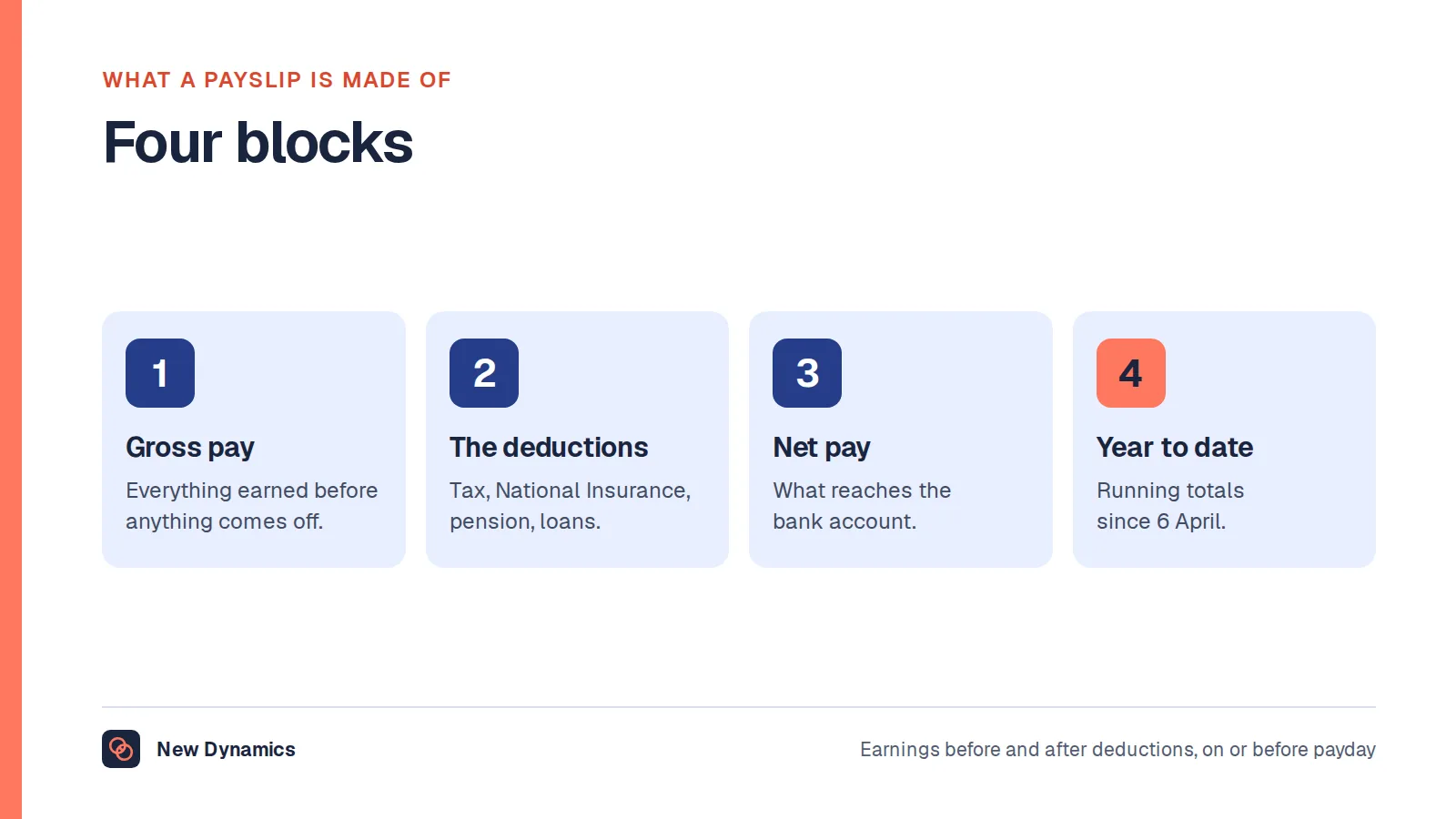
That is not a paraphrase. GOV.UK's employer guidance on payslips uses the phrase directly. Payslips must show "pay before any deductions ('gross' wages)", "deductions to pay like tax and National Insurance", "pay after deductions ('net' wages)" and "the number of hours worked, if the pay varies depending on time worked".
Gross wages, gross pay, gross earnings and the gross amount all mean the same figure. Which word you meet depends on who is writing: payroll software tends to say gross pay, the statute says wages or salary, an American pay stub says gross wages.
The right to be given the figure
The duty sits in statute, not in guidance. Section 8 of the Employment Rights Act 1996 provides that "a worker has the right to be given by his employer, at or before the time at which any payment of wages or salary is made to him, a written itemised pay statement".
Section 8(2) then lists what that statement "shall contain particulars of":
- "(a) the gross amount of the wages or salary";
- "(b) the amounts of any variable, and (subject to section 9) any fixed, deductions from that gross amount and the purposes for which they are made";
- "(c) the net amount of wages or salary payable";
- "(d) where different parts of the net amount are paid in different ways, the amount and method of payment of each part-payment";
- "(e) where the amount of wages or salary varies by reference to time worked, the total number of hours worked in respect of the variable amount of wages or salary either as (i) a single aggregate figure, or (ii) separate figures for different types of work or different rates of pay".
Two of those provisions are recent. The legislation.gov.uk annotations record that paragraph (e) was "inserted (6.4.2019)" by the Employment Rights Act 1996 (Itemised Pay Statement) (Amendment) Order 2018, and that the words "a worker" were substituted in section 8(1) on the same date, replacing a narrower right that covered employees only.
The extent marked on the provision is E+W+S, so section 8 applies in England, Wales and Scotland. Northern Ireland has its own employment legislation. The tax rules below apply across the United Kingdom, with income tax rates and bands differing in Scotland.
GOV.UK's worker-facing guidance on payslips puts the same duty more plainly: a payslip must show "your earnings before and after any deductions" and "the number of hours you worked, if your pay varies depending on time worked".
What GOV.UK puts inside gross pay
The employer-side page that actually settles the list is GOV.UK's guidance on recording employees' pay. It starts with the obvious part, "record your employees' salary or wages in your payroll software", and then names what else goes in.
Statutory payments are in. The page lists Statutory Sick Pay and statutory pay for parents, which "includes maternity pay, paternity pay, adoption pay, parental bereavement pay, shared parental pay, neonatal care pay", and is blunt about their treatment: "you must record these in your software - they're taxed like normal pay." GOV.UK's guidance on Statutory Sick Pay for employers says SSP is paid "in the same way as wages, for example on the normal payday, deducting tax and National insurance", and its page on maternity pay says of Statutory Maternity Pay that "tax and National Insurance will be deducted". A month on statutory pay still produces a gross figure, just a smaller one.
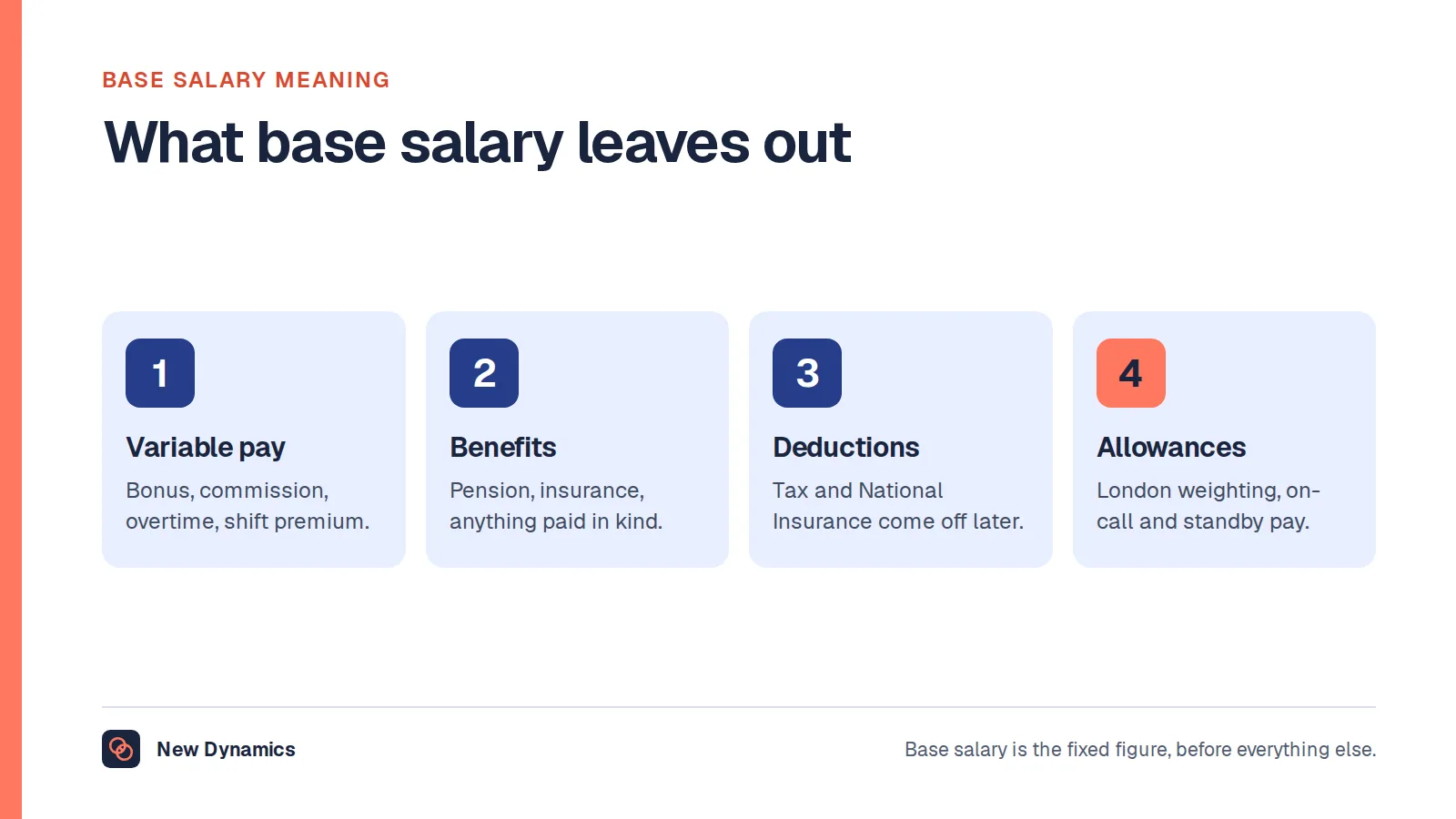
Variable pay is in. The same page lists other payments "you should record as normal pay": bonuses, commission, "holiday pay (unless you pay it in advance or use a holiday pay scheme)", payments for time spent travelling, passenger payments "except the first 5 pence per mile", medical and maternity suspension payments, guarantee payments, inducement payments described as "golden hello" payments, and "cash prizes for competitions you run".
Tips depend on the route. GOV.UK says to "treat tips to your staff as normal pay if they're paid into your till", including tips added to card or cheque payments, and that "the rules are different if tips are given straight to your employees by customers or paid into a tronc".

What sits outside gross pay
Most of the confusion here comes from one instinct: if money moved because of work, it must be wages. It does not follow.
The employer's pension contribution. The employee's own contribution is a deduction from gross pay, so it is inside the figure and then taken off it. The employer's contribution is not. It is the employer's money, paid to the scheme, and it never appears in the gross total. GOV.UK's page on what you, your employer and the government pay gives the automatic enrolment minimums as, from April 2019, 3% for "the minimum your employer pays", 5% for "you pay" and 8% as the "total minimum contribution".
Most reimbursed expenses. GOV.UK's guidance on expenses and benefits states that "you do not have to report some routine employee expenses to HM Revenue and Customs (HMRC). This is called an 'exemption'", covering items "like business travel, phone bills, business entertainment expenses, uniform and tools for work", where you either pay a benchmark or approved bespoke flat rate or are "paying back the employee's actual costs". Mileage shows where the line falls. GOV.UK's page on business travel mileage sets the approved rate for cars and vans at "55p from 6 April 2026 (45p before 6 April 2026)" for the first 10,000 miles, and says that above the approved amount you must either "report on form P11D" or "add anything above the 'approved amount' to the employee's pay, and deduct and pay tax as normal". Below it, a mileage payment is a reimbursement. Above it, the excess becomes pay.
Benefits in kind. GOV.UK says that "expenses or benefits like uniforms or company cars are reported separately at the end of the tax year". A company car or private medical cover has a taxable value and may change someone's tax code, but it is not part of the gross cash figure.

A gross wages example you can check
Here is one monthly pay period for an hourly-paid worker whose hours vary. The figures are a constructed case rather than anyone's actual payslip, and every line is arithmetic you can repeat. Two published rates are used, both for the 2026 to 2027 tax year, and both named below.
| Line | Working | Amount |
|---|---|---|
| Basic pay | 142 hours at £13.50 | £1,917.00 |
| Overtime | 9 hours at £20.25 | £182.25 |
| Commission | agreed for the month | £145.00 |
| Holiday pay | 15 hours at £13.50 | £202.50 |
| Statutory Sick Pay | 2 qualifying days at £24.65 | £49.30 |
| Gross wages | the five lines added | £2,496.05 |
The overtime rate is the basic rate at time and a half, so £13.50 multiplied by 1.5 gives £20.25. The sick pay uses HMRC's published unrounded daily rate. GOV.UK's rates and thresholds for employers: 2026 to 2027 states that "the weekly rate of Statutory Sick Pay (SSP) for 2026 to 2027 is £123.25 or 80% of the employee's average weekly earnings, whichever is lower", and lists the unrounded daily rate for someone working five qualifying days a week as £24.65. The hourly rate clears the floor: the same page gives the National Minimum Wage from 1 April 2026 as £12.71 for workers "aged 21 and above (national living wage rate)".
Three items are deliberately absent, and each is a question people ask. The employer's pension contribution is not in the £2,496.05. A reimbursement of 120 business miles at the approved 55p, which is £66.00, is not in it either. Nor is employer-provided medical cover, because it is reported separately.
What happens next is the subject of our post on reading a payslip line by line, which takes a gross figure through income tax, National Insurance, pension and student loan to net pay, and of our post on payroll deductions, which covers what an employer is allowed to take off it.
The hours line, and why it will not add up
Look again at section 8(2)(e). It requires "the total number of hours worked in respect of the variable amount of wages or salary". Hours worked, not hours paid.
In the example above, the hours worked are 142 plus 9, which is 151. The 15 hours of holiday pay and the two sick days are paid time, not worked time. So the payslip shows £2,496.05 next to an hours figure of 151, and 151 multiplied by any single rate will not produce £2,496.05. That is not an error. It is what the provision asks for.
The statute also offers a choice of presentation: a single aggregate figure, or "separate figures for different types of work or different rates of pay". Separate figures are more work and far easier to check, so prefer them where pay mixes rates.
Four figures are called gross. Which one is being asked for?

This is the distinction that resolves most arguments about a gross number, because the same worker has several of them in the same month.
- Gross wages on the payslip. The section 8(2)(a) figure: everything earned in the period before anything comes off. In the example, £2,496.05.
- Taxable pay. Gross wages minus any deduction taken before tax, such as a pension contribution under a net pay arrangement. This is what income tax is worked out on, and it is normally lower.
- Qualifying earnings for a pension. GOV.UK says that "in most automatic enrolment schemes, you'll make contributions based on your total earnings between £6,240 and £50,270 a year before tax", and that those total earnings include "salary or wages, bonuses and commission, overtime, statutory sick pay, statutory maternity pay" and the other statutory parental payments. A band, not the whole figure, which is why 5% of gross pay rarely equals the pension line.
- Pay for minimum wage purposes. Its own calculation again, with its own pay reference periods and rules on what counts.
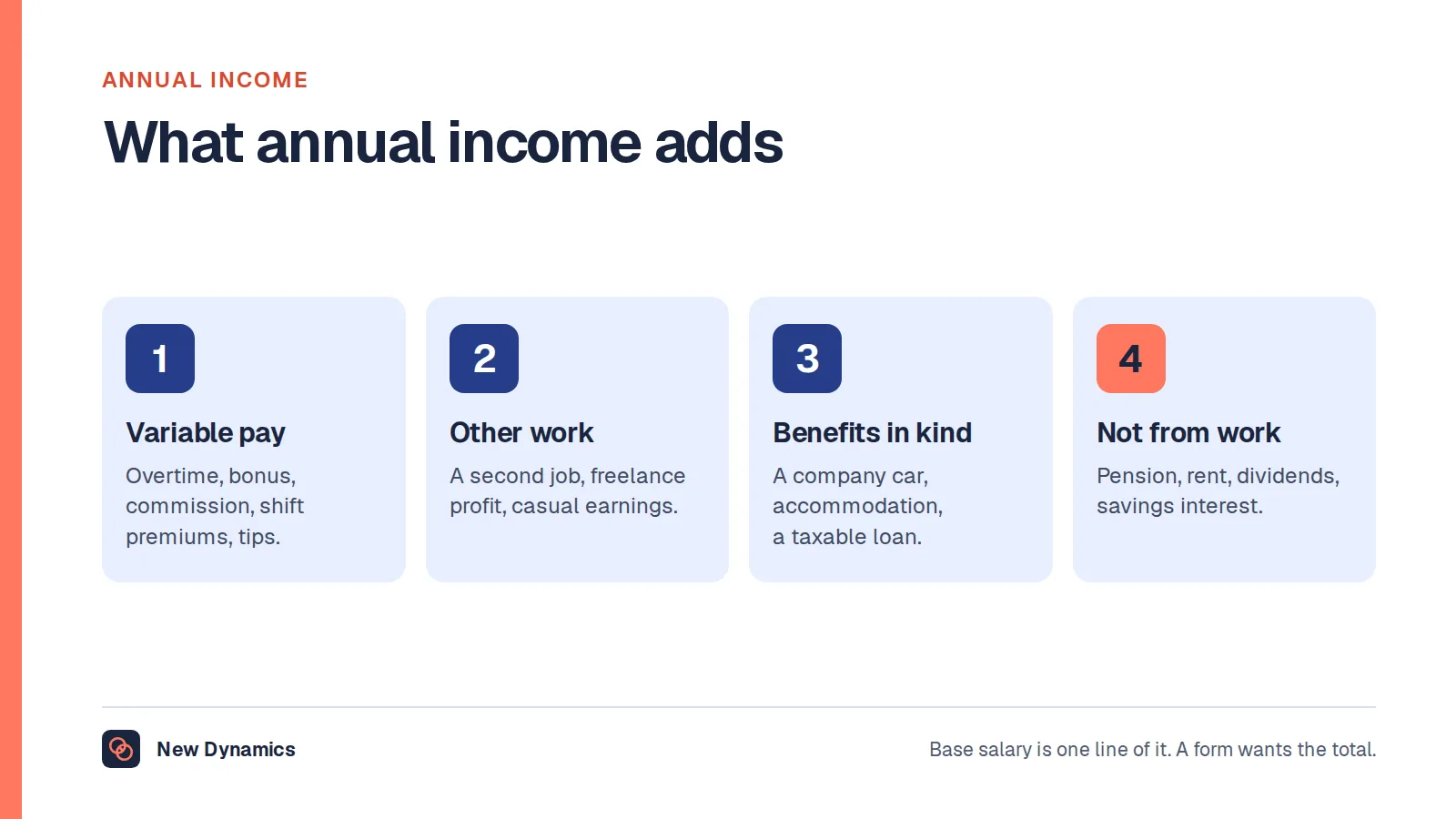
So "what is my gross pay" has a precise answer, and "is that the figure you need" usually needs one more question. Our post on annual income covers which figure each form wants over a year, and the HR statistics hub collects the published pay and workforce figures we cite elsewhere.
How a gross figure is evidenced
A gross figure you cannot show on paper is an assertion. Four documents carry it.
- The payslip for the period, which must show it under section 8(2)(a).
- The P60. GOV.UK's guide to your P45, P60 and P11D says "your P60 shows the tax you've paid on your salary in the tax year (6 April to 5 April)", that an employer you are working for on 5 April "must give you a P60" and provide it "by 31 May, on paper or electronically", and that you need it "as proof of your income if you apply for a loan or a mortgage".
- The P45. On leaving, it gives your "total pay and tax from 6 April until the date you left".
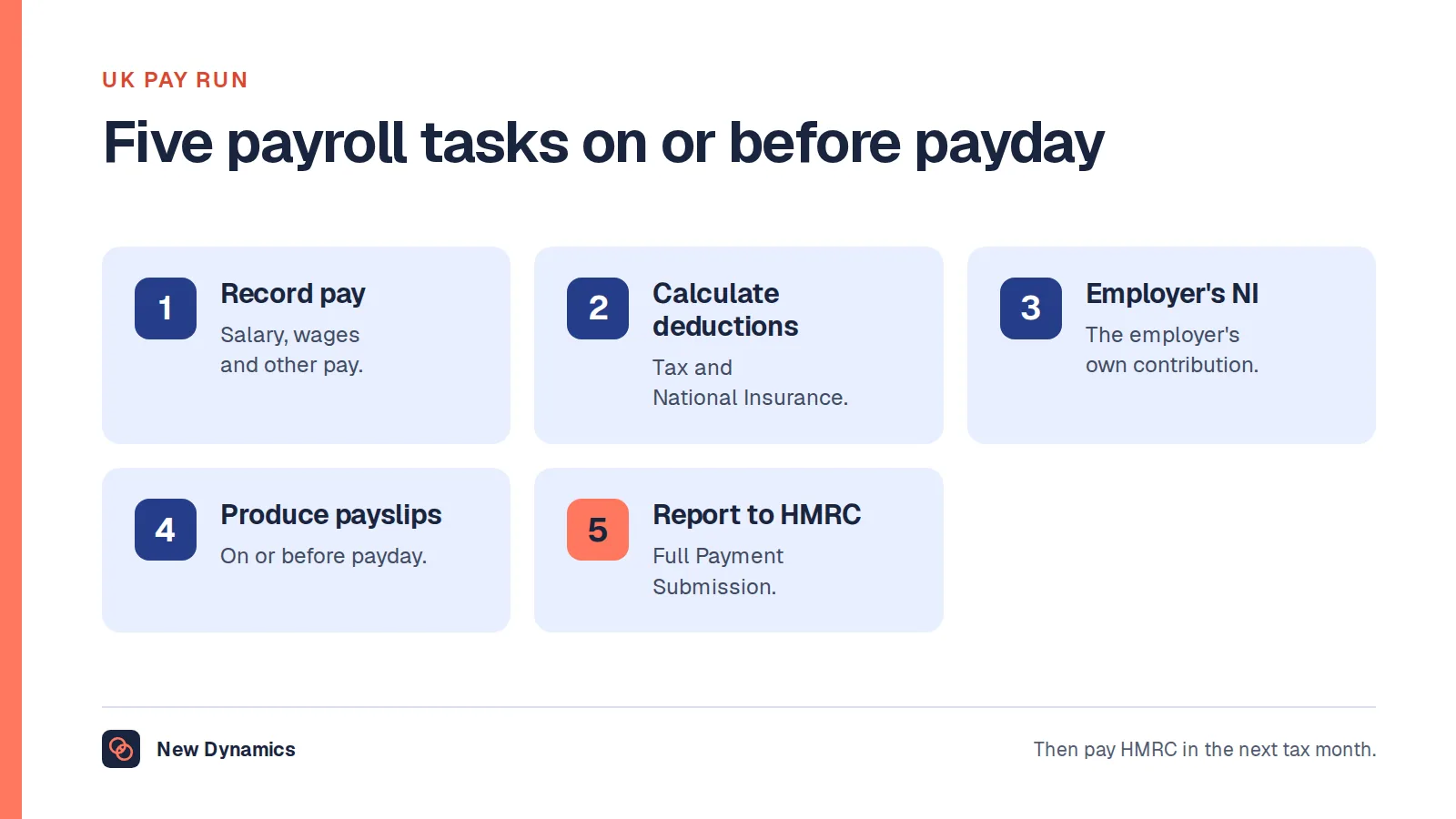
- The Full Payment Submission. An employer must, on or before payday, "report their pay and deductions to HMRC in a Full Payment Submission", which is why a payroll error can reach a Universal Credit award before anyone notices it on paper.
If none is to hand, GOV.UK says you can "use your personal tax account or the HMRC app to find the information that would be on the P60". Check the year-to-date column too: a year-to-date gross that does not match your own running total is worth raising.
Gross wages in the United States
On an American pay stub, gross wages means the same thing: the total before deductions. The rules behind the total are different, and two federal regimes treat items differently.
Section 5 of IRS Publication 15 (2026), the Employer's Tax Guide, states that "wages subject to federal employment taxes generally include all pay you give to an employee for services performed", that "the pay may be in cash or in other forms", and that "it includes salaries, vacation allowances, bonuses, commissions, and taxable fringe benefits".
The Fair Labor Standards Act asks a narrower question, because it is working out overtime rather than tax. The Department of Labor's fact sheet on the regular rate says that "under the FLSA, the regular rate includes 'all remuneration for employment paid to, or on behalf of, the employee'", and that the statute "provides an exhaustive list of types of payments that can be excluded from the regular rate of pay when calculating overtime compensation", paid leave among them.
So a payment can be inside gross wages for tax and outside the regular rate for overtime. If you are working to US rules, take the detail from the IRS and the Department of Labor rather than from a UK page.
Frequently asked questions
What are gross wages?
Gross wages are everything a worker earned in a pay period before anything is deducted. GOV.UK's employer guidance says a payslip must show "pay before any deductions ('gross' wages)", and Employment Rights Act 1996 section 8(2)(a) calls it "the gross amount of the wages or salary". Gross pay and gross earnings mean the same figure.
How do you calculate gross wages?
Add every amount earned in the period before any deduction: basic pay for the hours or the salary instalment, overtime at the rate that applies, commission, bonus, holiday pay and any statutory payment such as sick pay or maternity pay. Do not add the employer's pension contribution, a reimbursement within HMRC's approved amounts, or a benefit in kind that is reported separately.
Do gross wages include overtime and holiday pay?
Yes. GOV.UK's guidance on recording employees' pay lists bonuses, commission and holiday pay among the payments to record as normal pay, with an exception where holiday pay is paid in advance or through a holiday pay scheme. Overtime is pay for hours worked, so it sits inside the gross figure for the period it is paid in.
Is statutory sick pay part of gross wages?
Yes. GOV.UK says of Statutory Sick Pay and statutory pay for parents that "you must record these in your software - they're taxed like normal pay", and that SSP is paid "in the same way as wages, for example on the normal payday, deducting tax and National insurance". A month on statutory pay produces a smaller gross figure, not no gross figure.
Does gross pay include the employer's pension contribution?
No. The employee's own contribution comes out of gross pay as a deduction, so it is inside the figure first. The employer's contribution, at least 3% of qualifying earnings under automatic enrolment since April 2019, goes straight to the scheme and never forms part of the employee's gross wages.
Why do the hours on my payslip not match my gross pay?
Because section 8(2)(e) asks for "the total number of hours worked", not hours paid. Holiday hours and sick days are paid but not worked, so they raise the gross figure without raising the hours figure. Employers may show a single aggregate figure or separate figures for different types of work or rates of pay.
What does gross wages mean on a US pay stub?
The same pre-deduction total. IRS Publication 15 (2026) says wages subject to federal employment taxes "generally include all pay you give to an employee for services performed", including salaries, vacation allowances, bonuses, commissions and taxable fringe benefits. The Fair Labor Standards Act then excludes certain items from the regular rate used for overtime.
Your next step: rebuild one gross figure
- Take one payslip and list every earnings line above the deductions block.
- Rebuild each line from the hours, rate, salary instalment or published statutory rate, and name the tax year of any rate you use.
- Check the hours figure separately, counting hours worked rather than hours paid.
- Confirm the three usual absences: the employer's pension contribution, reimbursements within the approved amounts, and benefits reported separately.
- Compare the year-to-date gross with your own total, and raise any gap in writing with the payslip attached.
If you set pay rules for other people, write them down in language the people they apply to can follow: read and download our compensation policy guide. The guide is free to read, and the PDF uses our short download form.
Want pay decisions, and the figures that follow from them, to rest on a record that already exists? Book a New Dynamics demo and bring the process you run today. You can also email contact@new-dynamics.com.