TL;DR
- A growth mindset is the belief that abilities can be developed through effort, good strategies and help from others. A fixed mindset is the belief that ability is a set quantity that you either have or lack.
- The difference shows in how people respond to challenges, mistakes, feedback and other people's success. The 40 paired examples in this article make it concrete.
- A growth mindset is more than praising effort. It needs new strategies, real feedback and a workplace that treats mistakes as something to learn from.
Two colleagues get the same tough feedback on a presentation. One thinks, “I am just not a presenter”, and avoids the next opportunity. The other thinks, “That was not good enough yet”, asks what to change and volunteers again. Their ability was the same. What differed was what they believed about it.
This article gives you 40 growth mindset examples, each beside its fixed mindset version, for employees, managers and students. It also offers statements you can use, ways to build the habit, and an honest look at what the evidence does and does not show.
Mindset grows where feedback is frequent and safe. See how New Dynamics continuous feedback helps people to ask for, give and act on feedback in everyday work.
What is a growth mindset?
The idea comes from the psychologist Carol Dweck. Stanford University's Teaching Commons, in its guide to growth mindset and enhanced learning, puts it simply: “Growth mindset, simply stated, is a learner's belief that their intelligence can expand and develop. In contrast, fixed mindset is a learner's belief that their intelligence is a fixed, immutable trait.” It notes that the concept was pioneered by Dweck in her book Mindset: The New Psychology of Success (2006).
The guide explains why this matters. People with a fixed mindset “tend to worry about proving their intelligence rather than improving it”. Faced with a setback, they may conclude that they lack ability, and give up.
Three clarifications help.
- Nobody is purely one or the other. Most of us have a growth mindset about some things and a fixed one about others. You may believe that you can learn a language, and that you are simply “not a numbers person”.
- It is about belief, not cheerfulness. A growth mindset does not mean being positive. It means treating ability as something that can be built.
- It does not claim that anyone can do anything. People differ in talents and circumstances. The claim is that everyone can improve from where they are.
Fixed vs growth mindset: the pattern
| Situation | Fixed mindset response | Growth mindset response |
|---|---|---|
| A challenge | Avoid it, in case I fail | Take it on, because I will learn |
| Effort | Needing effort means I lack talent | Effort and good strategy build skill |
| A mistake | Hide it, or blame something else | Own it, and work out what to change |
| Feedback | Take it as an attack | Treat it as information |
| Other people's success | Feel threatened | Ask what I can learn from them |

40 growth mindset examples
Each pair shows a fixed mindset thought first, then a growth mindset alternative.
Facing challenges at work
- “I have never done this, so I should say no.” → “I have never done this, so it is a chance to learn. What support will I need?”
- “I am not technical.” → “I have not learned this tool yet. Who can show me the basics?”
- “If I take the stretch project and struggle, people will see that I am not that good.” → “If I take it and struggle, I will be better by the end of it.”
- “Public speaking is not my thing.” → “I am a beginner at public speaking. I will start with five minutes at the team meeting.”
- “This problem is too hard for me.” → “This problem is hard. Which part can I solve first?”
- “I will stick to what I know I am good at.” → “I will spend part of my time on things I am not good at yet.”
- “I am too old to change career.” → “I have experience that transfers. What do I need to add?”
- “That is above my pay grade.” → “I would like to understand how that decision is made.”
Responding to mistakes and setbacks
- “I failed. I am useless at this.” → “That attempt failed. What does it tell me?”
- “I hope nobody notices.” → “I made a mistake. Here is what happened and what I am doing about it.”
- “The client was impossible.” → “The pitch did not land. What would I do differently with a client like that?”
- “I did not get the promotion, so there is no point in trying.” → “I did not get it this time. I will ask what would make me the obvious choice next time.”
- “The project failed, so it was a waste of a year.” → “The project failed. Let me write down what we learned, so that it counts.”
- “I always mess up interviews.” → “Interviews are a skill. I will practise with a friend and ask for feedback.”
- “I missed the target. I am not cut out for sales.” → “I missed the target. Where in the process am I losing people?”
- “I cannot believe I said that in the meeting.” → “That came out badly. I will apologise, and prepare my point next time.”
Receiving feedback
- “They are criticising me.” → “They are telling me something I cannot see for myself.”
- “She just does not like me.” → “Is there something true in this, even if it was badly put?”
- “My review said ‘meets expectations’. That is insulting.” → “What would ‘exceeds’ look like? I will ask for examples.”
- “I do not need feedback. I know my job.” → “Who could tell me one thing that I do not want to hear?”
- “If I ask for help, I will look incompetent.” → “Asking a good question is how competent people get better.”
- “That feedback is wrong.” → “Let me understand what they saw before I decide.”
Our colleague feedback examples include 20 questions for asking colleagues what you could do better.
Effort, learning and other people's success
- “She is a natural. I could never do that.” → “She has practised that for years. What can I learn from how she does it?”
- “He got the job I wanted. It is not fair.” → “What does he do well that I could develop?”
- “If I were talented, this would be easy.” → “Things worth being good at are hard for everyone at first.”
- “I tried that once, and it did not work.” → “I tried one approach. What is another?”
- “I have worked hard, so I deserve the result.” → “Hard work matters, and so does working on the right things. Is my strategy right?”
- “I already know this.” → “What might I be missing?”
- “Training is a waste of time.” → “What is one thing from this course that I can use on Monday?”
- “I am not creative.” → “Creativity is a habit. I will propose one new idea a month.”
For managers
- “He is just not leadership material.” → “Which specific skills does he need, and how can I help him to build them?”
- “She is a star. He is a plodder.” → “What has each of them learned this year, and what is next for each?”
- “Mistakes are unacceptable in my team.” → “Carelessness is unacceptable. Honest mistakes on hard problems are how we learn, and we talk about them openly.”
- “I hire for talent.” → “I hire for the ability and the appetite to learn.”
- “Good effort!” after a poor result → “That approach did not work. What did you learn, and what will you try next?”
- “I should have all the answers.” → “I do not know. Let's find out.”
Our guide to what makes a good manager sets out the routines that make this real.
For students
- “I am bad at maths.” → “I have not mastered this topic yet. Which step am I getting stuck on?”
- “I got a C, so I am a C student.” → “I got a C on this essay. What did the comments say, and what will I change?”
- “Everyone else understands, and I do not.” → “I will ask the question. Others are probably wondering the same thing.”
- “If I have to revise this much, I must not be clever.” → “Revision is how knowledge gets in. What is the best way for me to revise?”

Growth mindset statements to use
Short statements can interrupt an automatic fixed-mindset thought.
- I cannot do this yet.
- What can I learn from this?
- Mistakes are information.
- Which strategy have I not tried?
- Who could help me with this?
- Feedback is a gift, even when the wrapping is poor.
- I am a work in progress, and so is everyone else.
- This is hard because I am learning.
- Progress, not perfection.
- What would I attempt if I were sure that I would improve?
How to develop a growth mindset
- Notice your fixed-mindset triggers. For many people they are criticism, a talented colleague, or a task outside their comfort zone. Name the thought when it appears.
- Add “yet”. It is a small word that turns a verdict into a stage.
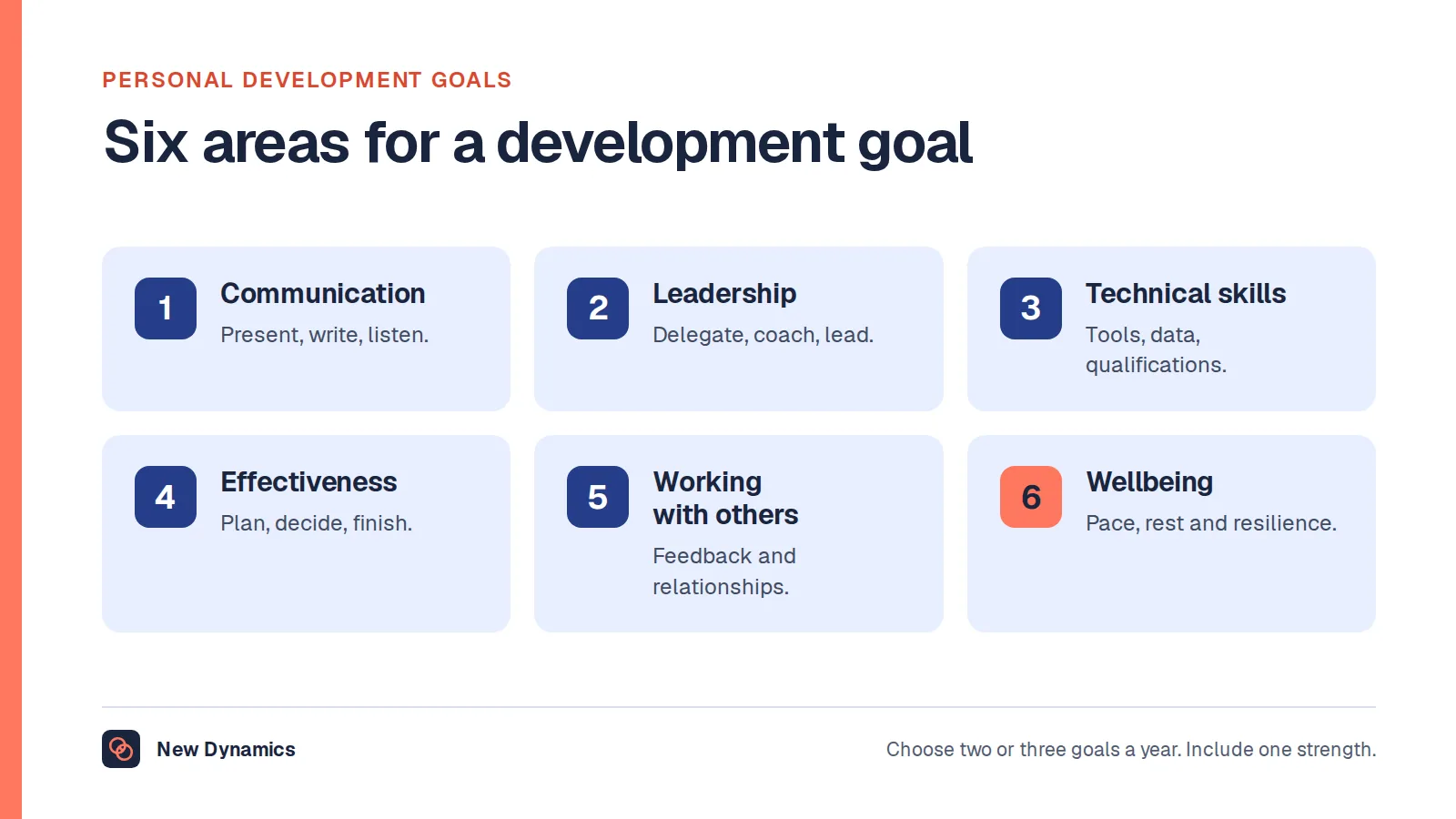
- Set learning goals as well as performance goals. “Learn to build a financial model” sits beside “deliver the forecast on time”. Our personal development goals examples can help.
- Change strategy, not only effort. If something is not working, more of the same will not fix it. Ask for advice, watch an expert or break the task down.
- Ask for feedback often, and thank people for it.
- Reflect on setbacks in writing. What happened, what did I learn, and what will I try next?
- Pay attention to who inspires you. Study how they improved. It was almost never luck alone.
A growth mindset is more than effort
The idea is easy to oversimplify. The Stanford guide reports that Dweck “has revisited the growth mindset and expressed concerns about oversimplifications”, and that “a growth mindset isn't just about effort”. Effort is a first step towards the real goal, which is learning and development. Praising effort when nothing was learned does not help anyone.
The guide reports two further points that matter at work. Some observers argue that teaching based on grit and persistence alone “has placed too much focus on the student's effort and not enough on the role of the instructor and institution”. In a workplace, that means the manager and the organisation. It is unfair to ask people to embrace mistakes in a culture that punishes them. Dweck also worries that teachers might blame a student's underperformance on a fixed mindset. Managers should take the same care. “She has a fixed mindset” is a label, and labels are exactly what the idea warns against.
So organisations that want a growth mindset need to do their part.
- Make it safe to admit mistakes and to ask questions. See why teamwork is important for what Google's research found about psychological safety.
- Give frequent, specific feedback.
- Reward learning and improvement, as well as results.
- Offer stretch work with support.
- Promote people who develop others.
What the evidence says
Growth mindset is popular, and the research is more modest than the posters suggest.
The strongest large study is the National Study of Learning Mindsets, published in Nature in 2019. Its authors report that “a short (less than one hour), online growth mindset intervention—which teaches that intellectual abilities can be developed—improved grades among lower-achieving students” in a nationally representative sample of US secondary school students. They also found that context mattered: “the intervention changed grades when peer norms aligned with the messages of the intervention”.
Three cautions follow. The study was of school students, and evidence from workplaces is thinner. It does not show that mindset alone transforms results. And the surroundings made a difference. Treat growth mindset as a useful way of thinking that works best in a supportive environment, and be wary of anyone who sells it as a cure for poor performance.

Frequently asked questions
What is an example of a growth mindset?
After a presentation goes badly, a person with a growth mindset thinks, “That was not good enough yet. What should I change?” They ask for feedback, practise and volunteer again. They treat the setback as information about what to work on.
What is an example of a fixed mindset?
After the same poor presentation, a person with a fixed mindset thinks, “I am just not a presenter”, and avoids speaking in future. They treat the result as proof of a permanent lack of ability, so there seems no point in trying.
What is the difference between a fixed and a growth mindset?
A fixed mindset is the belief that ability is a set trait that you either have or lack. A growth mindset is the belief that ability can be developed through effort, good strategies and help from others. The two lead to different responses to challenge and feedback.
What are growth mindset statements?
They are short phrases that reframe a fixed-mindset thought, such as “I cannot do this yet”, “What can I learn from this?”, “Mistakes are information” and “Which strategy have I not tried?” They work best alongside real changes in how you practise.
How can I develop a growth mindset at work?
Notice the situations that trigger fixed thinking, add the word “yet”, set learning goals alongside performance goals, change your strategy when effort alone is not working, ask for feedback often and write down what you learn from setbacks.
Does a growth mindset really work?
The best large study, of US secondary school students, found that a short growth mindset programme improved grades among lower-achieving students, especially where peers supported the message. Evidence from workplaces is thinner. It is a helpful way of thinking, not a cure-all.
Your next step: catch one thought this week
- Notice one moment when you think “I am just not good at this”.
- Rewrite it with “yet”, and add one strategy you could try.
- Ask one person for feedback on something you want to improve.
- At the end of the week, write down what you learned.
For a worksheet that turns development aims into a plan, read and download our career development guide. The guide is free to read, and the PDF uses our short download form.
Want feedback and development goals to be part of everyday work? Book a New Dynamics demo and bring your current approach. You can also email contact@new-dynamics.com.