TL;DR
- A personal development goal describes how you want to grow: a skill to build, a habit to change or an experience to gain. A performance goal describes a result you will deliver. You need both.
- Write each goal with a skill, a reason, actions, evidence and a date. Most development happens through real work, feedback and reflection, so plan for more than a course.
- Choose two or three goals a year, agree them with your manager, review them in one-to-ones and keep a short record of what you learned.
Most review forms have a box labelled “development objectives”. It is often filled in last, in a hurry, with something like “improve communication skills” or “attend a course”. A year later, the same words go into the same box.
This article helps you to do better. It explains what personal development goals are, gives 40 examples of personal objectives at work, shows a formula and a sample growth plan, and explains how to agree goals with your manager and keep them alive.
Development goals work when they sit beside your other goals and come up in regular conversations. See how New Dynamics Goals & OKRs keeps them visible through the year.
What are personal development goals?
A personal development goal is an aim to grow your skills, knowledge, behaviour or experience. You will also see the terms personal objectives, personal growth goals and self-development goals. At work they mean much the same thing.
The CIPD defines continuing professional development as “learning experiences which help you develop and improve your professional practice”. It adds that this “can include building on your strengths, as well as developing yourself where you have capability gaps”. That is a useful reminder. Development is not only about fixing weaknesses.
Development goals have a place in formal reviews too. Acas says that performance reviews are a chance to discuss, among other things, a person's “career and any development objectives”, and that a review may consider whether someone is following an agreed development plan.
Personal development goals, performance goals and career goals
| Type | What it describes | Example |
|---|---|---|
| Performance goal | A result you will deliver | Cut month-end close from nine working days to six by September |
| Development goal | A way you will grow | Learn to build financial models well enough to own the forecast |
| Career goal | Where you want your career to go | Become a finance business partner within three years |
The three connect. A career goal sets the direction. Development goals build what you need to get there. Performance goals are where you practise and prove it. For the longer view, see our career goals examples.
How to write a SMART personal development goal
A development goal needs five parts.
- The skill or behaviour. Name it in plain words.
- The reason. Say why it matters for your role, your team or your career.
- The actions. Include practice and feedback, as well as any course.
- The evidence. Decide how you and others will know that you have improved.
- The date. Set a review point.
A simple formula:
By [date], I will be able to [skill or behaviour], so that [reason]. I will [actions], and I will know I have succeeded when [evidence].
For example: “By 30 June, I will be able to present our monthly results to the leadership team clearly and without notes, so that I can take this over from my manager. I will present at three team meetings, ask two colleagues for feedback each time and complete the presentation skills workshop. I will know I have succeeded when I deliver the June results myself and the feedback is positive.”
That is specific, measurable, achievable, relevant and time-bound. Our SMART goal template gives you a sheet to fill in.

40 examples of personal development goals for work
The examples are shortened to fit. Add your own reason, evidence and date. All details are illustrative.
Communication
- Present at three team meetings this quarter, and ask two colleagues for feedback each time.
- Write shorter, clearer emails: put the request in the first two lines, and check the change with my manager after a month.
- Learn to explain technical issues to non-specialists, by rewriting two help articles and testing them with a colleague from another team.
- Speak up at least once in every leadership meeting for the next three months.
- Practise active listening by summarising what I heard before I respond, in every one-to-one this quarter.
- Learn to give difficult feedback, using our negative feedback examples, and do so within a week of each event.
- Reach a working level of Spanish, enough to hold a customer call, by December.
Leadership and management
- Delegate one recurring decision to a team member each quarter, including the authority to make it.
- Complete the new manager programme by June, and apply one idea from each module with my team.
- Learn to coach: ask questions before offering answers, and ask my team in the autumn whether they see a difference.
- Lead one cross-team project from start to finish this year.
- Find a mentor outside my department and meet them every six weeks.
- Mentor a new starter through their first three months.
- Chair the monthly operations meeting for a quarter, to build confidence in running discussions.
See the characteristics of a great leader for behaviours to practise.
Technical and digital skills
- Learn to build my own reports in our analytics tool, so that I no longer rely on the data team for routine questions.
- Gain the professional certification for my field by September.
- Learn enough about finance to read our monthly accounts and explain the main movements.
- Learn to use AI tools safely for drafting and summarising, within company policy, and share three useful prompts with the team.
- Shadow the product team for a week to understand how roadmap decisions are made.
- Automate one manual task a quarter, and document how I did it.
- Learn the basics of project management, and use them to plan the office move.
Personal effectiveness
- Plan each week on Friday afternoon, and protect two focus blocks a day for a quarter.
- Improve my estimates: record planned and actual time for each main task for six weeks.
- Learn to say no, with reasons, to requests that do not fit my agreed priorities.
- Prepare for every meeting I attend: read the papers and note one question beforehand.
- Make decisions faster: for reversible decisions, decide within a day and record my reasoning.
- Build a habit of finishing: reduce my open projects from seven to four by March.
Our SMART goals for productivity give more examples of this kind.
Working with others
- Build relationships with three stakeholders in other departments, by meeting each of them once a quarter.
- Involve other teams earlier: list everyone affected at the start of each project.
- Learn to handle disagreement calmly, by raising concerns directly and privately within two days.
- Ask five colleagues for feedback in the spring, and act on the main theme.
- Give credit by name whenever I present joint work.
- Join a cross-company working group, to widen my network and understanding.
Wellbeing and resilience
- Finish work by 6pm on at least four days a week, and raise it with my manager in any week when I cannot.
- Take all of my annual leave this year, booked in advance.
- Learn two techniques for managing pressure before presentations, and use them each time.
- Take a proper lunch break away from my desk on four days a week.
Knowledge and perspective
- Read one book or long article about my field each month, and share a one-page summary with the team.
- Attend two industry events this year, and bring back three ideas to test.
- Visit two customers each quarter to see how they use what we make.

How to choose your personal development goals
- Look at your role now. Which skill, if stronger, would make the biggest difference to your results? Your last review and recent feedback are good clues.
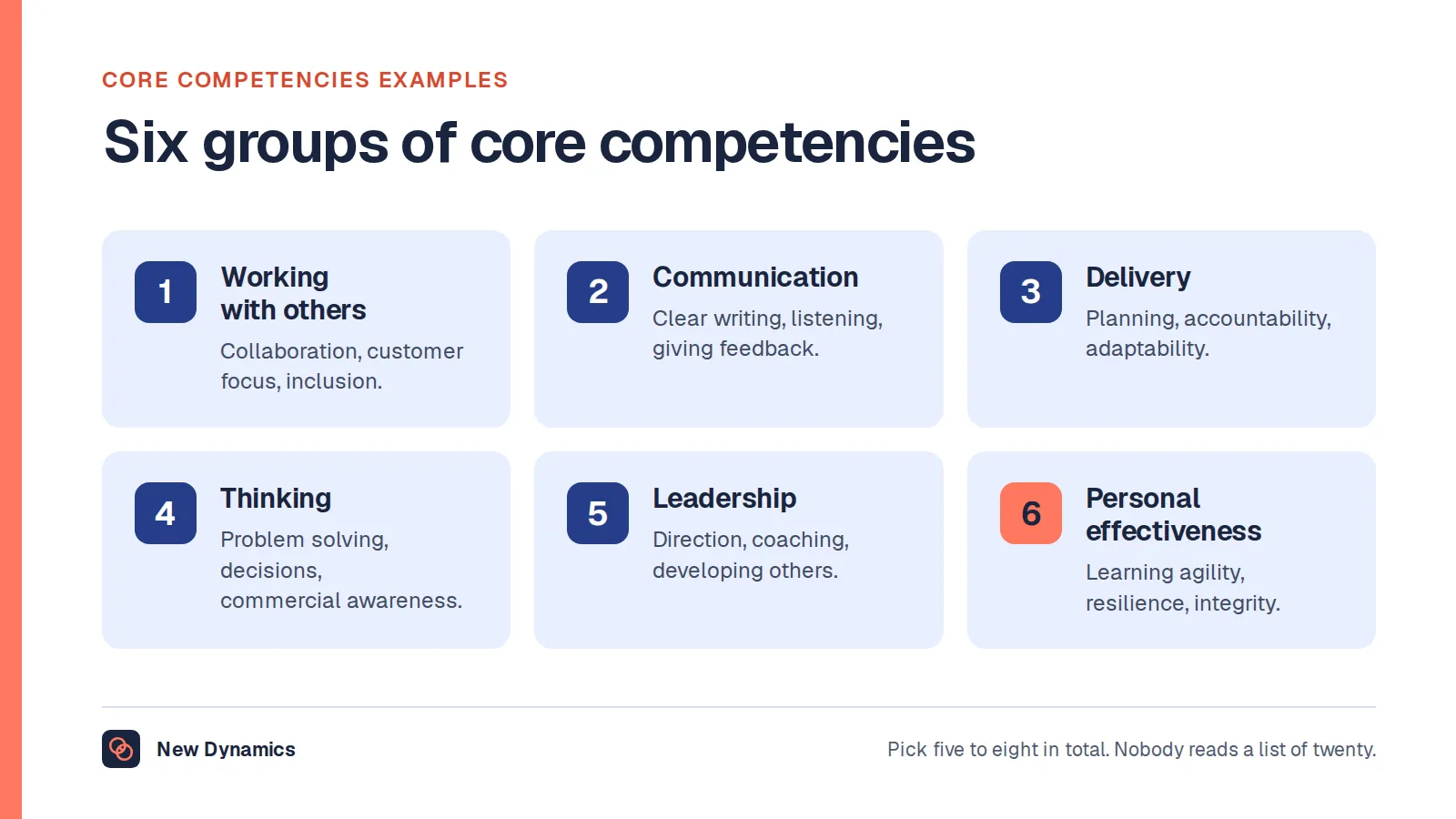
- Look ahead. What will your role, or the next one, demand in two years? Compare yourself with the expectations at the next level. Our guide to core competencies shows how levels are described.
- Ask others. Put one question to three people: “What is one thing I could do better that would make the most difference?”
- Include a strength. Pick at least one goal that builds on something you are already good at.
- Choose two or three. More than that, and none will get proper attention.
- Test for energy. A goal you do not care about will not survive a busy month.
Plan how you will learn, not only what
A course is one way to learn, and often not the most powerful. Build each goal from a mix of:
- Doing. A stretch task, a project, a secondment or standing in for your manager.
- Learning from others. Feedback, coaching, mentoring, shadowing and watching someone skilled.
- Study. Courses, qualifications, reading and online learning.
- Reflection. The CIPD says that the key to making and embedding a change “is reflecting on your learning”. After each attempt, note what happened, what you learned and what you will try next.
Goal 1 above uses all four: presenting is the doing, feedback is learning from others, a workshop is study, and a note after each talk is reflection.
A sample personal growth plan
Here is a short example for a customer support team leader. It is illustrative.
| Goal | Why | Actions | Evidence | Review |
|---|---|---|---|---|
| Coach my team, and step in less | Team feedback says that I fix problems too quickly | Management programme. Ask before advising. Monthly session with my mentor | Team pulse feedback in October. Fewer escalations to me | Quarterly |
| Read and explain our monthly numbers | I want to move into an operations manager role | Finance for non-finance-managers course. Shadow the finance partner at month end | I present the support budget review in September | June |
| Present to senior audiences with confidence | I will present the quarterly service review from Q3 | Three practice talks with feedback. Workshop in May | I deliver the Q3 review, with feedback from two directors | Monthly |
Three goals, each with a reason, actions of more than one kind, evidence and a review date. That is enough for a year.
How to agree development goals with your manager
- Bring a draft. Managers respond better to a proposal than to “what should I work on?”
- Link each goal to the team's needs as well as your own. It makes support easier to justify.
- Ask for something specific. Time, budget, a stretch task, an introduction or regular feedback.
- Agree the evidence. Decide together how you will both know that you have improved.
- Put it in your one-to-ones. A standing five minutes a month keeps the goal alive. See our one-to-one meeting guide.
If you manage people, ask about development before they have to raise it, and follow through on what you promise. People notice quickly whether development conversations lead anywhere.
Common mistakes with personal development goals
The goal is a course. “Attend a leadership course” is an action. The goal is what you will be able to do afterwards.
Too vague. “Improve communication” could mean anything. Name the situation and the behaviour.
Too many. Six development goals means none. Choose two or three.
Only weaknesses. Building a strength is often the faster route to more impact.
No evidence. If nobody could tell whether you improved, rewrite the goal.
Set and forget. A goal reviewed once a year was written for the form. Review it monthly.
Kept private. Tell people what you are working on. They will give you chances to practise, and feedback when you do.

Frequently asked questions
What are personal development goals?
Personal development goals are aims to grow your skills, knowledge, behaviour or experience. At work they are also called personal objectives, personal growth goals or self-development goals. They describe how you want to improve, where a performance goal describes a result you will deliver.
What is an example of a personal objective at work?
“By 30 June, I will be able to present our monthly results clearly and without notes. I will present at three team meetings, ask two colleagues for feedback each time and complete a presentation skills workshop.” It names the skill, the actions, the evidence and the date.
What are good personal growth goals?
Good goals are specific, matter to your role or career and can be practised in real work. Examples include learning to coach, delegating one decision a quarter, building your own reports, giving difficult feedback within a week and building relationships with three key stakeholders.
How do you write a SMART personal development goal?
Name the skill or behaviour, say why it matters, list actions that include practice and feedback, decide what evidence will show improvement and set a date. Check that it is achievable alongside your workload, and agree it with your manager.
How many personal development goals should I have?
Two or three a year is enough for most people. Each one needs practice, feedback and reflection over several months. A longer list usually means that none of them gets the attention it needs.
What is the difference between personal development and professional development?
The terms overlap. Professional development usually means skills and knowledge for your occupation, such as a qualification. Personal development is broader and includes habits, confidence, resilience and how you work with others. At work, a good plan often contains both.
Your next step: write one goal this week
- Ask three people what one thing you could do better.
- Choose one skill or behaviour to work on.
- Write it with the formula: date, skill, reason, actions and evidence.
- Take it to your next one-to-one, and ask for one specific piece of support.
For a worksheet and prompts for career conversations, read and download our career development guide. The guide is free to read, and the PDF uses our short download form.
Want development goals to sit beside performance goals, feedback and reviews? Book a New Dynamics demo and bring your current development plan. You can also email contact@new-dynamics.com.