TL;DR
- An employer can pay £6 a week, or £26 a month for monthly paid employees, to an employee working regularly at home without having to justify the amount. HMRC's manual says that at the guideline rate "the employee does not have to keep any records to demonstrate the additional expenditure". GOV.UK's table gives the same £6 for "2020 to 2021 onwards", so it is unchanged for the tax year 6 April 2026 to 5 April 2027.
- The employee's own claim has gone. GOV.UK states that "From the tax year 6 April 2026 to 5 April 2027, you will not be able to claim tax relief for working from home", and section 360B ITEPA 2003, inserted for 2026-27 by Finance Act 2026, blocks the deduction outright. Before that it was never available to someone who chose to work from home.
- The payment covers extra costs caused by the work, such as heating and lighting the work area, metered water and business calls. HMRC excludes mortgage interest, rent, council tax and water rates, and also excludes furniture and office equipment, which run through a separate exemption.
Someone in your team works from home two days a week and asks whether the company will contribute to the heating bill. A colleague says they heard you can claim six pounds a week from HMRC. Both halves of that point at real rules, but they are different rules, tested differently, and one of them stopped working in April 2026.
This post sets out what a UK employer may pay a homeworker without a tax charge, how much, what the payment may and may not cover, how equipment and broadband are treated, and what has to be reported. It covers the United Kingdom and the tax year 6 April 2026 to 5 April 2027. It is general information and not tax advice; confirm the treatment with your payroll or your own adviser before a policy promises anything.
A homeworking allowance only works if the arrangement behind it is recorded, because that agreement is the condition for the exemption. See how New Dynamics workflows let you shape the stages, participants and approvals around your own process, so an agreement has a record rather than an email thread.
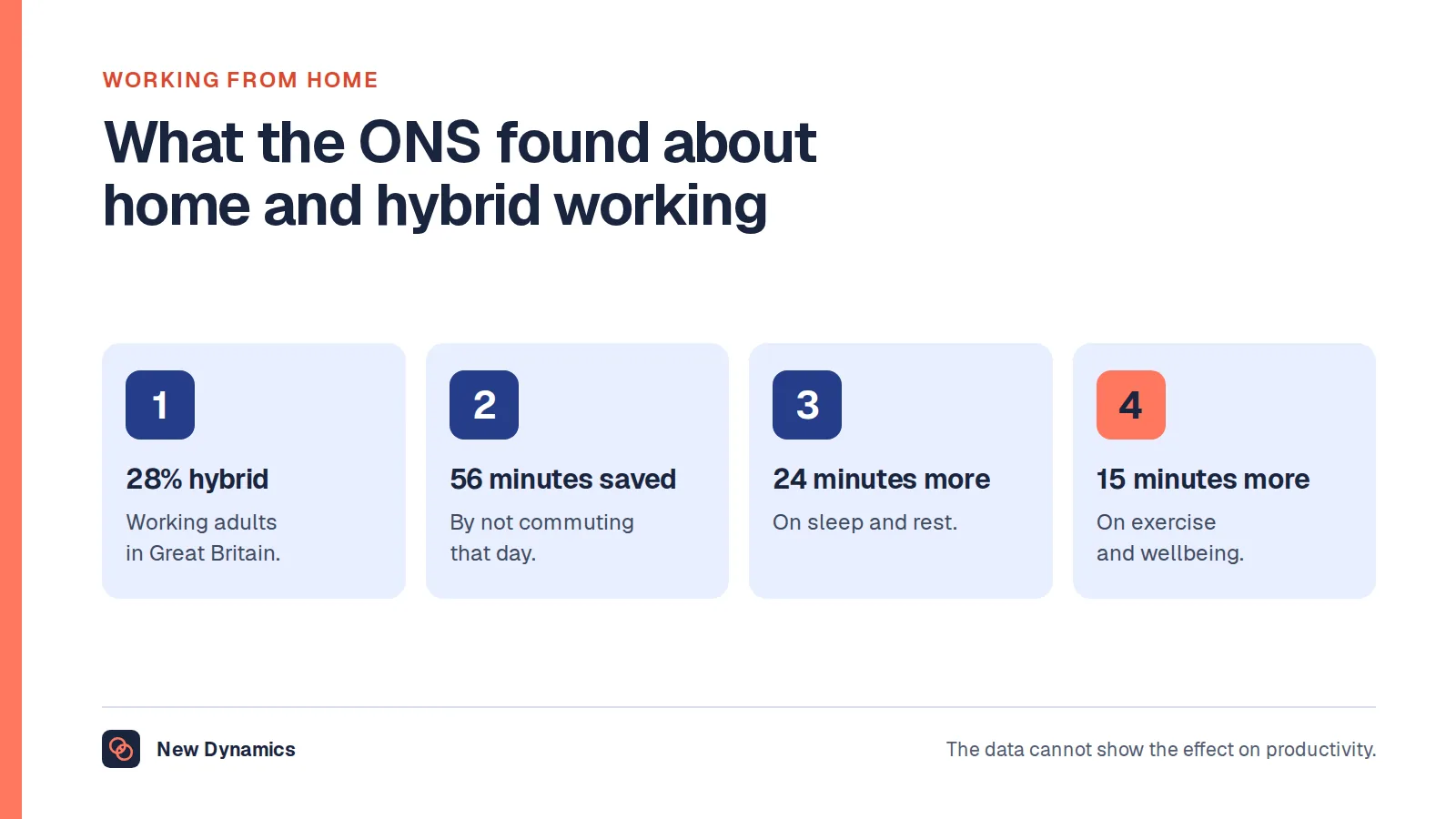
The population is published. In the Office for National Statistics dataset Public opinions and social trends, Great Britain: working arrangements by personal characteristics, released on 16 October 2026, the edition covering 1 July to 27 September 2026 reports that among those who said they were working, 39% answered "Yes, all of the time or some of the time" to the question "In the past seven days, have you worked from home?", with a 95% confidence interval of 37% to 41%. Our HR statistics hub collects the wider picture.
A home working allowance and tax relief are two separate routes
Both end in money and both involve the same household bills, which is why they get mixed up.
The employer route is an exemption. Section 316A of the Income Tax (Earnings and Pensions) Act 2003 applies where an employer pays an employee "in respect of reasonable additional household expenses which the employee incurs in carrying out duties of the employment at home under homeworking arrangements", and then "No liability to income tax arises in respect of the payment."
The employee route was a deduction. The employee paid the cost and asked HMRC to reduce their taxable earnings by it. For current years that route no longer exists.
HMRC's manual spelled out the gap while both were running. EIM32825 says the circumstances for an exempt payment "are much less restrictive" than those for an employee's relief, so "the fact that an exempt payment has been or could be made does not mean that the employee is entitled to relief for household expenses."

The flat rate is £6 a week, and it is still £6
HMRC's EIM01476 sets the figure: "from 6 April 2020 you can agree to a payment of £6 per week or £26 per month for monthly paid employees to an employee working regularly at home without the employer having to justify the amount paid. If the £6 guideline rate is paid the employee does not have to keep any records to demonstrate the additional expenditure."
GOV.UK's guidance on homeworking expenses and benefits that are exempt from tax publishes the same figure as a table of weekly tax limits. Against the tax years "2020 to 2021 onwards" it gives "£6.00 (or £26 a month for employees paid monthly)", and against the years from 2012 to 2013 up to 2019 to 2020 it gives "£4.00 (or £18 a month for employees paid monthly)". There is no later row, so the rate for the tax year 6 April 2026 to 5 April 2027 is the same £6 a week it has been since 6 April 2020. Six years of inflation have not moved it.
Three points follow.
- It is a floor, not a ceiling. EIM01476 states that the guideline rate "is not a maximum" and that "Greater amounts can be paid where the employer provides evidence to justify them."
- There are two ways to pay more. Agree a scale rate with HMRC in advance, "calculated to do no more than reimburse the average additional costs", or reimburse actual additional costs, where HMRC expects the employer "to keep records to show how the payments have been computed".
- It is weekly or monthly, not daily. HMRC publishes no pro rata daily figure for a hybrid worker, so an employer paying by the day is building its own calculation and should be able to show it reimburses no more than the real additional cost.
Who qualifies: what "homeworking arrangements" means
The exemption hangs on the arrangement, not on the fact of working at home. EIM01472 reduces the definition in section 316A(3) to two tests: "there must be arrangements between the employer and the employee" and "the employee must work at home regularly under those arrangements".
HMRC then fills in the edges. The arrangements "need not be in writing but usually will be" and "do not need to apply to all employees", but the exemption "does not apply where an employee works at home informally and not by arrangement with the employer. For example, it will not apply where an employee simply takes work home in the evenings."
On regularity it is generous. Accept regular working at home where it "is frequent or follows a pattern", and HMRC's own example is an employee working three days on the premises and two at home. The same page confirms the exemption "may also apply where the arrangement involves hybrid or flexible working".
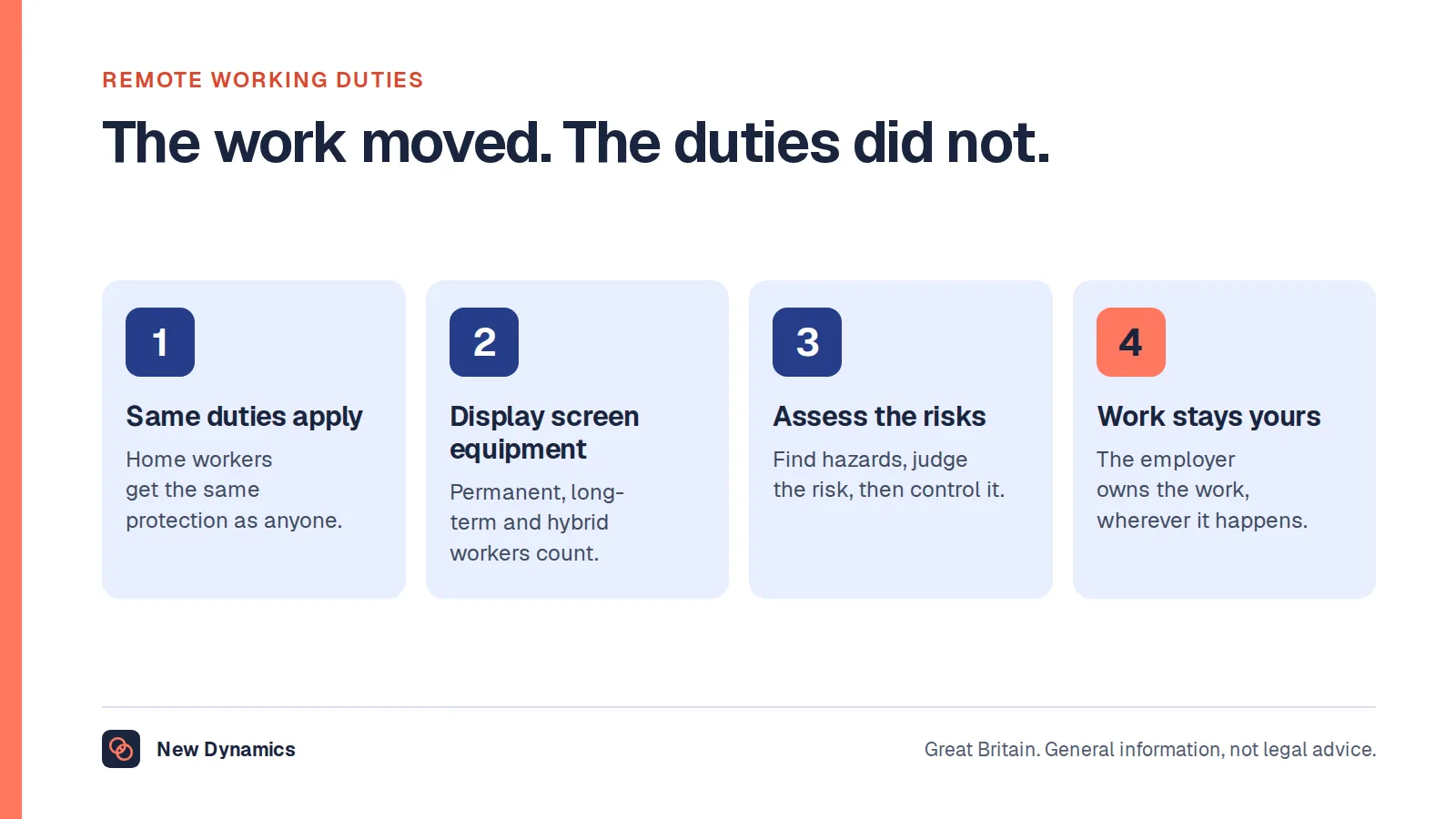
So a hybrid employee qualifies, and an employee who answers email at the kitchen table after dinner does not. Our post on remote working practice covers the wider duties that follow the work home.
What the allowance may cover, and what it may not
EIM01474 gives HMRC's own examples. The payment can meet "reasonable additional household expenses", and "Typically this will include the additional costs of heating and lighting the work area or the metered cost of increased water use. There might also be increased charges for Internet access, home contents insurance or business telephone calls. Where working at home leads to a liability for business rates the additional cost incurred can also be included."
The exclusions matter more, because they are where policies go wrong. The test "excludes costs that would be the same whether or not the employee works at home, for example mortgage interest, rent, council tax or water rates. It also excludes expenses that put the employee into a position to work at home, for example building alterations or the cost of furniture or office equipment."
A desk, in other words, is not an additional household expense. It runs through a separate exemption.

Equipment and furniture, and the condition on private use
That separate exemption is section 316 ITEPA 2003. EIM21611 says there is no tax charge on supplies and services provided away from the employer's premises, "provided for the sole purpose ... of enabling the employee to perform the duties of the employment", where "any use for the employee's private purposes is not significant". It covers "office furniture and equipment such as desks, filing cabinets" and "computer equipment".
GOV.UK puts the condition more plainly: no report and no tax where equipment is "only used for business purposes" or "any non-work use ('private use') is insignificant". It adds the practical instruction, "You can decide how much private use you allow but you need to state this clearly to employees." Mobile phones are simpler, with no tax and no need to restrict private use, limited to one per employee.
Three details are easy to miss.
- "Not significant" is a policy test, not a stopwatch. EIM21613 says it "should not be decided purely on the absolute time spent on different uses", and HMRC accepts the test is met where the private use policy "is clearly stated to the employees and sets out the circumstances in which private use may be made". Writing that policy down is what secures the exemption.
- Keeping the kit changes the answer. EIM21611 says there is no charge when equipment is returned, but "If ownership of the equipment is transferred to the employee, at any time, this will become an employee benefit." EIM21612 also excludes some things outright, including any motor vehicle and "the extension, conversion or alteration of any living accommodation", so a home office built onto the house is outside the exemption.
- Reimbursement now has its own exemption. From 6 April 2026 section 316ZA ITEPA 2003 applies, EIM21611 explains, "where the employer does not provide the accommodation, supplies or services directly, but instead the employee incurs the cost on behalf of the employer, and the employer pays or reimburses the expenses", on the same conditions.
Broadband, and why it usually fails
Broadband is the most asked question and the most common no. EIM01475 explains why: if the employee "is already paying for a broadband internet connection at home, there is no additional expense. The employer cannot, therefore, reimburse the employee's broadband internet charges, tax free, under Section 316A. Any such payment that the employer may decide to make should be subject to PAYE and NICs."
The exception is narrow. Where the employee does not already pay for a connection and needs one to work from home, "the broadband fee is an additional household expense that the employer can reimburse, tax free". GOV.UK states the three conditions together: a connection "was not already available", "they need it to work from home", and "it is mainly used for business purposes".
Almost every household already has broadband, so almost every broadband payment is pay. Put it through payroll and call it a broadband allowance rather than an expense reimbursement, so nobody is surprised by the deduction. Our post on payroll deductions covers what then shows on the payslip.
The employee claim closed on 6 April 2026
GOV.UK's guidance on claiming tax relief for working at home now opens with the change: "From the tax year 6 April 2026 to 5 April 2027, you will not be able to claim tax relief for working from home. You can still claim for the 4 previous tax years."
HMRC's manual gives the mechanism. EIM32759 states that "From 6 April 2026 onwards, a deduction from earnings is no longer permitted for an employee's additional household expenses", through "section 360B ITEPA 2003". Section 360B is short: "No deduction from earnings is allowed under this Chapter for additional household expenses which the employee incurs in the performance of the duties of the employment at home." Its amendment note records that it was "inserted (for the tax year 2026-27 and subsequent tax years) by Finance Act 2026 (c. 11), s. 21".
Two things are worth saying plainly to anyone who asks.
It is not available at all for the current tax year. Not reduced, not restricted to certain jobs. The deduction is blocked by statute from 6 April 2026, and the only live claims are backdated ones for the four earlier tax years.
Even before that, it was never available simply because someone works from home by choice. GOV.UK remains explicit for the years still claimable: "You cannot claim tax relief if you choose to work from home. This includes if your employment contract lets you work from home some or all of the time" and if "your employer has an office, but you cannot go there sometimes because it's full." The old test at EIM32760 required the expense to be incurred "wholly, exclusively and necessarily in the performance of the duties", and one condition was that "at no time ... is the employee able to choose between working at the employer's premises or elsewhere". A hybrid worker with a choice failed that test then and has no claim now.
The employer side is untouched. EIM32759 is careful about it: the change "should not be confused with the exemption under section 316A ITEPA 2003, which continues to apply", and "The removal of deductions for household expenses therefore only applies to unreimbursed household expenses." So the route that remains open is the one you control. If homeworking costs your people money and you want that recognised, you have to pay it.
What to report, and when nothing needs reporting
GOV.UK's overview sets the starting point: "As an employer providing homeworking expenses for your employees, you have certain tax, National Insurance and reporting obligations."
Nothing needs reporting for additional household expenses where both of GOV.UK's conditions are met: the employee is "working at home as agreed with you" and regularly works from home under those arrangements, and the amount given is "not more than their additional household expenses or ... not more than the current weekly limit". Pay £6 a week under a written arrangement and there is no P11D entry and no Class 1A charge.
Above that the burden shifts. GOV.UK's page on what to report and pay states that "If you cover any costs over the weekly limit (£6, or £26 a month for employees paid monthly), you need to be able to prove that the payments are no more than your employee's additional household expenses." Payments above those expenses "count as earnings", so the employer must "work out the excess", add it to other earnings and "deduct and pay PAYE tax and Class 1 National Insurance through payroll". Where there is no supporting evidence of cost, GOV.UK's guidance on how to work out the value says to "use the total cost to you minus the £6 a week limit".
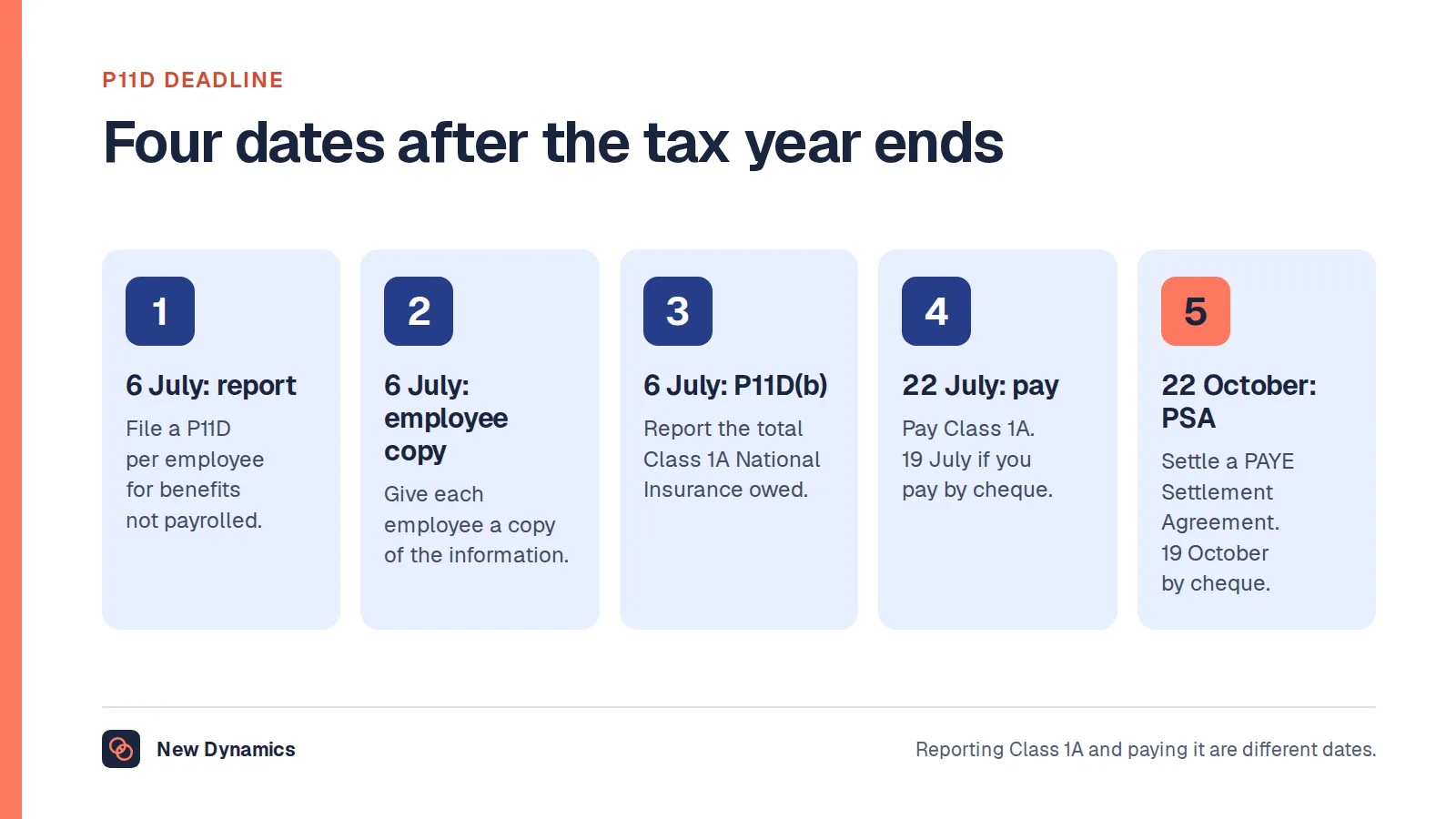
Equipment is reported differently. Where equipment, services and supplies are provided "for both business and private use", GOV.UK says the employer must "report it on form P11D" and "pay Class 1A National Insurance on the value of the benefit". Our post on P11D reporting covers the form and the deadlines.

Frequently asked questions
How much is the home working allowance in 2026?
£6 a week, or £26 a month for monthly paid employees. GOV.UK's table of weekly tax limits gives that figure for the tax years "2020 to 2021 onwards" and publishes no later row, so it is unchanged for the tax year 6 April 2026 to 5 April 2027. HMRC's EIM01476 describes it as a guideline rate an employer can pay "without the employer having to justify the amount paid".
Can I still claim tax relief for working from home?
Not for the current tax year. GOV.UK states that "From the tax year 6 April 2026 to 5 April 2027, you will not be able to claim tax relief for working from home. You can still claim for the 4 previous tax years." Section 360B ITEPA 2003, inserted for 2026-27 by Finance Act 2026, blocks the deduction. For the earlier years still claimable, GOV.UK's rule remains that you cannot claim if you choose to work from home.
Does my employer have to pay a home working allowance?
No. Section 316A is an exemption from tax on a payment an employer chooses to make, not an entitlement for the employee, and HMRC's EIM01472 notes that homeworking arrangements "do not need to apply to all employees". Whether to pay, and how much, is a reward decision that belongs in your pay policy rather than in a tax rule.
Can an employer pay more than £6 a week tax free?
Yes, with evidence. EIM01476 states that the guideline rate "is not a maximum" and that greater amounts can be paid where the employer can justify them, either through a scale rate agreed with HMRC in advance or by reimbursing actual additional costs with records showing how the payments were computed.
Can we pay an employee's broadband bill tax free?
Usually not. EIM01475 explains that where the employee already pays for broadband at home "there is no additional expense", so the payment should be subject to PAYE and National Insurance. It is exempt only where a connection was not already available, the employee needs it to work from home, and it is mainly used for business purposes.
Does a desk or a chair count as a home working allowance?
No, and mixing the two is the most common mistake. EIM01474 excludes "the cost of furniture or office equipment" from additional household expenses. Equipment runs through section 316 instead, which is exempt where the sole purpose is enabling the employee to do the job and private use is not significant.
Your next step: write the arrangement down, then set the figure
- Confirm who is in scope. For each homeworker, check there is an arrangement with the employer and that the work at home is frequent or follows a pattern, which are HMRC's two tests at EIM01472.
- Get the arrangement into writing even though HMRC does not require it. The exemption turns on the arrangement existing, and a written one is what you can show.
- Decide the figure. £6 a week needs no records. Anything higher needs a scale rate agreed with HMRC in advance, or actual costs with evidence.
- Write a private use policy for equipment, stating what private use is allowed. EIM21613 treats that clearly stated policy as the route to meeting the "not significant" test.
- Tell people the employee claim has closed, and why the company payment is now the only route. That conversation is easier before someone files a claim that gets refused.
For the policy document this sits inside, read and download our compensation policy guide. The guide is free to read, and the PDF uses our short download form.
Want the agreements, approvals and records behind decisions like this to exist in one place rather than in a mailbox? Book a New Dynamics demo and bring your current homeworking policy. You can also email contact@new-dynamics.com.