TL;DR
- GOV.UK sets three duties at 6 July after the end of the tax year: report expenses and benefits, give your employees a copy of the information, and report the total Class 1A National Insurance you owe. Paying that Class 1A is a separate date, 22 July, or 19 July by cheque.
- A late P11D(b) carries a fixed penalty. GOV.UK: "You'll get a penalty of £100 per 50 employees for each month or part month your P11D(b) is late." The Class 1A rate on expenses and benefits for 2026 to 2027 is 15%.
- Mandatory payrolling is now phased. HMRC's policy paper, updated on Budget day 28 October 2026, sets company cars, car fuel, vans and van fuel and employer-provided medical benefits from 6 April 2027, and most remaining benefits from 6 April 2028. The detail sits in regulations not yet made.
Benefits in kind reporting fails on dates more often than on arithmetic. Somebody files the forms on time, pays the Class 1A National Insurance the same day, and finds it was not due for another sixteen days. Somebody else tries to register to payroll benefits in May and is told nothing can change until the next tax year. And a reform that has already moved twice is now close enough to affect which payroll software you buy.
This article gives every date in the cycle, the rate, the penalty, how payrolling registration works, and the phased start of mandatory real time reporting. It covers the United Kingdom and is general information, not tax advice. Your payroll provider or accountant owns the submission. What usually goes missing is the part before it: who confirms the benefits list, who checks the car data, and by when. See how New Dynamics workflows let you build those stages, owners and reminders around your own calendar rather than a template.
The P11D deadline, and the three other dates around it
GOV.UK's deadlines page for expenses and benefits states them as days after the end of the tax year rather than fixed calendar dates, because the cycle repeats.
| What you need to do | Deadline after the end of the tax year |
|---|---|
| Report expenses and benefits | 6 July |
| Give your employees a copy of the information | 6 July |
| Report the total Class 1A National Insurance you owe | 6 July |
| Pay Class 1A National Insurance | 22 July (19 July if paying by cheque) |
| Pay tax and Class 1B National Insurance if you have a PAYE Settlement Agreement | 22 October (19 October if paying by cheque) |
| Pay PAYE tax or Class 1 National Insurance if payrolling | Monthly through payroll |

Two things are easy to miss. The employee copy is a 6 July duty, in the same list as the submission, so filing on time and sending staff their statements in August still misses a deadline. And reporting Class 1A is not paying it: reporting is 6 July, payment is 22 July, brought forward to 19 July by cheque. GOV.UK adds that "You'll also be charged penalties and interest if you're late paying HM Revenue and Customs."
HMRC names the date in each year's guidance. Its guide on how to complete P11D and P11D(b), last updated 6 April 2026, says: "The return date for P11D and P11D(b) for 2025 to 2026 is 6 July 2026." Apply the same rule to the tax year now running, 2026 to 2027, and the return date is 6 July 2027 with Class 1A payable by 22 July 2027.
What the P11D does, and what the P11D(b) is for
The P11D is per employee. One common entry has its own exemption and its own deadline: see our post on relocation expenses. GOV.UK's reporting and paying guidance says to "Complete a P11D for each employee you've provided with taxable expenses or benefits that were not payrolled." The P11D(b) is per employer and is the Class 1A return: "Use P11D(b) to declare the amounts of Class 1A National Insurance contributions you're due to pay for the year."
So payrolling removes P11D forms, not the P11D(b). GOV.UK is explicit on both halves: "You do not need to report expenses and benefits for each employee at the end of the tax year if all their expenses and benefits are payrolled," and then, "At the end of the tax year, you must still report the Class 1A National Insurance you owe by submitting an online form called a P11D(b)."
Class 1A National Insurance: the rate for this tax year
HMRC's rates and thresholds for employers 2026 to 2027 states it in one line: "The National Insurance Class 1A rate on expenses and benefits for 2026 to 2027 is 15%."
Class 1A is employer-only, which is why a benefit priced at its purchase cost is always underpriced in a proposal: fifteen pence on the pound, plus the reporting work, sits on top of the invoice. For the wider set of employer figures we track, see our HR statistics hub.
The penalty for a late P11D(b)
One sentence on the GOV.UK deadlines page covers it: "You'll get a penalty of £100 per 50 employees for each month or part month your P11D(b) is late."
Read "part month" carefully. There is no grace period inside a month, so a return filed on 7 July costs the same as one filed on 31 July. HMRC's completion guide adds a separate regime for getting it wrong rather than late: "There are penalties if you do not make returns or if you submit incorrect returns on P11D and P11D(b), either carelessly or deliberately."
Payrolling benefits in kind, and how registration works now
Voluntary payrolling means putting the cash equivalent of a benefit through payroll during the year, so income tax comes off in real time instead of being collected afterwards through a tax code.
When to register. GOV.UK's payrolling registration guidance is firm: "You need to register to voluntarily payroll benefits before the start of the relevant tax year," and "You cannot change the way you report benefits and expenses for the current tax year." There is no mid-year route in. Miss it and you wait twelve months.
What the service now covers. It reopened on 5 November 2026, and the change note records what moved with it: "The service has reopened for registrations and cancellations. Living accommodation and loans can now be payrolled." That closes a long-standing gap.
What you cannot register there. Three items: "company cars and fuel", "company vans and fuel" and "medical insurance". These are not excluded from payrolling. The instruction is the opposite: "You must report these benefits through your payroll software."
Telling employees. HMRC's voluntary payrolling guidance, updated 5 November 2026, adds a date most compliance calendars miss: "You must send your employees a written notification (by payslip, email or letter) by 1 June after the end of each tax year to explain that you're payrolling benefits." It must cover the payrolled benefits and their values, anything payrolled under an optional remuneration arrangement, and the benefits you did not payroll.
What still goes on the P11D(b). All of the Class 1A: "You'll still need to work out the Class 1A National Insurance contributions on the cash equivalent (or relevant amount for an optional remuneration arrangement) and fill in form P11D(b)." The record keeping behind it "must be done by 6 July after the end of the tax year".
One mechanic to know before you register: excluding an employee from a payrolled benefit works one way only, because "Once you've excluded an employee, you cannot add them back to a benefit in the same tax year", and that employee then needs a P11D.

Mandatory payrolling: what is legislated, and what is announced
This is the part employers are planning around, and it has moved, so the dates matter more than the summary.
HMRC's policy paper Changes to reporting of benefits in kind from April 2027, first published 13 July 2026 and last updated on Budget day, 28 October 2026, gives the history in a sentence: "The government first announced this measure in January 2024 and confirmed on 28 April 2025 that more time would be provided to support business readiness."
The original start was April 2026. The paper's own costing note is unusually direct about the slip, describing the Budget 2026 decision as "benefits in kind (BiKs) to delay mandatory payrolling of company cars, vans, fuel and medical benefits from 6 April 2026 to 6 April 2027, with most remaining benefits in kind implemented from 6 April 2028".
So there are now two phases:
- From 6 April 2027: company cars, car fuel, vans and van fuel, and employer-provided medical benefits. HMRC's interim guidance on the phased introduction confirms "Phase 1 will commence from 6 April 2027 and phase 2 will commence from 6 April 2028."
- From 6 April 2028: "most remaining benefits in kind".
- Employer-provided loans and accommodation stay out. The policy paper says mandation for them "will be confirmed at a later date", and the interim guidance notes they "will remain voluntary" at phase 2.
Two exits exist. Employers with globally mobile employees can apply to HMRC for an exception, published on 5 November 2026, which lets them "report the employee's benefits through the P11D and P11D(b) forms at the end of the tax year". And there is a one year softening: the measure provides "a power to allow penalties not to be charged for non-deliberate inaccuracies for the 2027 to 2028 tax year".
Now the distinction worth being precise about. The operative date is stated: "The measure will have effect from 6 April 2027." What has been published alongside it is draft legislation for Finance Bill 2026-27, and the working detail is not in it. The paper says secondary legislation "will set out the detailed operation of the mandatory payrolling regime", including which benefits must be payrolled, which are excluded, and what must be reported through Real Time Information. Treat 6 April 2027 as firm government policy with a published operative date, and the fine print as not yet made. Buy the software and clean the data now; wait for the regulations before writing the procedure. For scale, HMRC says it currently receives "approximately 3.5 million P11D forms each year" and expects a significant administrative impact on around 280,000 employers.

The company car position, in outline
Company cars are in phase 1, so this is the benefit most likely to force a payroll change, and its taxable value is not a cost figure.
HMRC's completion guide sets out the build. Start with the list price, which "will usually be the UK list price of the car on the day before the date of first registration", including VAT, car tax where appropriate, delivery charges and number plates. Add accessories at list price including VAT, fitting and delivery, counting those present when the car was first made available and later additions costing £100 or more. Deduct capital contributions from the employee, to a "maximum deduction £5,000".
Then the step that does the work: "This figure is multiplied by the 'appropriate percentage' to give the car benefit charge for a full tax year." That percentage "depends on the carbon dioxide (CO2) emissions of the car and the type of fuel used", and since 6 April 2020 it also needs the first registration date, plus zero emission mileage for hybrids with CO2 between 1 and 50g per km. The table itself lives in HMRC's appendix 2 and varies by tax year and registration date, so look it up rather than memorising it. A car unavailable for part of the year is reduced proportionately.
Private fuel is a separate charge built from a multiplier, not from what the fuel cost. HMRC's policy paper of 3 December 2025, Increase to van benefit charge and fuel benefit charges for cars and vans, confirms the 2025 to 2026 figures set by SI 2024/1349 and the next year's: the car fuel benefit multiplier "will increase to £29,200 for tax year 2026 to 2027", the van fuel benefit flat rate "to £798", and the van benefit charge "to £4,170".
Spreading the result through payroll is then arithmetic. HMRC's worked example takes a company car with a cash equivalent of £5,200 and a monthly payroll: £5,200 divided by 12 is £433.33 added to taxable pay each payday.
Frequently asked questions
When is the P11D deadline?
GOV.UK sets it at 6 July after the end of the tax year, and the same date covers three duties: reporting expenses and benefits, giving your employees a copy of the information, and reporting the total Class 1A National Insurance you owe. HMRC named the date for the last full year directly: "The return date for P11D and P11D(b) for 2025 to 2026 is 6 July 2026." For the 2026 to 2027 tax year the equivalent date is 6 July 2027.
Is the Class 1A payment deadline the same as the P11D deadline?
No, and this is the most common slip. Reporting Class 1A on the P11D(b) is due 6 July. Paying it is due 22 July, or 19 July if you pay by cheque. If you hold a PAYE Settlement Agreement, the tax and Class 1B on it are due later still, on 22 October, or 19 October by cheque.
What is the penalty for a late P11D(b)?
GOV.UK states: "You'll get a penalty of £100 per 50 employees for each month or part month your P11D(b) is late." Because part months count, nothing is saved by filing late within the same month. Late payment attracts its own penalties and interest on top.
Do I still file a P11D(b) if I payroll everything?
Yes. Payrolling removes the per employee P11D, not the employer's Class 1A return. HMRC: "At the end of the tax year, you must still report the Class 1A National Insurance you owe by submitting an online form called a P11D(b)." Keep the benefit records through the year so the return and the payment can both be made on time.
When do I have to register to payroll benefits in kind?
Before the tax year starts. GOV.UK: "You need to register to voluntarily payroll benefits before the start of the relevant tax year," and "You cannot change the way you report benefits and expenses for the current tax year." The service reopened on 5 November 2026, and living accommodation and loans can now be payrolled through it. Company cars and fuel, company vans and fuel and medical insurance are not registered there; HMRC says you must report those through your payroll software.
Has mandatory payrolling of benefits in kind been delayed?
Yes, and twice over. It was announced in January 2024 to start in April 2026, and HMRC records that the government "confirmed on 28 April 2025 that more time would be provided to support business readiness". At Budget 2026 it became a phased start: company cars, car fuel, vans and van fuel and employer-provided medical benefits from 6 April 2027, most remaining benefits from 6 April 2028, with employer-provided loans and accommodation to be confirmed later. The operative date is published, but the detail sits in secondary legislation that has not yet been made.
How is the taxable value of a company car worked out?
From the list price on the day before first registration, including VAT, car tax, delivery and number plates, plus accessories, less any capital contribution up to £5,000. HMRC then says that figure "is multiplied by the 'appropriate percentage' to give the car benefit charge for a full tax year", and that percentage turns on CO2 emissions, fuel type, the registration date and, for some hybrids, zero emission mileage. Private fuel is charged separately, using a multiplier of £29,200 for the 2026 to 2027 tax year.
Your next steps: put the four dates in one place
- Diarise all four dates as separate items with owners: 6 July for the P11D and P11D(b), 6 July for the employee copies, 22 July for the Class 1A payment, and 22 October if you hold a PAYE Settlement Agreement.
- If you payroll benefits, add 1 June for the written notification, and check it names the benefits, their values and anything you did not payroll.
- Decide before 5 April whether to register for voluntary payrolling for the next tax year, because the mid-year route does not exist.
- Pull your company car, van, fuel and medical benefit data now and check it is complete enough to report in real time. Those are the phase 1 benefits from 6 April 2027. Ask your payroll provider in writing when their release lands, and keep the answer.
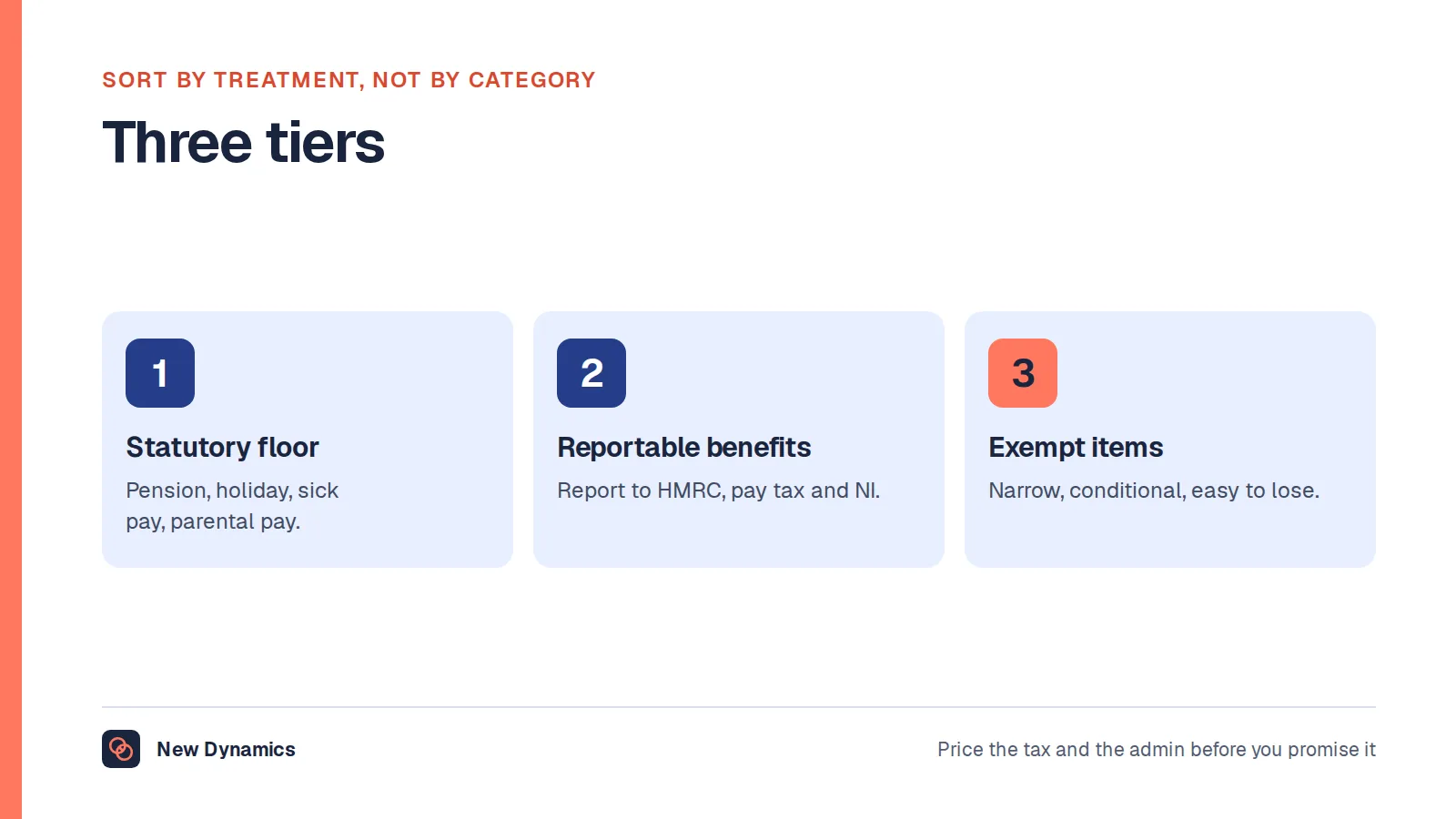
- List every benefit you provide, including the informal ones, and mark each as exempt, payrolled, P11D or settlement agreement. Our guide to employee benefits sorts a package into those tiers, and our post on fringe benefits covers what HMRC counts in the first place.
For the policy wrapper around all of this, read and download our compensation policy guide. The guide is free to read, and the PDF uses our short download form.
Want these recurring duties to live in a process with an owner and a date rather than in one person's calendar? Book a New Dynamics demo and bring your benefits list. You can also email contact@new-dynamics.com.