TL;DR
- Most interview questions test how well someone interviews rather than whether they can do the job. The fix is to decide what you need evidence of before you write a single question, then ask every candidate the same questions in the same order and score them against criteria you agreed in advance.
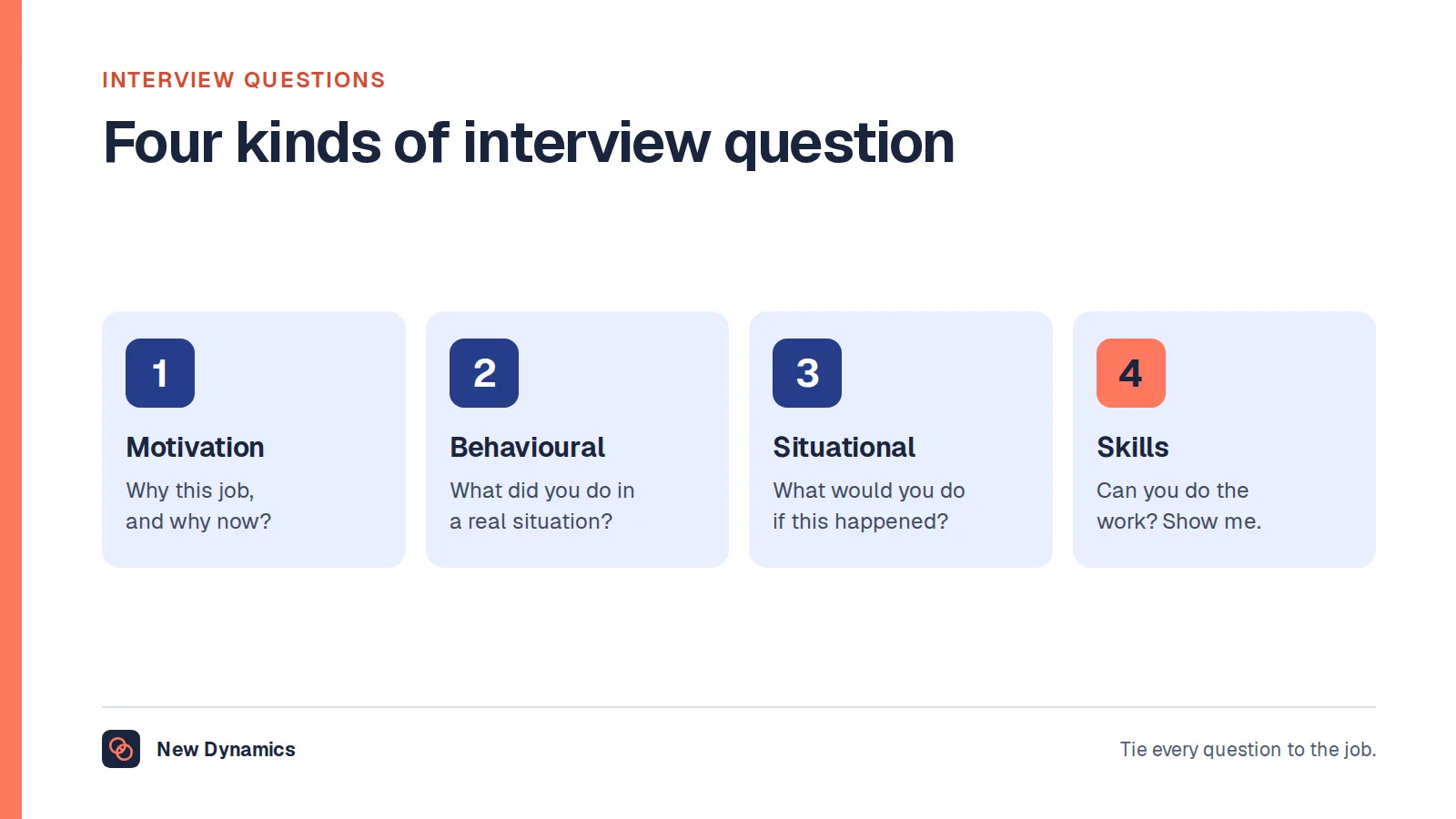
- Three question types earn their place: past behaviour with a real example, a work sample or task, and a situational question built from a real problem in the job. Hypotheticals with an obvious right answer, trick questions, brainteasers and loose culture-fit questions reward similarity to the interviewer.
- The legal line matters most. GOV.UK says you must not ask candidates about protected characteristics, and Acas says you must not ask a job applicant about their health or any disability at any stage in the application or interview process unless an exception applies. This is general information for Great Britain, not legal advice.
Sit in enough interviews and a pattern appears. The candidate who performs best is often the candidate who has interviewed most recently. They have a tidy answer about a weakness, a story about a difficult colleague, and a question at the end that sounds researched. None of it tells you whether they can do the work.
That is the central problem with most interview questions: they test interviewing. This article is about the employer's side of the hour. It covers how to decide interview questions to ask an interviewee, why structure beats conversation, which question types produce usable evidence, which ones do not, where the legal line sits, and what should be different about a second interview or an internal candidate's interview.
What you probe at interview should be the same thing you support in someone's first weeks, so see how New Dynamics onboarding carries the agreed expectations from the offer into the first month rather than starting again.
Start with the job, not with the questions
The usual order is backwards. Someone books a room, then looks for questions. Work the other way.
- List the requirements that actually decide the job. Five or six, from the job description and person specification. Not twelve. If a requirement cannot be assessed in an hour, note how you will assess it instead: a reference, a task, a trial shift.
- Decide what evidence would convince you on each one. For "handles a complaint without escalating it", the convincing evidence is a specific occasion, with what the person said. For "can write a clear update", the convincing evidence is a piece of writing.
- Choose the question type that produces that evidence. Past behaviour, work sample or situational. The type follows the evidence, not your preference.
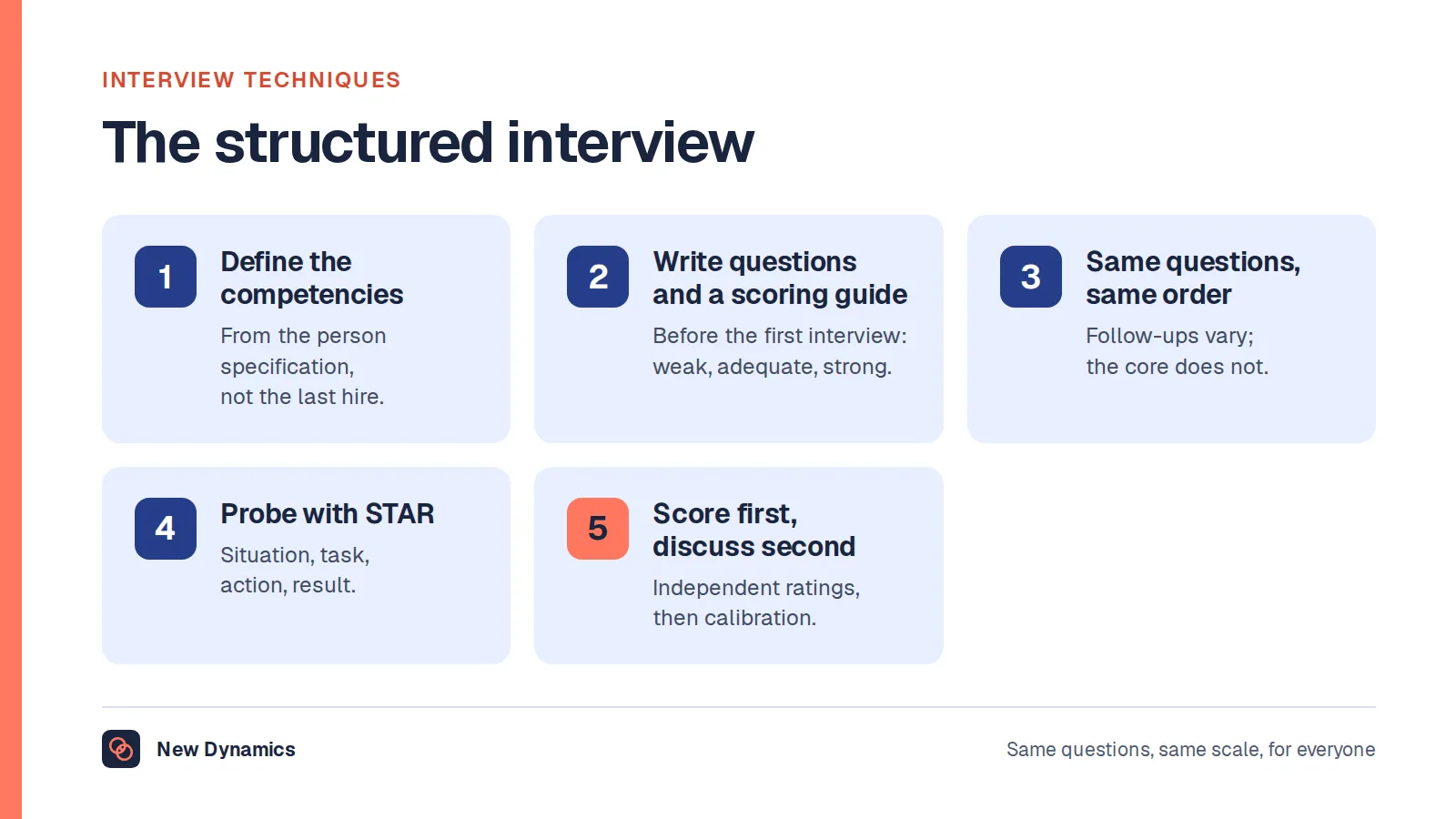
- Agree what a strong, adequate and weak answer contains before you meet anyone. This is the step that gets skipped, and it is the step that makes scoring mean anything.
Acas describes this logic for the stage before the interview, in its guidance on choosing who to interview: "Turn each point in the job description and person specification into a checklist", then "Score each application form against the checklist." The same checklist should drive the interview itself.

Structured interviewing: the same questions, in the same order, scored
A structured interview means every candidate gets the same questions, in the same order, scored against criteria agreed beforehand. Follow-up probes can differ, because the answers differ. The question set does not.
Two reasons to do it this way.
It is fairer, and it reduces a known legal risk. Acas, in its guidance on interviewing job applicants, says "When interviewing it's a good idea to ask each applicant the same questions where possible" and that "Questions must not discriminate." On panels it says: "If possible, each interview should be carried out by more than 1 person to reduce the risk of discriminating." Acas also recommends that selection staff "use a consistent decision-making process, such as a scoring system."
It is more comparable. If three candidates answered three different sets of questions, you are not comparing them, you are comparing your memory of three conversations. A free-flowing chat feels more insightful and produces less evidence. It also drifts towards the candidate you warmed to, which is where small talk about schools, hometowns and families does its damage.
The practical test: could a colleague who was not in the room read your scores and see why one candidate ranked above another? If not, the interview was a conversation.
Three question types that work
Past behaviour, with a real example
Ask for one occasion, then make the person be specific. The signal is in the detail, not the narrative.
- "Tell me about a time when you had to deliver something late. What did you tell the people waiting for it?"
- "Describe an occasion when you spotted a mistake in someone else's work. What did you do about it?"
- "Tell me about a piece of work you were asked to redo. What changed the second time?"
Probe with "What did you do, exactly?", "What did you say?" and "What happened next?" An answer made of "we" and "generally" is not evidence. Our guide to interview techniques covers probing and scoring in more depth.
A work sample or short task
The closest thing to watching someone do the job. Keep it short, make it representative, pay for anything substantial, and give every candidate the same brief and the same time.
- For a support role: "Here is a real customer email, with the names changed. Draft a reply in ten minutes, then talk me through your choices."
- For a coordinator: "Here are four competing requests and one afternoon. Tell me the order and what you would tell whoever waits."
- For an analyst: "Here is a small spreadsheet with two errors in it. Find them."
A situational question, built from a real problem
Useful where the candidate has no comparable work history. The scenario must come from the job, and it must have more than one defensible answer.
- "A regular customer asks for a discount we do not offer. Your manager is on leave. What do you do?"
- "You are halfway through a task when a colleague asks for urgent help with theirs. How do you decide?"
- "You are given instructions you think are wrong. What happens next?"

Questions that do not work, and why
Hypotheticals with an obvious right answer. "How do you handle pressure?" has one acceptable response and everyone knows it. The question tests whether the candidate can recognise the expected answer, which is a skill in interviews and rarely in the job.
Trick questions. Deliberately misleading a candidate tests composure under an artificial threat. It also sets the tone for how you will treat them as an employee, which is not a message worth sending to the people you lose.
Brainteasers and puzzles. How many piano tuners, why is a manhole cover round. They measure familiarity with the genre and willingness to think out loud in front of a stranger. Unless the job is competitive puzzle solving, use a work sample instead.
Loose culture-fit questions. "Would you get on with the team?" and "Would you have a drink with this person?" invite a judgement about similarity. The risk is not only a weaker hire, it is a pattern of hiring people like the interviewer, which is how indirect discrimination builds up quietly over a year of recruitment. If something about how you work genuinely matters, name the behaviour and ask about it: see the culture questions below.
The legal line, which is the part to get right
This section describes the position in Great Britain, where the Equality Act 2010 applies. Northern Ireland has its own discrimination legislation. It is general information rather than legal advice, and a complex case deserves proper advice.
Acas lists the nine protected characteristics as "age, disability, gender reassignment, marriage and civil partnership, pregnancy and maternity, race, religion or belief, sex, sexual orientation", and its guidance on discrimination and the law states that "all employers must make sure they do not unfairly discriminate in any aspect of work". Job applicants are protected, not only employees.
GOV.UK's guidance on recruitment and discrimination is direct: "You must not ask candidates about 'protected characteristics' or whether they: are married, single or in a civil partnership, have children or plan to have children". On date of birth it adds: "You can only ask for someone's date of birth on an application form if they must be a certain age to do the job, for example selling alcohol."
Health questions are restricted further, and before an offer they are the easiest mistake to make. Acas, on following discrimination law in recruitment, says: "You must not ask a job applicant about their health or any disability at any stage in the application or interview process, unless an exception applies." You can ask "once you have selected them for a group of potential candidates for the job" or "offered them a job either outright or on a conditional basis". The exceptions are narrow and specific, including establishing whether a reasonable adjustment is needed to take part in the selection process. GOV.UK puts the same restriction as three permitted reasons: necessary job requirements that cannot be met with reasonable adjustments, finding out if someone needs help to take part in a selection test or interview, and positive action to recruit a disabled person.
Acas is also clear about the other side of this: "By law (Equality Act 2010), you must make reasonable adjustments for job applicants or interviewees if they are disabled." Ask every candidate, in the same words, whether they need any adjustment to take part. That is a permitted question and a necessary one.
So avoid: "How old are you?", "When did you finish school?", "Are you planning a family?", "Who looks after your children?", "Do you have any health conditions we should know about?", "Where are you originally from?", "Which church do you go to?"
Ask about the requirement instead, of everyone: "This role includes two Saturdays a month. Are you able to work that pattern?" and "Do you have the right to work in the UK?" Right to work is a check you must make before employment begins, and Acas warns on offering someone a job that "You could be fined if you do not check this."

Eighteen interview questions, grouped by what they test
Use these as a starting set and cut them down to the five or six requirements that decide your role. Every question below is open, single and answerable with evidence.
Opening questions, to settle the room
- "What made you apply for this particular job?"
- "Which part of the job description looked most like work you have already done?"
Motivation and expectations
- "What is missing from your current role that you are looking for here?"
- "What would you want to have achieved by the end of your first six months?"
- "What kind of work do you avoid when you can?"
Evidence of doing the work
- "Talk me through the piece of work on your CV that you are proudest of. What was your part in it?"
- "Describe the last time you had to learn something from scratch to finish a task."
- "How do you check your own work before it goes out?"
Judgement and priorities
- "Tell me about a time when you could not do everything asked of you. How did you decide?"
- "Describe a decision you made without all the information you wanted."
- "Tell me about something you decided not to do, and why."
Working with other people
- "Describe a disagreement with a colleague about how to do something. How did it end?"
- "Tell me about a time you had to persuade someone who did not report to you."
- "What do colleagues come to you for?"
Culture and how work gets done
Culture questions are useful when they ask about behaviour rather than belonging.
- "How do you prefer to receive feedback? Give me an example of feedback that landed well."
- "Describe the working environment in which you have done your best work. What made it work?"
- "When you disagree with a decision that has already been made, what do you do?"
Their turn
- "What have we not asked you that you think we should have?"
For a longer bank of questions by theme, see our sixty interview questions to ask candidates. For how this looks in a specific role, with scoring notes for a clinical panel, see our EMT interview questions.
Second interviews: what should be different
A second interview that repeats the first one wastes everybody's afternoon. Before you book it, write down what you still do not know. If the answer is nothing, make a decision.
What a second interview is for:
- Depth on the one or two requirements you could not test in an hour. Usually the technical core of the job, or a work sample you did not have time for.
- Different people. The team the person will work with, a peer in another department, the person they would manage. New interviewers see different things.
- The stretch of the role. Where the job is going in a year, and how the candidate thinks about that.
- Their real questions. By now they are deciding too. Give them time, and someone honest to ask.
Keep the structure. A second interview is still the same questions for every finalist, scored against the same criteria. Do not let it become the "do we like them" round, which is where fit creeps back in. And say clearly what the stage is for, who will be there and how long it will take.
Interviewing an internal candidate fairly
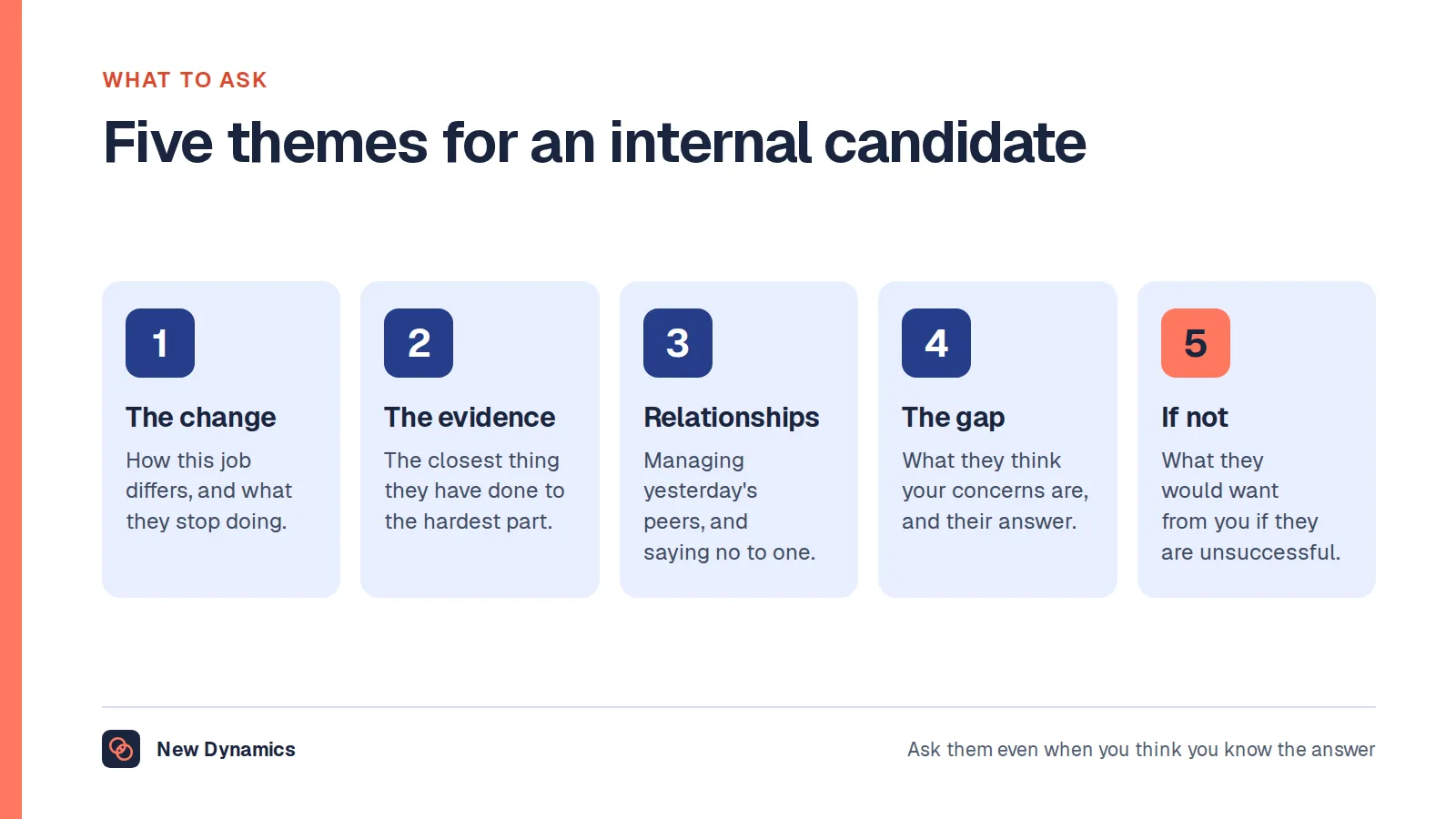
An internal candidate arrives with years of information attached, most of it gathered from a different job than the one you are filling. The discipline is to use it as evidence against specific criteria instead of as a general impression.
- Ask the same questions as external candidates, and resist the urge to skip the ones you think you know the answer to. Their answer may surprise you, and the record matters if the decision is challenged.
- Let them bring evidence, rather than assuming the panel remembers it. Someone who has worked for you for four years should not be penalised for your poor memory, or advantaged by your fondness.
- Be explicit about which role you are assessing. Strength in the current job is not evidence for the next one, which is the oldest promotion mistake there is.
- Say what the process is up front: who is in the pool, who decides, when they will hear, and what happens if they are unsuccessful.
On the last point, there is no general legal duty to give interview feedback, but with an internal candidate there is a practical one. They will be in the same building on Monday. Acas advises telling applicants "what sort of feedback to expect" and how they can ask follow-up questions, so set that expectation and then honour it: a real conversation rather than an email, specific reasons tied to the criteria, and one or two concrete things to work on with a date to review them. Our post on internal interview questions covers the questions themselves and the week afterwards.
Scoring, note taking, and why your notes are disclosable
Score alone, straight away, before the panel talks. Discussion first produces one shared view dressed up as three independent ones.
Score against the criteria you agreed, not against each other. A simple scale works: strong evidence, some evidence, no evidence, with a line of justification quoting what the candidate actually said. The justification is the useful part. "Scored 3" is not a reason.
Write what was said, not what you concluded. Notes should be legible, factual and about the requirements. Avoid anything about appearance, accent, age, family or health, both because it is irrelevant and because of the next paragraph.
Interview notes are personal data. A candidate can make a subject access request, and the ICO's guidance on keeping recruitment records notes that "candidates may make a SAR for their information", that "you must not keep information for longer than you need to" and that you "should carefully consider how long you need to keep this information for and set clear retention periods". Acas adds that if you make recordings or notes in interviews, "you must store them securely and confidentially" and follow data protection rules. Write every note as if the candidate will read it, because they may.
Keep the scores and the reasons for as long as your retention policy says, and no longer. They are also your evidence that the process was fair if anyone asks.
Frequently asked questions
What are the best interview questions to ask an interviewee?
The best questions are the ones tied to a requirement of the job, open, asked one at a time, the same for every candidate and possible to score. In practice that means past-behaviour questions such as "Tell me about a time when you could not do everything asked of you", a short work sample, and a situational question built from a real problem in the role.
What are good opening questions for an interview?
Two work well: "What made you apply for this particular job?" and "Which part of the job description looked most like work you have already done?" Both settle the candidate and produce useful information. Avoid personal small talk about family, hometown or school, which drifts towards protected characteristics and rewards similarity to the interviewer.
Should I ask every candidate the same questions?
Yes, as far as possible. Acas says it is a good idea to ask each applicant the same questions where possible, because it helps you treat applicants consistently and reduces the risk of discriminating. Follow-up probes can vary with the answers given.
What questions must employers not ask in an interview?
GOV.UK says you must not ask candidates about protected characteristics, or whether they are married, single or in a civil partnership, or have or plan to have children. Acas says you must not ask about health or any disability at any stage of the application or interview process unless a narrow exception applies, for example establishing whether someone needs an adjustment to take part.
What should a second interview cover?
Whatever the first interview could not settle: the technical core of the job, a work sample, the people the candidate would work with day to day, and where the role is going. Keep the same structure and scoring, and tell the candidate what the stage is for and who will be there.
Do we have to give feedback to an unsuccessful internal candidate?
There is no general legal duty to give interview feedback, but you should. Acas advises telling applicants what sort of feedback to expect and how to ask follow-up questions. For an internal candidate, hold a real conversation, give reasons tied to the published criteria, and agree one or two specific things to work on with a date to review them.
Your next step: build and test your question set
- Write down the five or six requirements that decide the role, from the job description.
- For each, write what evidence would convince you, then pick the question type that produces it.
- Agree what strong, adequate and weak answers contain, in writing, before you meet anyone.
- Use the same set and the same order for every candidate, score alone, and keep the reasons.
- Brief every interviewer on the question set and on what they must not ask.
For a fair process from the job description through to the offer, read and download our recruitment and selection guide. The guide is free to read, and the PDF uses our short download form.
Want the expectations you set at interview to survive the first month? Book a New Dynamics demo and bring your current interview pack. You can also email contact@new-dynamics.com.