TL;DR
- A leadership style is the pattern of behaviour a manager uses to direct, support and involve people. Common styles include directive, participative, delegating, supportive, coaching, achievement-oriented, transactional and transformational.
- No single style is best. Research on situational leadership suggests that the right approach depends on the task, the person's experience and the pressure of the moment.
- Good managers have a natural style and the range to move away from it. Know your default, read the situation, and tell people which mode you are in.
Ask ten managers to describe their leadership style and most will say something like “collaborative” or “hands-off”. Ask their teams, and you may hear something different. Ask what style the situation needs, and the conversation becomes useful.
This article explains eight leadership styles that managers use, with examples, strengths and risks. It then shows how to choose a style for the situation in front of you, and how to find out what your own default really is.
Whatever your style, it reaches people through regular conversation. See how New Dynamics continuous feedback supports coaching, check-ins and recognition in everyday work.
What is a leadership style?
A leadership style is the pattern of behaviour that a manager uses to direct, support and involve the people they lead. It shows in who makes decisions, how much guidance is given, how feedback flows and how much attention goes to the task compared with the people.
Two ideas sit behind most models of managerial leadership style.
Task and relationship. The open textbook Organizational Behavior, published by OpenStax, describes the classic finding in its section on behavioural approaches to leadership. Researchers identified two major sets of leader behaviour. Consideration is “the ‘relationship-oriented’ behavior of a leader”, which creates and maintains good relationships. Initiating structure involves “‘task-oriented’ leader behaviors”, such as scheduling work. Leaders can be high or low on each.
Who decides. OpenStax also describes a continuum of leader power, from autocratic (boss-centred), through participative (workers are consulted and involved), to free-rein, where members are given the work and decide for themselves how to do it.
Most named styles are a position on these two dimensions.
Is there a best leadership style?
No. The OpenStax chapter on situational approaches to leadership quotes Ralph Stogdill, writing as early as 1948: “the qualities, characteristics, and skills required in a leader are determined to a large extent by the demands of the situation in which he is to function as a leader.”
That is the working assumption of this article. A style is a tool. The skill lies in choosing the right one.

Eight leadership styles for managers
The first four descriptions below follow path-goal theory, as set out by OpenStax. The theory describes four kinds of leader behaviour, each suited to particular situations. The remaining four are other widely used labels.
1. Directive
The manager sets goals and expectations, gives clear instructions and checks progress. OpenStax describes directive leaders as those who “let organizational members know what is expected, provide guidance, establish rules and procedures to guide work”.
- Works well when: the task is unclear, the person is new, or there is an emergency or a safety risk.
- Risk: used with experienced people, it feels like micromanagement and wastes their judgement.
- Example: on a new starter's first day on the support desk, the manager explains exactly how to log, prioritise and escalate a ticket.
2. Supportive
The manager shows concern for people's wellbeing and needs. Supportive leaders are, in OpenStax's words, “friendly, approachable, and considerate to individuals in the workplace”.
- Works well when: work is stressful, repetitive or frustrating, or when someone's confidence has taken a knock.
- Risk: support without standards can slide into avoiding difficult conversations.
- Example: during a gruelling month end, the manager checks in daily, takes a task off an overloaded colleague and says thank you by name.
3. Participative
The manager consults the team and takes their views into account before deciding. OpenStax says that participative leaders “consult with group members about job-related activities and consider their opinions and suggestions when making decisions”.
- Works well when: the problem is complex, the team has expertise, and commitment matters as much as the decision.
- Risk: slow when speed matters, and frustrating if people suspect that the decision has already been made.
- Example: before redesigning the rota, the manager asks the team for constraints and ideas, then decides and explains the reasoning.
4. Achievement-oriented
The manager sets stretching goals and shows confidence that people can reach them. OpenStax describes leaders who “set challenging goals, seek improvement in performance, emphasize excellence, and demonstrate confidence” in their people.
- Works well when: the team is capable and motivated, and the work allows real improvement.
- Risk: without support or realism, stretch becomes pressure. See our SMART goals for productivity for ways to add a safeguard.
- Example: a sales manager agrees an ambitious target for a new sector, and backs it with time, training and weekly problem-solving.
5. Delegating
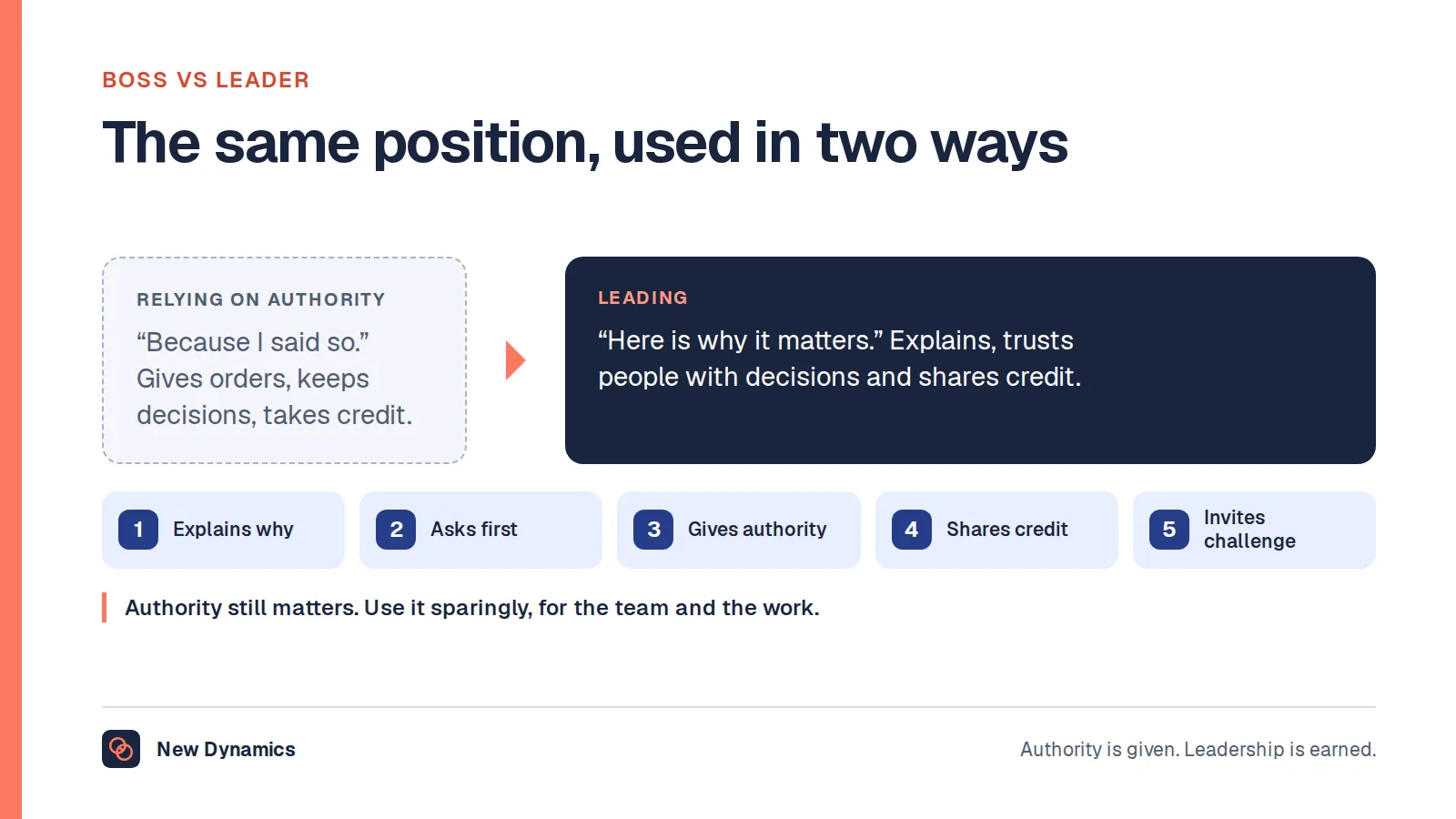
The manager hands over responsibility and authority, agrees the outcome and the check-in points, and then steps back. This is the healthy form of what the textbooks call free-rein leadership.
- Works well when: people are skilled and confident, and the manager's time is better spent elsewhere.
- Risk: with people who are not ready, or without clear outcomes, delegation becomes abandonment.
- Example: an experienced analyst takes full ownership of the monthly board report, including decisions about its content.
6. Coaching
The manager develops people by asking questions, giving feedback and creating chances to practise. Decisions may take longer today, so that people can take more of them tomorrow.
- Works well when: someone has potential and the will to grow, and there is time to learn.
- Risk: it is slow in a crisis, and irritating when someone simply needs an answer.
- Example: a team member brings a problem, and the manager asks, “What options have you considered?” before offering a view.
7. Transactional
The manager makes clear what is expected and what people will get in return, then monitors and rewards accordingly. OpenStax, in its section on transformational leadership, describes transactional leaders as “extremely task oriented and instrumental in their approach, frequently looking for incentives that will induce their followers into a desired course of action”.
- Works well when: work is routine and measurable, and standards must be met reliably.
- Risk: people do what is rewarded and no more. It does little for change or creativity.
- Example: a contact centre sets clear service targets, with a quarterly bonus tied to quality and response time together.
Our guide to expectancy theory explains when incentives like these work, and when they fail.
8. Transformational
The manager motivates through purpose. In OpenStax's words, transformational leaders do not rely on inducements. Instead, “they inspire others to action through their personal values, vision, passion, and belief in and commitment to the mission”.
- Works well when: the organisation needs to change direction, or people need to see why their work matters.
- Risk: vision without delivery breeds cynicism, and heavy dependence on one inspiring person is fragile.
- Example: a new head of service explains what excellent care would look like for patients, involves the team in redesigning it and removes the obstacles they name.
Most effective managers combine the last two. They paint the picture, and they keep their promises about targets and rewards.
Leadership styles compared
| Style | Who decides | Best suited to |
|---|---|---|
| Directive | The manager | New people, unclear tasks, emergencies |
| Supportive | Varies | Stressful or frustrating work |
| Participative | The manager, after consulting | Complex problems, experienced teams |
| Achievement-oriented | Goals agreed together | Capable, motivated people |
| Delegating | The team member | Skilled, confident people |
| Coaching | The team member, with guidance | People with potential, and time to learn |
| Transactional | The manager, by setting terms | Routine, measurable work |
| Transformational | Shared, around a purpose | Change, and work that needs meaning |
How to choose the right style
Ask four questions about the situation.
- How clear is the task? The less clear it is, the more direction people need at the start.
- How experienced and confident is the person, for this task? Someone can be an expert in one area and a beginner in another. Move from directive, through coaching and participative, to delegating as skill and confidence grow.
- How much time is there? A crisis calls for direction. A development opportunity calls for coaching.
- How much does commitment matter? If people must carry out the decision wholeheartedly, involve them in making it.
Then do two more things.
- Say which mode you are in. “I am going to decide this one, and here is why”, or “I want your views before I decide”, or “This is yours to decide”. Much frustration comes from people not knowing which it is.
- Review as things change. The style that suited a new starter in month one will insult them by month six.

How to find your default style
Everyone has a style that they fall back on under pressure. Knowing yours tells you when to deliberately do something else.
- Look at your last ten decisions. How many did you make alone, make after consulting, or hand over?
- Ask your team. “When would you like more direction from me, and when less?” It is a safe question that yields honest answers.
- Notice your stress response. Some managers grab control. Others go quiet and leave people alone.
- Use structured feedback, such as upward or 360 feedback, if your organisation offers it.
Common patterns are easy to spot. The expert who was promoted tends to be too directive with capable people. The manager who wants to be liked tends to be supportive, and to avoid setting standards. The busy manager delegates without checking whether the person is ready.
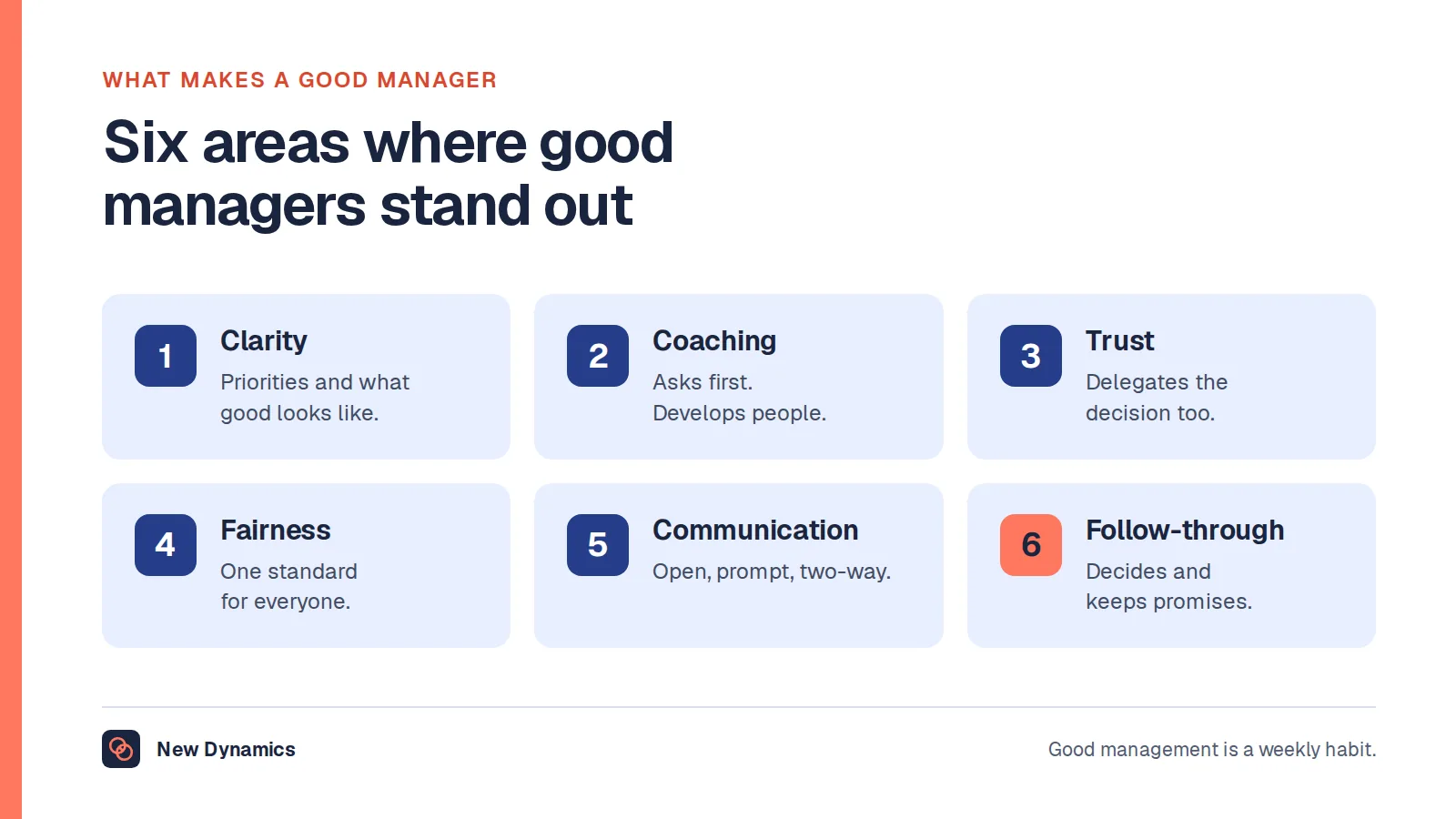
For the behaviours behind good management, whatever the style, see what makes a good manager.
Common mistakes with leadership styles
One style for everyone. Treating a new starter and a ten-year veteran alike fails both.
Treating a style as an identity. “I am just a hands-off manager” is a preference. The job is to give people what the situation needs.
Calling absence delegation. Delegation includes clear outcomes, authority and agreed check-ins.
Fake participation. Asking for views when the decision is already made teaches people not to offer them.
Staying in crisis mode. Direction is right during the fire. Carrying on afterwards is control.
Copying a famous leader. What worked for a celebrated chief executive in one company, at one moment, may not suit your team on a Tuesday.

Frequently asked questions
What are the main leadership styles in management?
Common managerial leadership styles are directive, supportive, participative, achievement-oriented, delegating, coaching, transactional and transformational. They differ in who makes decisions, how much guidance is given and how much attention goes to the task compared with the people.
What is the best leadership style for a manager?
There is no single best style. The right approach depends on how clear the task is, how experienced the person is, how much time there is and how much commitment the decision needs. Effective managers have a natural style and adapt it to the situation.
What is the difference between autocratic, participative and free-rein leadership?
They are points on a continuum of who decides. An autocratic leader decides alone. A participative leader consults and involves people before deciding. A free-rein leader hands the work over, and members decide for themselves how to do it.
What is the difference between transactional and transformational leadership?
Transactional leaders set clear expectations and use rewards to get the work done, which suits routine, measurable work. Transformational leaders motivate through values, vision and commitment to a mission, which suits change. Many good managers use both.
How do I find out my leadership style?
Review your last ten decisions and note who made them. Ask your team when they would like more direction and when less. Notice what you do under stress. If your organisation offers upward or 360 feedback, use it.
Can you change your leadership style?
Yes. A style is a pattern of behaviour, and behaviour can be practised. Most people keep a natural default, but they can learn to direct, coach, consult or delegate as the situation requires. Start by practising one new behaviour with one person.
Your next step: match your style to each person
- List the people in your team, and one main task for each.
- For each, note how experienced and confident they are in that task.
- Decide which style fits: direct, coach, consult or delegate.
- Tell each person what to expect from you, and ask whether it is what they need.
For an agenda and prompts for the conversation where most of this happens, read and download our one-to-one meeting guide. The guide is free to read, and the PDF uses our short download form.
Want every manager to coach, check in and give feedback as a habit? Book a New Dynamics demo and bring your current management routines. You can also email contact@new-dynamics.com.