TL;DR
- A vacancy is a job that nobody is doing and that is available for someone new to do. Statisticians count a position as a vacancy when the employer is actively seeking recruits from outside the organisation.
- Vacancies arise when someone leaves, moves or is promoted, when a new role is created, or when work grows. Each one is a chance to ask whether the job should be refilled as it was.
- Filling a vacancy runs through six stages: decide, approve, describe, advertise, select and close. Adverts must describe the real requirements and must not state or imply discrimination.
“We have a vacancy.” It is one of the most common sentences in working life, and one of the least examined. It can mean a resignation that landed on a manager's desk this morning, a line in a budget, an advert on a job board or a number in a national statistic.
This article gives the meaning of vacancy in plain terms, with dictionary and official definitions. It explains how a vacancy differs from an opening, a requisition and a job ad, how vacancies arise, the six stages of filling one and the rules for advertising a vacancy fairly.
A vacancy becomes a request, an approval and a series of steps. See how New Dynamics workflows let you shape forms, stages and approvals around the way you work.
What does vacancy mean?
The Cambridge Dictionary gives two everyday senses of vacancy. The first is “a space or place that is available to be used”, as in a hotel with no vacancies or a dentist with a vacancy tomorrow morning. The second is the workplace sense: “a job that no one is doing and is therefore available for someone new to do”.
Its business dictionary puts the same idea from the employer's side. A vacancy is “a job that is available in an organization and that people can apply for”. The usual verbs, it notes, are advertise, create and fill, and a vacancy is said to arise, exist or occur.
Three things follow from these definitions.
- A vacancy is a job, not a person. The post exists whether or not anyone is in it.
- A vacancy is unfilled. Once someone is doing the job, the vacancy has gone.
- A vacancy is open to applicants. The employer intends to fill it and people can put themselves forward. Our guide to the meaning of applicant covers what happens when they do.
Vacancies is simply the plural. “What are vacancies?” usually means “which jobs are open here?”, which is why careers pages list them under that heading.
The official definition: how vacancies are counted
The UK's Office for National Statistics publishes a monthly estimate of vacancies, and it needs a stricter definition than the dictionary. Its vacancies and jobs bulletin states: “Vacancies are positions for which employers are actively seeking recruits from outside of their business or organisation.”
Two words in that sentence matter to anyone in HR.
- Actively. A job that is empty but not being recruited for, because it is frozen or under review, is not a vacancy in the statistical sense.
- Outside. A post that will only be filled by an internal move or promotion does not count. Most organisations would still call it a vacancy internally, so be clear which meaning you are using when you report your own numbers.
The bulletin published on 15 September 2026 estimated 702,000 vacancies in the UK in June to August 2026, and reported that there were 2.5 unemployed people per vacancy in May to July 2026. It also uses a vacancy rate, which it describes as the number of unfilled jobs that employers are actively recruiting for, “as a proportion of the total number of jobs (including filled and unfilled jobs) in the economy”. The UK rate for June to August 2026 was 2.1%. Those figures will have moved by the time you read this; the bulletin is updated monthly.
Vacancy, opening, requisition, position and job ad
These words overlap, and people switch between them mid-sentence. Here is how we separate them.
| Term | What it means |
|---|---|
| Vacancy | A job that is unfilled and that the employer intends to fill |
| Job opening | The same thing in American usage. The ONS notes that the vacancy rate is “also referred to as the job openings rate” |
| Position | A place in the structure for one person, filled or not. Every vacancy is a position; not every position is a vacancy |
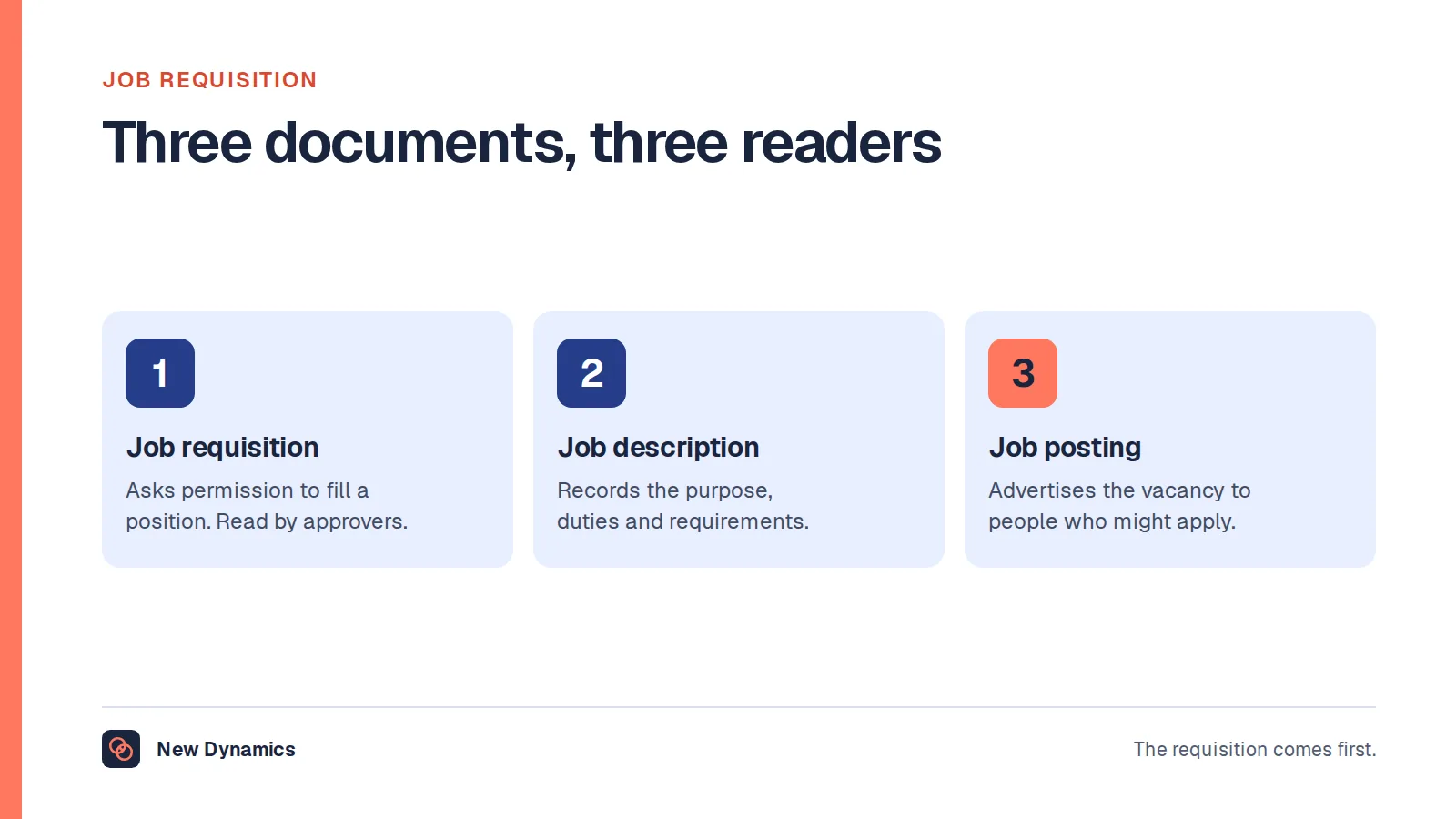
| Job requisition | The formal, approved request to fill a vacancy, usually with a budget and a reference number. See our guide to the job requisition |
| Job ad | The public description of the vacancy, written to attract applicants. Our guide to writing a job ad covers it |
A useful way to remember the sequence: a vacancy arises, a requisition approves it, a job ad announces it, and applicants respond.

How a vacancy arises
Cambridge's phrase is that a vacancy arises. There are four common causes.
- Someone leaves. A resignation, retirement, dismissal or the end of a contract. This is the replacement vacancy, and the most common kind. Our article on the meaning of attrition explains how leavers are measured.
- Someone moves. A promotion or a transfer fills one vacancy and creates another. A chain of internal moves can end with a single external hire several levels down.
- A new role is created. The organisation decides that it needs a job that did not exist before, perhaps because of a new product, a new site or a new requirement.
- Work grows. More of the same work needs more of the same people: a bigger contract, a seasonal peak or a second shift.
The cause shapes the response. A replacement vacancy invites the question of whether the job should be refilled as it was. A new role needs a job analysis before anyone writes an advert. Our guide to job analysis shows how to do one.
Six stages of filling a vacancy
1. Decide whether to fill it
A vacancy is a decision point, not an automatic instruction to recruit. Ask whether the work is still needed, whether it could be redistributed, automated or redesigned, and whether a permanent hire is the right answer. Our guide to the meaning of staffing sets out the alternatives, and our article on strategic workforce planning puts the vacancy in the context of the whole organisation.
2. Approve it
In most organisations the hiring manager raises a requisition, and someone with budget authority approves it. The requisition records the job title, grade, salary range, location, hours and the reason for the vacancy. This is where a vacancy becomes official.
3. Describe the job
Update or write the job description and the person specification. Separate what the job requires from what would be nice to have. Our job description template and our guide to job requirements cover both.
4. Advertise it
Choose where the vacancy will be seen: your careers page, job boards, an agency, professional networks, internal channels or a government service. In Great Britain employers can post vacancies on the government's Find a job service; GOV.UK's advertise a job page explains that the service is only available for England, Scotland and Wales, and that Northern Ireland has a different service.
5. Select a person
Shortlist, interview, assess, check references and make an offer. Our recruitment and selection guide sets out a fair process from start to finish.
6. Close the vacancy
The vacancy ends when the person starts, not when they accept. Until then, keep the requisition open and a plan B ready. When they do start, record the time to fill, tell unsuccessful applicants, and hand over to onboarding.

Advertising a vacancy fairly
GOV.UK's guidance for employers on discrimination in recruitment is short and clear. “You must not state or imply in a job advert that you'll discriminate against anyone.” It gives two practical warnings.
- Watch your phrasing. “Only use phrases like ‘recent graduate’ or ‘highly experienced’ when these are actual requirements of the job.” Otherwise the advert may discriminate against younger or older people.
- Watch where you advertise. “Where you advertise might cause indirect discrimination - for example, advertising only in men's magazines.”
The same guidance says that employers must not ask candidates about protected characteristics, and, with limited exceptions, must not ask about health or disability before offering a job. It applies in Great Britain. This is general information, not legal advice, and the law differs in other countries.
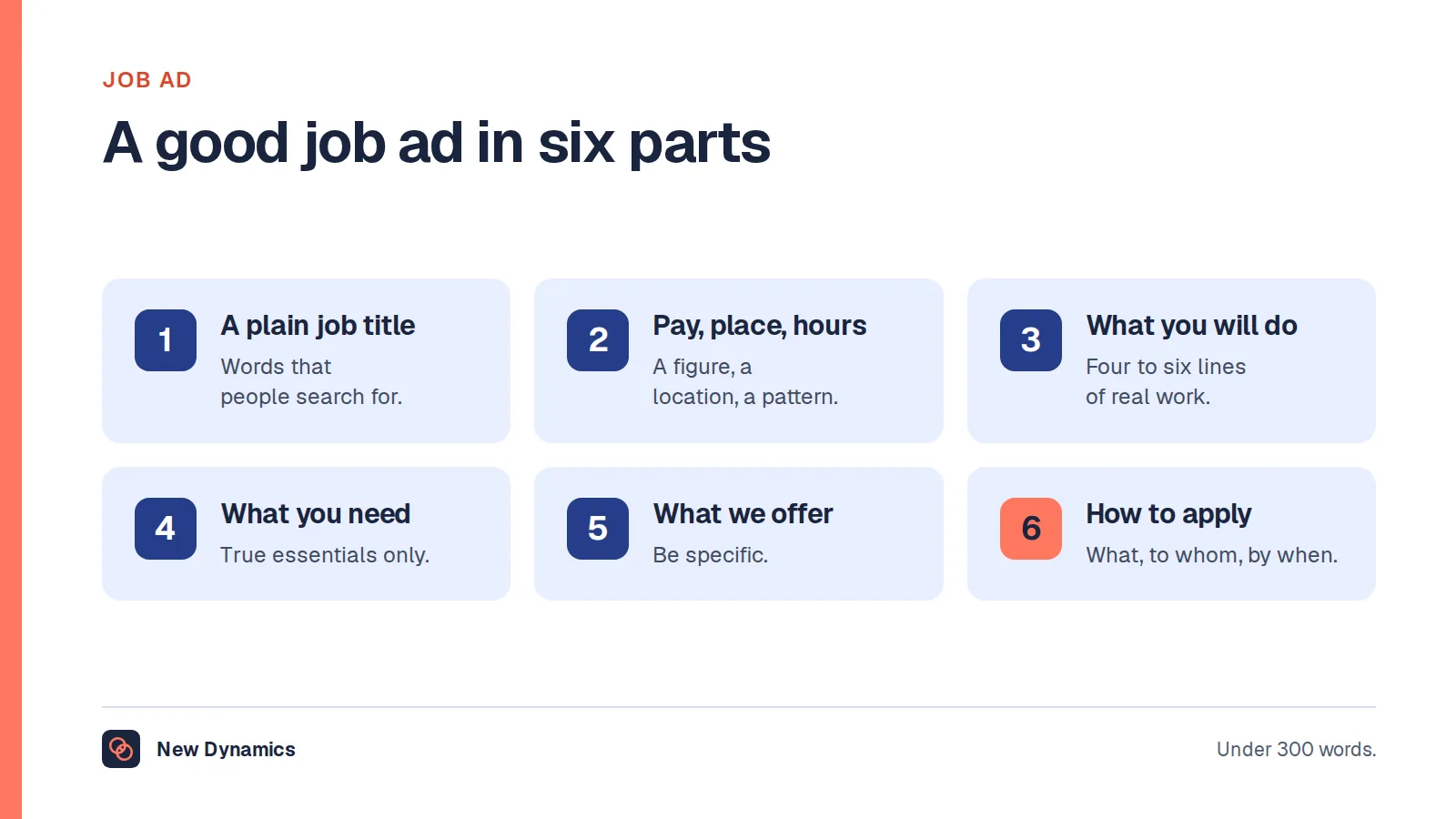
Four habits keep a vacancy advert on the right side of that guidance.
- Describe the job, not the person you imagine doing it.
- List only real requirements, and say which are essential.
- State the pay or the range. It saves everyone's time.
- Place the advert where everyone can see it, not only where you found the last hire.

Measuring vacancies inside an organisation
HR teams usually track a handful of vacancy measures.
- Open vacancies: the number of approved, unfilled posts at a point in time, often split by department and by how long each has been open.
- Time to fill: the days from approval to acceptance, or to start date. Decide which, and stick to it.
- Vacancy rate: open vacancies as a share of all posts, the internal version of the ONS measure.
- Hard-to-fill vacancies: posts open longer than an agreed threshold, which usually points to pay, location, skills shortages or an advert that puts people off.
- Source of hire: where the person who filled each vacancy came from.
Treat a long-standing vacancy as a signal. Sometimes the answer is a better advert. Sometimes it is that the job, as designed, cannot be filled at that pay, and the vacancy is really a design problem.
Vacancy in other settings
Outside work, the word keeps its first meaning: a space that is free. Hotels hang “no vacancy” signs, landlords speak of vacancy rates for empty property, and a vacancy on a committee or a board is a seat with nobody in it. A parliamentary vacancy leads to a by-election. In every case, the sense is the same: something that is meant to be occupied, and currently is not.
Frequently asked questions
What does vacancy mean in a job context?
A vacancy is a job that nobody is currently doing and that the employer intends to fill. The Cambridge Dictionary defines it as “a job that no one is doing and is therefore available for someone new to do”. The plural, vacancies, usually refers to all the open jobs in an organisation.
What are vacancies?
Vacancies are the unfilled jobs that an employer is recruiting for. On a careers page, the vacancies list shows every job you can apply for right now. In national statistics, the Office for National Statistics counts a vacancy only when the employer is actively seeking recruits from outside its organisation.
What is the difference between a vacancy and a job opening?
There is no real difference. Vacancy is the usual British term and job opening the usual American one. The ONS notes that the vacancy rate is also referred to as the job openings rate.
What is the difference between a vacancy and a job requisition?
A vacancy is the unfilled job. A job requisition is the formal, approved request to fill it, which usually carries a budget, a reference number and the details that will go into the advert. The vacancy exists first; the requisition makes it official.
How does a vacancy arise?
A vacancy arises when someone leaves, when someone moves or is promoted, when a new role is created, or when the amount of work grows. A replacement vacancy is the most common kind, and it is the moment to ask whether the job should be refilled as it was.
How should a vacancy be advertised?
Describe the job and its real requirements, say which are essential, state the pay or range, and place the advert where a wide range of people will see it. UK government guidance says you must not state or imply in a job advert that you will discriminate against anyone, and that phrases such as “recent graduate” should be used only when they are genuine requirements.
Your next step: look at your open vacancies
- List every approved, unfilled post and how long each has been open.
- For each one, confirm that somebody has asked whether it should be refilled as it was.
- Read the advert for the longest-standing vacancy as if you were a stranger, and check it against the four habits above.
- Agree one definition of time to fill and start recording it.
For a fair process from vacancy to offer, read and download our recruitment and selection guide. The guide is free to read, and the PDF uses our short download form.
Want vacancy approvals, hiring stages and onboarding in one place? Book a New Dynamics demo and bring your current process. You can also email contact@new-dynamics.com.