TL;DR
- MD&A stands for management's discussion and analysis. It is the narrative section of an annual report in which the people who ran the business explain the results, the risks and the outlook in their own words, next to the audited figures but not part of them.
- The requirement differs by country. In the United States, Item 303 of Regulation S-K sets out what MD&A must cover, and it appears at Item 7 of the annual report on Form 10-K. In the United Kingdom the equivalent duty is the strategic report under the Companies Act 2006, which must include a section 172(1) statement.
- This is also where workforce matters reach investors. British quoted companies must report on employees and give a breakdown by sex of directors, senior managers and employees. American registrants must describe their human capital resources in the business section.
Open a listed company's annual report and, near the audited accounts, you will find pages of prose in which management explains what the numbers mean. The idea is the same in every country that requires it: the people who ran the business telling the owners how the year went, in their own words. The name and the rule number are not.
MD&A stands for management's discussion and analysis. This article sets out what it means, where it sits, what American and British law each ask for, what a good one contains, the criticisms it attracts, how to read one, and the one place it touches HR.
Everything below is general information, not legal, accounting or investment advice. The two regimes are genuinely different, so each section says which country it describes.
We make performance management software, not financial reporting software, so treat this as a plain explainer. The connection to our work comes at the end: workforce numbers that start in an HR system and finish in a sentence a board has signed. For the people half of that chain, New Dynamics goals and OKRs is where a company objective becomes something an individual owns.
What is MD&A, and where does it sit in a report?
MD&A is the narrative section of a company's financial report. The statements say what happened in numbers. The MD&A says why, what management thinks it means and what could change it. It carries judgement in a way audited statements deliberately do not.
In the United States it sits at Item 7 of the annual report on Form 10-K. The SEC's Office of Investor Education and Advocacy, in its Investor Bulletin "How to Read a 10-K" (September 2011), says Item 7, "Management's Discussion and Analysis of Financial Condition and Results of Operations", "gives the company's perspective on the business results of the past financial year", and that "This section, known as the MD&A for short, allows company management to tell its story in its own words."
It is equally blunt about who stands behind it: "The SEC neither writes the 10-K nor vouches for its accuracy."
In the United Kingdom there is no section called MD&A in company law. The equivalent duty is the strategic report, and it sits at the front of the annual report rather than after the accounts.

The American position: Item 303 of Regulation S-K
In the United States, MD&A's contents are set by Item 303 of Regulation S-K (17 CFR 229.303). Quotations below are from the current Code of Federal Regulations, read in November 2026, in the original American spelling.
The rule opens with an objective. Paragraph (a) states that "The objective of the discussion and analysis is to provide material information relevant to an assessment of the financial condition and results of operations of the registrant including an evaluation of the amounts and certainty of cash flows from operations and from outside sources". It "must focus specifically on material events and uncertainties known to management that are reasonably likely to cause reported financial information not to be necessarily indicative of future operating results".
Paragraph (b), "Full fiscal years", asks for three things.
- The movements, explained. "Where the financial statements reflect material changes from period-to-period in one or more line items, including where material changes within a line item offset one another, describe the underlying reasons for these material changes in quantitative and qualitative terms."
- Liquidity and capital resources. Paragraph (b)(1) asks the company to "Analyze the registrant's ability to generate and obtain adequate amounts of cash to meet its requirements", separately for the next 12 months and the period beyond. Where a material deficiency is found, paragraph (b)(1)(i) requires it to "indicate the course of action that the registrant has taken or proposes to take to remedy the deficiency".
- Results of operations. Paragraph (b)(2)(ii) requires the company to "Describe any known trends or uncertainties that have had or that are reasonably likely to have a material favorable or unfavorable impact on net sales or revenues or income from continuing operations". Its named examples include "known or reasonably likely future increases in costs of labor or materials".
Paragraph (b)(3) adds critical accounting estimates, those involving "a significant level of estimation uncertainty" and reasonably likely to have a material impact. The company must explain "why each critical accounting estimate is subject to uncertainty" and the "sensitivity of the reported amount" to its assumptions.
An instruction to paragraph (b) adds the line most worth remembering: "The discussion must not merely repeat numerical data contained in the financial statements". A narrative that restates the income statement in sentences is avoiding the rule, not meeting it. Paragraph (c) extends the duty to interim reporting, which is why quarterly reports on Form 10-Q carry MD&A too.
The British position: the strategic report under the Companies Act 2006
In the United Kingdom, the comparable duty comes from Chapter 4A of Part 15 of the Companies Act 2006. Section 414A provides that "The directors of a company must prepare a strategic report for each financial year of the company", unless it "is entitled to the small companies exemption", which section 414B ties to the small companies accounting regime. So the British duty reaches far more companies than the American one, while exempting the smallest. The quotations below were read on legislation.gov.uk in November 2026.
Section 414C sets the contents, and its purpose is stated plainly: "The purpose of the strategic report is to inform members of the company and help them assess how the directors have performed their duty under section 172". The report must contain "a fair review of the company's business" and "a description of the principal risks and uncertainties facing the company".
The standard for that review sits in subsection (3). It must be "a balanced and comprehensive analysis of" the business's "development and performance" during the year and its "position" at the end of it, "consistent with the size and complexity of the business". That last clause is the proportionality valve.
Subsection (4) brings in measurement. The review must include "analysis using financial key performance indicators" and, "where appropriate, analysis using other key performance indicators, including information relating to environmental matters and employee matters". A medium-sized company may omit the non-financial part.
Quoted companies carry more. Subsection (7) requires "the main trends and factors likely to affect the future development, performance and position of the company's business", plus information about environmental matters, "the company's employees" and "social, community and human rights issues", including the policies on them "and the effectiveness of those policies". If the report omits any of the three, "it must state which of those kinds of information it does not contain". Subsection (8) adds the strategy, the business model and a sex breakdown of directors, senior managers and employees.
Larger entities also need a non-financial and sustainability information statement inside the strategic report. Section 414CA applies that to traded companies, banks and authorised insurers among others, and to a "high turnover company", one whose turnover "was more than £500 million", but not where it "had no more than 500 employees in that financial year".
The section 172(1) statement (United Kingdom)
The British regime has one feature with no American equivalent, and it is the part HR readers should know.
Section 172(1) requires a director to act in the way he considers, in good faith, "would be most likely to promote the success of the company for the benefit of its members as a whole", and in doing so to "have regard (amongst other matters) to" six listed matters. The second is "the interests of the company's employees". The others cover long-term consequences, business relationships, the community and the environment, a reputation for high standards of conduct, and "the need to act fairly as between members of the company".
Section 414CZA turns that duty into a disclosure. A strategic report "must include a statement (a “section 172(1) statement”) which describes how the directors have had regard to the matters set out in section 172(1)(a) to (f)". Medium-sized companies are outside it. So a British company above medium size must write down, for shareholders, how it took its employees' interests into account. That is a reporting duty, not a promise about outcomes.
What a good MD&A or strategic report contains

Four things make a narrative section worth reading, in the United States and the United Kingdom alike.
- The movements, explained. Not "revenue increased by 7%", which a reader can calculate, but what drove it: volume, price, a new product, one large contract.
- Cash, not just profit. Where it came from, what it is committed to, what happens under pressure.
- Risks named specifically. A risk that would fit any company tells a reader nothing.
- The judgements behind the numbers. Which estimates are soft, and how far the figure moves if the assumption changes.
In the United Kingdom the Financial Reporting Council publishes non-mandatory guidance on how to do this. Its Guidance on the Strategic Report, in the edition published on 4 February 2026, says "High-quality strategic reports provide shareholders and other primary users with a holistic and meaningful picture of the entity's development, performance, position and future prospects", and that it "encourages companies to focus on the application of materiality to disclosures". None of that is law. It is the British regulator describing what good looks like.
The standard criticisms of MD&A
Narrative reporting attracts three criticisms consistently, in both countries.
Boilerplate. Text repeated year after year with the numbers changed, or text that would fit any company in the sector. The American rule heads this off by saying the discussion "must not merely repeat numerical data contained in the financial statements"; the British one by demanding a "balanced and comprehensive analysis".
Selective framing. The section is management's own account, and management has an interest in the reader's conclusion. Good news arrives with explanation, bad news in the passive voice. The British anchor is the word "balanced" in section 414C(3).
Non-statutory measures presented flatteringly. Adjusted profit, underlying earnings and like-for-like growth are not defined by accounting standards, and the company chooses the adjustments. In the United States this is regulated, not banned. Item 10(e) of Regulation S-K requires a non-GAAP measure in a Commission filing to be accompanied by "A presentation, with equal or greater prominence, of the most directly comparable financial measure or measures calculated and presented in accordance with Generally Accepted Accounting Principles (GAAP)", plus "A reconciliation (by schedule or other clearly understandable method)" of the differences. It also forbids adjusting a measure "to eliminate or smooth items identified as non-recurring, infrequent or unusual, when the nature of the charge or gain is such that it is reasonably likely to recur within two years". The Companies Act 2006 does not define adjusted measures, so in the United Kingdom the discipline comes from that "balanced and comprehensive" standard.
One safeguard exists in both countries and readers underuse it. In the United Kingdom, section 496 makes the auditor "state whether, in his opinion, based on the work undertaken in the course of the audit", the strategic report and directors' report are "consistent with those accounts", and whether they have "identified material misstatements" in them. The narrative is not audited as the accounts are, but it is checked for consistency, and that check is reported. American oversight works differently: the SEC Investor Bulletin notes that "The Sarbanes Oxley Act requires the SEC to review every public company's financial statements at least once every three years".
How to read an MD&A as an outsider

You do not need an accountancy qualification. Five habits do most of the work, in either country.
- Find the section. Item 7 of an American Form 10-K; the strategic report near the front of a British annual report.
- Read last year's version first. Last year's stated expectations are the only free benchmark you have. Note what quietly disappeared.
- Follow the cash, not only the profit. Item 303(b)(1) exists because a profitable company can still run out of money.
- Check every adjusted number against the statutory one. Find the reconciliation, then ask what was excluded and whether it will recur.
- Count the specifics. Quantified causes, dates and amounts are evidence. Adjectives are not.
Where HR meets MD&A: workforce matters that reach investors
This part belongs on an HR site, and it is narrower than people-analytics marketing suggests.
In the United Kingdom, workforce information enters the strategic report at four points, all cited above: key performance indicators covering "employee matters" (section 414C(4)), information about "the company's employees" and the related policies for quoted companies (section 414C(7)), the sex breakdown of directors, senior managers and employees (section 414C(8)), and the section 172(1) statement.
In the United States the position differs, and the distinction matters: the headcount description does not sit in MD&A at all. Item 101(c)(2)(ii) of Regulation S-K requires, in the business section, "A description of the registrant's human capital resources, including the number of persons employed by the registrant, and any human capital measures or objectives that the registrant focuses on in managing the business", with examples given as measures "that address the development, attraction and retention of personnel". Workforce matters reach the American MD&A only when they move the numbers, for instance through the "costs of labor" named in Item 303(b)(2)(ii).
The consequence is the same either way. Once headcount, attrition, engagement or a diversity breakdown reaches a report like this, it stops being an internal HR figure. It needs a definition that holds up, a comparison with last year, a boundary (which entities, which employees, measured on which date) and, in the United Kingdom, an auditor checking it against the accounts. A figure from a spreadsheet nobody can reconstruct is a reporting risk.
Three things follow, in either country.
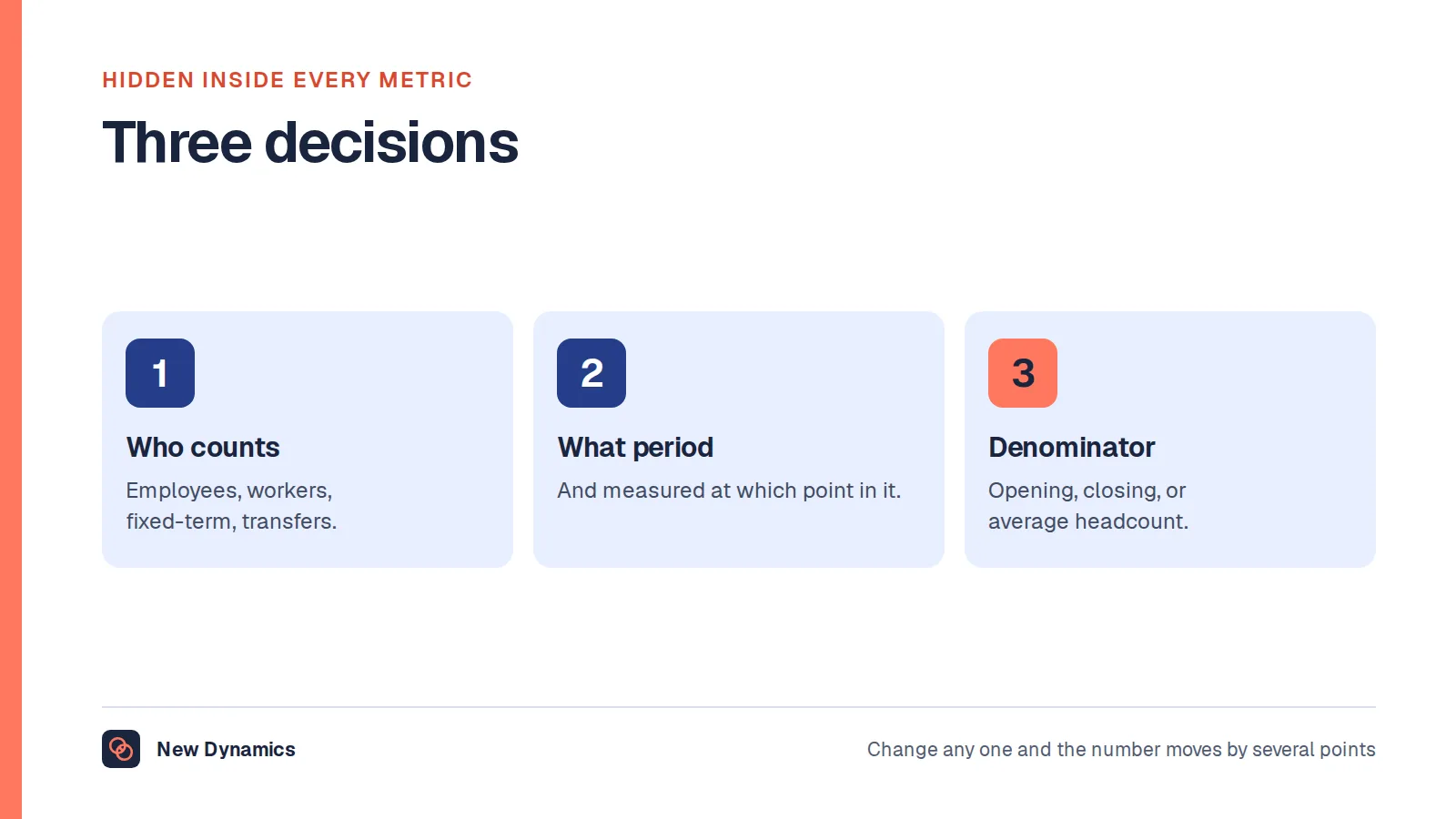
- Write the definition down before the number is published. Headcount at year end or average over the year, FTE or heads, permanent only or including contractors. Our post on HR metrics covers which measures are worth reporting, and the statistics hub collects the published UK figures we reference.
- Keep the source system able to answer the question twice. If someone asks in March how the December figure was produced, that should be a query, not an excavation.
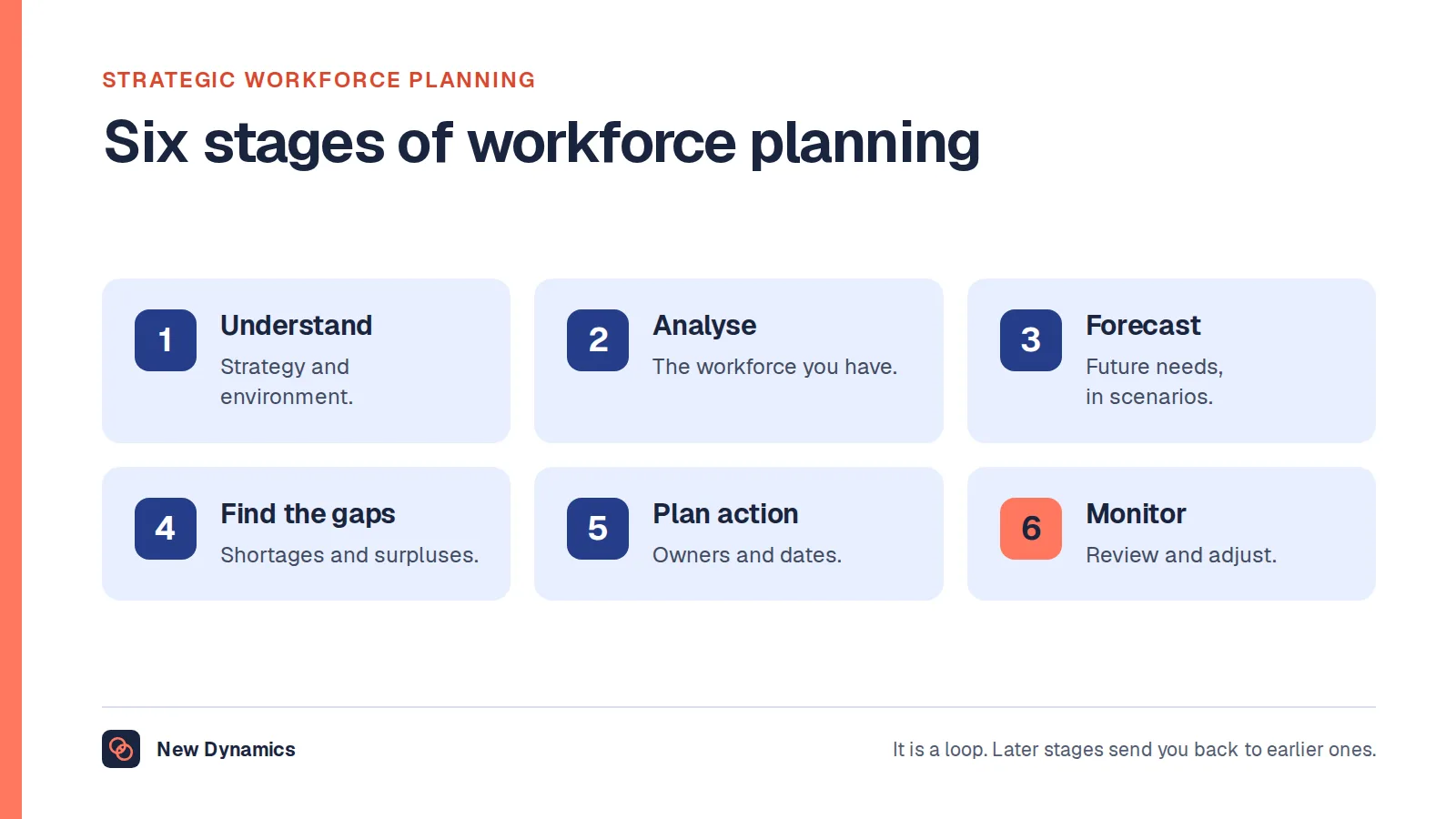
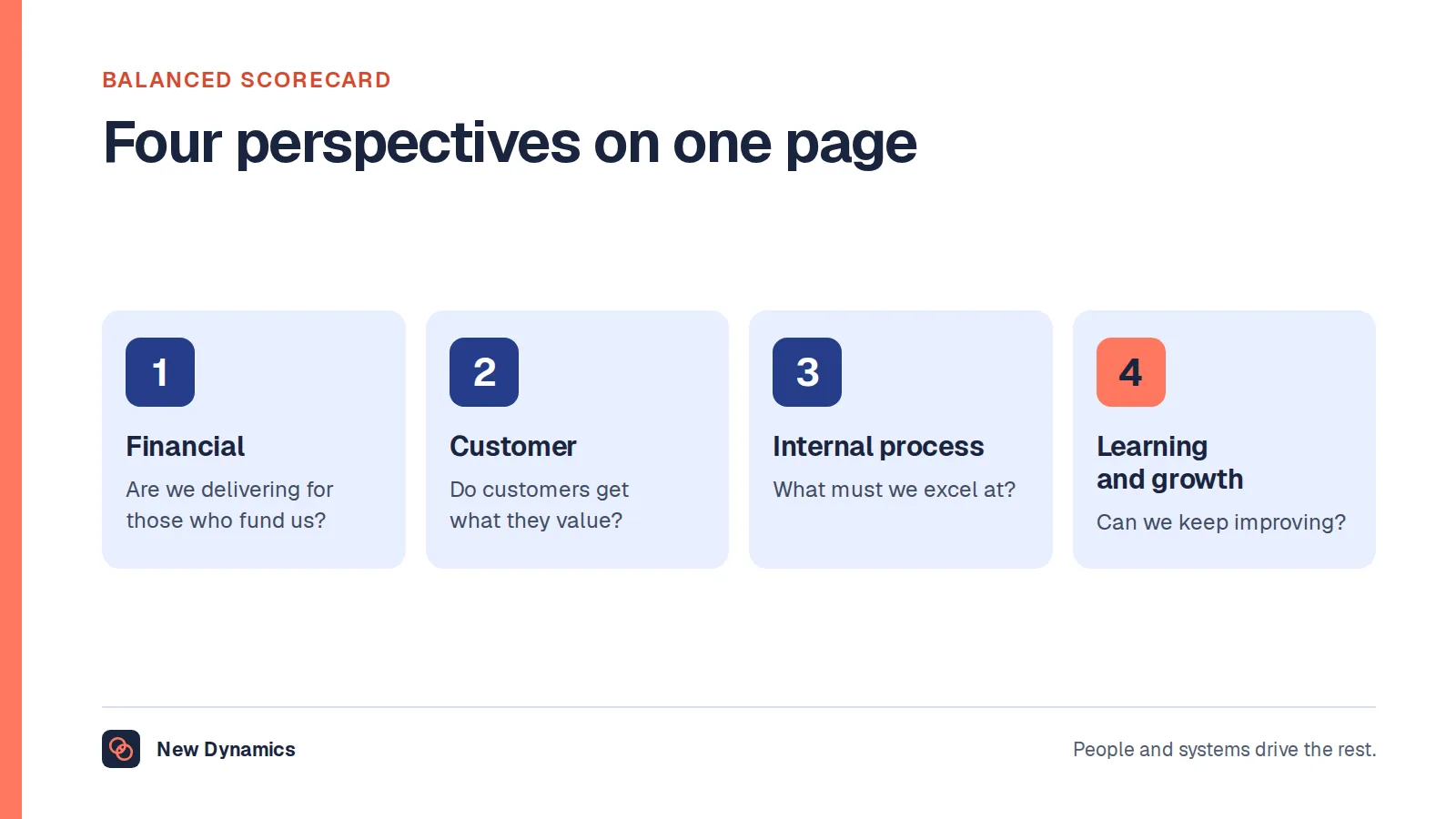
- Separate claims from evidence. "We invest in our people" is a claim. Completed appraisals, recorded objectives and a documented pay review are evidence. Our post on the balanced scorecard covers linking non-financial measures to strategy; strategic workforce planning covers the headcount forecast finance will want.
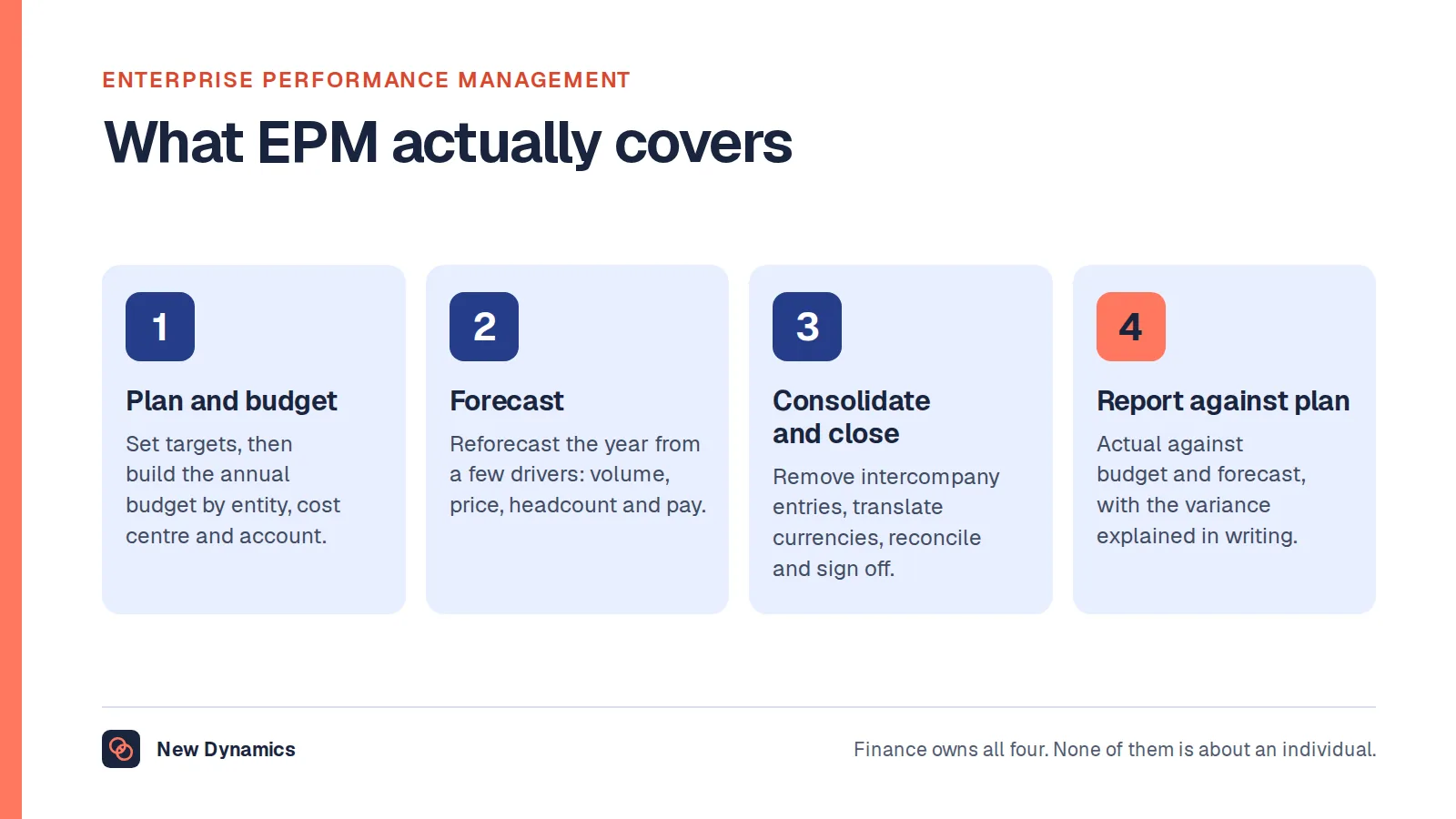
For the finance discipline that consolidates these figures, see enterprise performance management. None of this is legal, accounting or investment advice.
Frequently asked questions
What does MD&A mean?
MD&A stands for management's discussion and analysis. It is the narrative section of a company's financial report in which management explains the results, the risks and the outlook in its own words, alongside the audited figures rather than inside them. In the United States it is the name used in SEC filings; in the United Kingdom the equivalent section is the strategic report.
What is management discussion and analysis in simple terms?
It is the part of an annual report where the people who ran the company explain what the numbers mean. The accounts show revenue, profit, assets and cash. The discussion and analysis says why those figures moved, what cash the business needs, which trends could change the next results, and which accounting estimates carry the most judgement.
Is MD&A audited?
Not in the way the financial statements are, in either country. In the United Kingdom, section 496 of the Companies Act 2006 requires the auditor to state whether the strategic report and directors' report are consistent with the accounts, and whether material misstatements were identified. In the United States, the SEC sets the disclosure requirements and reviews filings, but its Investor Bulletin "How to Read a 10-K" states that the SEC "neither writes the 10-K nor vouches for its accuracy". General information, not accounting advice.
Does the United Kingdom have an MD&A requirement?
Not under that name. British company law requires a strategic report under section 414A of the Companies Act 2006, with contents set by section 414C and a section 172(1) statement under section 414CZA. Small companies are exempt and medium-sized ones have reduced duties. The purpose is close to the American one, but the wording and the scope differ, so the two are not interchangeable.
What does MDA mean in finance, and is it the same as MD&A?
Without the ampersand, MDA in finance almost always means the same thing: management's discussion and analysis. The abbreviation loses its ampersand in search boxes, file names and URLs. Outside financial reporting the same three letters cover unrelated ideas, so check the context. If the surrounding text is about an annual report, a 10-K or a strategic report, it means management's discussion and analysis.
Your next step
If you came here to read an annual report, use the five habits above and start with last year's version of the same section.
If workforce numbers are the part you own, the work is more ordinary than the regulation suggests.
- List the people measures that leave your team and reach a board paper or an investor.
- Write the definition and the boundary for each, including the measurement date.
- Check that the source system can reproduce last year's figure on request.
- Agree with finance who publishes which number, and when.
For the process that produces most of that evidence, read our guide to modern performance management. It is free to read, and the PDF uses our short download form.
To see a review cycle that produces a record you could stand behind in a report, book a New Dynamics demo and send us the appraisal form you use today. You can also email contact@new-dynamics.com.