TL;DR
- Regulation 18 of the Maternity and Parental Leave etc. Regulations 1999 splits the right to return. After ordinary maternity leave the employee returns to the job held before the absence. After additional maternity leave the employer may substitute another job only where returning to the original is not reasonably practicable, and that job must be both suitable and appropriate.
- Regulation 18A requires seniority and pension rights to be treated as if the employee had not been absent, and terms and conditions "not less favourable" than those that would have applied. GOV.UK confirms holiday keeps building through maternity leave and can be taken before or after it.
- Redundancy protection now outlives the leave. Regulation 10(1C), inserted by SI 2024/264 from 6 April 2024, ends the additional protected period the day after 18 months beginning with the first day of the expected week of childbirth, or with the day of childbirth where the employee has notified it. General information about the law in Great Britain, not legal advice.
An employer can run a maternity leave faultlessly and still get the ending wrong. The notice was confirmed, the pay went out for 39 weeks, cover held. Then someone restructures the team in month nine, the desk goes, and the return becomes a conversation about "a role at the same level" rather than the job the employee left.
This article sets out what an employee is entitled to on return, for the person arranging it. Every rule is quoted from the regulation, section or official page it comes from, and where the instrument and the GOV.UK summary diverge, both appear and the instrument is named as the one that governs. It is general information about Great Britain and not legal advice.
A return has fixed dates and a document trail that has to exist afterwards. See how New Dynamics workflows hold a process with deadlines, so the confirmation letter and the eight week notice are not sitting in one manager's inbox.
Ordinary and additional leave are two different rights to return
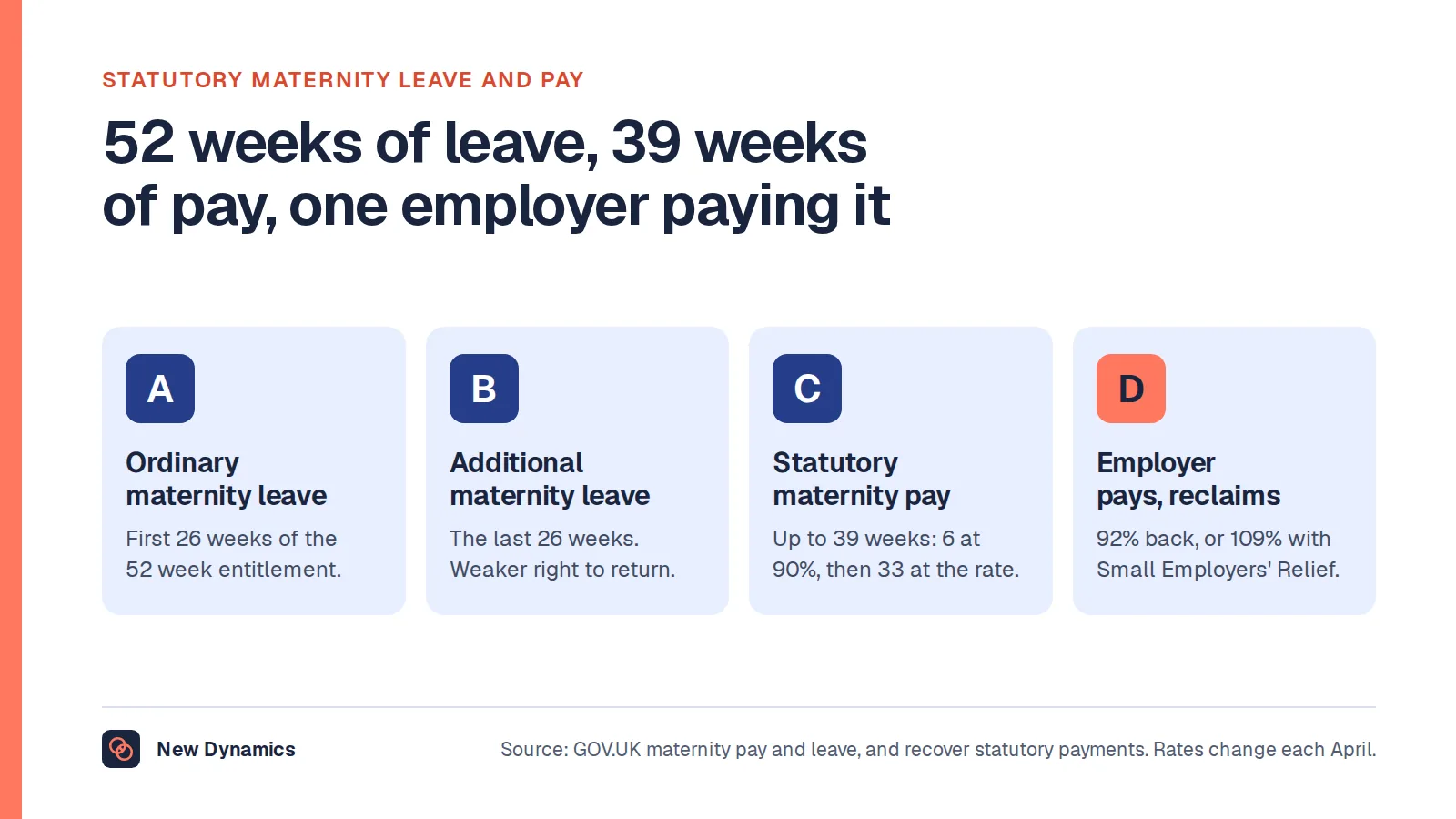
The 52 weeks are not one block. Section 71(1) of the Employment Rights Act 1996 lets an employee "be absent from work at any time during an ordinary maternity leave period", with section 71(3)(a) requiring regulations to secure "at least 26 weeks". Section 73(1) does the same for additional maternity leave. Both promise a return "to a job of a prescribed kind" and leave the prescribing to regulations. Section 72(3)(a) adds the part neither side can waive, that "no compulsory leave period is less than two weeks".
Regulation 18 of the Maternity and Parental Leave etc. Regulations 1999 does the prescribing, and its split is the thing to settle first. For the leave and pay framework underneath, see our post on maternity leave for employers.

Regulation 18: the same job, or a suitable and appropriate alternative
After ordinary maternity leave of 26 weeks or less, taken as an isolated period of leave, regulation 18(1) is unqualified. The employee "is entitled to return to the job in which she was employed before her absence." No practicability test appears in that paragraph.
After additional maternity leave, regulation 18(2) is different. The employee "is entitled to return from leave to the job in which she was employed before her absence or, if it is not reasonably practicable for the employer to permit her to return to that job, to another job which is both suitable for her and appropriate for her to do in the circumstances."
Read that in order, because employers read it backwards. The same job comes first. An alternative opens only once the original is not reasonably practicable, a test about the employer's position rather than its preference, and it has two limbs. A post at the same grade that nobody in that role would accept as a next step can satisfy "suitable" and fail "appropriate". Regulation 18(3) fixes the benchmark as the job held immediately before the leave began, so a reorganisation during the absence does not move it.
GOV.UK summarises the same split for readers without the instrument to hand: on extended leave the employee has "the right to return to their job or a similar job (if it's not possible to give them their old job)", and "Similar means the job has the same or better terms and conditions". A tribunal applies the words of regulation 18(2), so work from the regulation.
One sentence redirects all of it. Regulation 18(4): "This regulation does not apply where regulation 10 applies."
Terms, seniority and accrued holiday
Regulation 18A(1) sets what the return is worth: a right to return "with her seniority, pension rights and similar rights as they would have been if she had not been absent", and "on terms and conditions not less favourable than those which would have applied if she had not been absent."
That is counterfactual, not historical. The question is not what the terms were on the last day worked, it is what they would be now had the leave never happened. A pay award applied to the grade in March reaches the returner. GOV.UK agrees: employees "are entitled to any pay rises and improvements in terms and conditions given during the leave."
Holiday keeps accruing. GOV.UK states that employees "continue to build up holiday entitlement and can take any holiday they've accrued (built up) before or after the leave", and its holiday guidance says "The leave year and holiday entitlement is not affected by maternity, paternity or adoption leave". Statutory entitlement is 5.6 weeks a year, so a full year of leave accrues a full year of holiday. Settle how it will be taken before the return date, because an employee who has banked 28 days and comes back in November is a rota problem that needed solving in September.
Notice of an early return, and keeping in touch days
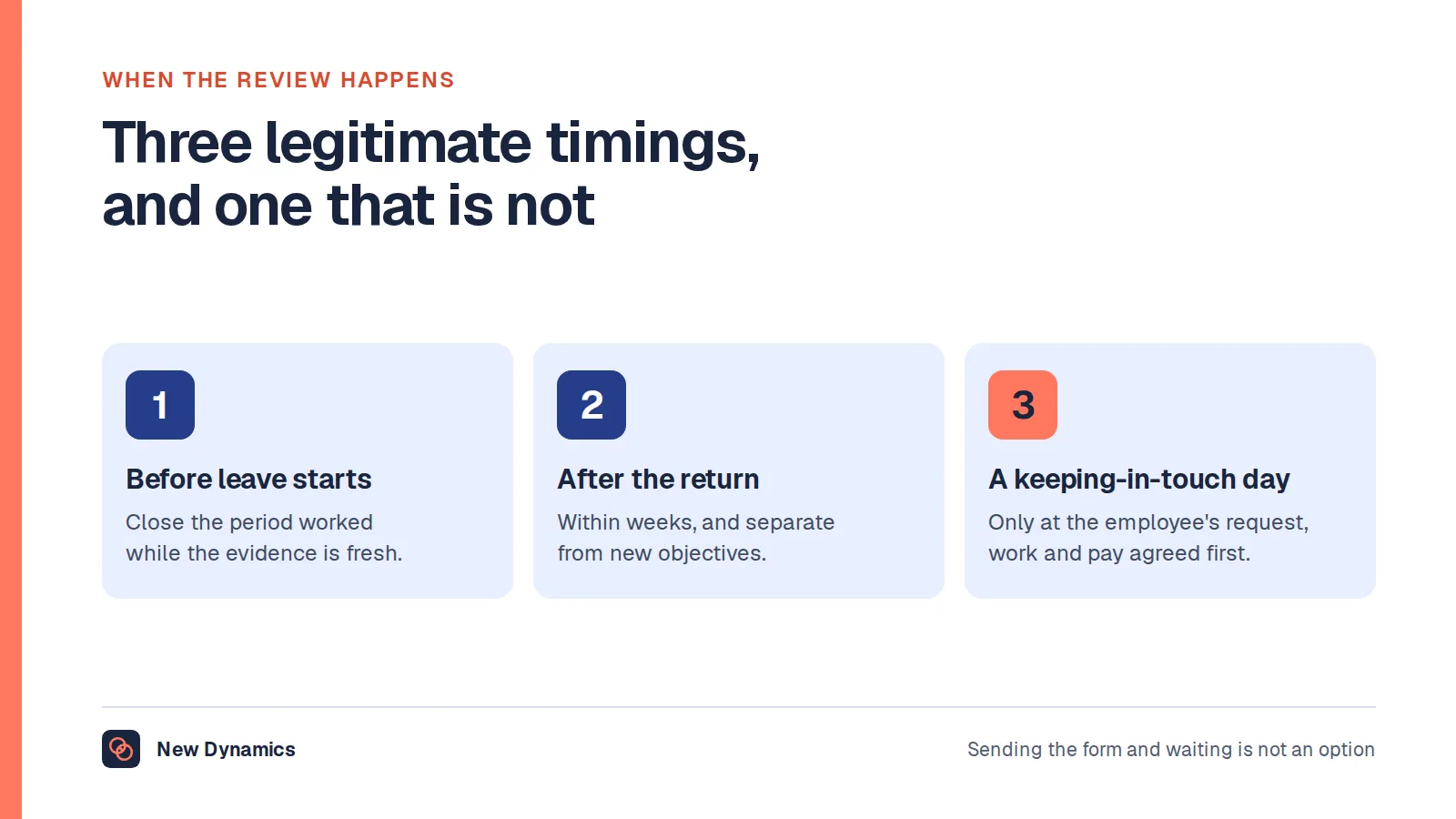
Leave normally runs to its notified end date. Coming back sooner is formal: regulation 11(1) requires "not less than 8 weeks' notice of the date on which she intends to return." Without it, regulation 11(2) gives the employer a remedy rather than a refusal, entitling it "to postpone her return to a date such as will secure" eight weeks' notice, capped by regulation 11(3) at the end of the leave period. GOV.UK gives the employee-facing version: "You must give your employer at least 8 weeks' notice if you want to change your return to work date." Regulation 11(5) then disapplies the whole regulation where the employer never notified the employee, under regulation 7(6) and (7), of the date additional maternity leave would end. No written confirmation, no right to insist on eight weeks.
Regulation 12A(1) allows "up to 10 days' work for her employer during her statutory maternity leave period without bringing her maternity leave to an end", and regulation 12A(7) confirms the days do not extend the leave. The paragraph that settles arguments is regulation 12A(6): the regulation "does not confer any right on an employer to require that any work be carried out during the statutory maternity leave period, nor any right on an employee to work during the statutory maternity leave period." GOV.UK says it in a line: "Keeping in touch days are optional - both the employee and employer need to agree to them", adding that the work and pay "should be agreed before they come into work." Ordinary contact is not work at all. Regulation 12A(4) provides that "Reasonable contact from time to time" between the parties, "for example to discuss an employee's return to work", does not end the leave.

Redundancy, and the protection that outlives the leave
This is the part most handbooks still describe as it was before April 2024.
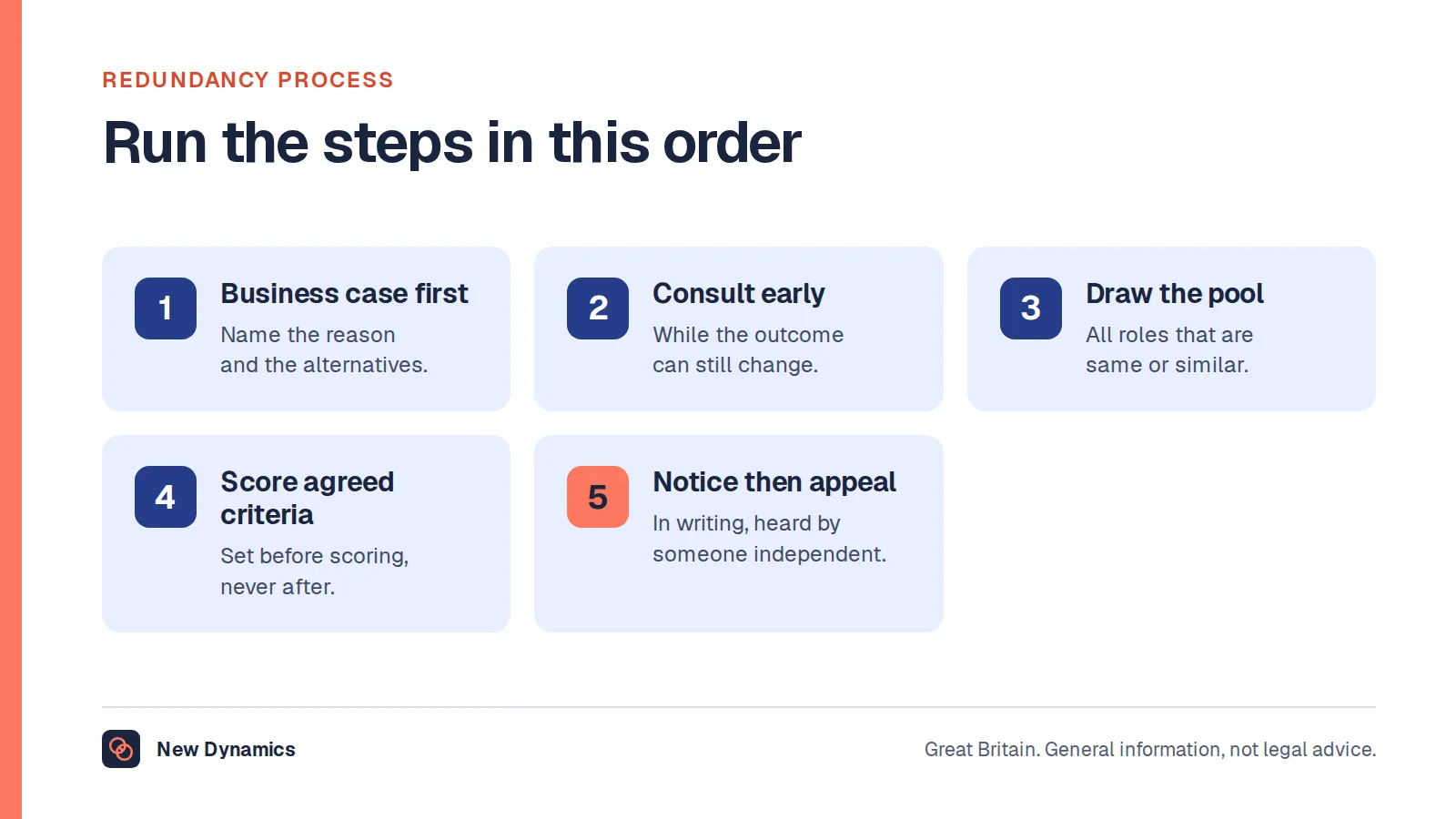
Regulation 10 applies where redundancy makes it impracticable to keep employing the person under her existing contract during "the protected period of pregnancy", "the statutory maternity leave period", or "the additional protected period". Inside any of them, regulation 10(2) creates an offer duty rather than a selection standard: "Where there is a suitable available vacancy, the employee is entitled to be offered (before the end of her employment under her existing contract) alternative employment". Under regulation 10(3) the work must be "of a kind which is both suitable in relation to the employee and appropriate for her to do in the circumstances", and the capacity, place and other terms "not substantially less favourable to her than if she had continued to be employed under the previous contract."
The third period is the new one, inserted by the Maternity Leave, Adoption Leave and Shared Parental Leave (Amendment) Regulations 2024, SI 2024/264, regulation 4(b), in force on 6 April 2024. Regulation 10(1B) starts it "with the day after the last day of the employee's statutory maternity leave period" and continues it "during any period of continuous employment that includes" that period. Regulation 10(1C) ends it, and words the length twice:
- Where regulation 10(1D) does not apply, the relevant day "is the day after a period of 18 months beginning with the first day of the expected week of childbirth".
- Where it applies, the relevant day "is the day after a period of 18 months beginning with the day that childbirth occurred".
Regulation 10(1D) applies only where the employer "has been notified by the employee of the day that childbirth occurred", before the end of the leave period or as soon as reasonably practicable afterwards, and regulation 10(1E) lets the employer require that in writing.
This is where the official sources diverge. GOV.UK says the right "lasts up until 18 months from the date the child is born or adopted" and that "It continues when the employee returns to work", with the worked example of a return at 12 months leaving a further 6 months. The regulation's default is not the birth date. It is the first day of the expected week of childbirth, with the actual date substituted only where the employee notified it, so a late birth produces two different end dates. The instrument governs: calculate from regulation 10(1C) and record whether you were notified. Note also the instrument's own limit, at regulation 3(1), that the regulation 4 amendments "have effect where the employee's statutory maternity leave period ends on or after 6th April 2024". For the exercise this sits inside, see our post on the redundancy process.
Flexible working, and how it meets the return
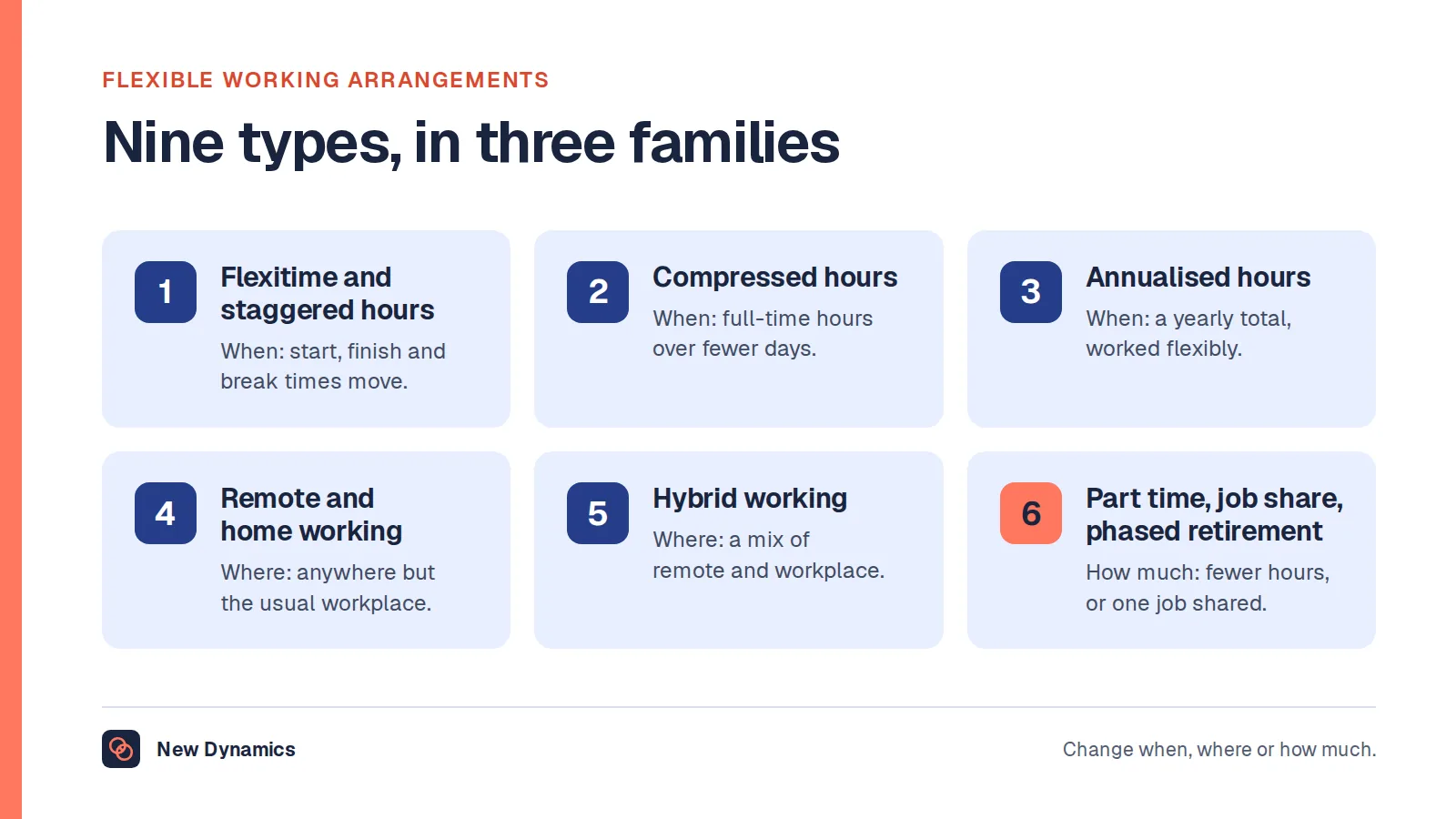
Most returns change hours or days, and that change has its own route. GOV.UK states that "All employees have the legal right to request flexible working" from their first day. Employers "must deal with requests in a 'reasonable manner'", may refuse only for a business reason, and "must discuss the employee's request with them before refusing their application". The decision comes "within 2 months - or longer if agreed with the employee", and an employee may make "2 applications for flexible working in any 12-month period".
Two months is the number that trips up a return: a request made in the last fortnight of leave can legitimately still be open on the first morning back. Invite it in the pre-return conversation. Keep the processes separate on paper too, because the right to return is a right to a job on particular terms while a flexible working application is a request to vary the contract, and granting the second does not discharge the first. See our posts on flexible working arrangements and the phased return to work.
Rest and breastfeeding facilities: what the law actually requires
Be careful here, because much HR material overstates it. There is no general statutory right to paid breastfeeding breaks in Great Britain. An employer offering them is offering a policy benefit, not meeting a legal minimum, and it is better to say so than imply a right that does not exist.
What the law requires is facilities. Regulation 25(4) of the Workplace (Health, Safety and Welfare) Regulations 1992 provides that "Suitable facilities shall be provided for any person at work who is a pregnant woman or nursing mother to rest", on top of the general duty in regulation 25(1) to provide "suitable and sufficient rest facilities" at readily accessible places.
The Health and Safety Executive makes that actionable. HSE tells employers "You must provide a suitable area where pregnant workers and breastfeeding mothers can rest", which should "include somewhere to lie down if necessary", "be hygienic and private so they can express milk if they choose to", with the warning that "toilets are not a suitable place for this", and "include somewhere to store their milk, for example a fridge". HSE also keeps the risk assessment running past the return, covering workers who "have given birth in the last 6 months" or "are currently breastfeeding", for as long as they wish to continue breastfeeding.
Detriment and automatically unfair dismissal
Regulation 19(1) entitles an employee "under section 47C of the 1996 Act not to be subjected to any detriment by any act, or any deliberate failure to act, by her employer" for the reasons in paragraph (2). Those include having "took, sought to take or availed herself of the benefits of, ordinary maternity leave or additional maternity leave", and, at regulation 19(2)(eee), having "undertook, considered undertaking or refused to undertake work in accordance with regulation 12A", so declining a keeping in touch day is itself protected. A detriment need not be a dismissal or a pay cut: losing an account, being left off a distribution list, or a rating applied to a year spent absent can each qualify. Our post on reviewing an employee on maternity leave covers the rating problem.
On dismissal, section 99(1) of the 1996 Act deems a dismissal unfair where the reason or principal reason "is of a prescribed kind", with section 99(3) naming "pregnancy, childbirth or maternity" and "ordinary, compulsory or additional maternity leave". Regulation 20 prescribes, and regulation 20(1)(b) is the one to read twice: a dismissal is automatically unfair where "the reason or principal reason for the dismissal is that the employee is redundant, and regulation 10 has not been complied with." Failing to offer the suitable available vacancy does not merely weaken a redundancy defence, it converts the dismissal into an automatically unfair one. There is no service threshold: section 108(1) imposes the ordinary two year qualifying period, and section 108(3)(b) disapplies it where section 99 applies.
What the Employment Rights Act 2025 changes, and what it does not
Three provisions touch this subject, and each is in force as a power rather than an entitlement.
Section 26 lets the Secretary of State "by regulations, make provision about dismissal (other than by reason of redundancy) during, or after, a protected period of pregnancy", and is "in force at 6.1.2026 by S.I. 2026/3, reg. 2(11)". Section 27 inserts ", or after," into section 74(2) of the 1996 Act so regulations may cover dismissal after a maternity leave period as well as during it, with subsections (2) to (5) in force on 6 January 2026 by SI 2026/3, reg. 2(12)(b) and subsections (1) and (6) on 6 April 2026 by SI 2026/323. Both are enabling only. The substantive protection still comes from regulations 10, 18, 19 and 20 as quoted above, whose latest amendments remain SI 2024/264 for regulation 10 and SI 2025/375 for regulation 20, so nothing in your return process changes yet.
Section 9 will change the return conversation when it lands. It rewrites section 80G(1)(b) so an employer "may refuse the application only if" a listed ground applies and "it is reasonable for the employer to refuse the application on that ground or those grounds", with a new section 80G(1ZB) requiring the refusal notice to explain why refusal is reasonable. That test is not yet in force for employers. Section 9 is "in force at 6.1.2026 for specified purposes by S.I. 2026/3, reg. 2(6)", and reg. 2(6) specifies it only "for the purposes of making regulations under Chapter 1 of Part 8A of the 1996 Act". Until a further commencement regulation is made, a request today needs only a listed business ground, consultation and a decision inside the decision period.
Everything above describes Great Britain. Northern Ireland has its own employment legislation and guidance, and GOV.UK notes that flexible working rules differ there.
Frequently asked questions
Does an employee have the right to return to the same job after maternity leave?
After ordinary maternity leave of 26 weeks or less, taken as an isolated period of leave, yes. Regulation 18(1) of the Maternity and Parental Leave etc. Regulations 1999 entitles the employee to return to the job in which she was employed before her absence, with no reasonable practicability qualification. After additional maternity leave, regulation 18(2) allows another job only where returning to the original is not reasonably practicable, and that job must be both suitable for her and appropriate for her to do in the circumstances.
What terms and conditions apply on return from maternity leave?
Regulation 18A(1) requires the return to be with seniority, pension rights and similar rights as they would have been had the employee not been absent, and on terms and conditions not less favourable than those which would have applied. GOV.UK puts the practical effect as an entitlement to any pay rises and improvements in terms and conditions given during the leave. The test is what the terms would be now, not what they were on the last day worked.
How much notice must an employee give to come back early?
Not less than eight weeks' notice of the intended return date, under regulation 11(1). Without it, regulation 11(2) lets the employer postpone the return so as to secure eight weeks' notice, though regulation 11(3) stops that running past the end of the leave period. Regulation 11(5) removes the employer's ability to insist where it never notified the employee of the date additional maternity leave would end.
How long does redundancy protection last after maternity leave?
Past the return. Regulation 10(1C), inserted by SI 2024/264 with effect from 6 April 2024, ends the additional protected period the day after 18 months beginning with the first day of the expected week of childbirth, or the day after 18 months beginning with the day childbirth occurred where the employee notified that day under regulation 10(1D). GOV.UK summarises it as 18 months from the date the child is born, but the instrument is the operative text.
Are keeping in touch days compulsory?
No, in either direction. Regulation 12A(6) states that the regulation confers no right on an employer to require work during the statutory maternity leave period and no right on an employee to work during it. GOV.UK says keeping in touch days are optional and that both employee and employer need to agree to them. Up to 10 days are available, the work and pay should be agreed before the employee comes in, and declining a day is protected under regulation 19(2)(eee).
Is there a right to paid breastfeeding breaks?
There is no general statutory right to paid breastfeeding breaks in Great Britain. What the law requires is facilities. Regulation 25(4) of the Workplace (Health, Safety and Welfare) Regulations 1992 requires suitable facilities for a pregnant woman or nursing mother at work to rest, and HSE guidance says employers must provide a suitable area to rest, private and hygienic enough to express milk, with somewhere to store it, adding that toilets are not a suitable place. Paid breaks beyond that are a policy choice.
Your next step: make the return a dated process
- Write the return as dated steps: the written confirmation of the end date under regulation 7(6) and (7), the eight week notice window, the pre-return conversation, the flexible working invitation, the accrued holiday decision and the first day.
- Record which job the employee is returning to and under which paragraph of regulation 18. If you are relying on regulation 18(2), write down why the original job was not reasonably practicable.
- Recalculate your protection dates from regulation 10(1C), and note whether the employee notified you of the actual date of childbirth. Any policy ending the protection with the leave is out of date.
- Check that the terms you are restoring reflect every change made to the grade during the absence.
- Confirm a private, hygienic rest area exists, and that it is not a toilet.
For the policy wording that holds a return together, read our employee handbook guide, and for the redundancy side, our redundancy and workforce change guide.
Want the end date confirmation, the eight week notice, the flexible working clock and the return conversation on one tracked path, with the regulation 18 decision recorded rather than remembered? Book a New Dynamics demo and bring your current return process. You can also email contact@new-dynamics.com.