TL;DR
- Redundancy is narrower than most people think. GOV.UK puts it as dismissing an employee because you no longer need anyone to do their job. A reorganisation where the same work carries on under a new title is not automatically redundancy.
- The order matters: business case, consultation, pool, criteria, individual meetings, notice, appeal. Collective consultation rules apply at 20 or more redundancies in any 90 day period at one establishment, with minimum periods of 30 days, or 45 days at 100 or more.
- Acas says selection criteria should be as objective and measurable as possible and not be affected by personal opinions. If you intend to score performance, the ratings have to exist already, in writing, applied the same way to everyone in the pool.
Most redundancy processes that go wrong do not go wrong at the end. They go wrong in the first week, when somebody decides who is leaving and then works backwards to a process that produces that answer. By the time a tribunal reads the paperwork, the order of events is visible, and the order is much of what makes a dismissal fair or unfair.
This article sets out the redundancy process in the order an employer should actually run it, with the rules quoted from GOV.UK and Acas as they are worded. It is written for employers, HR teams and managers in Great Britain. It is general information rather than legal advice, and you should take advice on your own facts before you start.
One part of the process depends on records you cannot create retrospectively. If selection will draw on performance, see how New Dynamics performance reviews keep dated, consistent evidence from the whole year in one place.
For the legal meaning of the word itself, our post on the definition of redundancy sets out the three statutory situations in detail.
What legally counts as redundancy
GOV.UK states the test in one line: "Redundancy is when you dismiss an employee because you no longer need anyone to do their job". The emphasis belongs on "anyone". The question is whether the organisation still needs a person to do that work, not whether it still needs that particular person.
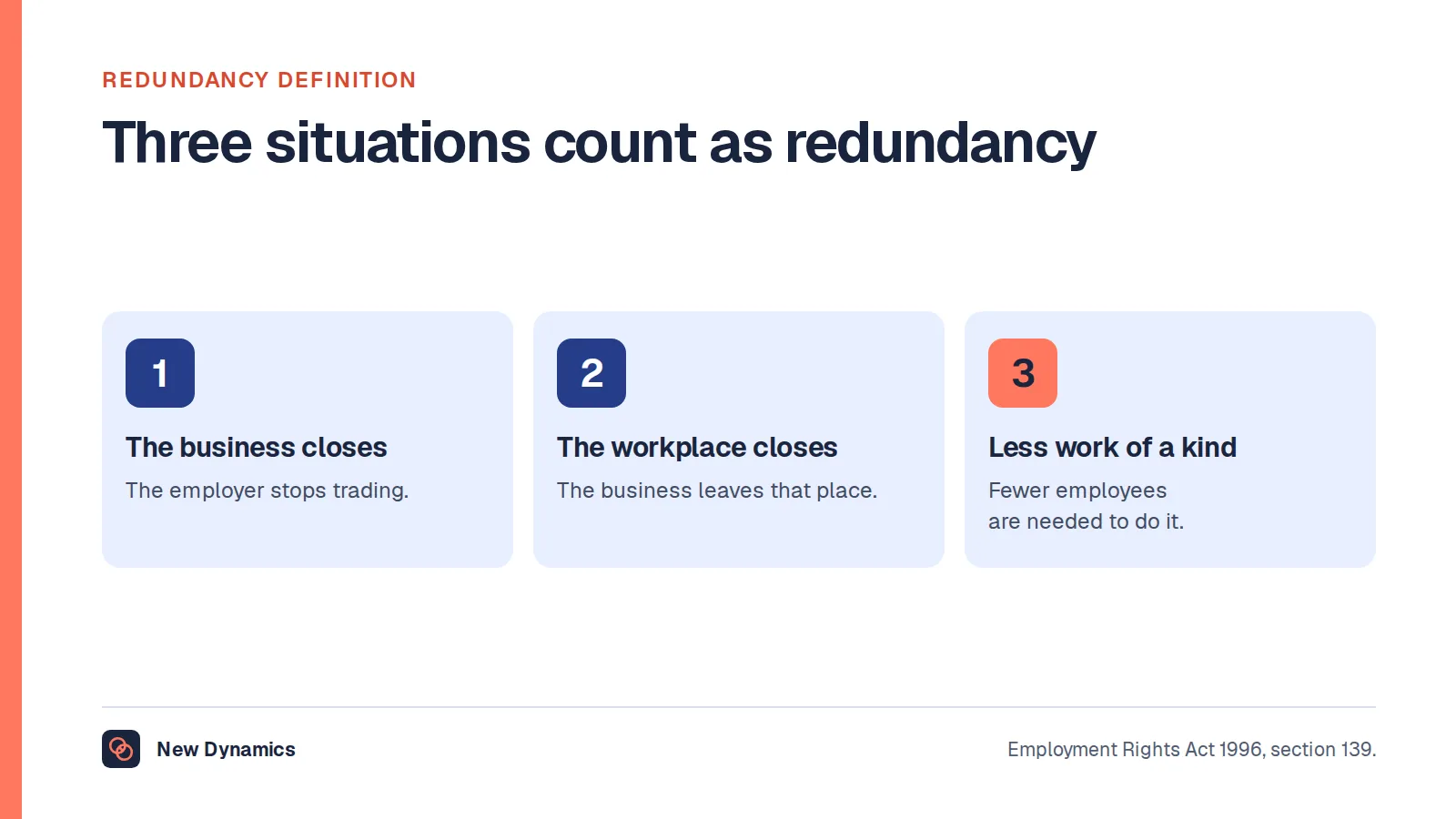
In law there are three situations:
- The business closes.
- The workplace closes.
- The requirement for employees to carry out work of a particular kind has ceased or diminished, or is expected to.
The third is where most disputes live, and where employers most often overreach. A reorganisation is not automatically a redundancy. If you delete a job title, write a new one with broadly the same duties and then dismiss the person who held the old title, the work has not ceased or diminished. You have reorganised, and the dismissal needs a different and properly run justification. Equally, if the real problem is one person's conduct or capability, redundancy is the wrong process, and using it anyway is the single most expensive shortcut in this subject.
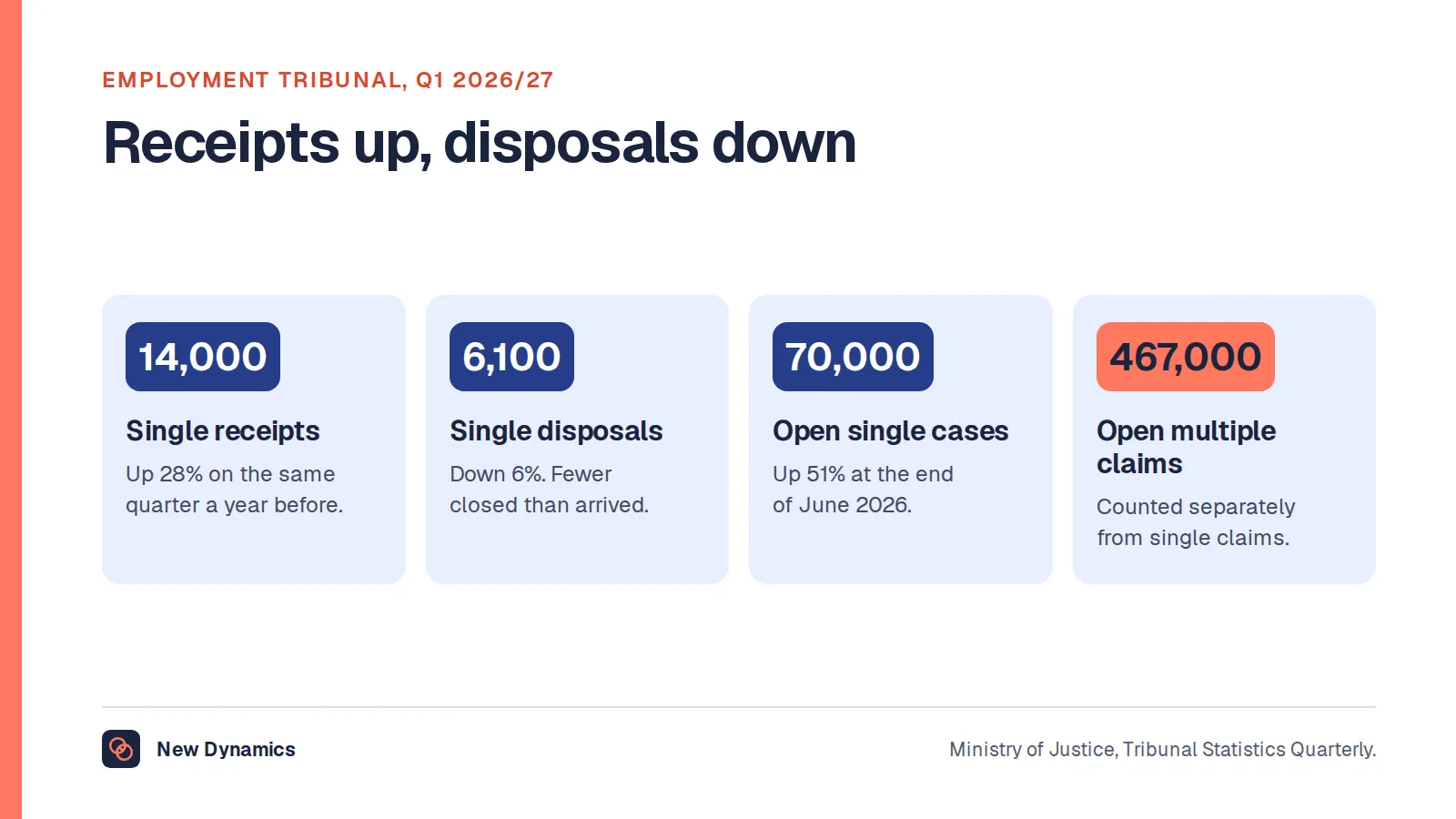
Redundancy levels in the UK are not unusual by historic standards. Our post on employee relations statistics cites the Office for National Statistics Labour Force Survey redundancy rate at 3.8 per 1,000 employees for June to August 2026. What has changed sharply is the volume of claims, which is a reason to get the process right rather than fast.
The redundancy process in order
Acas sets out managing a redundancy process in ten stages, beginning with checking that redundancy is needed and following the right process. Condensed into the sequence an employer runs, it looks like this.

1. Plan the change and write the business case
Before anyone is told anything, write down two things: which of the three situations applies, in one sentence, and what alternatives you have considered. Acas expects employers to explore alternatives first, such as flexible working, redeployment and reducing the use of temporary staff, before cutting permanent roles. Record the alternatives you rejected and why. This is the document that answers the first question any adviser or judge will ask, which is whether there was a genuine redundancy situation at all.
Decide at this stage how many roles are affected, which establishment they sit in and over what period the dismissals would take effect. Those three facts determine whether collective consultation rules apply, and you cannot work that out later without unpicking your own timetable.
2. Tell employees and start consultation
Consultation is not an announcement. GOV.UK is explicit that "Consultation does not have to end in agreement, but it must be carried out with a view to reaching it". That only works while the outcome can still change, which means consultation starts before the decision is made, not after.
Tell affected employees in writing that their roles are at risk, explain the reason, and say what the process and timetable will be. Where collective rules apply you consult with trade union representatives or elected employee representatives, and GOV.UK says this is with staff directly if there are none.
3. Draw the selection pool
The pool is the group of employees from whom the redundancies will be selected. Acas guidance on selecting employees says "You should include in each pool all roles that are the same or similar", and suggests also considering roles with comparable skill sets in other departments.
A pool drawn too narrowly is one of the commonest grounds of challenge, because a pool of one makes selection a formality. Write down how you defined the pool and why that boundary is the honest one. Our post on pooling at work covers the same ground from the employee's side, which is a useful test of whether your explanation stands up.
4. Set and apply selection criteria
This is covered in detail in the next section. In sequence, the point is that criteria are set and shared before anyone is scored, not chosen after the scores are known.
5. Hold individual consultation meetings
Each person at risk gets their own meetings: at least one to explain their provisional score or position and hear their response, and normally a further one to confirm the outcome. Give them the information they need to challenge the decision, including their own scores and how each was reached. Take notes, send them, and record what you did about anything they raised. A consultation where nothing an employee said made any difference to anything looks, in retrospect, like a process run for show.
6. Give notice and confirm in writing
Once selection is complete, give notice in writing, stating the reason, the last day of employment, the notice arrangements, the redundancy payment and how it was calculated, and the right to appeal.
7. Offer an appeal
Acas calls this good practice rather than a legal duty: "It's good practice to offer employees the chance to appeal if they feel they were selected unfairly for redundancy or believe this process was not followed properly". It recommends that a senior manager who was not involved in the decision leads the appeal meeting, that the employee may be accompanied by a colleague or union representative, that a reasonable timescale for appealing might be five days, and that the outcome is confirmed in writing. An appeal is also the cheapest opportunity you will ever get to fix a mistake.
Collective consultation: the thresholds and the timescales
GOV.UK sets the trigger precisely: "You must follow 'collective consultation' rules if you're making 20 or more employees redundant within any 90-day period at a single establishment".

The minimum periods before the first dismissal takes effect are 30 days for 20 to 99 redundancies and 45 days for 100 or more. The same deadlines apply to notifying the Redundancy Payments Service on form HR1, which GOV.UK requires 30 days before the first dismissal for 20 to 99 redundancies and 45 days for 100 or more. These are minimums, not targets, and they run before dismissal, not before the announcement.
Collective consultation also has a content requirement. GOV.UK says the written information you provide must cover the reasons for the redundancies, the numbers and categories of employees involved, how you will select people, how you will carry out the dismissals and how you will work out redundancy payments.
Below the threshold, GOV.UK is candid: "There are no set rules to follow if there are fewer than 20 redundancies planned, but it's good practice to fully consult employees and their representatives". No set rules is not the same as no obligation. Individual consultation is still part of a fair dismissal, so a small redundancy exercise with no consultation at all is exposed even though no collective timetable applies.
Selection criteria that hold up
The Acas wording here is the sentence to put at the top of your scoring sheet: "Criteria should be as objective and measurable as possible. This means they should be fair, be based on facts that can be measured and not be affected by personal opinions".
Acas gives examples of criteria employers use, including standard of work or performance, skills, qualifications or expertise, attendance record and disciplinary record.
Which of those are risky, plainly:
- Attendance records need careful handling. Absence that is disability related, or pregnancy and maternity related, must be discounted, or the criterion becomes discriminatory.
- Flexible working is not a criterion. Acas warns that if you use flexible working as one of the criteria, this could be sex discrimination.
- Last in, first out used alone tends to select the youngest employees, which is age discrimination risk for a criterion that measures nothing about the work.
- Attitude, commitment, flexibility and potential are the four words that most often mean "the manager's view". They are not measurable facts and they fail the Acas test on their face.
- Disciplinary records should be limited to live, formally recorded warnings, not to recollections of past friction.
Performance deserves its own warning. A performance rating is a legitimate criterion, and Acas guidance includes worked scoring examples for standard of work. But it only works as evidence if the ratings already existed before the redundancy was contemplated, were produced under the same process for everyone in the pool, and can be shown to the employee in the form they were written. Ratings created or revised during a redundancy exercise are not evidence of performance. They are evidence of the outcome you wanted.
Two practical safeguards. Have at least two people score independently and reconcile differences in writing. And sense check the result against protected characteristics before you confirm anything: if a pool that is half women produces an all female selection, you need to know why before the letters go out, not afterwards.
Redundancy pay: service, age bands and the cap
GOV.UK sets the qualifying service first: "You'll normally be entitled to statutory redundancy pay if you're an employee and you've been working for your current employer for 2 years or more".
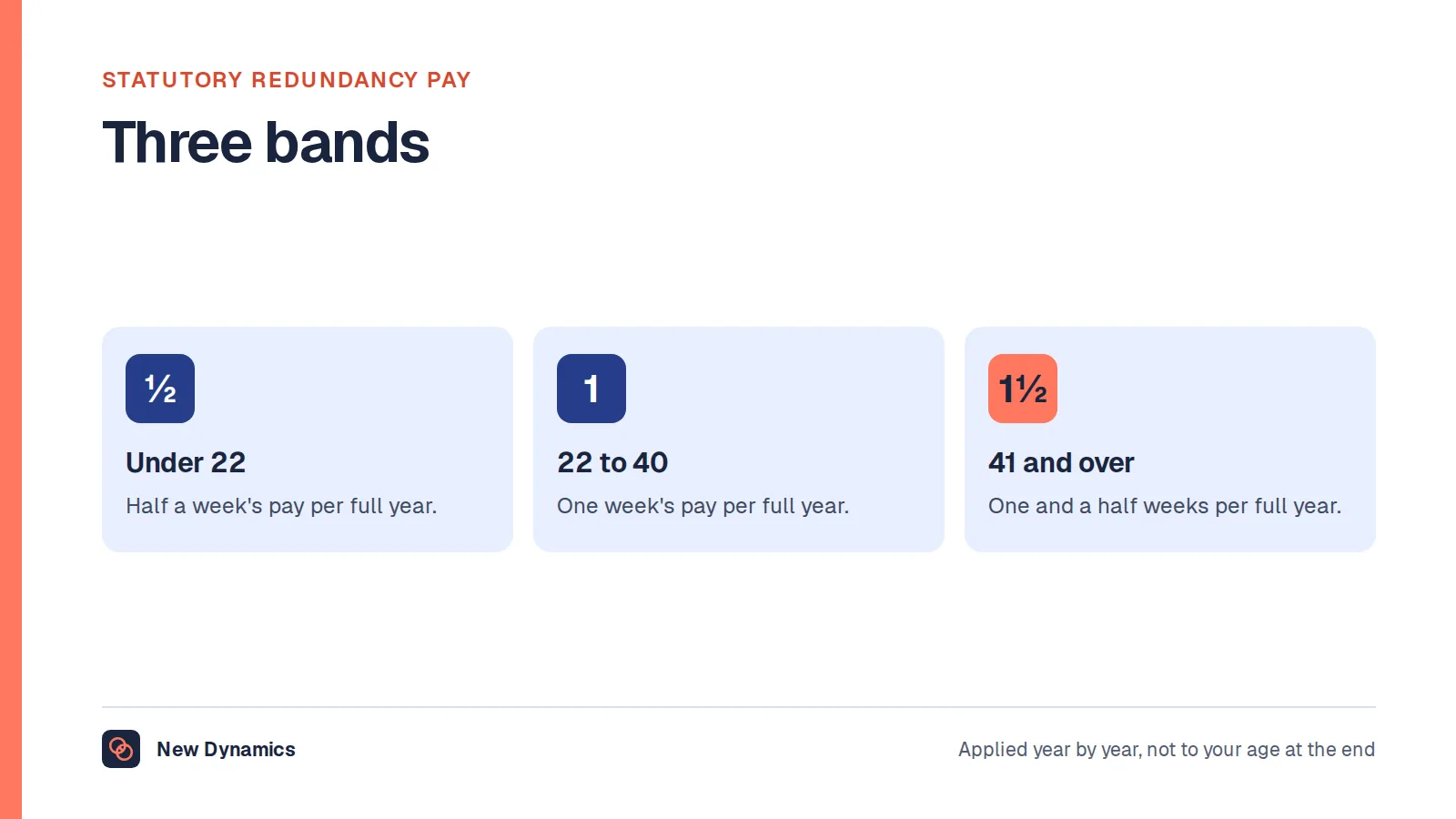
The amount is built from three age bands:
- half a week's pay for each full year the employee was under 22;
- one week's pay for each full year they were 22 or older, but under 41;
- one and a half week's pay for each full year they were 41 or older.

Length of service is capped at 20 years. A week's pay is capped too, and GOV.UK gives the current figures: "If you were made redundant on or after 6 April 2026, your weekly pay is capped at £751 and the maximum statutory redundancy pay you can get is £22,530". Those are the 2026 to 2027 tax year figures. The caps are reviewed each April, so check GOV.UK and use the official calculator rather than a figure saved in a spreadsheet last year.
An employer can pay more than the statutory minimum, under a contractual or discretionary enhanced scheme, and many do. An employer cannot pay less. If you run an enhanced scheme, apply it consistently, because an enhancement given to some people in a pool and not others needs an explanation of its own. For the arithmetic and the two details that change the total, see our post on severance pay.
Notice, alternative employment and time off
Notice. The statutory minimums on GOV.UK are at least one week's notice if employed between one month and two years, one week's notice for each year if employed between two and twelve years, and twelve weeks' notice if employed for twelve years or more. GOV.UK adds the point employers sometimes forget: "Your employer may give you more than the statutory minimum, but they cannot give you less". Notice pay is based on the average earned per week over the twelve weeks before the notice period starts, and the employer either pays through the notice period or pays in lieu.
Suitable alternative employment. GOV.UK says employers "must try to find suitable alternative employment within the organisation". That means telling people at risk about vacancies as they arise, across the organisation, and not leaving them to find the careers page themselves. Whether a role is suitable turns on the pay, status, hours, location and the employee's skills and circumstances.
The trial period. GOV.UK is specific: employees "can try out an alternative role for 4 weeks (or more if agreed in writing) without giving up their right to redundancy pay". Put the start and end dates of the trial in writing, along with what happens at the end of it. A trial that quietly turns into a permanent appointment nobody confirmed is a dispute waiting to happen.
Time off. GOV.UK states that all employees under notice of redundancy have the right to "reasonable time off to look for a new job or arrange training". Treat requests generously and record them. Refusing time off to someone you have just made redundant costs you goodwill from everyone who stays, for no saving at all.
Employees who are pregnant or who have recently returned from maternity, adoption or shared parental leave have additional protection in a redundancy situation, including priority for suitable alternative vacancies. Acas covers this in its guidance on redundancy protection for pregnancy and new parents, and it is a point to check early rather than at the letter stage.
Voluntary redundancy and compulsory redundancy
Compulsory redundancy is the process above: the employer defines the pool, applies criteria and selects.
Voluntary redundancy asks for volunteers first, usually with an enhanced payment and a closing date. The difference is who raises their hand, not whether the rules apply. Three things are commonly misunderstood.
First, the employer decides. Acas puts it directly: "It's your decision whether or not to accept the volunteers, taking into account the wider needs of the organisation". Say so in the invitation, so nobody volunteers believing acceptance is automatic.
Second, it is still a dismissal. Volunteering for redundancy is not resignation, statutory redundancy pay rights are unaffected, and the dismissal still has to be for a genuine redundancy reason.
Third, the risk is adverse selection. The people most likely to volunteer are the people with the best options elsewhere, which is often exactly the capability you were trying to keep. Decide in advance which roles or skills are excluded from the voluntary scheme, write that down, and be ready to explain it. Acas also warns against pressure: you should not pressure or single anyone out when offering voluntary redundancy, because a volunteer who was pushed is not a volunteer.
If volunteers do not produce the reduction you need, you move to compulsory selection with the pool and criteria you set out at the start. Do not change the criteria to catch the people who stayed.
Protected conversations and settlement agreements
A settlement agreement ends a dispute or an employment relationship on agreed terms, with the employee giving up the right to bring specified claims. Acas describes it as "a document that sets out the terms and conditions for settling an employment dispute", and sets out conditions for it to be valid. It must be in writing, must relate to a specific complaint or claim, the employee must have had advice from a relevant independent adviser, that adviser must be insured, and the agreement must name the adviser.
"Protected conversation" is the everyday name for a pre-termination negotiation. Acas publishes a statutory Code of Practice on settlement agreements under section 111A of the Employment Rights Act 1996, which is the provision that can make such discussions inadmissible in certain later claims. The protection is narrower than the nickname suggests: it does not cover every kind of claim, and it can be lost where there has been improper behaviour.
Two practical points for a redundancy. A settlement conversation is not a substitute for consultation, and offering one early can look like a decision already taken. And because the scope of the protection depends on the claim and the conduct, this is the part of the process where you take legal advice on the specific case rather than relying on a template.
The HR process: keep the evidence trail
A tribunal does not watch your redundancy happen. It reads what you wrote down, and it reads it in order. That is why the evidence trail is not administration left over from the process. It is the process, in the only form anyone else will ever see.
Five records carry most of the weight:
- The business case, dated before the announcement, naming which redundancy situation applies and which alternatives you rejected.
- The pool definition, with the reason for its boundary.
- The criteria and the scores, issued before scoring, scored by more than one person, with the source of each score identified.
- The consultation record: meeting invitations, notes, the points employees raised and what you did about each one.
- The outcome letters and the appeal, including who heard the appeal and why they were independent of the decision.
The part that cannot be assembled at the end is the performance evidence. Ratings and feedback are only credible when they were recorded over time, under a process everyone in the pool went through, on the same scale. That is what dated review records and a consistent review cycle give you, and why the time to fix your evidence trail is in a year when you are not making anyone redundant.
Acas covers England, Wales and Scotland, and the GOV.UK pages quoted here apply to Great Britain. Northern Ireland has its own redundancy legislation and its own figures and procedures, so check the Northern Ireland guidance if you employ people there. Nothing in this article is legal advice.
Frequently asked questions
What is the redundancy process in the UK?
In order: establish and document a genuine redundancy situation, consider alternatives, inform and consult affected employees, define the selection pool, set objective selection criteria, score and hold individual consultation meetings, confirm notice and redundancy pay in writing, and offer an appeal. Collective consultation rules add fixed minimum periods once 20 or more redundancies are proposed.
How long does a redundancy process take?
It depends on the numbers. Below 20 redundancies there is no statutory minimum period, but a fair individual process realistically needs several weeks. At 20 to 99 redundancies, consultation must begin at least 30 days before the first dismissal takes effect. At 100 or more it is at least 45 days. Those are minimums, and a complex pool or an appeal will take longer.
How does voluntary redundancy work?
The employer invites volunteers, usually with an enhanced payment and a deadline. Acas is clear that it is the employer's decision whether to accept volunteers, taking into account the wider needs of the organisation. Volunteering is a dismissal rather than a resignation, so statutory redundancy pay rights still apply and the redundancy reason must still be genuine.
What is the difference between voluntary and compulsory redundancy?
In voluntary redundancy the employee asks to be considered. In compulsory redundancy the employer selects from a pool using criteria. The legal duties are the same in both: a genuine redundancy situation, consultation, fair treatment and correct pay and notice. The difference is who initiates it and whether an enhanced payment is on offer.
How much redundancy pay is due?
Statutory redundancy pay normally starts after two years' service. It is half a week's pay per full year under 22, one week per full year from 22 to 40, and one and a half weeks per full year at 41 or over, with service capped at 20 years. GOV.UK states that for redundancies on or after 6 April 2026 a week's pay is capped at £751 and the total at £22,530. The caps change each April.
Can we use performance ratings to select for redundancy?
Yes, standard of work is among the criteria Acas lists, but only on conditions. The ratings must already exist, in writing, from before the redundancy was contemplated, produced under the same process for everyone in the pool, and capable of being shown to the employee. Acas says criteria should be based on facts that can be measured and not be affected by personal opinions.
Your next steps
- Write the one sentence business case today, before anything else, and name which redundancy situation applies.
- Count the proposed redundancies per establishment over any 90 day period, so you know whether collective rules apply before you set a timetable.
- Draft the pool and the criteria, and have someone who is not running the process try to pull them apart.
- Check what performance evidence actually exists for everyone in the pool, and discard any criterion you cannot evidence consistently.
- Take legal advice on your own facts, particularly on protected conversations, enhanced terms and anyone with additional protection.
For the planning, consultation and support side in one place, read and download our redundancy and workforce change guide. The guide is free to read, and the PDF uses our short download form.
Want performance records that would survive being read out in a hearing? Book a New Dynamics demo and bring your current review form. You can also email contact@new-dynamics.com.