TL;DR
- Acas states the pay position in two halves. For the hours worked, the person "should get their usual rate of pay for the hours they work". For the hours not worked, pay "will depend on" what has been agreed or what the employer's policy says, and may be full pay, company sick pay or statutory sick pay.
- Statutory sick pay cannot be split across a day. Acas: "Statutory sick pay can only be paid for full non-working days. If someone works part of a day, they cannot be paid statutory sick pay for the rest." GOV.UK puts the same rule the other way round: you are paid "for all the full days you're off sick that you normally would have worked".
- A fit note is advice, not an instruction. GOV.UK tells employers "this is advice, and you are not obligated to agree", and that if no change can be agreed the same fit note still works as sick pay evidence, with no new note needed.
Somebody has been off for three months and is ready to try two mornings a week. The hours are the easy part. The question that stalls the conversation, and the one people actually search for, is what lands in the payslip for the mornings they are not there.
This article answers that first, then covers the fit note and who can issue one, when statutory sick pay can run alongside part-time hours, what changes when the condition is a disability, the holiday that built up while the person was off, and what a phased return to work plan should contain. It describes the position in Great Britain, and it is general information rather than legal or medical advice.
A phased return has hours, a review date and an owner, and it falls apart when it lives in one manager's inbox. See how New Dynamics workflows let you shape the stages, participants, forms and rules of a process around how your organisation actually works, so an agreed plan has a date and a record.
What a phased return to work is
Acas defines it on its phased returns guidance, last updated on 1 October 2026: "A phased return to work is when someone who's been absent gradually builds up to returning to work." It gives three examples of the form it takes: "starting on reduced hours", "doing work that is different to their usual job" and "having a lighter workload". Acas lists the circumstances where one "might be appropriate" as a long-term illness, a serious injury or a bereavement, so it is not only a sickness arrangement.
Keep hold of the distinction between reduced hours and a lighter workload. It matters more than it looks, because Acas sets out a different pay rule for each.
For context on how often this comes up, the Office for National Statistics release Sickness absence in the UK labour market: 2025, published on 1 May 2026, reports that "The sickness absence rate for those with long-term health conditions was 4.0%. For those without long-term health conditions, the rate was 1.0%." Wider UK employment figures are collected on our HR statistics hub.
Pay during a phased return to work
This is where employers most often get it wrong, usually by assuming one rule covers the whole arrangement. Acas splits it.

For the hours actually worked, Acas is unambiguous: "They should get their usual rate of pay for the hours they work." A phased return is not a pay cut on the hours delivered.
For the hours not worked, Acas says pay "will depend on whether: they've agreed anything with their employer, their employer has a policy that covers this". It then lists what the person might get:
- "full pay if the employer has agreed to it or it's written in the organisation's policy"
- "company sick pay, if their employer offers this"
- "statutory sick pay (SSP), if they're eligible", and Acas adds the condition: "this is only if the employer does not offer full pay or company sick pay"
Where the phased return is a lighter workload rather than reduced hours, Acas says something different again: "it's up to the employer and worker to agree on a rate of pay. The employer should put this agreement in writing, for example in a letter or email."
GOV.UK frames the same decision as a judgement for the employer. Its guidance Getting the most out of the fit note: guidance for employers and line managers, last updated on 6 October 2023, says: "If your employee returns to work on reduced hours, you should consider whether your employee might be financially disadvantaged. In such cases you may decide to pay occupational sick pay for the hours not worked, or to pay full pay despite the reduced hours."
What the official sources do not settle
Read those two passages together and the honest conclusion is this: no official UK source states that an employer must pay for the hours not worked. Acas makes it turn on agreement or policy. GOV.UK says "you may decide". Neither creates a freestanding right to full pay during a phased return, and neither says there is none either, because the answer sits in the contract and the sick pay scheme.
Two things follow. If your sick pay policy is silent on phased returns, it is silent on the most expensive question in the process, and the gap gets filled case by case, inconsistently. And if you intend to pay full pay, write it down before the return starts, because Acas asks for the lighter-workload version in writing and there is no reason to treat the reduced-hours version more loosely.
Can statutory sick pay continue alongside part-time hours?
Yes, but only on whole days, and only on the days the person would normally have worked.
Acas states the limit directly: "Statutory sick pay can only be paid for full non-working days. If someone works part of a day, they cannot be paid statutory sick pay for the rest." Its worked example is worth reading twice. "Jan has a phased return. Usually Jan works 7 hours a day for 3 days. During the phased return, Jan only works 2 hours a day for 2 days. Jan cannot be paid statutory sick pay for the remaining 5 hours. However, Jan can be paid statutory sick pay on the day they do not work."
GOV.UK's employee guide to Statutory Sick Pay puts it from the other side: "You'll be paid SSP for all the full days you're off sick that you normally would have worked." Those days are qualifying days. Acas's statutory sick pay guidance, last updated on 6 November 2026, confirms that "Statutory sick pay is paid for the days they would have worked" and that "The days they would have worked are called 'qualifying days'."
So a two-days-worked, one-day-off pattern can carry SSP on the day off and nothing on the shortened days. Reshaping the same hours as five short days instead of two long ones removes the SSP, because there is no longer a full day not worked. That is a planning decision with a cash consequence, and it is worth modelling before the pattern is agreed rather than after the first payslip lands.
Three further points on the entitlement itself, which is what people usually mean when they ask what happens to statutory sick pay on a part-way return:
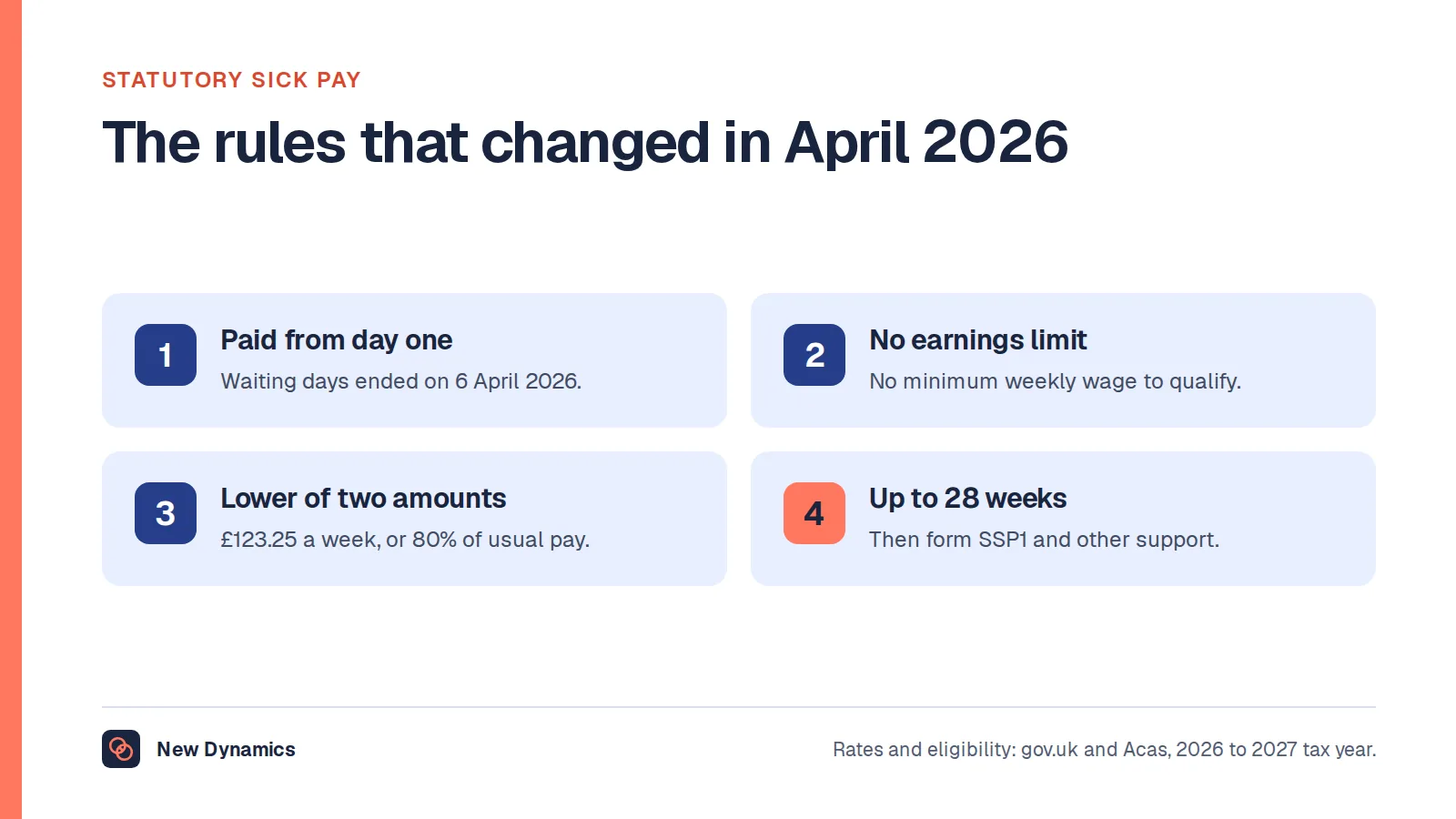
- Acas states the rate as either "£123.25 per week" or "80% of the worker's average weekly earnings", and that "Eligible workers are entitled to whichever rate is lower. It is paid from the first full day of sickness absence, for up to 28 weeks." A phased return does not reset that 28 weeks.
- Absences that are "8 weeks or less apart" count as linked periods, on the SSP eligibility guidance. A relapse shortly after a phased return therefore links back to the earlier absence rather than starting a fresh entitlement.
- "SSP stops when the employee comes back to work or no longer qualifies for it." GOV.UK also directs employers to its SSP calculator "to work out the actual amount, for example for a daily rate", and does not publish a worked part-week example of its own, so use the calculator rather than a rule of thumb.
Acas's own note that the eligibility criteria "changed on 6 April 2026" matters here too. Workers no longer need to "earn a minimum amount to be eligible" or "be off sick for at least 4 days in a row", so more people on a phased return qualify than did before. Our post on sick leave policy covers the eligibility criteria in full.
The fit note, and who can issue one

The list of professionals who can issue a fit note is wider than GPs, and has been since a dated change. The GOV.UK publication page for the fit note guidance records the change against 1 July 2022: "Fit notes can now be certified by doctors, nurses, occupational therapists, pharmacists and physiotherapists." GOV.UK's Taking sick leave guide lists the current issuers as "GP or hospital doctor, registered nurse, occupational therapist, pharmacist, physiotherapist", and Acas's fit notes guidance, last updated on 6 January 2025, gives the same five groups. A fit note is needed after more than seven calendar days off, weekends included.
The note says the person is either "not fit for work" or "may be fit for work". Where it says may be fit for work, GOV.UK's employer guidance lists the tick-box options, and the first one is the subject of this article: "a phased return to work: a gradual increase in work duties or hours", alongside "altered hours", "amended duties" and "workplace adaptations".
Then the part that surprises people. The note is advice. GOV.UK tells employers plainly: "remember that this is advice, and you are not obligated to agree, although we recommend that you take any supporting information into consideration. If you are unable to agree on any workplace modification or adjustments, then you can use the same fit note as evidence for your sick pay procedures. The employee does not require a new or revised fit note from the healthcare professional."
Acas describes the same outcome from the employee's side on its may be fit for work page: "If it's not possible for the employer to do anything that's recommended, the employee will become not fit for work. They do not need to get another fit note to show this." GOV.UK's Taking sick leave guide states the consequence as a rule: "The employee must be treated as 'not fit for work' if there's no agreement on these changes."
One limit on that discretion, from the same Acas page: "The employer must put recommendations in place if they are reasonable adjustments for a disabled employee." And GOV.UK notes that the person "can return to work at any time, even if this is before their fit note expires. They do not need to go back to their healthcare professional first."
When the condition is a disability
Acas's reasonable adjustments guidance, last updated on 30 January 2025, lists "a phased return to work after absence" among its examples of changing someone's working arrangements. So the same arrangement can be either a goodwill gesture or a legal duty depending on the person.
Acas names the trigger that applies most directly here: an employer must make reasonable adjustments when "someone's absence record, sickness record or delay in returning to work is because of, or linked to, their disability". The duty itself is in section 20 of the Equality Act 2010, whose first requirement is to take reasonable steps to avoid a substantial disadvantage caused by "a provision, criterion or practice". A rule that a return must be at full hours is such a practice. Section 20(7) adds that the employer cannot require the disabled person to pay the costs of complying, and Acas puts it shortly: "The employer is responsible for paying for any reasonable adjustments."
Whether that sentence reaches as far as paying for the hours not worked is not answered by any official source we could open. Acas's pay guidance keeps that question in the contract and the policy. Treat it as an open point to take advice on, not a settled rule either way. Our post on workplace adaptations and the reasonable adjustments duty sets out how the duty is triggered, handled and recorded.
The Health and Safety Executive adds a step employers skip. Its page on managing sick leave and return to work, updated on 4 June 2024, says employers should "review your health and safety risk assessment where: a worker's health condition makes them or others more vulnerable to workplace risks". GOV.UK says the same about fit note advice: "if it states that your employee should avoid lifting, you are liable if you give them work that involves manual handling."
The holiday that built up while they were off
Statutory holiday keeps accruing through sickness, however long it lasts. GOV.UK's Taking sick leave guide: "Statutory holiday entitlement is built up (accrued) while an employee is off work sick (no matter how long they're off)."
The carry-over rule is in regulation 13 of the Working Time Regulations 1998. Paragraph (15), inserted on 1 January 2024 by the Employment Rights (Amendment, Revocation and Transitional Provision) Regulations 2023, says that where sick leave prevented a worker taking the four weeks of leave under that regulation, "the worker is entitled to carry forward such untaken leave into the following leave year provided it is taken by the end of the period of 18 months from the end of the leave year in which the entitlement originally arose".
Acas's sick pay and holiday pay guidance, last updated on 6 November 2026, summarises it as "4 weeks' unused holiday entitlement, unless the employer allows more to be carried over", to be used "within 18 months from the date it's carried over". Where the two wordings differ, the regulation's eighteen months run from the end of the leave year, so use that as the deadline.
Two practical consequences. The four weeks is the regulation 13 leave only, so the extra 1.6 weeks is governed by the contract or by a relevant agreement rather than by that eighteen-month rule. And a returning employee may hold a large balance that they cannot take while they are still building hours back up, so put it on the plan rather than discovering it in March.
What a phased return to work plan should contain

Pulling the official guidance together gives a short and testable list.
- The starting pattern and the end point. Reduced hours, different work or a lighter workload, in Acas's three categories, with the full hours named as the destination.
- The pay for both halves. Usual rate for the hours worked, and, in writing, what applies to the hours not worked: full pay, company sick pay or statutory sick pay.
- What the fit note advises. Acas: "If a worker has a fit note, this will usually give advice on how long their phased return should be. However, the employer and worker should still discuss and agree this together."
- Any reasonable adjustments, separately listed. These outlast the phased return. The phased return ends; the adjustment may not.
- A risk assessment review where the condition or the changed work affects workplace risk, per HSE.
- Review dates and an owner. Acas: "The employer and worker should regularly review how the phased return is going." GOV.UK adds: "We recommend you record any changes, so that everyone is clear on what has been agreed."
Acas also says what flexibility looks like in practice: the employer "should be flexible and make sure they're supporting the worker's health and wellbeing", and may need to "extend the phased return to work" or "agree to new changes to the worker's responsibilities or work pattern". A plan that cannot be extended without starting again is not a plan.
The plan is normally settled in the conversation that follows the absence. Acas's returning to work after absence guidance, last updated on 1 October 2026, lists agreeing "a plan for returning to work, if appropriate, for example a phased return to work" among the purposes of that conversation. Our post on absence management covers the surrounding process, from reporting through to recording patterns.
How long a phased return lasts
No official UK source publishes a typical duration, and we are not going to invent one. Acas says only that "How long a phased return will last depends on the worker's individual circumstances. The employer and the worker should agree how long it will be for." Any figure you see quoted as standard, four weeks or six or twelve, comes from a vendor or a template rather than from Acas, GOV.UK or HSE.
The nearest thing to an official anchor is the fit note itself, which GOV.UK says "should cover the duration that the employee is likely to require adaptation or is unable to work", with a review date set by the healthcare professional if needed, and its recommendation that agreed changes "should last at least until the fit note expires".
Frequently asked questions
What is a phased return to work?
Acas defines it as when someone who has been absent gradually builds up to returning to work. It can mean reduced hours, doing work different to their usual job, or a lighter workload. Acas says it might be appropriate after a long-term illness, a serious injury or a bereavement.
Do you get full pay on a phased return to work?
For the hours actually worked, yes: Acas says the worker "should get their usual rate of pay for the hours they work". For the hours not worked, there is no automatic right to full pay. Acas says it depends on what has been agreed or what the employer's policy says, and the person might instead get company sick pay or statutory sick pay.
Can you get statutory sick pay during a phased return to work?
Yes, if you are eligible and only for full days you would normally have worked. Acas says statutory sick pay "can only be paid for full non-working days" and that someone who works part of a day cannot be paid it for the rest of that day. Acas also notes it applies only where the employer does not offer full pay or company sick pay.
Does a phased return reset the 28 weeks of statutory sick pay?
No. GOV.UK publishes a maximum of 28 weeks and treats absences 8 weeks or less apart as linked periods, so a relapse soon after a phased return links back to the earlier absence rather than starting again. Use the GOV.UK statutory sick pay calculator for the amount.
Who can issue a fit note now?
GOV.UK lists a GP or hospital doctor, a registered nurse, an occupational therapist, a pharmacist and a physiotherapist. The list widened beyond doctors from 1 July 2022, recorded on the GOV.UK fit note guidance page as "Fit notes can now be certified by doctors, nurses, occupational therapists, pharmacists and physiotherapists".
Does an employer have to follow a fit note that recommends a phased return?
Not automatically. GOV.UK tells employers the note "is advice, and you are not obligated to agree", and that where no change can be agreed the same note still works as sick pay evidence. But the employer must put a recommendation in place where it is a reasonable adjustment for a disabled employee, and GOV.UK says the person must then be treated as not fit for work if no changes are agreed.
How long should a phased return to work last?
There is no official figure. Acas says the length depends on the worker's circumstances and should be agreed between employer and worker, with the fit note usually advising on duration. Review it regularly and extend it if the person needs longer.
What happens to holiday built up during long-term sickness?
It keeps accruing, and unused leave carries over. Regulation 13(15) of the Working Time Regulations 1998 allows the four weeks of leave untaken because of sick leave to be carried into the following leave year, provided it is taken within 18 months of the end of the leave year in which it arose.
Your next step
- Open your sick pay policy and look for the words "phased return". If they are not there, the most expensive question in the process is undecided, and it is being decided case by case.
- Write the pay rule for both halves: usual rate for hours worked, and a named outcome for hours not worked.
- Model the pattern before you agree it. Two long days plus one full day off and five short days are not the same thing for statutory sick pay.
- List any reasonable adjustments separately from the phased return, with no end date attached to them.
- Put a review date on the plan, and give it an owner who is not the only person who knows it exists.
- Check the holiday balance that accrued during the absence and plan when it will be taken.
To keep the return conversations regular and on the record rather than remembered, read and download our manager one to one guide. The guide is free to read, and the PDF uses our short download form.
Want phased return plans to carry hours, pay, adjustments, an owner and a review date in one place? Book a New Dynamics demo and bring your current absence process. You can also email contact@new-dynamics.com.