TL;DR
- The limit is £8,000 for each change of residence, not for each tax year. Section 287(1) of the Income Tax (Earnings and Pensions) Act 2003 states that where the value of the exemption exceeds £8,000, the exemption “does not apply to the excess”. HMRC's manual puts it as £8,000 per employee per relocation.
- The figure has not moved. Finance Act 1993 set the qualifying limit at £8,000 for employment changes from 6 April 1993, and the same cash figure stands for the tax year 2026 to 2027. The 1993 power to raise it by Treasury order was not carried into the 2003 Act.
- A round sum relocation allowance is not a qualifying expense. HMRC's Employment Income Manual says the statutory exemption “works in terms of actual expenses incurred, so strictly there is no place for flat-rate allowances, which should be subject to PAYE”.
An offer letter promises eight thousand pounds towards the move. Payroll treats it as exempt. Two years later the figure turns up in a compliance check as earnings. The exemption for relocation expenses is real, and narrower than its reputation: a short list of costs, one change of residence, a fixed deadline, and no cover for a cash allowance.
This article sets out what the United Kingdom exemption covers, the limit and when it was set, the conditions on the move, what HM Revenue and Customs names as non-qualifying, the deadline and what is reportable. It is general information about the position in the United Kingdom and not tax or legal advice.
A relocation usually lands at the same time as a new starter, which is when the paperwork is thinnest. See how New Dynamics onboarding keeps the first ninety days, the documents and the owner of each task in one record, so a relocation claim is evidenced rather than remembered.
What the relocation expenses exemption covers
The rules are in Part 4, Chapter 7 of the Income Tax (Earnings and Pensions) Act 2003, headed "Exemptions: removal benefits and expenses". Section 271 removes the income tax charge on qualifying removal benefits and on the payment or reimbursement of qualifying removal expenses.
This is an employer relief, not an employee deduction. HMRC's manual at EIM03103 says so directly: "An employee who has to bear his or her own expenses of moving cannot get a deduction for them." If nobody reimburses the employee, there is nothing to claim.
Qualifying costs fall into six categories, listed at EIM03108:
- Disposal of the old residence. Agent and auctioneer fees, advertising, legal fees, a penalty for redeeming a related loan, disconnecting utilities, and rent, insurance, maintenance and security while the property stands empty pending sale.
- Acquisition of the new residence. Legal fees, survey, land registry fees, connecting utilities, loan procurement fees and, expressly, "stamp duty or stamp duty land tax charged on the acquisition". Abortive costs count too, under section 278, where a purchase falls through for reasons outside the buyer's control.
- Transporting belongings. Packing, unpacking, temporary storage where there is no direct move, and detaching fittings from the old home to attach and adapt at the new one.
- Travelling and subsistence. House-hunting visits, travel between the old home and the new workplace, and travel for a child staying elsewhere to finish a school year. Temporary accommodation counts only while it is genuinely temporary: EIM03117 treats a place occupied "for a considerable period" as a main residence, including for the whole of a posting of one, two or three years.
- Domestic goods for the new residence. Only replacements for items that will not work in the new home. EIM03120 gives "carpets and curtains that were the wrong size for the new home, or an electric cooker bought to replace a gas cooker where there is no gas supply in the new home".
- Bridging loan expenses, under section 284, where the loan is no more than the market value of the old home at the time the new one is bought.
The £8,000 limit, and the tax year it was set in
Section 287(1) is the whole of the cap: "If in the case of any change of residence the value of the exemption exceeds £8,000, section 271 (exemption of removal benefits and expenses) does not apply to the excess."
Read "any change of residence" carefully. The limit is per move. EIM03138 states it as "£8,000 per employee per relocation". It is not an annual allowance, and a second qualifying move later in a career brings its own £8,000.
The figure is £8,000 for the tax year 2026 to 2027, and it has been £8,000 for every tax year since 1993 to 1994. Schedule 5 to the Finance Act 1993 introduced the statutory exemption in the words "The qualifying limit, as regards any change of residence, is £8,000", applying to a change of residence resulting from "the employee becoming employed by an employer on or after 6th April 1993".
That 1993 text also let the Treasury "substitute for the sum for the time being specified in sub-paragraph (9) above a sum of a greater amount". The power was not reproduced in 2003. The only order-making power left in the chapter, section 286, covers sections 277 to 285, the lists of qualifying costs, and not section 287. The figure would now need primary legislation to change, and nothing published changes it.

The three conditions on the change of residence
Section 273 sets conditions A to C, and all three must be met.
Condition A is that the move results from one of three employment changes: "the employee becoming employed", "an alteration of the duties of the employment", or "an alteration of the place where the employee is normally to perform those duties". A move for personal reasons is outside the exemption, however generous the employer is being.
Condition B is that the move is made wholly or mainly to let the employee "reside within a reasonable daily travelling distance" of the place where the duties are normally to be performed after that change.
Condition C is that "the employee's former residence is not within a reasonable daily travelling distance of that place".
Reasonable daily travelling distance is not defined in the Act, and EIM03104 tells HMRC officers to "apply common sense and take account of local conditions". The same page confirms it is the main residence that has to change, that the home "does not have to be owner-occupied property; a rented property may be the employees main residence", and that the move has to happen: "If a relocation is cancelled, so that the employee does not in fact change his or her main residence, any expenses paid or reimbursed or benefits provided in connection with the cancelled relocation will be taxable."

What does not count, in HMRC's own words
The excluded items are where relocation packages go wrong, because they are the ones employees ask for. HMRC's National Insurance Manual at NIM06150 carries the clearest list, under the sentence "The following are all expenses which are not exempt. They are taxable in full and are also liable for Class 1 NICs from 6 April 1998."
Its two named headings are additional housing cost allowances, for "the extra costs of living in a more expensive location", and loss on sale of property, "either because the value of the property has fallen, or because the employee has to sell quickly for less than the market sale price".
It then lists examples of anything else outside section 272: "Counselling services", "Redirection of mail", "Council tax bills", "Compensation for loss in value of season tickets", "Cost of joining new sports clubs", "Penalties for giving insufficient notice of child's withdrawal from school", "Cost of buying new school uniforms", help with "an employee's spouse finding a job", "Home search facility", "Financial advice", "Nanny agency fees", "House cleaning on sale", "House cleaning on purchase", "Spouse's loss of earnings", "Help with starting a garden", and "Transporting and kennelling for domestic animals (unless directly related to the actual family move from the old to the new location)". HMRC adds: "This list is not exhaustive."
On loss on sale, EIM03126 is blunt. Where an employer compensates an employee for a fall in their house's value, or makes up a shortfall against an outstanding bridging loan, "there is no exemption. The payment is taxable in full."
The deadline, and payments made after it
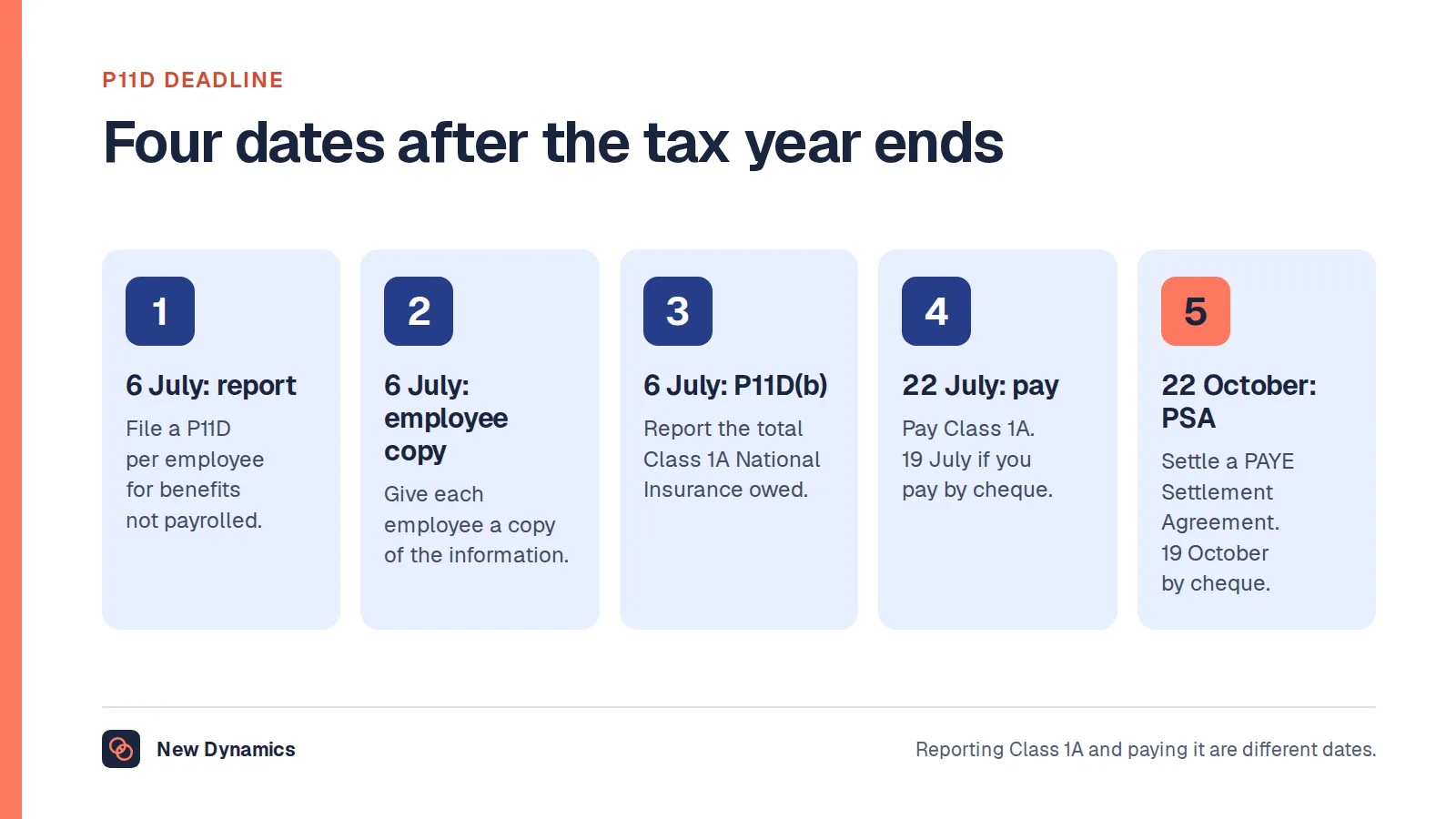
Section 274 defines the limitation day as "the last day of the tax year after that in which the employee begins to perform the duties of the employment after the employment change". GOV.UK gives the same test as a condition of what is exempt: "the costs are paid before the end of the tax year that's after the one in which the employee started their job".
For an employee starting in October 2026, inside the tax year 2026 to 2027, qualifying costs must be incurred or provided by 5 April 2028. EIM03104 adds the detail that catches people out: "It does not matter when the employee moves to his or her new home." The clock runs from the start of the duties, not the move.
Miss it and the exemption is unavailable, so a payment that would otherwise have qualified is taxable in full. Two things soften that. Section 274(2) lets an HMRC officer direct a later limitation day "if it appears to them reasonable to do so having regard to all the circumstances", and EIM03105 names two grounds for extension: a delay so a child can finish public examination courses, and difficulty selling the old residence, extended "by one year at a time". And the time limit was never written into the National Insurance rules. NIM06120 states that "a payment can be excluded from earnings regardless of when the payment is made as long as it satisfies the first two tax conditions", so a late payment can be taxable and still outside Class 1 National Insurance.

What goes on a P11D, and what is exempt
GOV.UK's page on what to report and pay gives four routes.
Qualifying costs within the limit are invisible: "You do not have to report or deduct anything for qualifying costs up to £8,000." Qualifying costs above it go on form P11D, and you "pay Class 1A National Insurance on the amount above £8,000". EIM03138 explains why PAYE is not the route: "The PAYE regulations state that PAYE should not be deducted from qualifying expenses that together with benefits exceed the limit of £8,000. The regulations say the excess should instead be reported on form P11D."
Non-qualifying costs split by who arranged them. Where you arrange the benefit and pay the supplier, it is the P11D plus Class 1A on the cost to you. Where the employee arranges it and you pay the supplier, it is the P11D plus Class 1 National Insurance through payroll but not PAYE tax. Where you reimburse the employee's own non-qualifying cost, GOV.UK says it counts as earnings, so you add it to other earnings and "deduct and pay PAYE tax and Class 1 National Insurance through payroll".
Relocation is not in the first wave of mandatory payrolling. HMRC's guidance on an exception to mandatory payrolling, published on 5 November 2026, names the mandated items: "From 6 April 2027, as an employer you must report these benefits in kind through your payroll: company cars and fuel, company vans and fuel, medical insurance." HMRC also said on 3 November 2026 that its mandatory payrolling guidance "will be updated in autumn", so recheck the scope before the 2027 to 2028 year. Our post on the P11D deadline covers the dates themselves.
The round sum relocation allowance, and why it usually fails
The commonest mistake is a single cash figure: a relocation allowance of £8,000, paid with the first salary, treated as exempt because it sits at the limit.
The exemption does not work that way. EIM03139, on flat rate allowances, is the page to read: "The statutory exemption works in terms of actual expenses incurred, so strictly there is no place for flat-rate allowances, which should be subject to PAYE."
HMRC then allows a narrow practice. An officer may treat a flat rate payment as qualifying where the amounts are "in themselves reasonable", where the officer is satisfied that "taking one employee with another, the amounts paid by an employer are in fact expended on qualifying expenses", and where "it is clearly understood that the flat-rate payment will be taken into account when deciding whether the £8,000 limit has been reached". The manual's own example is an allowance that would "do no more than pay for such items as carpets, curtains, etc". A lump sum the employee may spend as they wish, with no record of what it went on, is earnings.
Nobody publishes how often this goes wrong. HMRC's tax relief statistics, published on 22 January 2026, list the relief as "First £8,000 of reimbursed relocation packages provided by employers" in Table 4, "Cost estimates unavailable", with the reason "We do not have sufficient data on the population using this relief." There is no official figure for what the exemption costs or how many employees use it, so any number quoted for either is not HMRC's. Where official people data does exist, our HR statistics hub collects it.
Frequently asked questions
Are relocation expenses taxable in the UK?
Qualifying relocation expenses paid, reimbursed or provided by an employer are exempt from income tax up to £8,000 for each change of residence, under section 271 of the Income Tax (Earnings and Pensions) Act 2003. Anything above that figure, and anything outside the six qualifying categories, is taxable.
Is the £8,000 relocation exemption per year or per move?
Per move. Section 287(1) applies the limit to "any change of residence", and HMRC's Employment Income Manual states it as £8,000 per employee per relocation. It is not an annual allowance, so a later qualifying move brings a fresh £8,000.
Has the £8,000 relocation exemption ever been increased?
No. The qualifying limit was set at £8,000 by Schedule 5 to the Finance Act 1993 for employment changes from 6 April 1993, and section 287 of the 2003 Act still reads £8,000 for the tax year 2026 to 2027. The Treasury order power to raise it was not carried into the 2003 Act.
Is a relocation allowance tax free?
Not by itself. A round sum allowance is not an actual expense, and HMRC's guidance says flat rate allowances should be subject to PAYE. HMRC may accept a small, reasonable, evidenced allowance for replacing domestic goods, counted against the £8,000 limit, but a lump sum with no record of what it paid for is earnings.
What relocation costs do not qualify?
HMRC's National Insurance Manual names additional housing cost allowances and compensation for loss on the sale of a property, then lists council tax bills, mail redirection, counselling, financial advice, home search services, nanny agency fees, house cleaning, new school uniforms, sports club membership and spouse job search help. The list is not exhaustive.
When must relocation expenses be paid to stay exempt?
By the limitation day, which section 274 defines as the last day of the tax year after the one in which the employee begins the duties following the employment change. An employee starting in the tax year 2026 to 2027 has until 5 April 2028. HMRC can direct a later day in some cases, including difficulty selling the old home.
Your next step: turn the policy into a checklist
- Write the six qualifying categories into your relocation policy and list HMRC's excluded items beside them, so nobody promises a council tax contribution or a spouse job search by accident.
- Replace any round sum allowance with reimbursement against receipts. If you keep a small goods-replacement allowance, record what it is for and count it against the £8,000.
- Record the date the employee starts the duties at the new workplace, not the date they move, and work the limitation day from that.
- Keep a running total per employee per move, so you know when a claim crosses £8,000 and the excess has to reach the P11D.
- Separate non-qualifying items when you pay them, because the reporting route depends on who arranged and paid for them.
For the policy document behind all of this, read and download our compensation policy guide. The guide is free to read, and the PDF uses our short download form.
Want the relocation paperwork, the start date and the first ninety days held in one record rather than three inboxes? Book a New Dynamics demo and bring your current relocation policy. You can also email contact@new-dynamics.com.