TL;DR
- For 2026/27 the figures are an earnings trigger of £10,000 a year, a lower qualifying earnings limit of £6,240 and an upper limit of £50,270. The DWP review published on 3 November 2026 holds all three at the same level for 2027 to 2028, the second year running.
- The trigger decides who must be enrolled. The band decides what contributions are worked out on. Mixing them up heads The Pensions Regulator's own list of common errors, as "using incorrect earnings thresholds".
- Staging dates are history. The Pensions Regulator states that if you are employing staff for the first time, "your legal duties for automatic enrolment begin on the day your first member of staff starts work". The declaration of compliance is then due within five months.
Three numbers govern workplace pensions, and they get used in the wrong places. One decides who must be put into a pension scheme. The other two decide which slice of pay the contributions are worked out on. Swap them and you either enrol somebody who did not need enrolling, or underpay contributions for somebody who did, and then backdate the money.
This article covers the automatic enrolment earnings thresholds for 2026/27, the figures set for 2027/28, the minimum contribution levels and the earnings behind them, and the duties they trigger. It applies to the United Kingdom and is general information rather than financial or legal advice. Pension administration belongs to your payroll and your scheme provider. What sits with us is the part that gets lost: who agreed to do what, and by when, when a new person starts. See how New Dynamics onboarding coordinates tasks across the right people before day one, so a duties start date is not reconstructed months later.
Auto enrolment thresholds for 2026/27, and the figures set for 2027/28
The thresholds sit in legislation and are reviewed yearly. The Pensions Regulator's earnings thresholds page sets out the rhythm: "Every year, the Department for Work and Pensions (DWP) reviews the earnings thresholds for automatic enrolment", and "The changes take effect from the start of the next tax year following the changes on 6 April."
Here are the figures for the current tax year, with the pay frequency breakdown payroll actually needs.
| 2026/27 | Annual | 1 week | 4 weeks | 1 month |
|---|---|---|---|---|
| Lower level of qualifying earnings | £6,240 | £120 | £480 | £520 |
| Earnings trigger | £10,000 | £192 | £768 | £833 |
| Upper level of qualifying earnings | £50,270 | £967 | £3,867 | £4,189 |

Now the part that changed four days before this update. The DWP's Review of the Automatic Enrolment Earnings Trigger and Qualifying Earnings Band for 2027 to 2028, published on 3 November 2026, holds every figure where it is: "the existing threshold of £10,000 for the earnings trigger should be retained for 2027 to 2028", while "the value of the LEL for 2027 to 2028 will continue to be set at £6,240" and the upper limit "will continue to be set at £50,270".
The thresholds are frozen, then, for the second year running. The 2026/27 review of 18 December 2025 decided the same way, "to maintain the existing threshold values for 2025 to 2026 into the 2026 to 2027 tax year", for stability during the work of the Pensions Commission. The newer review repeats that reason and names its end: the Commission's "final report expected in early 2027".
Two cautions before 2027/28 goes into a payroll system. The DWP's table is headed "Proposed Thresholds for 2027 to 2028", because the values are set by order each year. And the Regulator's page, checked on 7 November 2026, still reads "The DWP have announced the annual thresholds for the 2026 - 2027 tax year" with no 2027/28 table yet. Use the 2026/27 figures until 6 April 2027, then look again.
The three thresholds do three different jobs
The earnings trigger decides who must be enrolled. Section 3 of the Pensions Act 2008 applies the duty to a jobholder "who is aged at least 22", "who has not reached pensionable age", and "to whom earnings of more than £10,000 are payable by the employer in the relevant pay reference period".
That last clause is a pay period test, not an annual salary test, and section 3(6B) is what produces the weekly and monthly columns above: in a pay reference period of less or more than 12 months, the amount applies "as if the amount in paragraph (c) were proportionately less or more". Somebody on a £9,000 salary who earns £900 in one month has crossed the £833 monthly trigger in that period. Hence the Regulator's instruction, in its guidance on ongoing duties, to "monitor the ages of your staff and the amount you pay them (including new starters)".
The lower limit does two jobs. Contributions start there, and it defines a second group. People earning between the lower limit and the trigger, says the DWP, "can opt-in to their employer's workplace pension and will receive a mandatory employer contribution". The Regulator gives the figures: staff "aged 16-74" who "earn at least £520 a month or £120 per week" must be put into the scheme within a month of asking, with the employer paying in.
The upper limit is a cap, not an eligibility test. In the DWP's words, "The UEL caps mandatory employer contributions." Nobody loses the right to be enrolled by earning above £50,270; the compulsory employer share simply stops being calculated above it.
Getting the trigger and the band mixed up is the first item on the Regulator's list of common errors in workplace pension duties: "using incorrect earnings thresholds", which it warns "could put your staff at risk of not receiving the pensions contributions they are due".
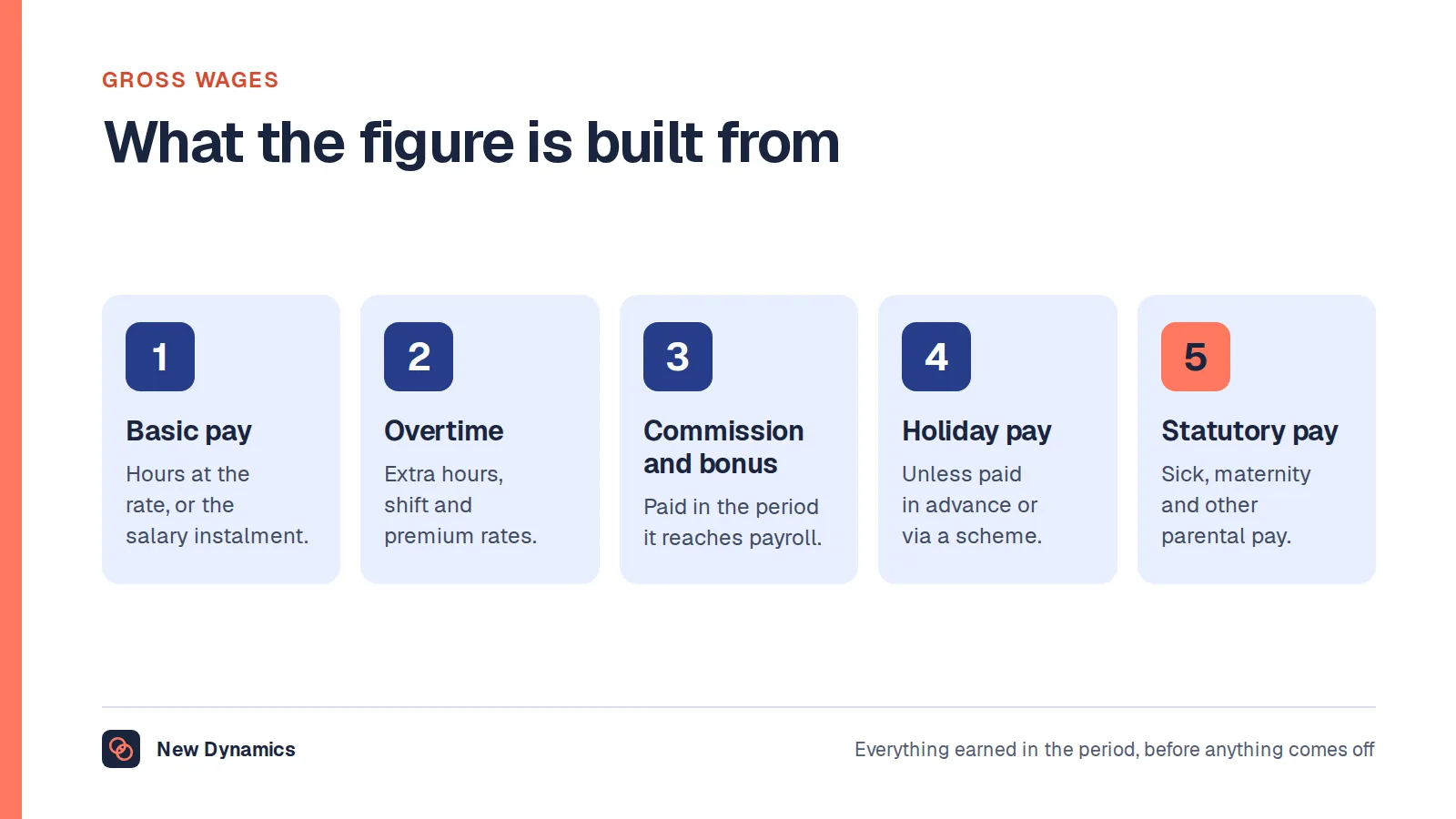
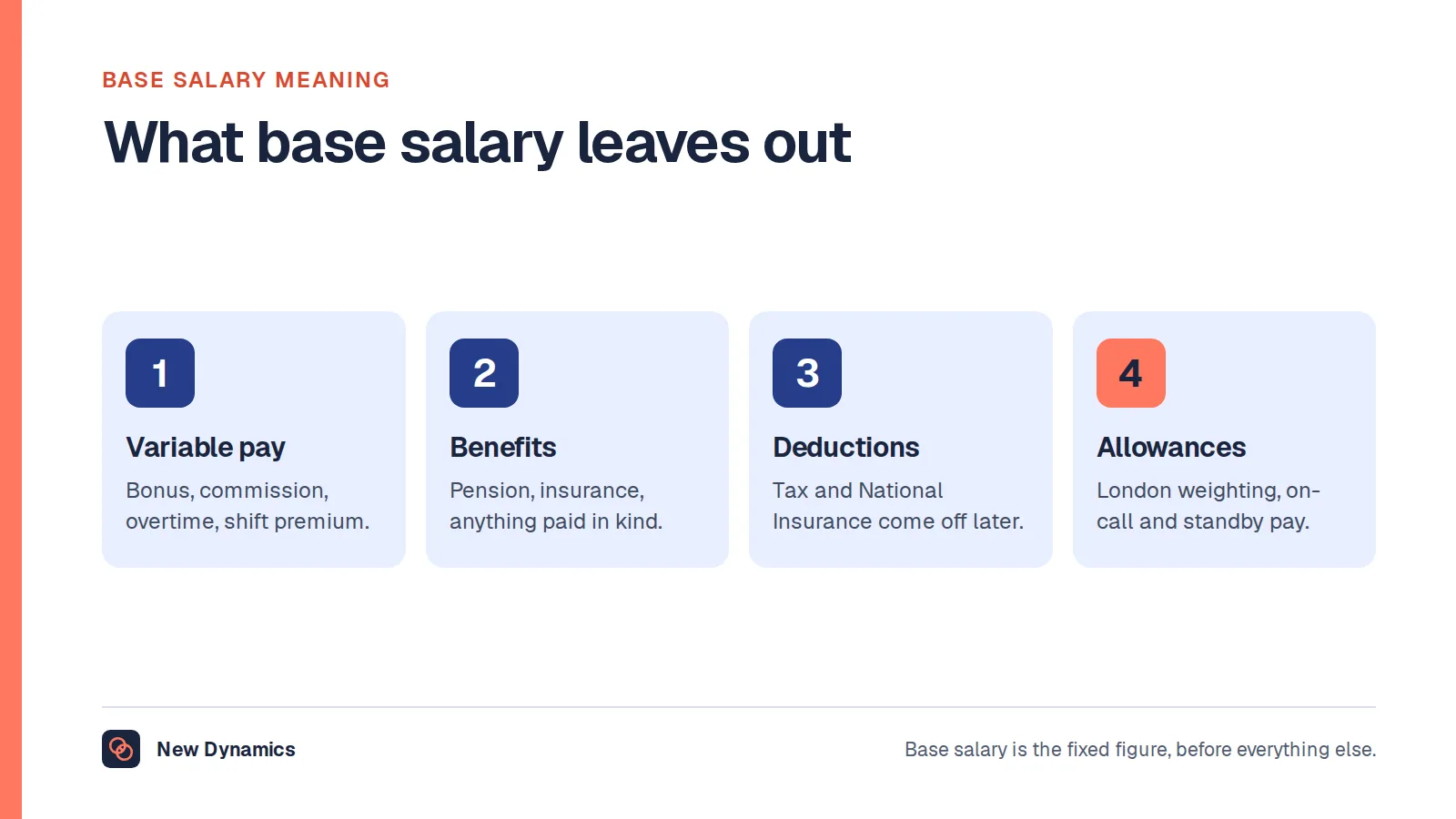
Our post on gross wages covers which pay elements make up the figure these tests apply to, and base salary explains why the advertised salary is rarely the right number for this sum.
Pension contribution levels, and the earnings they are calculated on
The Regulator's page on making contributions states the minimum plainly: "This is set at 8% of your member of staff's earnings. You, the employer, must pay at least 3% of this, but you can choose to pay more." Its table carries one row, "06/04/2019 onwards", with a total minimum of "8% (including 5% staff contribution)". GOV.UK's page on what you, your employer and the government pay gives the same split from April 2019.
The percentages are the easy part. The earnings they apply to are where money goes astray. The Regulator names the year: "For the 2026/27 tax year this range is between £6,240 and £50,270 a year (£520 and £4,189 a month, or £120 and £967 a week)."
That range is of pay, not of people. A worker on £30,000 has qualifying earnings of £23,760, so 8% is £1,900.80 rather than £2,400. GOV.UK's list of what counts is wider than salary: "salary or wages", "bonuses and commission", "overtime", statutory sick pay, and statutory maternity, paternity, adoption, shared parental, parental bereavement and neonatal care pay. Contributions come out of more than base pay and less than total pay at once.
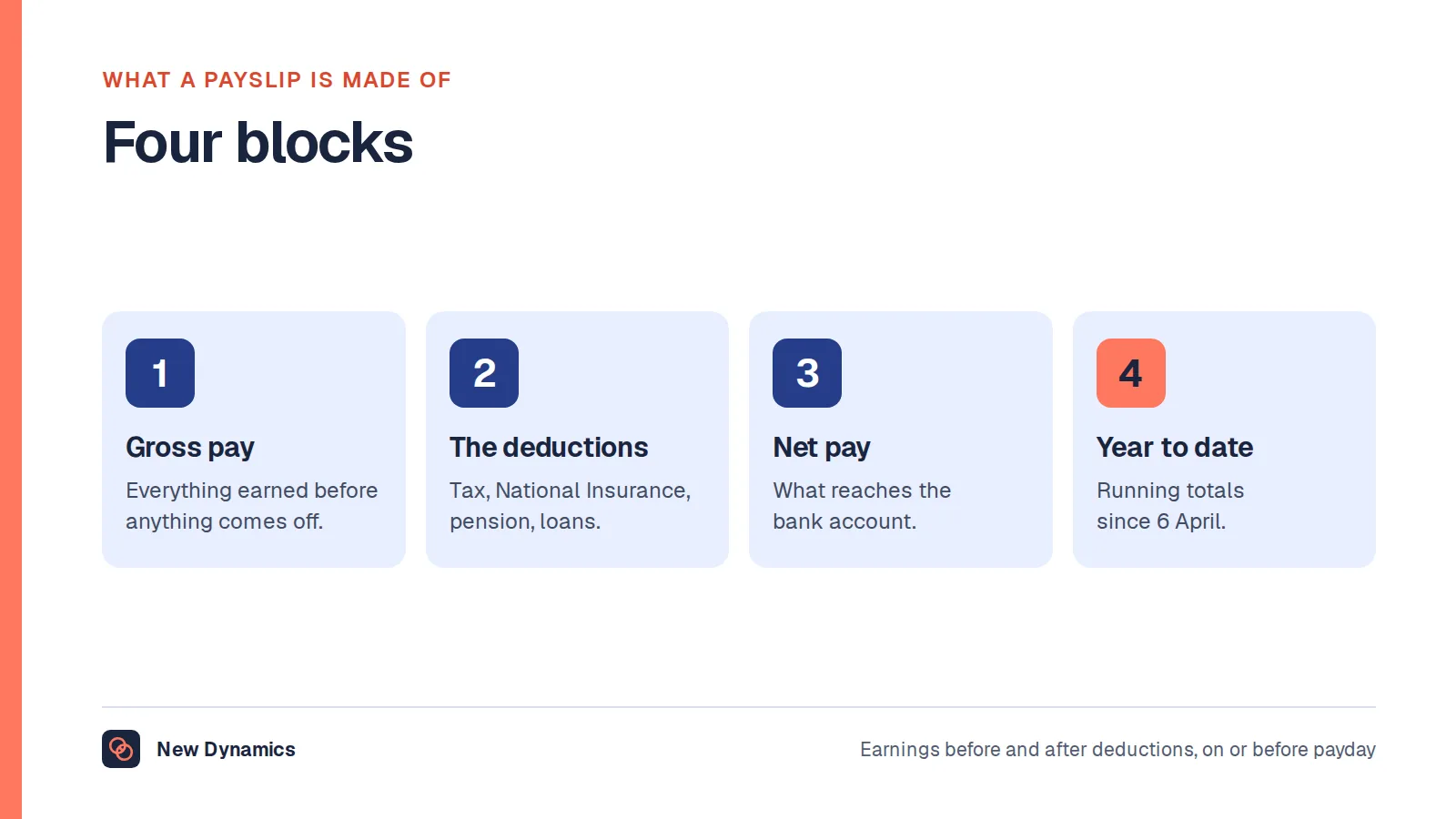
One timing rule belongs in a calendar. Having deducted contributions, the Regulator says, "by law" you "must pay these to your pension scheme by the 22nd (19th if you pay by cheque) day of the next month". Our posts on payroll deductions and pay stub deductions cover what may lawfully come off pay and how it shows on a payslip.
Workplace pension staging is history, and what replaced it
Searches for workplace pension staging still return staging date tables. They record how automatic enrolment was introduced between 2012 and 2018; they are not something to plan around. The Regulator's current position for a new employer is one sentence on its page for setting up a business: "If you are employing staff for the first time, your legal duties for automatic enrolment begin on the day your first member of staff starts work. This is known as your duties start date." The same page is blunt about who is caught: "Under the Pensions Act 2008, every employer in the UK must put certain staff into a workplace pension and pay into it."
From that date the deadlines are short. Choose a scheme. Work out who to enrol on the duties start date. Write to every member of staff individually "within 6 weeks after your duties start date". Declare compliance "within 5 months after your duties start date". Set the scheme up late and the Regulator is clear: "If you haven't set up your pension scheme within six weeks of your duties start date, you must backdate any contributions you've missed."

No official source publishes an average cost per employer for any of this, and we will not borrow one. The Regulator offers a contributions checker instead of a figure. For the figures that are published across HR, see our HR statistics hub.
The declaration of compliance, and the re-declaration every three years
The declaration of compliance is an online return telling the Regulator how you met your duties. Its declaration page sets deadline and consequence together: "You must do this within 5 months after your duties start date", and "it is your legal duty to make sure that the declaration is completed on time and the information entered is correct. If not, you may be fined." That holds where an accountant files it for you, and it applies even to an employer with nobody to enrol.
Then it recurs. The Regulator's re-enrolment page states: "Every three years you must put certain staff who have left your pension scheme back into it. This is called re-enrolment. Whether you have staff to put back into your scheme or not, you must complete a re-declaration of compliance to tell us how you have met your duties." GOV.UK gives the worker's side: the employer "must do this either every 3 years (from the date you first enrolled), or they can choose to do it sooner".
A three-year cycle with a filing deadline is what gets missed once the person who last did it has moved on. If the reminders live in one person's calendar, New Dynamics workflows can hold the stages, owners and dates instead, and our post on HR compliance covers keeping a register of recurring duties. Records have their own periods, kept "for six years except for requests to leave the pension scheme which must be kept for four years".
Pension opt out rules and the refund window
Enrolment is automatic; staying in is not. One month is the window, and both publishers describe it alike.
The Regulator, from the employer's side: "If they do ask to leave within one month of being put into a scheme, this is known as opting out." Then "you need to stop taking money out of their pay and arrange a full refund of what has been paid to date. This must happen within one month of their request."
GOV.UK, from the worker's side: "If you opt out within a month of your employer adding you to the scheme, you'll get back any money you've already paid in." Later, the position changes: "You may not be able to get your payments refunded if you opt out later - they'll usually stay in your pension until you retire."
Two follow-on rules catch employers out, both turning on twelve months. An employer does "not have to accept you back into their workplace scheme if you've opted in and then opted out in the past 12 months". And at re-enrolment, "If you chose to leave the scheme in the 12 months before the date you would have been re-enrolled, your employer does not have to automatically re-enrol you."

What an employer must not do is encourage the opt out. Our post on employee benefits covers presenting a pension as part of the package without steering the choice.
Jurisdiction: a wording difference worth noticing
Two official pages describe the geography differently. The DWP's 2027/28 review is labelled "Applies to England, Scotland and Wales" and says employers must enrol eligible workers "provided that they ordinarily work in Great Britain". The Regulator says "every employer in the UK".
Each is right about its own subject. Section 3 of the Pensions Act 2008 carries the extent marker "E+W+S", and Northern Ireland has its own provision, section 3 of the Pensions (No. 2) Act (Northern Ireland) 2008, marked "N.I." and worded identically, down to the same "£10,000" and "aged at least 22" test, with its own annual orders. One set of numbers applies across the United Kingdom, reached through two statutes, and the DWP review covers only the Great Britain one.
Frequently asked questions
What are the auto enrolment thresholds for 2026/27?
The earnings trigger is £10,000 a year, the lower level of qualifying earnings is £6,240 and the upper level is £50,270. The Pensions Regulator also publishes them by pay frequency: the trigger is £833 a month or £192 a week, and the band runs from £520 to £4,189 a month.
Have the auto enrolment thresholds been frozen?
Yes, for a second year. The DWP review published on 3 November 2026 concluded that the £10,000 trigger "should be retained for 2027 to 2028", and that the limits "will continue to be set at £6,240" and "£50,270". The reason given is stability while the Pensions Commission reports, expected in early 2027.
What are the minimum pension contribution levels?
Eight per cent in total, of which the employer pays at least three. The Pensions Regulator states that the minimum "is set at 8% of your member of staff's earnings. You, the employer, must pay at least 3% of this, but you can choose to pay more." Those rates have applied from 6 April 2019.
Which earnings are pension contributions calculated on?
On qualifying earnings, where you pay the statutory minimum: for 2026/27, the range between £6,240 and £50,270 a year. It includes salary or wages, bonuses and commission, overtime, and the statutory payments for sickness, maternity, paternity, adoption, shared parental, parental bereavement and neonatal care leave.
Do workplace pension staging dates still apply?
No. Staging was how automatic enrolment was phased in, and it has ended. The Pensions Regulator now states that for an employer taking on staff for the first time, "your legal duties for automatic enrolment begin on the day your first member of staff starts work", which it calls the duties start date.
When is the declaration of compliance due?
Within five months of your duties start date. The Pensions Regulator warns that the duty to file on time and accurately stays with the employer even where somebody else completes it, and that "If not, you may be fined." A re-declaration follows every three years alongside re-enrolment.
Can a worker get a refund if they opt out?
Yes, if they opt out within one month of being put into the scheme. The employer must stop the deductions and "arrange a full refund of what has been paid to date", within one month of the request. GOV.UK warns that after that window the payments "will usually stay in your pension until you retire".
Your next step: check the thresholds against your own payroll
- Confirm your payroll uses £10,000, £6,240 and £50,270, with the right weekly or monthly equivalents, and diarise 6 April 2027 to recheck the Regulator's thresholds page.
- Check contributions are calculated on earnings between the two limits, not on full pay or base salary, and that bonuses, commission, overtime and statutory payments are included.
- Find your duties start date and last declaration, work out the re-declaration date three years on, and give it an owner who is not about to leave.
- Pull the opt out requests from the last twelve months, confirm each refund went out inside one month, and check those records are kept for four years.
- Add the age and earnings check to your new starter process, so anyone crossing the trigger mid-year is caught in that pay period rather than at year end.
For the policy around these mechanics, read and download our compensation policy guide. The guide is free to read, and the PDF uses our short download form.
Want a recurring duty like a three-yearly re-declaration to sit in a process with an owner and a date rather than in somebody's memory? Book a New Dynamics demo and bring your current compliance calendar. You can also email contact@new-dynamics.com.