TL;DR
- In the United States no federal law requires an employer to give paid holidays or paid vacation. The Department of Labor says the Fair Labor Standards Act does not require payment for time not worked, such as vacations or holidays, federal or otherwise, and that these benefits are a matter of agreement between employer and employee.
- A federal holiday is a day named in statute for federal employees. OPM lists eleven of them for 2026, from New Year's Day on Thursday 1 January to Christmas Day on Friday 25 December. A private employer in the USA may open on every one of them and pay nothing extra.
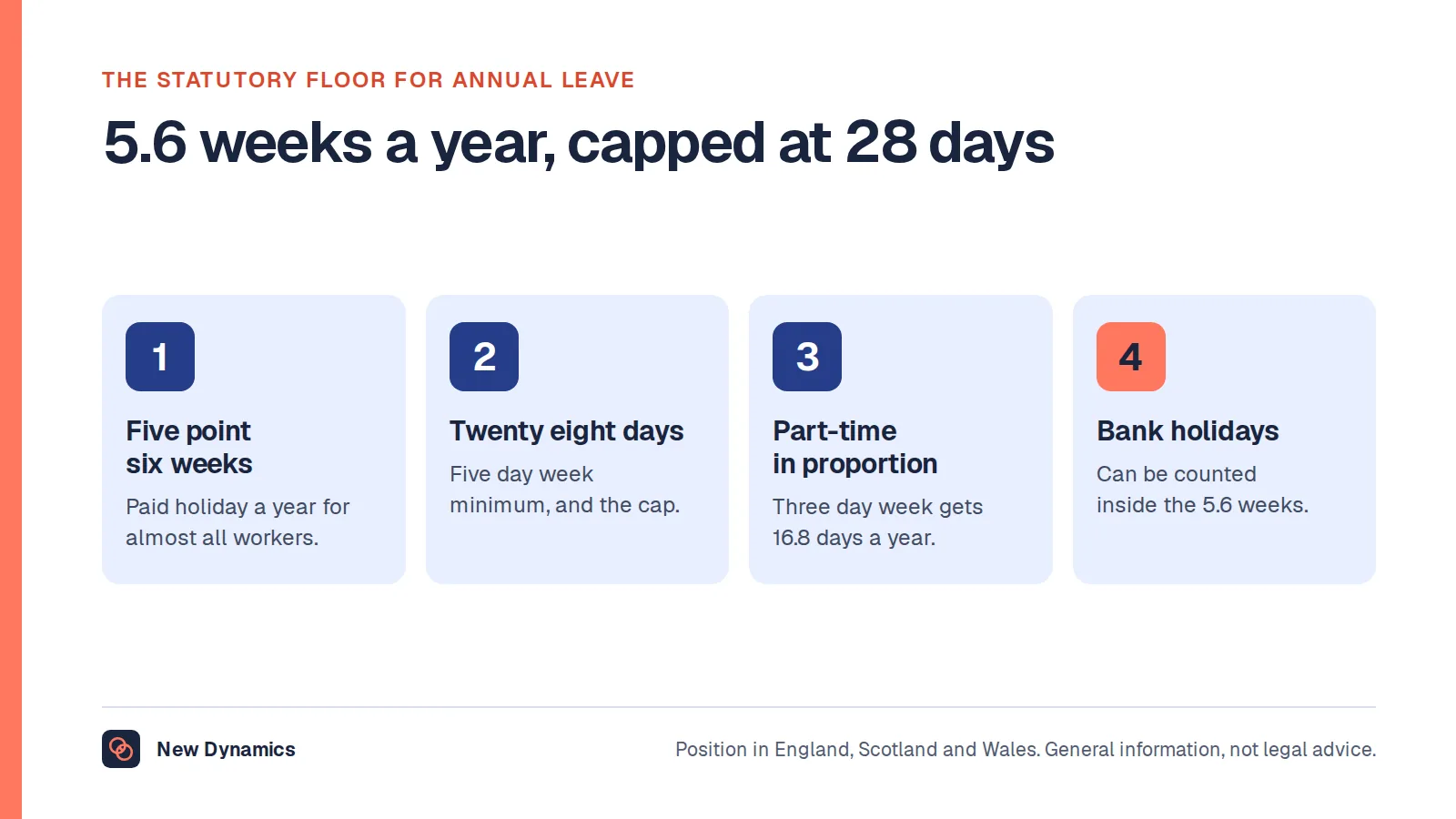
- In the United Kingdom the position reverses. Workers get 5.6 weeks of paid holiday a year, capped at 28 days, and bank holidays can be counted inside that figure rather than added to it. Holiday pay must reflect normal pay, including commission and regular overtime.
An HR team in London writes a holiday policy. It says 25 days plus bank holidays, and nobody argues. The same company opens an office in Chicago, copies the document, swaps bank holidays for federal holidays, and creates two problems in one afternoon. The American staff are promised something no American law requires, on dates nobody has checked. The policy then travels back the other way, a US handbook reaches a UK subsidiary with a line saying holidays are at the company's discretion, and that sentence is simply unlawful in Britain.
Paid holidays is the same phrase in both countries and almost the opposite legal idea. This article sets out what each system requires, quoting the government sources as worded, then gives the practical part for an employer running both: what you must give, what you choose to give, and what breaks when a policy crosses the Atlantic unchanged.
Most of the damage is administrative rather than legal. A request sits in an inbox, nobody records the decision, and two years later there is no evidence of what was agreed. See how New Dynamics workflows keep requests, approvals and records on one path.
This article covers the United States and the United Kingdom, and names the country in every section. It is general information, not legal advice.
Paid holidays meaning: two systems, one phrase
In the United States, a paid holiday normally means a named calendar day on which the employer closes, or excuses attendance, and pays the employee anyway. Thanksgiving Day and Christmas Day are the archetypes, counted separately from vacation, the pot of days an employee chooses. A list of paid holidays in an American handbook is therefore a list of dates, usually six to twelve, sitting above a separate vacation or PTO allowance.
In the United Kingdom, holiday means the days an individual chooses. The dates on which the country closes are bank holidays, a different category again. So a UK contract saying 25 days' holiday describes what an American would call vacation, and plus bank holidays describes something closer to the American paid holiday list.
One more word causes trouble. Entitlement in the UK almost always means a statutory minimum. In the USA it usually means whatever the employer has promised.
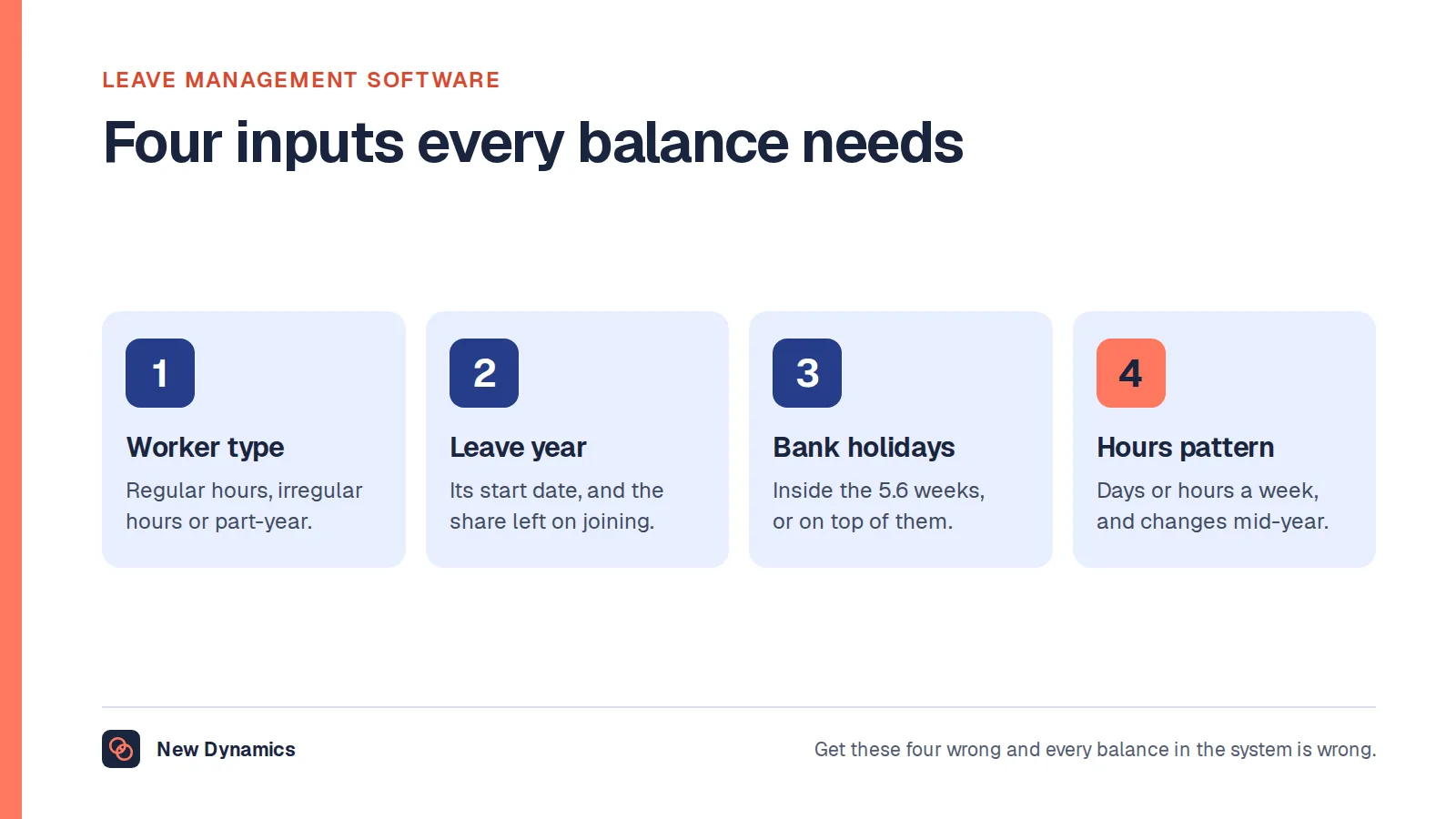
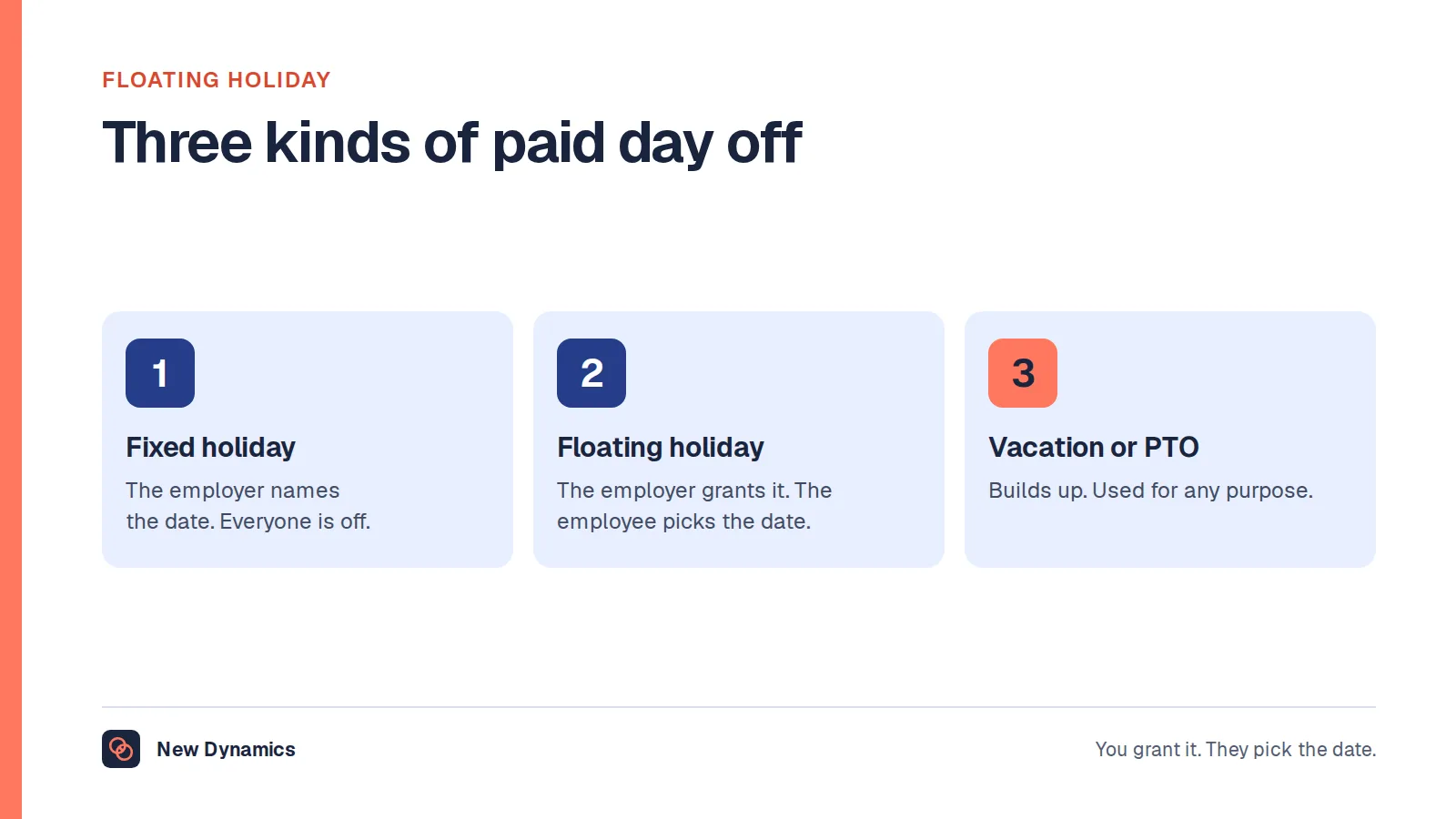
Our post on holiday entitlement sets out the UK vocabulary in full, including how PTO and personal days translate, and our post on floating holidays covers the American practice of granting a paid day and letting the employee pick the date.

Paid holidays in USA: no federal law requires them
This is the point most writing on the subject gets backwards, so here it is from the regulator. The US Department of Labor's page on holiday pay states it in two sentences: “The Fair Labor Standards Act (FLSA) does not require payment for time not worked, such as vacations or holidays (federal or otherwise). These benefits are generally a matter of agreement between an employer and an employee (or the employee's representative).”
The Department's companion page on vacations words it slightly differently: the FLSA “does not require payment for time not worked, such as vacations, sick leave or federal or other holidays. These benefits are matters of agreement between an employer and an employee.”
So there is no federal minimum number of paid holidays, no federal minimum amount of paid vacation, and no federal requirement to pay a premium to somebody who works on Christmas Day. A private employer in the United States can open on every federal holiday in the calendar, roster staff, pay the ordinary hourly rate and comply fully with federal wage and hour law.
Two narrow exceptions appear on the same pages, and both concern government contracts rather than employment generally. Under the McNamara O'Hara Service Contract Act, DOL says “holiday and/or vacation fringe benefit requirements are stated in the SCA wage determinations in contracts that exceed $2,500”. Under the Davis-Bacon and Related Acts, such pay “is required for specific classifications of workers only if the Davis-Bacon wage determination in the covered contract specifies such requirements”. The duty, where it exists, comes from the wage determination attached to a specific federal contract, not from a general right.
What fills the gap is agreement: the contract, the handbook, the bargaining agreement, and in some cases state or city law, which this article does not survey because it varies by jurisdiction and changes. The practical consequence is that your handbook is the source of the right. Write it as though it will be read back to you. United States position, general information only.
What a federal holiday is, and who it binds
A federal holiday is a day designated by statute for federal employees. That is the whole of it. The rest is inference.
The US Office of Personnel Management's page on federal holidays opens with the authority: “Federal law (5 U.S.C. 6103) establishes the public holidays listed in these pages for Federal employees.” Note the last two words. OPM's fact sheet on holidays, work schedules and pay describes the effect: “Most Federal employees are entitled to paid holiday time off when excused from duty on a designated holiday.”
Nothing in that reaches a private employer. A federal holiday has three real effects outside federal employment, and none is a pay obligation. Federal offices close, which is why Veterans Day looks like a national day off even where it is not. Banking and settlement calendars follow it, a payroll cut-off issue rather than an employment right, and the reason a two-country payroll calendar needs both lists. And private employers copy the list voluntarily, so a six to twelve day list in an American handbook is usually a subset of the federal one.
The list changes, and it changes by Act of Congress. The most recent addition is on congress.gov: Public Law 117-17, the Juneteenth National Independence Day Act, was an Act “To amend title 5, United States Code, to designate Juneteenth National Independence Day as a legal public holiday”, and section 2 amended section 6103(a) of title 5 by inserting, after the item relating to Memorial Day, “Juneteenth National Independence Day, June 19.” It was approved on 17 June 2021. An employer whose handbook lists paid holidays by name needs a review date for exactly this reason. United States position, general information only.

United States federal holidays, as OPM publishes them
Separate two things: the statutory rule that sets each day, and the date on which it falls in a given year. The second moves, and OPM publishes a schedule per year rather than a perpetual calendar.
Below is the statutory designation of each day, as OPM's fact sheet lists it, beside the 2026 schedule as OPM publishes it. Both columns were read on 6 November 2026.
| Federal holiday | Statutory designation | Observed in 2026 |
|---|---|---|
| New Year's Day | January 1 | Thursday, January 01 |
| Birthday of Martin Luther King, Jr. | Third Monday in January | Monday, January 19 |
| Washington's Birthday | Third Monday in February | Monday, February 16 |
| Memorial Day | Last Monday in May | Monday, May 25 |
| Juneteenth National Independence Day | June 19 | Friday, June 19 |
| Independence Day | July 4 | Friday, July 03 |
| Labor Day | First Monday in September | Monday, September 07 |
| Columbus Day | Second Monday in October | Monday, October 12 |
| Veterans Day | November 11 | Wednesday, November 11 |
| Thanksgiving Day | Fourth Thursday in November | Thursday, November 26 |
| Christmas Day | December 25 | Friday, December 25 |
OPM adds a naming note: “Though other institutions such as state and local governments and private businesses may use other names, it is our policy to always refer to holidays by the names designated in the law.” If your handbook says Presidents' Day, that is a popular name rather than the statutory one. Allowed, and worth knowing which you have written.
Eleven days, and one has already moved. Independence Day is 4 July by statute, and in 2026 that is a Saturday, so the observed federal holiday is Friday 3 July. OPM's note explains the mechanism: “If a holiday falls on a Saturday, for most Federal employees, the preceding Friday will be treated as a holiday for pay and leave purposes ... If a holiday falls on a Sunday, for most Federal employees, the following Monday will be treated as a holiday.”
A twelfth day appears in some years. OPM's 2025 schedule includes Inauguration Day, noting that “Federal employees in the Washington, DC, area are entitled to a holiday on the day a President is inaugurated on January 20th for each fourth year after 1965.” It is regional, not national, and it does not appear in the 2026 schedule.
We have deliberately not printed dates for later years. Observed dates are set by law and, for extra holidays, by executive order and proclamation, so the only safe source is OPM's schedule for the year you need. United States position, general information only.
How a federal holiday is actually paid
Federal holiday rules do not bind private employers, but they are worth understanding, because American handbooks borrow their mechanics and apply them to a different population. Everything here is the United States federal employment position, from OPM's fact sheet.
Paid time off on the day. “Full-time employees who are not required to work on a holiday receive their rate of basic pay for the applicable number of holiday hours”. On a standard 40 hour, five day schedule, OPM says such an employee is “generally excused from 8 hours of non-overtime work”.
Premium pay for working the holiday. “For each hour of holiday work, employees receive holiday premium pay in addition to their rate of basic pay. Holiday premium pay is equal to an employee's rate of basic pay.” OPM puts the result at double, or 200 percent, of basic pay, with a minimum of two hours' premium pay for anyone required to work during basic holiday hours.
A substitute day when the holiday falls on a day off. “All full-time employees, including those on flexible or compressed work schedules, are entitled to an ‘in lieu of' holiday when a holiday falls on the employee's nonworkday.” Then the line that catches people: “Part-time employees are not entitled to an ‘in lieu of' holiday.”
The substitute day rule is where a copied handbook goes wrong. Promising a day in lieu to everybody, part-timers included, is more generous than the federal rule and perfectly lawful, but it has to be budgeted. Copying the federal part-time rule into a private policy usually produces a part-time population who feel short changed. Decide which you mean, and say so.
The UK floor you cannot contract out of
Cross the Atlantic and the logic inverts. In the United Kingdom the statute does not name the dates. It names the quantity, and it is a minimum.
GOV.UK's guidance on holiday entitlement states it plainly: “Almost all people classed as workers are legally entitled to 5.6 weeks' paid holiday a year (known as statutory leave entitlement or annual leave).” That includes agency workers, workers with irregular hours and part-year workers. In days: “Most workers who work a 5-day week must receive at least 28 days' paid annual leave a year.” The same page caps it: “Statutory paid holiday entitlement is limited to 28 days.” Working a sixth day buys no extra statutory leave.
The source is the Working Time Regulations 1998. Regulation 13 sets the base: “Subject to paragraph (5), a worker is entitled to four weeks' annual leave in each leave year.” Regulation 13A adds “1.6 weeks” for “any leave year beginning on or after 1st April 2009”, then caps the total: “The aggregate entitlement provided for in paragraph (2) and regulation 13(1) is subject to a maximum of 28 days.” Both regulations carry the extent marker E+W+S on legislation.gov.uk, which the site expands as applying to England, Wales and Scotland. Northern Ireland has its own working time legislation and its own bank holidays, so check that position separately.
Three traps matter more than the arithmetic, which our post on holiday entitlement covers in depth.
It cannot be bought out while someone is employed. Regulation 13(9) says the leave “may not be replaced by a payment in lieu except where the worker's employment is terminated”. A willing employee who would rather have cash does not change that.
Part-year and irregular-hours workers accrue differently. Acas's guidance for irregular hours and part-year workers says the rules “were introduced on 1 April 2024”, and that these workers accrue holiday “at 12.07% of the hours they work in a pay period” and “on the last day of the pay period”. Who counts is a contractual test: someone is an irregular hours worker “if, under their contract in that year, their hours in each ‘pay period' are variable”, and a part-year worker's contract “says there are periods of at least a week when they are not required to work and which they are not paid for”. Term-time school staff and seasonal workers are the usual cases, and a US-style fixed annual allowance does not describe them.
Leave builds up from day one. Acas's page on holiday entitlement says workers “‘accrue' (build up) holiday from the day they start working”, including during “a probationary period”, “sick leave” and statutory leave such as maternity or shared parental leave. A probation period that withholds accrual is not lawful here. United Kingdom position, general information only.
Bank holidays are not an extra tier
This is the most expensive misunderstanding when an American policy is applied in Britain, and it runs in both directions.
GOV.UK is explicit on the holiday entitlement page: “Bank or public holidays do not have to be given as paid leave. An employer can choose to include bank holidays as part of a worker's statutory annual leave.” Its bank holidays page puts it from the worker's side: “Your employer does not have to give you paid leave on bank or public holidays.” Acas, on bank holidays and Christmas, adds that the position “is the same for full-time and part-time workers”.
So a UK bank holiday is not a federal holiday analogue. It is a date on which most of the country closes, and whether a worker is paid for it depends on the contract. A contract offering 20 days plus bank holidays and one offering 28 days including bank holidays can both be lawful in England and Wales, where there are eight permanent bank holidays.
The count differs across the UK, which is why one global clause does not work. Read from the GOV.UK bank holidays page on 6 November 2026, the 2027 lists run like this. England and Wales have eight: New Year's Day, Good Friday, Easter Monday, the early May, spring and summer bank holidays, and substitute days for Christmas Day and Boxing Day. Scotland has nine, and a different mix: no Easter Monday, but 2nd January and St Andrew's Day on 30 November. Northern Ireland has ten, adding St Patrick's Day on 17 March and the Battle of the Boyne, or Orangemen's Day, on 12 July.
Four consequences, all United Kingdom.
A weekend bank holiday moves. GOV.UK: “If a bank holiday is on a weekend, a ‘substitute' weekday becomes a bank holiday, normally the following Monday.” The same mechanic as OPM's in lieu rule, on a different list.
An April to March leave year has a variable number of them. Acas: “For leave years running from 1 April to 31 March, the number of bank holidays can change. This depends on when Easter is each year.” A contract promising 20 days plus bank holidays quietly promises a different total in different years.
Part-timers are affected unevenly. Acas: where a bank holiday falls on a day a worker does not usually work, “the employer cannot make them use that day as part of their holiday entitlement.” Its comparison is Ali, who works three days including Mondays, and Jo, who works three days but not Mondays. Both get 16.8 days. “As more bank holidays fall on a Monday, Ali has to use more of their holiday entitlement for bank holidays than Jo.”
Working a bank holiday does not reduce the floor. Acas: “If someone works on a bank holiday, they must still get their full 5.6 weeks of statutory holiday entitlement as paid time off.” A worker “could ask their employer if they can work the bank holiday and take another day off instead ... The employer does not have to agree to this.” Cashing them in is out: “A worker cannot get paid in lieu of bank holidays.” See our post on time off in lieu. General information only, not legal advice.
UK holiday pay has to look like normal pay
A US paid holiday is usually paid at straight time, and that is the end of the calculation. The United Kingdom sets a standard instead, and it catches employers who pay basic salary only.
Acas, on calculating holiday pay: “When a worker takes holiday, they should be paid the same as when they're at work.” It lists what the law requires to be included: “payments linked to doing tasks required in the contract, for example commission”, “payments related to professional or personal status, for example for length of service, seniority or professional qualifications”, and “other payments, for example overtime payments, if a worker has regularly been paid these during the last year”.
GOV.UK's section on holiday pay adds the structure underneath. For regular-hours workers, employers must pay “at least 4 weeks of the worker's statutory entitlement at their ‘normal' rate of pay” and “the remaining 1.6 weeks at a ‘basic' rate of pay”. Plenty of employers pay all 5.6 weeks at the normal rate, because running two rates inside one entitlement is an administrative cost and an argument waiting to happen.
Where pay varies, the reference period is 52 weeks. For irregular-hours and part-year work, GOV.UK gives a week's pay as “A worker's average pay from the previous 52 weeks (only counting weeks in which they were paid)”. One asymmetry inside that is worth flagging to whoever builds the calculation: for fixed hours and variable pay, Acas says holiday pay in the reference period “should not be included”, while for irregular hours and part-year workers it “should be included”. Same period, opposite instruction, decided by worker type. See our post on leave management software for the systems question, and our HR statistics hub for what is published about UK pay and working time.
United Kingdom position, general information only.
One employer, two countries
Side by side, the policy decisions sort into two columns: what law decides, and what you decide.
| Question | United States | United Kingdom |
|---|---|---|
| Minimum paid holiday or vacation set by federal law | None | 5.6 weeks a year, capped at 28 days |
| Who the public holiday list binds | Federal employees, under 5 U.S.C. 6103 | Nobody automatically; bank holidays need not be paid leave |
| Source of a private employee's right | Contract, handbook or bargaining agreement | Statute, then the contract on top |
| Premium pay for working the day | Not required federally | Not required; the floor is the 5.6 weeks |
| Cash instead of the minimum | A matter of agreement | Not while employed |
| Part-timers | As the policy provides | In proportion, and they cannot be treated less favourably |
What you must give. In the United Kingdom: 5.6 weeks of paid leave to almost every worker, accruing from day one, paid at normal pay for at least four of those weeks, never bought out during employment. In the United States: whatever the contract, handbook or bargaining agreement says, plus any wage determination on a federal contract and any state or city requirement where you operate.
What you choose to give. In the United Kingdom: everything above 5.6 weeks, how bank holidays are treated, whether part-timers get a pro-rated bank holiday allowance rather than the days as they fall, and the leave year, notice and carry-over rules. In the United States: all of it. The list of paid holidays, the premium rate, the substitute day, the vacation allowance, the accrual method, the carry-over rule and the leaver payout.
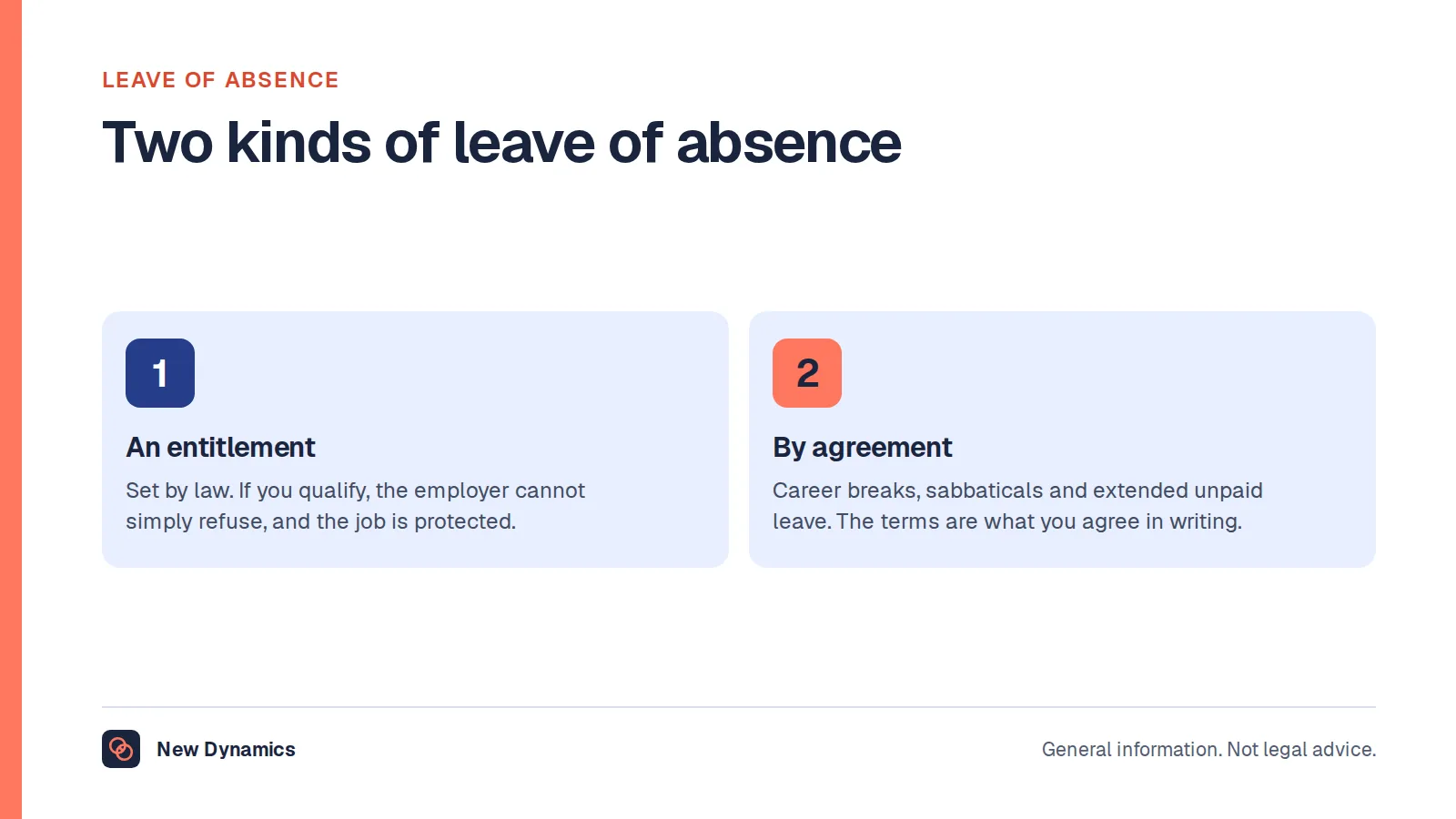
What you write down either way. The leave year. The treatment of public holidays. The pay rate for a holiday worked. The notice for a request and for a refusal. The approval route, and who covers when the approver is away. The rule for clashing requests. The record of days taken. Our employee handbook guide covers the wording, and our post on a leave of absence the other leave types beside holiday.

One structural point. Do not write a single global clause. Write one document with a labelled section per country, plus a short shared section for the process, the system and the records. A global clause either promises the American population something the business did not intend to pay for, or quietly offers the British population less than the law requires. Both happen, and the second is the expensive one.
Where a copied policy breaks
Six failures, by direction of travel.
A US handbook applied in the UK
Holiday is described as discretionary. Accurate in the USA. In the UK, GOV.UK is blunt: “Paid annual leave is a legal right that an employer must provide.” A clause reserving discretion over the statutory 5.6 weeks is unenforceable, and it tells a tribunal something unhelpful about the employer.
Accrual is withheld during probation. Acas says holiday accrues from the day someone starts working, probation included. A US-style waiting period does not survive the crossing.
Unused days are cashed out at year end as a perk. Generous in the USA, unlawful in the UK for the statutory part. Regulation 13(9) permits payment in lieu only where employment is terminated.
Bank holidays are bolted on without checking the nation. An England and Wales list of eight, applied to a Scottish or Northern Irish employee, is wrong on the count and on the days. St Andrew's Day, 2nd January, St Patrick's Day and the Battle of the Boyne are not in it.
A UK handbook applied in the USA
Bank holidays are translated as federal holidays and promised as paid. You may do that. Just price it, because you have created a contractual benefit federal law never required, on dates that move.
The 5.6 weeks is restated as a minimum entitlement. Harmless as a benefit, but it imports a British concept into a document governed by American law, usually together with carry-over and payment-in-lieu wording that has lost its statutory anchor.
The failure that happens in both directions
Nobody keeps the record. A policy is only as good as the evidence that a day was requested, approved and taken, and that evidence answers a leaver's claim, a payroll query or an audit. Our posts on leave management software and absence management cover the system and the practice. The requirement is the same in Chicago and in London: one register, both calendars, a decision recorded against every request.
This section covers the United States and the United Kingdom. General information, not legal advice, and it does not cover state, city or Northern Ireland specific requirements.
Frequently asked questions
What does paid holiday mean?
A paid holiday is a day an employee does not work and is still paid for. In the United States it usually means a named calendar date on which the employer closes, counted separately from vacation. In the United Kingdom holiday means annual leave, the days an employee chooses, while the dates the country closes are bank holidays. Not legal advice.
Are paid holidays required by law in the USA?
No, not by federal law. The US Department of Labor says the Fair Labor Standards Act “does not require payment for time not worked, such as vacations or holidays (federal or otherwise)”, and that these benefits “are generally a matter of agreement between an employer and an employee”. Wage determinations on some federal contracts, and state or city law, may add more. United States position, general information only.
What are the federal holidays in the USA?
OPM lists eleven for 2026: New Year's Day, Birthday of Martin Luther King, Jr., Washington's Birthday, Memorial Day, Juneteenth National Independence Day, Independence Day, Labor Day, Columbus Day, Veterans Day, Thanksgiving Day and Christmas Day. Inauguration Day is a twelfth in the relevant years, for federal employees in the Washington, DC area. Observed dates move, so read OPM's schedule for the year you need. United States position, general information only.
Is Christmas a federal holiday, and is New Year's Day?
Yes to both. OPM lists Christmas Day (December 25) and New Year's Day (January 1) among the holidays federal law designates for federal employees. In the 2026 schedule New Year's Day is Thursday 1 January and Christmas Day is Friday 25 December. Being a federal holiday does not oblige a private employer to close or to pay anything extra.
How much paid holiday must a UK employer give?
GOV.UK says almost all people classed as workers are legally entitled to 5.6 weeks' paid holiday a year, at least 28 days for a five day week, and statutory entitlement is capped at 28 days. Bank holidays do not have to be given as paid leave, and an employer can count them inside the 5.6 weeks. England, Wales and Scotland position; Northern Ireland has its own rules.
Do UK bank holidays come on top of the statutory minimum?
Not automatically. Acas says an employer can include bank holidays in the statutory minimum 5.6 weeks, or give them in addition, and that the position is the same for full-time and part-time workers. The contract decides. There are eight permanent bank holidays in England and Wales, nine in Scotland and ten in Northern Ireland, so one global clause will be wrong somewhere. Not legal advice.
Your next step: separate the floor from the choice
- Write down, per country, the legal floor and the days you add on top. If a sentence covers both countries, split it.
- Open OPM's federal holidays page and the GOV.UK bank holidays page, read the schedule for your next leave year, and put both sets of dates in the payroll calendar with the cut-offs around them.
- Check one UK payslip for a commission earner and one for somebody on regular overtime. If a holiday week pays less than a working week, fix that first.
- Check how your UK part-timers get bank holidays. If the days are taken as they fall rather than pro-rated, somebody on a Monday pattern is losing out.
- Pick three requests from the last quarter and try to produce the record: who asked, who approved, when, and what was paid. If you cannot, that is the gap to close.
For the policy wording behind all of this, use our employee handbook guide. The guide is free to read, and the PDF uses our short download form.
If the real problem is requests and approvals disappearing into inboxes across two time zones, book a New Dynamics demo and bring the process you run today. You can also email contact@new-dynamics.com.