TL;DR
- Leave management software looks like a booking form and a counter. Underneath it is a legal calculation: entitlement, accrual, carry over, holiday pay and a record that now has to survive six years.
- The hard parts are irregular hours and part-year workers accruing at 12.07% of hours worked, bank holidays for part-timers, sickness falling inside booked leave, and family leave crossing a leave year.
- Most of the damage happens at the payroll handover. Agree the cut-off date, the leaver balance and who reconciles the two sets of numbers before you sign anything.
Leave management software looks like the easiest category in HR technology: a form, a calendar, an approval button and a number that goes down. Buyers treat it as a commodity and pick on price.
Then the first leave year ends. A part-time colleague has been charged for bank holidays she never worked. A zero-hours worker's balance does not match what payroll paid. Somebody went sick inside a booked fortnight and nobody knows whose days those are.
This article is about the system rather than the practice: what leave management software has to calculate, which parts of the United Kingdom legal floor it must implement, and where it usually breaks. Every figure is quoted from legislation.gov.uk, GOV.UK or Acas as worded, with the reference period named. It is general information, not legal advice.
If your leave rules do not fit a standard template, the shape of the problem is a configurable form with stages and approvals: see how New Dynamics workflows work.
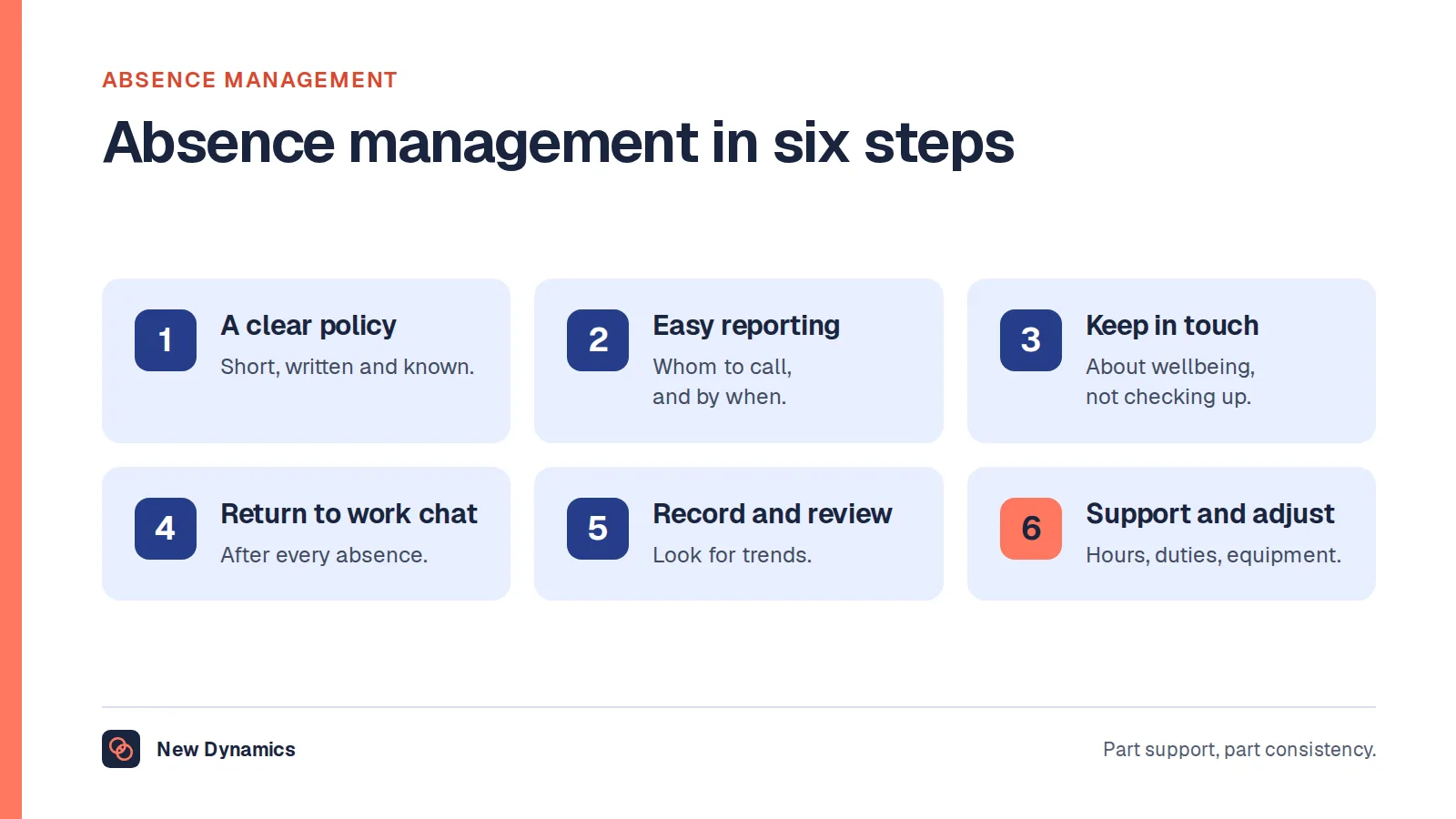
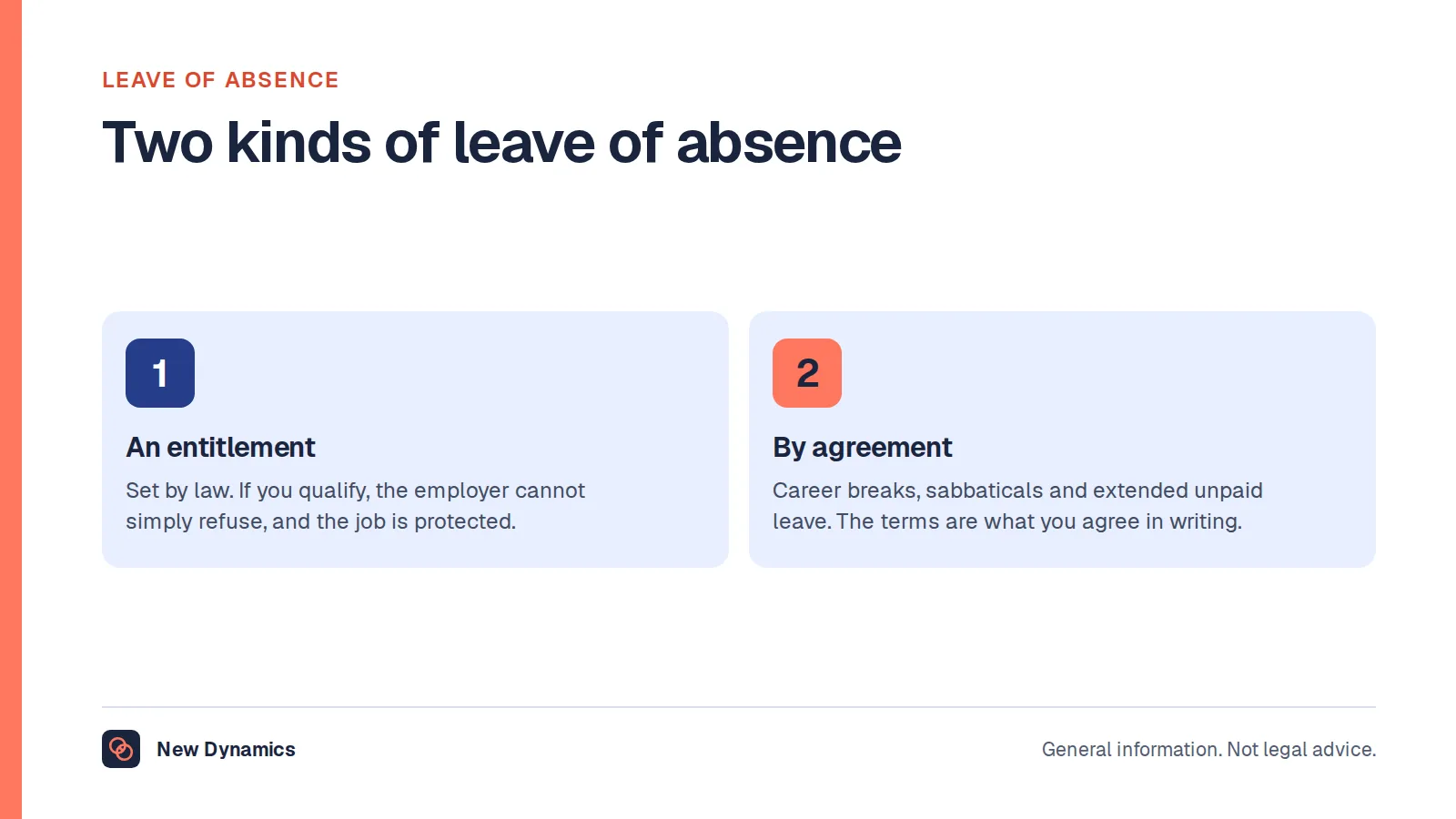
Two companion posts cover ground this one leaves alone. Absence management is the management practice: policy, return to work conversations, measurement and patterns. Leave of absence covers the leave types. For the entitlement rules themselves, see holiday entitlement.
What leave management software actually has to do
A leave system does six jobs.
- Hold the rules. Leave year, entitlement per contract type, bank holidays, notice periods, carry over, approval route.
- Calculate an entitlement for everyone, including mid-year joiners, people whose hours vary and people who changed hours in March.
- Accrue it over the year, in days or hours, correctly for each worker type.
- Take requests and answer them, with a route to the right approver and a record of the decision.
- Show cover without showing medical detail to people who do not need it.
- Hand numbers to payroll and keep the record, in a usable format, producible on demand.
Jobs two and three are arithmetic a spreadsheet gets wrong quietly. Job four is where cover collides with a legal right. Job six carries the liability.

Entitlement: the statutory floor the software must implement
The United Kingdom floor is the Working Time Regulations 1998, marked on legislation.gov.uk as extending to England, Wales and Scotland.
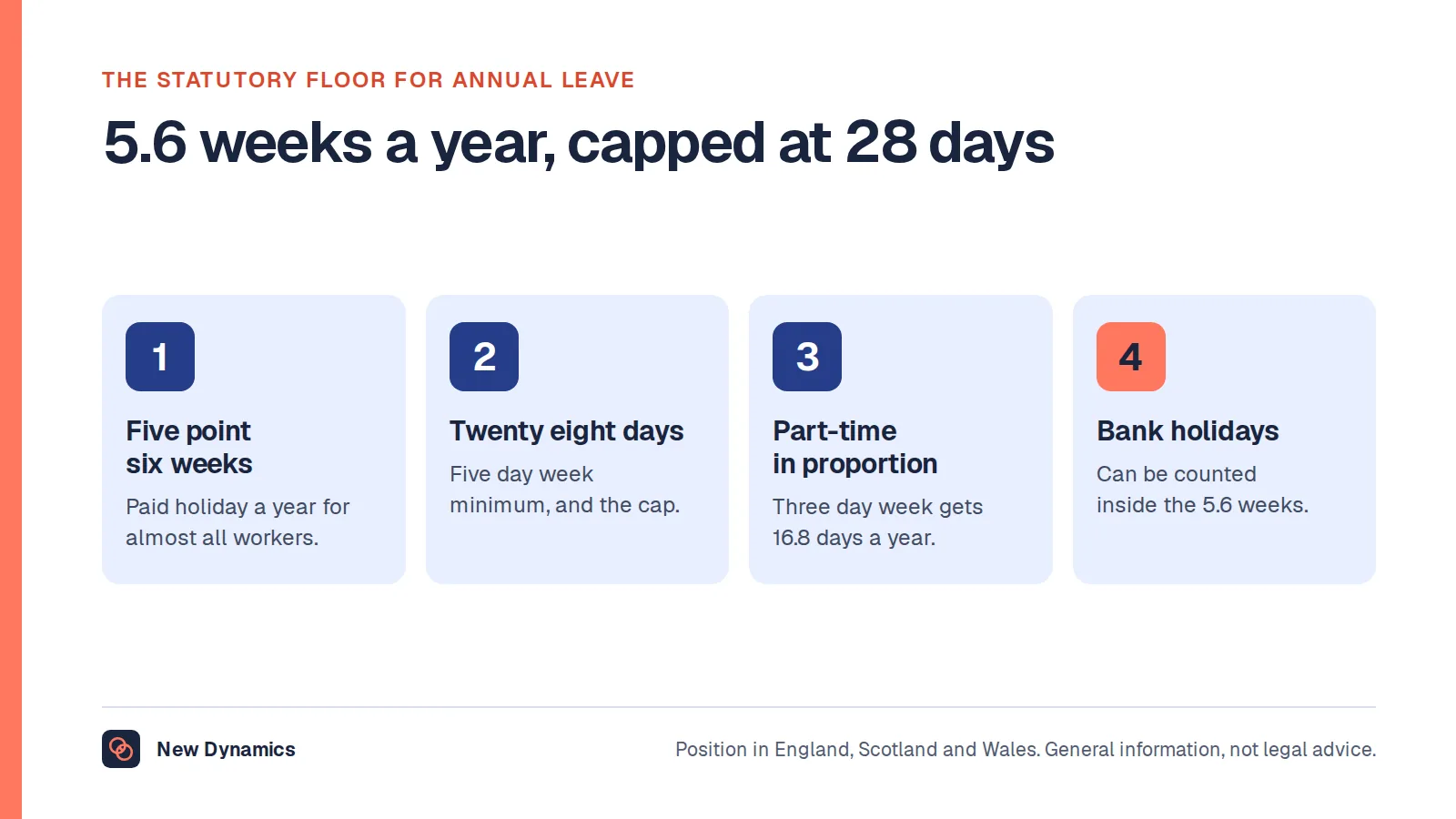
Regulation 13 sets the main entitlement: "Subject to paragraph (5), a worker is entitled to four weeks' annual leave in each leave year." Regulation 13A adds "1.6 weeks" for "any leave year beginning on or after 1st April 2009", then caps the total: "The aggregate entitlement provided for in paragraph (2) and regulation 13(1) is subject to a maximum of 28 days."
GOV.UK's holiday entitlement guidance says the same in plainer words: "Almost all people classed as workers are legally entitled to 5.6 weeks' paid holiday a year (known as statutory leave entitlement or annual leave)", and "Statutory paid holiday entitlement is limited to 28 days." Three consequences follow.
Hold the entitlement in weeks, not days. A field called "days per year" mis-handles a six-day and a four-day week in opposite directions, because 28 days is a cap, not the entitlement.
Pro-rate a joiner correctly. Regulation 13(5) says entitlement in the first leave year "is a proportion of the period applicable under paragraph (1) equal to the proportion of that leave year remaining on the date on which his employment begins". GOV.UK's calculate leave entitlement guidance offers an alternative: "If a worker starts part way through the month, they can accrue one-twelfth of their leave from their first day." Choose one and apply it to everybody.
Keep the two tranches apart. GOV.UK's holiday pay guidance says regular-hours workers must be paid "at least 4 weeks ... at their 'normal' rate of pay" and "the remaining 1.6 weeks at a 'basic' rate of pay". One pot of 28 days cannot tell payroll which days were which.
Accrual: irregular hours, part-year workers and changed hours
The 12.07 per cent rule
This is the most common point of failure, because it is a different calculation rather than a variation on one. Regulation 15B applies to an irregular hours worker or a part-year worker "in respect of any leave years beginning on or after 1st April 2024". For them the balance is accrued, plus carried forward, less taken, and accrual happens "on the last day of each pay period at the rate of 12.07% of the number of hours that they have worked during that pay period."
Two details systems miss. The cap still applies: "a worker cannot, in any leave year, accrue more than 28 days of annual leave under this regulation." And the rounding is prescribed: a fraction of an hour "is to be treated as zero if it is less than 30 minutes and one hour if it is 30 minutes or more".
Who counts is a contractual test. Regulation 15F makes someone an irregular hours worker "if the number of paid hours that they will work in each pay period during the term of their contract in that year is, under the terms of their contract, wholly or mostly variable", and a part-year worker where the contract requires work for only part of the year with unpaid periods "of at least a week". So the worker-type field has to be set from the contract, reviewed when the contract changes, and drive a different accrual engine.
Accrual does not stop when those workers are away. Regulation 15C sets a three-step calculation for accrual during sick or statutory leave, based on average weekly hours over "the period of 52 weeks ending with the day before the day on which the worker started the sick leave or statutory leave". Without that calculation a product cannot handle a zero-hours worker on maternity leave.
Year one, and a change of hours
GOV.UK describes the ordinary system for regular-hours workers: "a worker gets one-twelfth of their leave in each month". A mid-year change of hours is the quieter trap. Acas's guidance on calculating holiday pay states it plainly: "Their holiday entitlement should be recalculated from the date that the change happens. The change of hours does not affect any holiday accrued up to the date of the change." In Acas's example, Pat drops from 40 to 20 hours a week three months in, and entitlement is "calculated based on 3 months at 40 hours and 9 months at 20 hours".
A system that recalculates the whole year at the new pattern takes leave from whoever reduced their hours. Change a contract mid-year in the demo environment and ask to see the arithmetic.
Bank holidays and part-time pro rata
Bank holidays are a policy choice with a legal consequence, and the software has to carry it. GOV.UK is explicit that there is no separate right to them: "Bank or public holidays do not have to be given as paid leave. An employer can choose to include bank holidays as part of a worker's statutory annual leave."
The consequence falls unevenly on part-time staff. Acas's guidance on bank holidays and Christmas sets the limit: where a bank holiday falls on a day a worker does not usually work, "the employer cannot make them use that day as part of their holiday entitlement." Acas compares Ali, who works three days a week including Mondays, with Jo, who works three days but not Mondays. Both get 16.8 days, but because more bank holidays fall on a Monday, Ali spends more of it on days the business is closed anyway.
So the system must hold the bank holiday calendar for the right nation, know each working pattern so a closure day on a non-working day is not deducted, and cope with a leave year whose bank holiday count moves with Easter. Ask to see a part-time pattern with a bank holiday on a working day and one on a non-working day, on the same screen.
Carry over: what the rules actually allow
The default is use it or lose it. Regulation 13(9) says leave "may only be taken in the leave year in respect of which it is due", and "may not be replaced by a payment in lieu except where the worker's employment is terminated", subject to the exceptions in paragraphs (14), (15) and (17). Those three, plus an agreement route for the additional 1.6 weeks, make four, and one "allow carry over" switch cannot express them.
Statutory leave. Regulation 13(14): "Where, as a result of taking a period of statutory leave in any leave year, a worker is unable to take some or all of the annual leave to which the worker is entitled in that leave year under this regulation, the worker is entitled to carry forward such untaken leave into the following leave year."
Sick leave, with an 18-month clock. Regulation 13(15) allows the same carry forward where sick leave prevented the leave being taken, "provided it is taken by the end of the period of 18 months from the end of the leave year in which the entitlement originally arose."
Employer failure. Regulation 13(16) and (17) allow carry forward where the employer fails to recognise the right or pay for the leave, fails to "give the worker a reasonable opportunity to take the leave to which the worker is entitled under this regulation or encourage them to do so", or fails to "inform the worker that any leave not taken by the end of the leave year, which cannot be carried forward, will be lost."
The additional 1.6 weeks, by agreement. Regulation 13A(7): "A relevant agreement may provide for any leave to which a worker is entitled under this regulation to be carried forward into the leave year immediately following the leave year in respect of which it is due."
Acas's guidance on carrying over holiday gives the practical caps: on long-term sick leave a worker "can carry over a maximum of 4 weeks' holiday entitlement" and "must use it within 18 months starting from the end of the leave year in which they accrued it"; in the employer-failure case the maximum is also 4 weeks; and where there is no relevant agreement, "workers must take the 5.6 weeks' holiday entitlement during the leave year."

So carried days need a reason, an expiry date and an order of use. Days carried from a sickness year expire on a different date from contractual days carried by agreement, and a system that pools them into one opening balance will expire the wrong days or none at all.
Regulation 13(16) also describes a feature: a reminder in month nine telling someone what they will lose, logged when sent.
The approval chain, and who sees what
A manager is accountable for cover. An individual has a legal right to take their leave. The software sits between them and usually encodes only one side.
The notice rules in regulation 15 run both ways: a worker may take leave "on such days as he may elect by giving notice to his employer", and an employer "may require the worker ... to take leave ... or not to take such leave ... on particular days". Any of it "may be varied or excluded by a relevant agreement", which is why the contract usually governs.
GOV.UK's booking time off guidance draws the line the system must not cross: "Although employers can refuse to give leave at a certain time, they cannot refuse to let workers take the leave at all." Acas says the same in asking for and taking holiday. GOV.UK also sets a bar on telling people to take leave: the employer must "make sure that the worker can relax, rest and enjoy leisure during their holiday. For example, an employer cannot force a sick worker to take leave."
So an approval screen needs three things a yes or no button does not: a cover view by skill rather than headcount, a published tie-break rule for clashing requests, and a service level for answering. A request left unanswered for three weeks is a refusal with no notice.
One caution, because the two official pages are worded differently. GOV.UK says "The general notice period for taking leave is at least twice as long as the amount of leave a worker wants to take, plus 1 day", and that an employer refusing or cancelling "must give as much notice as the amount of leave requested, plus 1 day". Acas says workers "must ask for holiday at least twice the number of days before as the amount they want to take off", and that an employer refusing must give "at least the same amount of time as the amount they requested". GOV.UK includes an extra day in both directions and Acas does not. We are not resolving that here; both pages were open on 5 November 2026. Set your notice periods in the contract, which regulation 15(5) permits.
Who sees what
Leave data is ordinary personal data until it is not. "Annual leave, 14 to 25 July" is fine on a team calendar. "Sick, stress" is not, and nor is "fertility treatment" in a reason field the department can read.
| Who | Should see | Should not see |
|---|---|---|
| Colleagues | That a person is away, and when | Any reason or category |
| The line manager | Category, dates, balance | Medical detail beyond managing need |
| HR | The full record, including notes | Nothing further by default |
| Payroll | Dates, paid or unpaid, amounts | Reasons and notes |
Test those tiers with real accounts, not an administrator login. Acas notes employers "must keep records in line with UK GDPR"; our employee data protection guide covers the wider duty.
Sickness inside booked leave
Every leave year produces this case. Acas's guidance on sick pay and holiday pay handles both directions. Where someone falls ill during booked leave, "A worker must report their sickness to their employer if they want to take any holiday as sick leave", and they can then get statutory sick pay if entitled and "keep the time they were sick to use as holiday another time". Where someone wants holiday during sick leave, it is their choice: "An employer cannot force a worker to take holiday while off sick." If approved, "sick leave can be paused while the worker takes holiday".
That is a testable requirement. A booked leave record must be capable of partial conversion to sickness, mid-booking, with the untaken days returned to the balance and the pay type changed for the converted days only. Many systems can only cancel the whole booking, losing the dates and the audit trail.
Accrual continues throughout: Acas's page on sickness and statutory leave says someone can still accrue holiday when "off work because of sickness or injury" or "on statutory leave", and notes sick leave "is usually considered long term if it lasts longer than 4 weeks", the point at which the 18-month carry over clock matters. For the policy side, see the sick leave policy and the Bradford Factor.
Family leave and annual leave in the same year
Annual leave keeps building during family leave, so it has to go somewhere. GOV.UK states it directly: "The leave year and holiday entitlement is not affected by maternity, paternity or adoption leave. The employee still builds up ('accrues') holiday over these periods."
Acas lists the statutory leave during which employees still accrue holiday: maternity, paternity, adoption, shared parental, ordinary parental, neonatal care, parental bereavement, carer's leave and bereaved partner's paternity leave. It advises agreeing in advance "how much paid holiday they'll accrue before and during the planned statutory leave" and "how much they can carry over, if appropriate".
The mechanics the software needs:
- accrual that continues during family leave at the right rate, including the regulation 15C calculation for irregular hours and part-year workers;
- a carry forward reason of statutory leave under regulation 13(14), separate from the sickness reason and its 18-month deadline;
- booking annual leave immediately before or after a family leave block without the records colliding;
- paying out contractual leave above the minimum where policy allows, leaving the 5.6 weeks alone. GOV.UK is strict: "The only time someone can get paid in place of taking statutory leave (known as 'payment in lieu') is when they leave their job."
Our posts on maternity leave for employers and bereavement leave cover those leave types, and time off in lieu covers hours worked for time off.
Holiday pay, the 52-week reference period and the payroll handover
A leave system that does not understand holiday pay is a calendar. Regulation 16 says a worker "is entitled to be paid in respect of any period of annual leave ... at the rate of a week's pay in respect of each week of leave."
The reference period is 52 weeks. Regulation 16(3ZD) defines it, for someone employed 52 or more complete weeks, as "the period of 52 weeks ending" with the last complete week before the calculation date. Regulation 16(3ZE) excludes weeks in which "no remuneration was payable to the worker" or in which the worker "was, for any amount of time, on sick leave or statutory leave", and regulation 16(3ZF) then takes earlier weeks into account "so as to bring the number of weeks to 52 (or as close to 52 as possible)". GOV.UK adds the limit on that search: "You can count back a maximum of 104 weeks to find these."
What goes into the figure is prescribed too. Regulation 16(3ZA) includes payments "intrinsically linked to the performance of tasks which a worker is obliged to carry out under the terms of their contract", payments for "length of service, seniority or professional qualifications", and overtime "regularly paid to a worker in the 52 weeks preceding the calculation date".
One trap sits inside the Acas guidance. For a worker with fixed hours and variable pay, "Holiday pay during the 52-week reference period should not be included in the calculation." For irregular hours and part-year workers, "Any holiday pay during the 52-week reference period should be included." Same reference period, opposite instruction, by worker type. If a supplier says their product handles holiday pay, that is the question to ask.
Where the handover breaks
In practice the leave system rarely calculates pay. It hands numbers to payroll, and the gap between them is where most disputes start.

Five things to settle before you sign, not after go-live:
- What crosses the boundary? Days taken, unpaid days, hours for irregular hours workers, the 4 weeks and 1.6 weeks split, the leaver balance. Get the field list in writing.
- When is the cut-off? Leave booked after payroll's cut-off lands in the next run, so somebody has to own the correction.
- Who reconciles, and which system wins? A named person each side, a report comparing balances before every payroll, and a written decision on the source of truth.
- How are leavers handled? GOV.UK says employers "must pay for untaken statutory leave, even if the worker is dismissed for gross misconduct", and that where someone has overtaken their entitlement, "their employer must not take money from their final pay unless it's been agreed beforehand in writing."
- Who owns the reference period? If payroll calculates the 52-week average, the leave system must tell it which weeks contained sick or statutory leave.
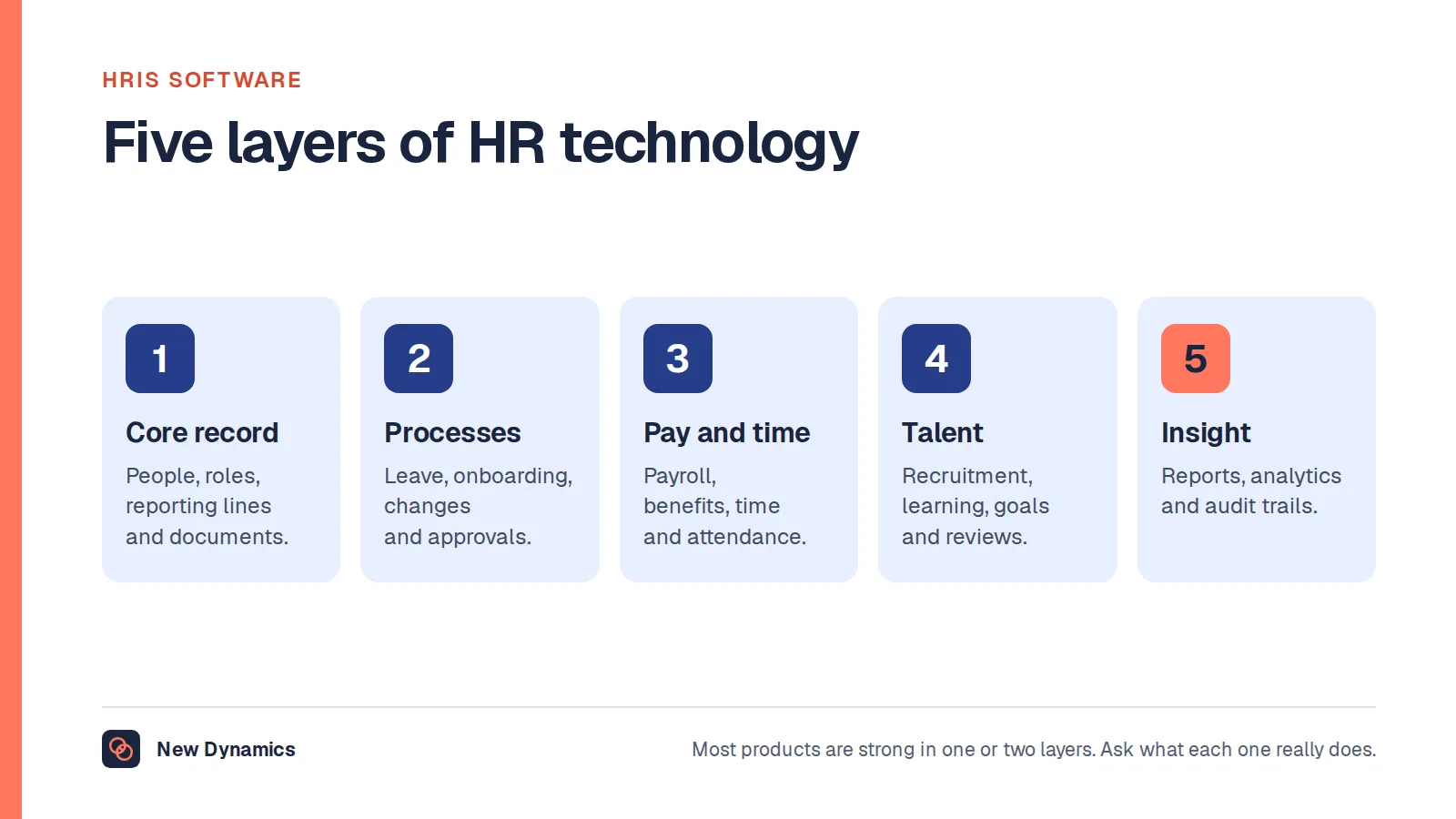
Our posts on payroll software and time and attendance software cover the systems on the other side of that boundary, HRIS software the people record both depend on, and employee scheduling software the rotas that decide who can be spared. For what is published about UK pay and working time, see our HR statistics hub.
The record keeping duty from 6 April 2026
The Working Time Regulations' own record duty is narrow: regulation 9 requires records "adequate to show whether the employer has complied with the limits" on weekly and night working, retained "for two years from the date on which they were made".
Holiday records are now a duty in their own right. GOV.UK's holiday pay guidance says: "From 6 April 2026, employers must keep detailed records of annual leave and holiday pay for a minimum of 6 years from the date they were made", adding that "Employers may have to pay a fine if they cannot show that they keep holiday records."
Acas's guidance on keeping records lists what must be recorded: "holiday taken", "holiday carried over from previous years", "holiday pay" and "any payments in lieu of holiday", noting that "For holiday pay, employers must give details of what's included. For example, bonuses or commission." Records may be kept "in any format they think is reasonable", and Acas warns that "If an employer cannot prove they have holiday records, it could be a criminal offence", with enforcement rights going to the Fair Work Agency. That page was last updated on 1 October 2026.
This changes the specification: six years of history, including carried days with their reasons and expiry dates and what each payment included, exportable on demand and survivable through a change of supplier. Put the export format in the contract and test it during implementation, not at the end.
No rankings, and where New Dynamics fits
Many searches that reach this page want a ranked list: best leave management software, top absence management tools, the five best staff holiday planners. This site does not publish vendor rankings, and will not name, rank, compare or price products in this category. The reasons are in why we do not publish a top 5 HRIS list: rankings can be shaped by commercial relationships a reader cannot see, and even an honest one cannot know your contract types, leave year, payroll or bank holidays.
What we can give you is the question set. Ask every supplier the same ten things, with your own data on screen.
- A term-time part-year worker accruing in hours across a pay period with a non-working week.
- A zero-hours worker who goes on maternity leave, and the accrual during that leave.
- A contract changed from 40 to 20 hours in month four: the balance before and after.
- A part-time pattern with a bank holiday on a working day and one on a non-working day.
- Days two and three of a five-day booking converted to sickness: balance, pay type, audit trail.
- Three carried balances with different reasons and expiry dates, and which is used first.
- The reminder warning someone they will lose untaken leave, and the log proving it was sent.
- Logins as a colleague, a line manager, HR and payroll, and what each sees in the reason field.
- The payroll file, the cut-off logic and the reconciliation report.
- An export of six years of holiday and holiday pay records, with what each payment included.
Our post on choosing HR software covers the selection itself, and the performance management software RFP template shows how to structure supplier questions so answers can be compared.
Plainly: this is not a product we sell. New Dynamics is a performance management platform for goals and OKRs, feedback, recognition, performance reviews and onboarding. It is not a core HR system of record, and it is not a leave or absence system. We do not calculate entitlement, accrue holiday, hold a leave balance or pay anybody. Where the subjects touch is the review cycle, because a long absence changes what a fair review looks like: see reviewing an employee on long-term sick leave and reviewing an employee on maternity leave. If the question is which system holds the leave record, the answer is your HR system or a specialist product.
Frequently asked questions
What does leave management software do?
Leave management software holds the leave rules, calculates entitlement, accrues it over the leave year, routes requests, shows managers who is away, hands numbers to payroll and keeps the record. In the United Kingdom it must also implement the Working Time Regulations 1998 floor of 5.6 weeks, the 28-day cap and the carry over rules. General information, not legal advice.
Is leave management software the same as absence management software?
They overlap. Leave management usually means booking and tracking planned time off such as annual leave. Absence management means the wider practice of recording and responding to all time off, including unplanned sickness. Many products do both, so compare features rather than labels.
How does leave management software handle irregular hours workers?
Differently from everybody else, by law. Under regulation 15B of the Working Time Regulations 1998, irregular hours and part-year workers accrue leave "on the last day of each pay period at the rate of 12.07% of the number of hours that they have worked during that pay period", capped at 28 days a leave year. Ask to see that in hours, on a real contract.
Can leave management software stop someone taking their holiday?
No, and a system configured to do so creates a legal problem rather than solving a staffing one. GOV.UK says that although employers can refuse leave at a certain time, "they cannot refuse to let workers take the leave at all". Dates can be refused with the right notice; the entitlement must stay available. United Kingdom position, general information only.
What holiday records must an employer keep?
GOV.UK says that from 6 April 2026 "employers must keep detailed records of annual leave and holiday pay for a minimum of 6 years from the date they were made". Acas lists holiday taken, holiday carried over, holiday pay and payments in lieu, with details of what the pay included. Check your system can export all six years.
What is the best leave management software?
We do not publish vendor rankings, so this site will not answer that with a product name. Best only means something relative to your contract types, leave year, bank holiday calendar and payroll arrangements. Use the ten demonstration questions above with your own data, and take references from organisations with similar contracts.
Your next step: run the ten scenarios
- Write your leave year, bank holiday treatment and carry over rule on one page.
- Pick four real people: a full-timer, a part-timer whose non-working day is a Monday, a term-time or part-year worker, and somebody who changed hours mid-year.
- Send the ten questions above to every supplier and insist on seeing them run, not described.
- Agree the payroll handover in writing, and test the six-year export before you sign.
For the method behind a selection like this, read our HRIS selection guide. The guide is free to read, and the PDF uses our short download form.
If the problem you are really trying to fix is the review cycle rather than the leave calendar, book a New Dynamics demo and send us the review form you use today. You can also email contact@new-dynamics.com.