TL;DR
- Payroll invoice is not a defined term. It is used for at least three different documents: the fee note from a payroll bureau, a self-employed person's invoice offered in place of going on payroll, and an umbrella company's invoice to a recruitment agency for a placed worker.
- A bureau's invoice is for the service, not the pay. Net wages, the PAYE bill and the provider's fee are three separate payments, and GOV.UK is blunt about what outsourcing does not move: "As an employer, you're legally responsible for completing all PAYE tasks - even if you pay someone else to do them."
- Whether someone can invoice you instead of being paid through payroll turns on employment status, not on preference. GOV.UK lists "they submit invoices for the work they've done" as one indicator of self-employment among several, and warns that employers "may have to pay unpaid tax and penalties" if the status is wrong. United Kingdom, general information, not legal or tax advice.
Three people search for payroll invoice in the same hour and want three unrelated answers. One has a fee note from a payroll bureau on the desk and cannot tell which lines are the service and which are the money. One has been asked whether somebody can come off payroll and invoice instead. One is in a staffing chain and wants to know what an umbrella company's invoice to the agency represents.
The phrase is not a term of art. No statute defines it and HMRC publishes no page under that heading, so this article answers all three in order. The middle question gets the most room because it is the one that costs money. It is settled by employment status, not by preference, and getting it wrong leaves the PAYE and National Insurance bill with the engager.
Invoice arguments are usually record arguments: who approved this scope, who signed off the status decision, who authorised the extra pay run. See how New Dynamics workflows put an owner and a date on each approval, so the evidence exists before anyone asks for it. New Dynamics does not run payroll and is not a payroll provider. This covers the United Kingdom and is general information rather than legal or tax advice.

Three different questions behind one phrase
Separating them saves confusion later.
- A payroll bureau's invoice. A bill from a provider for running your pay runs. The subject is a service fee.
- An invoice in place of payroll. Somebody who would otherwise be an employee or worker proposes to send invoices instead. The subject is employment status.
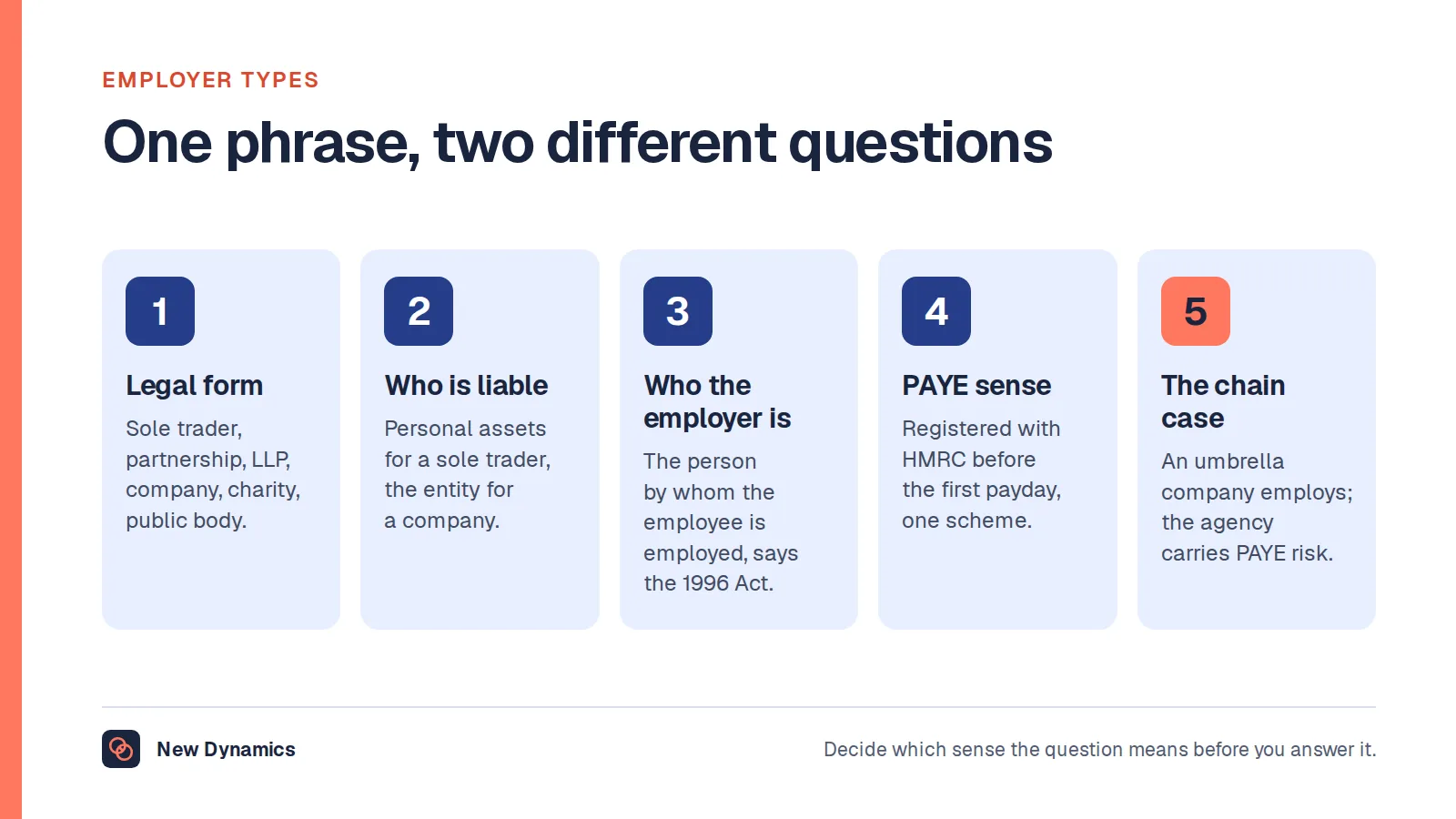
- An umbrella or agency invoice. A company in a labour supply chain invoices for the time a placed worker has worked. The subject is who employs the person and what the rate includes.
Only the first is an invoice for payroll. The other two are invoices instead of payroll, or invoices for labour, and different rules govern each. That is why one generic answer to "what is a payroll invoice" is wrong for two readers out of three.
What a payroll bureau invoice itemises
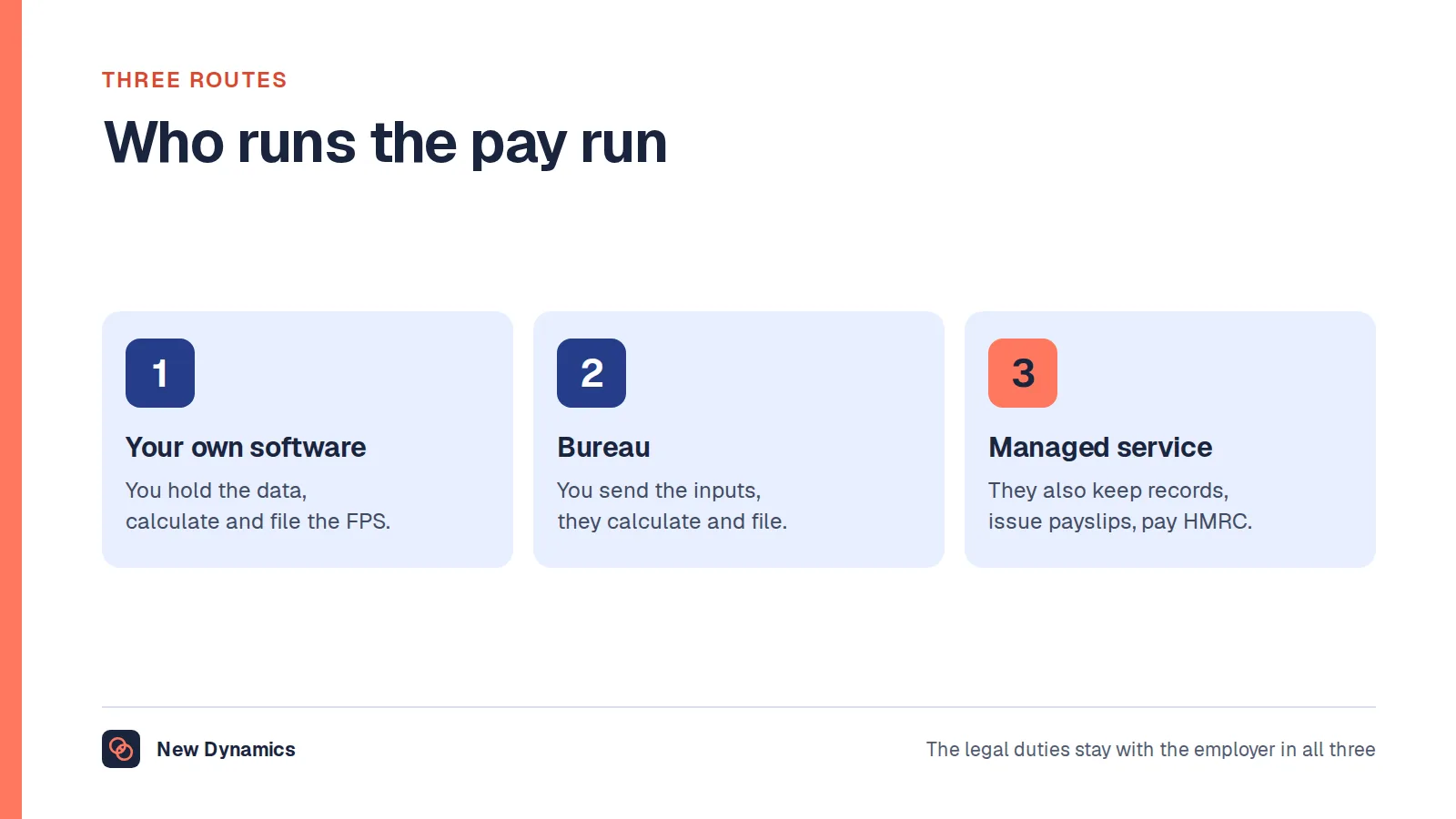
GOV.UK's guidance on PAYE and payroll for employers sets out the choice: "You can operate PAYE by either: paying a payroll provider to do it for you, doing it yourself using payroll software." It then describes how much a provider can take on, which is the key to reading an invoice: "Some payroll providers can offer you more support if you need it, for example keeping employee records, providing payslips and making payments to HM Revenue and Customs (HMRC)."
That last sentence is the invoice. Scope is what you are billed for. In practice a fee note is built from some combination of a standing charge per pay run, a charge per payslip produced, charges for starters and leavers, pension file submissions, year end documents, corrections and re-runs, and a one off implementation charge at the start.
No official source prescribes those line items, so there is no standard format to hold an invoice against. Your own contract is the only benchmark. Read the fee note beside the scope you agreed and check that every charged item is in scope, that per item charges match the headcount you actually paid that period, and that anything billed as an extra was asked for by somebody with authority to ask.
What the invoice is not is evidence that the filings happened. HMRC's guidance on how to check for signs of outsourced labour payroll fraud, published on 19 December 2022 and last updated on 4 February 2026, tells employers who have outsourced to "ask for evidence of Real Time Information (RTI) returns and payments made to HMRC", to "check who holds the contracts of employment for your staff" and to "keep a detailed record of all the checks you carry out". An invoice is a request for money, not a receipt from HMRC.
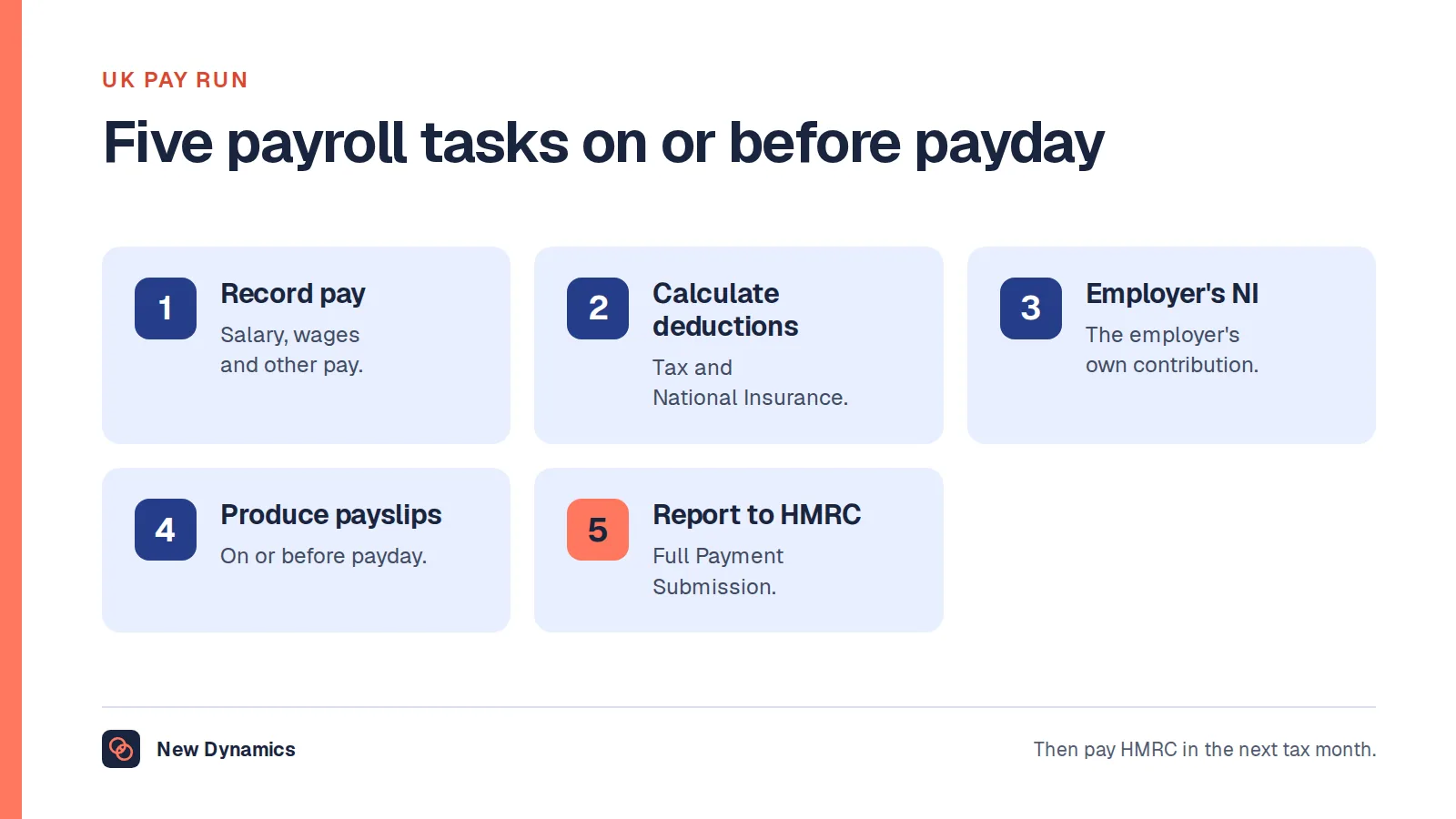
Nor does responsibility travel with the work. GOV.UK states it flatly: "As an employer, you're legally responsible for completing all PAYE tasks - even if you pay someone else to do them." For the wider choice between a bureau, a managed service and your own software, see our post on payroll services for small business. For what a pay run consists of, see what payroll is.
Why the invoice is not your wage cost
Three separate payments leave the business in a payroll month, and the invoice is the smallest.
- Net pay goes to employees on payday.
- The PAYE bill goes to HMRC. GOV.UK's guidance on how to pay your PAYE bill requires payment "by the 22nd of the next tax month if you pay monthly", and notes that "If you pay by cheque through the post, it must reach HMRC by the 19th of the month." The same page lists what the bill may include: "employee Income Tax deductions", "Class 1 and 1B National Insurance", "Class 1A National Insurance on termination awards and sporting testimonials", "Student Loan repayments", Construction Industry Scheme deductions and "your Apprenticeship Levy payments (starting from April 2017) if you, or employers you're connected to, have an annual pay bill of more than £3 million".
- The provider's fee goes to the bureau, on the invoice.
Employer National Insurance sits in the second of those, not the third, and it is a real cost that no invoice shows. HMRC's rates and thresholds for employers 2026 to 2027, published on 30 January 2026 and last updated on 1 September 2026, sets the secondary threshold (the point at which the employer starts paying) at £96 a week, £417 a month or £5,000 a year, against a primary threshold for employees of £242 a week, £1,048 a month or £12,570 a year. The same page gives Employment Allowance for 2026 to 2027 as £10,500 and the Apprenticeship Levy as a 0.5% charge with a £15,000 allowance.
Two GOV.UK pages disagree on that threshold, so it is worth knowing which to trust. The short guide to running payroll tells employers to "Calculate the employer's National Insurance contribution that you'll need to pay on their earnings above £242 a week", while PAYE and payroll for employers says the software works out what you owe "including an employer's National Insurance contribution on each employee's earnings above £96 a week". The rates and thresholds page governs. The £242 figure is the employee threshold, not the employer one.
VAT on payroll services
This is the section where a confident answer would be the wrong one. No GOV.UK or HMRC page states the VAT treatment of payroll bureau services as such. GOV.UK's list of VAT rates on different goods and services, last updated on 10 July 2026, says in its own words that it "is not a complete list", and payroll services are not among the exempt or zero rated items it names. The general position is on the VAT rates page: "The standard VAT rate is 20%", applying to "Most goods and services".
So the only safe statement is the narrow one. A VAT registered provider will charge VAT on its fee at the standard rate unless something specific takes that supply outside it, and the treatment of a particular invoice depends on what is actually supplied. Take advice on your own contract rather than reasoning from a rate table.
What HMRC does publish, and what matters more for reading an invoice, is how money passed on differs from money charged. The VAT guide (VAT Notice 700), last updated on 25 June 2026, explains at section 25.1.1 that "If you merely pay amounts to third parties as the agent of your client and debit your client with the precise amounts paid out, then you may be able to treat them as disbursements for VAT purposes, and exclude these amounts when you calculate any VAT due on your main supply to your client." Every condition must be met, including that "your outlay will be separately itemised when you invoice your client" and that "you recover only the exact amount which you paid to the third party". The notice's worked invoice shows services of £80.00 and expenses of £20.00 taken together as the £100.00 value for VAT, 20% VAT of £20.00, and disbursements of £50.00 outside that calculation, for a total of £170.00.
That is the structure to look for if a provider moves money for you as well as calculating it. Costs the provider incurred in making its own supply belong inside the VAT figure. Amounts genuinely paid on your behalf sit outside it.
A warning comes with it. HMRC's outsourced labour payroll fraud guidance tells employers to work out what they are buying, because "It may be: labour only, payroll services only, labour with payroll services", and adds: "If you know what you're getting, you'll be able to work how much VAT you should be paying. Fraudsters often lie about the supply of labour to make VAT seem higher than it should be." An invoice that blurs a fee, a wage and a supply of labour into one figure is not a formatting problem.

Can a worker invoice you instead of being on payroll?
The request usually sounds administrative. It is not. Whether somebody can be paid against an invoice rather than through PAYE depends on their employment status, and status is decided by how the work is actually done.
GOV.UK's employment status guide puts the two systems side by side: status "helps determine their rights, their employer's responsibilities", and "A person may have a different employment status in tax law." It also names who has the last word: "Courts and tribunals can make final decisions on employment status."
The page on being self-employed and a contractor is the one that matters for invoices. It opens with the test of substance, that "A person is self-employed if they run their business for themselves and take responsibility for its success or failure", and confirms that "Self-employed workers are not paid through PAYE." Then it lists the indicators, and the framing is the important part. Someone "is probably self-employed if they're self-employed for tax purposes and most of the following are true". Among them: "they put in bids or give quotes to get work", "they're not under direct supervision when working", "they submit invoices for the work they've done", "they're responsible for paying their own National Insurance and tax" and "they do not get holiday or sick pay when they're not working".
Invoicing is one item on that list. It is a symptom of running a business, not a way of becoming one. Issuing an invoice to a client you work for under supervision, at set hours, with no right to send a substitute changes the paperwork and nothing else. The same page states the consequence: "Individuals and their employers may have to pay unpaid tax and penalties, or lose entitlement to benefits, if their employment status is wrong." It also notes the asymmetry that catches people out: "HMRC may regard someone as self-employed for tax purposes even if they have a different status in employment law."
HMRC publishes a tool for the tax question. The guidance on Check employment status for tax (CEST), published on 2 March 2017 and last updated on 30 April 2025, says "The CEST tool gives HMRC's view of a worker's employment status, based on the information you provide." The commitment attached is conditional, and the conditions are the whole point: "HMRC will stand by all results given by the tool, as long as the information you give remains accurate and is in accordance with our guidance." There must be "a contract in place, or one expected", and you cannot save your progress part way through, so gather the facts first. Used afterwards, the result can serve as a status determination statement.
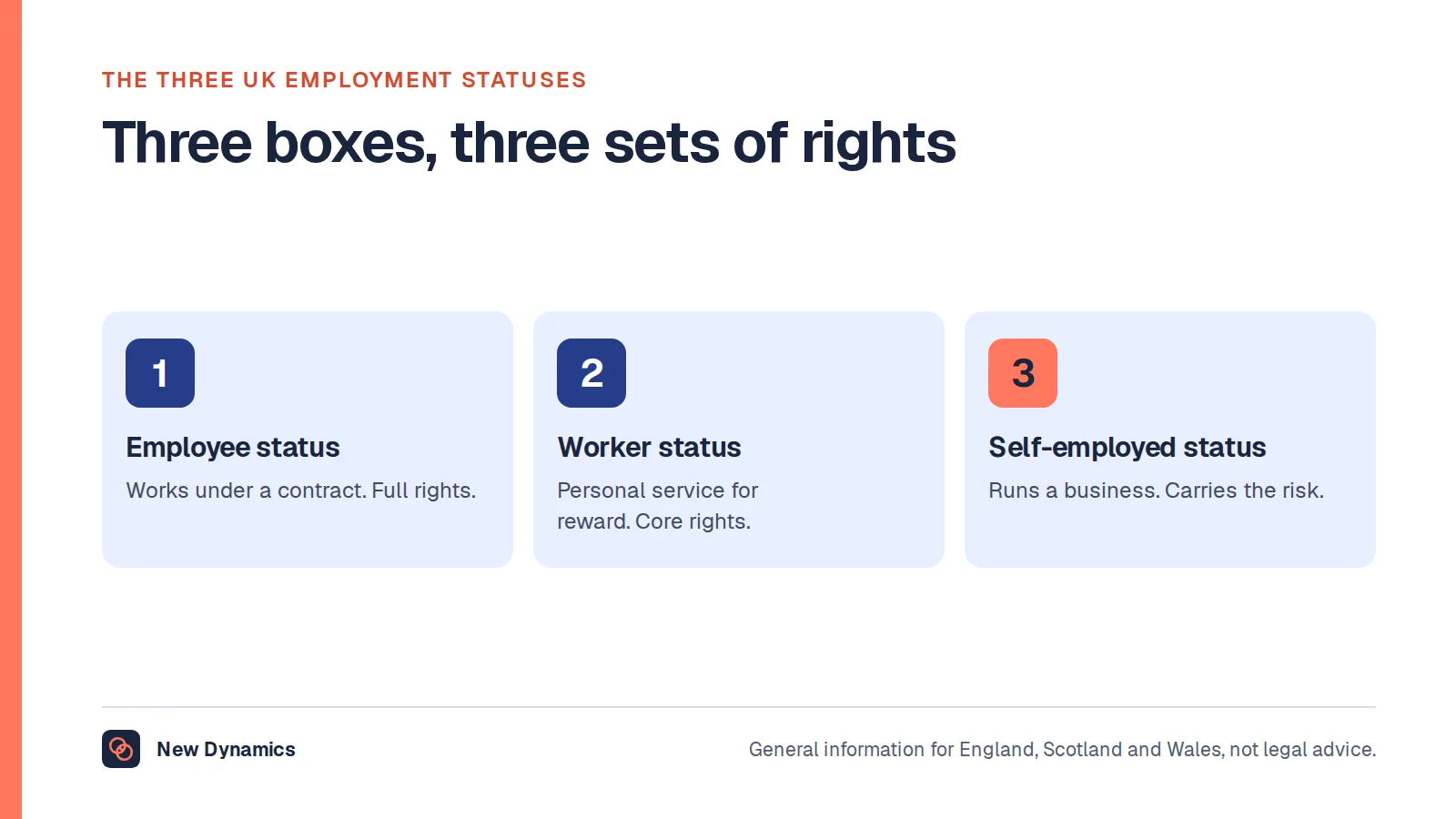
For the three statuses and the tests behind them, see our post on employment status. For what genuine self-employment looks like on both sides of the relationship, see independent contractor.
Off-payroll working, and who decides status
If the worker provides services through their own company, a second set of rules decides who carries the status decision. HMRC's guidance on understanding off-payroll working (IR35), published on 22 August 2019 and last updated on 26 February 2026, states the purpose: the rules "make sure that a worker (sometimes known as a contractor) pays broadly the same Income Tax and National Insurance as an employee would".
Responsibility splits by the client's size and sector. The same page: "In most cases, the client will be responsible for determining the employment status of the worker. However, if a worker provides services to a small client outside the public sector, the worker's intermediary is responsible for deciding the worker's employment status and if the rules apply." Where the client decides, it "should produce a status determination statement (SDS) including the reasons for their determination".
The guidance on off-payroll working for clients adds the mechanics. The statement "must be passed to the worker and the person or organisation you contract with" and "give your conclusion and the reasons for reaching it". Until you do that, "You are responsible for deducting Income Tax, employee National Insurance contributions, and paying employer National Insurance contributions". If a worker disagrees, "You must provide a response within 45 days", and failing to respond in time "will result in the worker's Income Tax and National Insurance contributions becoming your responsibility".
The size test is the part most likely to be out of date in whatever you read next, including on GOV.UK itself. The clients page, last updated on 30 August 2024, still lists the old Companies Act figures: "have an annual turnover of more than £10.2 million", "have a balance sheet total of more than £5.1 million", "have more than 50 employees". HMRC's Employment Status Manual at ESM10006A, updated on 7 October 2026, carries the current ones: "From 6 April 2025, two of these three thresholds in the Companies Act increased. The changes apply to financial years beginning on or after 6 April 2025. For these financial years, the thresholds for when a corporate entity is medium or large-sized are: Turnover of more than £15million; and Balance sheet total of more than £7.5 million. The 50-employee limit remains unchanged."
Both pages are official and they disagree. The manual governs, because the test follows the Companies Act 2006 small companies regime as amended and the shorter guidance page has not caught up. Do not assume the new thresholds take you out of the rules at once, though. A company must meet the conditions for two consecutive financial years, the relevant year is the last one whose filing period ended before the tax year began, and on HMRC's own reading of the transitional provision "the earliest tax year the transitional provision will impact a client is 2027/28". For the records this leaves you holding, see our post on contractor management software.
What an umbrella company invoice represents
HMRC's guidance on working through an umbrella company, published on 29 April 2021 and last updated on 17 September 2025, describes the arrangement: "An umbrella company is a business often used by recruitment agencies to pay temporary workers", and "The umbrella company is your employer and will pay you. The work you carry out will be for one of the recruitment agency's clients."
The invoice flows between the middle parties, not to the worker and usually not from the end client. HMRC lists what the umbrella company is responsible for under its contract with the agency: "employing you and paying your wages, in line with the key information document" and "invoicing the agency for the time you've worked". The amount follows the assignment rate: "The recruitment agency pays the umbrella company the agreed rate. This should be the assignment rate, multiplied by the time you have worked."
That rate is not the worker's wage, and HMRC says so directly: "You may not get paid the advertised pay rate. This is because it usually includes the umbrella company's operating costs." HMRC lists the deductions a worker should normally see on the reconciliation statement before gross pay is reached: "umbrella company operating costs (sometimes called 'margin')", "employer National Insurance contribution", "employer workplace pension contribution", "holiday pay" and "Apprenticeship Levy (if applicable)". Income Tax, employee National Insurance and employee pension contributions then come off gross pay, not off the assignment rate.
Two further points matter. The off-payroll rules are "unlikely to apply if you are employed by an umbrella company", because the worker is already an employee somewhere. And the PAYE position in these chains changed: HMRC flags "introducing new PAYE rules for labour supply chains that include umbrella companies from 6 April 2026". Our post on employer types covers who the employer is when an agency or an umbrella sits in the middle.
Frequently asked questions
What is a payroll invoice?
There is no legal definition. In practice the phrase covers three different documents: a payroll bureau's fee note for running your pay runs, an invoice sent by a genuinely self-employed person in place of being paid through payroll, and an umbrella company's invoice to a recruitment agency for the time a placed worker has worked. Each is governed by different rules.
Does a payroll invoice include the wages?
Usually not. A bureau's invoice is for the service. Net pay goes to employees and the PAYE bill goes to HMRC, which GOV.UK requires by the 22nd of the next tax month if you pay monthly. Where a provider also moves money for you, amounts paid on your behalf should be itemised separately from the fee rather than folded into it.
Is there VAT on payroll services?
No GOV.UK or HMRC page states the VAT treatment of payroll services specifically, and GOV.UK's list of rates says it is not a complete list. The published general position is that the standard rate of 20% applies to most goods and services, so a VAT registered provider will normally charge VAT on its fee, but the treatment of a particular supply depends on what is being supplied. Take advice on your own contract.
Can an employee invoice instead of going on payroll?
Not by choosing to. Payment method follows employment status, and status follows how the work is actually done. GOV.UK lists submitting invoices as one indicator of self-employment among several, alongside bidding for work, working without direct supervision and carrying your own tax and National Insurance. It also warns that employers may have to pay unpaid tax and penalties if the status is wrong.
Who decides whether the off-payroll working rules apply?
In most cases the client. HMRC states that where a worker provides services to a small client outside the public sector, the worker's own intermediary decides instead. A client that decides must issue a status determination statement giving its conclusion and reasons, pass it to the worker and the party it contracts with, and answer any disagreement within 45 days.
What counts as a small client for off-payroll working?
The Companies Act thresholds, as amended. HMRC's Employment Status Manual at ESM10006A, updated on 7 October 2026, gives turnover of more than £15 million and a balance sheet total of more than £7.5 million for financial years beginning on or after 6 April 2025, with the 50-employee limit unchanged. The shorter guidance page for clients still shows the older £10.2 million and £5.1 million figures.
What does an umbrella company invoice cover?
The time a worker has worked, at the assignment rate agreed with the recruitment agency. HMRC says the umbrella company is responsible for invoicing the agency for that time, and that the advertised rate usually includes the umbrella company's operating costs, so the worker's gross pay is what remains after the margin, employer National Insurance, employer pension contributions, holiday pay and any Apprenticeship Levy are taken off.
Your next step: match the invoice to the question
- Decide which of the three documents you are holding. A bureau fee note, an invoice in place of payroll and an umbrella invoice raise different questions.
- For a bureau invoice, lay it beside the contracted scope and your headcount for that period, line by line, and separate the fee from any money passed on.
- Ask your provider for evidence of Real Time Information returns and payments to HMRC, not just an invoice, and record that you asked.
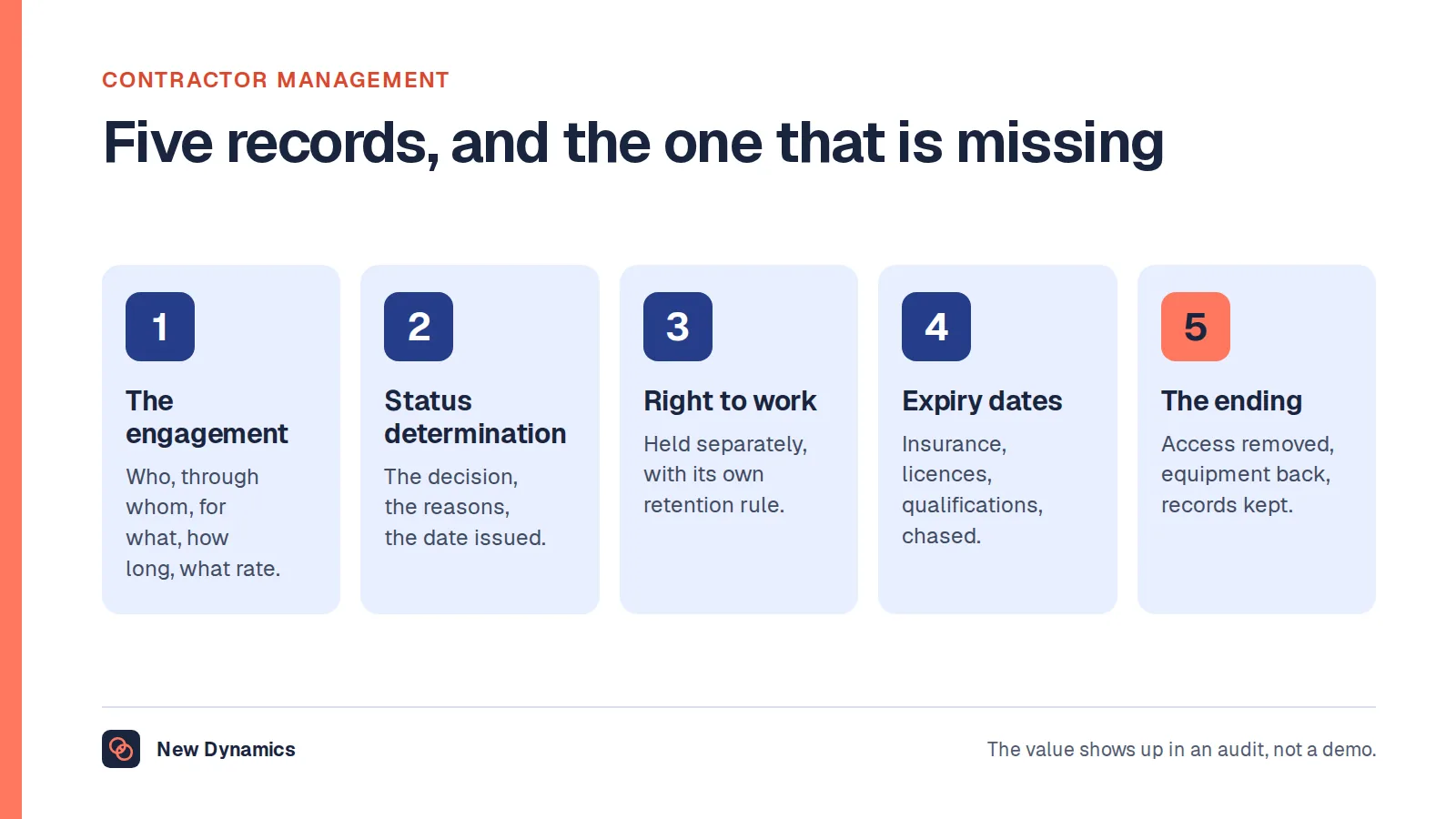
- For anyone proposing to invoice rather than join payroll, write down how the work is actually controlled, whether a substitute could be sent and who carries the financial risk. Run the facts through HMRC's Check Employment Status for Tax tool and keep the result with its answers.
- If the person works through their own company, confirm your own size under the current thresholds, then issue a status determination statement with reasons, and for an umbrella placement get the key information document and confirm which entity employs the person.
For the pay policy that sits behind all of this, read and download our compensation policy guide. The guide is free to read, and the PDF uses our short download form.
Want approvals, scope changes and status decisions recorded against the person instead of scattered through email? Book a New Dynamics demo and bring a real invoice query. You can also email contact@new-dynamics.com.