TL;DR
- GOV.UK says you can operate PAYE by either “paying a payroll provider to do it for you” or “doing it yourself using payroll software”. A managed service is the first option with more of the surrounding work included.
- Outsourcing moves the labour, not the liability. In GOV.UK's words: “As an employer, you're legally responsible for completing all PAYE tasks - even if you pay someone else to do them.”
- This site does not publish provider rankings or prices. What it gives you instead is the shape of the pricing models, the questions that separate a cheap quote from a complete one, and the duties nobody can take off your hands. United Kingdom, general information, not legal or tax advice.
Most small employers do not decide to outsource payroll. They arrive at it. The person who understood the spreadsheet is on holiday, a starter is paid late, somebody queries a deduction nobody can explain, and the conclusion forms on its own: this should be somebody's job, and that somebody should not be us.
The instinct is sound. What follows it is usually a search for a league table, which is where the trouble starts. The real choice is not between named companies. It is between three divisions of labour, each leaving a different amount of work, and the same legal responsibility, with you.
This article covers what a payroll bureau actually does, how a bureau differs from your own software and from a fully managed service, what a United Kingdom employer stays responsible for after outsourcing, the one-employee case, contractors and off-payroll working, and what changes when people are paid in more than one country.
Payroll fails at handovers far more often than at arithmetic, and outsourcing adds a handover rather than removing one. See how New Dynamics workflows put an owner and a due date on each starter, leaver and approved pay change, so the facts reach whoever runs the pay run before the cut-off instead of after it.
A note on the product, stated plainly: New Dynamics does not run payroll and is not a payroll provider. It does not calculate tax, file to HMRC or move money. This is general background, and it names no providers.
Our post on payroll software covers the software route, and our post on the payroll process covers the run itself. This article is about paying somebody else.
The jurisdiction throughout is the United Kingdom. This is general information rather than tax or legal advice, and rates, thresholds and rules change every tax year.
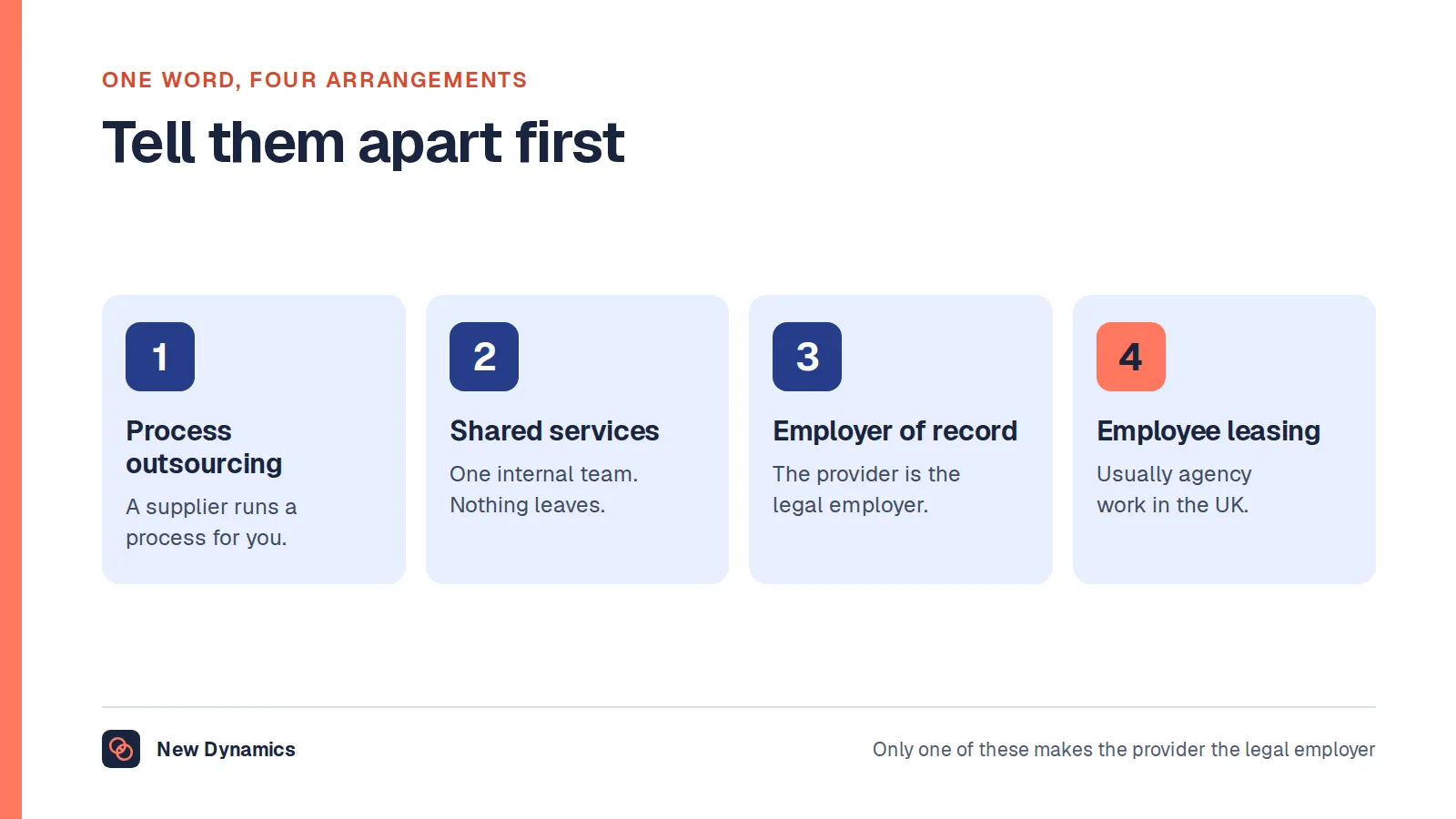
The words: payroll company, bureau, managed service
Providers use these terms interchangeably, so be precise before you ask for a quote. The words decide what you are buying.
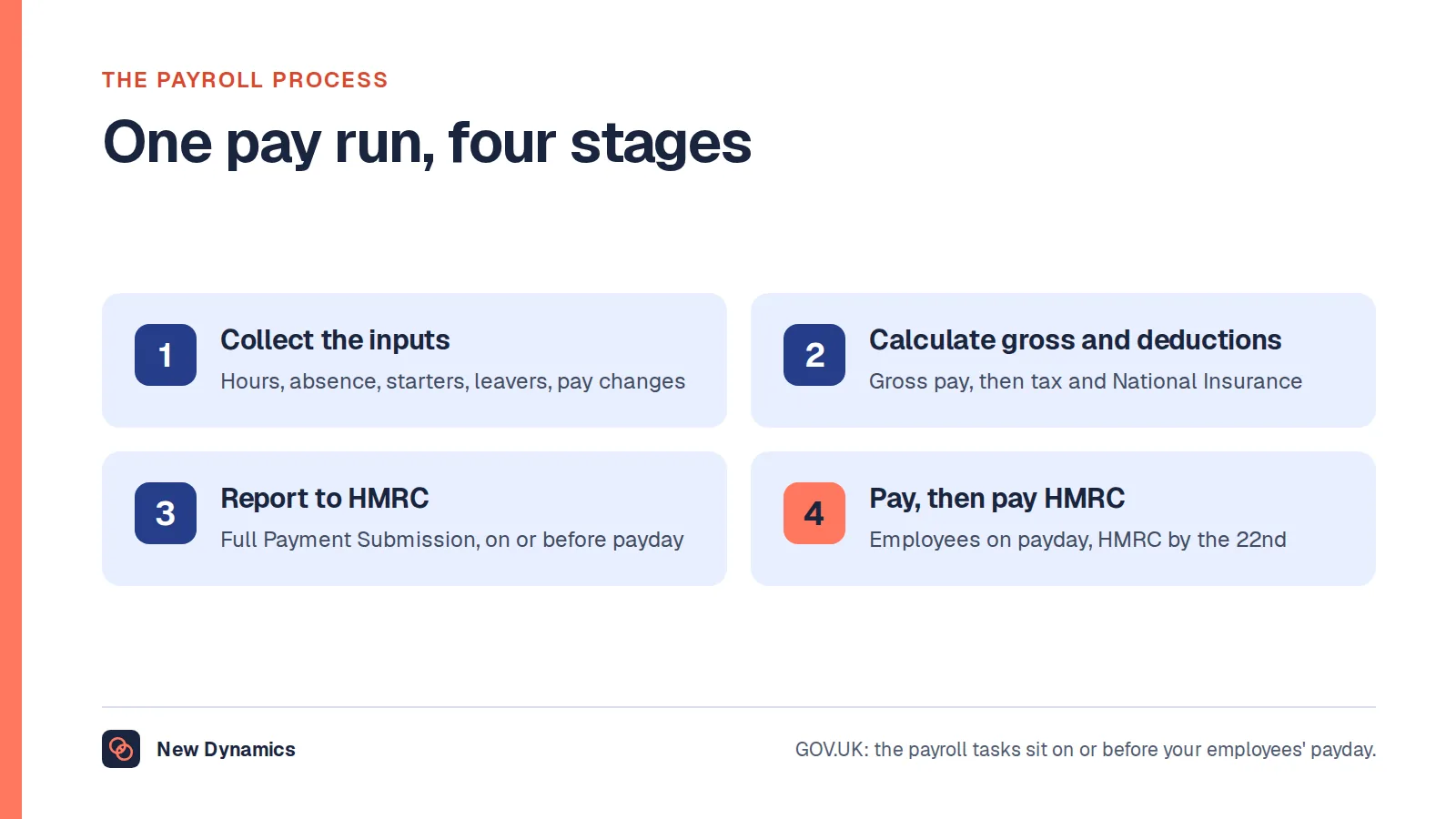
- Payroll bureau. You send the inputs each period (hours, absence, starters, leavers, pay changes), the bureau calculates pay, produces payslips and files to HMRC, then returns a report and a payment instruction. You still gather the facts and usually still make the payments.
- Managed payroll service. The same, with more included: holding employee records, issuing payslips to staff, handling HMRC correspondence and statutory payments, sometimes paying HMRC for you.
- Payroll company, payroll provider, payroll services. Umbrella terms covering both, saying nothing about scope.
- Online payroll for a small business. Either software you operate in a browser, or a bureau whose portal is how you send data. Establish which in the first conversation.
- HR and payroll companies. An HR system and a payroll service sold together. Check whether the payroll is theirs or resold, and who answers the phone on payday.
- Accountant. For many small employers this is the real answer. GOV.UK's own example of a payroll provider is "a bureau or accountant".
Strip the marketing away and the government describes a binary. GOV.UK's guidance on how to choose how to run payroll puts it in two lines: you can operate PAYE by either "paying a payroll provider to do it for you" or "doing it yourself using payroll software". Everything else is a question of how much work travels with the first option. The same page notes that providers "can offer you more support if you need it, for example keeping employee records, providing payslips and making payments to HM Revenue and Customs (HMRC)".
One further term appears if you look abroad: an employer of record, where a third party becomes the legal employer of your staff. Our post on the meaning of a PEO covers that separately.
What a payroll bureau actually does

A bureau is not a black box. It performs a defined list each period, and anything not on the list is still yours.
- It receives your inputs by an agreed cut-off. Hours, overtime, absence and statutory leave, starters with their tax information, leavers with final dates, pay changes, bonuses, commission and bank detail changes.
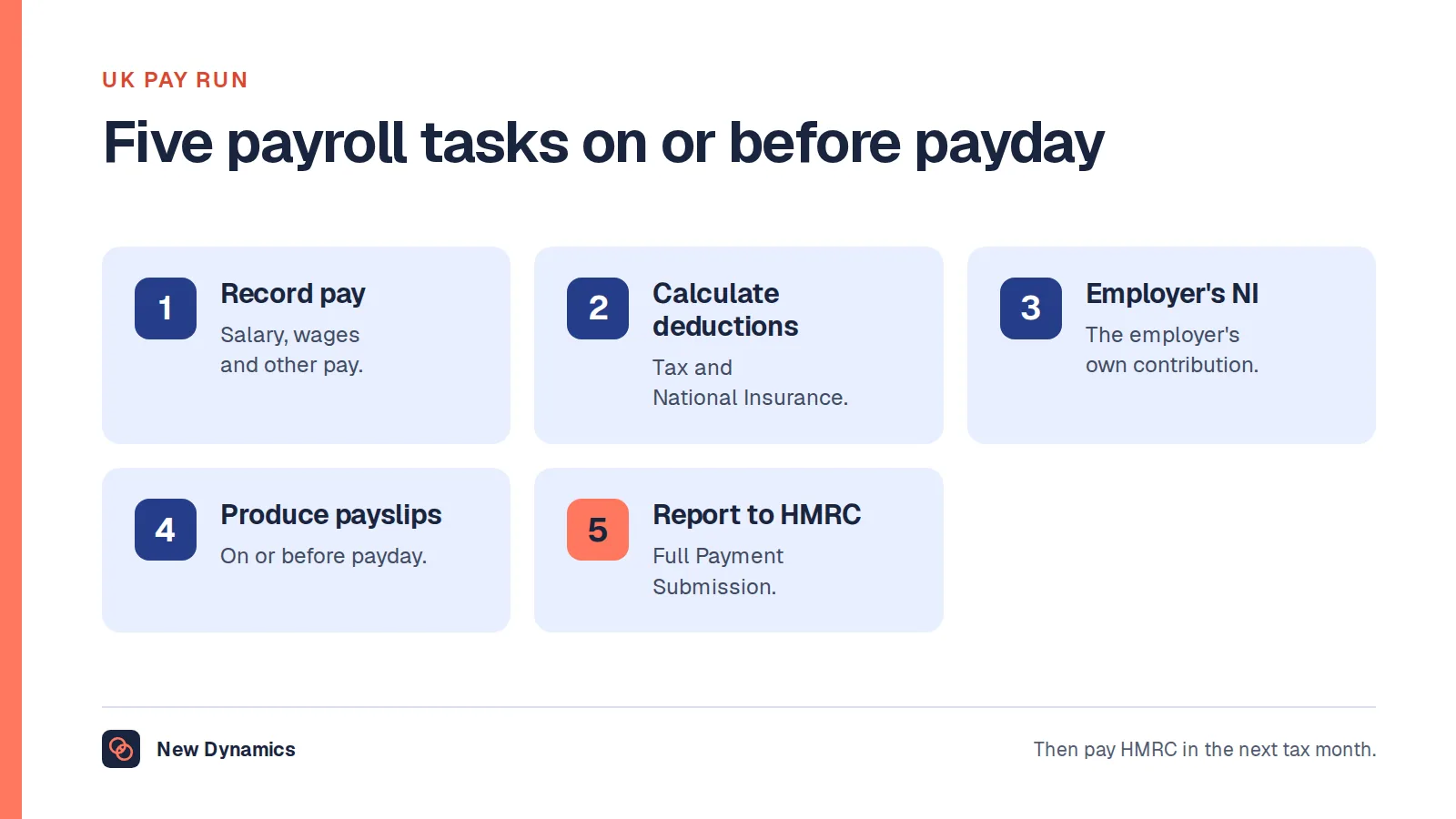
- It calculates gross pay, then the deductions. Income tax, National Insurance, pension contributions and student loan repayments. Our post on payroll deductions sets out which are compulsory, which need agreement and which are not permitted.
- It calculates the employer's own costs. Employer National Insurance and employer pension contributions, which are your cost rather than a deduction from the employee.
- It produces payslips. GOV.UK's guidance on payslips is firm: "Payslips must be provided on or before payday", and a payslip must show "your earnings before and after any deductions".
- It files the Full Payment Submission and returns the reports. Under Real Time Information the filing happens at the point of payment, not the month end. Back come the net pay total, a bank file and the amounts owed to HMRC and the pension provider.
- It handles the year end. The final submission of the tax year, P60s, P45s for leavers, and the rollover into the new year.
What a bureau typically does not do unless you pay for it: chase managers for timesheets, decide whether a worker is employed or self-employed, choose your pension scheme, answer employees' questions about their own pay, or notice that a leaver was never reported to it.
A bureau can only process what arrives. The most common outsourced payroll failure is not a miscalculation, it is a fact that never reached the bureau.
Your own software, a bureau, or a fully managed service
The useful comparison is not features against features. It is which tasks leave your building, what each option costs in time, and what breaks when the one person who understands it is away.
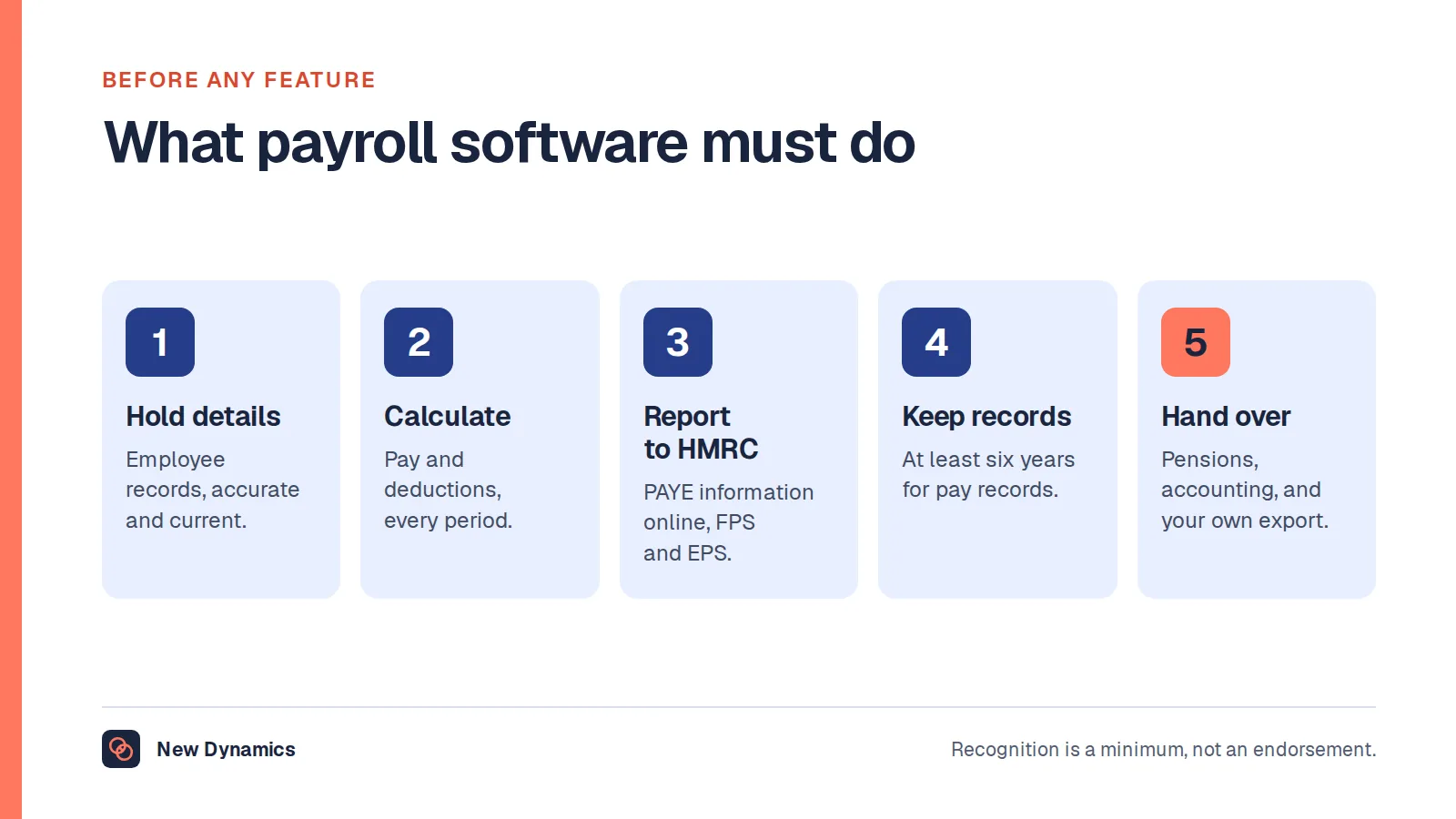
Running your own software. You keep full control of timing and corrections, and you carry the knowledge risk. GOV.UK's page on finding payroll software lists the job: "recording your employees' details", "working out your employees' pay and deductions" and "reporting payroll information to HMRC". This suits a stable headcount, simple pay, and at least two people who can run a period.
A bureau. The calculation and the filing leave your building. The data gathering does not. You gain professional experience, cover for holidays and illness, and somebody who has seen statutory maternity pay before. You lose flexibility on late changes, because the cut-off is a real deadline. This suits an employer where payroll takes a day a month and is understood by one person.
A fully managed service. Employee records, payslip distribution, HMRC correspondence and sometimes the HMRC payment go too. The cost is higher and the dependency deeper. You are relying on a provider for records you are legally obliged to produce, which makes the export clause a compliance question. This suits an employer with no internal payroll capability, or one whose payroll has complications (multiple entities, construction subcontractors, people in more than one country) that an occasional operator will get wrong.
Whichever route you take, compare total time and risk rather than the monthly invoice. A bureau that halves your invoice and doubles your preparation time has saved you nothing.
Why this site does not rank or price providers
Search for the best or cheapest payroll service and you will find dozens of ranked lists. We do not publish one. We cannot verify a provider's accuracy rate, its payday response time, its error-correction record or its price for your payroll, and a ranking assembled from marketing pages is worse than none. Nor do we publish prices: a quote depends on headcount, pay frequency, entities, statutory payments and scope, so any number here would be wrong for most readers.
HMRC takes the same position about the software market. On finding payroll software it states that HMRC "cannot recommend one software product or service over another and is not responsible for any problems you have with software that you've bought". A department that holds the filings declines to rank the market, and a website should be at least as careful.
How payroll pricing is usually put together
What we can give you is the shape of the models, so you can compare two quotes that look nothing alike. Ask which apply, and ask for the quote itemised.
- Per payslip. A leaver paid twice in a month may count as two.
- Per employee per month. A headcount charge however often that person is paid. Cheaper for weekly payrolls, dearer where there are many leavers.
- A minimum monthly fee. The figure that governs the cost of a one-employee or two-employee payroll.
- A setup fee. For taking the payroll on, loading history and parallel running. Ask whether it is waived, fixed or time-based.
- Charges per payroll run, if you need off-cycle runs for a late starter or a correction.
- Extras, where quotes diverge. Year end and P60s, P11D reporting, pension files, auto-enrolment assessment, statutory payments, bank files, portals, corrections and advisory time.
Two questions turn a headline rate into a comparable one: what would last year's payroll have cost under this quote, and what is not included?
A cheap quote is not automatically a bad one. But the costs that hurt are not on the invoice: the late Full Payment Submission, the duplicated record after a careless migration, the hours reconciling a total that will not match. Price the whole thing, including the exit.
What a UK employer stays responsible for

The PAYE duties do not move. GOV.UK: "As an employer, you're legally responsible for completing all PAYE tasks - even if you pay someone else to do them." Authorising an agent to deal with HMRC for you is an administrative permission, not a transfer of liability.
The data is yours to collect and keep. GOV.UK is explicit: "You're responsible for collecting and keeping records of your employee's details." The statutory duty appears in GOV.UK's guidance on keeping payroll records, which lists what you pay employees, the deductions you make, your reports and payments to HMRC, leave and sickness, tax codes and taxable benefits. It sets the period too: "you need to keep them for 3 years from the end of the tax year they relate to", and the consequence: "If you do not keep full records, HMRC may estimate what you have to pay and charge you a penalty of up to £3,000."
If your records live only in a provider's portal, and the contract ends, the obligation outlives your access. Our post on payroll records sets out the categories in full.
The filing deadline is still your deadline. GOV.UK's guidance on sending an FPS after payday says that a late Full Payment Submission "without a valid reason" may bring "an online penalty warning message for the first late FPS you send each month", or a penalty. A bureau that files late because your inputs arrived late has created a problem that lands on your PAYE record.
Auto-enrolment is a separate duty. GOV.UK's guidance for employers on workplace pensions states that "employers have to provide a workplace pension scheme for eligible staff as soon as their first member of staff starts working for them (known as your 'duties start date')". A provider can run the assessment and the deductions. The duty is yours.
Employment status and data protection stay with you too. GOV.UK's guidance on employment status notes that "courts and tribunals can make final decisions on employment status", so it is a legal determination rather than a payroll setting. Handing payroll data to a provider also makes them a processor of sensitive personal data: "You must follow rules on data protection if your business stores or uses personal information."
So the model is not "payroll is now their problem" but "payroll is now their work and still my responsibility". Hence the most valuable step after outsourcing: name one person internally who checks the output before every payday.
Payroll for one employee, and a director paying themselves
The one-employee case is the most searched and the least well served, partly because it is often not an employee at all. It is a director of a limited company paying themselves a salary.
The Department for Business and Trade's business population estimates for 2025, published on 2 October 2025, report that at the start of 2025 "there were estimated to be 5.7 million UK private sector businesses" and that "1.4 million (25%) businesses had employees and 4.3 million (75%) did not employ anyone aside from the owners". Most have no employees at all. For wider workforce figures, see our HR statistics hub.
A single-person payroll still involves:
- The full PAYE machinery, at full length. One employee does not mean a simplified scheme. You register as an employer, file a Full Payment Submission on or before each payday, produce a payslip, pay HMRC and keep records for three years.
- A filing even in months when nobody is paid. GOV.UK's guidance on running payroll states that you must send an "Employer Payment Summary (EPS) to HM Revenue and Customs (HMRC) if you've not paid any employees in a tax month". A director taking salary irregularly still has a monthly reporting obligation, and this is the most common one-person payroll mistake.
- Employment Allowance may not be available. GOV.UK's guidance on Employment Allowance eligibility states: "If your company has only one director, they must not be the only employee liable for secondary Class 1 National Insurance."
- Auto-enrolment still has to be assessed. Sole-director companies with no other staff are often outside the duty, but the position depends on the facts. Check it rather than assuming it.
- A P60 at the year end, and a P45 if you stop. Even for one person.
On cost, the honest answer is the one nobody wants: for a one-employee payroll the price is governed by the provider's minimum monthly fee rather than its per-payslip rate, and we do not publish provider prices. Ask three providers for a fixed annual figure covering twelve filings, a year end, a P60 and any month in which no salary is paid, then compare those numbers. Many accountants run a single-director payroll as a line on an existing engagement.
Contractors: off-payroll working, umbrellas and CIS
"Contractor payroll services" means at least four different things in the United Kingdom, and buying the wrong one is expensive.
A genuinely self-employed contractor who invoices you is not payroll at all. It is accounts payable. GOV.UK's payslips guidance confirms that an employer does not have to provide one to someone who is "not an employee or 'worker', for example a contractor or freelancer".
A contractor working through their own company may bring the off-payroll working rules into play. HMRC's guidance on understanding off-payroll working (IR35), last updated on 26 February 2026, explains that the rules "make sure that a worker (sometimes known as a contractor) pays broadly the same Income Tax and National Insurance as an employee would".
Who decides matters, and small businesses are treated differently: "In most cases, the client will be responsible for determining the employment status of the worker. However, if a worker provides services to a small client outside the public sector, the worker's intermediary is responsible for deciding the worker's employment status and if the rules apply." Where the rules apply, the deemed employer has PAYE obligations on the payment, which is a payroll task and belongs in your provider's scope.
A contractor supplied by an agency may be employed by an umbrella company. HMRC's guidance on working through an umbrella company, last updated on 17 September 2025, describes an umbrella as "a business often used by recruitment agencies to pay temporary workers" and says that "in most cases, the umbrella company employs you and pays your wages through PAYE". It also flags a change: the government is "introducing new PAYE rules for labour supply chains that include umbrella companies from 6 April 2026". If you use agency labour, ask your provider and your agencies what that means.
Construction work carries a separate scheme on top. GOV.UK's guidance on the Construction Industry Scheme explains that under CIS "contractors deduct money from a subcontractor's payments and pass it to HM Revenue and Customs (HMRC)", that "the deductions count as advance payments towards the subcontractor's tax and National Insurance", and that "contractors must register for the scheme". It catches businesses outside construction that have "spent more than £3 million on construction in the 12 months since you made your first payment".
CIS returns are monthly, a filing obligation in their own right, and not every payroll provider includes them. Ask. Our post on contractor management software covers the records side, and our post on employment status covers the categories.
Paying people in more than one country
Global payroll and international payroll are sold as single products. They are almost never a single payroll, but a coordination layer over a set of local payrolls, each run under its own country's rules.
A person working in the UK for an overseas employer may still be your PAYE problem. HMRC's guidance on a new employee coming to work from abroad, last updated on 10 December 2025, says: "You must operate PAYE tax and National Insurance contributions for employees coming to work in the UK from abroad, whether they're working for you on a temporary or permanent basis." On secondments it goes further: "If the employee is still employed by an overseas business and you do not actually pay them, you're still treated as their employer and are responsible for recording and reporting their earnings and PAYE deductions to HMRC."
Social security is decided separately from income tax. HMRC's guidance on National Insurance for workers from the UK working in the EEA or Switzerland sets out the principle: "If you leave the UK to work in the EU, Gibraltar, Iceland, Liechtenstein, Norway or Switzerland, you will only pay into one country's social security scheme at a time", and "you will usually pay social security contributions (National Insurance in the UK) in the country you are working in". For the employer, "your liability to pay social security contributions will follow the liability of the employee concerned". Staying in the UK scheme is not a setting in payroll software: "You only need to pay National Insurance in the UK if HMRC has issued you with a certificate of coverage (also referred to as a PDA1)." That has to be applied for, per person and per posting.
So the questions for an international provider are narrow and factual.
- Which countries do you run yourself, and which do you subcontract? Get the local partners' names.
- Who is the legal employer in each country? An employer of record is a different arrangement, with implications for employment rights and termination.
- Who carries responsibility for local filings and local penalties, and where is that written?
- What is the local filing deadline and cut-off, and is reporting consolidated? Ask to see a real consolidated report, with the exchange rate basis, and check where the personal data sits.
A country list is a sales document rather than a capability statement, so ask when they last ran a payroll there and for how many people. Permanent establishment and local employment law are not payroll questions: take local advice before the first payday in a new country.
Questions to ask before you sign
Bring these to the second conversation, after the demonstration and before the contract.
- Show me a messy pay run. A mid-month starter, a leaver with holiday pay, an overtime correction and one statutory payment, in the same period.
- What is in scope, task by task? Use the six-step list above and mark each line theirs, yours or extra.
- What is the cut-off, and what happens when I miss it? Get the cost and the mechanism of an off-cycle run.
- How do errors get corrected, and who pays? Ask specifically about a late FPS caused by the provider.
- What does the data handover look like if we leave? Format, timescale and cost. Then check it would satisfy a three-year record request.
- What would last year's payroll have cost under this quote?
The two words providers lean on hardest need pinning down here as well. Reliability, in a contract, is a named contact on payday, a stated response time, an escalation path, an error-correction process and a position on who bears the cost when a filing is late. If none of that is written down, the word is decoration. Automation is worth paying for where it removes re-keying, which is where most payroll errors begin, and not worth having where it removes a check.
Three failures account for most outsourced payroll trouble: inputs that arrive after the cut-off, a leaver nobody reported, and records that live only in the provider's portal until the contract ends. Ask how each is handled before you sign. The provider calculates what it is sent, and checking that what it was sent was right is your job.
Switching provider without breaking the tax year

Moving payroll is the part people get wrong, and it is avoidable. One trap is documented by HMRC itself. On finding payroll software, under its heading on changing software, GOV.UK warns that "some payroll software will not let you continue with the same employee Payroll IDs if you've already used them in other software", and that where yours does not, you must "put 'Yes' in the 'Payroll ID changed indicator' for each employee in your Full Payment Submission (FPS)". The consequence of skipping it is stated plainly: "Your PAYE bill may be calculated incorrectly, and payroll records duplicated, if you do not."
That is the most useful sentence here for anyone changing provider mid-year. The rest is sequencing.
- Choose the date deliberately. The start of a tax year is cleanest, the start of a tax month next best. Mid-period is where year-to-date figures go wrong.
- Export everything before you give notice. Payslips, FPS history, year-to-date figures, pension records, P45s and P60s, in files you can open without the provider's software.
- Run one period in parallel, and compare the totals line by line.
- Confirm the first filing landed, in your HMRC online account rather than on anyone's word.
- Tell your employees before their payslip changes shape. A new layout, portal or bank reference generates queries that one email prevents.
Frequently asked questions
What is a payroll bureau, and how is it different from payroll software?
A payroll bureau is a provider you pay to run your pay run. You send the inputs by an agreed cut-off, and the bureau calculates pay and deductions, produces payslips and files to HMRC. Payroll software is a product you operate yourself. GOV.UK frames the choice as operating PAYE by either "paying a payroll provider to do it for you" or "doing it yourself using payroll software". A managed service is the first option with record keeping and payslip distribution included.
If I outsource payroll, is the provider liable for mistakes?
Not to HMRC. GOV.UK states that "as an employer, you're legally responsible for completing all PAYE tasks - even if you pay someone else to do them". Authorising an agent lets them act for you, but it does not transfer the duty. Whether you have recourse against a provider for its own error depends on your contract, so ask what it says about late filings and corrections before signing. This is the United Kingdom position and general information, not legal advice.
Which is the best payroll service for a small business?
This site does not publish provider rankings, and treats any list naming the best as marketing rather than evidence. We cannot verify accuracy rates, payday response times or error-correction records, and HMRC itself says it "cannot recommend one software product or service over another". Use the question list above instead: scope task by task, the cut-off, the named payday contact, the error-correction terms and the cost of leaving.
How much do payroll services cost for a small business?
We do not publish prices, because a quote depends on headcount, pay frequency, entities, statutory payments and scope. What you can compare is the structure: a per-payslip or per-employee-per-month charge, a minimum monthly fee, a setup fee, and extras such as the year end, P11Ds, pension submissions and off-cycle runs. For a very small payroll the minimum fee decides the cost.
Can I use a payroll service for one employee, or just for myself as a director?
Yes, and plenty of providers and accountants do. The obligations are not reduced by having one person on the payroll: you still file a Full Payment Submission on or before each payday, issue a payslip, pay HMRC and keep records for three years. Watch two things. GOV.UK requires an Employer Payment Summary "if you've not paid any employees in a tax month", and on Employment Allowance says that "if your company has only one director, they must not be the only employee liable for secondary Class 1 National Insurance".
Do I need an international payroll provider to pay someone in another country?
You need a compliant local payroll in each country, which a coordinating provider may arrange rather than run itself. Ask which countries are run in-house, which are subcontracted, and who is the legal employer in each. Two UK points matter whatever you choose: HMRC says you "must operate PAYE tax and National Insurance contributions for employees coming to work in the UK from abroad", and for EU postings you only pay National Insurance in the UK "if HMRC has issued you with a certificate of coverage".
Your next step: scope it before you shop
- Write down your last three payroll problems and where each started. Most will be a fact that arrived late rather than a sum that was wrong, and outsourcing alone does not fix those.
- Draw the six-step list and mark each line theirs, yours or extra. Take that sheet into the quote conversation instead of a feature grid.
- Fix the cut-off and the owner of each input first. A clean input process makes every option cheaper.
- Name the person who checks the output before every payday, and ask for the exit terms in writing at the start.
Pay decisions arrive at payroll as instructions, so they need to be made and recorded properly before they get there. Read and download our compensation policy guide for a clear approach to setting, approving and documenting pay. The guide is free to read, and the PDF uses our short download form.
Want the starters, leavers and approved pay changes to reach your payroll provider on time, with an owner and a date against each one? Book a New Dynamics demo and bring your current payroll calendar. You can also email contact@new-dynamics.com.