TL;DR
- There is no official definition of "employer type". The phrase covers two separate questions: what legal form the employing entity takes, and whether that entity has registered with HMRC as an employer.
- The Employment Rights Act 1996 settles identity rather than form. Section 230(4) says "employer", in relation to an employee or a worker, means "the person by whom the employee or worker is (or, where the employment has ceased, was) employed".
- Legal form rarely changes a core duty. The Pensions Regulator states that under the Pensions Act 2008 "every employer in the UK must put certain staff into a workplace pension scheme and contribute towards it". Size and sector are what switch extra duties on.
Ask what type of employer someone is and the answer depends on which question was meant. One person wants to know whether the employing entity is a sole trader, a partnership or a limited company. Another is filling in a form that asks for an employer type and wants to know what HMRC calls them. Running the two together is how an employee ends up chasing a person who was never their employer.
This article separates the two senses, then covers the part where most of the confusion lives: who the employer is when an agency or an umbrella company sits in the middle. Keeping the answer straight is a records problem first, which is why New Dynamics org charts hold the employing entity against each person. It covers the United Kingdom, and it is general information rather than legal advice.
First, a definition problem worth naming. No official source defines "employer type". GOV.UK and HMRC use "business structure" or "legal status" for the legal form. HMRC's internal PAYE Manual does have a section titled employer types, introduced as concerning "the tax and NIC treatment of certain types of employer", but it turns out to cover councillors, care workers, local religious centres and school funding arrangements. The phrase is real and unstandardised. If a form asks for it, read the options before you answer.
Knowing which entity employs each person is a records problem before it is a legal one. New Dynamics org charts hold the employing entity against each person, so a group with several payrolls can see who sits in which company.
The two senses of "employer type"
Sense one: the legal form of the employing entity. Sole trader, ordinary partnership, limited liability partnership, limited company, charity, unincorporated association, public body. This decides who the contract is with, who can be sued, and whose assets are at risk.
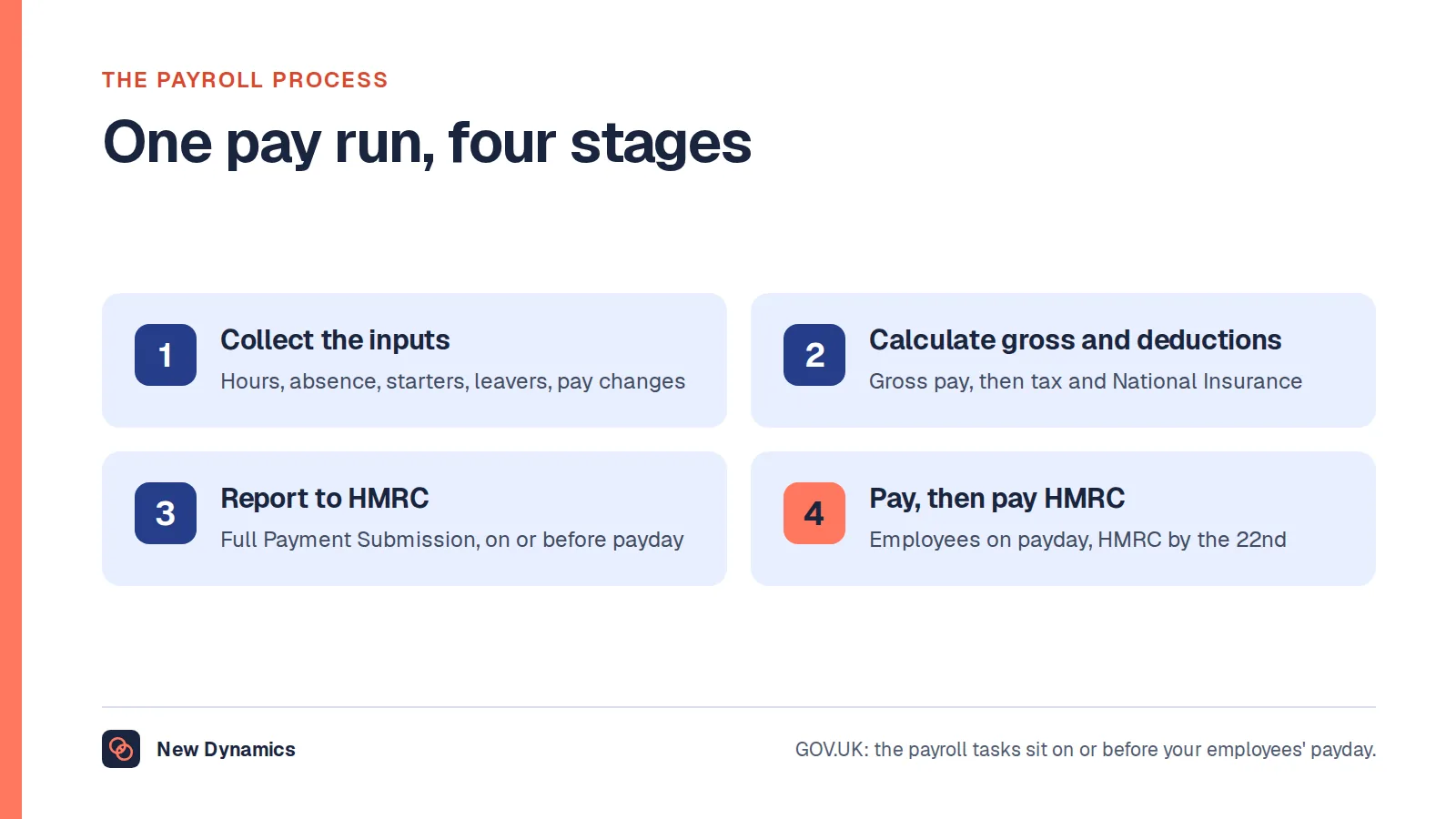
Sense two: the HMRC and PAYE sense. Whether the entity has registered as an employer, and which reporting obligations follow. This decides what it must send HMRC and when.
A sole trader with four staff and a limited company with four staff are far apart in sense one and nearly identical in sense two.
Who the employer is in law
The law answers identity, not form. The Employment Rights Act 1996, at section 230(4), says: "In this Act 'employer', in relation to an employee or a worker, means the person by whom the employee or worker is (or, where the employment has ceased, was) employed." Legislation.gov.uk records that section 230 "is up to date with all changes known to be in force on or before 06 November 2026".
"Person" there includes a company, a partnership and a public body, not only a human being. And the statute does not grade employers by type: it asks who employed the individual, and liability flows from that one fact. For which rights the individual then gets, see our post on employment status.
The legal forms, and what changes with each
GOV.UK's guide on setting up a business makes the point that matters: "The business structure you choose can affect the way you pay tax and your legal responsibilities."
- Sole trader. GOV.UK: "You are personally responsible for all of the debts of the business. This is called 'unlimited liability'." A sole trader can still be an employer, and the same page says under "Taking on employees" that "You can have employees". The contract is with the individual, so an award against the business reaches that individual's own assets.
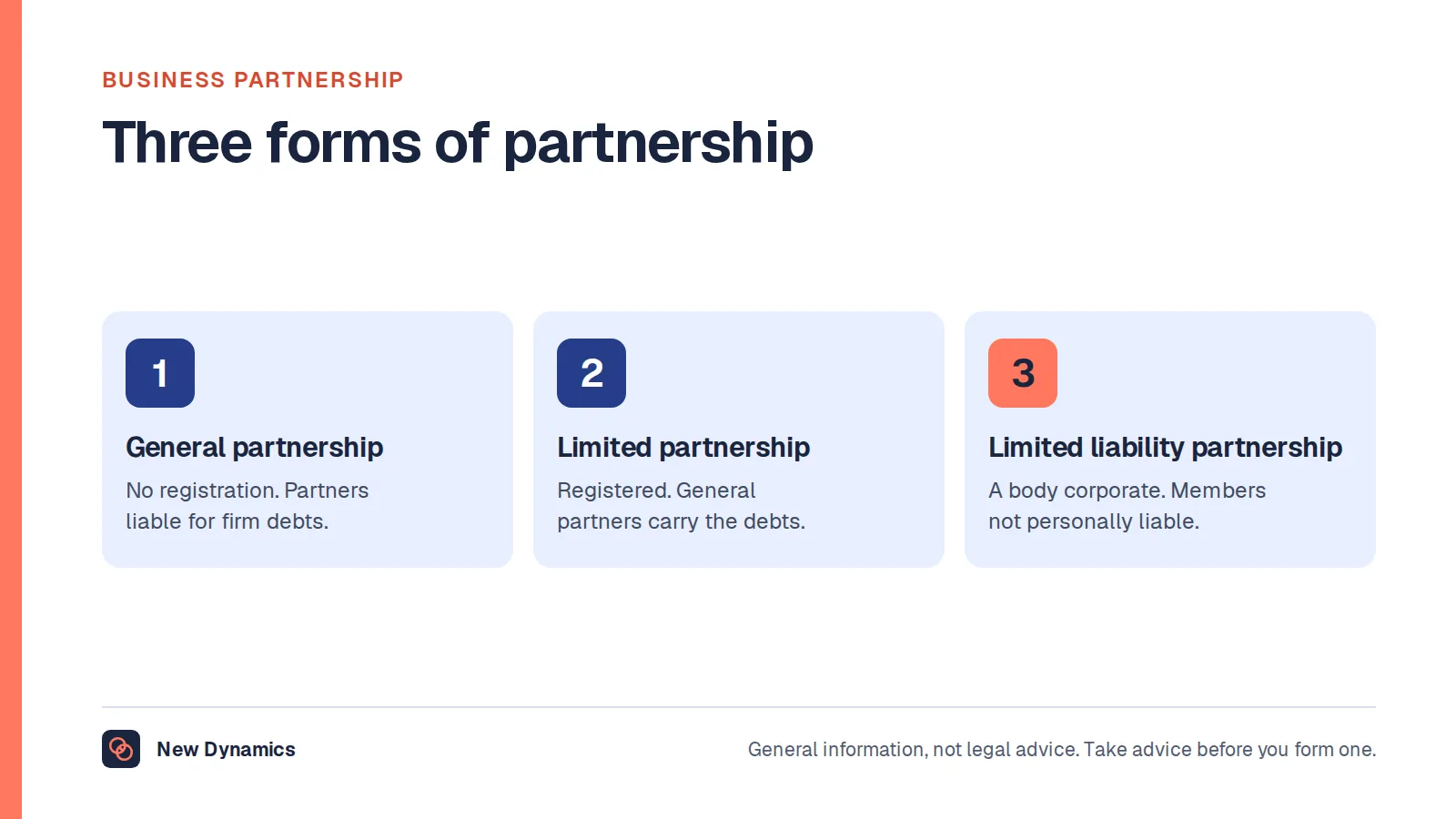
- Ordinary partnership. Partners are self-employed and liability is shared, so staff are employed by the firm, meaning the partners jointly. Our post on business partnerships covers the three partnership forms and joint and several liability.
- Limited liability partnership. A body corporate in its own right, so the LLP is the employer. Gender pay gap reporting treats its members oddly: the statutory guidance says "Do not include partners in traditional partnerships and limited liability partnerships" in the calculations, while the headcount does include "partners on a salary, or limited liability partnership (LLP) members who you treat as employees for payroll purposes".
- Limited company. GOV.UK: "A limited company is legally separate from the people who own it, and is run by one or more directors", and owners "are responsible for the debts of the business only up to the value of their financial investment. This is called 'limited liability'." On the director's own position it is careful: "Company directors may be employees of the company or office holders."
- Charity and unincorporated association. GOV.UK lists "a social enterprise" and "an unincorporated association" among the other ways to set up. A charity employs in its own right, but where it is unincorporated the trustees carry the exposure, which is why many charities incorporate before taking on staff.
- Public body. The core duties match the private sector; the edges diverge, and the Employment Allowance restriction below is the clearest case.
Most employers are companies, even though most businesses are not
The Department for Business, Innovation, Science and Trade published Business population estimates for the UK and regions 2026 on 5 November 2026, reporting the position at the start of 2026. By count, "the UK private sector business population comprised 3.1 million sole proprietorships (55% of the total), 2.2 million actively trading companies (39%) and 343,000 ordinary partnerships (6%)". Ask which of them employ anyone and the ranking inverts: "1.22 million companies were employers, as were 175,000 sole proprietorships and 77,000 ordinary partnerships". The release is an official statistic in development and excludes the government and not-for-profit sectors. For more figures like this, see our HR statistics hub.

Who is the employer with an agency or an umbrella company
This is where the question usually arrives in practice, and the answer is rarely the business where the person turns up for work.
HMRC's guidance on working through an umbrella company is direct: "The umbrella company is your employer and will pay you. The work you carry out will be for one of the recruitment agency's clients." HMRC lists four parties in the chain, a client, a recruitment agency, an umbrella company and the worker, and only one of them is the employer.
The PAYE side changed this year. HMRC's guidance on PAYE rules for labour supply chains that include umbrella companies from 6 April 2026 was first published on 17 September 2025 and updated on 19 June 2026 with the note that "The wording about the rules and draft legislation have been updated because it is now in force". The rules apply to "money paid to workers on or after 6 April 2026", and the key sentence is: "The agency or end client is responsible for making sure PAYE is operated correctly, when an umbrella company employs their workers. We can recover any underpayment of PAYE from them."
So there is a genuine split. The umbrella company remains the employer and, in HMRC's words, "still responsible for working out PAYE for your employees correctly and paying us on time", while the agency or end client now carries the PAYE risk too. Employment duties and tax exposure sit with different entities in the same chain. If you hire through an agency, our post on working with a staffing agency covers the practical side.
The PAYE sense: registering as an employer
GOV.UK's page on registering as an employer, last updated on 27 November 2024, sets the duty and the timing.
- The trigger: "You normally need to register as an employer with HM Revenue and Customs (HMRC) when you start employing staff, or using subcontractors for construction work."
- The one-person case: "You must register even if you're only employing yourself, for example as the only director of a limited company."
- The timing, which is the part people miss: "You must register before the first payday to get your employer PAYE reference number. This will be sent to you in a letter. You cannot register more than 2 months before you start paying people." There is a deadline and there is a window, and both bite.
Registering and operating PAYE are not quite the same test. GOV.UK's guide to PAYE and payroll for employers says: "You must register for PAYE if any of the following applies to an employee in the current tax year (since 6 April): they're paid £96 or more a week; they get expenses and company benefits; they're getting a pension; they've had another job; they've received Jobseeker's Allowance, Employment and Support Allowance or Incapacity Benefit." Then the sentence that catches out the smallest employers: "If you do not need to register, you'll still need to keep payroll records."
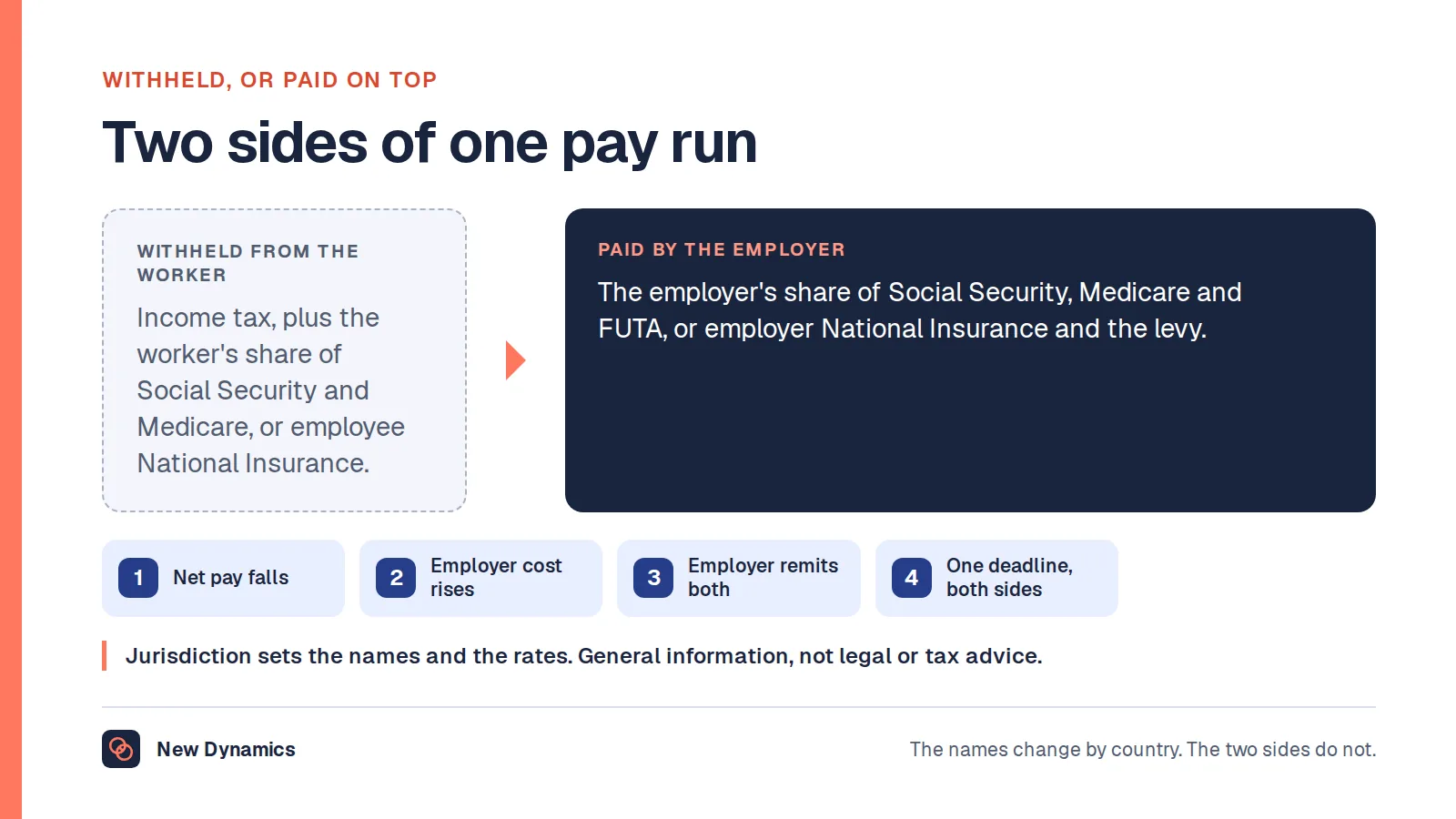
The same page gives a size concession on payment frequency: "If you're a small employer that expects to pay less than £1,500 a month, you can arrange to pay quarterly". GOV.UK publishes two different weekly employer National Insurance thresholds on two live pages, and our post on payroll tax against income tax quotes both rather than picking one.
The duties that do not care what type of employer you are
Pensions. The Pensions Regulator states, on its page for employers, that "Under the Pensions Act 2008, every employer in the UK must put certain staff into a workplace pension scheme and contribute towards it. This is called 'automatic enrolment'. If you employ at least one person you are an employer and you have certain legal duties." On timing, its guidance for new employers is unambiguous: "Your workplace pension legal duties begin on the day your first member of staff starts work. This is known as your duties start date. Even if you think you won't need to put your staff into a scheme, you'll still have duties."
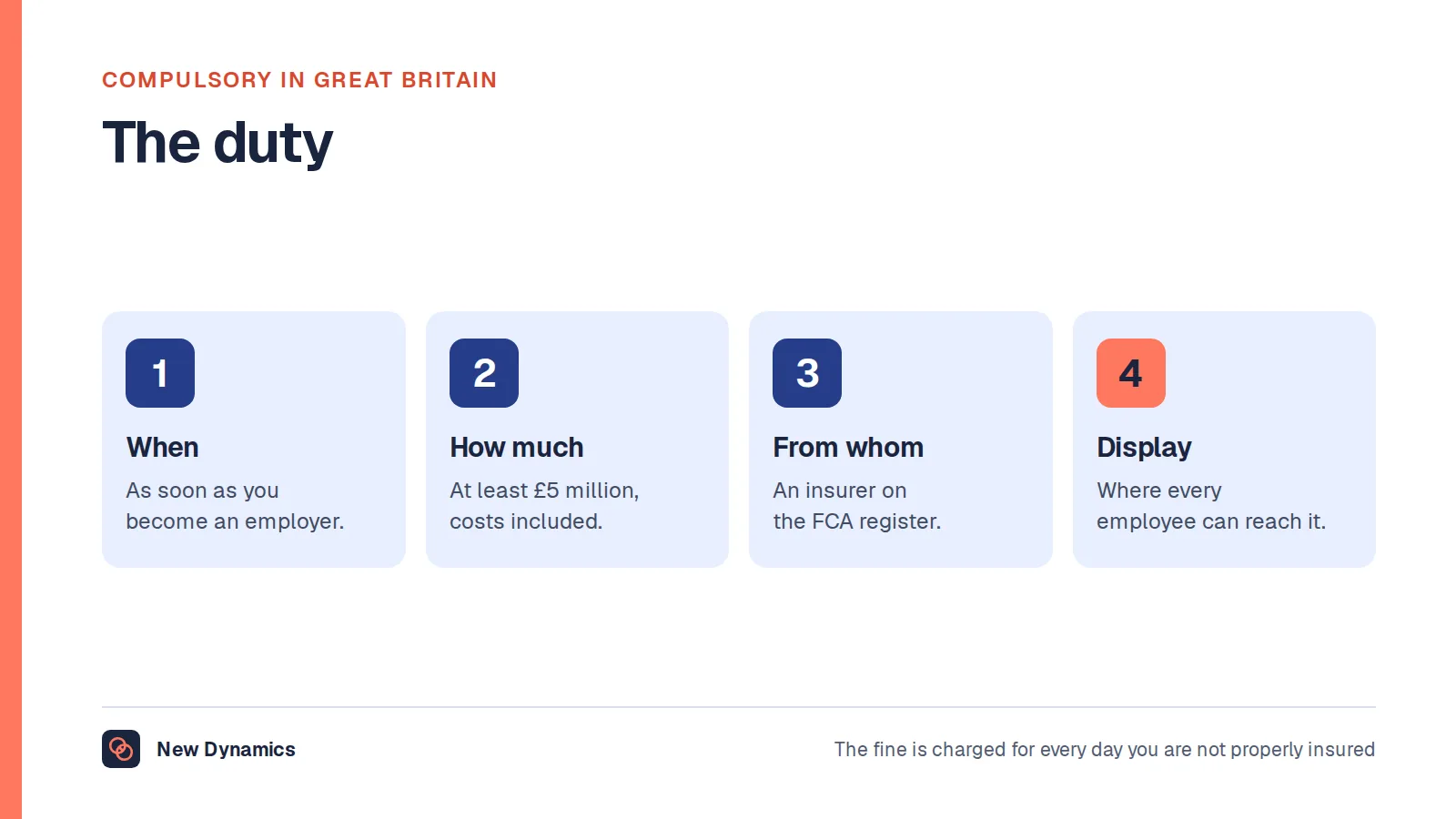
Employers' liability insurance. GOV.UK's page on employers' liability insurance requires it "as soon as you become an employer", "to cover you for at least £5 million" and "from an authorised insurer". Two narrow exceptions apply, where you only employ "a family member" from a listed set of relatives, or "someone who is based outside of England, Scotland and Wales". The penalty runs per day: "You can be fined £2,500 every day you are not properly insured", with a further £1,000 for failing to display the certificate. Our post on employers' liability insurance has the detail.
A health and safety policy. The Health and Safety Executive, in its guide to preparing a health and safety policy, puts the duty on everybody: "The law says that every business must have a policy for managing health and safety."
The thresholds that switch a duty on
Here is where employer type becomes a real distinction, and it is usually about size or sector rather than legal form.
- Five or more employees: write the policy down. HSE, on the same page: "If you have five or more employees, you must write your policy down. If you have fewer than five employees you do not have to write anything down, but it is useful to do so."
- 20 or more redundancies: collective consultation. GOV.UK on redundancy consultations: "You must follow 'collective consultation' rules if you're making 20 or more employees redundant within any 90-day period at a single establishment." Notifying the Redundancy Payments Service is tiered with it: for 20 to 99 proposed redundancies, "30 days before the first redundancy"; for 100 or more, "45 days before the first redundancy".
- 250 or more employees: gender pay gap reporting. The statutory guidance on who needs to report, updated 21 May 2026, says: "Any employer with 250 or more employees on a specific date each year (the 'snapshot date') must report their gender pay gap data." Employer type decides the date: "The snapshot date is 31 March for most public authority employers, and 5 April for everybody else." It bites per entity, not per group, since you report for "each separate 'legal entity', if you are part of an organisation or group with more than one legal entity". And agency workers are not yours: "Do not include agency workers, because they are part of the headcount of the agency that provides them."
- Employment Allowance: sector and group structure both matter. GOV.UK states the value of Employment Allowance as a reduction in "your annual National Insurance liability by up to £10,500". You can claim if "you're a business or public body", but only if "you do less than half your work in the public sector (such as for local councils and NHS services)". For groups: "If you're part of a group of charities or companies (also known as connected companies), only one company in the group can claim the allowance." Charities can claim. A single-director company has its own trap: "If your company has only one director, they must not be the only employee liable for secondary Class 1 National Insurance."

Frequently asked questions
Is there an official list of employer types?
No. GOV.UK and HMRC do not publish a standard taxonomy under that name. GOV.UK uses "business structure" and "legal status" for the legal form, and HMRC's PAYE Manual uses "employer types" for a short list of special PAYE cases such as councillors and local religious centres. If a form asks you to pick an employer type, the options on that form define the term.
Can a sole trader employ people?
Yes. GOV.UK's comparison of business structures says under "Taking on employees" that a sole trader "can have employees". The difference is liability, not capacity. Because a sole trader has what GOV.UK calls "unlimited liability", an employment claim is a claim against that individual.
Who is the employer when I work through an umbrella company?
The umbrella company. HMRC states that "The umbrella company is your employer and will pay you", while the work is done for one of the recruitment agency's clients. From 6 April 2026 the agency or end client became responsible for making sure PAYE is operated correctly, and HMRC can recover underpaid PAYE from them, but that does not move the employment relationship.
Do I have to register as an employer if I only pay myself?
Yes, if you are a company director. GOV.UK: "You must register even if you're only employing yourself, for example as the only director of a limited company."
Does a group of companies count as one employer?
It depends on the duty, which is why this question is hard. For gender pay gap reporting you report for "each separate 'legal entity'". For Employment Allowance the opposite applies: "If you're part of a group of charities or companies (also known as connected companies), only one company in the group can claim the allowance." Check each obligation separately rather than assuming the group is treated consistently.
Are public sector employers treated differently?
At the core, no. At the edges, yes. A public authority has a different gender pay gap snapshot date, 31 March rather than 5 April, and Employment Allowance is restricted to employers who "do less than half your work in the public sector".
Your next step: write down which entity employs whom
- List every legal entity in your organisation, with its PAYE scheme reference against it.
- Put every person on the payroll against one of those entities, and flag anyone you cannot place.
- For agency and umbrella placements, record the employing entity from the key information document rather than guessing.
- Count employees per entity and mark which of the five, 20 and 250 thresholds each one crosses.
- Record the automatic enrolment duties start date for each entity that has staff.
Getting the policies that follow into writing is the next job, and the five-employee threshold is only the first of several. Read and download our employee handbook guide for the policy set most employers end up needing. The guide is free to read, and the PDF uses our short download form.
If your people records span more than one legal entity and you want the employing entity held against each person, Book a New Dynamics demo and bring your entity list. You can also email contact@new-dynamics.com.