TL;DR
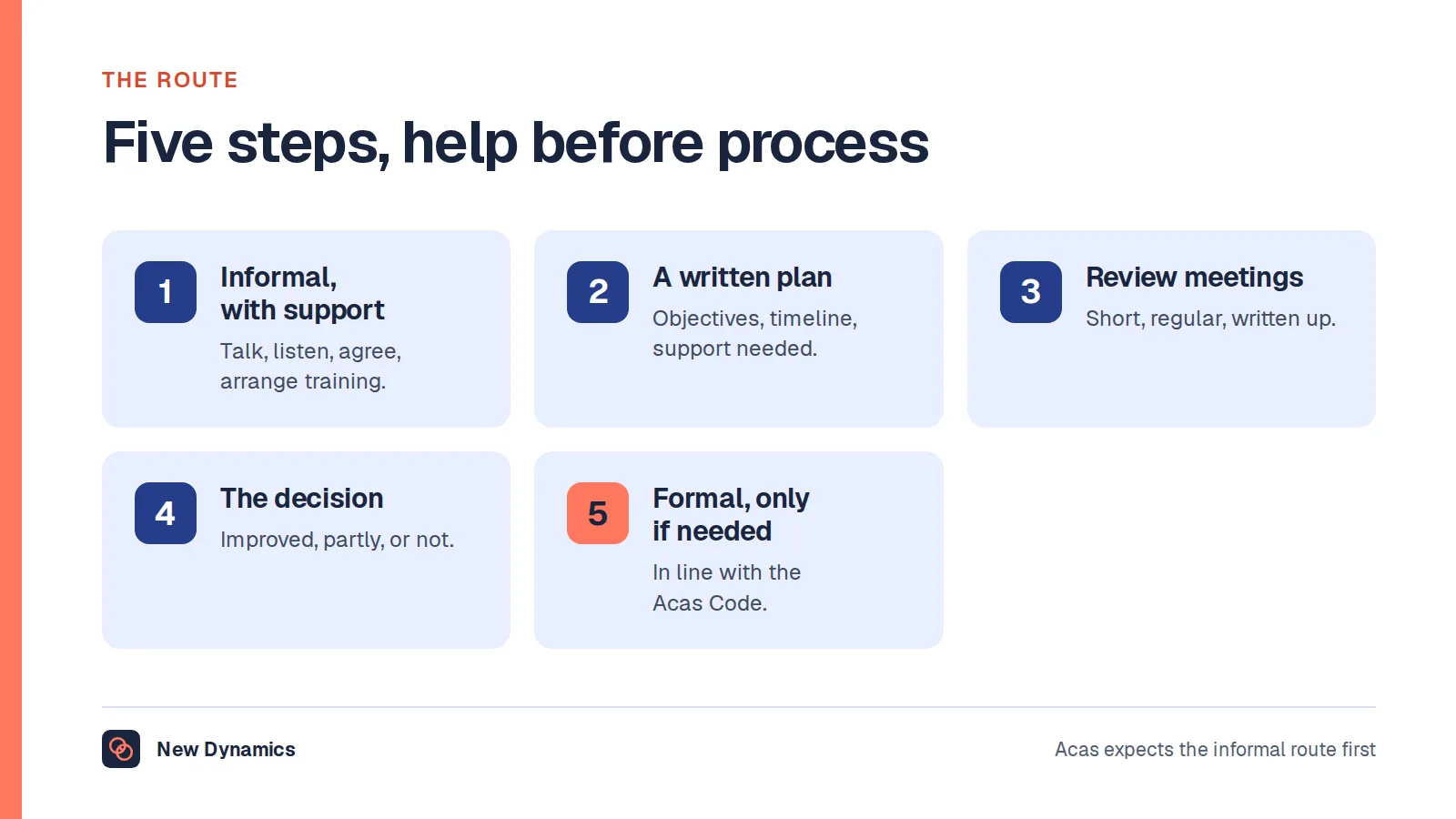
- A performance improvement plan is a written agreement about a specific performance gap, the standard expected, the support the employer will provide, how long the person has and what happens at the end. Acas says it should set out specific objectives, a reasonable timeline to meet them and any further support or training needed.
- Every PIP answers one question: is this a genuine attempt to help someone improve, or the paperwork before a dismissal. Employees usually assume the second. An employer who means the first has to prove it through the support it actually delivers, not through the wording of the document.
- A PIP is the wrong tool when the real cause is unclear expectations, a health condition or disability needing adjustments, workload, or the manager. Fix the cause first, because a plan aimed at the wrong problem fails and the failure looks like the employee's.
Somebody hands you a document titled performance improvement plan and your stomach drops. That reaction is not irrational, and pretending otherwise is the fastest way to lose the trust the plan depends on. A PIP can be the most useful thing an organisation does for a struggling employee, or the file note that makes a dismissal defensible, and the document looks almost identical either way.
This article explains what a PIP is in HR, the question that decides everything about it, when an improvement plan is the wrong tool entirely, how to write and run one, when an extension is fair rather than a stall, and where disability duties change what an employer must do. It describes the position in England, Scotland and Wales, and it is general information rather than legal advice. Take advice before any formal step.
A plan only works on top of an honest record of what was expected and what happened. See how New Dynamics performance reviews keep that record as the year goes along, rather than reconstructing it afterwards.
What is a PIP in HR?
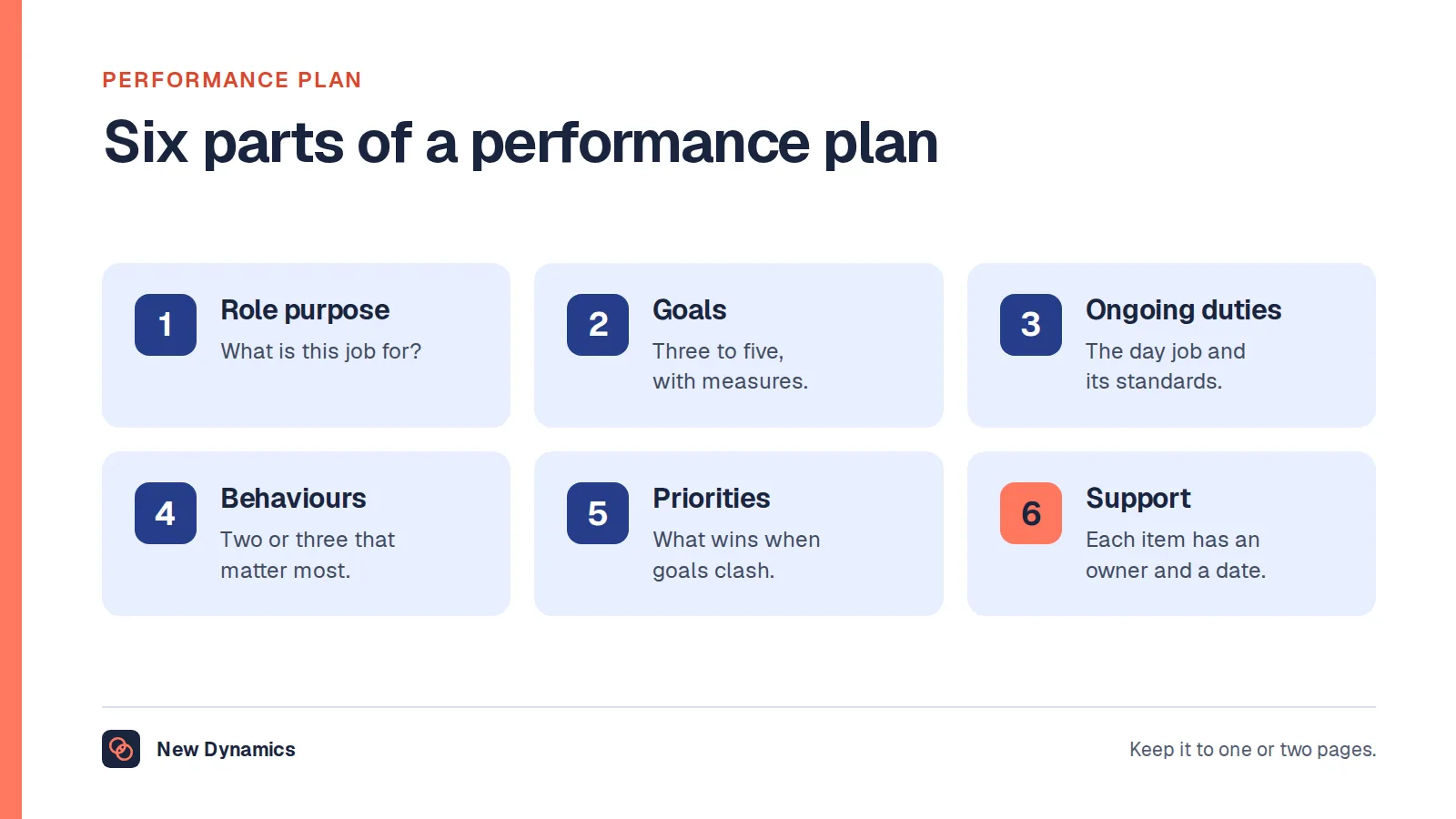
A performance improvement plan, almost always shortened to PIP, is a short written agreement between an employer and an employee that names a specific performance gap, states the standard expected, sets out the support the employer will provide, fixes a period in which the gap should close, and says what happens at the end of that period.
Acas, the UK workplace advice service, puts the content requirement plainly. Performance improvement plans should set out "specific objectives for the employee", "a reasonable timeline to meet them" and "any further support or training they need". It adds that "The employer should make clear what will happen if the employee does not make the required improvements."
A PIP normally sits in the capability route rather than the disciplinary one. Acas separates the two by cause: it is "a capability issue if the problem is with the employee's ability to do something", and "a conduct issue if the problem is with the employee's behaviour, rather than their ability to do the job". If you are unsure which route you are on, our post on the capability procedure walks through the steps in order, and our post on disciplinary action covers the conduct route.
A PIP is not the same as a performance improvement project
Search for performance improvement and you will find two different things. A performance improvement plan is about one person. A performance improvement project is about a process, a team or a service, and it belongs with operational change rather than with employee relations. The two get confused in job adverts and in internal emails, and the confusion matters: running a process problem as an individual plan puts the blame on whoever is closest to the failure.
The question that decides everything
There is one question behind every PIP, and both sides know it. Is this a genuine attempt to help someone improve, or is it the paperwork before a dismissal?
Say the uncomfortable part first. Employees usually read a PIP as the second. They have heard the stories, they have seen a colleague go on a plan and leave eight weeks later, and they can see that the document is written in the kind of language that gets read out at a hearing. That assumption is not paranoia. It is a reasonable inference from how plans are often used.
Which means an employer who genuinely intends the first thing has to work to show it, because the document itself proves nothing. What shows it is evidence:
- The support in the plan is specific, dated and booked before the plan starts, not promised in general terms.
- The manager's diary actually contains the review meetings, and they happen even in a busy month.
- The person's workload is adjusted so improvement is possible, rather than added to as a test.
- Positive movement gets written down as soon as it appears, not only at the end.
- The employee was asked what would help, and at least one thing they named is in the plan.
Acas describes the same priority from the dismissal end. "To dismiss someone because of a conduct or capability issue, employers must follow a fair procedure." And where the problem is capability, "If it's a capability issue, employers should support employees to improve first. Dismissal should be a last resort."
Here is the practical test for an HR team. If the plan were to succeed tomorrow, is there a role, a team and a manager ready to welcome the person back as a normal colleague? If the honest answer is no, the plan is not a plan, and it should not be started under that name.
When a performance improvement plan is the wrong tool

A PIP measures one thing: whether an individual closes a gap. If the gap has another cause, the plan measures the wrong thing and the person carries a failure that was never theirs. Check four causes before writing anything.
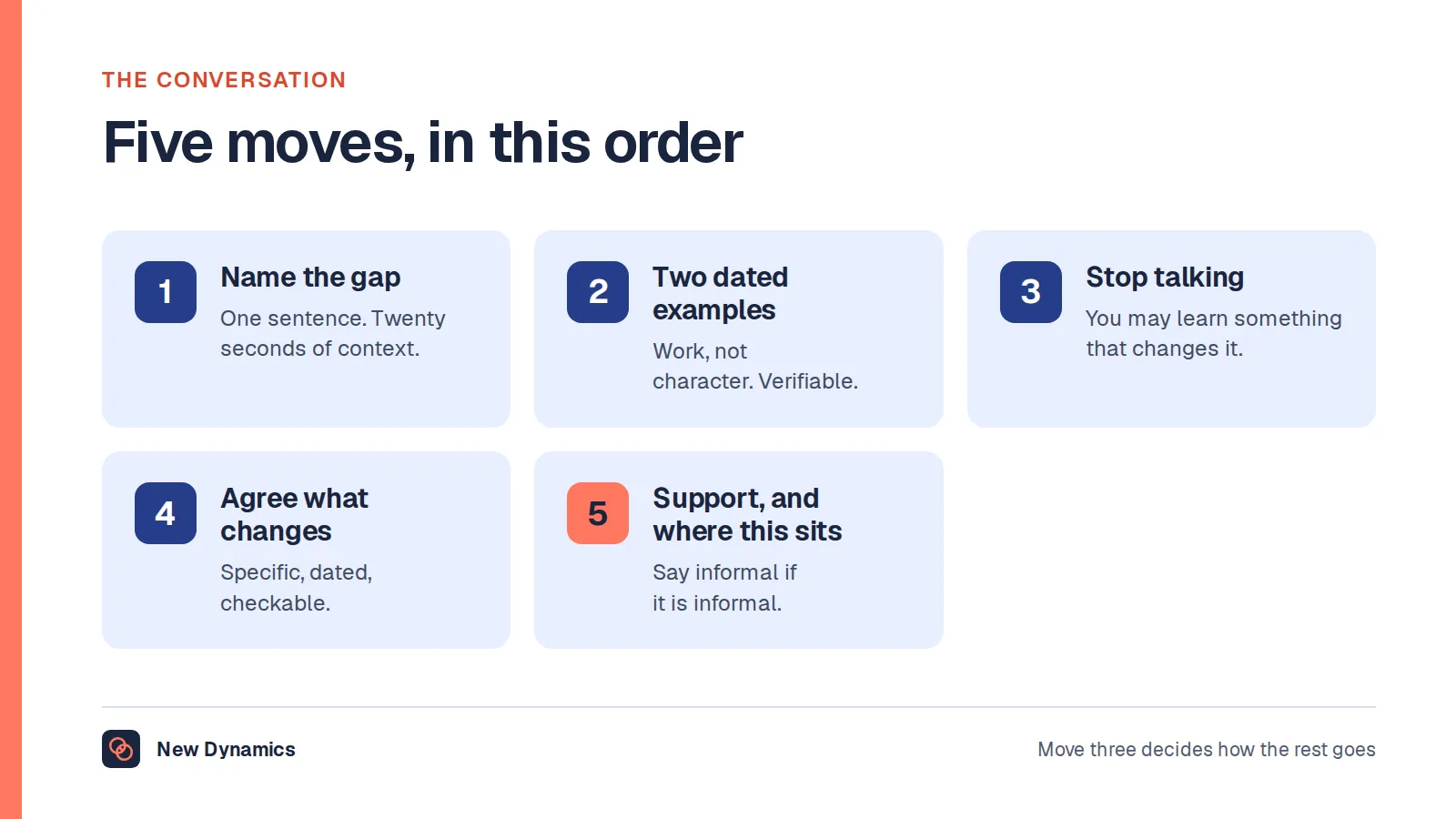
Unclear expectations. If nobody has ever written down what good looks like in this role, the first problem is the job, not the person. The fix is a plain statement of the standard and a few weeks of ordinary management, not a formal plan. Our post on the underperformance conversation covers how to open that discussion.
A health condition or a disability. This is the one that most often goes wrong, and it is covered in its own section below. Where a condition may be relevant, adjustments come before any plan.
Workload or resourcing. Someone doing the work of two people will not improve by trying harder. Compare the workload with what others in the same role carry. If it is out of line, the honest intervention is to change the work.
The manager. Sometimes the only person who thinks there is a performance problem is the manager, or the relationship has broken down, or the feedback has never been specific enough to act on. A plan built on one person's frustration tends to collapse under scrutiny. Ask who else has raised the concern, and what evidence exists other than opinion.
None of these means the performance problem is imaginary. It means the cause has to be addressed in the right place, and a PIP started before that is a plan designed to fail.
How to write a performance improvement plan

Five parts, and each one has a failure mode.
1. The specific gap. Name the behaviour or output, with dates and examples. "Three of the last five client reports were submitted after the agreed deadline, on 4, 11 and 19 September" is usable. "Attitude to deadlines" is not, because there is nothing in it to improve.
2. The standard expected, in observable terms. Write what success will look like to an outside observer. A standard that cannot be checked without a judgement call will produce a dispute at the end of the plan. If judgement is unavoidable, say who exercises it and against what, and name the examples that would count.
3. The support the employer will provide. This is the employer's half of the deal and the part most often left vague. Performance improvement plan training is a common search for a reason: training is frequently the right answer and frequently the item that quietly never happens. List each item of support, who arranges it, and the date it starts. Coaching, shadowing, a mentor, a shorter task list, a tool, protected time, a reduced caseload while skills build.
4. A realistic review period. Long enough for the work cycle to turn over at least twice, so improvement can actually show. A monthly reporting job cannot be assessed in three weeks. Say when each review meeting happens, in the plan, with dates.
5. What happens at the end. Acas is explicit that the employer should make clear what will happen if the required improvements are not made. Write the possible outcomes, all of them, including continuing as normal, an extension, and a formal stage. An employee who is told the consequences at the start cannot be surprised by them at the end, and an employer who hid them has a procedural problem.
One more thing belongs in the document: the record. Acas says "It's important for employers to keep a record of any conversations they have with employees about performance." Agree in the plan that each review will be written up and shared, and then do it the same day.
How to run the review meetings
The PIPs process lives or dies in these meetings, and most of what goes wrong is tone and frequency rather than content.
Keep them short and regular. Thirty minutes, at the dates in the plan, in private. A plan reviewed once at the end is not a plan, it is an exam.
Run each one the same way. What has happened since last time, against the standard. What support was delivered, and what was promised but has not arrived. What is getting in the way. What changes for the next period. Then a written note, shared with the employee, with a line for anything they disagree with.
Three rules that protect everybody. Do not add new objectives part-way through, because that moves the target and makes the plan unfair. Do not let the support lapse when the manager gets busy, because the plan then measures the organisation. And say what is going well, out loud, in the meeting: a plan that only reports failure teaches the person that improvement is not being noticed, which is the opposite of the stated purpose.
An improvement plan at work is stressful, and stress itself affects performance. Keep the process private, point the person towards whatever wellbeing or employee assistance support exists, and keep the review meetings away from open-plan rooms and shared calendars that leak the subject.
Extensions, and when extending is fair

Acas names an extension as a legitimate outcome. Where someone has improved but not to the level agreed in the plan, the next step could be "an extension to the timeline in the performance improvement plan". Where the issue continues, it may be "a final written warning, followed by a dismissal if the issue continues".
A performance improvement plan extension is fair when the delay has a reason that points at success:
- The person has improved, measurably, but has not yet reached the agreed level.
- Support that the plan promised arrived late or not at all, so the person has not had the period the plan described.
- Something outside the plan interrupted it, such as sickness absence, a reorganisation, a new system or a change of manager.
- A new fact has appeared, such as a diagnosis or an adjustment that is now being made, and the plan needs to be re-run on the new basis.
An extension is unfair, and reads badly afterwards, when it is used to avoid a decision. Signs of that: a second extension with no change to the standard or the support, an extension granted because the manager has not held the review meetings, or an open-ended extension with no new end date. If you extend, write down what is different this time, for how long, and what happens at the end. An extension is a new short plan, not a postponement.
The right to be accompanied
The statutory right to be accompanied applies to formal disciplinary and grievance hearings. Acas states that an employee can choose a colleague, "a workplace trade union representative who's certified by their union to act as a companion" or "an official employed by a trade union", and that employers may allow someone else at their discretion.
An ordinary PIP review meeting is not usually a disciplinary hearing, so the statutory right may not be engaged. Two practical points follow. First, where the plan forms part of a formal capability procedure, or where the meeting could lead to a warning or a dismissal, treat it as a formal hearing and set it up properly. Acas says the employer should put in writing beforehand "the alleged misconduct or performance issue", the evidence, the arrangements, "information on the employee's right to be accompanied" and "the possible outcomes". On the employer side, gov.uk lists among the signs of a reasonable dismissal that you "allowed the employee to be accompanied at disciplinary or dismissal hearings" and "gave the employee the chance to appeal".
Second, allow a companion at PIP reviews anyway if the employee asks. It costs nothing, it calms the meeting, and refusing it signals exactly the thing you are trying not to signal.
Disability, and adjustments before and during a plan
This is where a badly run plan becomes a legal problem rather than a management one.
Acas states that "If an employee has a disability, employers must make reasonable adjustments. These are changes that remove or reduce a disadvantage related to their disability." It defines them as "changes an employer makes to remove or reduce a disadvantage related to someone's disability". The gov.uk guidance states the duty as follows: "Employers must make reasonable adjustments to make sure workers with disabilities, or physical or mental health conditions, are not substantially disadvantaged when doing their jobs." Its examples include "changing their equipment, for instance providing a special keyboard if they have arthritis" and "allowing employees who become disabled to make a phased return to work, including flexible hours or part-time working".
The timing is the point. Adjustments have to be considered before a plan starts, because a plan that measures someone against an unadjusted standard measures the disadvantage rather than the performance. They also have to be revisited during the plan, because a condition can change and a plan can reveal a difficulty nobody had named. Acas notes that the duty can be triggered without a formal request, including when an employer notices someone having difficulty with their job or sees absence patterns connected to a disability.
Watch the overlap too. Something that presents as conduct, such as repeated lateness or missed messages, can have an underlying cause that amounts to a disability, and the adjustment question comes before any disciplinary step. Acas says an employer "must not dismiss or discipline someone just because they're disabled".
Acas describes the framework as follows: "Discrimination law (Equality Act 2010) protects people against discrimination at work." The protected characteristics it lists are "age, disability, gender reassignment, marriage and civil partnership, pregnancy and maternity, race, religion or belief, sex, sexual orientation". The Equality Act 2010 applies in England, Scotland and Wales, which is also the scope of Acas advice. Northern Ireland has separate discrimination legislation and separate advisory arrangements, so check the position locally before applying any of this there.
Jurisdiction, and the qualifying period that is changing
Two things to be careful with before a PIP turns into a dismissal question.
First, the fair reason. Gov.uk lists "their capability or conduct" among the valid reasons for dismissing someone, and sets out that a dismissal must also be handled reasonably, including having "followed the relevant procedures".
Second, the qualifying period, which is in the middle of a change and is easy to state wrongly. Gov.uk currently says "Employees can usually only claim unfair dismissal if they've worked for a qualifying period. This is usually 2 years." The same page states that "From 1 January 2027, most employees will be able to claim unfair dismissal after 6 months." That reduction comes from the Employment Rights Act 2025. As gov.uk words it, the six month period is a future change with a stated date rather than the position today, so do not treat it as already in force, and do check the page again before relying on either figure. The same page adds that "In Northern Ireland, the qualifying period is still usually 1 year." There are also circumstances in which no qualifying period applies at all, including automatically unfair reasons and discrimination claims, which have no service requirement.
The planning point for HR: a qualifying period is not a window of safety, and it never has been. A plan run badly inside it still produces discrimination exposure, a departure that damages the team, and a manager who has learned nothing.
Frequently asked questions
What is a PIP in HR?
A PIP, or performance improvement plan, is a written agreement that names a specific performance gap, the standard expected, the support the employer will provide, the period in which improvement should happen and what happens at the end. Acas says a plan should set out specific objectives for the employee, a reasonable timeline to meet them and any further support or training they need.
Does a performance improvement plan mean I am being dismissed?
Not by itself. A PIP can be a genuine attempt to help someone improve, and employees often do come off plans and carry on. But employees commonly read it as the paperwork before a dismissal, and the way to tell is the employer's half: whether specific support is named and dated, whether the review meetings actually happen, and whether the workload makes improvement possible.
How long should a performance improvement plan last?
Long enough for the work to cycle through at least twice, so improvement can show. Acas asks for a reasonable timeline rather than a fixed number of weeks, which means the right length depends on the job. A monthly reporting cycle cannot be judged in three weeks, and a daily task might be clear within a month.
Can a performance improvement plan be extended?
Yes. Acas names an extension to the timeline in the plan as a possible outcome where someone has improved but not to the level agreed. An extension is fair when there is a reason that points at success, such as real progress, support that arrived late, or an interruption like sickness absence. Repeated open-ended extensions with no change to the support are a different thing.
What support should an employer provide during a PIP?
Whatever the gap actually calls for, named and dated in the plan. Training is the most common item, along with coaching, a mentor, shadowing, protected time, a reduced caseload while skills build, or a different tool. Acas expects any further support or training needed to be set out in the plan, and the support that was promised but never delivered is the first thing anyone will look at later.
Do reasonable adjustments apply during a performance improvement plan?
Yes, and before it. Acas says that if an employee has a disability, employers must make reasonable adjustments, which are changes that remove or reduce a disadvantage related to their disability. Consider them before a plan starts and revisit them during it, because a plan that measures someone against an unadjusted standard is measuring the disadvantage rather than the performance.
Your next step: write the employer's half first
- Write the gap in one sentence with dates and examples, and the standard in one sentence an outsider could check.
- List the support you are committing to, with an owner and a start date for each item, and book it before the plan begins.
- Ask HR whether any health condition or disability may be relevant, and sort adjustments out before the plan, not after.
- Put every review meeting in the diary now, and write each one up the same day.
- Write the possible outcomes, all of them, and tell the employee what they are at the start.
For the full plan structure, the review template and the conversations around it, read and download our performance improvement guide. The guide is free to read, and the PDF uses our short download form.
Want the evidence, the support and the review notes in one place before any of this starts? Book a New Dynamics demo and bring your current plan template. You can also email contact@new-dynamics.com.