TL;DR
- A performance plan is a short agreement between an employee and their manager about what the person will achieve in the coming period, how success will be judged and what support they will get.
- A good plan has six parts: the purpose of the role, three to five goals, ongoing responsibilities, behaviours, priorities and support. Add an agreed rhythm for check-ins, and keep it to one or two pages.
- The plan only works if it is tracked. A simple performance tracker, updated monthly with the latest figure, the status and the next action, turns the annual review into a summary of conversations you have already had.
Ask an employee in November what they were supposed to achieve this year, and then ask their manager. If the two answers differ, the review that follows will be an argument about the past. A performance plan prevents that, by settling the question at the start.
This article explains what a performance plan is, what goes in it and how to write one, with a free template, a worked example and a simple tracker to keep it alive.
If you want goals, check-ins and progress updates in one shared place, explore New Dynamics Goals & OKRs.
What is a performance plan?
A performance plan is a short, written agreement between an employee and their manager. It records what the person will achieve in the coming period, how success will be judged and what support they will receive. It is written at the start of the year, or when someone starts a new role, and it is reviewed throughout.
The United States Office of Personnel Management treats planning as the first stage of its performance management cycle. Its guidance on planning says:
“Planning means setting performance expectations and goals for groups and individuals to channel their efforts toward achieving organizational objectives.”
It adds that involving employees in planning helps them to understand “what needs to be done, why it needs to be done, and how well it should be done”. Those three questions are a good test of any plan.
A performance plan is not a performance improvement plan
The names are similar, and the purposes differ.
| Document | Who it is for | When | Purpose |
|---|---|---|---|
| Performance plan | Every employee | Start of the year or of a new role | Agree goals, standards and support |
| Development plan | Every employee | Alongside the performance plan | Build skills and experience for the future |
| Performance improvement plan (PIP) | Someone whose performance is a concern | When informal support has not worked | Set out the gap, the support and a review date |
For the other two, see our guide to the development plan and our performance improvement guide.
What goes in a performance plan: six parts and a rhythm
- Purpose of the role. One or two sentences. What is this job for?
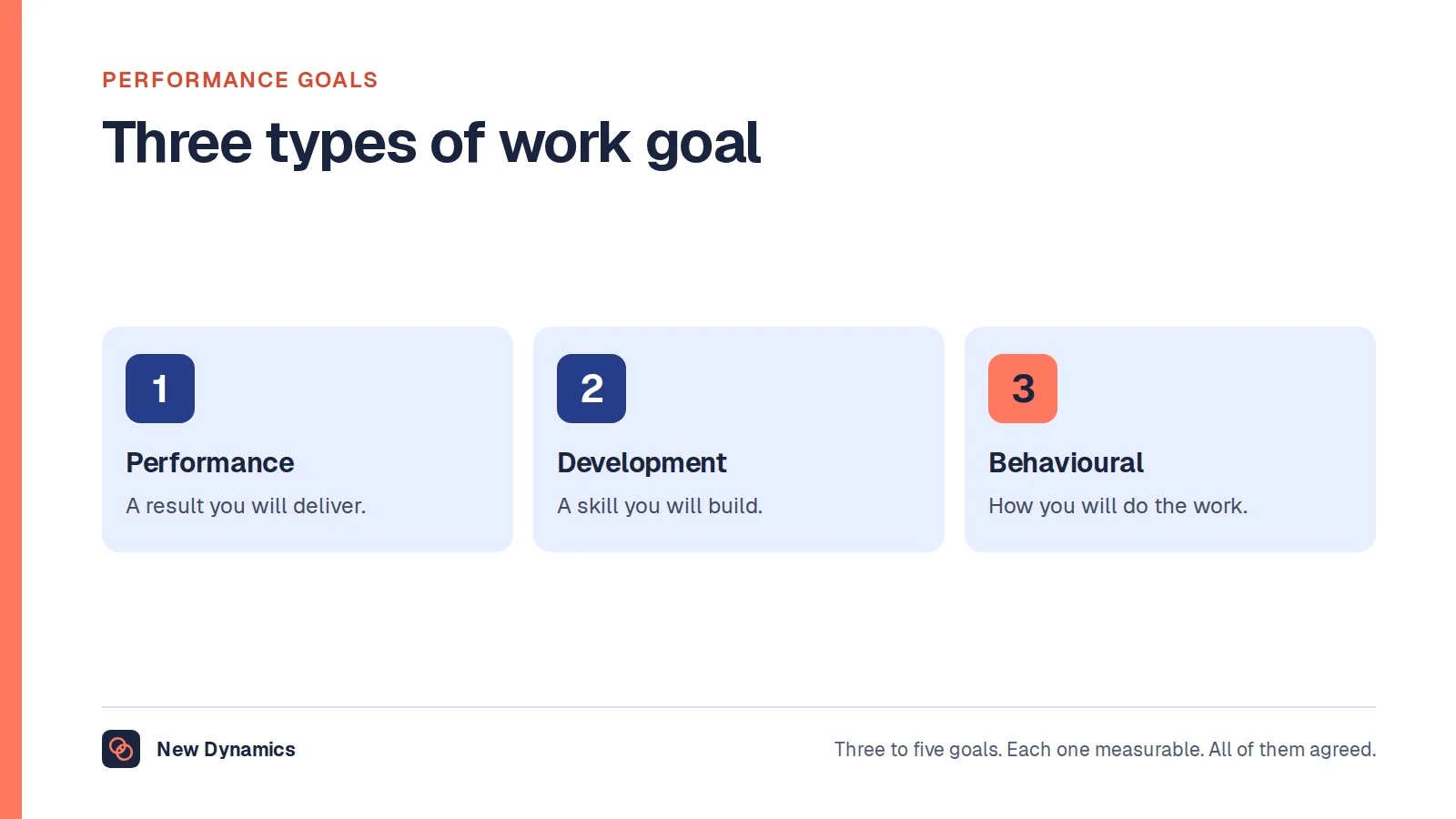
- Goals. Three to five outcomes for the period, each with a measure, a baseline, a target and a date.
- Ongoing responsibilities. The standing duties that continue whatever the goals are, with the standard expected. For most roles, this is most of the work.
- Behaviours. Two or three behaviours that matter most this year, described so that both of you would recognise them. See core competencies.
- Priorities. What comes first when goals conflict. They will.
- Support. Training, tools, access, time and decisions that the employee needs, each with an owner and a date.
Then agree a check-in rhythm: how often you will look at the plan together, and in which meeting.
Add one development goal, or link to the development plan.
Keep the whole thing to one or two pages. A plan that needs a binder will not be opened again.

How to write a performance plan in six steps
- Start from the team's goals. The manager shares the two or three team or company goals that matter most this year. Our guide to cascading goals explains how to connect levels without dictating.
- Ask the employee to draft first. People commit to goals they have helped to write, and they know the obstacles better than anyone.
- Turn each goal into an outcome with a measure. “Improve onboarding” becomes “raise the share of new starters who complete setup in week one from 60% to 90% by June”. Our SMART goal examples and performance goals examples give wording for many roles.
- Check that the plan is fair. Acas says that objectives “should be fair and reflect the employee's usual tasks and workload”, though they might also stretch the person. Its guidance on performance management also recommends that objectives are specific, measurable, achievable, relevant and time-bound.
- Agree the support and the priorities. Write down what the manager will do, as well as the employee.
- Set the check-in rhythm and sign it off. Put the dates in both calendars before the meeting ends.
Free performance plan template
Download our free performance plan template as an editable CSV that opens in Excel, Google Sheets or any spreadsheet tool. No form is required. It includes the six parts, the check-in rhythm, a development goal, a monthly tracker, an evidence log and an end-of-period review.
The template follows the structure below.
| Section | What to write |
|---|---|
| Purpose of the role | One or two sentences |
| Team and company goals | The two or three goals this role supports most |
| Goals 1 to 3 (up to 5) | Outcome, measure, baseline, target and date |
| Ongoing responsibilities | Three to five standing duties, with the standard expected |
| Behaviours | Two or three, with what good looks like |
| Priorities | The order, if goals conflict |
| Support needed | Training, tools, access and decisions, each with an owner and a date |
| Development goal | One skill or experience to build |
| Check-in rhythm | How often, and in which meeting |
| Changes to the plan | What changed, when and why |
Performance plan example
Here is an illustrative plan for a customer support team leader. The figures are examples. Measure your own baseline first.
Purpose of the role: lead a team of eight so that customers get accurate help quickly and agents grow in skill and confidence.
Goals for the year
- Cut the median time to first response from six working hours to two by 30 June, and hold it for the rest of the year.
- Raise customer satisfaction after contact from 4.2 to 4.5 out of 5 by 31 December.
- Every agent has a development plan by 31 March, reviewed quarterly.
- Reduce reopened tickets from 9% to 5% by 30 September.
Ongoing responsibilities: weekly rota published by Thursday noon. Monthly one-to-one with every agent. Quality review of five tickets per agent per month.
Behaviours: gives specific feedback within a week of the event. Shares problems with other team leaders early.
Priorities: if speed and quality conflict, quality comes first.
Support: reporting access by 15 January (operations manager). Coaching skills course in the first quarter (manager to approve). Agreement to recruit one agent if volume stays above forecast for two months.
Check-ins: monthly one-to-one, with a fuller review each quarter.
Notice the safeguard built into the plan. Goal 1 rewards speed, so goals 2 and 4 protect quality. Any single number can be gamed, and pairing measures is the simplest defence.
Keep it alive: a simple performance tracker
A plan that is filed in January and opened in December has done nothing. A performance tracker is a one-page view of progress against the plan, updated regularly. It needs only a few columns.
| Goal | Baseline | Target | Latest (date) | Status | Next action |
|---|---|---|---|---|---|
| First response time (median) | 6 hours | 2 | 3.5 (30 April) | On track | Extend the new triage rota to Fridays |
| Customer satisfaction | 4.2 | 4.5 | 4.3 (30 April) | At risk | Review the ten lowest-scored contacts |
| Development plans in place | 0 of 8 | 8 | 8 (28 March) | Done | Quarterly reviews booked |
| Reopened tickets | 9% | 5% | 8% (30 April) | Off track | Find the top three causes by 15 May |
Three habits make a tracker useful.
- The employee updates it, before each one-to-one. It is their plan.
- Every line has a next action. A status without an action is only a colour.
- Keep an evidence log beside it: dated notes of real examples, good and bad. They make the review fair, and they guard against judging the year by its last month.
A tracker exists to support the conversation. It is not a surveillance tool. Track outcomes that were agreed in the plan, and leave keystrokes and minutes alone. For team-level measures, see our KPI tracker guide.

When the plan should change
Plans meet reality. A reorganisation, a lost customer or a new priority can make a goal pointless by April.
- Change the plan when the facts change, and do it openly. Record the date and the reason.
- Do not change it to fit the results. Lowering a target in November because it will be missed defeats the purpose. Discuss why it was missed.
- Review the priorities each quarter. Ask, “If we were writing this today, what would be different?”
Acas advises that, alongside formal reviews, managers should talk to employees informally about their performance on a regular basis. The plan gives those conversations a structure. Our one-to-one meeting questions can help.
Common mistakes with performance plans
Too many goals. Ten goals means no priorities. Keep three to five.
Tasks in place of outcomes. “Run four training sessions” is an activity. “Cut errors by half” is a result.
Written by the manager alone. A plan handed down is complied with. A plan written together is owned.
No baseline. “Raise satisfaction to 4.5” means little if nobody knows today's figure.
Ignoring the day job. If the plan lists only projects, the standing work that fills most of the week goes unrecognised.
Nothing about support. A plan that sets out only what the employee owes is half an agreement.
Filed and forgotten. If it is not on the agenda of the one-to-one, it does not exist.

Frequently asked questions
What is a performance plan?
A performance plan is a short, written agreement between an employee and their manager. It sets out what the person will achieve in the coming period, how success will be measured, the behaviours expected and the support they will receive. It is reviewed regularly through the year.
What should a performance plan include?
Include the purpose of the role, three to five goals with measures and dates, ongoing responsibilities with standards, two or three key behaviours, priorities if goals conflict, the support the employee needs and a rhythm for check-ins. Add a development goal.
What is the difference between a performance plan and a performance improvement plan?
A performance plan is for every employee and is written at the start of a period to agree goals and support. A performance improvement plan is used only when someone's performance is a concern, to set out the gap, the support offered and a review date.
How do you write a work performance plan?
Start from the team's goals, ask the employee to draft first, turn each goal into an outcome with a measure, check that the workload is fair, agree support and priorities, and set dates for regular check-ins. Keep it to one or two pages.
What is a performance tracker?
A performance tracker is a one-page view of progress against the performance plan. For each goal it shows the baseline, the target, the latest figure with its date, a status and the next action. The employee updates it before each one-to-one.
How often should a performance plan be reviewed?
Look at it briefly in every one-to-one, which for most teams means monthly, and hold a fuller review each quarter. Update the plan openly when priorities change, recording the date and the reason.
Your next step: draft one plan this week
- Download the template and fill in the purpose of the role.
- Ask the employee to draft three goals with measures.
- Meet for forty-five minutes to agree the goals, the support and the priorities.
- Put the monthly check-ins in both calendars.
For help with wording goals, read and download our SMART goals guide. The guide is free to read, and the PDF uses our short download form.
Want plans, goals and check-ins in one place, visible to the employee and the manager? Book a New Dynamics demo and bring your current template. You can also email contact@new-dynamics.com.