TL;DR
- A questionnaire is a set of written questions that several people are asked, so that information can be collected about something. It is the instrument; a survey is the whole exercise of choosing whom to ask, collecting the answers and analysing them.
- Workplaces use questionnaires for engagement and pulse surveys, onboarding and exit feedback, training evaluation, stress risk assessment, 360-degree feedback and equality monitoring.
- Good questions are closed where possible, ask one thing at a time, use plain words and allow 'I do not know'. Recruitment questionnaires must not ask about protected characteristics, and may ask about health only in narrow circumstances.
Someone sends you a link and asks you to “fill in a quick questionnaire”. You have seen a hundred of them: the engagement survey, the training feedback form, the equality monitoring page at the end of a job application. Few people stop to ask what makes something a questionnaire, how it differs from a survey, or why some are a pleasure to complete and others are abandoned at question four.
This article gives the meaning of questionnaire in plain terms, explains the difference between a questionnaire and a survey, lists the kinds used at work, describes the five question formats, sets out eight rules for writing good questions and covers what UK employers must not ask.
A questionnaire once a year is a thin way to listen. See how New Dynamics continuous feedback gives every employee a regular voice.
What is a questionnaire?
The Cambridge Dictionary defines a questionnaire as “a list of questions that several people are asked so that information can be collected about something”. Its business dictionary says much the same: “a set of written questions used to collect information from a number of people”.
Three parts of that definition do the work.
- A list of questions. Not one question, and not a conversation. The questions are fixed in advance and written down.
- Asked of several people. A questionnaire is designed to be answered by many people in the same way, so that their answers can be compared or added up.
- To collect information about something. It has a purpose. The answers are data, and somebody intends to use them.
The verbs that go with it are fill in, fill out, complete and answer. In the plural, “what are questionnaires?” has the same answer: written sets of questions used to gather information from a group.
Questionnaire vs survey
People use the two words as if they meant the same thing. There is a useful distinction.
| Term | What it is |
|---|---|
| Questionnaire | The instrument: the list of questions and the answer options |
| Survey | The whole exercise: deciding whom to ask, distributing the questionnaire, collecting the answers, analysing and reporting them |
A questionnaire is one part of a survey, and a survey can use other tools as well, such as interviews or focus groups. In everyday use the words overlap, and nobody will object if you call your engagement questionnaire a survey. When you are designing one, though, the distinction is a reminder that writing the questions is only a part of the job. Whom you ask, how many reply and what you do with the results matter at least as much.
Types of questionnaire used at work
- Engagement surveys. An annual or twice-yearly questionnaire on how people experience their work, manager and organisation. Our workplace engagement survey gives 40 questions.
- Pulse surveys. Short, frequent questionnaires, often three to ten questions, that track a few measures over time.
- Onboarding questionnaires. Asked at 30, 60 or 90 days, to find out whether a new starter has what they need.
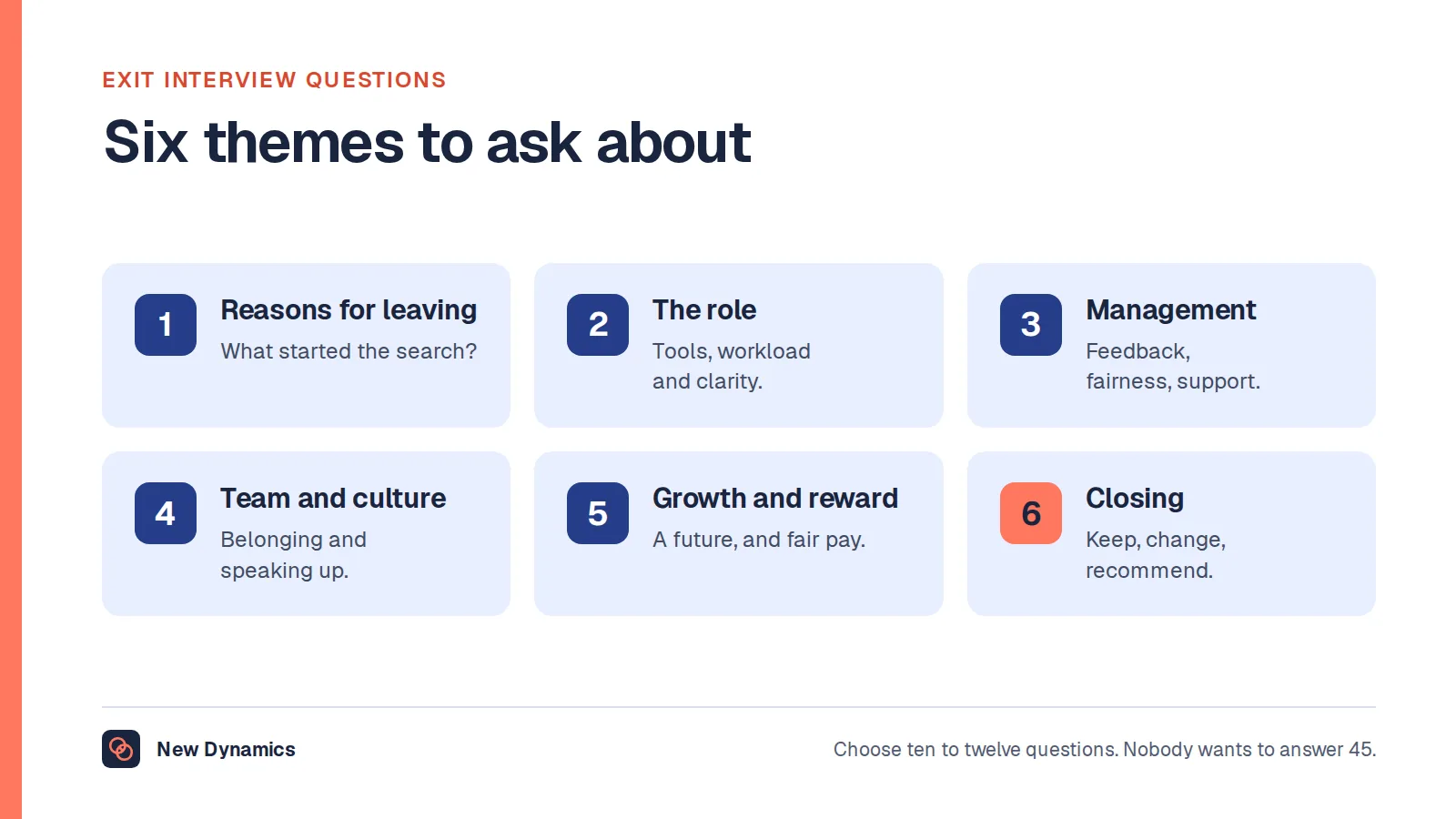
- Exit questionnaires. Completed by leavers, often alongside an exit interview. See our exit interview questions.
- Training evaluation. The form at the end of a course, and ideally a second one some weeks later asking what changed.
- Stress risk assessment. The UK Health and Safety Executive publishes an Indicator Tool for its Management Standards; its guidance on surveys explains that the tool “consists of 35 items that ask about ‘working conditions’ known to be potential causes of work related stress”.
- 360-degree feedback. A questionnaire about one person, answered by their manager, peers, direct reports and themselves.
- Culture and inclusion surveys. Our culture survey questions and inclusion survey questions cover both.
- Equality monitoring forms. Collected separately from selection, so that an employer can check that its recruitment is fair.
- Application and screening questionnaires. The questions on an application form, or a short set of screening questions before an interview.

The five question formats
Every questionnaire is built from a handful of question types.
- Closed, single answer. Yes or no, or one option from a list. Easy to answer and to count.
- Closed, multiple answer. Tick all that apply. Useful for “which of these have you used?”
- Rating scale. Agree to disagree on a five- or seven-point scale, or a score out of ten. The backbone of engagement surveys.
- Ranking. Put these options in order. Harder for respondents; use sparingly.
- Open text. Tell us in your own words. Rich, slow to analyse, and often where the most useful answers are.
The GOV.UK Service Manual's guidance on designing good questions makes the case for the first kind. “Closed questions are easier to answer than open questions”, it says, and they are “more accessible to people who find reading or writing difficult, for example users whose first language is not English”. It also notes: “A series of simple questions can be easier to answer than one complex question.”
A good workplace questionnaire mixes formats: a spine of rating-scale questions that can be tracked over time, a few closed questions for facts, and one or two open questions that let people say what the scales missed.
Eight rules for writing a good questionnaire
- Know why you are asking every question. The Service Manual makes this the first step. If you cannot say what you will do with an answer, cut the question.
- Ask one thing at a time. “My manager gives me clear goals and useful feedback” is two questions. Someone whose manager does one but not the other cannot answer.
- Use closed questions where you can, and open ones where you need them.
- Use plain words. No jargon, no acronyms, no double negatives. The Service Manual suggests adding help text only where research shows people need it.
- Allow “I do not know”. The Service Manual advises letting users answer with “I'm not sure” or “I do not know” if these are valid answers. Forcing a guess produces bad data.
- Keep it short. Every extra question lowers the completion rate. A pulse survey of five questions that everyone answers beats a 60-question survey that half the workforce abandons.
- Test it first. Give it to a handful of people, watch where they hesitate and change the questions until they work. The Service Manual's heading for this step is “Change the questions until you find what works”.
- Say what happens next. Tell people who will see the answers, whether they are anonymous, and when they will hear the results. Then keep the promise.

What you must not ask in a recruitment questionnaire
Application forms and screening questionnaires are covered by discrimination law. GOV.UK's guidance for employers on discrimination in recruitment says that employers must not ask candidates about “protected characteristics”, or whether they are married, single or in a civil partnership, or whether they have or plan to have children.
On health, the guidance is narrow. “You can only ask about health or disability if” one of three things applies: there are necessary requirements of the job that cannot be met with reasonable adjustments; you are finding out whether someone needs help to take part in a selection test or interview; or you are using positive action to recruit a disabled person.
A date of birth can be asked on an application form only if the person must be a certain age to do the job. The guidance adds that you can ask for it on a separate equality monitoring form, which the people selecting or interviewing candidates should not see.
This is general information about guidance that applies in Great Britain. It is not legal advice, and the law differs in other countries.
Anonymity, confidentiality and data
A questionnaire that collects personal data is subject to data protection law. Before you send one, decide and state:
- whether responses are anonymous (nobody can identify the respondent) or confidential (someone can, but will not share it);
- the minimum group size below which you will not report results, so that small teams cannot be identified;
- who will see raw answers, particularly open-text comments, which often identify the writer;
- how long you will keep the data and what it will be used for.
Our employee data protection guide covers the wider duties.
From questionnaire to action
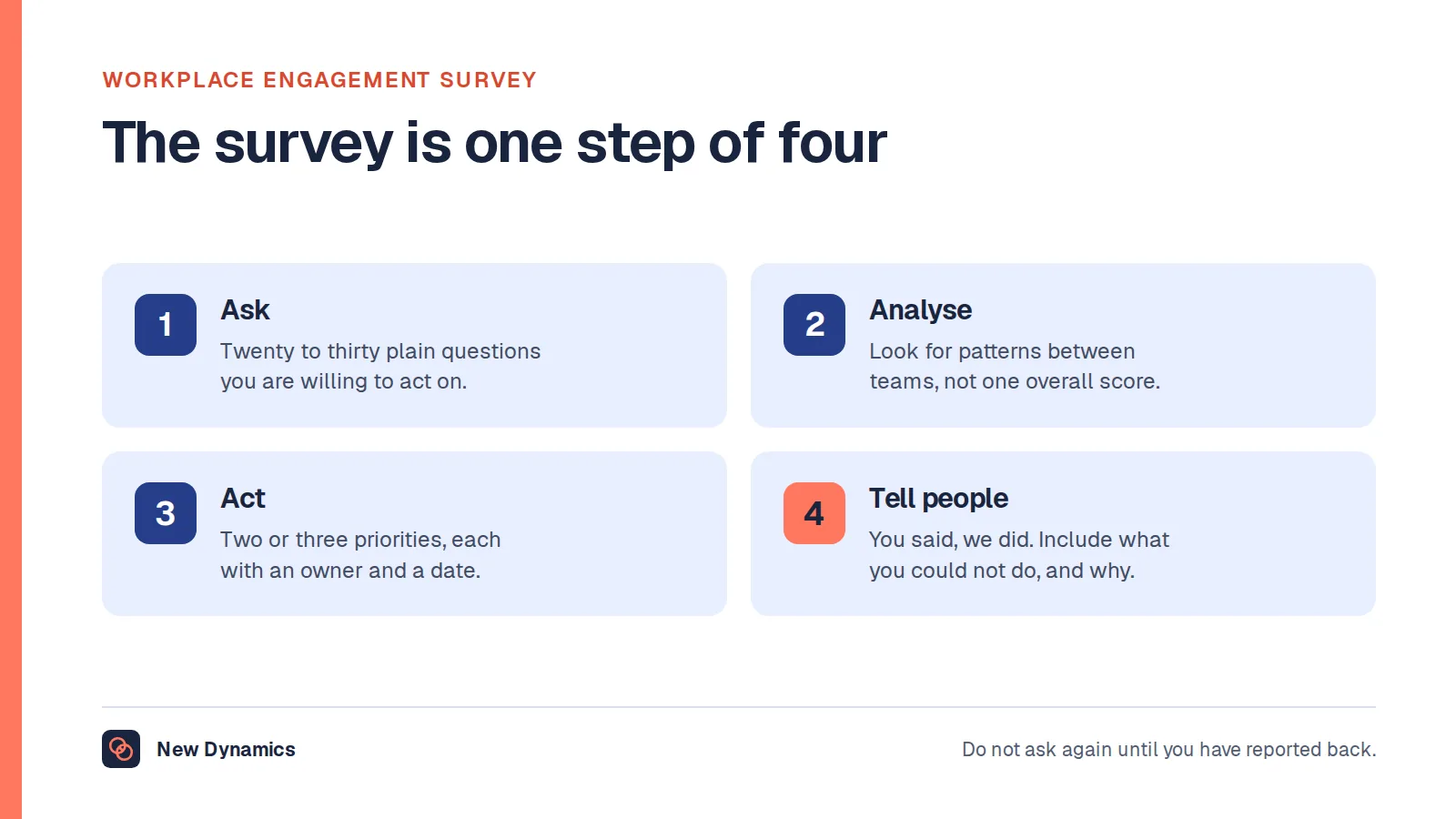
The point of a questionnaire is not the data but what changes because of it. A short cycle keeps the exercise honest.
- Share the results with everyone who was asked, within a few weeks.
- Pick two or three things to change, not twenty.
- Say who owns each one and when people will see a difference.
- Ask again and show whether the numbers moved.
The HSE's guidance on stress surveys puts it plainly: whatever survey approach you use, “the next step, communicating the results, is equally important”. Surveys that produce no visible action teach people that answering is pointless, and the next response rate shows it.

Frequently asked questions
What is a questionnaire?
A questionnaire is a list of written questions that several people are asked, so that information can be collected about something. It is the instrument used in a survey, and it is built from closed questions, rating scales and open-text questions.
What is the difference between a questionnaire and a survey?
A questionnaire is the set of questions. A survey is the whole exercise of deciding whom to ask, distributing the questionnaire, collecting the answers and analysing them. In everyday speech the words overlap.
What are questionnaires used for at work?
Employers use questionnaires for engagement and pulse surveys, onboarding and exit feedback, training evaluation, stress risk assessment, 360-degree feedback, culture and inclusion surveys, equality monitoring and job application screening.
How long should a questionnaire be?
As short as its purpose allows. Every extra question lowers the completion rate. A pulse survey may have five questions; an annual engagement survey might have 30 to 40. Cut any question whose answer you would not act on.
What questions cannot be asked on a job application questionnaire?
In Great Britain, GOV.UK says employers must not ask about protected characteristics, marital or civil partnership status, or whether someone has or plans to have children. Health or disability questions are allowed only in narrow circumstances, such as finding out whether a candidate needs help to take part in an interview.
Should a workplace questionnaire be anonymous?
Usually, for opinion surveys, because people answer more honestly. Say clearly whether responses are anonymous or confidential, set a minimum group size for reporting, and be careful with open-text comments, which can identify the writer.
Your next step: review the last questionnaire you sent
- Read each question and write down what you did with the answer. Cut the ones with no entry.
- Find any question that asks two things, and split it.
- Check that people could answer “I do not know”.
- Confirm that the results were shared, and that at least one thing changed.
For a way to listen between the annual surveys, read and download our AI employee listening guide. The guide is free to read, and the PDF uses our short download form.
Want feedback to flow all year rather than once a survey? Book a New Dynamics demo and bring your last questionnaire. You can also email contact@new-dynamics.com.