TL;DR
- There is no right to time off for annual training. GOV.UK states that "Employers do not have to allow time off for training, but may choose to." Mobilisation is the opposite: the Reserve Forces (Safeguard of Employment) Act 1985 obliges the former employer to take the reservist back.
- An employer that wants to stop a mobilisation has 7 days. Regulation 8(1)(b) of the Reserve Forces (Call-out and Recall) (Exemptions Etc.) Regulations 1997 says an application may not be made "more than 7 days after the relevant date, except with the leave of the adjudication officer".
- After reinstatement the employer must keep employing the reservist for 13, 26 or 52 weeks, set by section 7 of the 1985 Act according to how long they had worked there before they left. The reservist's own written application must reach the employer by the third Monday after service ends.
Two requests land in the same week. One employee wants a fortnight off in July for annual training with the Army Reserve. Another hands over a letter from the Ministry of Defence saying they report for duty in 28 days. They look like the same conversation. In law they are close to opposites: the first you may refuse outright, and the second carries a statutory duty to take the person back.
This article sets out the duties an employer of a reservist has, and the ones it does not: time off for training, what happens on mobilisation, the 7 day window for objecting, the costs the Ministry of Defence reimburses, and reinstatement under the Reserve Forces (Safeguard of Employment) Act 1985. It covers the United Kingdom and it is general information rather than legal advice.
A mobilisation runs for months and touches payroll, the manager, the replacement and the return. See how New Dynamics workflows let you shape the stages, forms and approvals around your own process, so the handover does not depend on one person remembering.
Training and mobilisation are two different questions
Annual training is your choice. GOV.UK's guide for reservists and employers states it in one line: "Employers do not have to allow time off for training, but may choose to." It describes the commitment as "one evening a week", "several weekends throughout the year" and "a 15-day training course each year". Most of that falls outside working hours. The 15 day course does not, and that is the request you will actually receive.
Mobilisation is nobody's choice. Once a reservist is called out for permanent service, the 1985 Act and the regulations under the Reserve Forces Act 1996 apply whether or not you allowed the training. You cannot opt out of reinstatement by having said no in June.
The scale is published. In the Ministry of Defence's Quarterly service personnel statistics for 1 July 2026, Volunteer Reserve strength was 32,130, or 17.6 per cent of UK Service Personnel. The release explains the exposure: "Volunteer Reserves voluntarily accept an annual training commitment and are liable to be mobilised to deploy on operations." No official source publishes how many UK employers have an employee mobilised in a year, so this article does not offer that number. For the figures we do hold, see our HR statistics hub.

Does a reservist have to tell their employer?
Usually not in person. Reservists "need to give their employer's details to their commanding officer", and GOV.UK says employers "usually get a letter from the Ministry of Defence (MOD) within 5 weeks of an employee signing up". The employee's own duty is narrow: they "only have to tell their employer themselves if it's a condition of their job that they do not take any other work."
Three details change how a policy should read. Northern Ireland differs, because "MOD does not contact employers in Northern Ireland". The notification can be waived, because a reservist with a good reason can get an "employer notification waiver" that "lasts for 12 months, but you can apply to renew it". And notice is short: "In most cases the reservist will get 28 days' notice."
So the mobilisation letter can be the first you hear of any of it.
Mobilisation: what an employer must and must not do
Stop paying them. GOV.UK: "Do not pay their salary or pension contributions while they're away, the Ministry of Defence (MOD) pays these costs." Where service is expected to last under 12 months, set the irregular payment pattern indicator to "Yes" on the next Full Payment Submission and the tax code to "BR M1" for monthly pay or "BR W1" for weekly. Where it is expected to exceed 12 months, enter a leaving date and issue a P45, but not where shorter service simply ran over.
Do not dismiss them. Section 17 of the Reserve Forces (Safeguard of Employment) Act 1985 makes it a criminal offence to end the employment of someone liable to be called up "solely or mainly by reason of any duties or liabilities" arising from that liability, with a fine "not exceeding level 3 on the standard scale". Section 17(2) reverses the burden: where the court sees reasonable cause to believe those liabilities contributed, that is the deemed reason "unless the employer proves that the termination was for a reason not connected with them". Section 18 lets the convicting court add compensation up to "five weeks' remuneration". GOV.UK adds that "Reservists cannot be made redundant due to training or mobilisation."
Decide within a week whether to object. That deadline is the one employers miss.
Exemption and deferral: the 7 day window
An employer is not a bystander. Under the Reserve Forces (Call-out and Recall) (Exemptions Etc.) Regulations 1997, in force since 1 April 1997, a reservist or an employer may apply for deferral of the obligation to report, revocation of the notice, or exemption from liability to be called out.
Regulation 8(1)(b) is the limit: an application may not be made "more than 7 days after the relevant date, except with the leave of the adjudication officer". The relevant date is normally the date the call-out notice was served. Regulation 8(2) allows lateness only where the grounds, or the call-out itself, "did not come to the employer's attention until after that time", and the application was then "made promptly".
The employer's ground, in Schedule 1 paragraph 2(1), is that the absence "would cause serious harm to the business or other undertaking in which the reservist is employed". Paragraph 2(2) includes "loss of sales, markets, reputation, goodwill or other financial harm" and "impairment of ability to produce goods or provide services". Read its closing words first, because they decide most applications: the harm must be harm "which could not be prevented by the granting of financial assistance". If the money fixes it, the money is the answer. Schedule 2 then makes the adjudication officer weigh your case against the operation, including "the number of reservists required" and "the need to maintain unit cohesion".
The official sources diverge on duration. GOV.UK says you can apply to "get an exemption for a year or more". Regulation 7(3) says a deferral or exemption "shall not remain in force for more than 12 months from the day on which it takes effect". The regulations are the law, so plan for a 12 month ceiling and a fresh application after it.
What an employer can claim when a reservist is mobilised
The money comes from the Reserve Forces (Call-out and Recall) (Financial Assistance) Regulations 2005, in force since 14 April 2005, as amended by the 2015 Amendment Regulations, in force from 27 March 2015 and applying "only to periods of relevant service that begin on or after 27th March 2015". Each cap is quoted as the regulations word it.
- The replacement, above what the reservist cost you. Regulation 6(2) awards "the amount by which the replacement costs incurred by the employer exceed the relevant earnings of the reservist", and regulation 6(3) says "the cap is £110 per day".
- Agency fees and advertising. Regulation 6(4), as substituted in 2015, covers "agency fees" and "non-recurring advertising costs".
- Training the replacement. Regulation 7A applies where the adjudication officer is satisfied it is needed: "the cap is £2000".
- A handover each way. Regulation 7B allows no more than 5 days before the service period and no more than 5 after, capped at "the sum of the daily rate of pay to the reservist during the handover and £110 per day".
- Specialist clothing for the replacement. Regulation 7C caps this at "the lesser of £300 or 75% of the costs incurred".
- Retraining the reservist. Regulation 7 covers training they need, because of the service, to do their job again.
GOV.UK also publishes an employer incentive payment of "a further £500 a month for each full-time employee who is mobilised", where turnover "was no more than £25.9 million in the 12 months before the reservist was called up", there were "no more than 250 employees or partners on the date of mobilisation", and the employer is a private or charity sector employer or business partner. It does not appear in the 2005 Regulations as published on legislation.gov.uk, so confirm the current rate with Defence Relationship Management rather than budgeting from a handbook. You cannot claim "loss of profits, turnover or goodwill", or the reservist's salary and pension contributions if you keep paying them.
The deadline is four weeks. Regulation 8(2): a claim other than a training award "shall not be made more than 4 weeks after the end of the relevant period unless an adjudication officer agrees to an extended period". A training award goes in "within 8 weeks of the reservist completing the relevant training". If a claim is refused, GOV.UK's appeal guidance, updated on 17 January 2025, is blunt about the window: "The tribunal must receive your appeal within 5 days of you receiving the decision ('determination') letter or your application may be rejected."

Reinstatement: the duty to take the reservist back
The reservist triggers this, not you. Section 3 of the 1985 Act requires an application that "is of no effect unless it is made in writing", made in the period beginning with the end of their whole-time service and "ending with the third Monday after the end of the applicant's whole-time service". Lateness is excused where the applicant was prevented by "his sickness or other reasonable cause". The application then "ceases to have effect on the expiry of thirteen weeks from the date of its making" unless renewed in writing.
Section 1(2) is the duty: you must take them back "in the occupation in which the applicant was last employed" on "terms and conditions not less favourable" than would have applied had they never served. Only where that is not "reasonable and practicable" may you offer instead "the most favourable occupation and on the most favourable terms and conditions which are reasonable and practicable in his case".
Two timing points. Section 1(3) fixes the duty at "the first opportunity (if any) at which it is reasonable and practicable" on or after the availability date the reservist notifies, so you need not restart them at an impossible moment. Section 1(4)(b) is the outer limit: no obligation survives "after six months have elapsed from the end of the applicant's whole-time service". You cannot pull them back early either, because GOV.UK states that "Employers cannot force a reservist to return to work before their leave finishes."
How long the protected period lasts
Section 7 sets the obligation after reinstatement, and its length turns on service before departure. The default in section 7(1) is "the following 26 weeks". Section 7(2) makes it 52 weeks after "a consecutive period of not less than 52 weeks", and 13 weeks where that period was "less than 13 weeks". Section 7(3) carries the count across a change of employer, so a transfer mid-mobilisation does not reset it.
| Weeks of employment before mobilisation | Weeks the reservist must be re-employed for |
|---|---|
| Up to 13 | At least 13 |
| Between 13 and 51 | At least 26 |
| 52 weeks or more | At least 52 |
If an employer refuses
Section 8 lets the reservist apply "within the prescribed time" to a Reinstatement Committee, a three person body under Schedule 2: a chair from a panel appointed by the Lord Chancellor, one member representing employers and one representing employed persons. On a default it may order employment to be made available on specified terms, and order compensation, capped at the remuneration the reservist would have earned across the protected period. Section 9 gives an appeal to an umpire, whose "decision shall be final".
Mind one wording gap. GOV.UK describes the route as applying "to a tribunal" and gives the Employment Tribunal Service in Manchester for England, Scotland and Wales, and the Office of the Industrial Tribunals for Northern Ireland. The Act names a Reinstatement Committee and an umpire. The statute sets the rights and remedies; the GOV.UK addresses are where the paperwork goes.
The Armed Forces Covenant creates no duty on an employer
Signing the Armed Forces Covenant as an employer is a pledge, not a legal obligation, and a policy should say so accurately.
The duty that does exist is narrow. Sections 343AA to 343AD of the Armed Forces Act 2006, inserted by the Armed Forces Act 2021 and fully in force from 22 November 2022, require "due regard" to the Covenant principles. Section 343AA confines that to a "relevant housing function", a "relevant education function" or a "relevant healthcare function", and binds a listed set of public bodies, among them local authorities in England, maintained schools, Academies, NHS England, integrated care boards and NHS trusts. The Ministry of Defence's Armed Forces Covenant Duty Statutory Guidance, published on 8 November 2022 and last updated on 10 January 2023, calls it "a legal obligation on certain public bodies to pay due regard to the Covenant principles when exercising certain functions".
No private employer is on that list. Your duties towards a reservist come from the 1985 Act and the regulations under the Reserve Forces Act 1996, signed Covenant or not.
What to put in your own policy, and what to do next
- Your answer on annual training, in writing. You are not required to give time off. Silence reads as a refusal in some teams and an entitlement in others.
- One named owner for the 7 day deferral decision, holding the Schedule 1 test and the sentence about harm that financial assistance could prevent.
- The four deadlines. 7 days to apply for a deferral, the third Monday for the reinstatement application, 4 weeks to claim, 5 days to appeal a refused claim.
- The payroll steps, split either side of 12 months, which is where the P45 error happens.
- The protected period, at 13, 26 or 52 weeks, flagged to whoever makes headcount decisions.
Then search your handbook for "reserve". If nothing comes back, settle the training question now rather than under a 28 day notice.
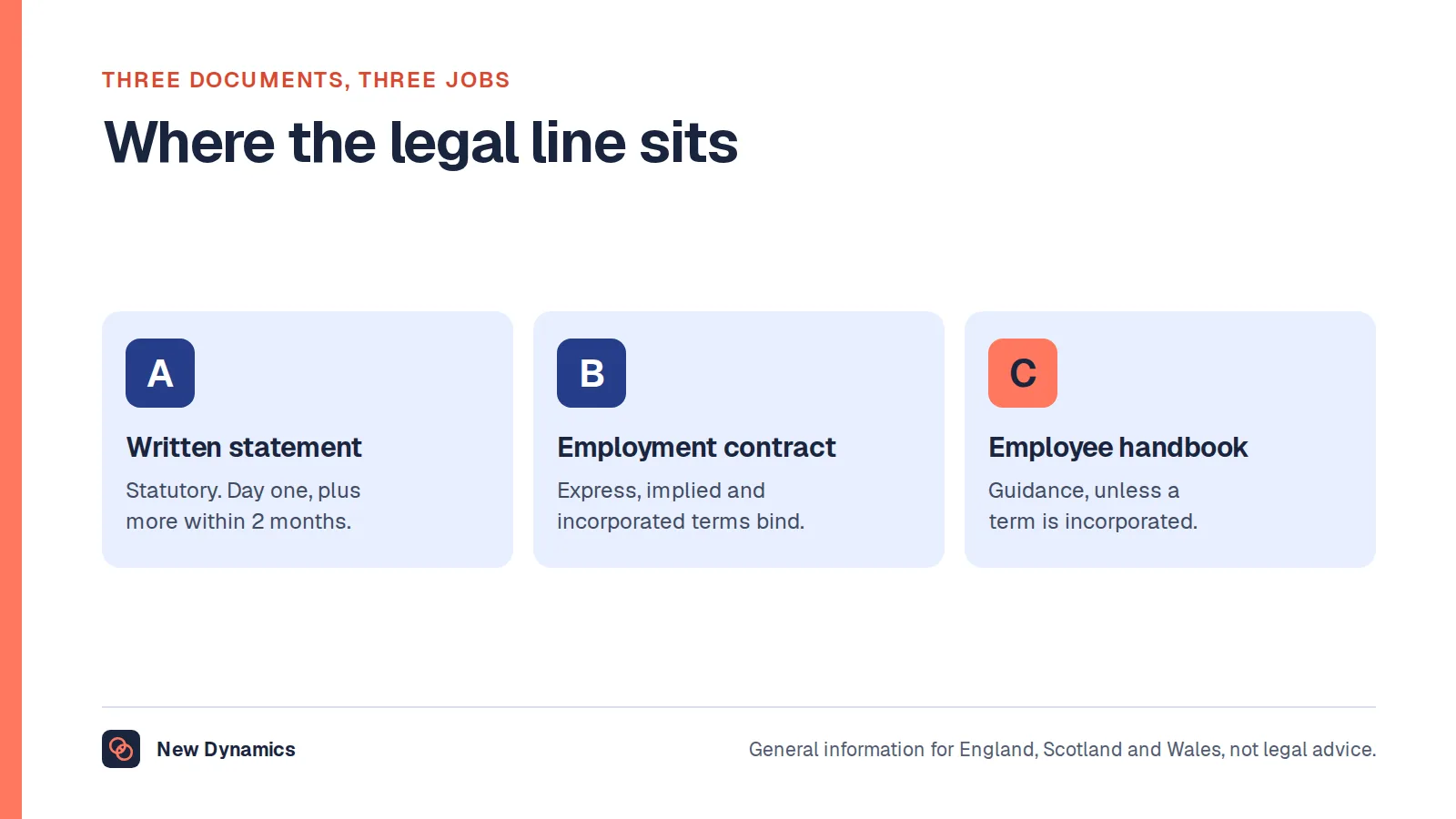
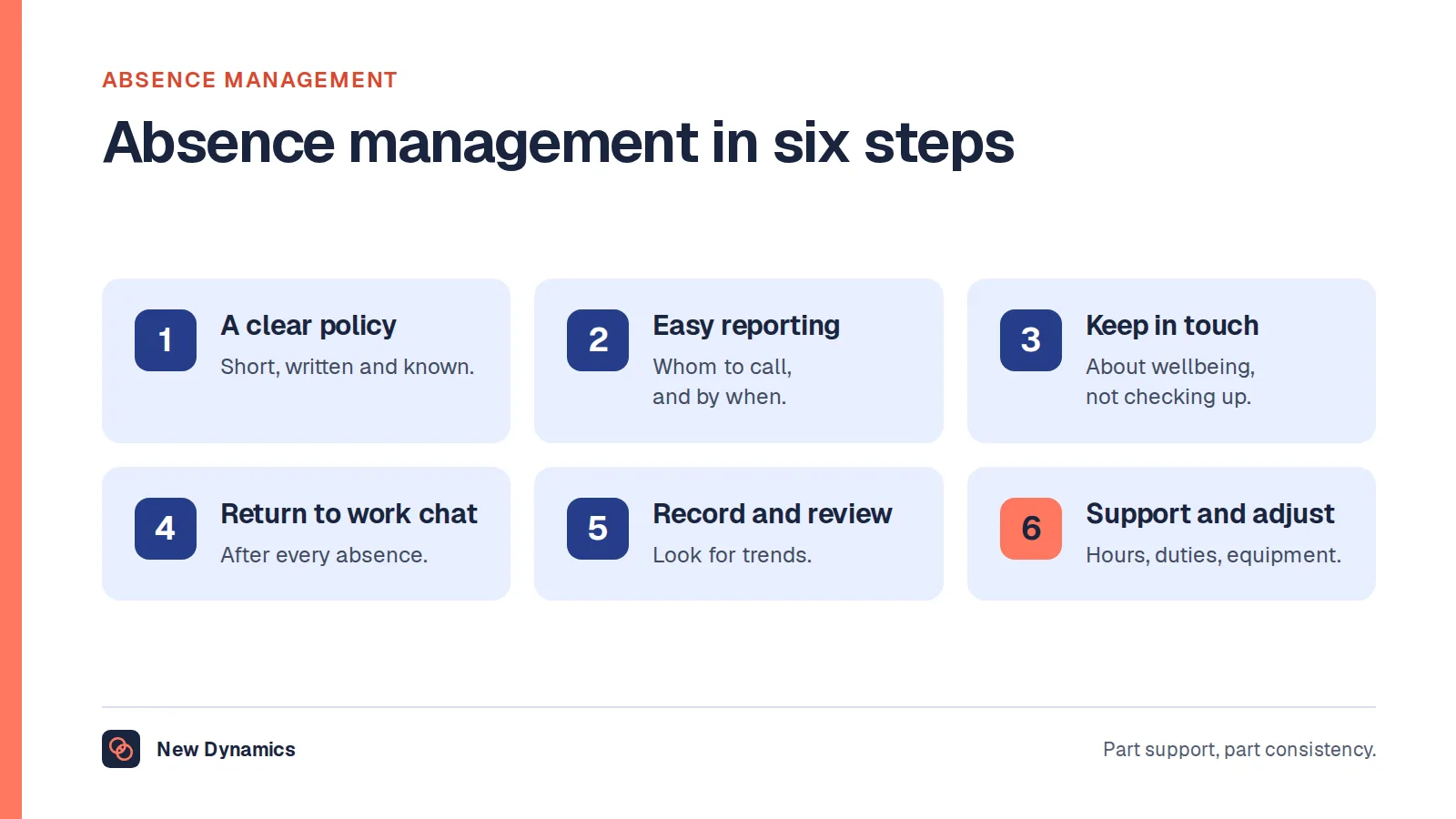
Treat this as one chapter of your leave rules, not a standalone document. Our post on a leave of absence covers stepping away and coming back, absence management covers the surrounding process, and the employee handbook is where a reservist policy belongs.
Frequently asked questions
Does an employer have to give a reservist time off for training?
No. GOV.UK states that employers do not have to allow time off for training, but may choose to. The commitment it describes is one evening a week, several weekends through the year and a 15 day training course each year, so the annual course is usually the only part needing working time. Mobilisation is a separate matter and does not depend on your answer here.
Can an employer stop a reservist being mobilised?
An employer can apply for the mobilisation to be deferred or revoked, or for the employee to be exempted, under the Reserve Forces (Call-out and Recall) (Exemptions Etc.) Regulations 1997. The ground is serious harm to the business that could not be prevented by the granting of financial assistance. Regulation 8(1)(b) requires the application within 7 days of the relevant date, normally the date the call-out notice was served, unless the adjudication officer gives leave for a late one.
How much can an employer claim when a reservist is mobilised?
Replacement costs above the reservist's own earnings, capped at £110 per day by regulation 6(3) of the Reserve Forces (Call-out and Recall) (Financial Assistance) Regulations 2005, plus agency fees and non-recurring advertising, up to £2,000 for training a replacement, up to 5 handover days each side, and the lesser of £300 or 75 per cent of specialist clothing costs. GOV.UK also publishes an employer incentive payment of £500 a month for smaller private and charity sector employers. A claim other than a training award must be made within 4 weeks of the end of the service period.
Does a reservist have to tell their employer they are a reservist?
Only in a narrow case. GOV.UK says reservists have to tell their employer themselves if it is a condition of their job that they do not take any other work. Otherwise they give their employer's details to their commanding officer and the Ministry of Defence usually writes to the employer within 5 weeks of the employee signing up. The MOD does not contact employers in Northern Ireland, and a reservist can apply for a 12 month employer notification waiver.
How long does an employer have to keep a reservist on after they return?
Section 7 of the Reserve Forces (Safeguard of Employment) Act 1985 sets 26 weeks as the default, 52 weeks where the reservist had been continuously employed for at least 52 weeks before mobilisation, and 13 weeks where that period was less than 13 weeks. If an employer refuses to reinstate at all, section 8 lets the reservist apply to a Reinstatement Committee, which can order the job to be made available and order compensation.
Does signing the Armed Forces Covenant create a legal duty for an employer?
No. The statutory Covenant duty in sections 343AA to 343AD of the Armed Forces Act 2006 applies to specified public bodies exercising housing, education or healthcare functions, and no private employer is on that list. An employer's duties towards a reservist come from the 1985 Act and the regulations under the Reserve Forces Act 1996 instead.
Next steps
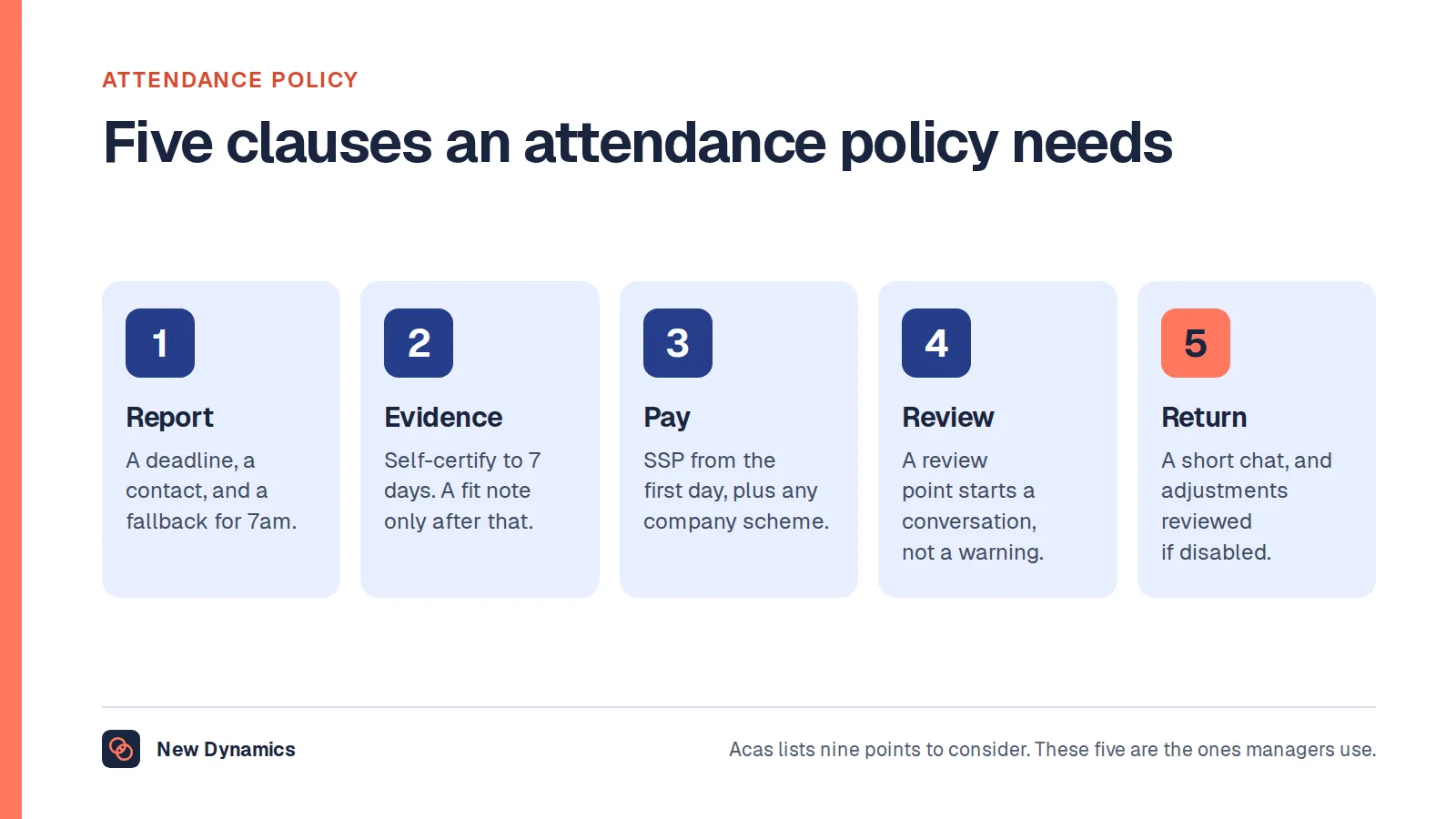
Policies only work when a manager can find them. Read and download our employee handbook guide for the structure that keeps rules like this findable, and see attendance policy for how planned and unplanned absence sit together in one set of rules.
Want the notice, the approval, the payroll change and the return to work in one record instead of four inboxes? Book a New Dynamics demo and bring your current leave policy. You can also email contact@new-dynamics.com.