TL;DR
- Acas is explicit that a review point system should not run itself: an employer "should not use review points to automatically trigger disciplinary action for absence". A trigger is a provision, criterion or practice, so section 20 of the Equality Act 2010 can require it to be adjusted for a disabled employee.
- The policy cannot demand more evidence than the law allows. GOV.UK tells employers: "You can only ask for a fit note if your employee is off work for more than 7 days in a row (including non-working days)", and "You cannot withhold SSP if the employee is late sending you a fit note."
- Where a clause can lead to a warning or a dismissal, the Acas Code applies. Tribunals "will take the Code into account", and can adjust an award "by up to 25 per cent for unreasonable failure to comply with any provision of the Code".
Most attendance policies are written to solve one problem: a manager who does not know what to do when someone does not turn up. They then create a second problem, because the rule that makes a manager's life simple is usually the rule a tribunal finds unreasonable. A fixed number of absences leading to a fixed warning is the clearest example.
This article is about the document itself. What each clause has to say, what the law limits, and where the standard wordings fail. It describes the position in Great Britain and is general information, not legal advice. Take advice on your own policy before you rely on it.
A policy is only as good as the conversations it prompts, and those happen between a manager and one person. See how New Dynamics continuous feedback keeps those check-ins on the record as they happen.
For the wider practice of planning for, recording and responding to time off, including how to measure absence, read our post on absence management. This article does not repeat it. It stays on the document.
What an attendance policy is for
Acas's guidance on creating absence policies says that having absence policies can "help everyone understand their responsibilities" and "support employers to manage absence consistently", and that an employer can "decide whether to have one policy or separate policies to cover different types of absence".
That choice matters. Many organisations write one attendance policy covering sickness, lateness and unauthorised absence, because a manager meets all three in the same week. The risk is that one escalation ladder then gets applied to a train strike, a migraine and a chronic condition. Keep them in one document if you like, but keep the routes separate inside it.
Acas adds the duties around the document: share the policy with the whole organisation, make it clear and easy to follow, provide training on it, and involve any recognised trade union, or worker representatives where there is none.
The clauses the policy needs
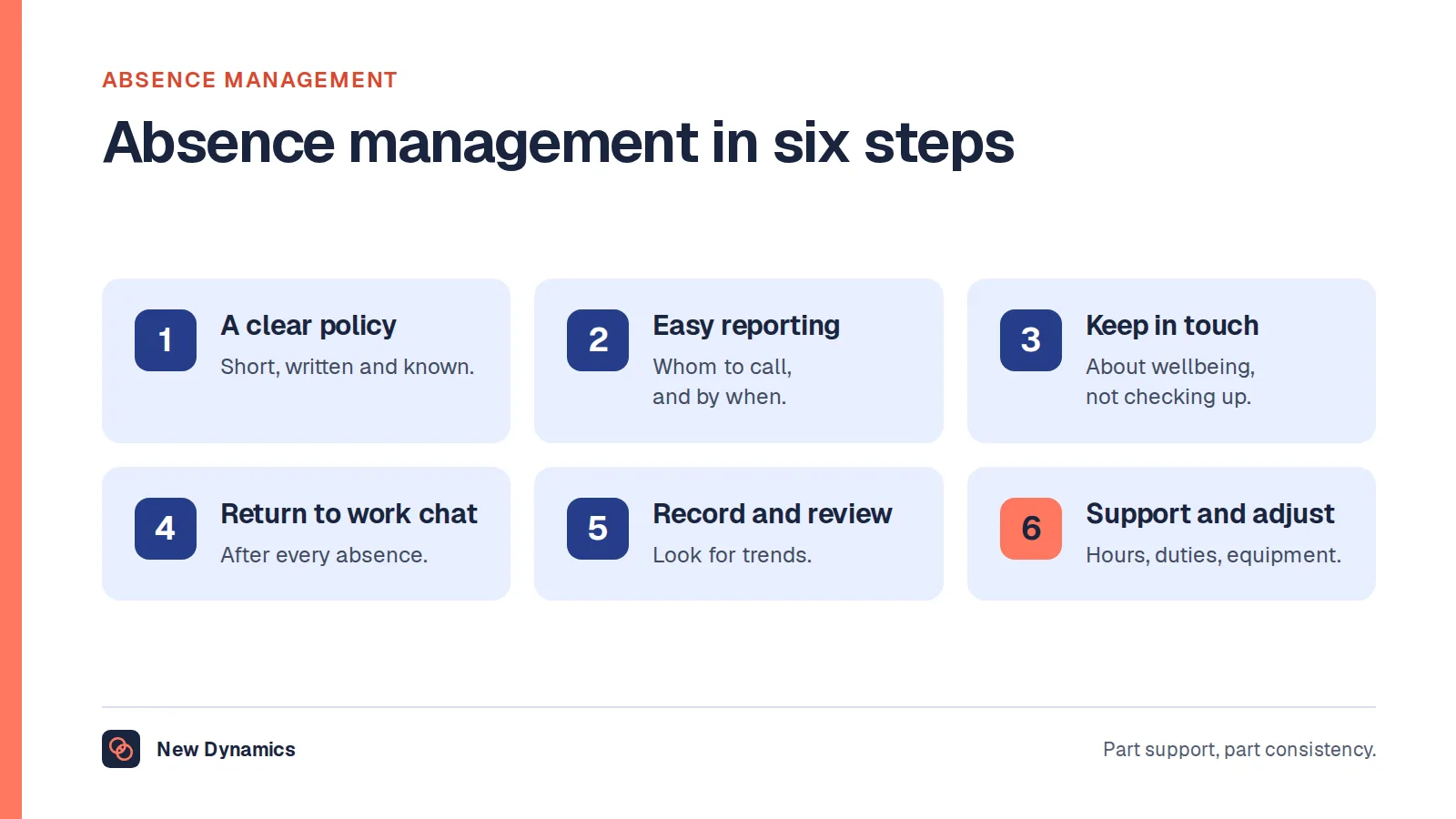
Acas's list of what to consider including is the best starting frame, because anyone reviewing your policy later will compare it with the public guidance you could have followed. Acas says to consider:
- how workers should book planned absences;
- how workers should report unplanned absences;
- how you handle unauthorised absence and lateness;
- whether you use a trigger point system and how this works;
- how workers should keep in touch during absence;
- support available to workers while they are off;
- what to do if someone needs time off for reasons related to a disability;
- support available for workers returning to work after absence;
- what you will pay your worker during absence, for example if they will get sick pay or holiday pay.
Acas notes that in some areas "you must follow what the law says", and names statutory sick pay, fit notes and time off for dependants. Those are the clauses where a loose draft is not merely unhelpful. It is wrong.

Notification: what you can and cannot require
This is the clause managers actually use, and the one most often drafted too tightly.
GOV.UK's employer guide to statutory sick pay says: "The employee should tell you they're sick within the time limit set by you, or 7 days if you do not have one. You cannot insist they tell you in person or on a special form." So you may set a deadline, and you should, because the default is seven days. You may not make one phone call to one named person the only valid route.
The deadline has teeth. GOV.UK continues: "You do not have to pay Statutory Sick Pay (SSP) for any days the employee was late in telling you (unless there's a good reason for the delay)." Its worked example is a five day limit where the employee reports on day seven, and the employer does not have to pay for the two late days.
A workable clause names a deadline, names a primary contact, names a fallback for when that person is unreachable at seven in the morning, and says what information is needed. What it must not ask for is a diagnosis. "I am unwell and not fit to work today" is a complete report.
Evidence and fit notes
The evidence clause is where policies quietly ask for things an employer cannot require.
GOV.UK is direct: "You can only ask for a fit note if your employee is off work for more than 7 days in a row (including non-working days)." And: "You cannot withhold SSP if the employee is late sending you a fit note." A fit note must be issued by a GP or hospital doctor, registered nurse, occupational therapist, pharmacist or physiotherapist, and it "can be printed or digital". With the employer's agreement the employee can give other evidence instead, such as "an Allied Health Professional (AHP) Health and Work Report" or "a plan to support a return to work".
Below that threshold the employee self-certifies. Acas's guidance on fit notes and proof of sickness says that if someone is off "for 7 calendar days or less (including weekends), they do not need a fit note", they "do not need to provide medical evidence", and "they should still be paid the amount of sick pay they're entitled to".
The two official pages word the limit slightly differently, and it is worth knowing which to copy. Acas says an employer "should only ask their employee for a fit note from the 7th day of absence", while GOV.UK's employer guide allows it only where the absence runs to "more than 7 days in a row". Use the GOV.UK wording. It is the statement of what an employer may require, and it matches the seven calendar day self-certification period both pages describe. Nothing stops an employee giving you a note sooner if they already have one.
The pay clause
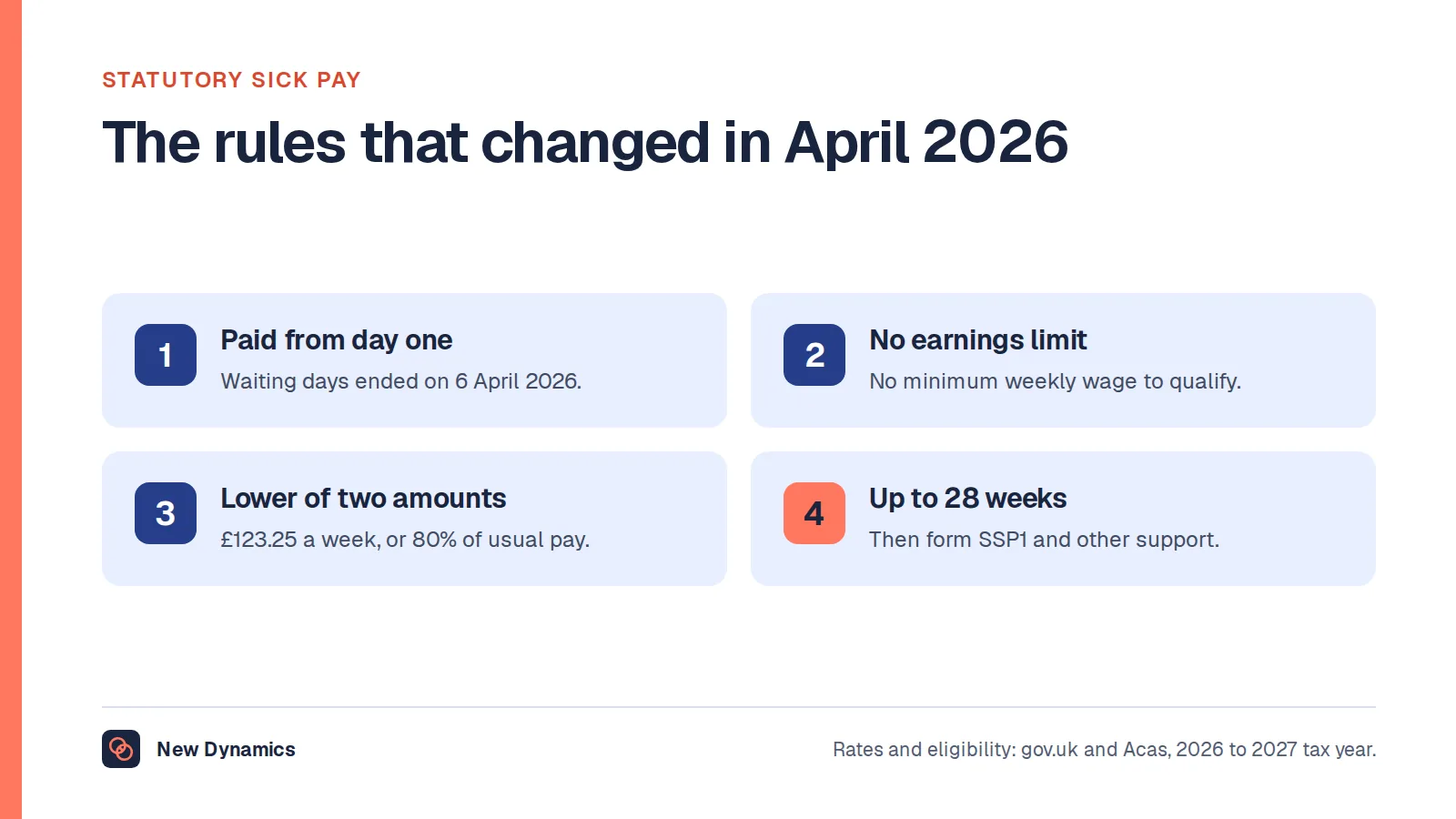
HMRC's table of rates and thresholds for employers 2026 to 2027 states that the figures "apply from 6 April 2026 to 5 April 2027" and that "the weekly rate of Statutory Sick Pay (SSP) for 2026 to 2027 is £123.25 or 80% of the employee's average weekly earnings, whichever is lower". GOV.UK adds that it is "paid for up to 28 weeks" and that SSP "is paid when the employee is sick for at least one full working day".
Acas records the change that makes older clauses wrong: "The eligibility criteria for statutory sick pay changed on 6 April 2026", and workers no longer need to be off sick for at least four days in a row, the condition known as "waiting days". An eligible worker is now "entitled to statutory sick pay from the first day of sickness absence". If your policy still says the first three days are unpaid, it is telling staff something untrue. Our post on the sick leave policy covers the pay rules and the qualifying day calculation in full.
Trigger points, and the biggest legal risk in the document
Acas's guidance on absence trigger points begins with the fact most policies ignore: "There are no legal rules about how or when absence should be reviewed. It depends on what works for an organisation." If you use triggers, set them out clearly and make clear "what the review points are", "the process for flagging up that an employee has reached a review point" and "that reaching a review point will start an absence review".
Then the sentence to write into your own document: an employer "should not use review points to automatically trigger disciplinary action for absence". Acas explains why in behavioural terms. "If employees view the system as a way to punish them, this could cause more absence", because people come back too early to avoid reaching a point.
Acas's own example on having an unauthorised absence policy makes the same point about lateness. Sam's train is delayed. Under a policy that gives a warning for lateness either way, Sam takes the whole day off. Under a flexible policy, Sam rings in, arrives half an hour late and makes the time up. The rigid rule bought the employer a lost day.
The legal risk sits on top of that. A trigger is a provision, criterion or practice. Section 20 of the Equality Act 2010 sets the duty to make adjustments, and the first requirement applies "where a provision, criterion or practice of A's puts a disabled person at a substantial disadvantage in relation to a relevant matter in comparison with persons who are not disabled", requiring "such steps as it is reasonable to have to take to avoid the disadvantage". Section 21 then makes a failure to comply discrimination in itself: "A discriminates against a disabled person if A fails to comply with that duty in relation to that person."
Acas's guidance on disability-related absence names the adjustments: "not counting some or all sickness absence related to a disability towards any trigger points", "increasing the number of absences that will trigger a review", and recording disability absence separately from other sickness absence. It also suggests deciding "that absence related to disability or pregnancy will not count towards review points".
So the clause needs three things a standard template lacks: a statement that reaching a point starts a review and nothing else, a route for adjusting or discounting disability related and pregnancy related absence, and a named decision maker. If you score absence, our post on the Bradford Factor explains why frequency weighted scores reach disabled employees first.

Lateness and unauthorised absence
This part of the policy has nothing to do with sickness and needs its own words.
Acas defines unauthorised absence as when someone does not turn up and either "has not got permission from their employer beforehand" or "does not follow the organisation's policy for reporting an unexpected absence". It notes that "unauthorised absence can include when someone is late for work", and that leaving early without permission can count too.
Before any of that comes a welfare step that is usually missing from the document. Acas says employers "have a duty of care towards their employees" and should try work contact details, then personal contact details, then the emergency contact. As a last resort they could go to the home address if appropriate, or ask the police for a welfare check if they have serious concerns about safety. Lone workers need this agreed in a risk assessment in advance.
Acas also warns on recording. A pregnant employee repeatedly late because of morning sickness who is disciplined for it "could be discrimination on the grounds of pregnancy or maternity". Recording pregnancy and disability related lateness separately is Acas's suggested answer, and it adds that separate recording "does not mean the employer should ignore them".
Where there is no valid reason, Acas says to handle it informally if appropriate, and to treat it as a disciplinary matter only where "the absence or lateness has serious consequences" or where the employee "is repeatedly late or absent without a valid reason and they're making no attempts to improve their behaviour". Our post on the disciplinary procedure covers what then has to be followed.
Return to work meetings
Acas's guidance on return to work meetings contains a line written for policy drafters: "An employer should have a process they follow when someone returns to work. This should be in the organisation's absence policy, if they have one."
The meeting itself is light. Acas says it "is often just an informal chat between a worker and their manager", that "it's not a legal requirement to have a return to work meeting", and that a conversation soon after a return is a chance to check the person is ready, share what happened while they were off, see if they need support, agree a phased return where appropriate, and talk about "what they would like other workers to know about their absence and what they would like to keep confidential". Where the worker is disabled, the employer "should review their reasonable adjustments".
A policy that mandates a meeting but trains nobody to hold one produces a signed form and no information.
Short term intermittent absence against long term sickness
These are different problems and they need different clauses.
Short term intermittent absence is a pattern question: several separate spells, each self-certified, often short and unconnected. The policy's job is to make the pattern visible, start a supportive review at a stated point, and check for causes the employer can fix, such as workload, shift timing, an unmanaged condition or work related stress.
Long term sickness is one continuing absence. There the policy has to settle contact, pay, medical evidence, occupational health referral, adjustments and a planned return. Acas lists the questions an absence review should consider in either case, including whether to refer to occupational health, whether the absence might be disability related, whether it relates to pregnancy or mental health, whether any of it was caused by work, and whether more flexible working would help. Where a review cycle runs into a long absence, our post on reviewing an employee on long-term sick leave covers the sequence.

When attendance becomes capability rather than conduct
This distinction decides which procedure applies, and getting it wrong is how employers lose cases they could have won.
Acas's guidance on types of dismissal lists the potentially fair reasons under the Employment Rights Act 1996, including misconduct, "when the employee has done something that's inappropriate or not acceptable", and capability, "when the employee is not able to do the job or does not have the right qualifications". On sickness it is specific: "Dismissal because of long-term illness would usually be a capability issue. This means it would depend on whether or not the employee is able to do their job." Acas adds that "dismissal should be a last resort", that the employer should first support the employee and help them get back to work, and that dismissing someone because they are disabled "could be discrimination".
Genuine sickness absence is therefore not misconduct, however inconvenient the pattern. Conduct enters in two narrow places. Acas's trigger point guidance says a reviewing employer should consider whether "they believe the reason for the absence is genuine", and if not, "they might need to deal with it as a misconduct issue". And unauthorised absence or repeated lateness with no valid reason is a conduct matter from the start, because the failure is in not following the reporting rule rather than in being unwell.
Write that fork into the policy. One route for not being able to attend, which is supportive and ends, if it ends badly, in a capability decision. One route for not following the rules, which is disciplinary. Our post on the capability procedure sets out the first route step by step.
The Acas Code, and the uplift for ignoring it
Any clause that can lead to a warning or a dismissal drags the Acas Code of Practice in with it.
The Acas Code of Practice on disciplinary and grievance procedures states that it "is issued under section 199 of the Trade Union and Labour Relations (Consolidation) Act 1992". Its foreword sets out the consequence: "A failure to follow the Code does not, in itself, make a person or organisation liable to proceedings. However, employment tribunals will take the Code into account when considering relevant cases." And: "Tribunals will also be able to adjust any awards made in relevant cases by up to 25 per cent for unreasonable failure to comply with any provision of the Code." The adjustment runs both ways, and can reduce an employee's award by up to the same proportion.
The Code also answers the capability question for drafters, at paragraph 1. "Disciplinary situations include misconduct and/or poor performance. If employers have a separate capability procedure they may prefer to address performance issues under this procedure. If so, however, the basic principles of fairness set out in this Code should still be followed, albeit that they may need to be adapted." A separate attendance route does not escape the Code. It inherits it.
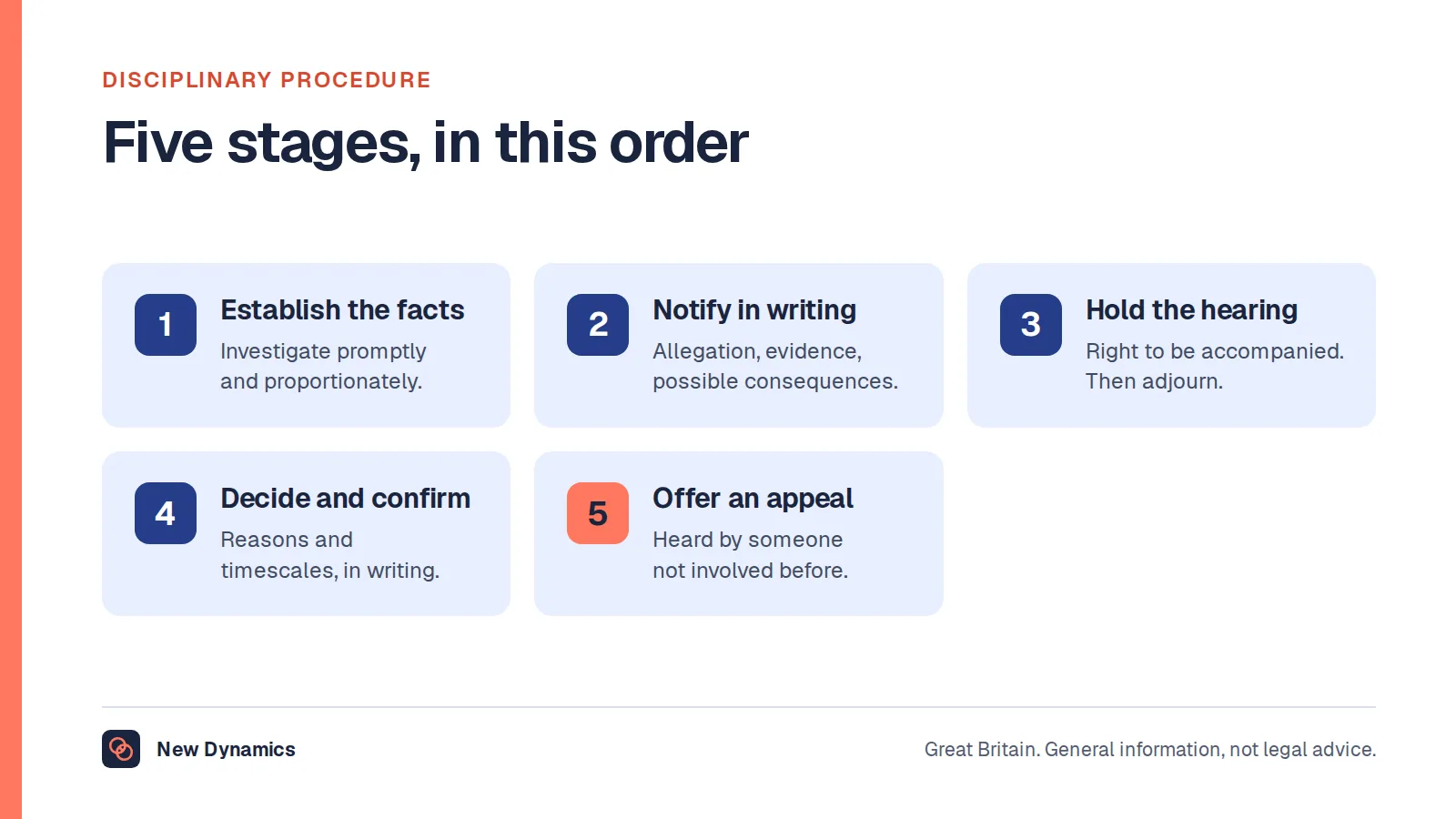
The fairness elements at paragraph 4 are the ones to design your attendance meetings around: deal with issues promptly, act consistently, carry out any necessary investigations, inform the employee of the basis of the problem and give them a chance to respond before any decision, allow them to be accompanied at any formal meeting, and allow an appeal. Acas notes on the Code's page that it is being updated, so check the published version before citing paragraph numbers in your own document.
Attendance records are special category data
The policy has to say what you record and who sees it, because the records themselves are regulated.
The ICO's employment guidance on sickness and injury records states that "sickness and injury records include information about workers' physical or mental health. Holding sickness or injury records therefore involves processing special category data."
It also draws the distinction that lets most attendance policies work with less sensitive data. A sickness record "contains details of the illness or condition responsible for a worker's absence". An absence record "may give the reason for absence as 'sickness' or 'accident' but does not include any reference to specific medical conditions", and "a simple absence record, without any details of a worker's health condition is not likely to be special category data". The ICO says employers "could, and you may prefer, to use absence records instead of sickness records where practical".
On the lawful basis, the ICO says you "can likely rely on legitimate interests or legal obligation as your lawful basis and the employment law condition for processing", and that consent is unlikely ever to be appropriate, partly because an employer "may use sickness absences in potential disciplinary proceedings", so the worker has no real choice. A consent tick box in an attendance policy is the wrong answer.
Two further rules belong in the clause. Access is on a need to know basis: "You should not make the sickness, injury or absence records of individual workers available to others, unless it is necessary for them to do their jobs." And league tables are out: an employer "must not publish 'league tables' of sickness absences of individual workers where everyone can see a person's sickness, injury or absences".
Where attendance policies go wrong
- An automatic sanction at a trigger. Acas says review points should not automatically trigger disciplinary action. This is the most common drafting failure.
- A fit note demanded on day three. GOV.UK limits what an employer may ask for to absences of more than seven days in a row.
- One route for sickness, lateness and absence without permission. Three problems, three responses.
- Silence on disability. With no adjustment route for trigger points, the policy sits on the wrong side of section 20.
- Pay wording left at the old rules. Waiting days ended on 6 April 2026.
- A single named contact and no fallback. The policy then fails at 7am, which is when it is used.
- Attendance bonuses. Paying people for never being off rewards working while ill, and reaches disabled employees and carers last.
Frequently asked questions
What should an attendance policy include?
Acas suggests covering how to book planned absence, how to report unplanned absence, how unauthorised absence and lateness are handled, any trigger point system and how it works, keeping in touch during absence, support while off and on return, what to do where absence relates to a disability, and what is paid.
Are attendance trigger points legal in the UK?
Yes. Acas says there are no legal rules about how or when absence should be reviewed. The risk is in how a trigger is used. Acas says an employer should not use review points to automatically trigger disciplinary action, and under the Equality Act 2010 a trigger may need to be adjusted or disapplied for disability related absence.
Can an employer ask for a fit note for a short absence?
No. GOV.UK tells employers they can only ask for a fit note if the employee is off work for more than seven days in a row, including non-working days. Below that the employee self-certifies and does not need to provide medical evidence.
Is poor attendance misconduct or capability?
It depends on the reason. Acas says dismissal because of long-term illness would usually be a capability issue, turning on whether the person is able to do their job. Unauthorised absence or repeated lateness without a valid reason is a conduct matter, as is absence the employer does not believe is genuine.
Does an attendance policy have to follow the Acas Code?
Where a stage of the policy can lead to a warning or a dismissal, yes in practice. Tribunals take the Code into account and can adjust an award by up to 25 per cent for an unreasonable failure to comply with any provision of it. The Code says a separate capability procedure must still follow its basic principles of fairness.
Must a return to work meeting be in the policy?
Acas says an employer should have a process they follow when someone returns to work, and that this should be in the organisation's absence policy. The meeting itself is not a legal requirement, and Acas describes it as often just an informal chat between a worker and their manager.
Your next step: redraft three clauses
- Find the trigger clause and check that reaching a point starts a review and nothing else. Add the route for adjusting or discounting disability related and pregnancy related absence.
- Find the evidence clause and compare it with GOV.UK's limit of more than seven days in a row. Delete anything that asks for medical evidence sooner.
- Find the pay clause and check it against the rate and the rules in force from 6 April 2026. Remove any reference to unpaid waiting days.
- Split the lateness and unauthorised absence route from the sickness route, and add the welfare steps Acas lists for someone who has not turned up.
- Name who holds the records, who may see them and on what lawful basis.
To turn clauses like these into a handbook that managers actually open, read and download our employee handbook guide. The guide is free to read, and the PDF uses our short download form.
Want the attendance conversations on the record before they become formal ones? Book a New Dynamics demo and bring your current policy. You can also email contact@new-dynamics.com.