TL;DR
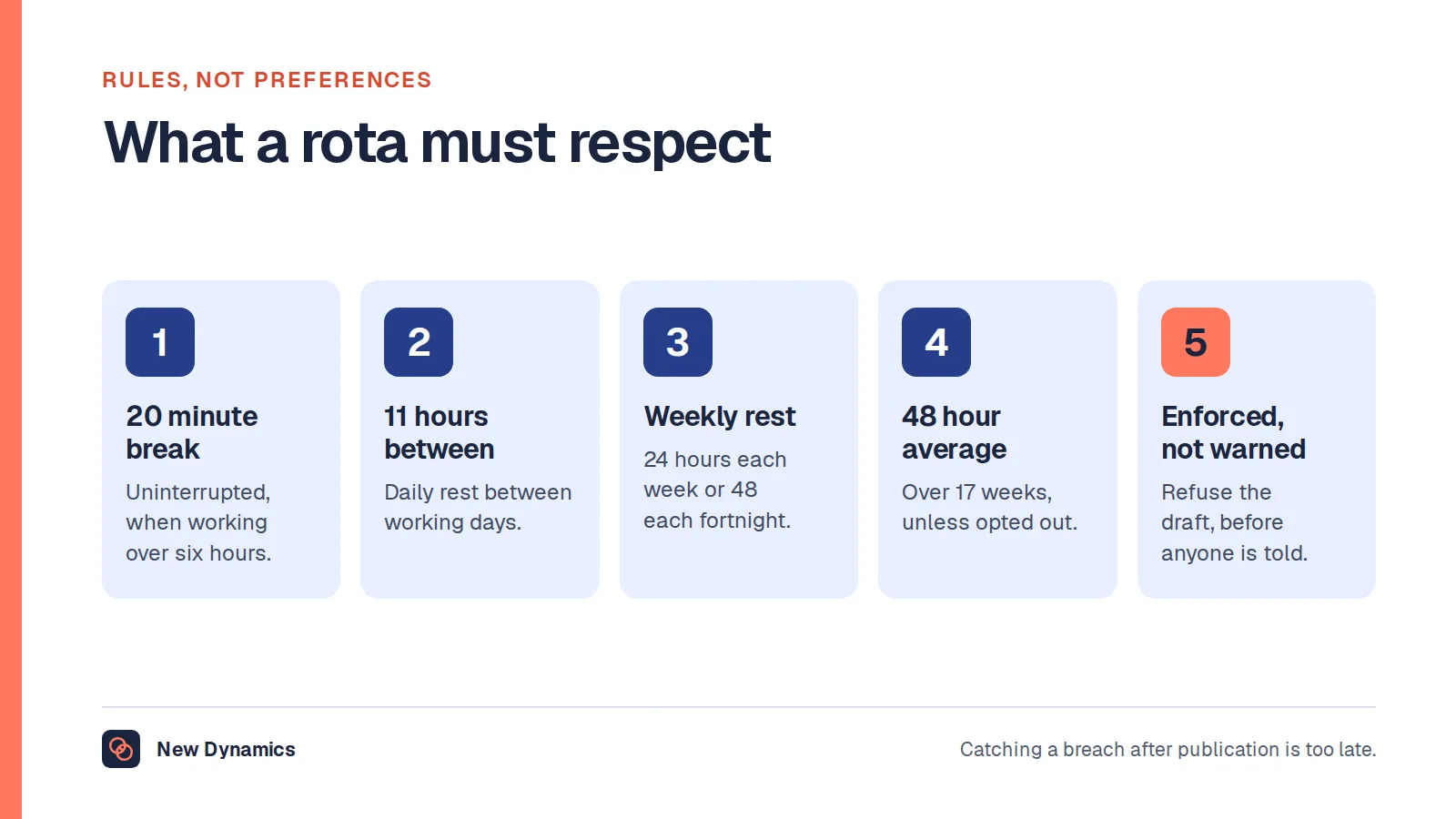
- The five limits a restaurant rota has to clear all sit in the Working Time Regulations 1998: an uninterrupted 20 minutes above six hours of daily working time (regulation 12(3)), 11 consecutive hours of daily rest (regulation 10(1)), 24 hours weekly or 48 hours a fortnight (regulation 11), a 48 hour average over 17 weeks (regulation 4), and an average of eight hours a night for night workers (regulation 6(1)).
- The catering exception for under 18s is narrower than it reads. Regulation 27A(3) lifts the 10pm to 6am ban for a restaurant, bar or hotel only up to 4am, and only where the work maintains continuity or answers a surge, no adult is available, and education is not affected. The eight hour day and 40 hour week in regulation 5A are never lifted.
- There is still no statutory minimum notice of a shift or a shift change in Great Britain. The Employment Rights Act 2025 rights to guaranteed hours, reasonable notice and payment for cancelled shifts are not in force: sections 1 to 3 were commenced on 6 January 2026 only so far as they confer a power to make regulations, and GOV.UK says the timings will be updated after consultation.
A restaurant rota is built under pressure. Two people are off sick, Saturday is double booked, a chef wants a double so they can take Monday off, and the sous chef is 17. The rota that comes out of that hour is a legal document, and most of the rules it has to satisfy are in a statutory instrument from 1998 rather than in anyone's contract.
This article sets out restaurant employee scheduling against the regulation text: the rest a shift pattern has to leave room for, the 48 hour average and what an opt out does not buy, night work, the tighter caps on under 18s, split shifts, notice of a change, and what the rota has to leave behind on paper. It describes the position in England, Scotland and Wales and is general information, not legal advice.
Shift swaps, opt out forms and young worker checks are processes with a date and a signature attached. New Dynamics workflows let you shape the stages, forms and approvals around your own process, so the record exists when an inspector asks rather than being rebuilt from a group chat.
Choosing a tool rather than writing next week's rota? Our post on employee scheduling software covers what to test in a demo. For the 48 hour agreement in full, see our post on the working time opt out.
The five limits a restaurant rota has to clear

All five sit in the Working Time Regulations 1998, quoted here from the in force version on legislation.gov.uk.
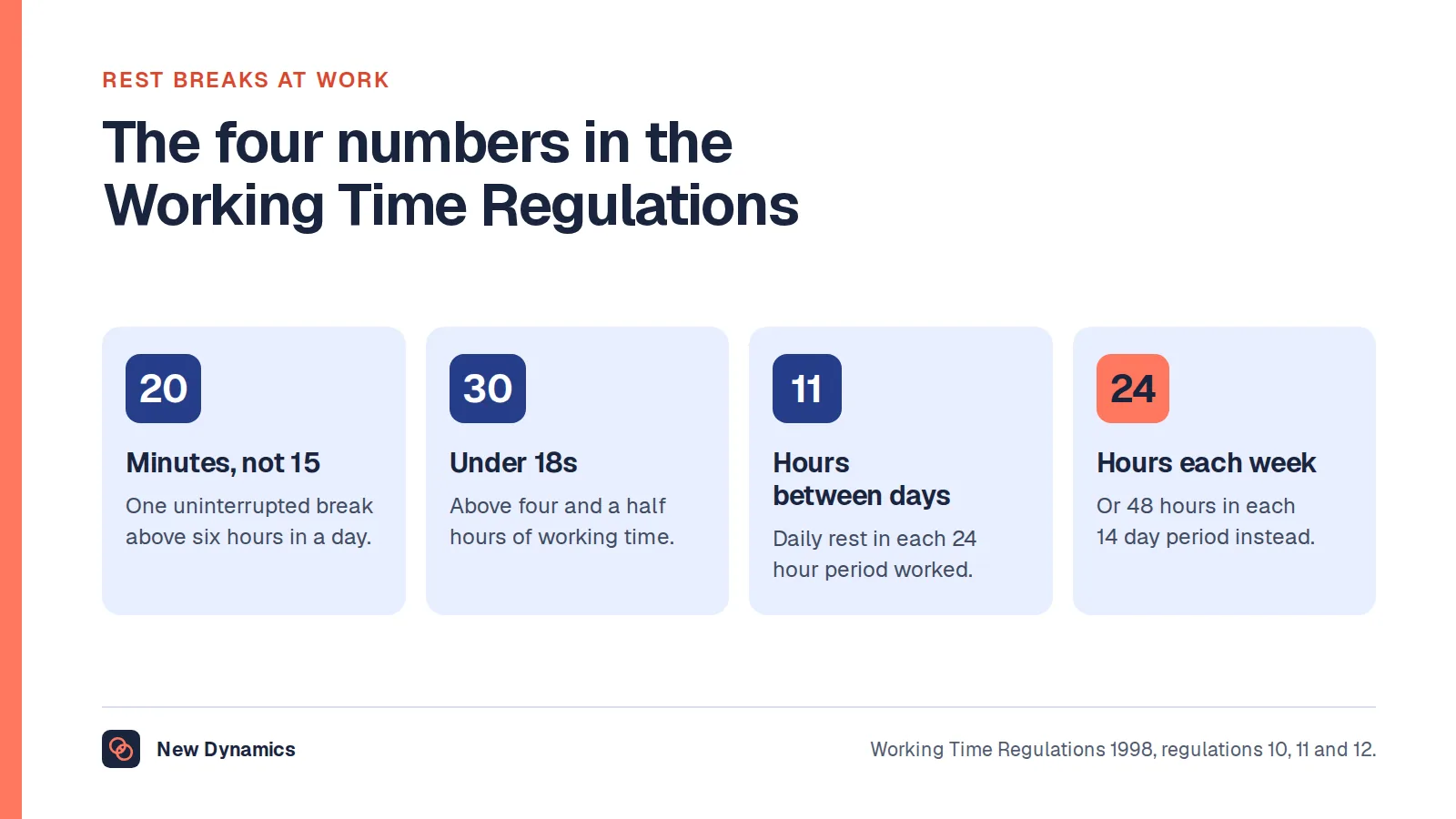
The in-shift break. Regulation 12(3) makes it "an uninterrupted period of not less than 20 minutes", spent away from the workstation, and regulation 12(1) triggers it only where daily working time is "more than six hours". A shift of exactly six hours gets nothing, and ten minutes at the pass plus ten minutes later is a breach, because neither block is uninterrupted. GOV.UK is blunt on the third trap: "It does not count as a rest break if an employer says an employee should go back to work before their break is finished."
Daily rest. Regulation 10(1) gives "a rest period of not less than eleven consecutive hours in each 24-hour period during which he works for his employer". GOV.UK puts it in rota terms on rest breaks at work: "if they finish work at 8pm, they should not start work again until 7am the next day." A 1am close and a 10am prep start is nine hours, and that is where restaurants fail.
Weekly rest. Regulation 11(1) gives "an uninterrupted rest period of not less than 24 hours in each seven-day period", and regulation 11(2) lets the employer substitute two such periods or "one uninterrupted rest period of not less than 48 hours" each fortnight. Regulation 11(7) adds the part that gets missed: weekly rest "shall not include any part of a rest period to which the worker is entitled under regulation 10(1)" unless objective, technical or work organisation reasons justify it. An overnight gap cannot count twice.
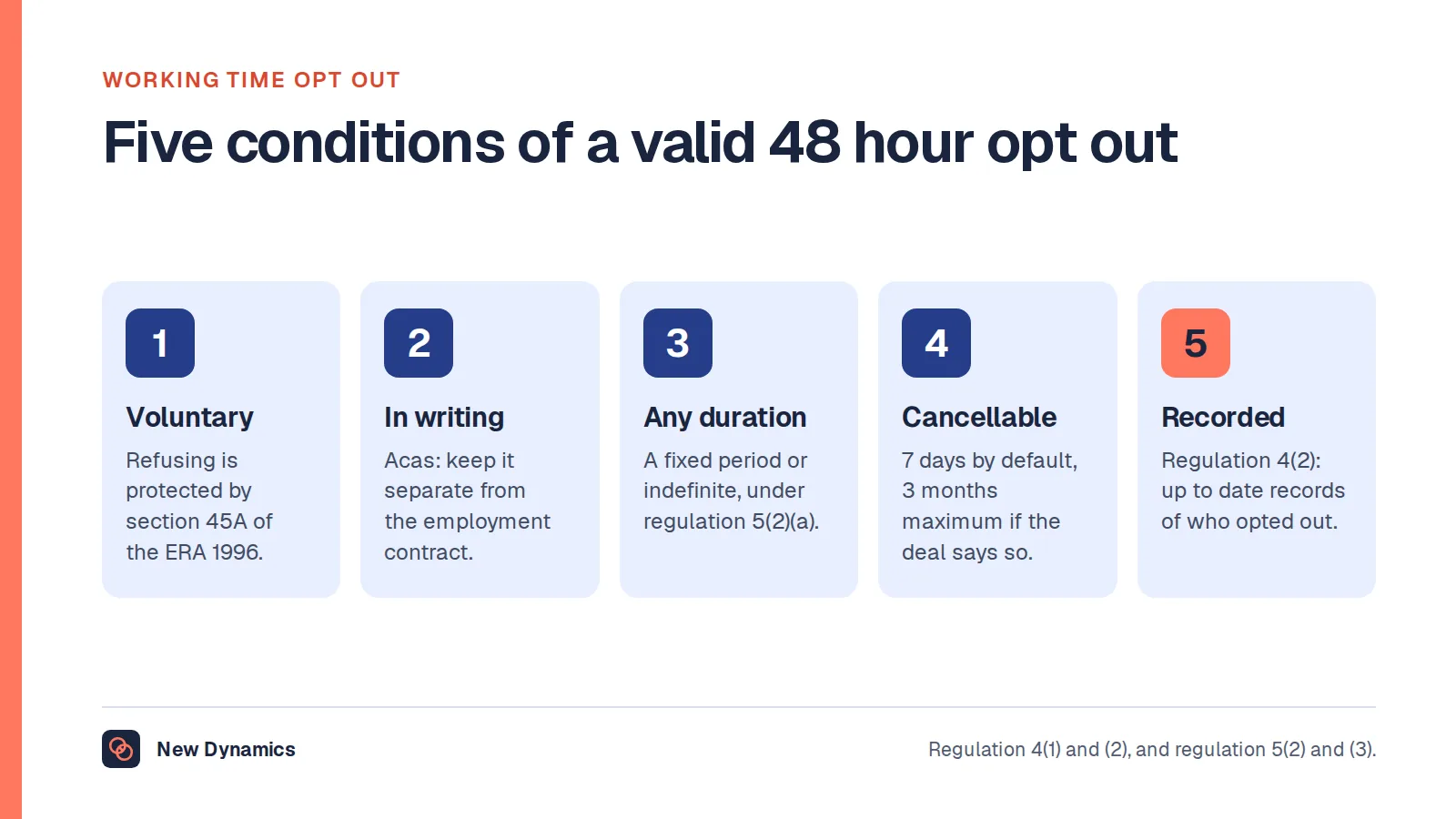
The weekly average. Regulation 4(1) caps working time, "including overtime", at "an average of 48 hours for each seven days" unless the employer "has first obtained the worker's agreement in writing to perform such work". Regulation 4(3) sets the reference period at 17 weeks by default.
Night work. Regulation 6(1) limits a night worker's normal hours to "an average of eight hours for each 24 hours", over the same 17 week default.
What the opt out does and does not allow
A signed opt out lifts regulation 4(1) and nothing else. Breaks, daily rest, weekly rest and the night limit are untouched. It is also weak security: regulation 5(2)(b) makes the agreement "terminable by the worker by giving not less than seven days' notice to his employer in writing", with regulation 5(3) capping any longer contractual notice at three months. A rota that only balances because the brigade has opted out is one letter away from a breach. Nobody under 18 can opt out, and GOV.UK states on maximum weekly working hours that "If you're under 18, you cannot work more than 8 hours a day or 40 hours a week."
Night work in a late kitchen
The definition matters more than the hours. Under regulation 2(1), "night time" is a period of at least seven hours including midnight to 5am, fixed by a relevant agreement or, in default, "the period between 11 p.m. and 6 a.m." A night worker is someone who, "as a normal course, works at least three hours of his daily working time during night time". A bar closing at 1am makes night workers of the people who do it on most of the days they work, whether or not anyone calls it a night shift.
GOV.UK's guidance on night working hours adds two rota points: "Regular overtime is included in the average, but not occasional overtime", and "Workers cannot opt out of the limit." Regulation 6(7) is stricter and is not an average at all. Where night work "involves special hazards or heavy physical or mental strain", the employer must ensure the worker does not work more than eight hours in any 24 hour period, and regulation 6(8) brings work inside that rule if the employer's own risk assessment recognises it as a significant risk.
Under 18s, and the catering exception that is narrower than it looks

A young worker, in regulation 2(1), has reached 15 but not 18 and is above compulsory school age. Four limits tighten at once.
- Regulation 5A(1): working time "shall not exceed" eight hours a day or 40 hours a week, with no averaging and no agreement that lifts it. Regulation 5A(2) aggregates hours across every employer, so a 17 year old with two bar jobs is measured on the total.
- Regulation 12(4): a 30 minute break once daily working time is more than four and a half hours, "which shall be consecutive if possible".
- Regulation 10(2): 12 consecutive hours of daily rest, not 11.
- Regulation 11(3): 48 hours of weekly rest, reducible under regulation 11(8) but "not to less than 36 consecutive hours".
Night work is where restaurants reach for an exception. Regulation 6A bans a young worker from working during "the restricted period", which regulation 2(1) defines as 10pm to 6am, or 11pm to 7am where the contract provides for work after 10pm. Regulation 27A(3) disapplies that for "a catering business" and for "a hotel, public house, restaurant, bar or similar establishment", but only "except in so far as it prohibits work between midnight and 4 a.m.", and only "in the circumstances referred to in paragraph (1)": that the work is "necessary either to maintain continuity of service or production or to respond to a surge in demand", that "no adult worker is available to perform the work", and that it "would not adversely affect the young worker's education or training". Regulation 27A(4) then requires adult supervision where necessary for protection, plus "an equivalent period of compensatory rest".
GOV.UK's night working page reaches the same place, listing "a hotel or catering" among the sectors with an exception and stating the conditions separately. Read as drafted, this is a cover-the-gap provision with a hard floor at midnight, not a standing late licence. Anyone still of compulsory school age is outside all of it, governed by child employment rules and council permits instead, for which GOV.UK's child employment page is the starting point.
Split shifts and the double
The regulations assume split shifts. Regulation 22(1)(c) provides that "neither regulation 10(1) nor paragraphs (1) and (2) of regulation 11 apply to workers engaged in activities involving periods of work split up over the day". Daily and weekly rest can therefore be displaced for genuinely split work, but not for free: regulation 24 requires the employer to "allow him to take an equivalent period of compensatory rest" wherever possible, and where that is impossible, to give "such protection as may be appropriate in order to safeguard the worker's health and safety".
Regulation 21 does something similar where "there is a foreseeable surge of activity", naming tourism, again subject to compensatory rest. Regulation 4(1) is not in regulation 21's list, so a seasonal surge does not raise the 48 hour average. And the unsocial hours premium a split shift usually carries does not help with the minimum wage: GOV.UK's guidance for employers and the minimum wage lists "tips, service charges and cover charges" and "extra pay for working unsocial hours on a shift" among the payments that "must not be included".
How much notice of a shift change is reasonable
There is no statutory minimum. Nothing in the Working Time Regulations sets a notice period for publishing a rota or changing a published shift, and no GOV.UK page states one. Notice is contractual, or it is custom.
Be careful with what you may have read about this changing. The Employment Rights Act 2025 (2025 c. 36) contains section 1, a right to guaranteed hours, section 2, rights to reasonable notice of a shift, and section 3, a right to payment for cancelled, moved and curtailed shifts. None of those rights exists yet. Sections 1 to 4 came into force on 6 January 2026 under the Employment Rights Act 2025 (Commencement No. 1 and Transitional and Saving Provisions) Regulations 2026, and regulation 2(2) commences them only "In so far as conferring a duty to consult or a power to make regulations" under the new Chapters of Part 2A of the Employment Rights Act 1996. The explanatory note says the same in plain words: they are commenced "to enable the making of regulations".
GOV.UK's timeline, on its page for implementing the Plan to Make Work Pay and Employment Rights Act and last updated on 5 November 2026, gives no date: "Timings for the introduction of the right to guaranteed hours, the right to reasonable notice and payment for shifts cancelled or changed at short notice will be updated following the consultation process." Until the regulations fixing the specified notice period and the specified payment are made, a cancelled shift carries no statutory compensation. One thing has changed: section 7 of the 2025 Act repealed the Workers (Predictable Terms and Conditions) Act 2023 from 6 January 2026, so the right to request a predictable working pattern is gone rather than pending.
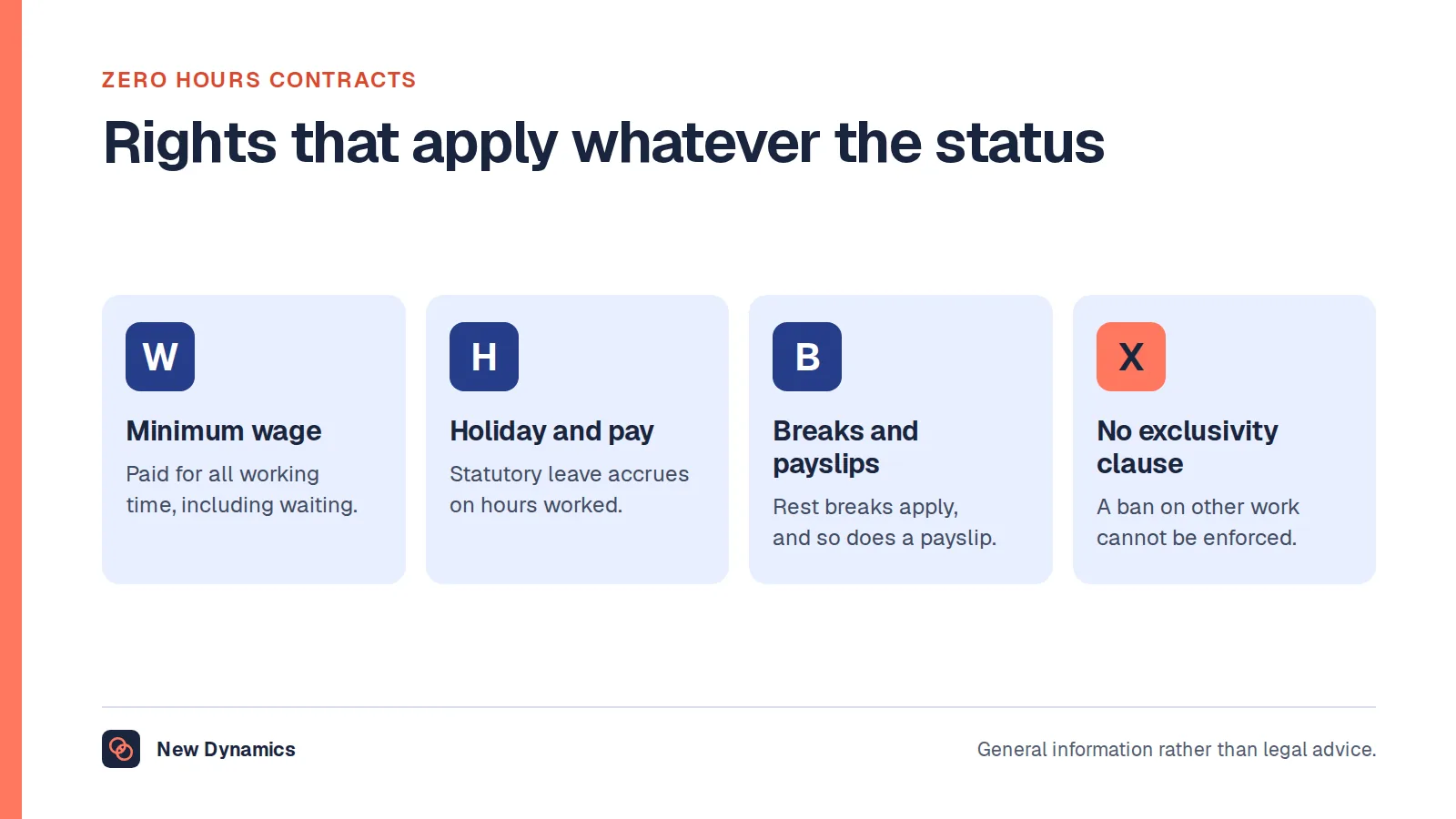
What is left is a management decision. Publish the rota a fixed number of weeks ahead, write that period into the contract or the handbook, require a reason for any change inside it, and keep the change log. Our post on zero hours contracts covers the contractual side for the staff most exposed to short notice.
Absence is what a rota has to absorb, and it is not evenly spread. In sickness absence in the UK labour market: 2022, the Office for National Statistics found that "workers in caring, leisure or other service occupations had the highest rate of sickness absence in 2022, at 4.3%, an increase of 0.5 percentage points on 2021", against 1.6% for managers and senior officials. Our HR statistics hub collects the wider absence and hours figures with their reference periods.
What the rota has to leave behind

Working time records. Regulation 9(1), as substituted on 1 January 2024 by the Employment Rights (Amendment, Revocation and Transitional Provision) Regulations 2023, requires records "adequate to show whether the employer has complied with the limits specified in regulations 4(1), 5A(1) and 6(1) and (7) and the requirements in regulations 6A and 7(1) and (2)", retained "for two years from the date on which they were made". The same amendment added regulation 9(3): an employer "need not record each worker's daily working hours" if compliance can be demonstrated without doing so. A published rota plus an exception log will usually do it. Note what regulation 9 leaves out: rest breaks, which our post on rest breaks at work deals with.
The opt out register. Regulation 4(2) requires "up-to-date records of all workers who carry out work to which it does not apply" because the employer obtained their written agreement. No form is prescribed, but the list has to be current, which means removing anyone who has withdrawn.
Pay records. Regulation 59(1) of the National Minimum Wage Regulations 2015 requires records "sufficient to establish that the employer is remunerating the worker at a rate at least equal to the national minimum wage", producible "in a single document" for a pay reference period. Regulation 59(8) sets retention at six years, substituted for three with effect from 1 April 2021.
Frequently asked questions
Does a six hour shift in a restaurant get a break?
Not under the regulations. Regulation 12(1) is triggered where daily working time is "more than six hours", so an exact six hour shift carries no statutory rest break. Above that it is one uninterrupted period of at least 20 minutes under regulation 12(3), spent away from the workstation, and unpaid unless the contract says otherwise.
Can a chef work a 1am close and a 10am start the next day?
Not without displacing daily rest. Regulation 10(1) entitles a worker to 11 consecutive hours in each 24 hour period worked, and a 1am to 10am gap is nine. Regulation 22 can displace it for shift changeovers and genuinely split work, and regulation 21 for a foreseeable surge, but regulation 24 then requires compensatory rest wherever possible.
How late can a 17 year old work in a restaurant?
Until midnight at the latest, and only in limited circumstances. Regulation 6A bans work between 10pm and 6am, or 11pm and 7am if the contract provides for work after 10pm. Regulation 27A(3) lifts that for a restaurant, bar, hotel or catering business "except in so far as it prohibits work between midnight and 4 a.m.", and only where the work maintains continuity or answers a surge, no adult worker is available, and education is not affected.
Is there a legal minimum notice for changing a restaurant shift?
No, not in Great Britain as things stand. The Working Time Regulations set no notice period for a rota or a change to one, and GOV.UK publishes no figure. The Employment Rights Act 2025 sections on reasonable notice of a shift and payment for cancelled shifts are commenced only for the purpose of making regulations, so any notice period you apply today is contractual rather than statutory.
Does an opt out let a kitchen skip breaks?
No. The agreement in regulation 4(1) lifts only the 48 hour average. Rest breaks under regulation 12, daily rest under regulation 10, weekly rest under regulation 11 and the night limit in regulation 6(1) are unaffected, and GOV.UK states of the night limit that "Workers cannot opt out of the limit."
How long do restaurant rota records have to be kept?
Two years for working time records under regulation 9(1)(b) of the Working Time Regulations 1998, and six years for minimum wage records under regulation 59(8) of the National Minimum Wage Regulations 2015. The opt out register under regulation 4(2) has no fixed period but must be kept up to date.
Your next step: five checks on next week's rota
- Search for short turnarounds. List every case where a close and the next open are less than 11 hours apart. That is regulation 10(1), and it is the most common breach in a restaurant.
- Check the break is one block. Not two tens, and not a break that ended early because the pass backed up.
- Flag everyone under 18 on the rota itself. Eight hours a day, 40 a week, a 30 minute break above four and a half hours, 12 hours of daily rest, and nothing after midnight.
- Count the night workers. Anyone working three hours between 11pm and 6am on most of the days they work is caught by regulation 6(1), which no opt out reaches.
- Decide your notice period and write it down. No statute sets one, so yours is whatever your handbook says. Our employee handbook guide covers how to word a rota and working time section a duty manager can apply. The guide is free to read, and the PDF uses our short download form.
For the wider sector picture, our hospitality HR page covers how multi-site teams keep records and reviews running across venues.
Want rota exceptions, opt outs and young worker checks running through one recorded process instead of a printed sheet behind the bar? Book a New Dynamics demo and bring last month's rota. You can also email contact@new-dynamics.com.