TL;DR
- The default retirement age was repealed with effect from 6 April 2011 by the Employment Equality (Repeal of Retirement Age Provisions) Regulations 2011 (SI 2011/1069). GOV.UK puts it plainly: "'Default retirement age' (a forced retirement age of 65) no longer exists."
- An employer may still operate a compulsory retirement age, but Acas says it "can still set a retirement age if it can legally prove the need, but this can be difficult to do". It has to be an objective justification, and only a tribunal can settle whether it is.
- Acas tells employers not to ask directly about retirement plans unless there is a good business reason, and never inside a discussion about performance or attendance. Ask everyone about their plans for the next one and three years instead.
Someone is approaching 65 and their manager wants to know what happens next. One assumes there is a retirement age. The other assumes that asking about it is unlawful. Neither is right, and the gap is where grievances start.
This article covers what the law in Great Britain says about a retirement age, what a retirement policy can and cannot do, the test a compulsory retirement age must satisfy, and how to discuss someone's plans safely. It is general information, not legal advice.
The safest ground an employer has is one conversation that every worker gets, recorded in the same place. See how New Dynamics performance reviews keep goals, feedback and development plans in one cycle, so a question about someone's future is routine rather than a signal.
The default retirement age was repealed with effect from 6 April 2011
GOV.UK's guidance on working after State Pension age, last updated on 9 January 2025, puts it in one sentence: "You can usually work for as long as you want to. 'Default retirement age' (a forced retirement age of 65) no longer exists."
The instrument behind that is The Employment Equality (Repeal of Retirement Age Provisions) Regulations 2011, SI 2011 No. 1069, made on 5th April 2011. Regulation 1(1) provides that they "come into force on 6th April 2011"; regulation 1(2) that they "extend to England and Wales and Scotland". Three things went.
- Regulation 2(2): "Omit paragraph 8 (retirement)" from Schedule 9 to the Equality Act 2010. Legislation.gov.uk shows that paragraph blank, noting "Sch. 9 para. 8 omitted (6.4.2011)".
- Regulation 3(3): "Omit sections 98ZA to 98ZH (retirement dismissals)" from the Employment Rights Act 1996. Retirement stopped being a reason for dismissal.
- Regulation 4(1) revoked the "duty of employer to consider employee's request to work beyond retirement". No retirement date is left to ask permission to pass.
Regulation 5 left a tail, preserving the old rules only where notification had been given before 6 April 2011 and the employee "has attained the age limit or will attain it before 1st October 2011". The last lawful default retirements fell before 1 October 2011. Acas sums it up in four words on its retirement guidance, last updated 10 June 2025: "This ended in 2011."

Can an employer compel someone to retire?
Generally, no. Acas opens with "Workers in most jobs can choose when to retire. There is no default retirement age, except for a small number of jobs", and adds: "In most jobs, an employer cannot force a worker to retire if they do not want to."
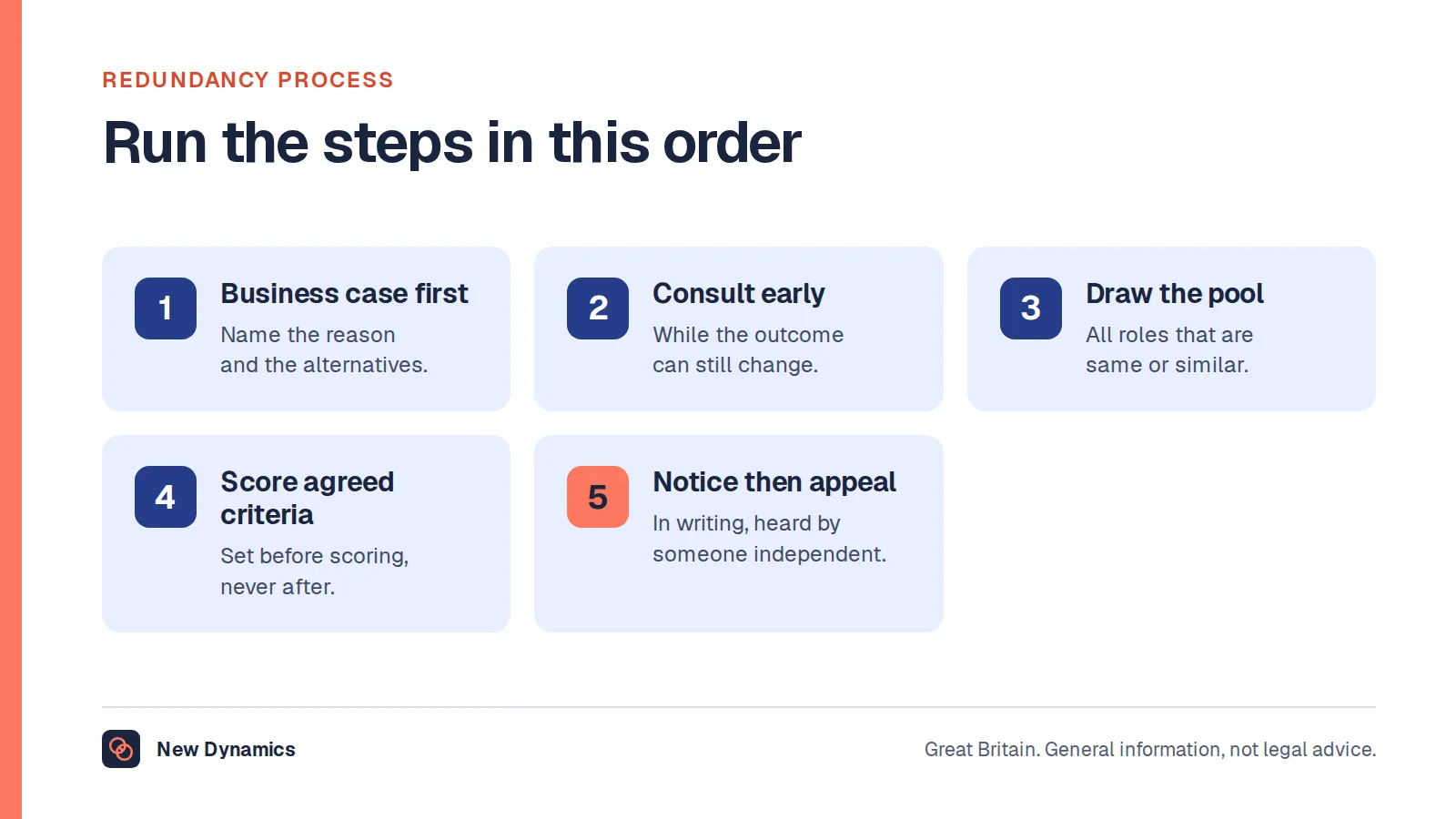
That changes what a retirement policy is. It can describe options: phased retirement, a flexible working request, how to take a pension, the notice to give. What it cannot do, absent justification, is set a date at which employment ends. A handbook line reading "employees retire at 65" is not a policy, it is a direct age discrimination claim with the evidence attached. If the real need is fewer people, that is redundancy, and selection must be age-blind: see our post on the redundancy process.
The test a compulsory retirement age must satisfy
An employer may still operate one. It is lawful only if justified, and the bar is high.
GOV.UK gives the clear cases: an employer may force retirement at a certain age, "known as 'compulsory retirement age'", only if it gives "a good reason why". Its examples are a job that "requires certain physical abilities (for example, in the construction industry)" and one with "an age limit set by law (for example, the fire service)".
Acas frames the test. An employer "can still set a retirement age if it can legally prove the need, but this can be difficult to do". Setting one "would be age discrimination but can be justified if it is an 'objective justification' and a 'proportionate means of achieving a legitimate aim'", meaning "there is a business need which is more important than the discriminatory effect". Then the sentence employers underrate: "This can only be determined by an employment tribunal following a discrimination claim."
Acas's guidance on objective justification, last updated 13 November 2023, names both limbs: "a 'legitimate aim', such as a genuine business need or a health and safety need", and that "the discrimination is 'proportionate, appropriate and necessary'". It adds that "Financial reasons alone are unlikely to justify discrimination", and advises taking legal advice first.
State Pension age is not a retirement age
It obliges nobody to stop. Acas: "A worker does not need to retire when they reach their State Pension age." GOV.UK notes one effect of carrying on: "You do not pay National Insurance if you work past State Pension age."
The current position and the scheduled rises sit in paragraph 1 of Schedule 4 to the Pensions Act 1995, as amended. Rule (6) sets pensionable age at 66 for anyone "born after 5th October 1954 but before 6th April 1960". Table 3 then phases those born between 6 April 1960 and 5 March 1961 from 66 years and 1 month up to 66 years and 11 months, before rule (8) sets 67 for anyone "born after 5th March 1961 but before 6th April 1977" and rule (10) sets 68 for anyone "born after 5th April 1978". Use the GOV.UK checker for a date.
State Pension age is social security law, set UK-wide, while the default retirement age repeal is employment law extending to England, Wales and Scotland. Check Northern Ireland separately.
No upper age limit applies to unfair dismissal or redundancy pay
This answer is older than 2011. The Employment Rights Act 1996 once held two age ceilings, and both went on 1 October 2006 under the Employment Equality (Age) Regulations 2006 (SI 2006/1031). Section 109, headed "Upper age limit", capped the right to claim unfair dismissal, and legislation.gov.uk now shows it empty, noting "S. 109 omitted (1.10.2006)". Section 156, also headed "Upper age limit", did the same for statutory redundancy pay and was "repealed (1.10.2006)".
Age still affects the amount of a redundancy payment, but only through the service bands. GOV.UK's guidance on redundancy pay gives "one and half week's pay for each full year you were 41 or older", caps service at 20 years and, for anyone made redundant on or after 6 April 2026, caps weekly pay at £751 and the payment at £22,530. A 68-year-old with twelve years' service is calculated exactly like a 45-year-old. See also our HR statistics hub.
A pension scheme's normal retirement date is not a retirement age
Scheme rules and employment contracts answer different questions. A normal retirement date, or normal pension age, fixes when benefits become payable without reduction. It says nothing about when employment ends.
GOV.UK confirms the two run in parallel: you can claim a pension while working once you reach State Pension age, or "the age agreed with your pension provider" for a workplace or personal pension. Acas adds the scheme-side limit: "Workers can claim a pension only when the pension scheme allows it. Pension schemes need to follow Equality Act 2010 rules." Ill health retirement also depends on scheme rules, and "No-one can be forced to retire because of ill health".
HMRC's policy paper on increasing Normal Minimum Pension Age, published 4 November 2021, confirms the rise in "the normal minimum pension age, from 55 to 57" with effect "from 6 April 2028". If a handbook treats a normal retirement date as the date employment ends, two clauses are doing one unlawful job. Separate them.
How to discuss someone's plans without it becoming discrimination
Acas's answer is to stop singling people out. "Rather than asking older workers directly about retirement, employers should have regular discussions with all their workers about future plans and aims", covering "what the worker would like to be doing in one year's time and in 3 years' time" and their skills and experience. Such discussions "can also lead to discussions about retirement without asking directly".

The question itself carries risk. "Putting pressure on someone to retire is likely to be age discrimination. In some circumstances, asking someone when they intend to retire can put them under pressure." Hence: "Unless there is a good business reason, employers should not ask directly about retirement plans. It's best to leave it to workers to raise the subject." Acas's comparison is useful: any worker can resign at any time, "and it would not be normal to ask workers if they intend to resign".
Where there is a genuine business reason, succession in a specialist role being Acas's example, the guidance sets conditions. The employer "must make it very clear that there is no pressure to retire", "must not ask the question as part of any discussion about problems such as performance or attendance", and must accept that workers "do not have to answer any questions about their retirement plans". Acas says workers "should raise the subject themselves first". So in a performance review the answer is no, and in a career conversation the right version is the open question everybody gets about the next one and three years.
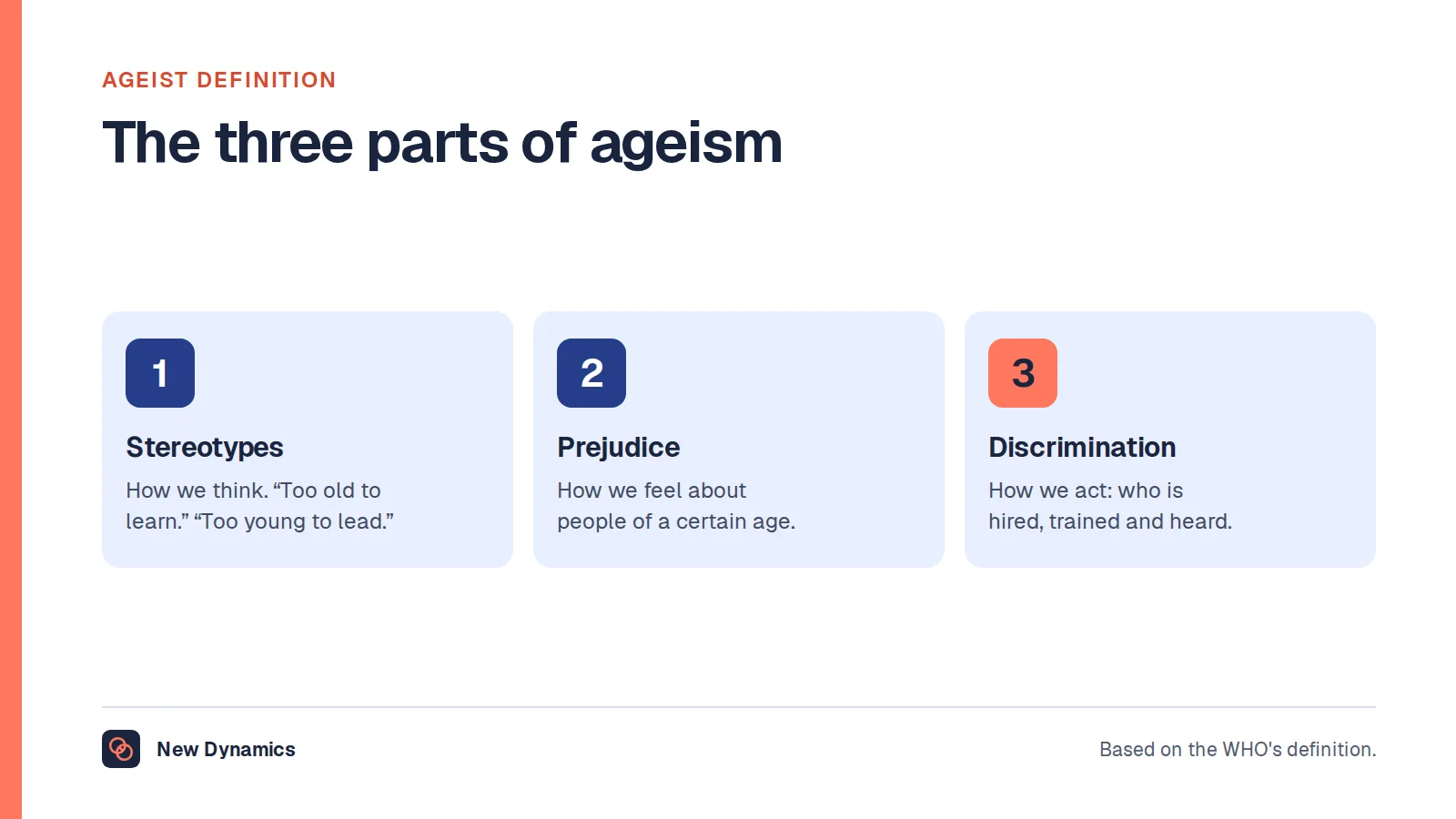
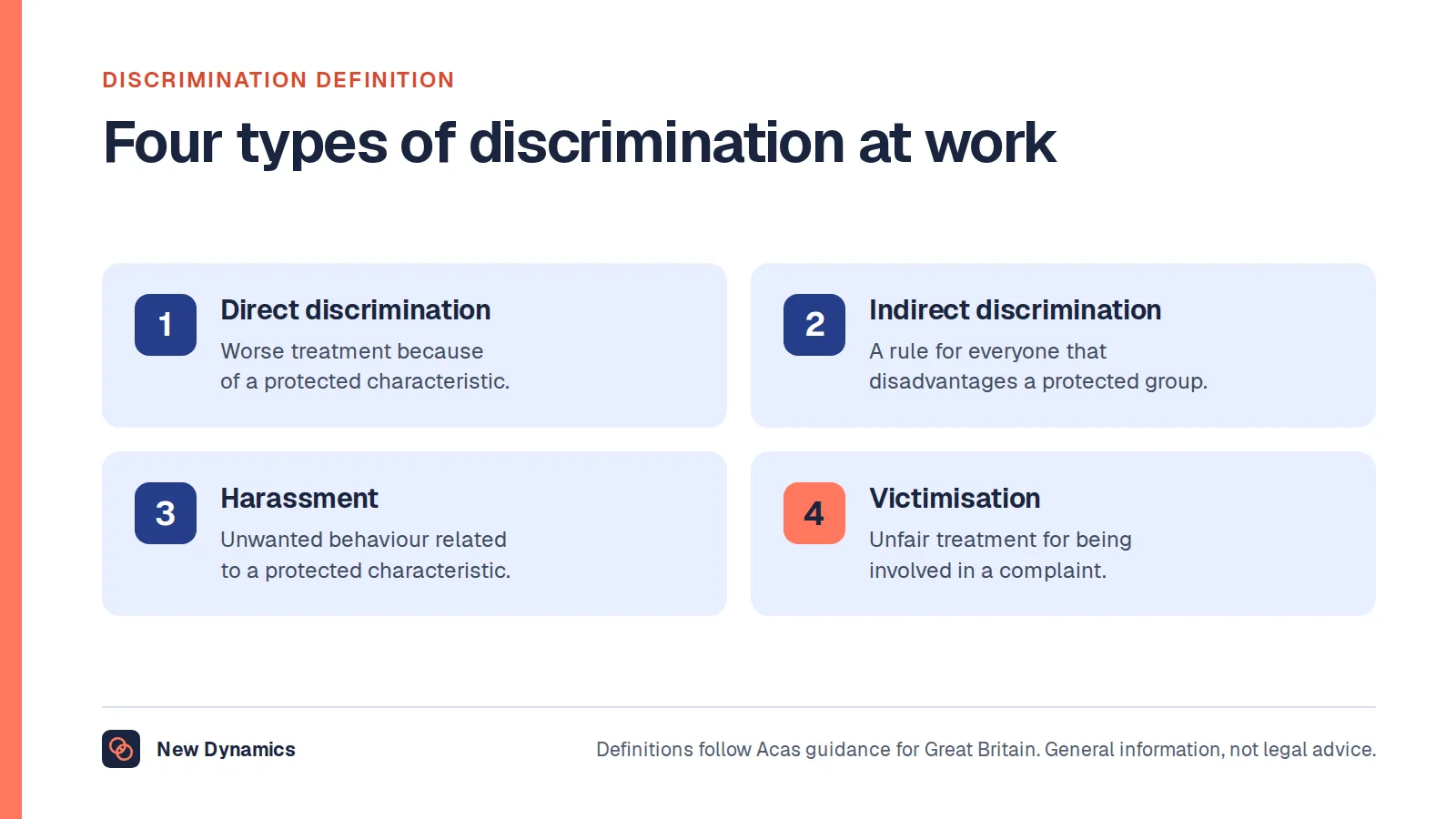
Acas's own example shows how fine the line is. An employer asks Pat, 64, to flag any retirement plans because a replacement takes longer to recruit than Pat's notice period, leaving the decision with Pat: "unlikely to be age discrimination". A year later, unhappy with Pat's attendance, the same employer asks twice more, once in an attendance review meeting: "likely to be age discrimination". Context and repetition did it. For the wider framework, see our posts on the definition of ageist and the definition of discrimination.
Frequently asked questions
What is the retirement age in the United Kingdom?
There is no general retirement age. GOV.UK states that "'Default retirement age' (a forced retirement age of 65) no longer exists" and that "You can usually work for as long as you want to".
When was the default retirement age abolished?
The Employment Equality (Repeal of Retirement Age Provisions) Regulations 2011 came into force on 6 April 2011. Regulation 5 kept the old rules alive only where notice had been given and the age limit fell before 1 October 2011.
Can my employer force me to retire?
In most jobs, no. Acas says that "In most jobs, an employer cannot force a worker to retire if they do not want to." A compulsory retirement age is lawful only where the employer can objectively justify it.
Does State Pension age mean I have to stop working?
No. Acas states that "A worker does not need to retire when they reach their State Pension age." Under Schedule 4 to the Pensions Act 1995 it is 66, 67 or 68 depending on date of birth.
Can an employer ask when I plan to retire?
Acas says employers should not ask directly unless there is a good business reason, and that it is best to leave workers to raise the subject. Asking inside a performance or attendance discussion is out.
Is there an age limit on unfair dismissal or redundancy pay?
No. Sections 109 and 156 of the Employment Rights Act 1996, both headed "Upper age limit", went on 1 October 2006 under the Employment Equality (Age) Regulations 2006.
Your next step
- Search your handbook and contracts for "retirement" and delete every stated retirement age you cannot justify for a named role.
- Separate the pension clause from the employment clause, so a normal retirement date reads as a benefits date.
- Put one future-plans question into every review cycle, for every employee at every age.
- Brief managers on the single prohibition: retirement never comes up in a performance, attendance or capability meeting.
For the structure behind those conversations, read and download our career development guide. The guide is free to read, and the PDF uses our short download form.
Want every employee to get the same conversation about the next three years, on the record? Book a New Dynamics demo and bring your current review form.