TL;DR
- Rightsizing is management language, not a legal category. No United Kingdom statute, and no GOV.UK or Acas guidance, defines it or attaches anything to it.
- The Cambridge Dictionary defines rightsizing exactly as it defines downsizing, and adds that the word is “used especially by organizations that want to avoid using the word 'downsize'”.
- What governs is what you actually do. Dismissals bring section 139 of the Employment Rights Act 1996 and, at 20 or more at one establishment in 90 days, collective consultation with 30 and 45 day minimum periods and an HR1 notification GOV.UK warns can be fined an unlimited amount if missed.
A board paper lands with the word rightsizing in the title. Nobody in the room is quite sure whether it means redundancies, a reorganisation, a hiring freeze or all three. That ambiguity is usually the point, and it is also the problem. The duties that follow a workforce change in the United Kingdom attach to what the employer does, not to what the plan is called.
This article does three things. It says what rightsizing means as a word, including where it came from. It separates it from downsizing and restructuring in ordinary usage. Then it sets out, with the sources, the UK duties that bite depending on what the plan actually involves. It describes the position in the United Kingdom and is general information, not legal advice. Take advice on your own facts.
Before a structure is changed it helps to be able to see the one you have, including the working relationships that the reporting lines leave out. See how New Dynamics org charts hold the formal structure and the matrix relationships together.
What rightsizing means
Rightsizing, also written as right sizing or right-sizing, has no legal definition anywhere in UK employment law. It is business vocabulary. The clearest published definition is in the dictionary rather than the statute book. The Cambridge Dictionary entry for rightsizing gives it as "the practice of making a company or an organization smaller by reducing the number of people working for it, or to become smaller in this way", and then adds the part that matters, in brackets: "used especially by organizations that want to avoid using the word 'downsize'".
That is a dictionary saying, in its own entry, that the word exists largely as a substitute for another word. Its example sentence makes the same point: "Business types sometimes try to rationalize downsizing as 'rightsizing'."
The literal claim inside the word is that there is a correct size for the organisation and the exercise is to reach it. In practice that correct size is almost always smaller than the current one.
Where the word came from
Rightsizing is American business coinage from the late twentieth century. Dictionary.com, drawing on the Random House Unabridged Dictionary, defines the verb rightsize as "to adjust to an appropriate size" and dates its first recorded use to the second half of the 1980s. The sentence it gives alongside is blunt about what the word is for: "Layoffs will be necessary to rightsize our workforce."
That lineage explains something British readers notice: the word usually arrives attached to layoff rather than redundancy, because layoff is the American term. It also carries no legal content when it crosses the Atlantic, because it never had any. Importing the vocabulary does not import a process.
Rightsizing, downsizing and restructuring in ordinary usage
These three words are used loosely and often interchangeably, but in ordinary business usage they point at different things.
- Downsizing means making the organisation smaller. The Cambridge Dictionary entry for downsizing gives "the practice of making a company or an organization smaller by reducing the number of people working for it, or an occasion when this is done". Compare that with the rightsizing definition above and the core wording is identical. The only difference is the note about avoiding the word.
- Rightsizing means the same thing with a justification built in. The size is being corrected, not merely cut.
- Restructuring means changing how the work is arranged: layers, reporting lines, teams, locations, job content. A restructure can reduce headcount, keep it flat or increase it. It is about shape rather than size.
So rightsizing and downsizing are near synonyms, and restructuring is a different claim. The practical test is to ask what changes for a named person. Does their job disappear, does its content change, or does their employer change? Each answer has a different legal consequence, and none of them depends on the word at the top of the slide.

The word you choose does not change the duty
Only one of these words has a statutory definition, and it is the one rightsizing is often chosen to avoid.
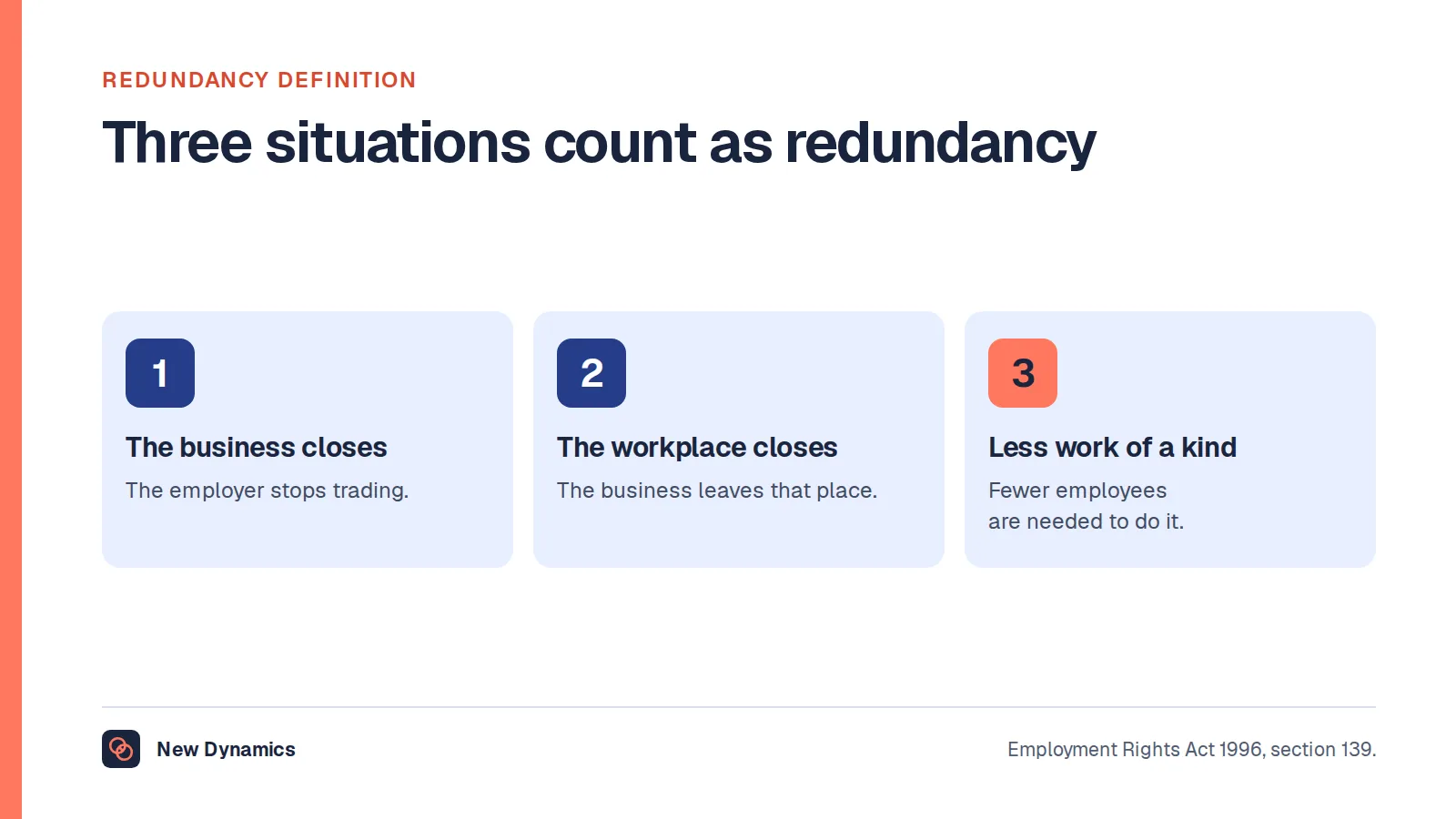
Section 139 of the Employment Rights Act 1996 provides that an employee is dismissed by reason of redundancy if the dismissal is "wholly or mainly attributable to" the employer ceasing to carry on the business, or ceasing to carry it on in the place where the employee worked, or to the requirements of the business "for employees to carry out work of a particular kind" having "ceased or diminished or are expected to cease or diminish". Nothing in that section turns on what the employer calls the exercise. Our post on the definition of redundancy sets out the three situations and the rights that follow.
If the plan involves dismissals at scale, the collective duty is next. GOV.UK's guidance on redundancy consultations states that "You must follow 'collective consultation' rules if you're making 20 or more employees redundant within any 90-day period at a single establishment", and warns that "If you do not consult employees in a redundancy situation, any redundancies you make will almost certainly be unfair and you could be taken to an employment tribunal". Its table gives a minimum consultation period before dismissal of 30 days for 20 to 99 proposed redundancies and 45 days for 100 or more. Where there are fewer than 20 planned, the same page says there are no set rules, but that it is good practice to consult fully and that a tribunal "could decide that you've dismissed your staff unfairly if you do not".
The statute behind that is section 188 of the Trade Union and Labour Relations (Consolidation) Act 1992. It requires that consultation "shall begin in good time and in any event" at least 45 days where 100 or more dismissals are proposed and "otherwise, at least 30 days, before the first of the dismissals takes effect". It also fixes the agenda: consultation "shall include consultation about ways of (a) avoiding the dismissals, (b) reducing the numbers of employees to be dismissed, and (c) mitigating the consequences of the dismissals, and shall be undertaken by the employer with a view to reaching agreement with the appropriate representatives". A programme whose target headcount is already fixed and announced has nothing to consult about under paragraph (a), which is the usual reason these exercises come apart.
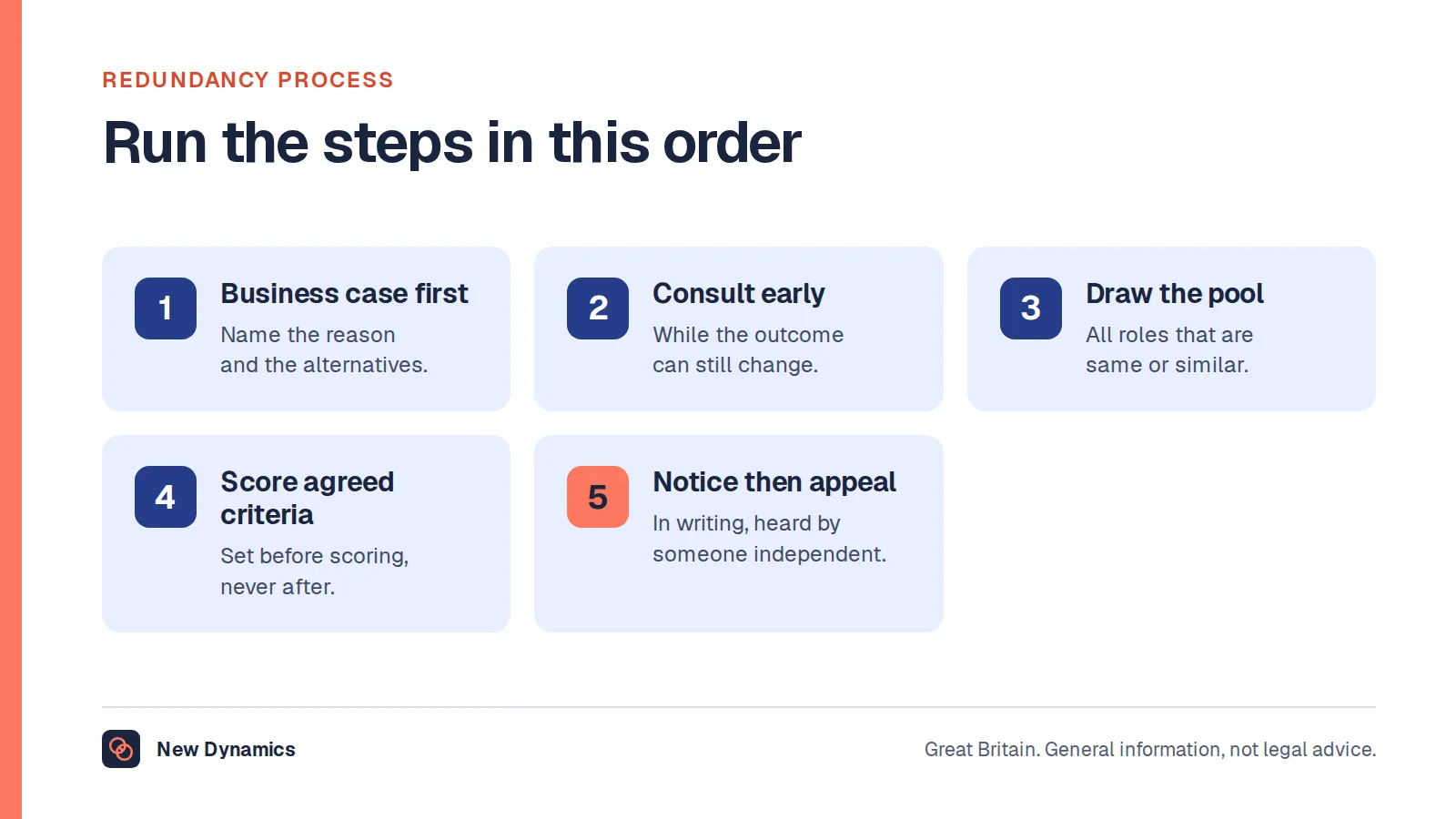
There is also a notification duty that is easy to miss and expensive to miss. The same GOV.UK page says "You must notify the Redundancy Payments Service (RPS) before a consultation starts", by "submitting form HR1 online", 30 days before the first redundancy for 20 to 99 and 45 days before for 100 or more. On that duty the page carries a warning in its own words: "You can be fined an unlimited amount if you do not notify RPS." Our guide to the redundancy process puts the sequence in order, and union meaning explains the role of representatives.

If the plan changes terms rather than cuts heads
Many rightsizing plans do not remove roles. They change hours, pay, grades, locations or duties. That is a different duty, not a lighter one.
Section 4 of the Employment Rights Act 1996 requires that where there is a change in any of the particulars that have to be in the written statement of employment particulars, the employer "shall give to the worker a written statement containing particulars of the change", and that the statement "shall be given at the earliest opportunity and, in any event, not later than one month after the change in question".
Consent comes before paperwork. Acas is direct on its guidance about changing an employment contract: "Any changes must be agreed by both the worker and employer." On the shortcut that gets reached for when agreement does not arrive, it is equally short: "Employers should avoid 'fire and rehire'. They must consult before dismissal." Dismissing people in order to re-engage them on worse terms is a dismissal, with everything that follows from being one.
If the plan moves work to another entity
If the exercise moves a function to a different employer, an outsourced provider or a contractor, TUPE may apply. GOV.UK's guidance on business transfers, takeovers and TUPE states that when the regulations apply, "the employees' jobs usually transfer over to the new company", "their employment terms and conditions transfer" and "continuity of employment is maintained". It covers two types of transfer, business transfers and service provision changes, and says that "The size of the business does not matter".
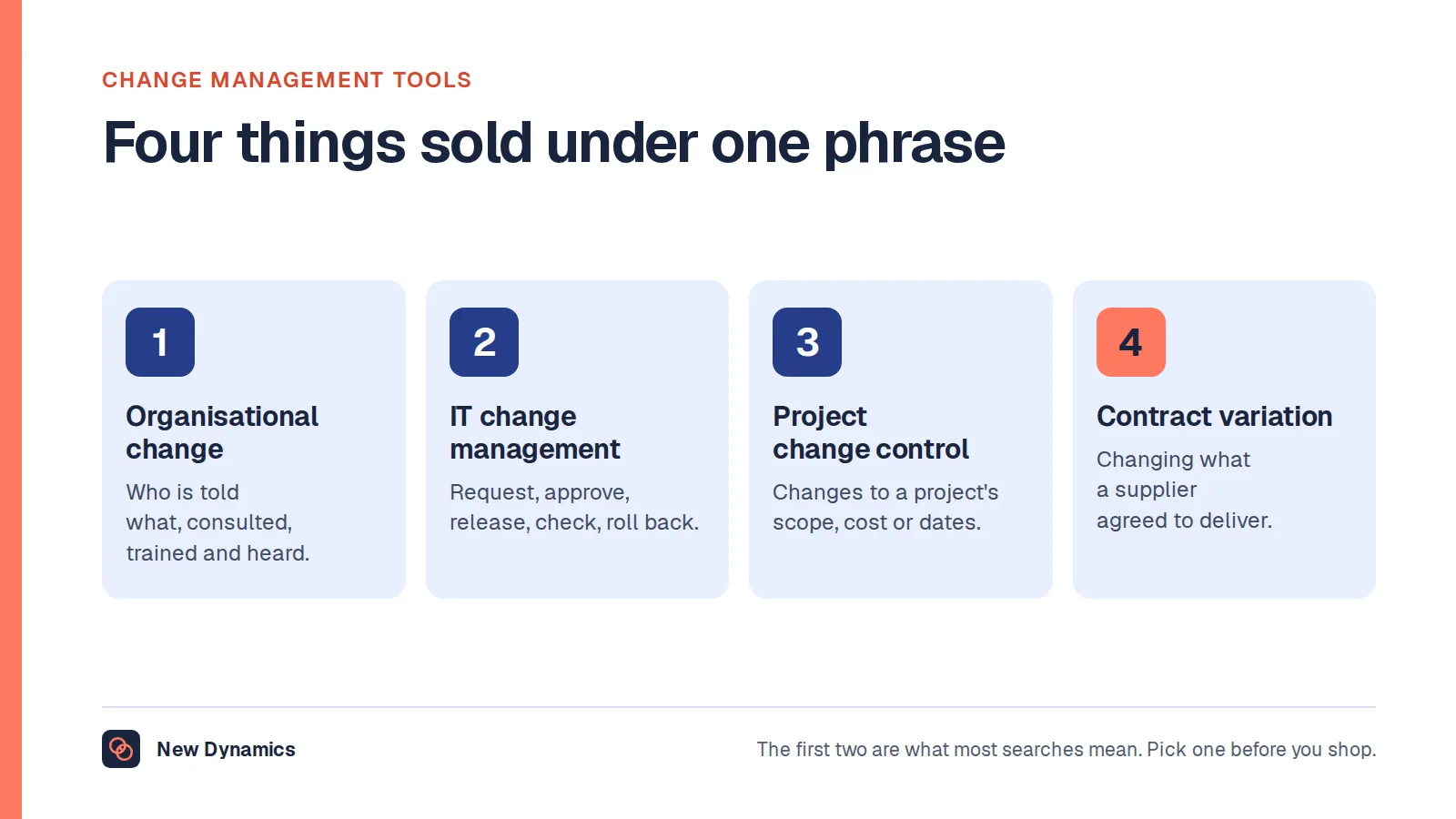
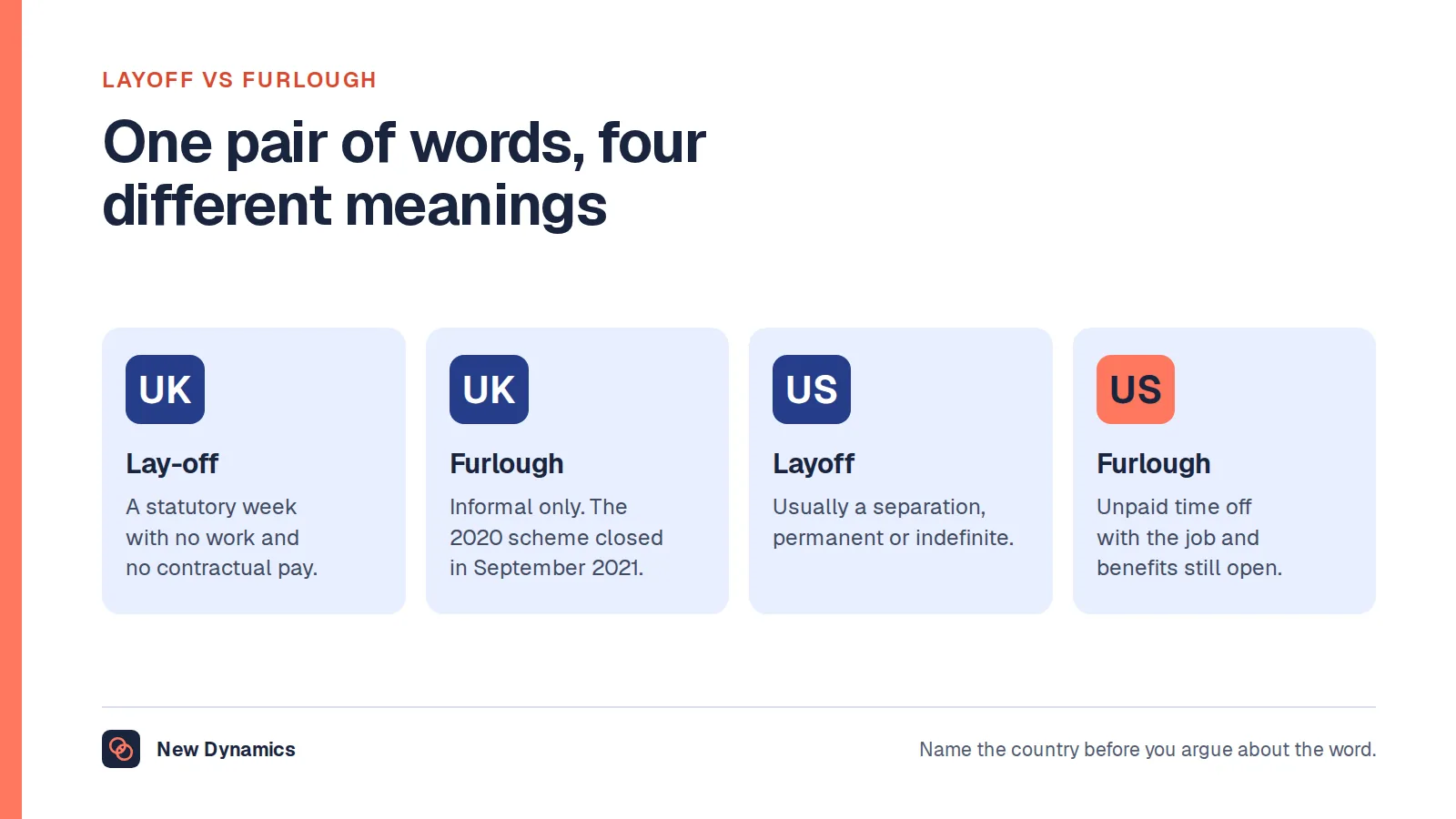
The same guidance closes the obvious loophole. After a transfer, "The new employer cannot change an employee's terms and conditions if the reason is the transfer itself", and "The new employer cannot make employees redundant just because they were transferred from another employer". Changes for an economic, technical or organisational reason involving changes in the workforce are possible, and even then "The employee needs to agree to this change". Our post on change management tools covers the records each of these duties produces, and layoff and furlough separates two more words that get used interchangeably.
The numbers nobody official publishes
You will be shown a success rate for rightsizing programmes, or a cost saving per head, usually to a decimal place. We looked for an official UK source for either and there is none. Rightsizing is not a statistical category: the Office for National Statistics does not measure it, and neither GOV.UK nor Acas publishes a success rate or a saving for programmes of this kind. The figures in circulation come from consultancies and vendors, and we are not going to borrow one, because a number without a published method and a reference period cannot be checked.
What is published is the scale of redundancy itself. The ONS series "LFS: ILO redundancy level (thousands): UK: All: SA" stood at 113,000 for June to August 2026, the three month average the ONS labels 2026 JUL by its middle month, in figures released on 20 October 2026. The matching series "LFS: ILO redundancy rate: UK: All: SA" gives 3.8 per 1,000 employees for the same period. Those are national counts of what actually happened, not an estimate of how well any programme worked. More of what official sources publish is collected in our HR statistics hub.
What a defensible process looks like
The test a tribunal applies is not whether the plan was called rightsizing. It is whether the employer did what the law required for what it actually did. Six things make that answerable.
- Name the action, not the programme. Write down, for each affected group, whether the proposal is dismissal, a change of terms, a transfer or redeployment. The duty follows from that line.
- Count the dismissals before you announce anything. 20 or more proposed dismissals at one establishment within 90 days triggers collective consultation and the HR1 notification, and the clock runs before the first dismissal takes effect, not from the announcement.
- Consult while the answer can still change. Section 188 requires consultation about avoiding dismissals. If the number is already final, the consultation is a briefing.
- Keep the business case in one document, dated. Which of the section 139 situations applies, in one sentence, and the alternatives considered with the reason each was rejected.
- Use evidence recorded before the decision. Selection that leans on appraisal records needs records that existed, and were applied the same way across the pool, before anyone drew up a list. Ratings written afterwards are not evidence.
- Write the change down within the month. Where terms change by agreement, the section 4 statement is due at the earliest opportunity and in any event within one month of the change.

If the plan survives all six, the word in the title does not matter. If it does not, no word will save it.
Frequently asked questions
What is rightsizing?
Rightsizing is management language for adjusting an organisation to what its leadership considers the correct size, which in practice almost always means making it smaller. It has no legal definition in UK employment law. The Cambridge Dictionary defines it as making a company smaller by reducing the number of people working for it, and notes that it is used especially by organisations that want to avoid the word downsize.
Is rightsizing the same as redundancy?
No. Redundancy is a statutory concept. Section 139 of the Employment Rights Act 1996 defines it, and the duties that follow a redundancy apply whenever a dismissal is wholly or mainly attributable to one of the situations in that section. Rightsizing is a label for a programme. If the programme dismisses people because fewer are needed for work of a particular kind, those are redundancies whatever the programme is called.
What is the difference between rightsizing and downsizing?
Very little in meaning. The Cambridge Dictionary gives both words essentially the same core definition, and only the rightsizing entry carries the note that the word is used especially to avoid saying downsize. Rightsizing adds an implied justification: that the new size is the correct one.
How does rightsizing differ from restructuring?
Restructuring changes how work is arranged, including layers, reporting lines, teams and job content, and it can leave headcount unchanged. Rightsizing is about the number of people. A restructure often produces redundancies, but it does not have to.
When does a rightsizing programme trigger collective consultation in the UK?
GOV.UK states that collective consultation rules must be followed when making 20 or more employees redundant within any 90-day period at a single establishment. The minimum consultation period before dismissal is 30 days for 20 to 99 proposed redundancies and 45 days for 100 or more, and the Redundancy Payments Service must be notified on form HR1 to the same deadlines.
Can we avoid consultation by calling it something other than redundancy?
No. The duties attach to the proposed dismissals, not to the description of the exercise. GOV.UK warns that if you do not consult employees in a redundancy situation, any redundancies you make will almost certainly be unfair and you could be taken to an employment tribunal.
What is the success rate of rightsizing programmes?
No official UK source publishes one. Rightsizing is not a measured category, so there is no ONS, GOV.UK or Acas figure for how often these programmes achieve what they set out to do, or what they save. Any percentage you are shown comes from a private source, and it is worth asking for its sample, its definition of success and its date.
Your next step: write the one line that decides everything
- For each affected group, write one line saying whether the proposal is a dismissal, a change of terms, a transfer or a redeployment.
- Add up the proposed dismissals per establishment over any 90-day window, and check the answer against the threshold of 20.
- If you are at or over it, put the HR1 notification and the 30 or 45 day minimum period into the plan before the announcement date.
- If terms are changing, diarise the written statement within one month of the change, and record the agreement that preceded it.
- Check that any appraisal evidence you plan to rely on was recorded before this exercise began.
For a structured approach to planning, consultation and support, read and download our redundancy and workforce change guide. The guide is free to read, and the PDF uses our short download form.
Want the structure and the performance evidence to already be consistent before a change plan ever needs them? Book a New Dynamics demo and bring your current org chart. You can also email contact@new-dynamics.com.