TL;DR
- In the United Kingdom, lay-off is a statutory term. The Employment Rights Act 1996 defines it as a week in which the employer does not provide work and the employee is "not entitled to any remuneration under the contract in respect of the week". Four consecutive weeks of it, or six weeks in thirteen, can open a redundancy claim.
- In the United States, layoff ordinarily means a separation. The Department of Labor's own guide to the WARN Act counts "A layoff exceeding 6 months" as an employment loss, while a shorter furlough keeps the employment relationship running without pay.
- A British employer with no contractual or agreed right to lay off without pay is making an unauthorised deduction from wages. Guarantee payments exist, but they are capped at £41 a day for five days in any three-month period.
Two words, two countries, almost nothing in common. A British HR manager who writes "we may need to furlough you" is reaching for a scheme that closed years ago. An American manager who writes "you are being laid off" means the job has gone. A British manager writing the same sentence may mean the opposite: stay employed, come back when there is work.
This article separates the two jurisdictions. It gives the United Kingdom position from the statute itself, then the United States position from the Department of Labor, and then what goes wrong when one country's sense of the word lands in the other country's contract. It is general information, not legal advice, and the jurisdiction is named in every section.
Workforce change is where undocumented process costs the most. See how New Dynamics workflows keep the steps, approvals and dates for a people process in one auditable place.

The short answer, country by country
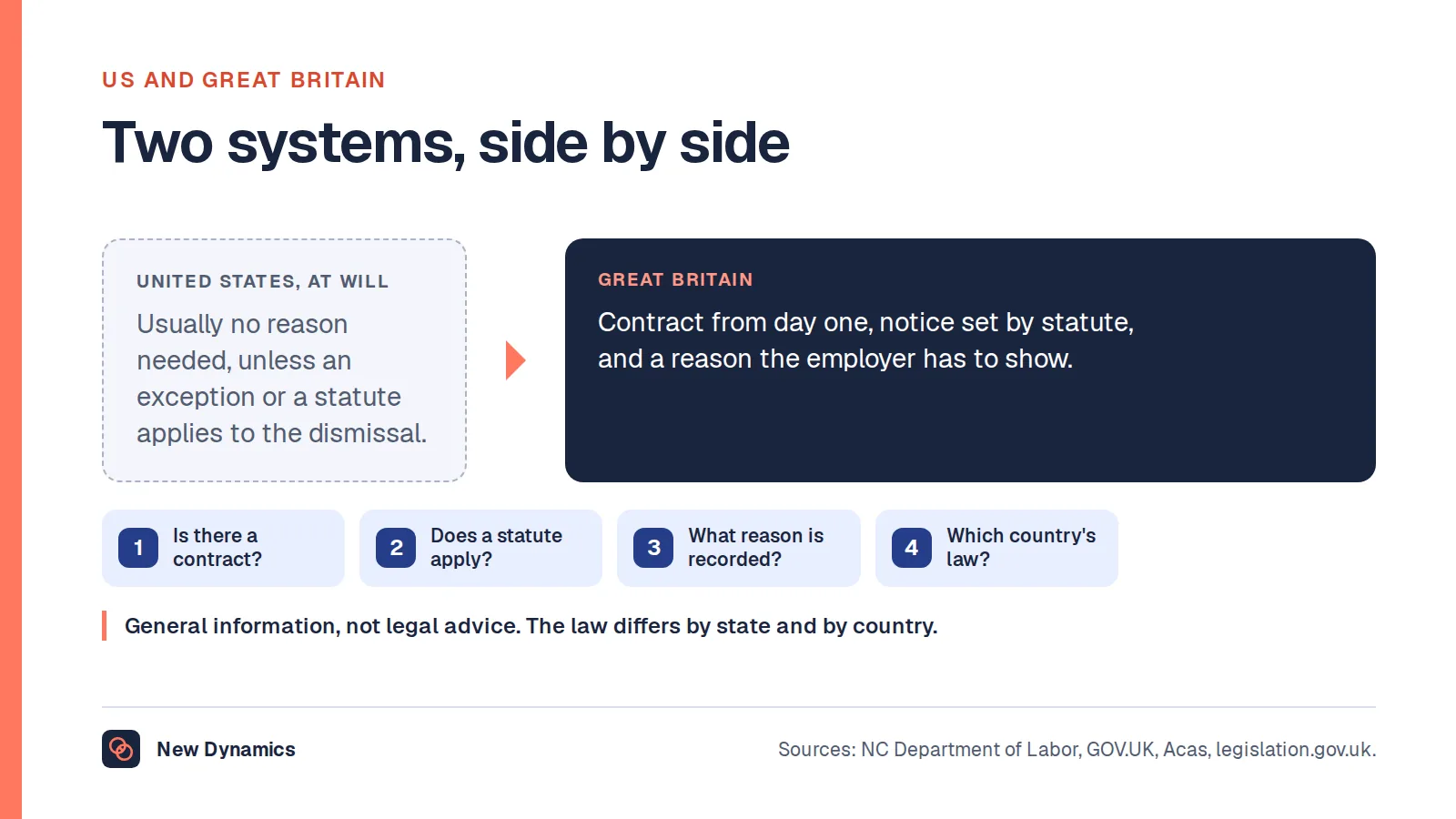
United Kingdom. "Lay-off" has a statutory definition: a week in which the employer provides no work and owes no contractual pay, with the employment continuing. "Furlough" has no statutory meaning here at all. It entered British speech in 2020 through a temporary government scheme, and that scheme has closed.
United States. "Layoff" ordinarily means a separation, permanent or of indefinite length. "Furlough" ordinarily means unpaid time off during which employment, and usually benefits coverage, continues. Neither term is defined as such in federal employment statute, but the Department of Labor's notice materials draw the line at a layoff exceeding six months.
The same word therefore points in opposite directions. In Britain a lay-off keeps you employed. In America a layoff ends your employment and a furlough keeps it.
United Kingdom: lay-off is a statutory term, and it has thresholds
The definition sits in Part XI of the Employment Rights Act 1996. Section 147 is headed "Meaning of 'lay-off' and 'short-time'", and subsection (1) provides that an employee is taken to be laid off for a week if:
"(a) he is employed under a contract on terms and conditions such that his remuneration under the contract depends on his being provided by the employer with work of the kind which he is employed to do, but (b) he is not entitled to any remuneration under the contract in respect of the week because the employer does not provide such work for him."
Short-time working is the sibling concept. Section 147(2) treats an employee as kept on short-time for a week where, by reason of a diminution in the work provided, "the employee's remuneration for the week is less than half a week's pay". GOV.UK says the same in everyday words on its lay-offs and short-time working page: "A lay-off is if you're off work for at least 1 working day. Short-time working is when your hours are cut."
The definition matters because of what it unlocks. Section 148 makes an employee eligible for a redundancy payment by reason of lay-off or short-time where they give written "notice of intention to claim" and, before serving it, have been laid off or kept on short-time:
"(a) for four or more consecutive weeks of which the last before the service of the notice ended on, or not more than four weeks before, the date of service of the notice, or (b) for a series of six or more weeks (of which not more than three were consecutive) within a period of thirteen weeks".
Section 154 adds two points that are easy to miss. A qualifying series can be lay-off weeks, short-time weeks or a mixture. And no account is taken of any week where the lay-off or short-time is "wholly or mainly attributable to a strike or a lock-out".
The claim is not automatic. Section 149 gives the employer seven days to serve a written counter-notice contesting liability. Section 150 requires the employee to resign, with notice, inside the relevant period. Section 151 says an employee is not entitled to a lay-off redundancy payment "if he is dismissed by his employer", which leaves any redundancy right arising from the dismissal itself intact. Section 152 lets the employer defeat the claim by counter-notice where full employment of at least thirteen weeks was reasonably to be expected within four weeks.

United Kingdom: no contractual right to lay off means an unlawful deduction
This catches employers who have borrowed American language along with American assumptions. Section 147 describes an employee who "is not entitled to any remuneration under the contract". It does not create a power to stop paying someone. That power has to come from the contract or the employee's agreement. GOV.UK states it plainly on the same lay-offs page: "You should get your full pay unless your contract allows unpaid or reduced pay lay-offs."
Withhold pay without that right and you are in Part II of the Act. Section 13(1) provides that an employer "shall not make a deduction from wages of a worker employed by him" unless the deduction is required or authorised by a statutory provision or "a relevant provision of the worker's contract", or the worker "has previously signified in writing his agreement or consent to the making of the deduction". Section 13(2) is strict about what counts: a written term the worker was given a copy of before the deduction, or a term whose existence and effect was notified in writing before that occasion. Section 13(5) closes the back door, so a term introduced by a later variation cannot authorise a deduction for something that happened first. And section 13(3) treats a shortfall as a deduction in itself, because where wages paid fall below wages properly payable, "the amount of the deficiency shall be treated for the purposes of this Part as a deduction".
United Kingdom: guarantee payments, and the cap most people miss
A separate right to a small payment applies where there is no work. Section 28(1) gives an employee who would normally be required to work, and is not provided with work by reason of "a diminution in the requirements of the employer's business for work of the kind which the employee is employed to do", the right "to be paid by his employer an amount in respect of that day", which section 28(3) calls a "workless day". Section 29 excludes anyone not "continuously employed for a period of not less than one month" before the day claimed, any day caused by "a strike, lock-out or other industrial action", and any day where suitable alternative work was offered and the employee "has unreasonably refused that offer".
Then come the limits, and they are why guarantee pay rarely solves anything. Section 31 provides that the amount payable "in respect of any day shall not exceed £41", a figure substituted with effect from 6 April 2026 by the Employment Rights (Increase of Limits) Order 2026. Section 31(2) adds that an employee "is not entitled to guarantee payments in respect of more than the specified number of days in any period of three months", and section 31(3) fixes that number as the days, "not exceeding five", on which the employee normally works in a week. GOV.UK's guarantee pay page does the arithmetic: "The maximum you can get is £41 a day for 5 days in any 3-month period", a maximum of £205. If you usually earn less than £41 a day you get your normal daily rate, and you "cannot claim guarantee pay for any day that you do some work."
Five days of capped pay in a quarter is not an income. It is a floor beneath an unpaid lay-off, not a reason to use one.
Why British readers say furlough, and why the scheme has gone
The word arrived in British workplaces with the Coronavirus Job Retention Scheme. GOV.UK's guidance page on how to claim for wages through the Coronavirus Job Retention Scheme now opens with one sentence: "The Coronavirus Job Retention Scheme ended on 30 September 2021." The same page records that claims for September had to be submitted on or before 14 October 2021, with amendments by 28 October 2021.
That matters for drafting. Between 2020 and 2021, furlough in Britain meant one specific thing: a grant-supported period of no work with a government contribution to wages. There is no such scheme now. A British policy that still says "we may place you on furlough" describes a mechanism that does not exist, and is usually reaching for the statutory lay-off provisions without the contractual right that makes them usable.
United States: layoff usually means separation, furlough usually does not
American usage runs the other way. A layoff is ordinarily a separation from employment, presented as permanent or as indefinite with a possibility of recall. A furlough is ordinarily unpaid leave during which employment, and usually benefits coverage, continues.
The Department of Labor's own guide to the notice rules draws the line at six months. In the glossary to its Worker's Guide to Advance Notice of Closings and Layoffs, the Department states that "The term 'employment loss' means: 1. An employment termination, other than a discharge for cause, voluntary departure, or retirement; 2. A layoff exceeding 6 months; or 3. A reduction in hours of work of individual employees of more than 50% during each month of any 6-month period."
In federal notice terms, then, a short furlough is not an employment loss and a layoff running past six months is. The working American distinction is duration and finality, not the presence or absence of pay.
On pay, the Wage and Hour Division addresses furloughs directly in Fact Sheet #70, dated September 2019: "The FLSA does not require employers to pay non-exempt employees for hours they did not work." For salaried exempt employees the rule catches people out. The full predetermined salary is due for any week in which the employee performs any work, but "there is no requirement that the predetermined salary be paid if the employee performs no work for an entire workweek", and "If the employee is ready, willing, and able to work, deductions may not be made for time when work is not available." A partial-week furlough of an exempt employee can therefore cost the exemption. The weekly salary threshold printed in that 2019 fact sheet has been revised since, so check the current figure rather than quoting it.
United States: the WARN notice threshold, in the Department's words
The notice obligation is the one figure most US readers are looking for. The Department of Labor's Plant Closings and Layoffs page words it as follows:
"The Worker Adjustment and Retraining Notification Act (WARN) protects workers, their families, and communities by requiring employers with 100 or more employees (generally not counting those who have worked less than six months in the last 12 months and those who work an average of less than 20 hours a week) to provide at least 60 calendar days advance written notice of a plant closing and mass layoff affecting 50 or more employees at a single site of employment."
The same page confirms that WARN makes exceptions "when layoffs occur due to unforeseeable business circumstances, faltering companies, and natural disasters", that notice must also reach "employees' representatives, the local chief elected official, and the state dislocated worker unit", and that "Some states also have their own plant closure laws", which commonly set lower thresholds.
Two Department of Labor pages word the same threshold differently
These two official pages do not say quite the same thing, and the difference is worth naming rather than smoothing over.
The Plant Closings and Layoffs topic page, quoted above, describes a "mass layoff affecting 50 or more employees at a single site of employment". The glossary in the Department's Worker's Guide is narrower. A mass layoff there means a reduction in force not resulting from a plant closing which produces an employment loss at the single site during any 30-day period for at least 50 to 499 employees "if they represent at least 33% of the total active workforce at a single site of employment, excluding any part-time employees", or for "500 or more employees (excluding any part-time employees). In this case, the 33% rule does not apply."
The topic page is a short summary and omits the percentage test. The Worker's Guide glossary tracks the statutory definition and the regulations at 20 CFR Part 639, and that is what governs. A US employer counting heads should apply the 33% test, not the bare figure of 50. A plant closing is defined separately and the 33% test does not apply to it.
Writing it down: one clause cannot serve both countries
The failure mode is a single global policy with one definition of each word.
Use the American sense in a British contract and you get a clause saying the employer may "lay off" employees when it means dismiss them, in a jurisdiction where lay-off means something else and dismissal brings consultation, notice and redundancy pay obligations. Nothing in that clause gives a right to withhold pay during a genuine lay-off, so the first unpaid week is an unauthorised deduction under section 13. Use the British sense in an American contract and you get a clause promising continued employment in a document that is otherwise at will, plus a notice calculation that misses the six-month point at which a layoff becomes an employment loss.
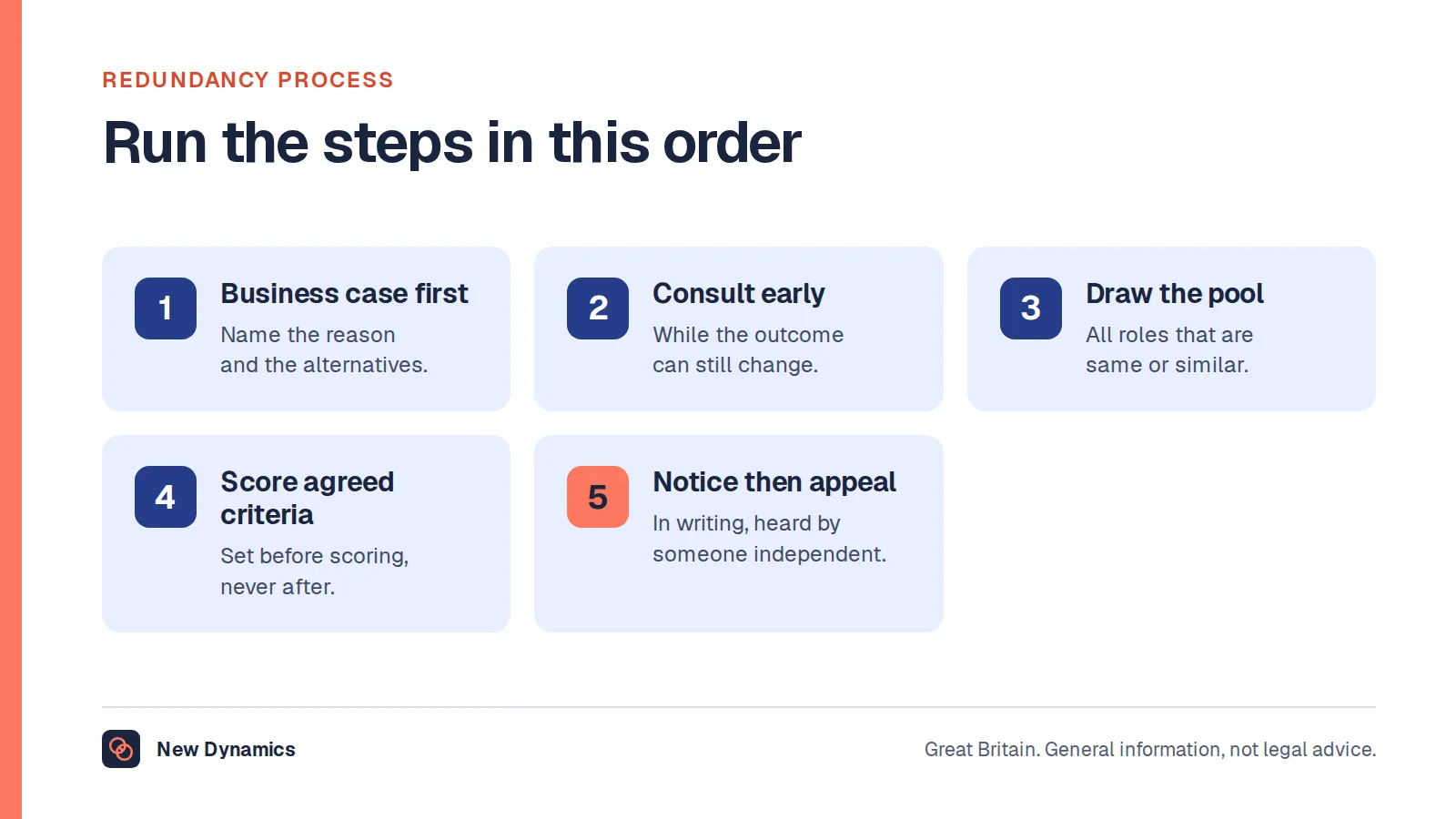
Three drafting rules follow. Name the country in the clause, not just the policy header. In a British contract, say in terms whether the employer may lay off without pay or on reduced pay, and get it signed, because the right has to pre-date the deduction. And log guarantee payment days per employee per rolling three-month period, because the cap is per employee and per period and nobody reconstructs it afterwards. Our post on the redundancy process covers a temporary measure becoming permanent, and pooling at work covers selection.

Frequently asked questions
What is the difference between a layoff and a furlough?
It depends which country you are in. In the United Kingdom a lay-off is statutory: a week in which the employer provides no work and owes no contractual pay, with the employment continuing. Furlough has no UK statutory meaning and now describes only the closed government scheme. In the United States a layoff ordinarily means a separation, permanent or indefinite, and a furlough ordinarily means unpaid leave with employment continuing.
Can a UK employer lay someone off without pay?
Only with a contractual or agreed right. GOV.UK states that you should get your full pay unless your contract allows unpaid or reduced pay lay-offs. Without that right, withholding pay is a deduction, and section 13 of the Employment Rights Act 1996 bars a deduction unless a statutory provision, a written contractual term notified in advance, or the worker's prior written consent authorises it.
How long can a UK lay-off last before redundancy pay applies?
There is no maximum length, but thresholds open a claim. Section 148 of the Employment Rights Act 1996 lets an employee who has served written notice of intention to claim seek a redundancy payment after four or more consecutive weeks of lay-off or short-time, or a series of six or more weeks in thirteen of which no more than three were consecutive. The employer may counter-notice within seven days, and the employee has to resign.
How much is UK guarantee pay during a lay-off?
The cap is low. Section 31 of the Employment Rights Act 1996 says a guarantee payment for any day shall not exceed £41, substituted from 6 April 2026, and limits entitlement to a number of days, not exceeding five, in any three-month period. GOV.UK gives the maximum as £41 a day for five days in any 3-month period, so £205, with your normal daily rate applying if you usually earn less.
Is the UK furlough scheme still running?
No. GOV.UK states that the Coronavirus Job Retention Scheme ended on 30 September 2021, with September claims due by 14 October 2021. A British policy still offering to place staff on furlough describes a scheme that no longer exists, and should be rewritten around the statutory lay-off provisions and a contractual right.
Does a US furlough trigger WARN notice?
Not by itself, if it is short. The Department of Labor's Worker's Guide counts a layoff exceeding 6 months as an employment loss, along with a reduction in hours of more than 50% during each month of any 6-month period. The Department's Plant Closings and Layoffs page requires employers with 100 or more employees to give at least 60 calendar days advance written notice, and state plant closure laws can set lower thresholds.
Your next step: check the clause before you need it
- Search every contract template you use for "lay off", "layoff" and "furlough", and note which country each template is for.
- For UK templates, confirm there is an express written right to lay off without pay or on reduced pay and that staff have a copy. If not, do not use a lay-off until that is fixed.
- Delete or rewrite any reference to furlough in UK documents. The scheme it refers to closed on 30 September 2021.
- Log guarantee payment days per employee per rolling three-month period, with the daily cap recorded against the date it applied.
- For US templates, write the six-month point into the process notes and check your state's own notice law alongside the federal threshold.
For the wider process, read and download our redundancy and workforce change guide. The guide is free to read, and the PDF uses our short download form.
Want the steps, approvals and dates of a workforce change recorded as they happen rather than reconstructed later? Book a New Dynamics demo and bring your current contract template. You can also email contact@new-dynamics.com.