TL;DR
- There is no statutory right to a sabbatical in the United Kingdom. GOV.UK states that "There are no laws that deal specifically with taking a career break", that employers do not have to offer them, and that an employee "cannot take legal action if an employer decides they cannot return to their job or a similar one".
- Continuity of employment turns on one question. Section 212(1) of the Employment Rights Act 1996 counts any week in which "an employee's relations with his employer are governed by a contract of employment", and section 210(4) says a week that does not count breaks continuity.
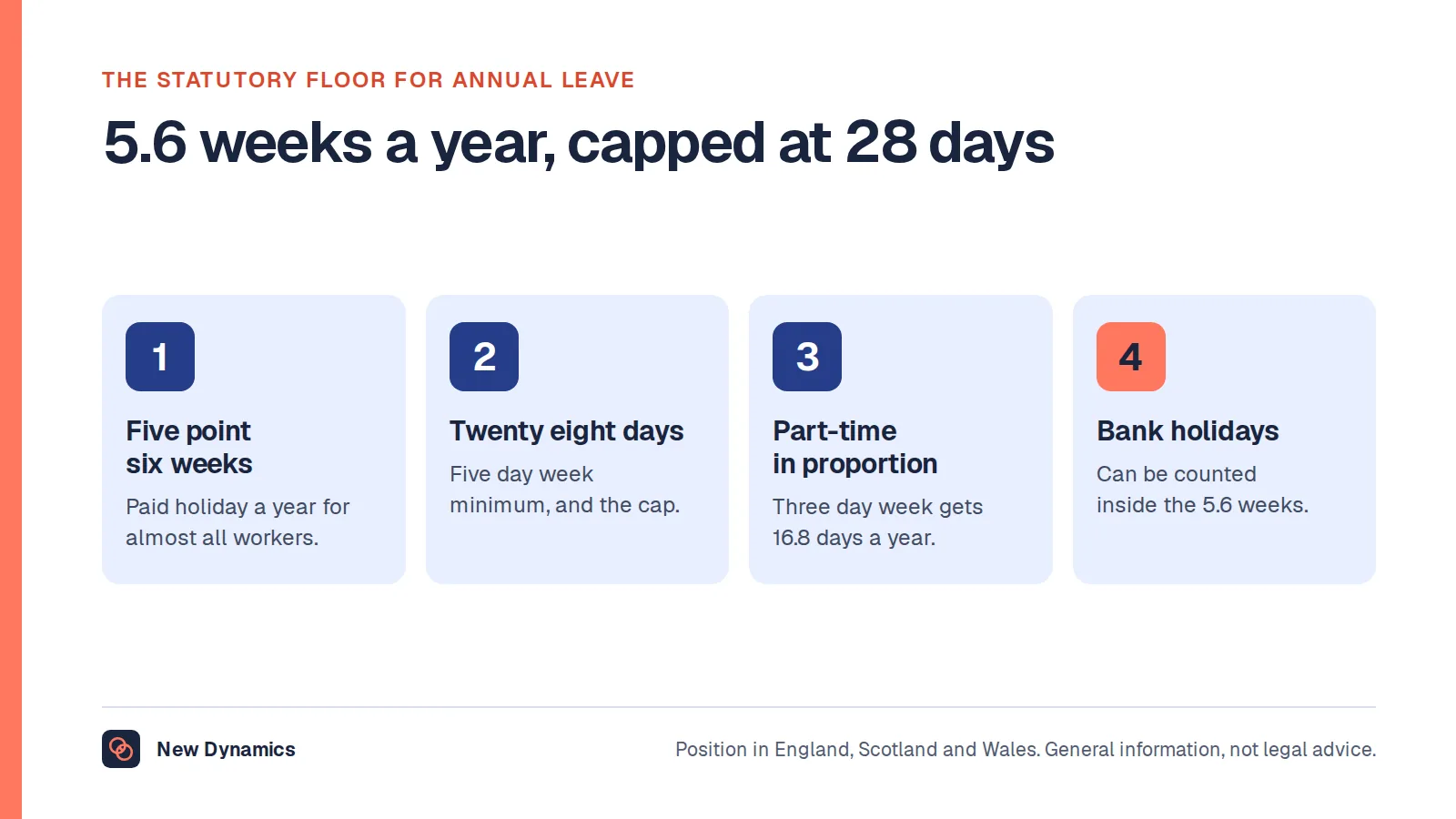
- Statutory holiday does not stop. The Working Time Regulations 1998 reduce the 5.6 weeks only where employment begins part-way through a leave year, and regulation 35 voids any agreement purporting to limit the Regulations.
A sabbatical request is the one leave question where the handbook is the whole of the answer. Nobody in the United Kingdom has a statutory right to a sabbatical, so there is no fallback rule when a manager and an employee disagree about whether the job is held, whether holiday keeps building or whether the pension carries on. Whatever the policy leaves out is what gets argued about on the way back. This post separates the few points where UK law bites from the many the employer decides itself, and it is general information rather than legal advice.
A discretionary scheme is only defensible if the same questions get asked in the same order every time. New Dynamics workflows let you shape the stages, participants, forms and approvals around your own process, so a request leaves the same record whoever handles it. Our post on a leave of absence covers the wider family of leave an employer may grant. This one designs the policy.
There is no statutory right to a sabbatical
GOV.UK publishes one page on this, Career breaks, first published on 3 August 2012 and last updated on 4 December 2019. Every line of it matters:
- "There are no laws that deal specifically with taking a career break". GOV.UK adds that it is "only an agreement between the employer and the employee".
- "Employers do not have to offer career breaks. If they do, the policy must be clearly laid out (for example, in a staff handbook)".
- "Employees can make arrangements to return to work after a career break but these agreements are not legally binding and it could mean ending the existing contract of employment."
- "Employees cannot take legal action if an employer decides they cannot return to their job or a similar one."
The last line is the one people do not expect: a return arrangement reached outside the contract is not a job guarantee, and GOV.UK puts it in a warning box.
Acas has no live guidance here at all. Its page Taking a career break from work now reads: "This advice is for employees wishing to take a career break or 'sabbatical' from work. It is archived and may not be up to date." Acas says it will "add advice on this topic as part of that work". That was still the position on 7 November 2026, so the usual second opinion is not available.
No official source publishes how many UK employers offer sabbaticals. We found no figure in GOV.UK or ONS releases and have not borrowed one from elsewhere. The official numbers we do have on leave sit in our HR statistics hub.

Where UK law does apply
Continuity of employment, and what breaks it
This is the point that costs money, because continuous service decides unfair dismissal rights, redundancy pay and statutory notice. Chapter I of Part XIV of the Employment Rights Act 1996 does the work. Section 212(1) provides that "Any week during the whole or part of which an employee's relations with his employer are governed by a contract of employment counts in computing the employee's period of employment". Section 210(4) adds that, subject to sections 215 to 217, "a week which does not count in computing the length of a period of continuous employment breaks continuity of employment", determined, says section 210(3), "week by week".
So if the contract continues, every week counts, paid or not, worked or not, and continuity is intact. If the contract ends instead, which GOV.UK warns a return arrangement "could mean", the weeks count only if section 212(3)(c) brings them in: a week in which the employee is "absent from work in circumstances such that, by arrangement or custom, he is regarded as continuing in the employment of his employer for any purpose". Section 212(4) caps weeks counted for sickness at twenty six, but sets no cap under section 212(3)(c).

Statutory holiday keeps arising
Under regulation 13 of the Working Time Regulations 1998, "a worker is entitled to four weeks' annual leave in each leave year". Regulation 13A(2)(e) adds, "in any leave year beginning on or after 1st April 2009, 1.6 weeks", and regulation 13A(3) caps the aggregate at 28 days. That is the familiar 5.6 weeks.
Now look for a reduction. The only pro-rating in those regulations, in regulation 13(5) and regulation 13A(5), deals with employment beginning after the leave year has started. Nothing in them cuts the entitlement because a worker was absent unpaid. And regulation 35(1)(a) voids any provision in an agreement in so far as it purports "to exclude or limit the operation of any provision of these Regulations".
So a policy line saying statutory holiday does not accrue during a sabbatical is on weak ground while the contract runs. The real exposure is the opposite one. Regulation 13(9)(a) provides that leave "may only be taken in the leave year in respect of which it is due", subject to exceptions in paragraphs (14), (15) and (17) covering statutory leave, sick leave and an employer's failure to give a reasonable opportunity to take the leave. A sabbatical is none of the three, so the Regulations write no carry forward route for it and do not settle what happens to leave the sabbatical makes it impossible to take. The policy must. The tidy answer is to fix the dates so the question never arises, usually by having the person take that leave year's holiday first. Our post on holiday entitlement covers accrual and carry over in full.
Pension contributions
Section 13(1) of the Pensions Act 2008 sets qualifying earnings in a pay reference period of twelve months as the part of gross earnings "more than £6,240, and not more than £50,270". Section 13(3) defines "earnings" as sums "payable to the person in connection with the person's employment", listing "salary, wages, commission, bonuses and overtime" and the statutory family and sick payments.
Unpaid means nothing payable, so there are no qualifying earnings in that period and nothing to calculate a contribution on. What no official source we could open settles is whether an employer should contribute anyway: that turns on the scheme rules and the employer's own choice, not on the Act. Our post on the pension auto enrolment thresholds sets out the figures and the periods they attach to. Say whether contributions continue, pause or are made up on return, and whether any life cover depends on them being paid.
The contract, notice and benefits
If the contract continues, so does everything in it that is not expressly suspended: statutory notice rights, confidentiality, restrictive covenants and any contractual benefit. GOV.UK's own list of what the policy should cover includes "if the employment contract's terms and conditions continue - for example, qualifying for pay increases". So name each benefit rather than generalising. Private medical cover, a car, a phone, professional subscriptions, share scheme participation, contractual sick pay. For each, say whether it continues, stops, or continues with the employee paying the cost.
The flexible working route is not the same thing
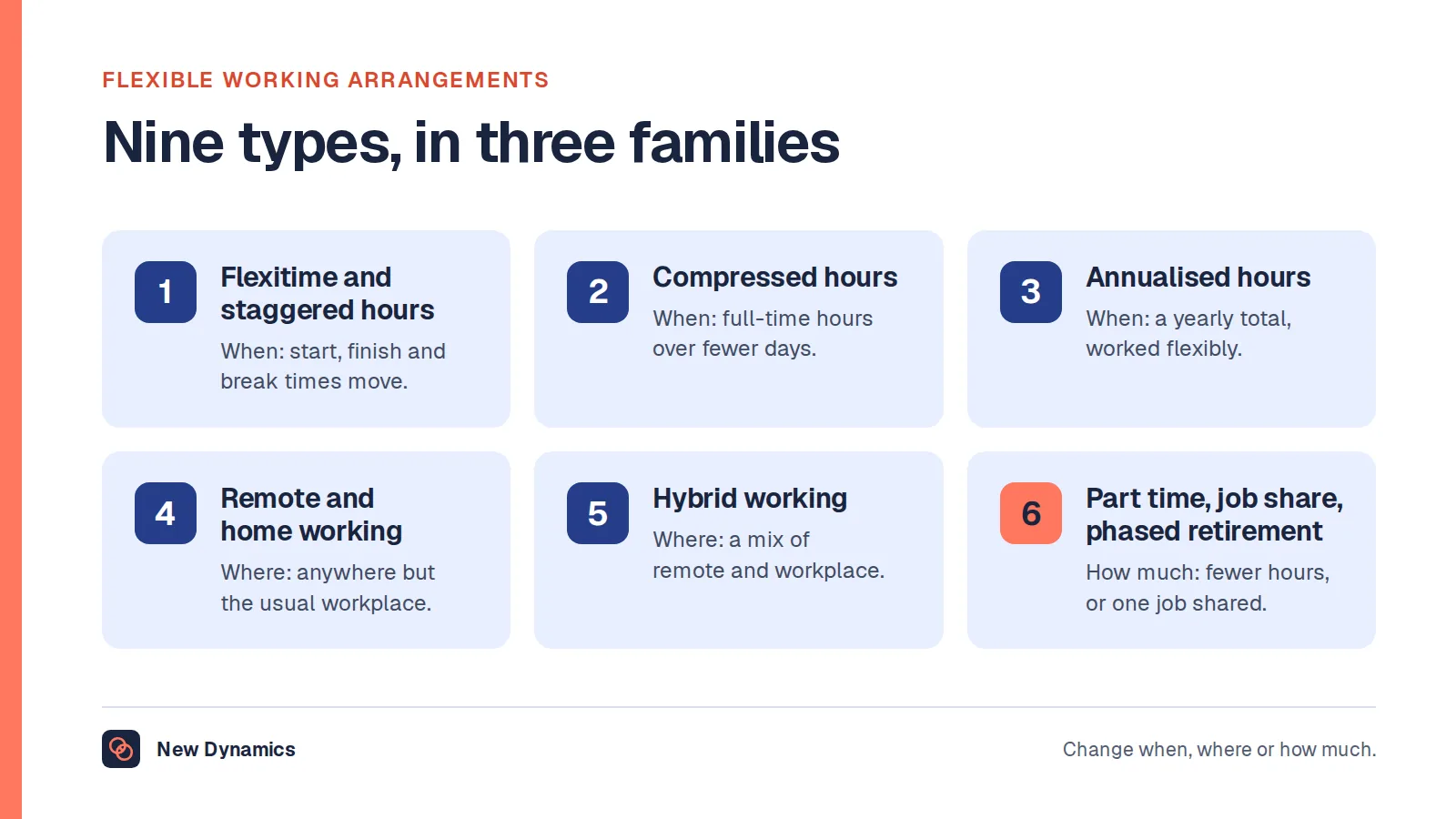
Section 80F(1)(a) of the Employment Rights Act 1996 lets a qualifying employee apply for a change relating to the hours they work, the times they work, or where they work. The service requirement is gone: regulation 2 of the Flexible Working (Amendment) Regulations 2023 omits regulation 3 of the Flexible Working Regulations 2014, which held the twenty six week rule.
Section 80G requires the employer to deal with the application "in a reasonable manner", provides that it "shall not refuse the application unless the employee has been consulted about the application", and permits refusal only on one of eight listed grounds, from "the burden of additional costs" to "planned structural changes", and only where that is reasonable.
None of that gives a right to a block of unpaid leave. But a long spell of reduced hours sits inside section 80F, and three months away does not. Our post on flexible working arrangements walks through the request and the eight grounds. Say which route applies to which request, so nobody refuses a statutory request as though it were discretionary.
A sabbatical can be a reasonable adjustment
Where a disability is involved, the discretion changes character. Section 20 of the Equality Act 2010 requires, where "a provision, criterion or practice" puts a disabled person "at a substantial disadvantage", that the employer "take such steps as it is reasonable to have to take to avoid the disadvantage". Section 20(7) adds that the employer may not require the disabled person to pay its costs of compliance.
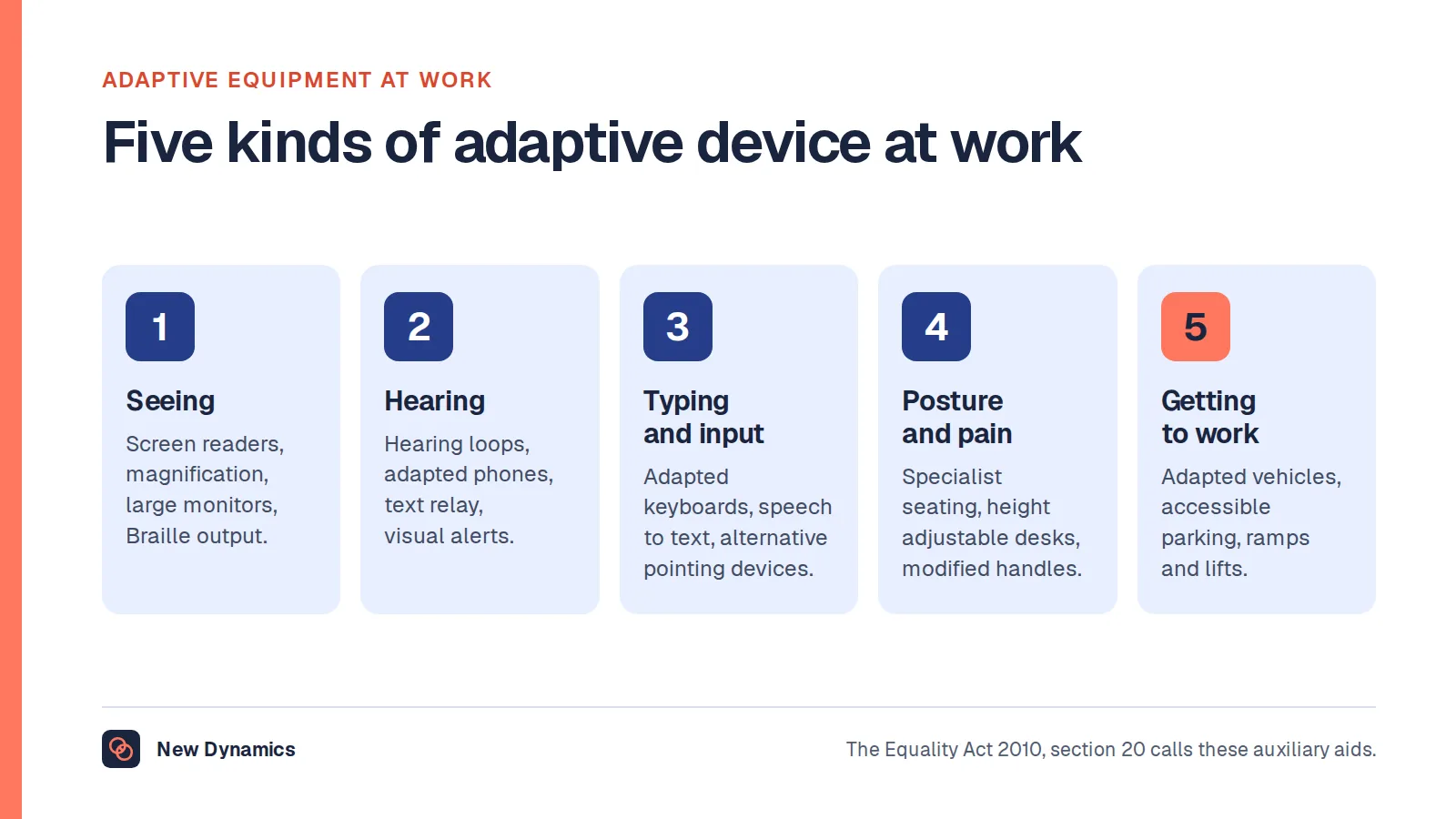
A period of leave can be one of those steps. The Act lists no adjustments, and no official source states that a sabbatical is or is not reasonable in a given case, because reasonableness turns on the facts. What follows is narrow: the discretionary scheme cannot be the only route. Say that a request connected to a health condition or disability is also considered under the adjustments process, and that refusing it under the sabbatical rules does not dispose of the duty. Our post on workplace adaptations covers how that duty is assessed and recorded.
What a sabbatical policy must settle
GOV.UK names the first three. The rest are the ones we see argued about.
- Eligibility and service. Who can apply, and after how long.
- How to apply, and the notice required. GOV.UK lists "eligibility and notice periods" and "how to apply and how long is allowed".
- Whether the contract's terms continue, which GOV.UK raises in the context of "qualifying for pay increases". Say in one sentence that the contract and continuous service both run on.
- Length and frequency. A minimum, a maximum, and how long before someone can apply again.
- Paid or unpaid. If part paid, the rate, and whether it is repayable on an early resignation.
- Who decides, on what grounds, with a written reason and one appeal heard by someone else.
- The return. The same job, a similar one, or neither, in the written agreement rather than left as an understanding.
- Benefits and pension, named one by one.
- Holiday, including when the leave year's entitlement is to be taken.
- If the business changes while the person is away. If a restructure or redundancy exercise touches the role, say the person is included on the same terms as if they were at work and that consultation reaches them. Silence here is how a sabbatical becomes a dismissal nobody intended.
The risk in a discretionary scheme applied unevenly
Discretion is lawful. Discretion exercised differently for different people is where the exposure sits. A service requirement applied to one person and waived for another. Requests granted to staff without caring responsibilities and refused to those with them. A scheme used by one part of the workforce because managers elsewhere discourage it quietly. None of that is answered by pointing at the policy, because the complaint is about how the policy was used.
Three habits reduce it. Write the grounds down before the first request, not after. Record every request, the reason given and the outcome in one place and one format. Review the pattern once a year by team, grade, age, sex and disability, and write the explanation down while people still remember it.
Frequently asked questions
Is there a legal right to a sabbatical in the UK?
No. GOV.UK states on its career breaks page, last updated on 4 December 2019, that "There are no laws that deal specifically with taking a career break" and that employers "do not have to offer career breaks". Whether you can take one, and on what terms, depends on your employer's policy and your contract.
Does a sabbatical break continuous employment?
It depends on whether the contract of employment continues. Section 212(1) of the Employment Rights Act 1996 counts any week in which the employee's relations with the employer are governed by a contract of employment, and section 210(4) provides that a week which does not count breaks continuity. If the contract runs through the sabbatical, continuity is unaffected.
Do you still accrue holiday during unpaid leave?
While the contract continues, the statutory entitlement keeps arising. Regulation 13 of the Working Time Regulations 1998 gives four weeks' annual leave in each leave year and regulation 13A adds 1.6 weeks, and the only pro-rating there is for employment beginning part-way through a leave year. The practical risk is losing leave rather than not earning it, because regulation 13(9)(a) says leave may only be taken in the leave year it is due.
Do pension contributions continue during a sabbatical?
Not automatically. Section 13 of the Pensions Act 2008 calculates contributions on qualifying earnings, meaning sums payable to the person, so unpaid leave leaves nothing to calculate on. Whether the employer contributes anyway is a matter for the scheme rules and the policy, so check both before you go.
Is my job guaranteed when I come back from a sabbatical?
Only if the agreement says so. GOV.UK warns that return arrangements "are not legally binding" and that employees "cannot take legal action if an employer decides they cannot return to their job or a similar one". Get the return terms in writing, and ask what happens if the role changes while you are away.
Can an employer refuse a sabbatical request?
Yes, if the scheme is discretionary. The limits sit elsewhere. Refusing inconsistently can give rise to a discrimination claim, a request connected to a disability engages the reasonable adjustments duty under section 20 of the Equality Act 2010, and a request about hours or place of work may be a flexible working request, refusable only on a ground listed in section 80G of the Employment Rights Act 1996.
Your next step: get the ten points on one page
- Check whether you already have a policy. A handbook that mentions sabbaticals without settling the ten points above is worse than silence, because it creates an expectation with no terms.
- Decide the contract question first and write it in one sentence. Everything else follows from it.
- Ask your pension provider, in writing, what happens to contributions and insured cover during a period of no pay.
- Fix the holiday mechanics, so the leave year's entitlement is taken before the sabbatical starts.
- Put the request, the decision and the written reason on one route, and set a review date twelve months out.
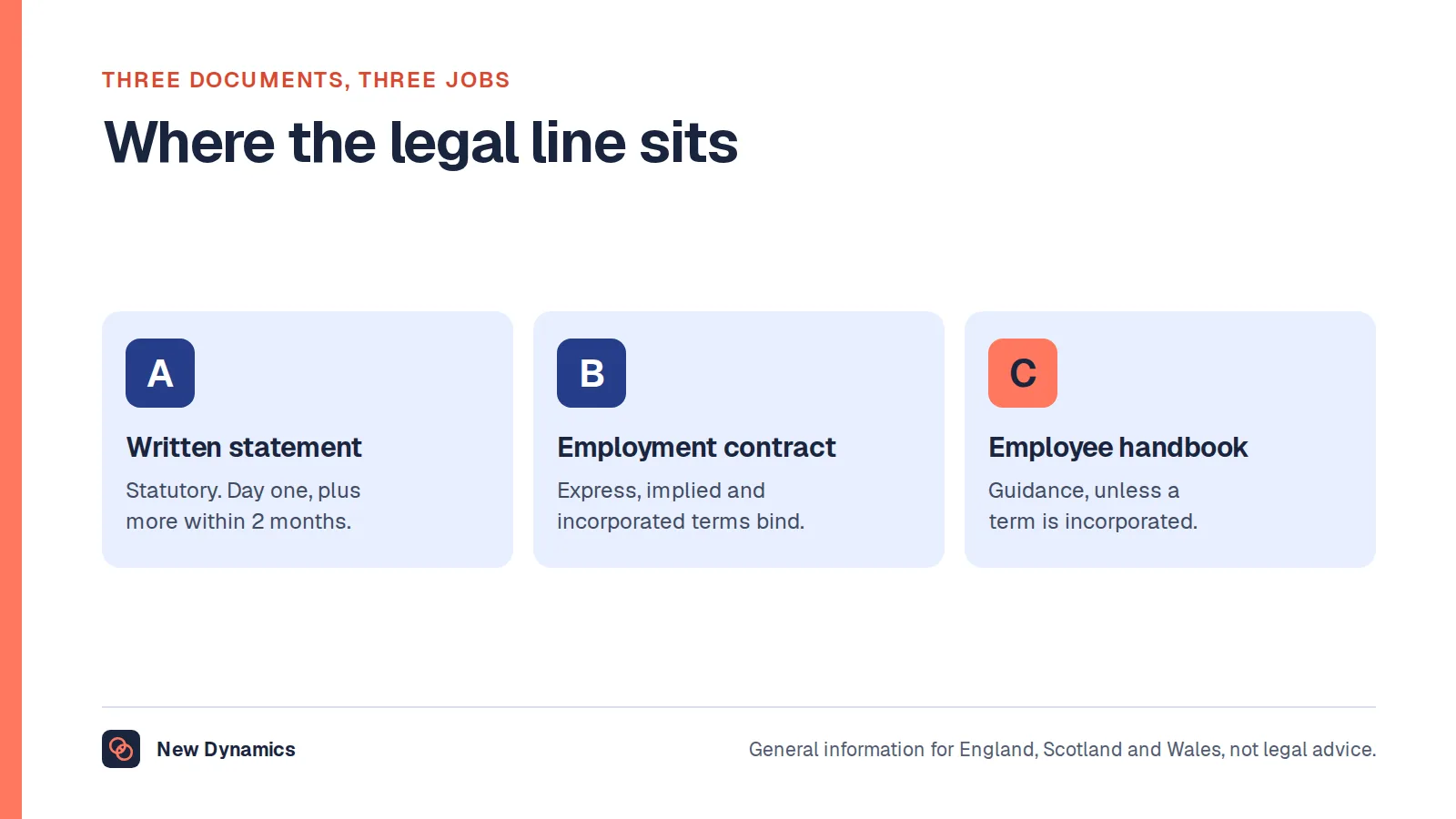
For the wider document this sits inside, read and download our employee handbook guide. The guide is free to read, and the PDF uses our short download form.
Want every leave decision to leave the same record, whoever made it? Book a New Dynamics demo and bring your current handbook. You can also email contact@new-dynamics.com.