TL;DR
- There is no legal category called an adaptive device. In the United Kingdom the relevant words are in the Equality Act 2010, section 20, which sets out three requirements, the third being to take reasonable steps to provide an auxiliary aid. Section 20(11) adds that an auxiliary aid includes an auxiliary service, so an interpreter counts as much as a keyboard.
- The employer pays. Section 20(7) says the employer is not entitled to require a disabled person to pay to any extent the employer's costs of complying with the duty, and GOV.UK states plainly that Access to Work will not pay for reasonable adjustments.
- Buying the equipment does not end the duty. The statutory code of practice says a failure to make a reasonable adjustment cannot be justified, and that an employer may need to make more than one adjustment.
Somebody asks for a chair. Or a second screen, software that reads the screen aloud, or a keyboard they can actually use. Three questions follow, and most organisations answer them in the wrong order: do we have to, who pays, and who signs it off.
This article answers them in order, for the United Kingdom, and names the statute behind each rule: what counts as an adaptive device or a piece of adaptive equipment at work, who the duty protects, what "reasonable" means, who pays, how a request is handled, what to write down, and the mistake that produces tribunal claims, which is treating the purchase order as the end of the matter. The United States position is named at the end, because it is a different statute with a different test. This is general information about the law in Great Britain and not legal advice.
A request that arrives by chat message and is agreed in a corridor leaves nothing behind. See how New Dynamics workflows let you shape the stages, participants, forms and rules of a process around how your organisation actually works, so an agreed adjustment has an owner, a date and a record.
What counts as an adaptive device or a piece of adaptive equipment at work
Start with the honest answer: nothing counts, as a category. "Adaptive device" and "adaptive equipment" are useful everyday phrases, but neither appears in UK employment law. There is no approved list and no threshold. The law asks whether a particular person is at a substantial disadvantage at work, and whether a step that would remove it is reasonable for this employer to have to take. So the list below is examples, not a definition:
- Seeing. Screen reader software, magnification, a large monitor, Braille output. The Equality and Human Rights Commission statutory code gives "a large screen for a visually impaired worker" as a step it might be reasonable to have to take.
- Hearing. An adapted telephone, text relay, a hearing loop, a vibrating or visual alert. GOV.UK's guidance on reasonable adjustments for disabled workers gives "an audio-visual fire alarm for a deaf person" as an example of a physical change to the workplace.
- Typing, writing and input. An adapted keyboard, speech to text software, an alternative pointing device, a document scanner. GOV.UK names "changing their equipment, for instance providing a special keyboard if they have arthritis".
- Posture, pain and reach. Specialist seating, a height adjustable desk, a footrest, modified tooling. The statutory code gives "other modified equipment for disabled workers (such as longer handles on a machine)".
- Getting to work and moving around it. An adapted vehicle, an accessible parking space, a ramp, a lift. GOV.UK's Access to Work guidance lists "adaptations to your vehicle so you can get to work".
- People, not objects. A British Sign Language interpreter, a reader, a job coach, a support worker.
That last bullet matters more than it looks. Section 20(11) of the Equality Act 2010 says that "A reference in this section, section 21 or 22 or an applicable Schedule to an auxiliary aid includes a reference to an auxiliary service." A person can be the aid. An employer who has a budget line for hardware and none for interpreters has misread the duty.

The UK duty: Equality Act 2010, section 20
Section 20 is the engine. It applies in England, Wales and Scotland, and for work it operates through Schedule 8, as the table in section 20(13) sets out. Northern Ireland has its own separate system.
Section 20(2) says: "The duty comprises the following three requirements." Almost every argument about equipment turns on which of the three you are in.
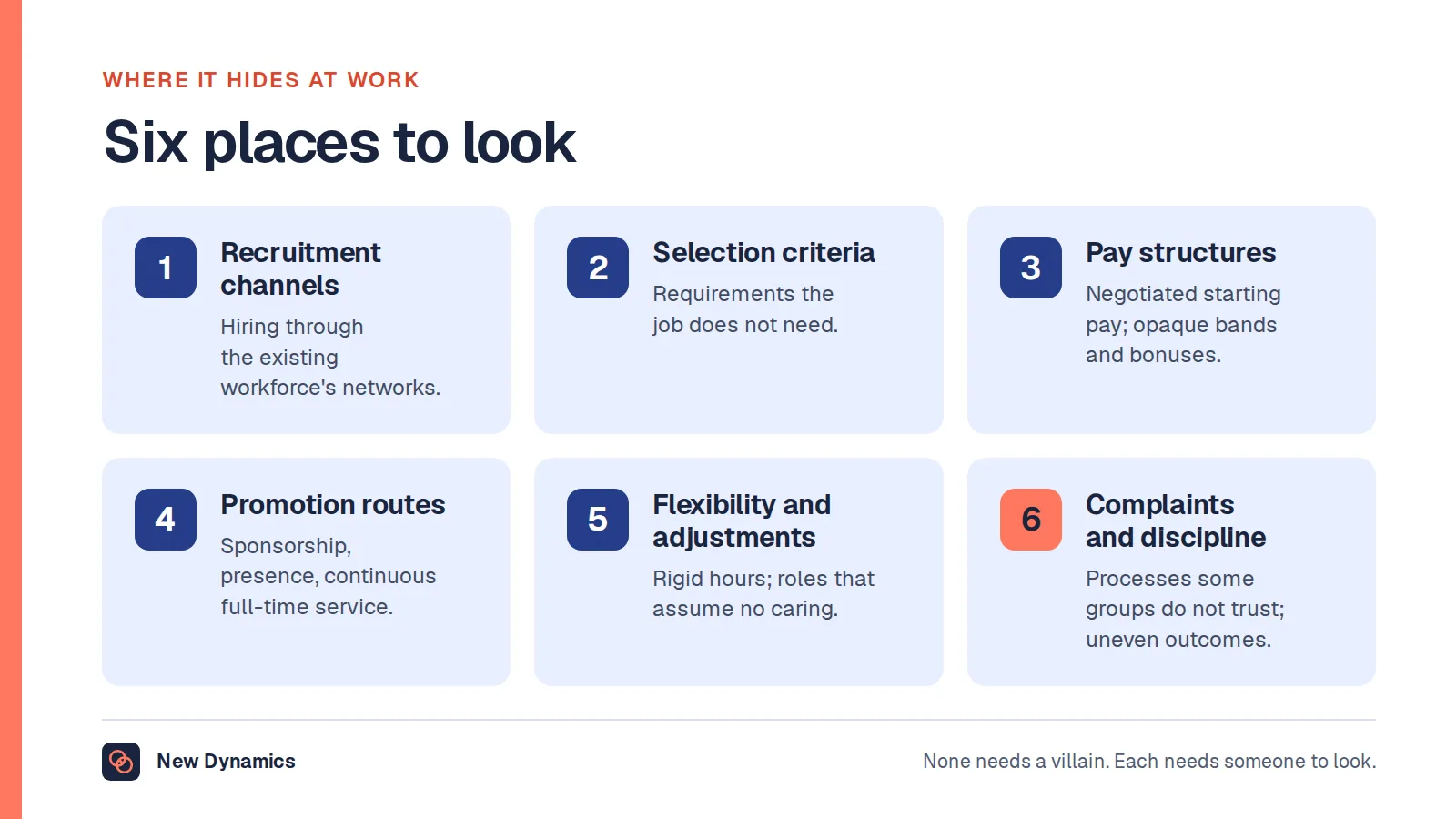
- The first requirement bites where "a provision, criterion or practice of A's puts a disabled person at a substantial disadvantage", and requires "such steps as it is reasonable to have to take to avoid the disadvantage". This is the rule about how you work: hot desking, shift patterns, a written test, an attendance trigger.
- The second requirement covers a physical feature. Section 20(10) defines that to include "a fixture or fitting, or furniture, furnishings, materials, equipment or other chattels, in or on premises", so a chair you already own is a physical feature. Section 20(9) says avoiding the disadvantage includes removing the feature, altering it, or "providing a reasonable means of avoiding it".
- The third requirement is the equipment one, drafted the other way round. It applies "where a disabled person would, but for the provision of an auxiliary aid, be put at a substantial disadvantage", and requires "such steps as it is reasonable to have to take to provide the auxiliary aid". Nothing has to be wrong with the workplace. If the aid is what prevents the disadvantage, the duty is to take reasonable steps to provide it.
Section 20(6) adds that where the first or third requirement relates to providing information, reasonable steps "include steps for ensuring that in the circumstances concerned the information is provided in an accessible format".
Who the duty protects: section 6, and what the employer has to know
Section 6 of the Equality Act 2010 is the gate. A person has a disability if "P has a physical or mental impairment, and the impairment has a substantial and long-term adverse effect on P's ability to carry out normal day-to-day activities". The section requires no diagnosis and lists no qualifying conditions. Section 6(4) extends the Act to a person who has had a disability, so somebody in remission is still covered.
Reach is wider than payroll. GOV.UK states that employers must make reasonable adjustments so that workers "are not substantially disadvantaged when doing their jobs", and that "This applies to all workers, including trainees, apprentices, contract workers and business partners". Job applicants are covered too.
The one real limit is in Schedule 8, paragraph 20: an employer "is not subject to a duty to make reasonable adjustments if A does not know, and could not reasonably be expected to know" that the person has a disability and is likely to be placed at the relevant disadvantage. Note the second half. Not knowing helps only if you also could not reasonably have been expected to know, which is why an unread occupational health report, or a manager who was told and said nothing, is not a shield. Our post on the definition of discrimination covers the surrounding claims.
What "reasonable" means, and who decides
The Act does not say. The Equality and Human Rights Commission's statutory code of practice on employment is explicit at paragraph 6.23: "The Act does not specify any particular factors that should be taken into account. What is a reasonable step for an employer to take will depend on all the circumstances of each individual case."
The code is not optional background reading. Paragraph 1.12 says "It is a statutory Code. This means it has been approved by the Secretary of State and laid before Parliament." Paragraph 1.13 adds that while the code "does not impose legal obligations", "Tribunals and courts must take into account any part of the Code that appears to them relevant to any questions arising in proceedings."
Paragraph 6.28 lists "some of the factors which might be taken into account":
- whether taking any particular steps would be effective in preventing the substantial disadvantage
- the practicability of the step
- the financial and other costs of making the adjustment and the extent of any disruption caused
- the extent of the employer's financial or other resources
- the availability to the employer of financial or other assistance to help make an adjustment (such as advice through Access to Work)
- the type and size of the employer
Three points there are routinely missed. Paragraph 6.29 says the test "is an objective one", so your own good faith is not the measure. Paragraph 6.25 says effective adjustments "often involve little or no cost or disruption and are therefore very likely to be reasonable for an employer to have to make", and that even a significant cost may be cost-effective "compared with the costs of recruiting and training a new member of staff". Paragraph 6.30 is blunt: "The Act does not permit an employer to justify a failure to comply with a duty to make a reasonable adjustment." Once the duty applies, reasonableness is the only question.
Acas gives the practical boundary in one line on its guidance on reasonable adjustments, last updated on 30 January 2025: "The employer does not have to change the basic nature of the job."
Who pays for adaptive equipment at work
The employer. Section 20(7) of the Equality Act 2010 says an employer subject to the duty "is not (subject to express provision to the contrary) entitled to require a disabled person, in relation to whom A is required to comply with the duty, to pay to any extent A's costs of complying with the duty". Acas says the same plainly: "The employer is responsible for paying for any reasonable adjustments." Salary sacrifice, or a staff contribution, is not a lawful way to fund an adjustment.
Access to Work is a separate thing, and the distinction is the most misunderstood point in this area. GOV.UK's Access to Work guide says the scheme "could give you a grant to help pay for things like: specialist equipment and assistive software; support workers, like a BSL interpreter, a job coach or a travel buddy; costs of travelling to work, if you cannot use public transport; adaptations to your vehicle so you can get to work; physical changes to your workplace". It adds that "Your workplace can include your home if you work from there some or all of the time", and that a grant "will not affect any other benefits you get and you will not have to pay it back".
Then, under its own heading, the same page says: "Access to Work will not pay for reasonable adjustments. These are the changes your employer must legally make to support you to do your job." And: "Access to Work will advise your employer if changes should be made as reasonable adjustments." Acas agrees: the scheme "is not a substitute for the employer's legal obligation to make reasonable adjustments or pay for them".
So the grant tops up. It does not transfer the duty, and the worker applies, not the employer. GOV.UK's conditions include being 16 or over, being in paid work or about to start or return to it within 12 weeks, and living and working "in England, Scotland or Wales", with "a different system in Northern Ireland". Voluntary work does not qualify, self-employed applicants need "an annual turnover of at least £6,500", and civil servants are outside the scheme: "Your employer will provide support instead of Access to Work."

The cost share rules, and the cap
GOV.UK's Access to Work factsheet for employers, last updated on 7 October 2025, sets out the arithmetic. An employer "may have to share the cost with Access to Work if the person has been working for you for more than 6 weeks when they apply". Cost share applies only to "special aids and equipment" and "adaptations to premises or equipment", and not to self-employed applicants or the Mental Health Support Service.
Where it applies: "Access to Work will refund up to 80% of the approved costs between a threshold and £10,000. As the employer, you will contribute 100% of costs up to the threshold level and 20% of the costs between the threshold and £10,000." The threshold depends on headcount: nil for 0 to 49 employees, £500 for 50 to 249, and £1,000 for over 250. "Any balance above £10,000 will normally be met by Access to Work."
On the cap, the same page says "Access to Work grants awarded on or after 1 October 2015 are capped", and publishes a table by award period. Its last row is "8 April 2024 to 31 March 2025", at £69,260 a year. GOV.UK publishes no later row, so no cap figure has a published effective date running past 31 March 2025, although the same page still tells employees that "Your employee can continue to get a grant of up to £69,260 a year". For the figure that applies to an award now, use the decision letter, which GOV.UK says "will tell you how much your grant will be and what it should pay for", not the table.
One sequencing trap: GOV.UK warns that "You or your employer may need to pay some costs up front and claim them back later". A purchasing policy that will not release funds before a grant lands delays the adjustment, and delay is itself a risk.
How a request is made and handled
There is no statutory form and no statutory deadline. Acas sets out how a request should work, and following it is the cheapest insurance available.
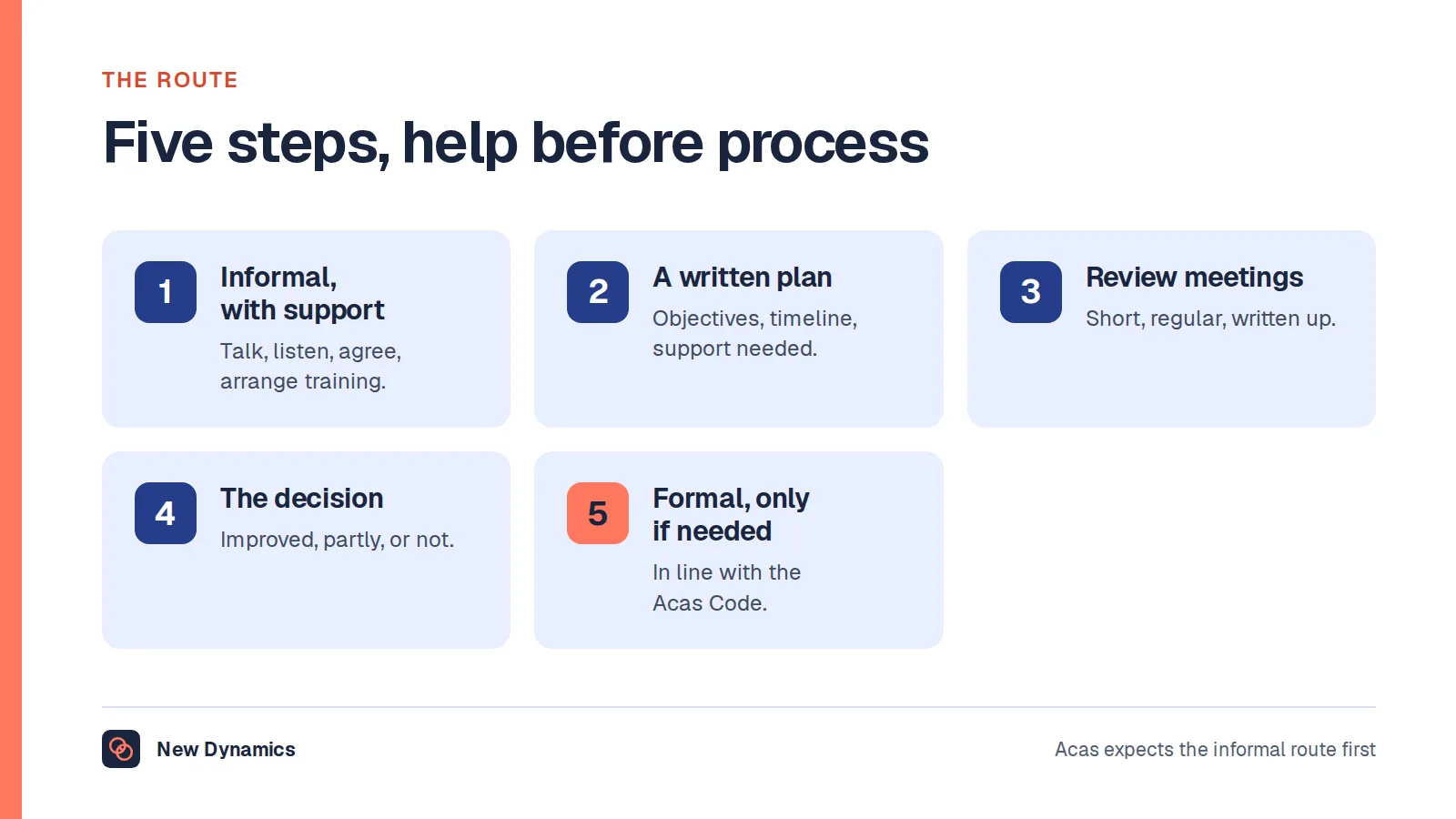
A request can be made "in writing, for example in a letter or email", in a meeting, or through a formal internal process, and Acas advises anyone asking to "consider doing this in writing" as well as talking it through. The employer should "arrange a meeting", "listen to the person and try to understand how their disability affects them at work", "not make assumptions" and "consider the person's specific situation".
On who proposes what, the statutory code says at paragraph 6.24: "There is no onus on the disabled worker to suggest what adjustments should be made (although it is good practice for employers to ask)." Acas says employers "should take the lead from the person asking for reasonable adjustments", because they usually know what would help. Where the answer is unclear, the employer can agree with the person to get an occupational health assessment or to write to their doctor.
Health and safety is a legitimate factor, not a trump card. The code says at paragraph 6.27 that an adjustment that "would increase the risk to health and safety of any person (including the disabled worker in question)" raises a relevant factor, and that "Suitable and sufficient risk assessments should be used to help determine whether such risk is likely to arise". Our post on workplace safety covers the assessment side.
Then decide, and say so. Acas: "An employer should confirm any agreed reasonable adjustments in writing." The code adds at paragraph 6.32 that adjustments "should be implemented in a timely fashion", and that "It is advisable to agree any proposed adjustments with the disabled worker in question before they are made."

What to record, and for how long
No statute prescribes an adjustments record. A tribunal will look for evidence of what was asked, considered, decided, why, and what happened next. In practice, keep:
- the request, as made, with its date
- what the person said about the effect of their condition on the work
- any medical or occupational health input, and the date it was obtained
- the options considered, including the ones rejected, and the reason for each
- the decision, confirmed in writing to the person, with start dates and owners
- the review dates, and what changed at each review
Acas recommends a review "every 6 months or if something changes", and lists the triggers: a new role, a redundancy process, new equipment or a new workplace, a change in the condition, or a condition that gets worse over time. It also suggests a "reasonable adjustments passport", a record held by the person covering how their disability affects them at work, what has been agreed, and what they may need in future, so that "if someone's manager changes, they can show their new manager what's been agreed". A manager change is the commonest point at which an agreed adjustment quietly stops happening.
All of this is health information, so it is special category data under data protection law. Keep it apart from the general personnel file, limit who can see it, and write down a retention period. Our employee data protection guide covers the handling rules, and our post on sick leave policy covers the overlap with absence records.
The trap: the equipment is not the whole duty
This is where otherwise careful employers lose. The duty is to take reasonable steps to avoid a substantial disadvantage. Equipment is a means to that, and buying it discharges nothing by itself. Four ways the gap opens:
- The equipment arrives and the practice does not change. Speech to text software does not help if the attendance policy still counts disability related absence against a trigger, or if the hot desking rule means the specialist chair is somewhere else. Section 20(3) is a separate requirement from section 20(5).
- One adjustment is treated as the answer. The code says at paragraph 6.32 that "it may also be necessary for an employer to make more than one adjustment". Acas puts the corollary bluntly: "An employer does not have to make adjustments that are unreasonable. However, they should still find other ways to support the disabled person." A refusal on cost grounds starts the next conversation rather than ending it.
- Nobody else is told what the adjustment requires. Acas says the employer must "make sure other people do what's needed for a reasonable adjustment to work", giving the example of information that has to be presented in a certain format. An adjustment that depends on colleagues who were never told is not in place.
- It is never reviewed. The code notes at paragraph 16.36 that "In employment, the duty to make reasonable adjustments is not anticipatory", unlike the services duty. That cuts both ways: you need not stock every format in advance, but a decision made two years ago is not an answer to today's disadvantage.
One genuine limit, from paragraph 6.33: "There is no requirement to provide or modify equipment for personal purposes unconnected with a worker's job, such as providing a wheelchair if a person needs one in any event but does not have one." The duty is tied to the work, not to the person's life generally.
Our posts on systemic discrimination, capability procedures and performance reviews during long term sickness cover where this gap most often becomes a claim. For wider figures on UK employment practice, see our HR statistics hub.
The United States: a different statute, a different test
If you employ people in both countries, write the rule twice and label each. The American duty is in the Americans with Disabilities Act, codified at 42 U.S.C. 12112. Section 12112(b)(5)(A) makes it unlawful discrimination to be "not making reasonable accommodations to the known physical or mental limitations of an otherwise qualified individual with a disability who is an applicant or employee, unless such covered entity can demonstrate that the accommodation would impose an undue hardship on the operation of the business of such covered entity".
Two differences sit in that one sentence. The American term is reasonable accommodation, not reasonable adjustment. And the defence is undue hardship, which the employer must demonstrate, where the UK question is whether the step was one it was reasonable to have to take. They are not the same test, the case law is not interchangeable, and a single global adjustments policy written to one of them will be wrong somewhere. This article does not go beyond naming the American duty.
Frequently asked questions
What is an adaptive device?
An adaptive device is any item that lets someone do a task they would otherwise be disadvantaged in doing, such as a screen reader, an adapted keyboard, specialist seating or an adapted vehicle. It is an everyday phrase, not a legal category. UK employment law instead asks whether a step is reasonable to remove a substantial disadvantage at work.
What is adaptive equipment at work?
Adaptive equipment at work is any equipment provided or modified so that a disabled person is not at a substantial disadvantage doing their job. The Equality Act 2010 calls it an auxiliary aid, and section 20(11) says an auxiliary aid includes an auxiliary service, so an interpreter or a reader counts as well as hardware or software.
Who pays for adaptive equipment at work in the UK?
The employer. Section 20(7) of the Equality Act 2010 says an employer is not entitled to require a disabled person to pay to any extent the employer's costs of complying with the duty. GOV.UK states that Access to Work will not pay for reasonable adjustments, because those are the changes the employer must legally make.
What does Access to Work pay for?
GOV.UK says an Access to Work grant can help pay for specialist equipment and assistive software, support workers such as a British Sign Language interpreter or job coach, travel to work where public transport cannot be used, vehicle adaptations and physical changes to the workplace. The grant does not have to be repaid and does not affect other benefits.
Is there a cap on an Access to Work grant?
GOV.UK publishes a table of annual caps for grants awarded on or after 1 October 2015. The last period in that table is 8 April 2024 to 31 March 2025, at £69,260 a year. No later row is published, so check the award figure on the decision letter rather than assuming the table still applies.
Does buying the equipment end the employer's duty?
No. The statutory code of practice says a failure to make a reasonable adjustment cannot be justified, and that an employer may need to make more than one adjustment. Equipment is one step. The working practice, the people who have to cooperate with the adjustment, and the review all sit inside the same duty.
How should an employee ask for adaptive equipment?
Acas suggests asking in writing, for example by letter or email, as well as talking it through, and says the employer should arrange a meeting, listen, avoid assumptions and consider the person's specific situation. There is no statutory form. The employer should then confirm whatever is agreed in writing.
Your next step: turn a conversation into a record
- Take the three adjustments you believe are currently in place and find the written confirmation for each. If there is none, write it now, with the date it started and who owns it.
- Check which of the three section 20 requirements each one answers. If every entry is equipment, you are probably missing a practice that still disadvantages someone.
- Put a review date on each, about six months out, and add the triggers Acas lists: new role, new equipment, new workplace, change in condition.
- Separate adjustment records from the general personnel file, decide who can see them, and write down a retention period.
- If you employ people in the United States, split the policy in two and label each half with its statute and its test.
For the handling and retention rules behind step 4, read and download our employee data protection guide. The guide is free to read, and the PDF uses our short download form.
Want agreed adjustments to have an owner, a date and a review rather than living in somebody's inbox? Book a New Dynamics demo and bring your current adjustments process. You can also email contact@new-dynamics.com.