TL;DR
- No statute forbids a second job. What limits it is the contract, the 48 hour average and the tax code. Regulation 4(1) of the Working Time Regulations 1998 caps "a worker's working time, including overtime, in any reference period" at "an average of 48 hours for each seven days", and GOV.UK says of more than one job that "Your combined working hours should not be more than 48 hours a week on average".
- Exclusivity clauses are void for two groups only. Section 27A(3) of the Employment Rights Act 1996 makes them unenforceable in a zero hours contract, and regulation 3 of the Exclusivity Terms for Zero Hours Workers (Unenforceability and Redress) Regulations 2022 extends that from 5 December 2022 to any other contract paying "net average weekly wages that do not exceed the lower earnings limit", which is £129 a week in 2026 to 2027.
- Daily rest does not aggregate for adults. Regulations 10 and 11 give 11 consecutive hours and 24 hours of rest "in each 24-hour period during which he works for his employer", per employer, while regulation 5A(2) and regulation 12(5) spell out aggregation across employers only for young workers.
Two people arrive at this question from opposite ends. A worker wants to know whether taking a second job is allowed, and whether the first employer can stop it. An employer has just found out that someone already has another job, and wants to know what it can do about it. The answer is the same set of rules read from two directions, and almost none of it turns on permission.
This article sets out the starting point in law, what a contract can and cannot do, where exclusivity clauses are void and where they are not, how the 48 hour average and the rest periods behave across two employers, and how Income Tax and National Insurance are worked out when two payrolls are paying the same person. It covers the United Kingdom, with the Northern Ireland position noted separately at the end, and it is general information rather than legal or tax advice.
A declared second job is a fact that belongs on a record rather than in somebody's memory. New Dynamics onboarding collects what a new starter has to tell you at the point they join, so the hours question is asked once and the answer is still there in six months.
Nothing in law forbids a second job
There is no statutory prohibition on holding two jobs at the same time in the United Kingdom. No provision of the Employment Rights Act 1996, the Working Time Regulations 1998 or any tax legislation says a person may hold only one employment. The limits that exist are a cap on hours, a set of rest entitlements, the terms of each contract, and the way one Personal Allowance is split between two payrolls.
Second jobs are also usually small. The Office for National Statistics table HOUR01, "Actual weekly hours worked (seasonally adjusted)", published on 20 October 2026, puts average actual weekly hours in second jobs at 9.8 for June to August 2026, against 32.0 hours for all workers. The next edition is due on 17 November 2026. The ONS does not publish a regular count of how many people hold a second job. Its tables on that are one-off releases, the latest of which covers 2019, so no current official figure for the number of second jobs exists to quote, and this post does not give one.

What a contract can and cannot do about a second job
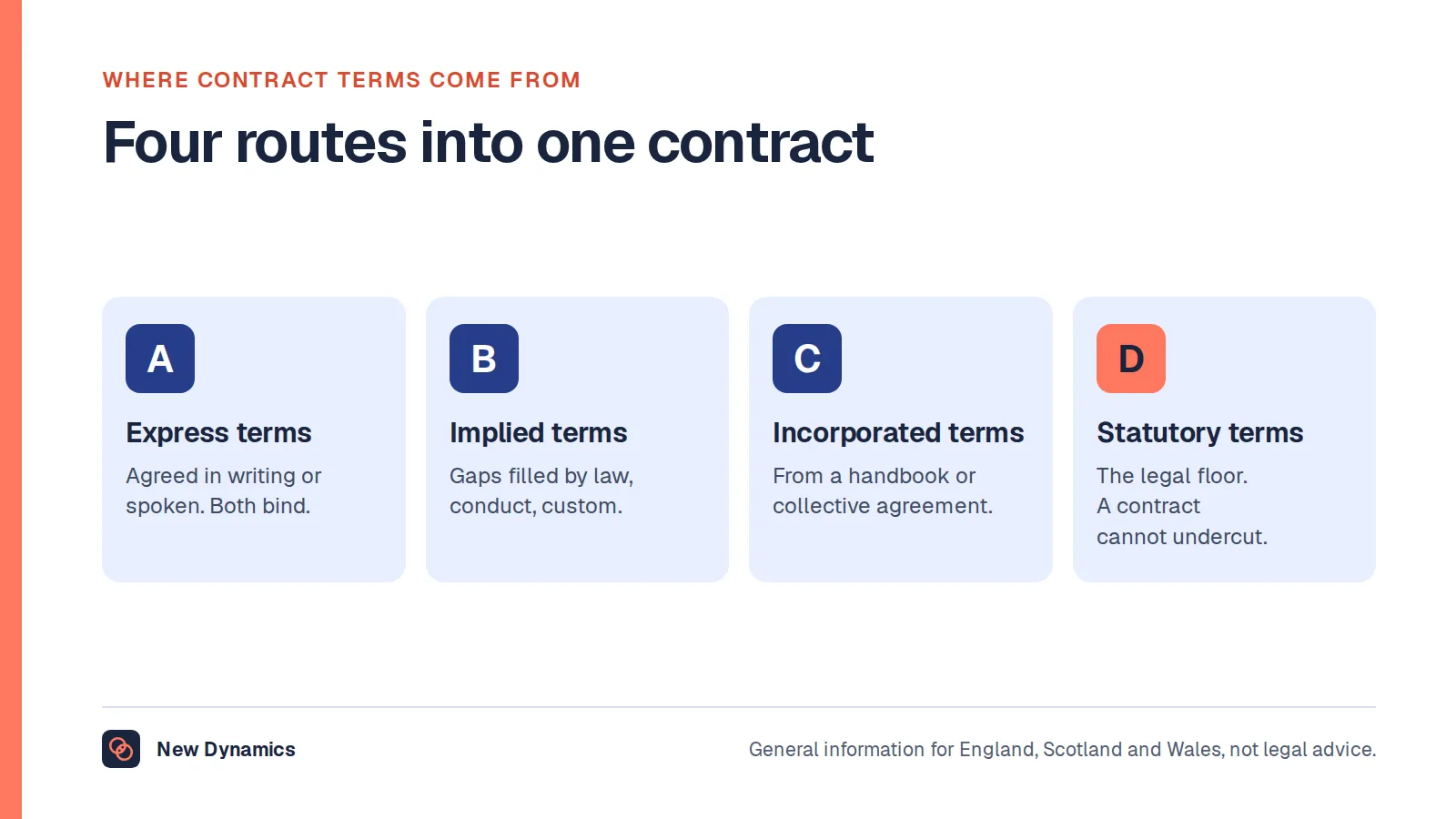
A clause restricting other work is a contract term. It binds in the ordinary way unless a statute takes it away, and Parliament has taken it away for two groups of workers, not for everyone.
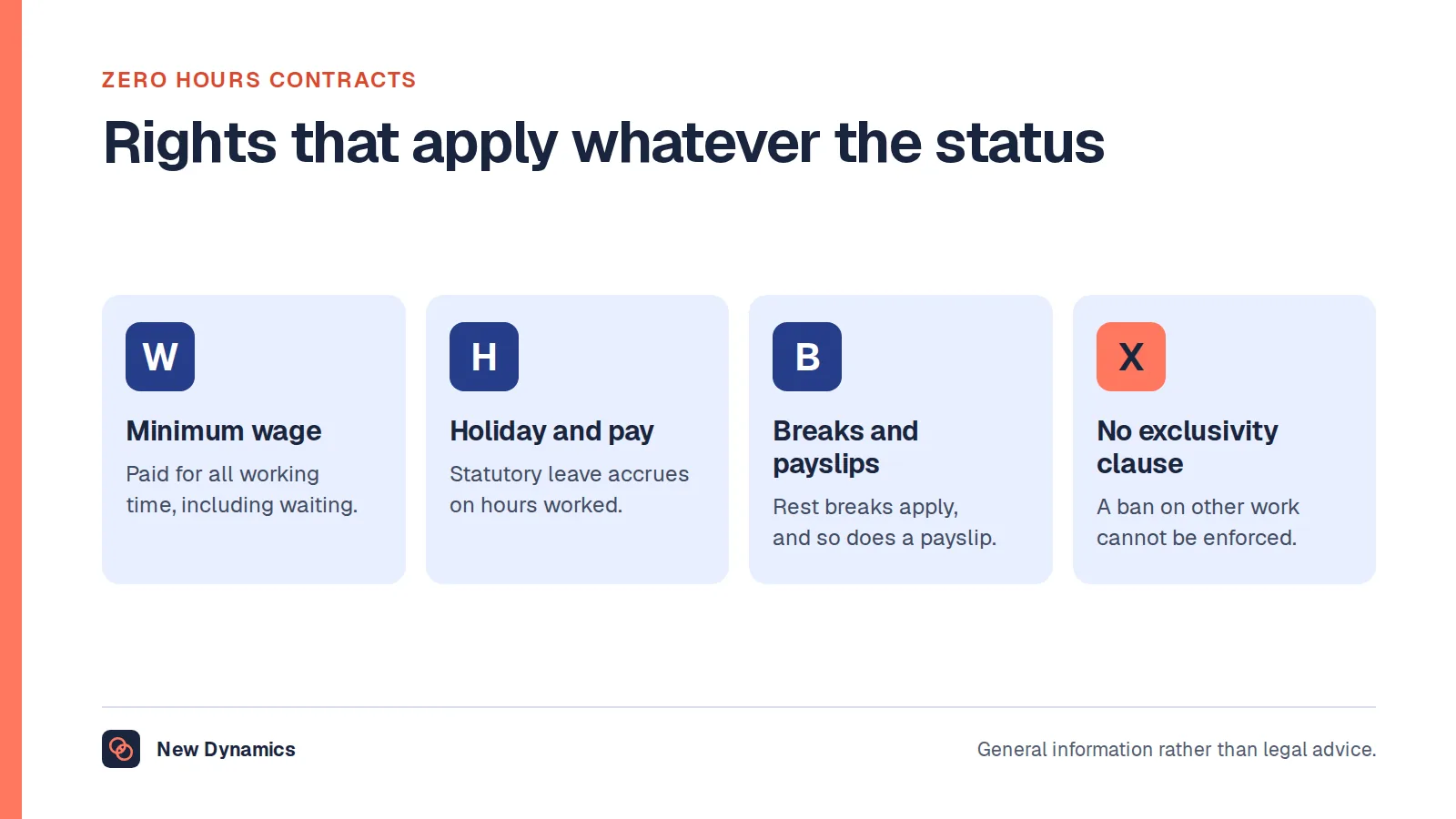
The first is zero hours contracts. Section 27A(3) of the Employment Rights Act 1996 provides that any provision of a zero hours contract which "(a) prohibits the worker from doing work or performing services under another contract or under any other arrangement, or (b) prohibits the worker from doing so without the employer's consent, is unenforceable against the worker". Section 27A(1) defines a zero hours contract as one where the undertaking to work is conditional on the employer making work available and "there is no certainty that any such work or services will be made available to the worker". The section was inserted on 26 May 2015.
The second group is low paid workers who are not on zero hours contracts. Regulation 3(1) of the Exclusivity Terms for Zero Hours Workers (Unenforceability and Redress) Regulations 2022 provides that "Any provision of a specified contract which contains an exclusivity term is unenforceable against a worker". Regulation 3(2) defines a specified contract as one "which is not a zero hours contract and entitles a worker to be paid under that contract, net average weekly wages that do not exceed the lower earnings limit". Those Regulations were made on 7 November 2022 and came into force on 5 December 2022.
So the threshold is the lower earnings limit, calculated net and as an average over the contract. GOV.UK's rates and thresholds for employers 2026 to 2027 gives the lower earnings limit as "£129 per week", "£559 per month" and "£6,708 per year". Regulations 4 to 6 of the 2022 Regulations set out the arithmetic: divide a permanent contract's annual entitlement by 52, or any other contract's total by the number of weeks it is expected to run, then subtract "all deductions of whatever nature".
That is the whole of it. A worker on a contract that guarantees more than £129 net a week, and is not a zero hours contract, has no statutory answer to an exclusivity clause. The common claim that exclusivity clauses are simply void is wrong, and an employer relying on that claim to leave a clause in a senior contract will be surprised at how little the statute does for the worker.
Where the clause is unenforceable, the redress is real. Regulation 7(1) of the 2022 Regulations makes a dismissal automatically unfair where the principal reason is that the worker breached an exclusivity term, with no qualifying period, and regulation 7(2) gives a right not to be subjected to a detriment for that reason. Regulation 8(2) sets a three month time limit for a detriment complaint. Our post on zero hours contracts covers how the casual side of this works day to day.
What the Employment Rights Act 2025 changes, and what it does not
Section 8 of the Employment Rights Act 2025, headed "Exclusivity terms in zero hours arrangements", is in force. Its commencement note reads "S. 8 in force at 6.1.2026 by S.I. 2026/3, reg. 2(5)". Read on its own, that looks like a change in the law for workers. It is not.
Section 8 amends only section 27B of the 1996 Act, which is the power to make further regulations. Among other things it inserts into section 27B(6) a power to provide for "exclusivity terms in prescribed categories of zero hours arrangements that are contractual arrangements to be unenforceable". The power is live; no regulations have been made under it. A title search on legislation.gov.uk for "Exclusivity Terms" returns two instruments, the 2015 redress Regulations and the 2022 Regulations above, and nothing later.
The guaranteed hours provisions are in the same position, only more so. Section 1 of the 2025 Act, which inserts a right for qualifying workers to be offered guaranteed hours, carries the note "S. 1 in force at 6.1.2026 for specified purposes by S.I. 2026/3, reg. 2(2)(a)". Regulation 2(2) of that commencement instrument limits those purposes to "conferring a duty to consult or a power to make regulations" and matters "relating to the exercise of such a power to make regulations". The duty on an employer to offer guaranteed hours is not yet in force, and nobody can claim it.
The 48 hour average week, and how precisely it aggregates
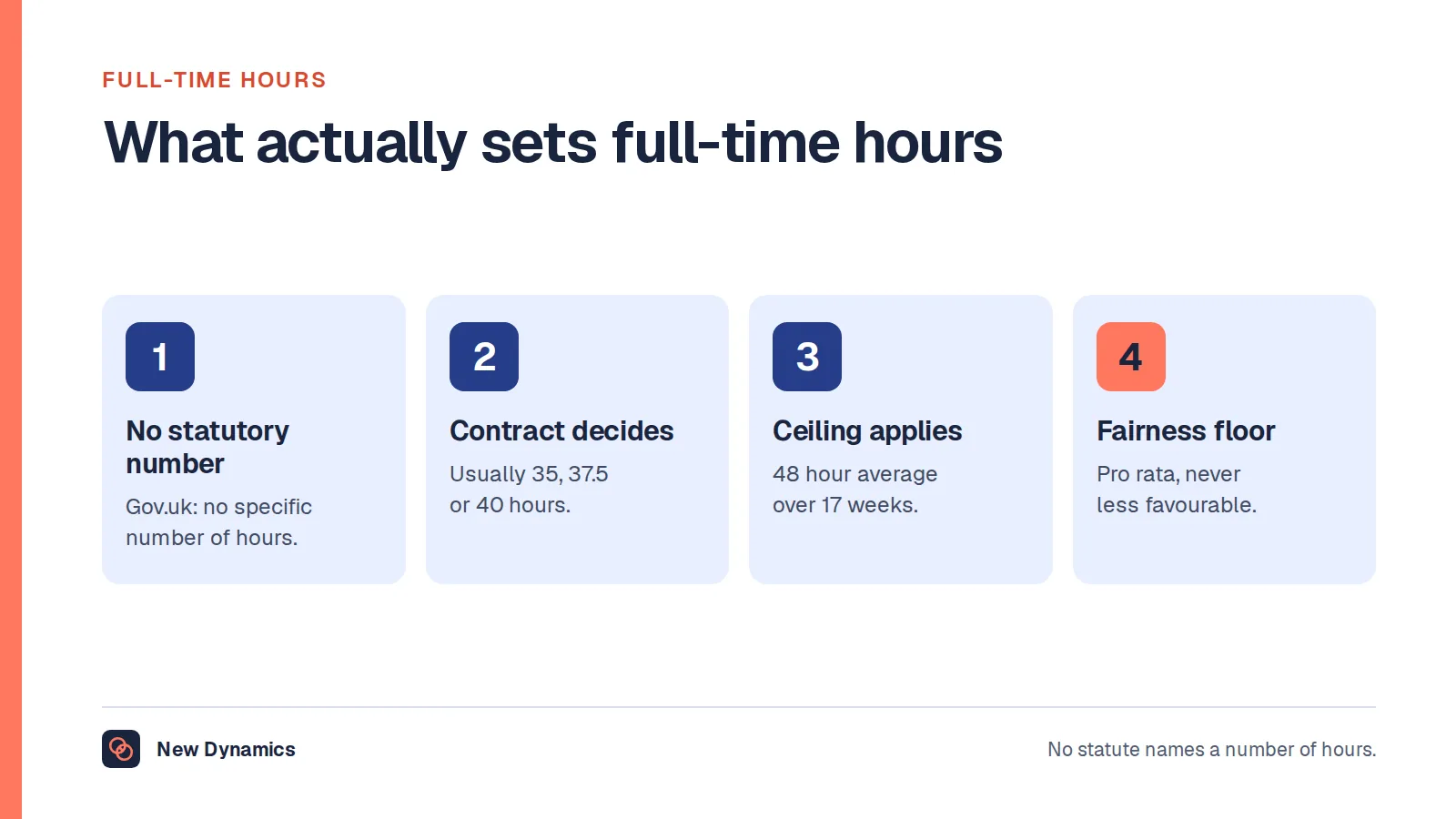
Regulation 4(1) of the Working Time Regulations 1998 reads, in its in force version: "Unless his employer has first obtained the worker's agreement in writing to perform such work, a worker's working time, including overtime, in any reference period which is applicable in his case shall not exceed an average of 48 hours for each seven days."
Note what the words do and do not say. The limit is on "a worker's working time", not on the working time of a worker for a particular employer, and the default reference period under regulation 4(3)(b) is "any period of 17 weeks in the course of his employment". GOV.UK takes the limit as a combined one. Under the heading "You have more than one job", its guide to maximum weekly working hours says: "Your combined working hours should not be more than 48 hours a week on average." It then gives two options, sign an opt out agreement or "reduce your hours to meet the 48-hour limit".
Be careful how firmly you state that, because the Regulations themselves spell out aggregation across employers in exactly two places, and both are about workers under 18. Regulation 5A(2) says that where "a young worker is employed by more than one employer, his working time shall be determined for the purpose of paragraph (1) by aggregating the number of hours worked by him for each employer", paragraph (1) being the eight hour day and 40 hour week. Regulation 12(5) does the same for a young worker's in-work break. There is no equivalent sentence for adults. GOV.UK says "should", not "must", and it is the only official statement of the combined position. Treat 48 hours across both jobs as the number to work to, and do not tell a worker the Regulations say in terms that their two jobs are added together, because they do not.
Who deals with the opt out when there are two employers
Each employer, separately. The opening words of regulation 4(1) are "Unless his employer has first obtained the worker's agreement in writing", so the agreement is between that worker and that employer. One employer's opt out form does nothing for the other.
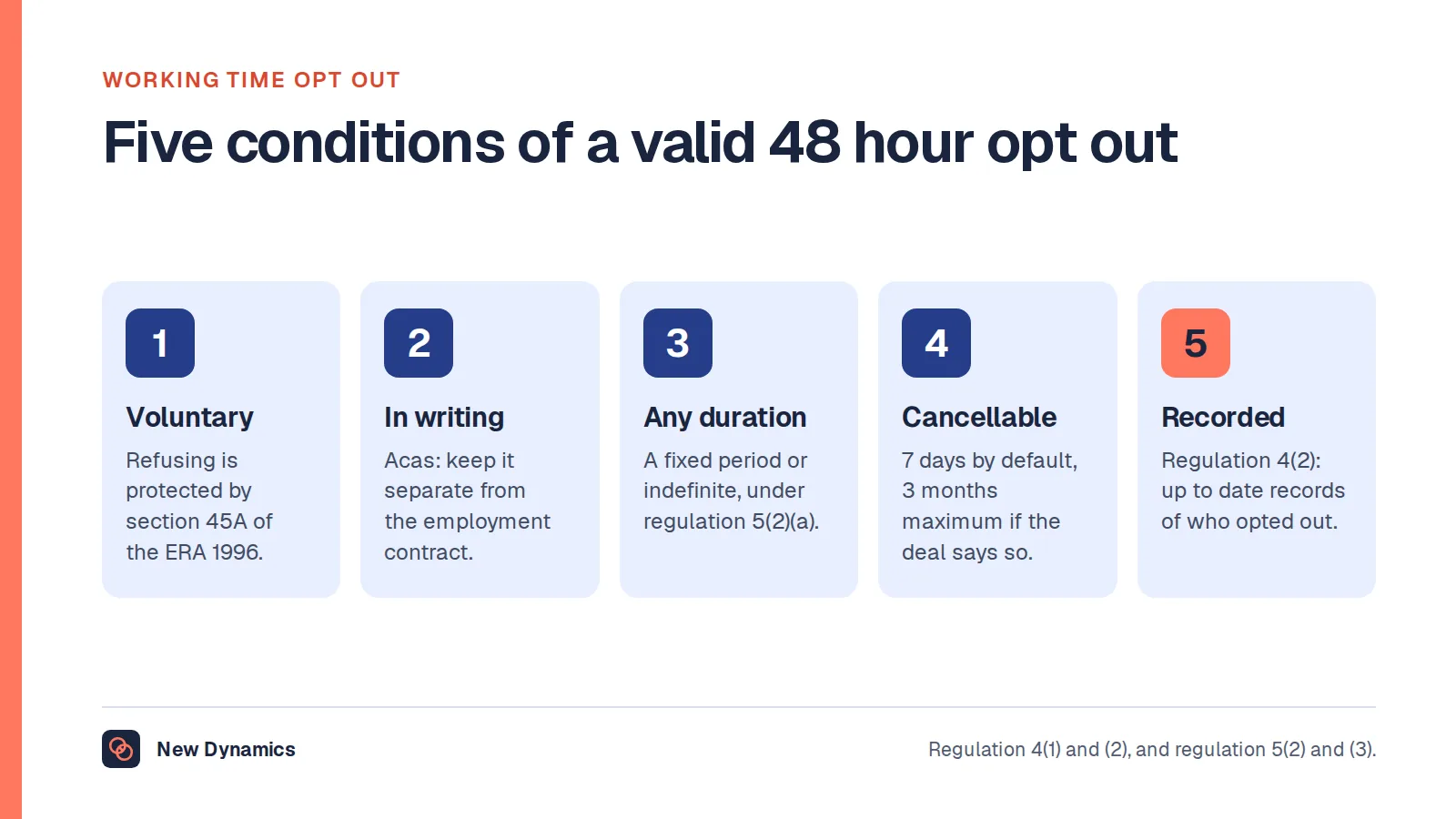
The duty follows the same pattern. Regulation 4(2) requires an employer to "take all reasonable steps, in keeping with the need to protect the health and safety of workers, to ensure that the limit specified in paragraph (1) is complied with in the case of each worker employed by him in relation to whom it applies", and to keep records of workers who have opted out. An employer that knows about a second job and does nothing has not taken all reasonable steps. That is the legitimate reason for asking about hours elsewhere, and it is a better reason to give a worker than a vague appeal to the contract. The mechanics of the agreement itself, including the seven day withdrawal notice, are in our post on the working time opt out.

Rest breaks and daily rest do not combine across two jobs
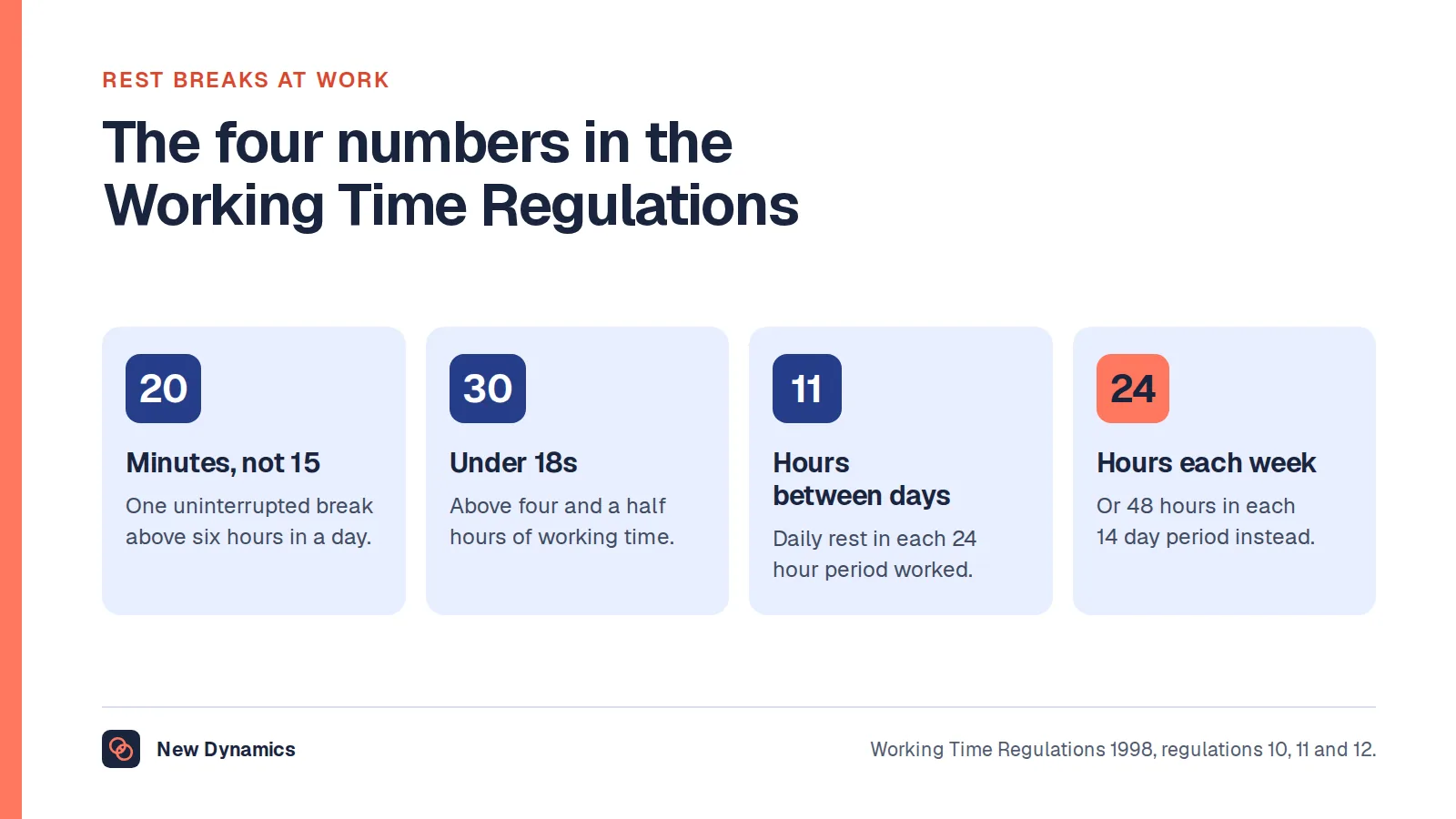
This is where two jobs produce a result nobody intended. Regulation 10(1) entitles a worker to "a rest period of not less than eleven consecutive hours in each 24-hour period during which he works for his employer". Regulation 11(1) gives "an uninterrupted rest period of not less than 24 hours in each seven-day period during which he works for his employer". Regulation 12(1) and 12(3) give a 20 minute uninterrupted break, away from the workstation, where "daily working time is more than six hours".
Every one of those entitlements is framed around "his employer". An early shift for one employer and a late shift for another can leave a worker with far less than eleven hours between finishing and starting, while each employer, looking only at its own rota, is compliant. The Regulations do not say the two employers' rest periods are read together for an adult worker, and GOV.UK does not say so either. The only aggregation the text provides is regulation 12(5), for a young worker's break. If you run shifts, the practical answer is to ask about the other job's pattern rather than only its hours. Our post on rest breaks at work sets out the single employer position in full.
Tax: one Personal Allowance, two tax codes
This is the part that catches people out, and GOV.UK now has a page for it. Its guidance on how tax works if you have more than one job, published on 26 May 2026, states: "You only get one Personal Allowance for each tax year even if you have income from more than one job, pension, or other source."
The allowance is attached to one employment. The guidance says that when you have more than one job as an employee, "your Personal Allowance is usually allocated to the job that pays you the most", and that each job will usually have a different code: one may use the allowance on 1257L, while "another may have a code like BR (basic rate) or D0 (higher rate)". It explains the codes in turn: BR taxes all income at the basic rate of 20%, D0 at the higher rate of 40% and D1 at the additional rate of 45%. For 2026 to 2027 the standard employee personal allowance is "£242 per week", "£1,048 per month", "£12,570 per year", and in England and Northern Ireland the basic rate of 20% applies to annual earnings above the PAYE threshold "Up to £37,700".
So nothing is deducted twice, and nothing is a penalty for taking a second job. A BR code simply assumes the allowance is fully used elsewhere. Two things go wrong in practice. First, if the main job pays less than the Personal Allowance, a BR code on the second job takes 20% of money that should have been tax free, and GOV.UK's answer is to "Contact HMRC to check if your Personal Allowance can be split between your jobs", with the warning that if it is split and income is irregular "you might not pay the right amount of tax". Second, starting a second job does not produce a P45, because you have not left the first one. The guidance is explicit: "you'll need to fill in a starter checklist and give this to your new employer", and "make sure you include that you already have another job". If that box is wrong, the code is wrong from the first payslip. After the year end HMRC checks the total and issues a P800 calculation where too much or too little was paid. Rates and codes can differ in Scotland and Wales.
National Insurance is worked out in each job separately
Income Tax looks at the year in total. Class 1 National Insurance looks at each employment and each pay period on its own. GOV.UK's National Insurance guide gives the Class 1 rates for most people for 2026 to 2027 as 8% on pay from "£242 to £967 a week (£1,048 to £4,189 a month)" and 2% "Over £967 a week (£4,189 a month)".
Two consequences follow. Someone earning below £242 a week in each of two jobs may pay no Class 1 at all, even though the combined pay is well above the threshold. Someone earning a lot in both can pay 8% twice over earnings that a single employer would have charged at 2%. For that second case there is a remedy. GOV.UK's guidance on deferring National Insurance says employees with more than one job "may be allowed to defer (delay) paying Class 1 National Insurance on their other jobs", because "there's a limit on the amount of Class 1 National Insurance employees with more than one job have to pay". To qualify with two jobs you need to earn "£967 or more per week from one job" and "£242 or more per week in your second job". Deferment means paying 2% instead of the standard rate on earnings between £242 and £967 in the other job. The application is form CA72A, and for the 2026 to 2027 year "HMRC must receive your application by 14 February 2027". HMRC tells the employers what rate to use and "will not give your employers any information about your other jobs".
Holiday and sick pay build up in each job on its own
Holiday accrues under each contract. GOV.UK's guide to holiday entitlement states that "Most workers who work a 5-day week must receive at least 28 days' paid annual leave a year", which is 5.6 weeks, and that "Statutory paid holiday entitlement is limited to 28 days". Regulation 13A(3) of the Working Time Regulations puts the cap in statutory form: "The aggregate entitlement provided for in paragraph (2) and regulation 13(1) is subject to a maximum of 28 days." The cap applies within an employment relationship, so two part time jobs produce two separate 5.6 week entitlements rather than one shared 28 days.
Statutory Sick Pay works the same way. GOV.UK's Statutory Sick Pay guide says plainly: "If you have more than one job, you may get SSP from each employer." The rate is "£123.25 a week Statutory Sick Pay (SSP) or 80% of your normal weekly earnings - whichever is lower", paid by the employer for up to 28 weeks, and to qualify you must "be classed as an employee", "have done some work for your employer" and "have been ill for at least one full working day".
Conflicts of interest and confidentiality
No official source publishes a general rule that a second job is a conflict of interest, and none sets a test for when it becomes one. This is a contract question, and the honest answer is that it depends on the terms the employer wrote and on what the second job actually involves.
What an employer can sensibly rely on is narrower than a ban and more useful. Confidentiality terms, terms about who owns work created in the course of employment, and terms about not working during the hours the employer is paying for all operate normally and are unaffected by sections 27A and the 2022 Regulations, which reach exclusivity terms only. If the real concern is a competitor, a customer list or use of company equipment, write the clause about that, because it will survive where a blanket exclusivity clause will not.
What an employer can reasonably ask, and what it cannot
It can ask. Asking a worker how many hours they work elsewhere is the first of the "all reasonable steps" regulation 4(2) requires, and it can ask for an opt out agreement in writing, which the worker is free to refuse and free to withdraw. It can ask about the pattern as well as the total, because the rest periods are what break first. It can require compliance with confidentiality and with a conflict of interest clause it actually wrote.
It cannot enforce an exclusivity clause against a zero hours worker or against a worker on a specified contract under the 2022 Regulations, and it cannot punish either of them for ignoring one: regulation 7(2) gives a right not to be subjected to a detriment, and regulation 7(1) makes a dismissal for that reason automatically unfair with no qualifying period. It cannot refuse an opt out withdrawal. And for anyone else, it cannot assume the clause is self enforcing. Taking the hours question out of the contract and into a short declaration at onboarding, reviewed when a rota changes, gets the employer better information than a clause nobody reads.
Northern Ireland
Working time is devolved in effect, because the Regulations do not reach it. Regulation 4 of the Working Time Regulations 1998 is marked "E+W+S". Northern Ireland has the Working Time Regulations (Northern Ireland) 2016, whose regulation 4(1) is worded almost identically: "Unless an employer has first obtained the worker's agreement in writing to perform such work, a worker's working time, including overtime, in any reference period which is applicable in the case of that worker, shall not exceed an average of 48 hours for each seven days."
The exclusivity rules do not reach Northern Ireland either. Section 244(1) of the Employment Rights Act 1996 provides that "Subject to the following provisions, this Act extends to England and Wales and Scotland but not to Northern Ireland", and section 27A is not among the sections listed in section 244(3) as extending there. Regulation 1(3) of the 2022 Regulations says they "extend to England and Wales and Scotland". Income Tax and National Insurance, by contrast, are UK wide, so the tax code and deferment points above apply in Northern Ireland as they do elsewhere.
Frequently asked questions
Can I work two jobs at the same time in the UK?
Yes. No statute forbids holding two jobs at once. The limits are the 48 hour average week under regulation 4(1) of the Working Time Regulations 1998, the daily and weekly rest periods, and whatever your contracts say. GOV.UK states that where you have more than one job, "Your combined working hours should not be more than 48 hours a week on average". This is general information about the United Kingdom and not legal advice.
Can my employer stop me taking a second job?
Only through a contract term, and only where that term is enforceable. Section 27A(3) of the Employment Rights Act 1996 makes an exclusivity clause unenforceable in a zero hours contract. The Exclusivity Terms for Zero Hours Workers (Unenforceability and Redress) Regulations 2022 extend that to any other contract paying net average weekly wages no higher than the lower earnings limit, £129 a week in 2026 to 2027. Above that, and outside zero hours, the clause is not removed by statute.
Do I have to tell my employer about a second job?
Your contract may require it, and there is a practical reason to say yes even where it does not. Your employer owes a duty under regulation 4(2) of the Working Time Regulations 1998 to take all reasonable steps to keep you within the 48 hour average, and it cannot do that without knowing your other hours. Each employer also needs its own written opt out agreement if you go over the limit, because regulation 4(1) refers to "his employer".
How much tax will I pay on a second job?
Usually 20% of all of it, if your main job already uses your Personal Allowance. GOV.UK says you get one Personal Allowance however many jobs you have, that it is "usually allocated to the job that pays you the most", and that a second job commonly carries a BR code, meaning "all income taxed at the basic rate (20%)", or D0 at 40% or D1 at 45%. If your main job pays less than £12,570 a year, contact HMRC about splitting the allowance, or you will overpay during the year.
Do I pay National Insurance twice on two jobs?
Class 1 National Insurance is worked out separately in each job and each pay period, so two jobs can mean paying 8% twice on earnings a single employer would have charged at 2%. GOV.UK's deferment guidance applies where you earn £967 or more a week in one job and £242 or more in the second. Apply on form CA72A by 14 February 2027 for the 2026 to 2027 tax year to pay 2% instead in the other job.
Do I get holiday and sick pay from both jobs?
Yes, separately in each. GOV.UK says most workers on a five day week get at least 28 days' paid annual leave, equivalent to 5.6 weeks, and the 28 day cap in regulation 13A(3) applies within one employment rather than across both. On sickness, GOV.UK states that "If you have more than one job, you may get SSP from each employer", at £123.25 a week or 80% of normal weekly earnings, whichever is lower.
Does the Employment Rights Act 2025 change any of this?
Not yet, for exclusivity. Section 8 came into force on 6 January 2026 under S.I. 2026/3, regulation 2(5), but it only widens the regulation making power in section 27B of the 1996 Act, including a new power to make exclusivity terms in prescribed contractual zero hours arrangements unenforceable. No regulations have been made under it. Section 1, the guaranteed hours right, is in force only "for specified purposes", namely consulting and making regulations.
Your next step: get the hours question out of the contract
- Read the exclusivity clause in your own template and work out which group it applies to. If the contract is zero hours, or guarantees £129 net a week or less, the clause is unenforceable and should come out.
- Add one declaration to onboarding: does the person have other paid work, roughly how many hours, and on what pattern. The pattern matters more than the total, because daily rest breaks first.
- Check whether anyone's combined hours exceed 48 on average over 17 weeks. If they do, offer your own written opt out agreement, and record who has signed one as regulation 4(2) requires.
- Compare rotas with the other job's shifts for anyone working two jobs in your sector, and look for gaps shorter than eleven hours.
- Tell new starters with an existing job to complete a starter checklist and tick that they have another job, and point anyone whose main job pays under £12,570 towards HMRC about splitting the allowance.
For the policy wording behind all of this, read and download our employee handbook guide. The guide is free to read, and the PDF uses our short download form. For the wider picture on hours and pay, see our HR statistics hub.
Want the hours declaration, the opt out and the rota check to sit in one record rather than three inboxes? Book a New Dynamics demo and bring your current contract template. You can also email contact@new-dynamics.com.