TL;DR
- There is no statutory on call rate. Acas states that "It should be written in the employment contract whether the worker gets paid" for time on call at home or sleeping at the workplace. A standby allowance is contractual. What the law requires is that the minimum wage is met on average across the pay reference period for the hours that do count.
- Location decides whether availability counts. Regulation 32(1) of the National Minimum Wage Regulations 2015 makes time work include hours a worker is "available, and required to be available, at or near a place of work for the purposes of working unless the worker is at home". GOV.UK's example says a worker waiting at home for a call is not owed the minimum wage for that waiting time.
- An on call allowance usually does not count towards minimum wage pay. Regulation 10(k) excludes payments "attributable to a particular aspect of the working arrangements" that are "not consolidated into the worker's standard pay", and GOV.UK lists being "on call for work" among the allowances that do not count. A generous looking hourly average can still be an underpayment.
On call pay is the question that arrives after the rota is already set. Someone carries the phone from Friday to Monday, a call out happens or it does not, and payroll needs a number. The law gives two answers, they do not match, and most of the trouble comes from applying one of them to the other question.
This post covers the pay half in the United Kingdom: which standby hours have to be paid at least the minimum wage, what a sleep in shift is worth, and why an on call allowance can leave you underpaying when the payslip looks generous. It is general information rather than legal advice.
New Dynamics is a performance management platform, not payroll and not a rota tool, so there is nothing to sell you on the arithmetic. What it holds is the process around it. New Dynamics workflows let you shape the stages, forms and approvals around your own process, so a review of the on call policy has an owner, a date and a record instead of living in one manager's inbox.
There is no statutory on call rate
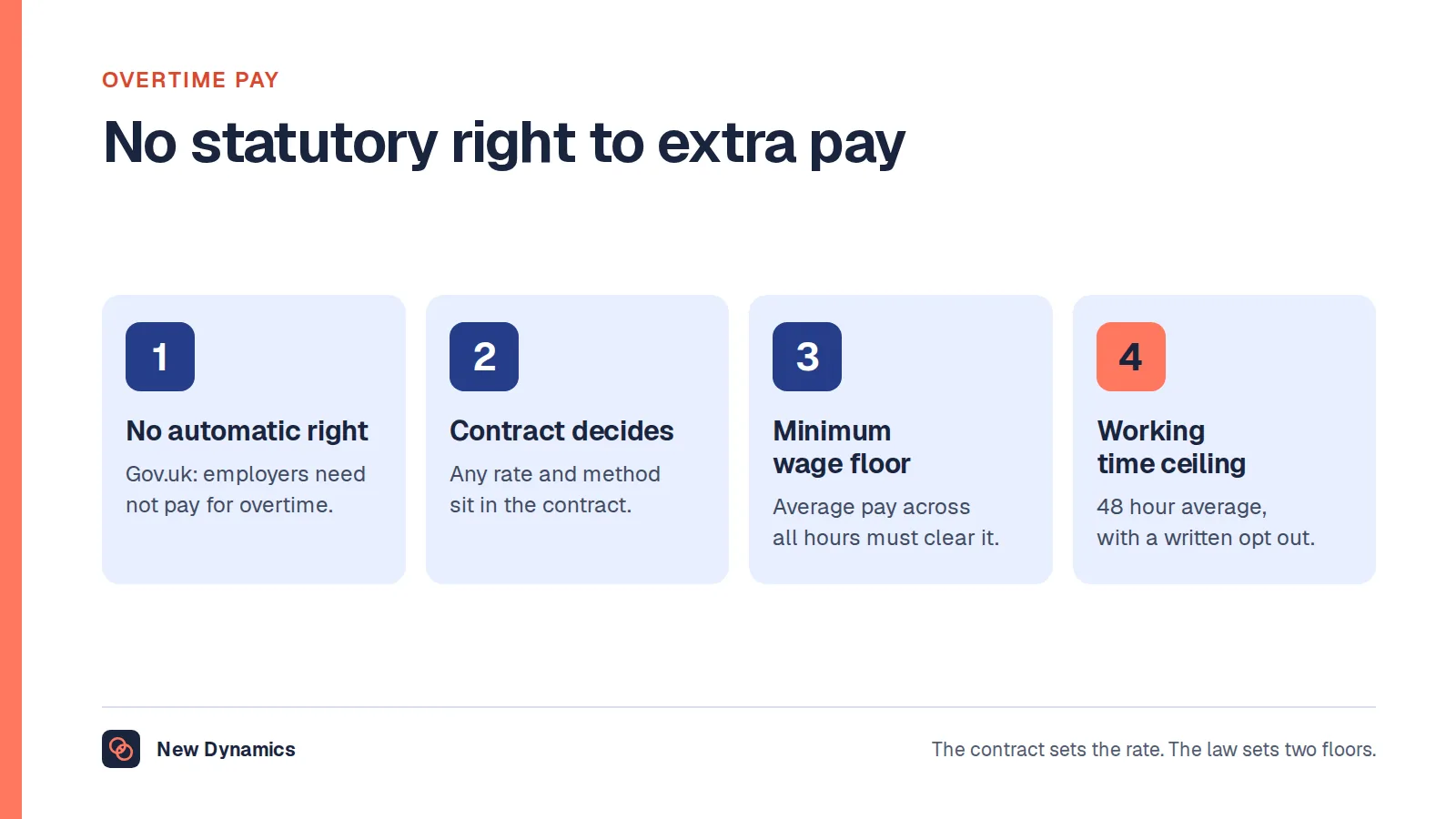
No United Kingdom statute sets an on call rate, a standby allowance or a call out minimum. Acas treats it as a contract question. Its guidance on workers who are on call or sleep in, last updated 21 March 2025, says: "It should be written in the employment contract whether the worker gets paid for time they spend" either "on call and at home" or "staying or sleeping at their workplace".
GOV.UK treats an on call payment the same way, listing the case where a worker "is on call for work" among the special allowances some employers pay "over and above standard pay". Not an obligation.
What the law does impose is a floor. Acas puts it in one sentence: workers "must be paid at least the National Minimum Wage on average during their pay reference period for any hours they work". Regulation 6 of the National Minimum Wage Regulations 2015 defines that period as "a month, or in the case of a worker who is paid wages by reference to a period shorter than a month, that period". From 1 April 2026 the National Living Wage for workers aged 21 and over is £12.71 an hour, rising to £13.21 from April 2027, on GOV.UK's National Minimum Wage rates page. For the wider pay picture, see the HR statistics hub.
So the real question is never what the on call rate is. It is which hours go into the denominator and which payments go into the numerator.
Minimum wage and working time ask different questions
This is the trap, and it catches careful employers. Two sets of rules look at the same night and ask different things. The Working Time Regulations 1998 ask whether a period is working time, which drives the 48 hour average, night work limits and rest. The National Minimum Wage Regulations 2015 ask whether it is an hour of work for pay. Nothing requires the answers to agree.
On a sleep in shift they usually do not. Acas says "Sleep-in time usually counts as working time, even if the person spends it asleep", because the worker is required by the employer to be at the workplace. GOV.UK's minimum wage manual says hours when a worker is permitted to sleep, with suitable facilities provided, are not eligible for the minimum wage. Both can be true of the same eight hours: the shift counts towards the 48 hour average and brings rest entitlements, and most of it is not paid hours.
Our post on the working time opt out covers the working time half, including where GOV.UK and Acas word the on call test differently. This post stays on pay.
What the Regulations say about availability for work
The pay answer is written into the Regulations, and it is short. Regulation 32, which applies to time work (work paid by reference to the time worked), says:
"(1) Time work includes hours when a worker is available, and required to be available, at or near a place of work for the purposes of working unless the worker is at home.
(2) In paragraph (1), hours when a worker is 'available' only includes hours when the worker is awake for the purposes of working, even if a worker by arrangement sleeps at or near a place of work and the employer provides suitable facilities for sleeping."
Regulation 27 does the same job for salaried hours work, treating as worked "hours a worker is available at or near a place of work for the purposes of working, unless the worker is at home", with the same sleeping carve out in paragraph (2).
Three conditions carry the weight. The worker must be available and required to be available. The place must be at or near a place of work. The worker must not be at home. Miss one and the availability hours drop out. One drafting difference is worth knowing if you read both: regulation 32(2) speaks of a worker who "by arrangement sleeps" there, regulation 27(2) of one who "is required to sleep" there, and neither defines "suitable facilities for sleeping".
Why being at home changes the answer
GOV.UK's guidance on working hours for which the minimum wage must be paid turns the regulation into a rule of thumb. For both time work and salaried hours work, the hours that count include "time required to be available for work either on standby or on-call at or near their workplace, unless the worker is at home".
Then the example that settles most arguments. A time worker is called into a factory to help with an urgent order and the delivery is delayed: "While the worker is at the factory and required to be available for work you must pay them at least the minimum wage rate for the time". No work can be given, and it makes no difference. The other half is the one employers miss: "if the worker is at home waiting for you to call them into work, you do not have to pay them the minimum wage for the time they are at home. They would only be entitled after they have arrived at work and are working or available for work."
A worker sitting in a depot rest room with nothing to do is owed the minimum wage for every hour. A worker at home with the phone on the kitchen table is not owed it for the waiting.
One thing the guidance does not settle. A home based engineer woken at 2am who spends ninety minutes fixing a fault remotely has worked, not waited. Regulation 31 makes the hours of time work "the total number of hours of time work worked by the worker", with no location qualifier, and the location limit in regulation 32 bites only on availability. Neither GOV.UK's list nor Acas's page addresses a call out performed at home for minimum wage purposes in those words, so we will not put a quotation behind an answer nobody has published. Record the worked minutes, pay them, and keep the waiting and the working as two separate lines.

Sleep in shifts after the Supreme Court
Sleep in shifts were litigated to the Supreme Court and the answer changed. GOV.UK records it directly: "the Supreme Court's unanimous judgment clarified that sleep-in workers are only working and eligible for minimum wage when they are 'awake for the purposes of working'. They are not entitled to minimum wage when they are permitted to sleep (judgment 19 March 2021 in the cases of Royal Mencap Society v Tomlinson-Blake and Shannon v Rampersad [2021] UKSC 8)."
Two qualifications matter as much, and both come from the same page.
The shape of the shift. Where workers "are expected to perform activities for all or most of a shift, and are only permitted to sleep between tasks where possible (such as napping when not busy)", GOV.UK says "it is likely that at least the minimum wage must be paid for the whole of the shift, including for any time spent asleep".
The facilities. "For time work and salaried hours work, the National Minimum Wage Regulations expressly require that, in order for the time spent asleep not to be eligible for minimum wage purposes, the employer must provide suitable sleeping facilities. If suitable sleeping facilities are not provided then the minimum wage must be paid for the entire shift."
GOV.UK's examples draw the line finely. A care worker with a bed, expected to sleep most of the night while keeping a "listening ear", who lies awake reading for pleasure, is not eligible for that reading time because they are "not awake for work purposes". A care worker woken to back up a colleague in an emergency, who dresses, sits with them and is not in the end needed, is "still 'awake for the purposes of working' for that hour". A security guard allowed to nap in a chair between regular tasks has no suitable sleeping facilities, so "they would be eligible for the minimum wage for the entire shift".
The last example is the one to diarise. GOV.UK describes a sleep in that drifts: woken occasionally at first, then "persistently woken so that in practice little sleep is possible". At that point "it could then no longer be said that they are expected to sleep for most or all of the shift", the worker likely stops being a sleep in worker, and the whole shift likely becomes payable. A classification made two years ago is not evidence about this year's rota.
An on call allowance usually does not count towards the minimum wage
Here is what turns a reasonable arrangement into arrears. Paying a flat standby allowance does not raise minimum wage pay, because the allowance is usually excluded from the calculation.
Regulation 10 lists payments that "do not form part of a worker's remuneration". Paragraph (k) covers "payments paid by the employer to the worker attributable to a particular aspect of the working arrangements or to working or personal circumstances that are not consolidated into the worker's standard pay unless the payments are attributable to the performance of the worker in carrying out the work".
GOV.UK applies that to on call money in terms: these allowances "don't count towards minimum wage pay unless you consolidate them into the worker's standard pay or they relate to the worker's performance". It adds that there is "no definition to determine when an allowance is consolidated into standard pay", and gives three indications that it is: the allowance moves with the overall pay package at annual increases, it is included in pensionable pay, and it is included when calculating any overtime rate.
The same page removes premium pay from the numerator. Where you pay above the basic rate for unsocial hours or overtime, "the amount by which the higher pay rate exceeds the worker's basic rate" does not count, and "This only applies to time work and output work; it does not apply to salaried hours work or unmeasured work".
A worked check
Example figures, using the rate year that began on 1 April 2026. A time worker aged 30 is paid a basic £14.00 an hour. In a monthly pay reference period they work 150 hours and spend a further 20 hours required to be available at the depot. They also receive a flat £300 on call allowance, which is not pensionable, does not move with the annual pay award and does not feed the overtime rate.
The headline looks comfortable: £2,400 across 170 hours, an average of £14.12 an hour.
The compliant figure is different. The 20 availability hours count, because the worker was at a place of work and not at home, so the denominator is 170. The £300 does not count under regulation 10(k), so the numerator is £2,100. That is £12.35 an hour against £12.71. The shortfall is £60.70 for the month, and it repeats until something changes.
Two fixes exist. Pay the availability hours at the basic rate, or consolidate the allowance into standard pay so it behaves like pay in every respect rather than only on the payslip. Renaming it is not one of them.

On call hours, the 48 hour average and rest periods
Briefly, because the detail sits in the working time post. Regulation 2(1) of the Working Time Regulations 1998 defines working time as a period when the worker is working, at the employer's disposal and carrying out their activity or duties, and says nothing about being on call. Acas fills the gap with a control test: on call time "does not usually count as working time if the worker is away from the workplace and can spend the time in any way they choose", and it is "more likely to count as working time the more control the employer has over the worker's" activities, location and time.
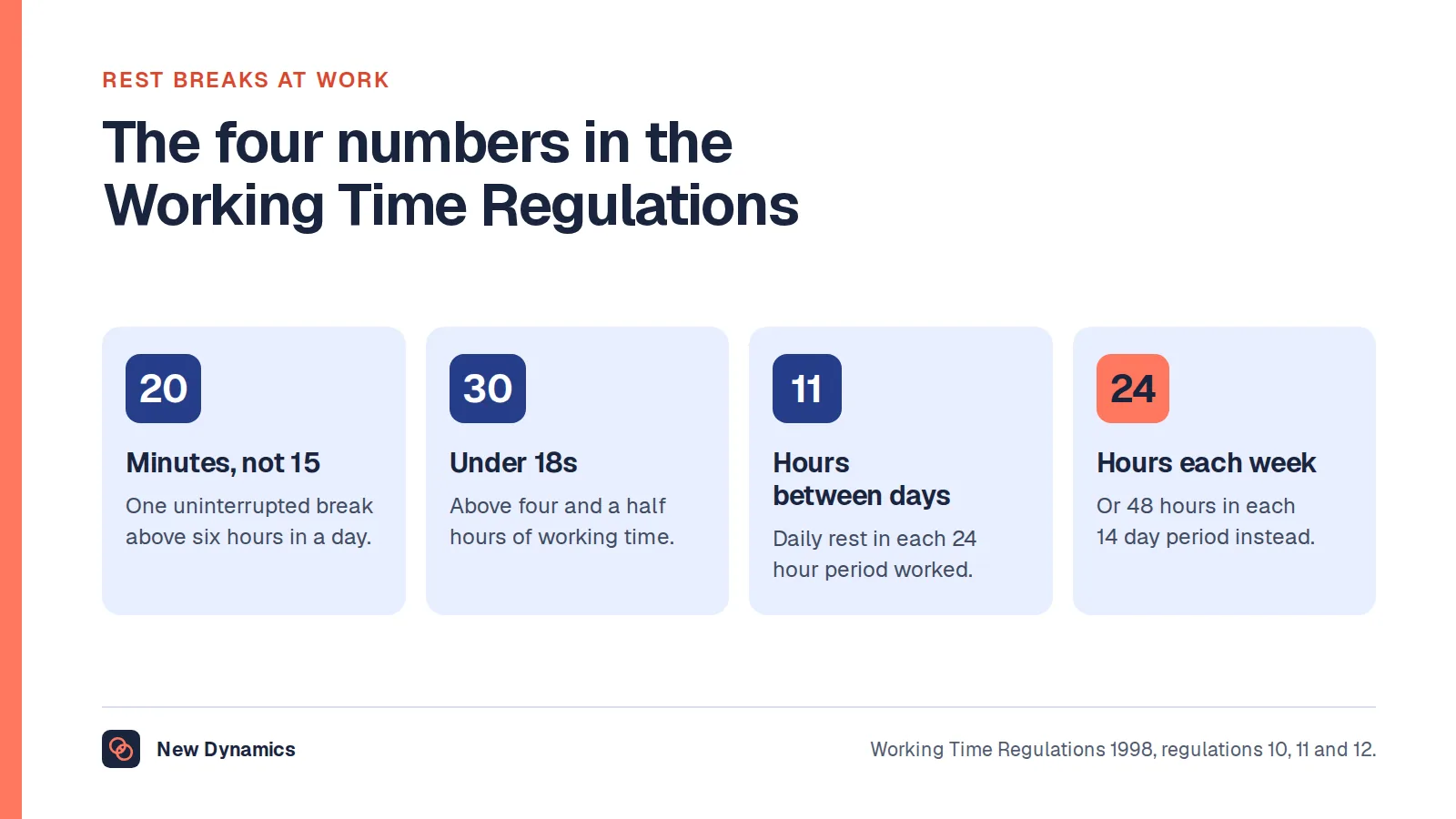
Two consequences follow. On call periods you control push up the 48 hour average even where they are not paid hours, which is how a 40 hour contract turns into a breach. And regulation 10(1) entitles a worker to "a rest period of not less than eleven consecutive hours in each 24-hour period during which he works for his employer", so a 3am call out eats into the eleven hours before the next shift. Our post on rest breaks at work covers the break rules themselves.
What to record, and for how long
The burden of proof sits with the employer. GOV.UK's enforcement guidance states that if a worker brings a minimum wage claim, "the burden will be on you to prove that the minimum wage has been paid". Since 1 April 2021 employers must keep minimum wage records "for a minimum of 6 years after the end of the pay reference period following the one that the records cover", and failing to do so is a criminal offence. A notice of underpayment carries a penalty of "up to 200% of the value of the minimum wage arrears, up to a maximum penalty £20,000 per worker", halved if you comply within 14 days, and arrears are recalculated at the current rate, so an old shortfall grows as the rates rise.
For an on call rota that means four things per shift rather than three: hours worked, hours required to be available and where, hours awake for the purposes of working on a sleep in, and what sleeping facilities were provided. A rota plus a payslip proves none of them.
Frequently asked questions
Do you have to pay extra for being on call in the UK?
No statute sets an on call or standby rate. Acas states that it should be written in the employment contract whether the worker gets paid for time spent on call at home or sleeping at the workplace, which makes a standby allowance contractual rather than statutory. Separately, the minimum wage must be met on average across the pay reference period for the hours that count as work.
Does on call time count towards the minimum wage?
It depends where the worker is. Regulation 32(1) of the National Minimum Wage Regulations 2015 includes hours a worker is available, and required to be available, at or near a place of work, unless the worker is at home. GOV.UK's example confirms that a worker waiting at home for a call is not owed the minimum wage for the waiting, while a worker waiting at the factory is.
What is the minimum wage position on sleep in shifts?
GOV.UK records that the Supreme Court's judgment of 19 March 2021 in Royal Mencap Society v Tomlinson-Blake and Shannon v Rampersad clarified that sleep in workers are only eligible for the minimum wage when they are awake for the purposes of working. Two exceptions apply. If the worker is expected to work for most of the shift and can only nap between tasks, the whole shift is likely payable. If suitable sleeping facilities are not provided, GOV.UK says the minimum wage must be paid for the entire shift.
Does an on call allowance count towards minimum wage pay?
Usually not. Regulation 10(k) excludes payments attributable to a particular aspect of the working arrangements that are not consolidated into standard pay, and GOV.UK lists being on call for work among the allowances that do not count. It counts only if you consolidate it into standard pay or it relates to the worker's performance.
Can a shift be working time but not paid hours for the minimum wage?
Yes, and it is the most common mistake here. Acas says sleep in time usually counts as working time even if the person spends it asleep, while GOV.UK says hours when a worker is permitted to sleep with suitable facilities provided are not eligible for the minimum wage. The two sets of rules ask different questions, so test both.
How long must on call pay records be kept?
Six years. GOV.UK states that from 1 April 2021 employers must keep minimum wage records for a minimum of six years after the end of the pay reference period following the one the records cover, and that failing to do so is a criminal offence.
Your next step: four checks on your on call rota
- Split the hours by location. For each on call period, record whether the worker was required to be available at or near a place of work, or at home. The first set goes into the minimum wage denominator and the second does not.
- Test every allowance against regulation 10(k). Is the standby payment consolidated into standard pay, pensionable and part of the overtime base? If not, take it out of the numerator and recalculate the pay reference period.
- Re-examine each sleep in. Confirm what sleeping facilities exist and how often the worker is actually woken. A shift where little sleep is now possible is likely payable in full.
- Recalculate the 48 hour average with on call included. Controlled availability is working time even when it is not paid hours, and a 3am call out cuts into the eleven hour daily rest before the next shift.
Then write the answers into a policy a manager can apply without ringing payroll. Our employee handbook guide covers how to word one, including keeping the pay and working time sections separate so the two tests are not confused. The guide is free to read, and the PDF uses our short download form.
Want on call policy reviews, sleep in reassessments and allowance checks running through one recorded process instead of a shared drive? Book a New Dynamics demo and bring your current on call wording. You can also email contact@new-dynamics.com.