TL;DR
- Statutory employee is a United States federal tax category only. The IRS says that workers who are independent contractors under the common-law rules "may nevertheless be treated as employees by statute (also known as statutory employees) for certain employment tax purposes".
- There are four categories in Publication 15-A (2026): certain drivers, full-time life insurance sales agents, home workers on employer-supplied materials, and full-time travelling or city salespersons. All three further conditions must apply as well.
- The practical effect: social security and Medicare tax are withheld, box 13 of Form W-2 is checked, federal income tax is not withheld, and the worker reports the earnings on line 1 of Schedule C.
A payroll clerk is handed a contract that says independent contractor, and a tax code that says withhold social security. Both are right. In the United States that contradiction has a name: the statutory employee. It is a category of United States federal tax law and nothing else. There is no such status in the United Kingdom, so a British reader who arrived here searching the phrase should skip to the section on the UK framework. This is general information, not tax or legal advice.
Classification arguments turn on records nobody kept: who set the hours, who supplied the equipment, who could refuse the work. See how New Dynamics workflows attach task ownership, approvals and dates to the person doing the work, so the facts of an engagement exist before anybody has to prove them.
What a statutory employee is
A statutory employee is a worker who fails the common-law test for employment, and so would be an independent contractor, but whom a statute treats as an employee for certain employment taxes anyway. The IRS states it directly in Publication 15-A (2026), Employer's Supplemental Tax Guide, which is marked "For use in 2026":
"If workers are independent contractors under the common-law rules, such workers may nevertheless be treated as employees by statute (also known as statutory employees) for certain employment tax purposes. This would happen if they fall within any one of the following four categories and meet the three conditions described next under Social security and Medicare taxes."
Two things in that sentence do the work. Any one of the four categories, so the categories are alternatives, not a cumulative test. And the three conditions, which must all apply on top of the category. A worker who matches a category but fails a condition is not a statutory employee.
The rule is narrow. It does not make the person an employee for every purpose, it does not give them employee benefits, it does not change the common-law answer, and it does not make them an employee for federal income tax. It moves one thing: who pays the social security and Medicare tax, and how.
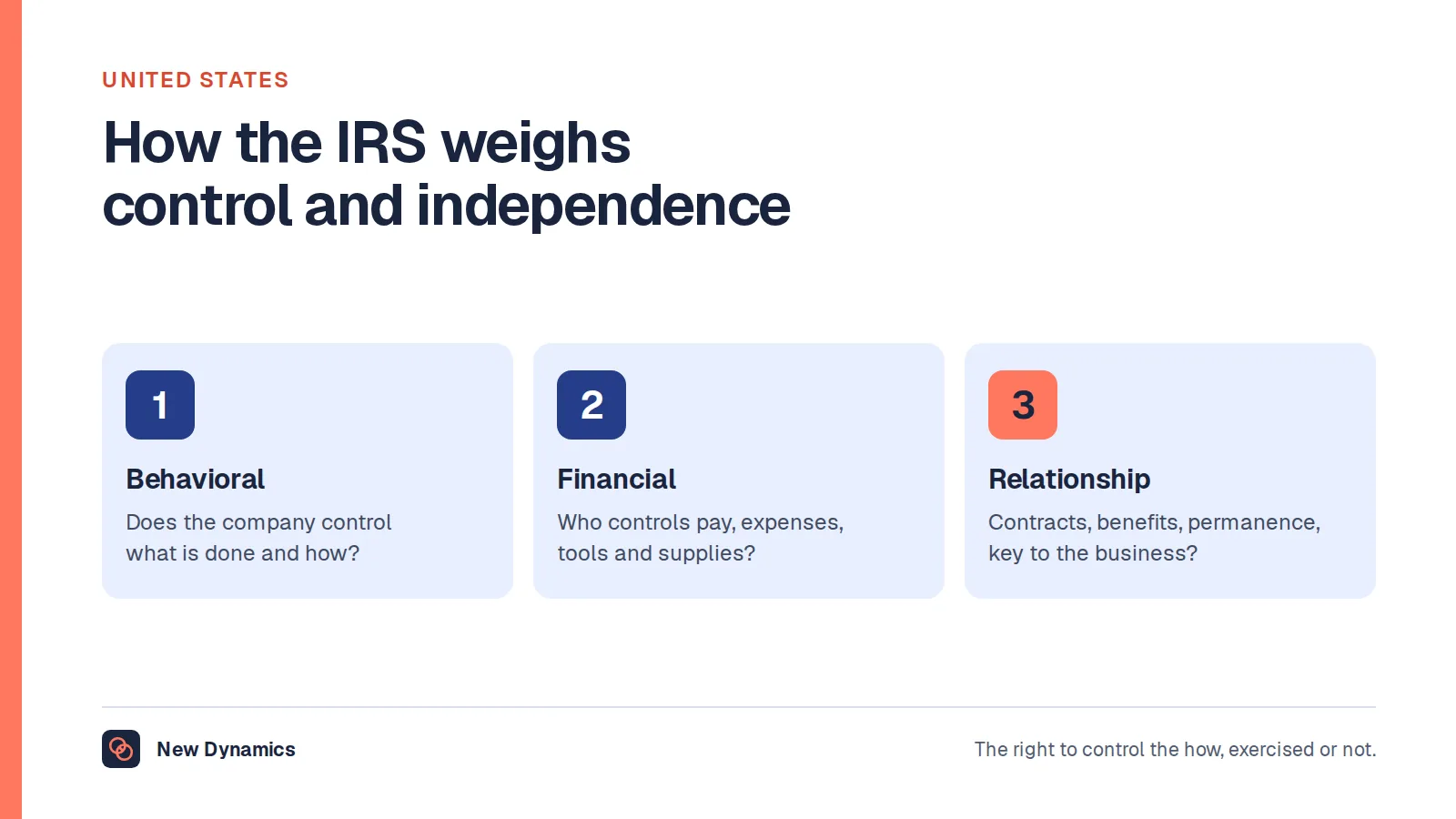
The IRS lists statutory employee as one of five possible business relationships on its page on whether a worker is an independent contractor (self-employed) or employee, alongside an independent contractor, an employee (common-law employee), a statutory nonemployee and a government worker. The common-law question comes first, and that page answers it from three categories of evidence: behavioural control, financial control and the type of relationship. Our post on the independent contractor definition covers that test in full.
The four categories, in the IRS's own words
Publication 15-A (2026) lists them as follows. The wording below is the publication's, quoted rather than summarised, because each clause narrows the category.
- "A driver who distributes beverages (other than milk) or meat, vegetables, fruit, or bakery products; or who picks up and delivers laundry or dry cleaning, if the driver is your agent or is paid on commission."
- "A full-time life insurance sales agent whose principal business activity is selling life insurance or annuity contracts, or both, primarily for one life insurance company."
- "An individual who works at home on materials or goods that you supply and that must be returned to you or to a person you name, if you also furnish specifications for the work to be done."
- "A full-time traveling or city salesperson who works on your behalf and turns in orders to you from wholesalers; retailers; contractors; or operators of hotels, restaurants, or other similar establishments. The goods sold must be merchandise for resale or supplies for use in the buyer's business operation. The work performed for you must be the salesperson's principal business activity."

Read the exclusions. Milk is carved out of category 1. Category 3 turns on who supplies the materials, who gets them back and who sets the specifications, all three. Category 4 requires the buyers to be businesses rather than consumers, and the goods to be for resale or for use in the buyer's business.
The same four categories appear, in nearly identical words, under the box 13 heading of the General Instructions for Forms W-2 and W-3 (2026), which refers the reader back to "section 1 in Pub. 15-A" for the detail.
The three conditions that must all apply
Category alone is not enough. Publication 15-A says: "You must withhold social security and Medicare taxes from the wages of statutory employees if all three of the following conditions apply."
- "The service contract states or implies that substantially all the services are to be performed personally by them."
- "They don't have a substantial investment in the equipment and property used to perform the services (other than an investment in facilities for transportation, such as a car or truck)."
- "The services are performed on a continuing basis for the same payer."

The transport carve-out in the second condition is the one people miss. A delivery driver who owns the van has not thereby made a substantial investment, because a vehicle is a facility for transportation. The same driver who also owns a warehouse probably has.
For the travelling or city salesperson in category 4, Publication 15-A raises the bar in its section on salespersons: "To determine whether a salesperson is an employee for social security, Medicare, and FUTA tax purposes, the salesperson must meet all eight elements of the statutory employee test." The eighth element catches people out, because it is the common-law question in reverse. The list ends with a salesperson who, in the publication's words, "Aren't an employee under common-law rules". If the person already is a common-law employee, they are not a statutory employee. They are simply an employee.
What it means on Form W-2, including box 13
This is where the category becomes visible. Publication 15-A gives the instruction in one paragraph:
"Furnish Form W-2 to a statutory employee, and check 'Statutory employee' in box 13. Show your payments to the employee as 'other compensation' in box 1. Also, show social security wages in box 3, social security tax withheld in box 4, Medicare wages in box 5, and Medicare tax withheld in box 6."
The W-2 instructions explain the checkbox from the other side: "Check this box for statutory employees whose earnings are subject to social security and Medicare taxes but not subject to federal income tax withholding. Do not check this box for common-law employees."
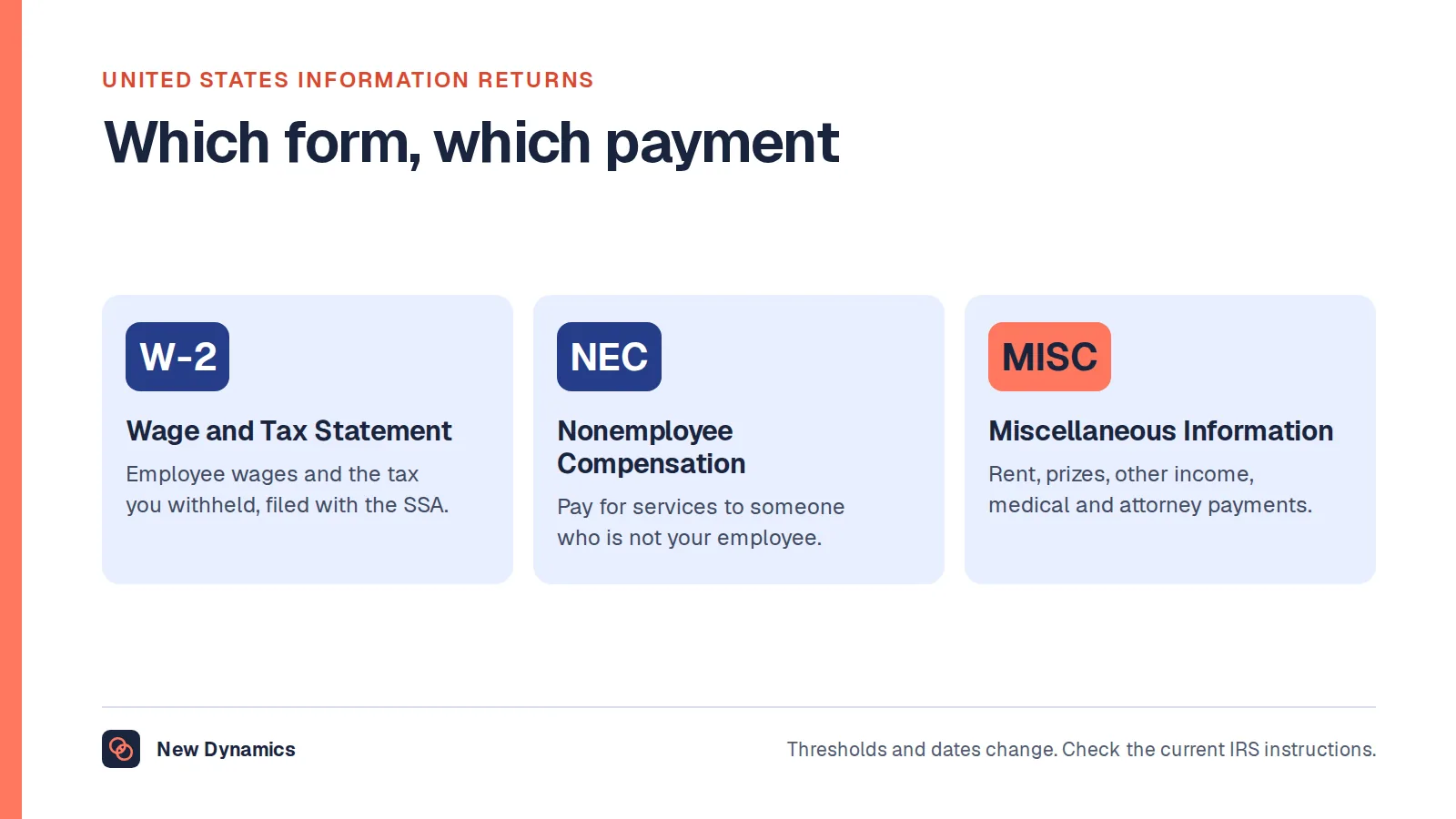
So a statutory employee receives a Form W-2, not a Form 1099-NEC, even though the common-law answer was contractor. Our post on IRS information returns covers which form goes to whom and why there is no such thing as a 1099 employee.
One exclusion is spelled out in the publication: for H-2A agricultural workers, "On Form W-2, don't check box 13 (Statutory employee), as H-2A workers aren't statutory employees."
Which taxes apply, and which do not

Social security and Medicare tax: withheld. Publication 15-A (2026) gives the rates: "The social security tax rate is 6.2% each for the employee and employer. The social security wage base limit is $184,500. The Medicare tax rate is 1.45% each for the employee and employer, unchanged from 2025. There is no wage base limit for Medicare tax." Those are the 2026 tax year figures and they change, so check the current revision before running a payroll on them.
Federal income tax: not withheld. The publication is a single sentence here: "Don't withhold federal income tax from the wages of statutory employees." The worker deals with their own income tax, which in practice means estimated payments.
Federal unemployment tax: it depends which category. This is the detail most summaries drop. Publication 15-A says that for FUTA tax, employee "means the same as it does for social security and Medicare taxes, except that it doesn't include statutory employees defined in categories 2 and 3 above. Any individual who is a statutory employee described under category 1 or 4 above is also an employee for FUTA tax purposes and subject to FUTA tax." So the drivers and the travelling salespeople are inside FUTA; the life insurance agents and the home workers are not.
Why the worker still files a Schedule C
The statute moves employment tax without moving income tax. For income tax the person is still running a business, so the business return applies. Publication 15-A: "The statutory employee can deduct their trade or business expenses from the payments shown on Form W-2. The statutory employee reports earnings on line 1 of Schedule C (Form 1040), Profit or Loss From Business, and also deducts business expenses on Schedule C (Form 1040)."
So the box 1 figure goes on Schedule C rather than on the wages line of the Form 1040, and business expenses come off against it. The person is an employee for social security and Medicare, and a business for income tax, at the same time, on the same money.
Statutory employee against statutory nonemployee
The mirror category is worth knowing, because the names are one syllable apart and the effect is opposite. Publication 15-A: "There are three categories of statutory nonemployees: direct sellers, licensed real estate agents, and certain companion sitters. Direct sellers and licensed real estate agents are treated as self-employed for all federal tax purposes, including income and employment taxes", provided substantially all payments relate to sales or output rather than hours worked, and that "Their services are performed under a written contract providing that they won't be treated as employees for federal tax purposes." A statutory employee is pulled towards employment for employment taxes. A statutory nonemployee is pushed out of it for everything. Neither follows from the label on the contract.
The United Kingdom has no statutory employee category
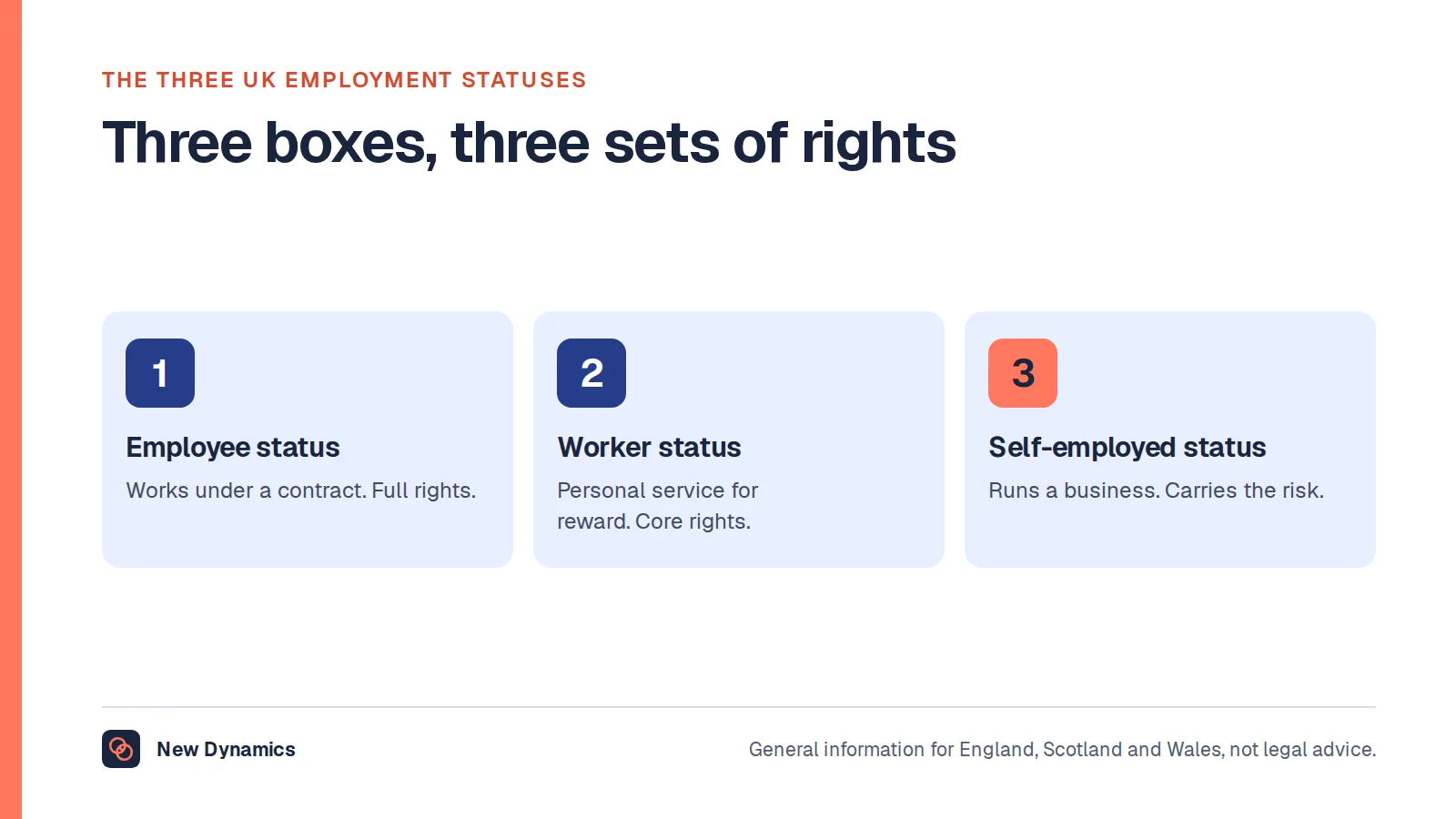
If you employ people in Britain, there is nothing here to map. The UK has no statutory employee classification, no box 13 equivalent and no mechanism that treats a self-employed person as an employee for National Insurance while leaving them self-employed for Income Tax. What it has instead is its own employment status framework. GOV.UK's guidance on employment status states that "In employment law a person's employment status helps determine" their rights and their employer's responsibilities, and lists the main types as worker, employee, self-employed and contractor, director, and office holder. The same page carries the warning that matters most: "A person may have a different employment status in tax law." Status for rights and status for tax are decided separately, and courts and tribunals make the final decision on the first. Our post on employment status sets out the main categories and the tests behind them.
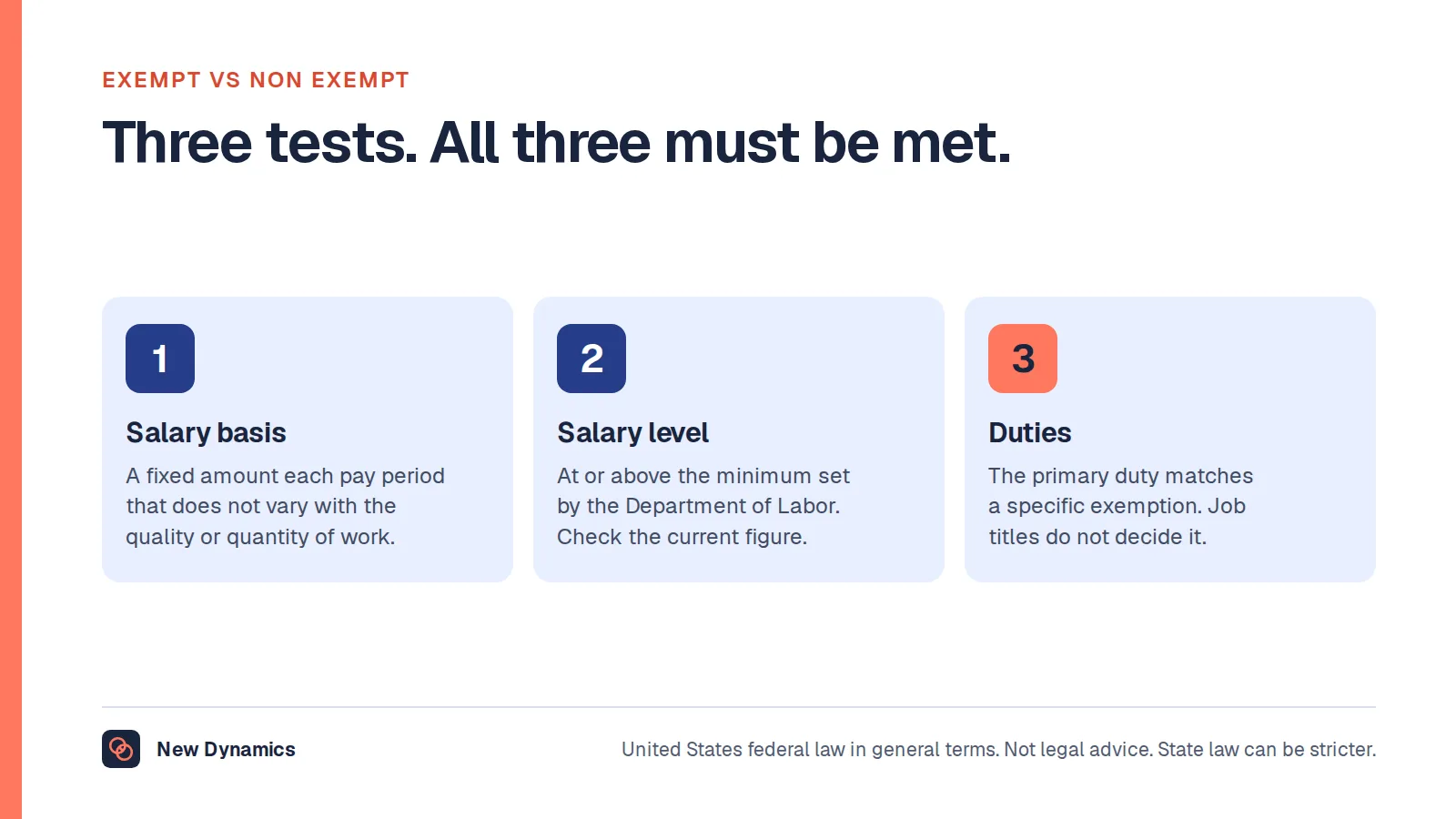
The nearest British regimes to the instinct behind the statutory employee rule are off-payroll working, the agency worker rules in tax law and the Construction Industry Scheme. Each changes who deducts what without converting anybody into an employee, and none of them is a statutory employee rule. A single global policy treating everyone on a contractor agreement as outside payroll will be wrong in the United States for these four categories, and wrong in the United Kingdom for different reasons. Write the rule twice and name the country each time. Our post on exempt and non-exempt employees covers another American classification with no British equivalent.
Frequently asked questions
What is a statutory employee?
A statutory employee is a worker in the United States who would be an independent contractor under the common-law rules but whom statute treats as an employee for certain employment taxes. IRS Publication 15-A says such workers "may nevertheless be treated as employees by statute (also known as statutory employees) for certain employment tax purposes" if they fall in one of four categories and meet three further conditions.
What are the four categories of statutory employee?
IRS Publication 15-A (2026) lists certain drivers who distribute beverages other than milk, or meat, vegetables, fruit or bakery products, or who pick up and deliver laundry or dry cleaning; full-time life insurance sales agents selling primarily for one company; individuals who work at home on materials the employer supplies and must have returned; and full-time travelling or city salespersons turning in orders from businesses.
Does a statutory employee get a W-2 or a 1099?
A Form W-2. The IRS tells the employer to furnish Form W-2 and to check "Statutory employee" in box 13, showing the payments as other compensation in box 1, with social security and Medicare wages and tax withheld in boxes 3 to 6. The W-2 instructions add that the box must not be checked for common-law employees.
Is federal income tax withheld from a statutory employee?
No. IRS Publication 15-A states: "Don't withhold federal income tax from the wages of statutory employees." Social security and Medicare tax are withheld, at 6.2% and 1.45% each for employee and employer for the 2026 tax year, with the social security wage base limit at $184,500 and no wage base limit for Medicare.
Where does a statutory employee report the income?
On Schedule C. Publication 15-A says the statutory employee "reports earnings on line 1 of Schedule C (Form 1040), Profit or Loss From Business, and also deducts business expenses on Schedule C (Form 1040)". The person is an employee for social security and Medicare purposes and a business for income tax purposes on the same earnings.
Is there a statutory employee category in the UK?
No. Statutory employee is a United States federal tax category with no British equivalent. GOV.UK's employment status guidance lists worker, employee, self-employed and contractor, director and office holder as the main types, and warns that a person may have a different employment status in tax law. The off-payroll working rules and the Construction Industry Scheme are separate regimes, not equivalents.
What is a statutory nonemployee?
The opposite category. Publication 15-A names three: direct sellers, licensed real estate agents and certain companion sitters. Direct sellers and licensed real estate agents are treated as self-employed for all federal tax purposes if substantially all their pay relates to sales or output rather than hours, and a written contract provides that they will not be treated as employees for federal tax purposes.
Your next step: check the four categories against your payroll
- List every engagement you currently treat as independent contractor work in the United States, and read the four categories in Publication 15-A against each one. Only one category has to match.
- For any match, test all three conditions: personal performance, no substantial investment beyond transport, and continuing service for the same payer. All three must hold.
- For a travelling or city salesperson, work through all eight elements in the salesperson section, including the last one, that the person is not already a common-law employee.
- Where the test is met, move the engagement to Form W-2 with box 13 checked, withhold social security and Medicare tax, and stop withholding federal income tax. Check whether FUTA applies, which depends on the category.
- Tell the worker what the W-2 means for their own return, because the box 1 figure belongs on line 1 of Schedule C rather than on the wages line. If you also employ in the UK, write that policy separately.
For a way of recording engagement terms you can explain to the person affected and to a tax authority, read and download our compensation policy guide. The guide is free to read, and the PDF uses our short download form.
Want the facts of each working relationship, who assigned the work and who approved what, to exist in one place before anybody has to defend a classification? Book a New Dynamics demo and bring one contractor agreement with you. You can also email contact@new-dynamics.com.