TL;DR
- Statutory Parental Bereavement Pay is paid to eligible employees whose child dies before the age of 18, or who have a stillbirth after 24 weeks of pregnancy. It is paid for up to two weeks, alongside Parental Bereavement Leave.
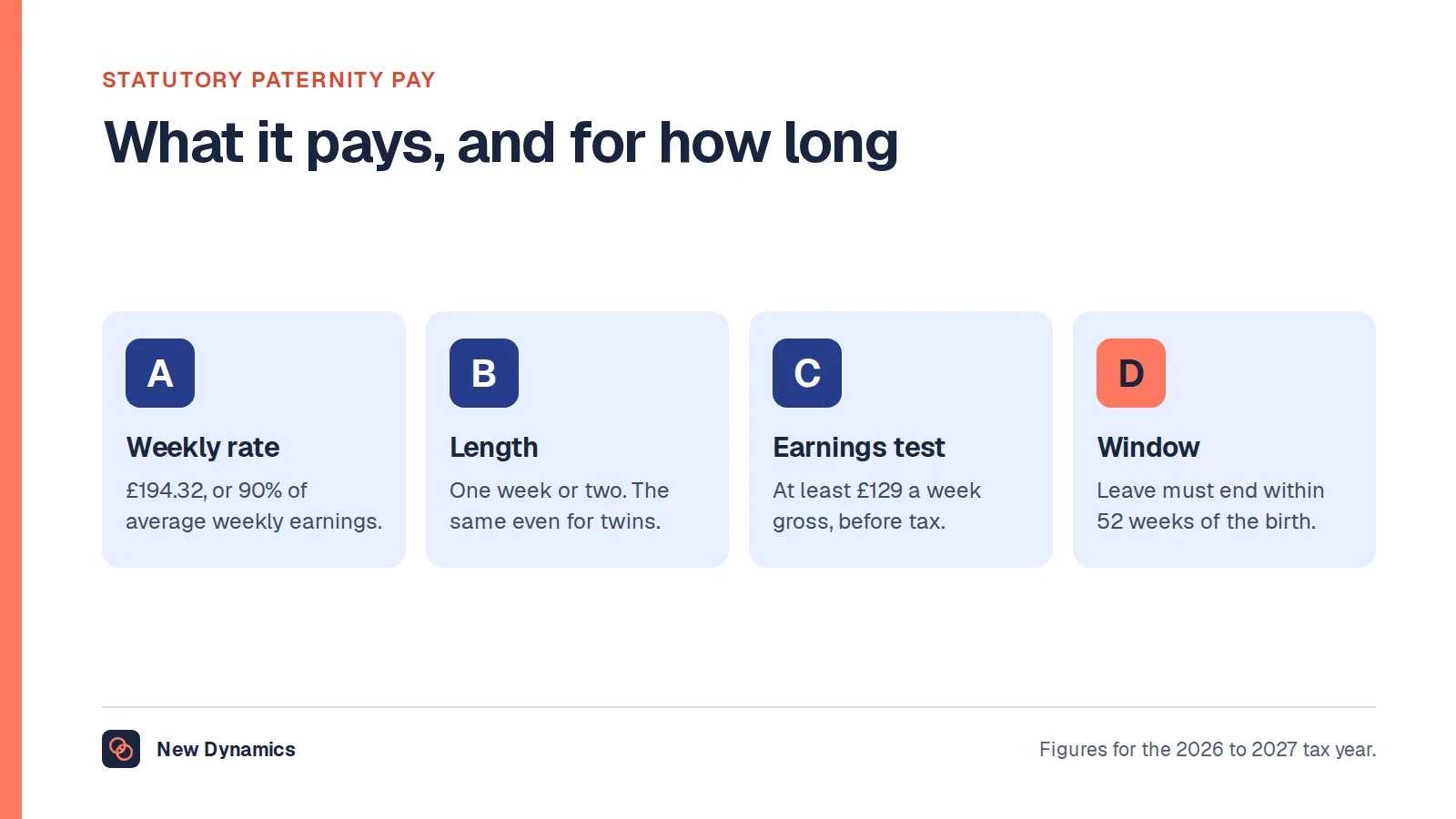
- For 2026 to 2027, GOV.UK sets the rate at £194.32 a week or 90% of average weekly earnings, whichever is lower. To qualify, an employee needs 26 weeks' continuous employment up to the relevant week and average earnings of at least £129 a week. Leave itself is a day-one right.
- The employee asks for pay in writing within 28 days; leave notice can be informal. Employers can usually reclaim 92% from HMRC, or 109% with Small Employers' Relief, and must keep records for 3 years. This is general information about Great Britain, not legal advice.
When an employee's child dies, the last thing they should have to do is chase payroll or prove their relationship to the child. The law is written to keep the process light, and most of the employer's job is knowing the rules well enough to make it so.
This article explains statutory parental bereavement pay (SPBP) for employers: who qualifies, how much it is, the notice and evidence rules, what you must not ask for, how to reclaim it, and the records to keep. It covers Great Britain; the rules differ in Northern Ireland, which since 6 April 2026 also covers miscarriage. It is general information, not legal advice. Figures are GOV.UK's at the time of writing; check its guide before you pay.
When someone is grieving, the practical steps still need an owner: telling payroll, adjusting work, planning the return. See how New Dynamics workflows give each step an owner and a date, so the employee does not have to chase anything.
For the wider rights to time off when someone dies, see our post on bereavement leave.
What statutory parental bereavement pay is
GOV.UK's guide for employers on Parental Bereavement Leave and Pay says an employee may be eligible if they or their partner "had a child who has died under 18 years old" or "had a stillbirth after 24 weeks of pregnancy".
There are two separate entitlements:
- Parental Bereavement Leave: two weeks' leave for each child who has died or was stillborn, which an employee can take "from the first day of their employment".
- Statutory Parental Bereavement Pay: pay for that leave, for employees who meet the service and earnings tests.
The Employment Rights Act 2025 will widen parental bereavement leave into a general bereavement leave right. At the time of writing, legislation.gov.uk records that section as in force only for specified purposes, which allows regulations to be made, so the rules in this article still apply.
An employee can have one without the other. Leave does not depend on length of service; pay does. GOV.UK also has a guide for employees that you can share, so the employee can read the rules without having to ask.
How much it is

GOV.UK states that Statutory Parental Bereavement Pay "for an eligible employee is either £194.32 a week or 90% of their average weekly earnings (whichever is lower)." That is the 2026 to 2027 rate, which applies from 6 April 2026. Tax and National Insurance are deducted in the usual way.
Employers can pay more under a company scheme. If you do, GOV.UK says "You must make sure your scheme's policies are clear and available to staff."
Who qualifies for pay
An employee must qualify both as a parent and as an employee.
As a parent. GOV.UK lists biological and adoptive parents, parents of a child born to a surrogate, and the partner of the child's parent. Someone who was not a parent may also qualify if the child lived with them for 4 continuous weeks ending with the date of death and they had day-to-day responsibility for the child's care, with some exceptions for people paid to look after the child.
As an employee. To get pay, GOV.UK says the employee "must have been continuously employed by you for at least 26 weeks up to the end of the 'relevant week'", which is the week ending with a Saturday immediately before the week of the death or stillbirth. This 26 weeks is the qualifying service; the separate 56 weeks below is the window for taking the leave. They must also stay employed up to the day the child dies or is stillborn, and "earn on average £129 a week (gross)", which is the lower earnings limit for 2026 to 2027.
When it can be taken
Leave and pay can be taken as one block of two weeks, two separate weeks, or a single week. The leave must start on or after the date of the death or stillbirth and "must finish within 56 weeks of the date of the death or stillbirth".
If the employee was already on another type of statutory leave, such as maternity leave, parental bereavement leave starts after that other leave ends.
Notice and evidence

The rules for leave and pay are different, and this is where employers most often get it wrong.
For leave, the notice depends on timing. In the first 8 weeks after the death, the employee only needs to tell you before the time they would normally start work on the first day off. From 9 to 56 weeks, they must give at least one week's notice. Notice can be informal, "for example by phone, text message or email."
GOV.UK is explicit that you cannot ask for:
- notice for leave in writing, such as a follow-up email, letter or form;
- notice to cancel leave in writing;
- evidence of entitlement for leave;
- details about the employee's relationship to the child or baby.
For pay, the employee "must ask for Statutory Parental Bereavement Pay within 28 days, starting with the first day of the week they want to claim pay for", and must give you in writing the dates claimed, their name and the date of the death or stillbirth. They also give a declaration of entitlement, once, the first time they ask for pay.
Reclaiming, refusing and record keeping
Reclaiming. GOV.UK says "You can usually only reclaim 92% of the statutory amount, even if you pay an employee more than that", or 109% if you qualify for Small Employers' Relief. GOV.UK's 2026 to 2027 rates page sets the test: 109% applies "if your total Class 1 National Insurance for the previous tax year is £45,000 or lower", and 92% if it was above £45,000, counting both employee and employer contributions. You can apply for an advance if you cannot afford the payments. GOV.UK also notes "You still have to pay Statutory Parental Bereavement Pay even if you stop trading."
Refusing. If the employee does not qualify, send them a non-payment form (SPBP1) or your own equivalent "within 28 days of their pay request". An employee who disagrees can contact HMRC's Statutory Payments Disputes Team within 6 months of the start of the period they claimed.
Records. Keep the start dates and payments, the employee's written declaration and details, and any weeks refused and why. GOV.UK says "You must keep records for 3 years from the end of the tax year they relate to."
Getting the human side right
The legal minimum is the floor, not the response. A few things help:
- Let the employee choose how they hear from you. One named contact is usually better than several.
- Do not ask for evidence for leave. The law does not allow it, and asking hurts.
- Handle the pay paperwork for them where you can, by sending the declaration ready to sign.
- Plan the return with them, including the second week if they have not yet used it, and a phased return if needed.
- Check whether your own policy pays more, and tell them before they have to ask.
Frequently asked questions
How much is statutory parental bereavement pay?
For 2026 to 2027, GOV.UK sets Statutory Parental Bereavement Pay at £194.32 a week or 90% of the employee's average weekly earnings, whichever is lower. Tax and National Insurance are deducted. Check GOV.UK for the current rate, as it is reviewed each tax year.
Who is eligible for statutory parental bereavement pay?
Parents, including adoptive parents, parents through surrogacy and the partners of parents, and some people with day-to-day responsibility for the child, whose child died under 18 or was stillborn after 24 weeks. They need 26 weeks' continuous employment up to the relevant week and average earnings of at least £129 a week.
Is parental bereavement leave a day-one right?
Yes. GOV.UK says an employee can take 2 weeks' leave from the first day of their employment. Pay has the 26-week service and earnings tests.
Can an employer ask for evidence?
Not for leave. GOV.UK says employers cannot ask for evidence of entitlement for leave or for details of the employee's relationship to the child. For pay, the employee gives a written request and a one-off declaration of entitlement.
Can employers reclaim statutory parental bereavement pay?
Yes. Employers can usually reclaim 92% of the statutory amount from HMRC, or 109% if they qualify for Small Employers' Relief.
Your next step: check your bereavement process
- Check your policy states the statutory rights, and anything you pay above them.
- Make sure managers know they must not ask for evidence for leave.
- Prepare a short, kind template for the pay declaration.
- Confirm payroll can reclaim and keep the records for 3 years.
For a clear way to set out leave and pay rules for staff, read and download our employee handbook guide. The guide is free to read, and the PDF uses our short download form.
Want leave, return-to-work and follow-up steps with an owner and a date? Book a New Dynamics demo and bring your current bereavement policy. You can also email contact@new-dynamics.com.