TL;DR
- GOV.UK gives the weekly rate as “£194.32 or 90% of the employee’s average weekly earnings, whichever is lower” for 2026 to 2027, and the earnings test as “at least £129 a week (gross)”. The rate applies from 6 April 2026.
- Since 8 March 2024 the two weeks no longer have to run together. The Paternity Leave (Amendment) Regulations 2024 allow “two non-consecutive periods of leave of a week each”, and replaced the old 56 day window after birth with 52 weeks.
- Paternity leave became a day one right on 6 April 2026 under section 16 of the Employment Rights Act 2025. Statutory paternity pay did not: it still needs 26 weeks of continuous employment by the qualifying week.
Most of what is written about paternity leave describes the rules as they were before March 2024. It says the two weeks must run together, and that they must be used inside 56 days of the birth. Both of those stopped being true, and a further change in April 2026 split the leave test away from the pay test altogether. An employer working from an old policy will refuse requests it has to allow, and will quote a rate that is two tax years out of date.
This article sets out what is actually in force now, with the dates. It covers England, Wales and Scotland. GOV.UK notes that "There are different rules if you're in Northern Ireland", and nidirect is the source there. It is general information and not legal advice.
Paternity notice is a deadline problem before it is a legal one. The due date arrives fifteen weeks early, the start date confirmation twenty eight days before the leave, and both land in a manager's inbox. See how New Dynamics workflows carry reminders and approvals, so a notice window is not something somebody has to remember.
What statutory paternity pay is worth in 2026 to 2027
GOV.UK's employer guide to Statutory Paternity Pay and Leave states it plainly: "Statutory Paternity Pay for eligible employees is either £194.32 a week or 90% of their average weekly earnings (whichever is lower). Tax and National Insurance need to be deducted."
The tax year matters, because the figure changes every April and the page itself does not name one. The year is named in Rates and thresholds for employers 2026 to 2027, which opens with "Unless otherwise stated, the following figures apply from 6 April 2026 to 5 April 2027" and gives the Statutory Paternity Pay weekly rate as "£194.32 or 90% of the employee's average weekly earnings, whichever is lower". The same page adds a detail that catches payroll out: "The Statutory Maternity Pay (SMP) rate applies from 5 April 2026. All other rates apply from 6 April 2026." Paternity pay is in the "all other rates" group.
Two weeks at the flat rate is £388.64 before deductions. That is the floor, not the norm. GOV.UK's note to employees is that "You could get more pay if your employer has a company paternity scheme", and that an employer "cannot offer you less than the statutory amounts".

We did not find a current official UK figure for how many eligible fathers take both weeks rather than one, so this post does not give one. The measures that do exist are collected in our HR statistics hub.
Paternity leave entitlement in the UK: how long, and in what blocks
GOV.UK's employee guidance on paternity pay and leave is short: "You can take up to 2 weeks' leave. You can take both weeks together or take them separately in one-week blocks. You get the same amount of leave even if you have more than one child (for example, twins)."
A week is defined by the working pattern, not by seven days. The same page says "A week of Paternity Leave is the same number of days that you normally work in a week. For example, if you only work on Mondays and Tuesdays, then a week of leave is 2 days."
The legislation is more precise than the guidance about what "separately" means. The Paternity Leave (Amendment) Regulations 2024 were made on 7 March 2024 and came into force on 8 March 2024, and they extend to England and Wales and Scotland. Regulation 9 rewrote the options so that an employee may take either "a single period of leave of either one week or two weeks" or "two non-consecutive periods of leave of a week each". Non-consecutive is the operative word. Two weeks back to back are the single two-week period, not the split option.
The same regulation 9 replaced the old window after the birth, substituting "52 weeks" for "56 days" in both places those words occurred. GOV.UK carries the result: "Your leave cannot start before the birth. It must end within 52 weeks of the baby's birth (or the due date if the baby is early)."
Regulation 5 of the 2024 instrument limits who gets the new shape. The amendments "have effect only in respect of" children "whose expected week of birth begins after 6th April 2024", and children expected to be placed for adoption on or after that date. For a child due before then the old single-block, 56 day rules still governed. By late 2026 that is history, but it explains why so much published guidance still describes the old position.
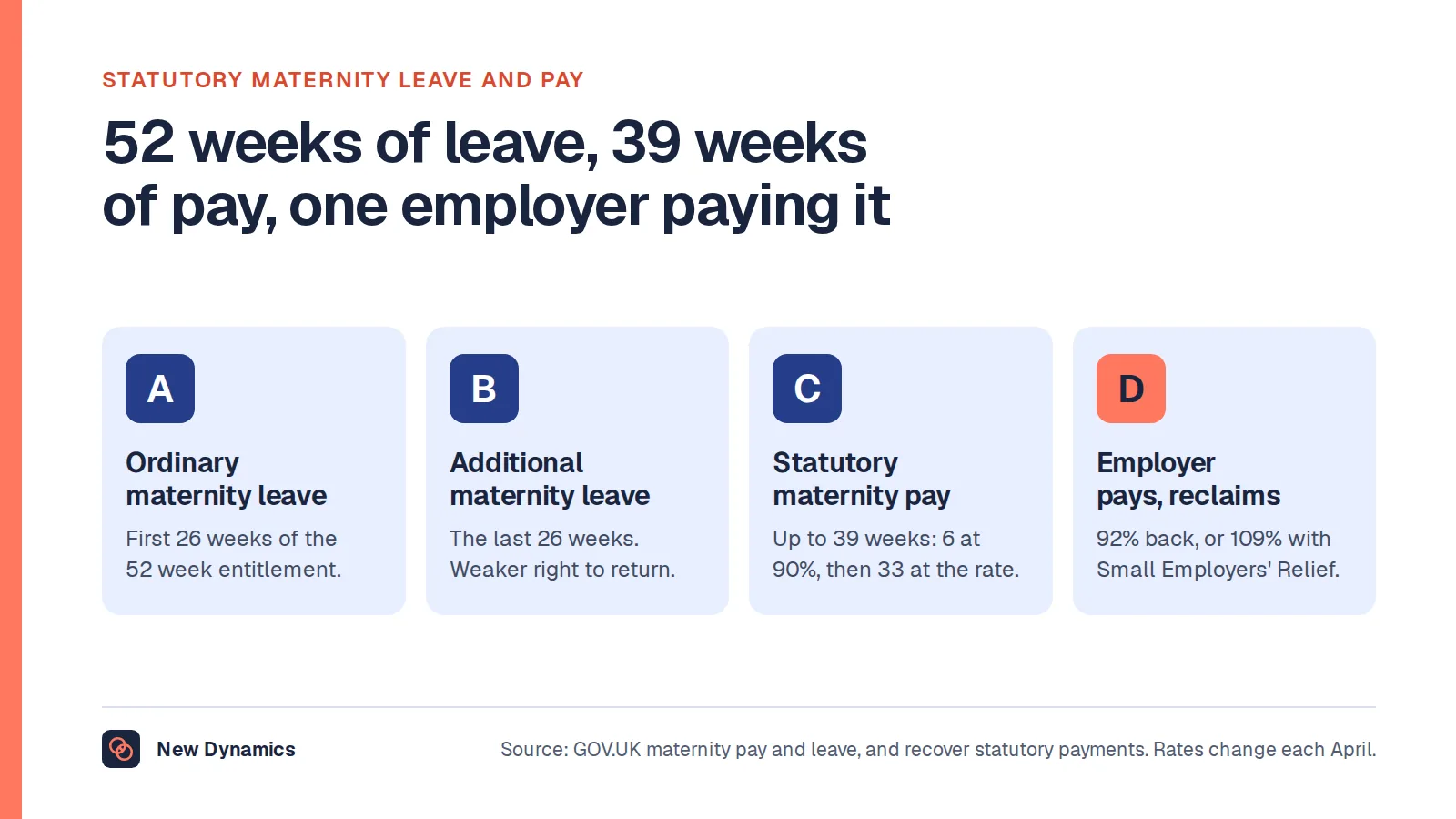
For the other side of the same birth, see our post on maternity leave for employers.
Leave became a day one right. Pay did not
This is the change most policies have not caught up with. GOV.UK's notice period page for employers states: "From 6 April 2026, employees will be eligible for Paternity Leave from their first day of employment."
The mechanism is section 16 of the Employment Rights Act 2025, headed "Paternity leave: removal of qualifying period of employment", which simply omits the duration of employment condition from sections 80A and 80B of the Employment Rights Act 1996. The consequential regulations, SI 2026/15, were made on 6 January 2026, brought part of the machinery in on 18 February 2026, and the rest on 6 April 2026. They too extend to England and Wales and Scotland.
Statutory paternity pay was left where it was. GOV.UK's employer eligibility page lists the pay conditions separately from the leave condition, and they still include being "employed by you up to the date the child is born (or placed with the adopter) (Paternity Pay only)", being "on your payroll and earn at least £129 a week (gross) in an 8 week 'relevant period' (Paternity Pay only)", and having "been continuously employed by you for at least 26 weeks up to any day in the 'qualifying week' (Paternity Pay only)". The same page then says, without qualification: "Employees are eligible for Paternity Leave from their first day of employment."
So a four month employee can now take the leave and get nothing for it. That is not an error in the guidance, it is the deliberate result of two reforms arriving separately, and a policy that treats leave and pay as one entitlement will give the wrong answer to a new starter.

The qualifying week is fixed: GOV.UK defines it as "the 15th week before the baby is due". Being short of 26 weeks at that point is not cured by reaching 26 weeks later. Early birth is treated kindly, though. GOV.UK says that where the child is born early "the employee is still eligible for Paternity Pay if they would have worked for you continuously for at least 26 weeks by the qualifying week".
Paternity leave notice period: two deadlines, and the rule for changing them
GOV.UK's employer notice page gives both deadlines in one list. Employees must tell you "the due date - at least 15 weeks before the baby is expected" and "when they want their leave to start and how much leave they want to take - at least 28 days before they want to take it". It adds that "Notice does not have to be in writing unless you request it", which is worth knowing before an HR team insists on a form it has no right to insist on.
For the pay, the deadline is earlier than many employers assume: "Employees must claim Paternity Pay at least 15 weeks before the week the baby is expected."
The start date is not a free choice. The employer guide lists the three permitted options: "the actual date of birth", "a specified number of days after the birth", or "a set date which is after the date of birth". Nothing can start before the birth.
Changing a date has its own arithmetic that the 2024 regulations spell out and the guidance does not. A notice varying or cancelling a chosen period must be given "by whichever is the earlier of at least 28 days before" the original day or date, or the new day or date. Move leave later and the clock runs from the old date. Move it earlier and it runs from the new one. For pay specifically, GOV.UK tells employees: "To change the start date you must give your employer 28 days' notice before the block of paid leave begins."
Employees do not have to prove anything. "You do not need to give proof of the pregnancy or birth", and they "do not have to give a precise date for your leave. Instead, you can give a general time, such as the day of the birth or one week after."
Late notice is the employer's decision, within limits. "You can delay the leave or pay start date if the employee does not have a reasonable excuse for giving you the wrong amount of notice. To delay it, write to them within 28 days of their leave request." Delay, in writing, within 28 days. Not refuse.

Two GOV.UK pages word the 2026 easement differently
Because paternity leave became a day one right partway through a pregnancy, a new starter could be past the 15 week deadline before the right existed. GOV.UK built a temporary easement, and its two pages describe the same easement with different edges.
The employer notice period page says the relief applies where "their baby is due between 5 April 2026 and 25 July 2026" and "they'll have been employed for less than 26 weeks up to any day in the 'qualifying week'". The employee how to claim page states only the upper edge, that the baby "is due before 25 July 2026", with no start date at all. Both pages agree on what happens afterwards: "If the baby is due on or after 26 July 2026, both the usual notice periods will apply."
The employer page is the one that states both ends of the window, so it is the fuller statement, and 26 July 2026 has now passed. For any baby due today, both notice periods apply in full. Neither page relieves the 28 day notice: "They'll still need to give 28 days notice of when they want their leave to start and how much leave they want to take."
What the employer pays, and what it gets back
Paternity pay goes through payroll like wages, with tax and National Insurance deducted, and most of it comes back. The rates page states the 2026 to 2027 recovery rate as "92% if your total Class 1 National Insurance (both employee and employer contributions) is above £45,000 for the previous tax year" and "109% if your total Class 1 National Insurance for the previous tax year is £45,000 or lower". The employer guide puts the same point from the other direction: "Even if you pay an employee more than the statutory amount, you can usually only reclaim 92% of that amount."
Two obligations sit alongside the money. Employment rights continue: "An employee's employment rights (like the right to pay, holidays and returning to a job) are protected during Paternity Leave. You still have to pay Statutory Paternity Pay even if you stop trading." And a refusal has to be explained. GOV.UK tells employees: "Your employer must tell you within 28 days if you do not qualify and why using form SPP1."
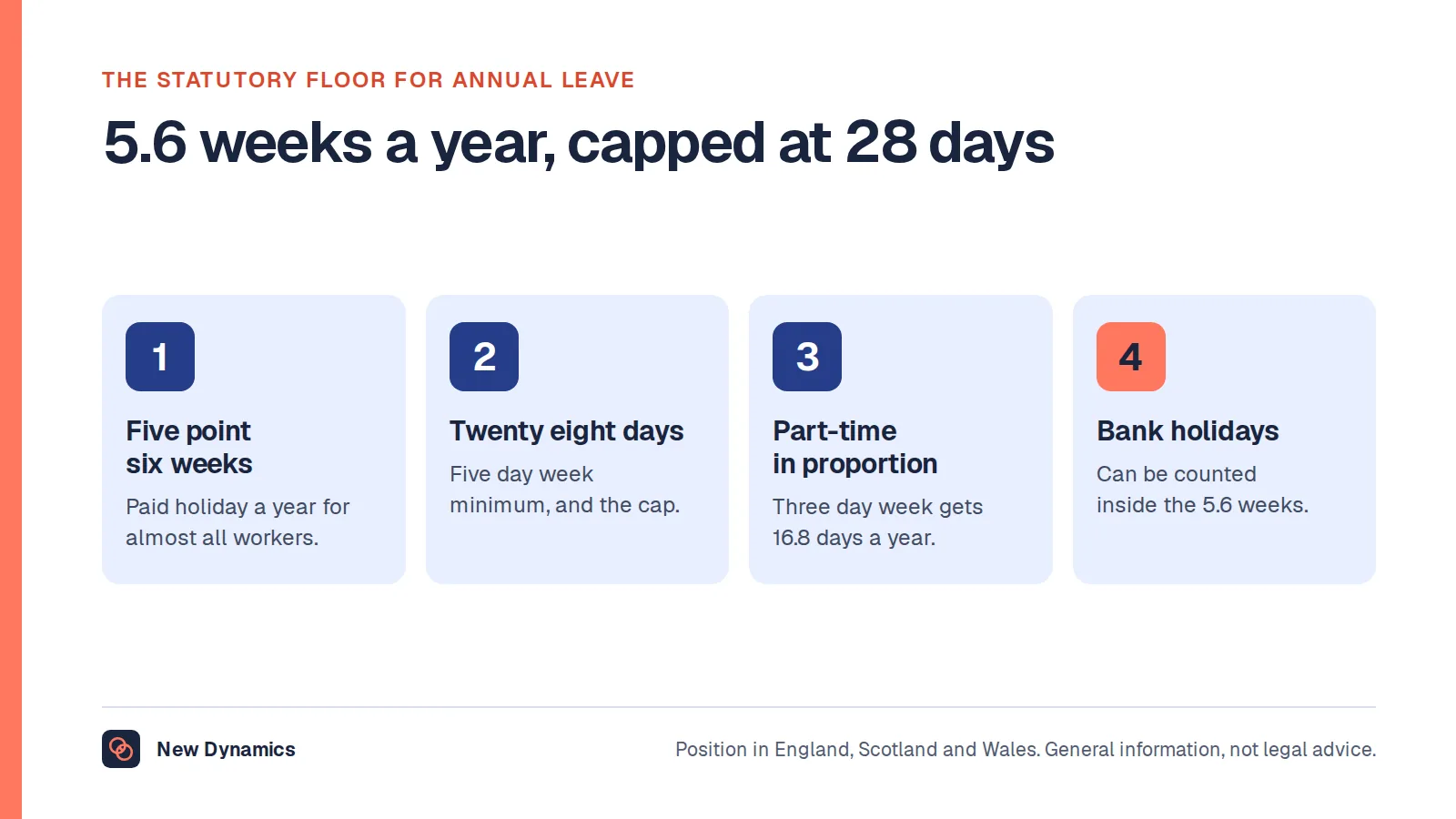
Holiday keeps accruing through paternity leave, as it does through any statutory leave. Our post on holiday entitlement covers the calculation, and our post on leave of absence places paternity among the other reasons people are away.
If the baby dies, and if the mother dies
Both are covered, by different rules, and both are easy to get wrong in a difficult conversation.
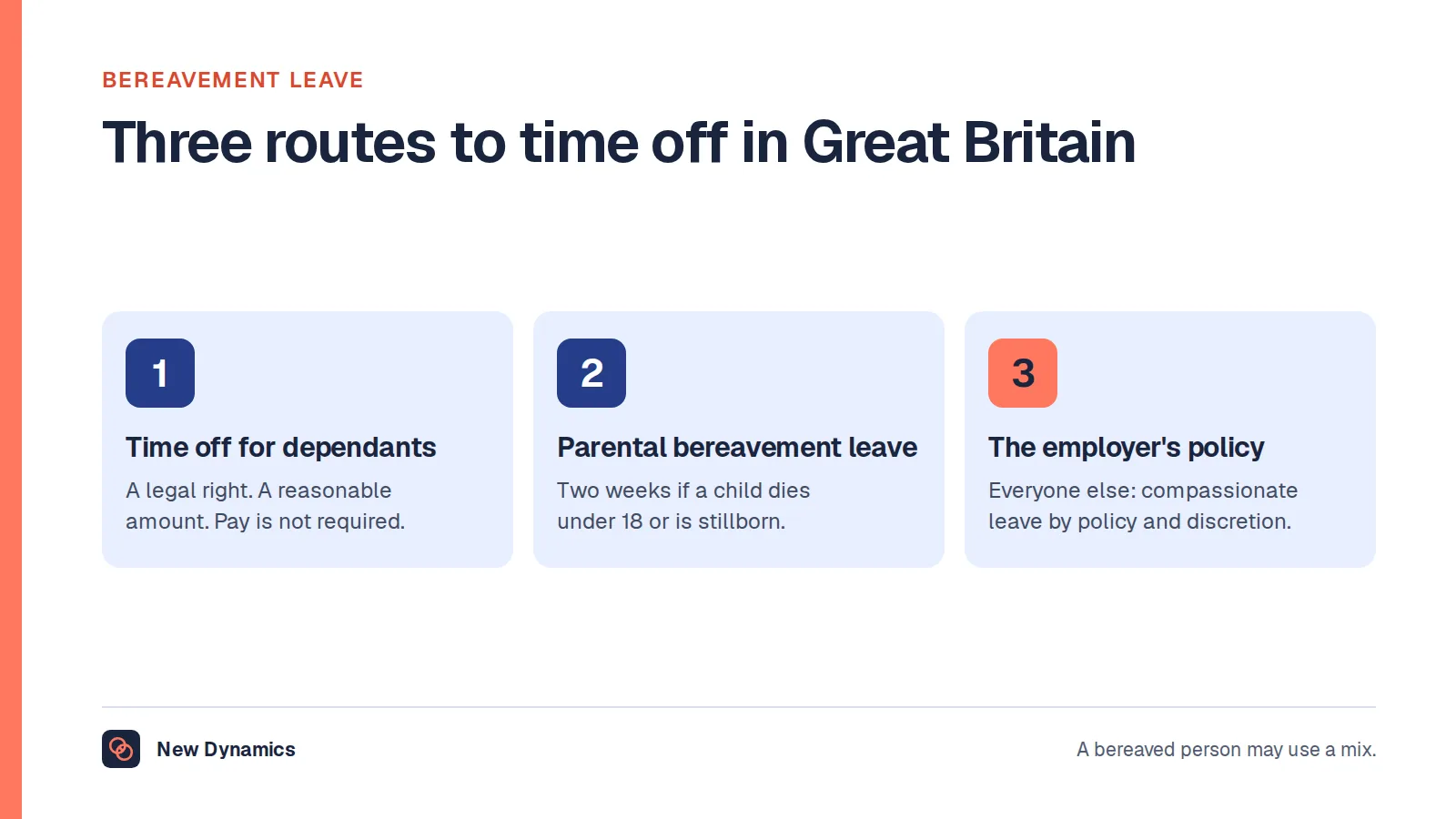
On the loss of a baby, GOV.UK is explicit that the entitlement survives: an employee still qualifies if the baby is "stillborn from 24 weeks of pregnancy" or "born alive at any point during the pregnancy". Booked leave can still be taken, and "If after losing the baby they have leave left to book, they can still book and take this. They must do this within 8 weeks of the death." Statutory Parental Bereavement Pay and Leave may also apply, which our post on bereavement leave covers.
Where the child's primary carer dies, a separate and much longer entitlement now exists. The Bereaved Partner's Paternity Leave Regulations 2026 were made on 10 March 2026 and came into force on 6 April 2026, extending to England and Wales and Scotland. Regulation 5(1) provides that an entitled employee "may take a single period of bereaved partner's paternity leave of up to 52 weeks". Regulation 2(1) limits it to a child "whose primary carer dies on or after the date these Regulations come into force", so it does not reach a death before 6 April 2026. Two weeks and fifty two weeks are a long way apart, and the difference turns on a fact nobody wants to look up in the moment.
Frequently asked questions
How much is statutory paternity pay?
GOV.UK gives the weekly rate for the 2026 to 2027 tax year as £194.32, or 90% of the employee's average weekly earnings, whichever is lower. Tax and National Insurance are deducted. The rate applies from 6 April 2026 and changes each April, so always check the tax year before quoting a figure.
How long is paternity leave in the UK?
Up to two weeks. A week means the number of days normally worked in a week, so someone working two days a week gets two days per week of leave. The entitlement is the same for twins or other multiple births. Leave cannot start before the birth and must end within 52 weeks of the birth, or of the due date if the baby is early.
Can you take paternity leave in two blocks?
Yes, since 8 March 2024. The Paternity Leave (Amendment) Regulations 2024 let an employee take either a single period of one or two weeks, or two non-consecutive periods of a week each. Two weeks taken back to back count as the single two-week period, not as the split option.
What is the paternity leave notice period?
There are two deadlines. The employee tells the employer the baby's due date at least 15 weeks before the baby is expected, and gives at least 28 days notice of the start date and whether they want one week or two. Notice need not be in writing unless the employer asks for it. A claim for paternity pay is due at least 15 weeks before the expected week.
Who qualifies for statutory paternity pay?
The employee must be the father, the mother's or adopter's husband or partner, the child's adopter or the intended parent in a surrogacy arrangement, and be taking the time off to look after the child. For the pay they must be employed up to the date of birth, earn at least £129 a week gross, have 26 weeks of continuous employment by the qualifying week, and give correct notice.
Is paternity leave a day one right?
Paternity leave is, from 6 April 2026, under section 16 of the Employment Rights Act 2025. Statutory paternity pay is not. Pay still requires 26 weeks of continuous employment up to any day in the qualifying week, which is the 15th week before the baby is due, so a new starter can be entitled to the leave and not to the pay.
What happens if an employee does not qualify for the pay?
The employer must tell them, in time and with a reason. GOV.UK states that the employer must tell the employee within 28 days if they do not qualify and why, using form SPP1. The leave may still be due, because the leave test and the pay test are now separate.
Your next step: check your policy against the three dates
- Open your paternity policy and search it for "56 days" and for "consecutive". Either phrase means the policy predates 8 March 2024 and refuses requests the law allows.
- Replace the rate with the figure for the current tax year and write the tax year next to it. For 2026 to 2027 that is £194.32 a week, or 90% of average weekly earnings if lower.
- Separate the leave section from the pay section, because the eligibility tests diverged on 6 April 2026. State the day one leave right and the 26 week pay condition in different paragraphs.
- Put the two notice deadlines, 15 weeks and 28 days, on the manager's side of the process rather than the employee's, with a reminder attached to the due date.
- Add a line on what happens when a baby or a primary carer dies, so nobody has to research it during the call.
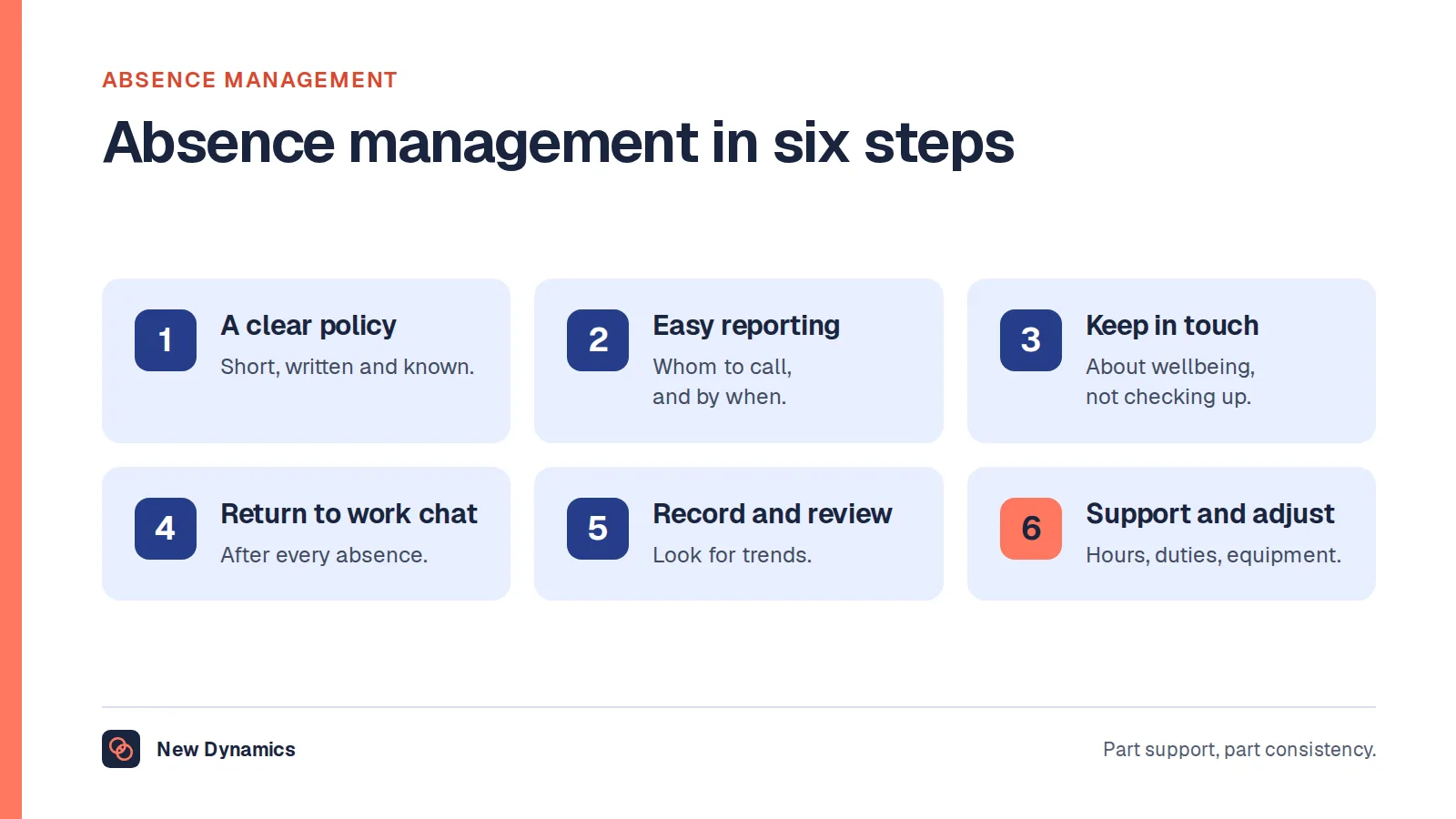
For the wider document this policy belongs in, read and download our employee handbook guide. The guide is free to read, and the PDF uses our short download form. Our post on absence management covers how the request, the approval and the record fit together.
Want notice windows, approvals and leave records to sit in one place instead of in a manager's memory? Book a New Dynamics demo and bring your current paternity policy. You can also email contact@new-dynamics.com.