TL;DR
- An exit interview tells you why somebody left, weeks after the decision. A stay interview asks the same questions while the answers can still change something, which is the entire difference and the entire argument.
- Frame the questions around the six areas HSE names as the work design managers control: demands, control, support, relationships, role and change. It keeps the conversation away from vague satisfaction and on things that can be fixed.
- The practice lives or dies on what happens afterwards. Sort answers into fix now, fix with others and cannot fix, and say which is which. Asking twice and doing nothing is worse than never asking.
Exit interviews produce the most useful information an organisation collects and the least usable, because it arrives after the decision, from someone who has already mentally left and who may have a reference to protect.
A stay interview asks the same questions of people who are still here. This article covers the difference, when to hold one and when not to, the questions, and the part that decides whether it is worth doing at all: what happens to the answers. It describes the position in Great Britain and is general information, not legal advice.
Most of what a stay interview surfaces should already be visible from ordinary conversations. See how New Dynamics continuous feedback keeps that record between managers and their teams.
The difference

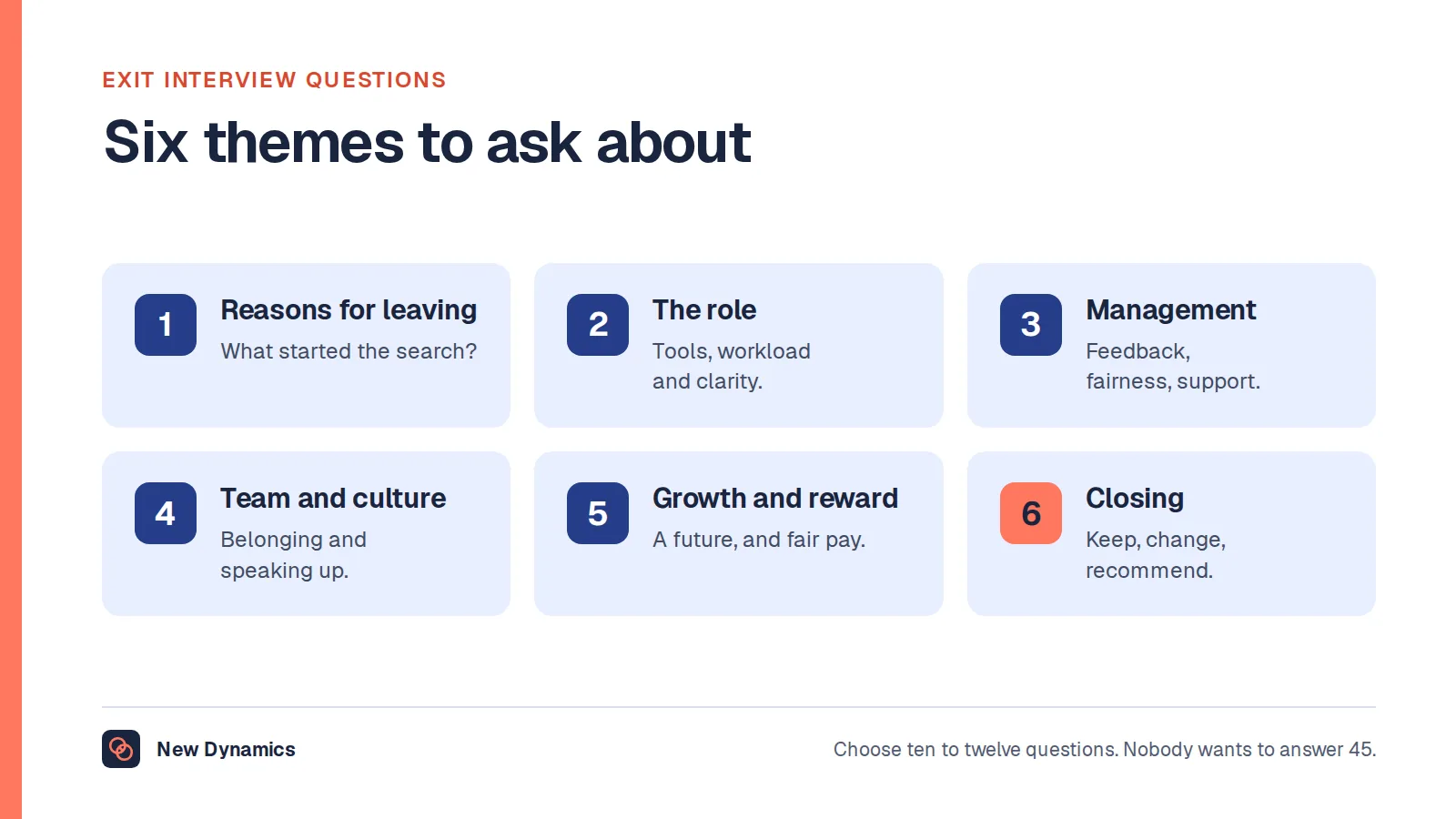
An exit interview is a diagnosis after the fact. It is still worth doing, as our post on exit interview questions sets out, because patterns across many leavers are real information. What it cannot do is change the outcome for the person in front of you.
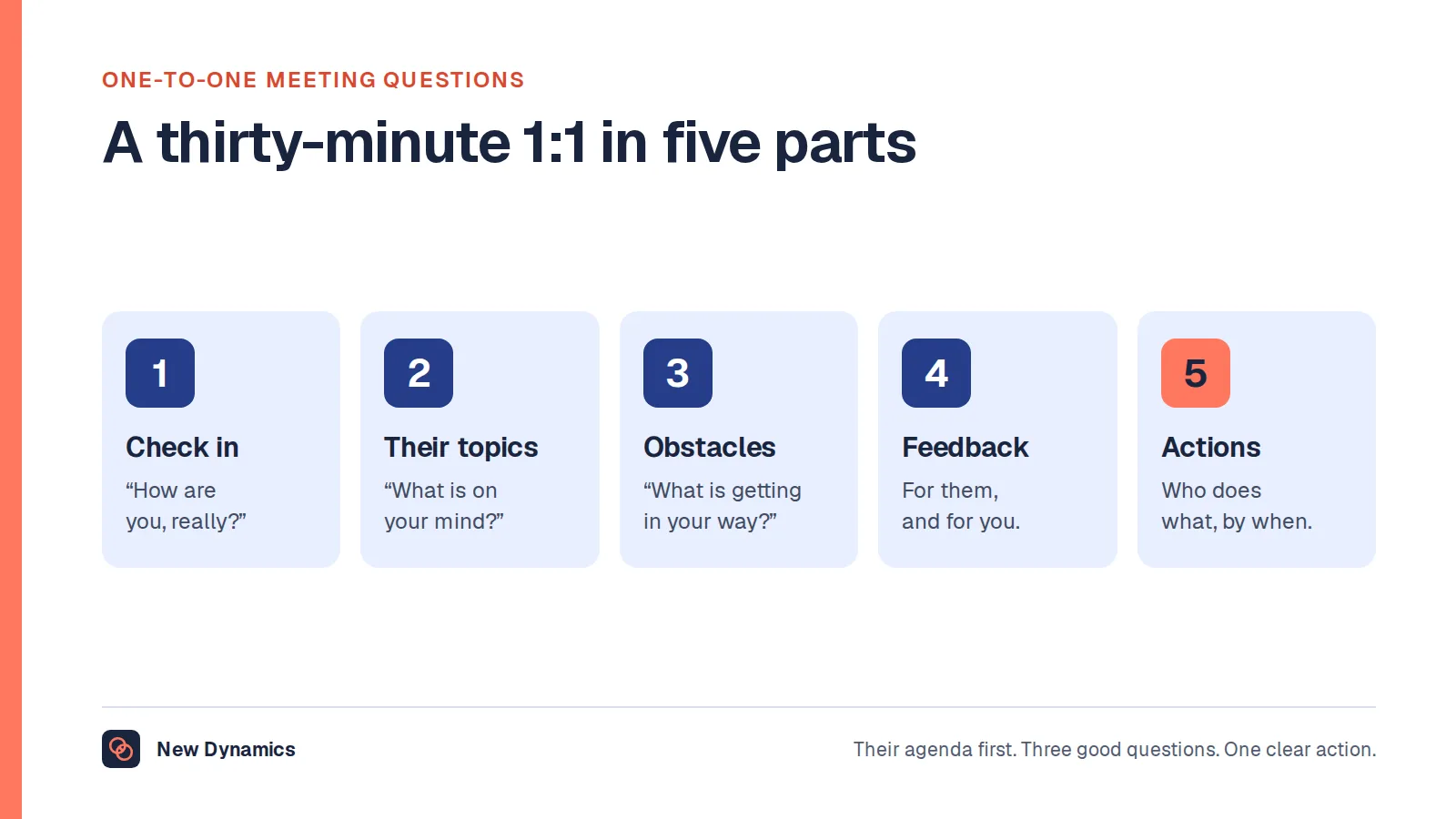
A stay interview asks why somebody stays, what would make them look elsewhere and what is getting in the way, at a point when all three answers can still be acted on. It is a conversation, not a survey, and it is deliberately separate from the performance review, because nobody describes their frustrations honestly to someone who is about to rate them.
The honest caveat: people will not tell you everything, especially the first time. What you get is the second-order version, and that is usually enough to find the fixable things.
When to hold one
Once a year for everyone, offset from the review cycle by several months. Add one when something changes: a reorganisation, a new manager, a promotion that went elsewhere, a return from long leave.
When not to hold one:
- Not during review season, for the reason above.
- Not after a resignation. That is a counter-offer conversation and a different thing entirely.
- Not only with the people you are worried about losing. Acas notes that less favourable treatment "might include: excluding someone from opportunities or benefits" and that it can happen without intent. Attention is a benefit, and a scheme that reaches only the people a manager happens to value distributes it unevenly.
- Not instead of ordinary one-to-ones. Acas lists "regular check-ins, sometimes known as one-to-ones" alongside the formal cycle as the normal way performance and support get discussed. A stay interview is a deeper version once a year, not a replacement.
The questions

Frame them with the six areas HSE names as the work design that affects health and productivity. Two or three questions from each is plenty for forty minutes.
Demands, which HSE describes as "workload, work patterns and the work environment". What does a bad week look like here? Which part of the workload is hardest to predict? What would you drop if you could?
Control, "how much say the person has in the way they do their work". Where do you have to ask permission that you would rather not? What decision would you like to own?
Support, "the encouragement, sponsorship and resources provided by the organisation, line management and colleagues". What support do you get that you value? What do you need that you are not getting? What would make the next six months easier?
Relationships, "promoting positive working to avoid conflict and dealing with unacceptable behaviour". Who do you most enjoy working with, and why? Is there a working relationship that takes more energy than it should?
Role, "whether people understand their role within the organisation and whether the organisation ensures that they do not have conflicting roles". Is anything about what is expected of you unclear? Are you being pulled in two directions by different people?
Change, "how organisational change (large or small) is managed and communicated". What change in the last year affected you most, and how did you find out about it?
Then three questions that sit outside the frame and earn their place:
- What keeps you here?
- What would make you take a call from a recruiter?
- If you could change one thing about this job tomorrow, what would it be?
Running it
Forty minutes, informal, somewhere private. The manager is usually the right person, unless the manager is the problem, which is the argument for HR or a skip-level holding some of them.
Four rules. Ask, then stop talking. Do not defend anything in the moment, including decisions you made. Take enough notes to act, and share them with the person afterwards, which is the discipline Acas applies to performance conversations generally. And never promise what you do not control: our post on career conversations covers the same trap.
What happens afterwards

Sort every answer into one of three piles and say which one it is in.
Fix now. Within your gift and quick: a meeting that should not exist, a tool, a rota change, an introduction. Do two of these within a fortnight, because the speed is the signal.
Fix with others. Needs a decision elsewhere: budget, headcount, a policy, a system. Name who you will ask and when you will come back, then come back even if the answer is no.
Cannot fix. The commute, the shift pattern the work genuinely requires, the promotion that does not exist this year. Say so plainly rather than letting it drift, because a clear no is easier to live with than a vague maybe, and some people will reasonably decide to leave. That is a better outcome than finding out in an exit interview.
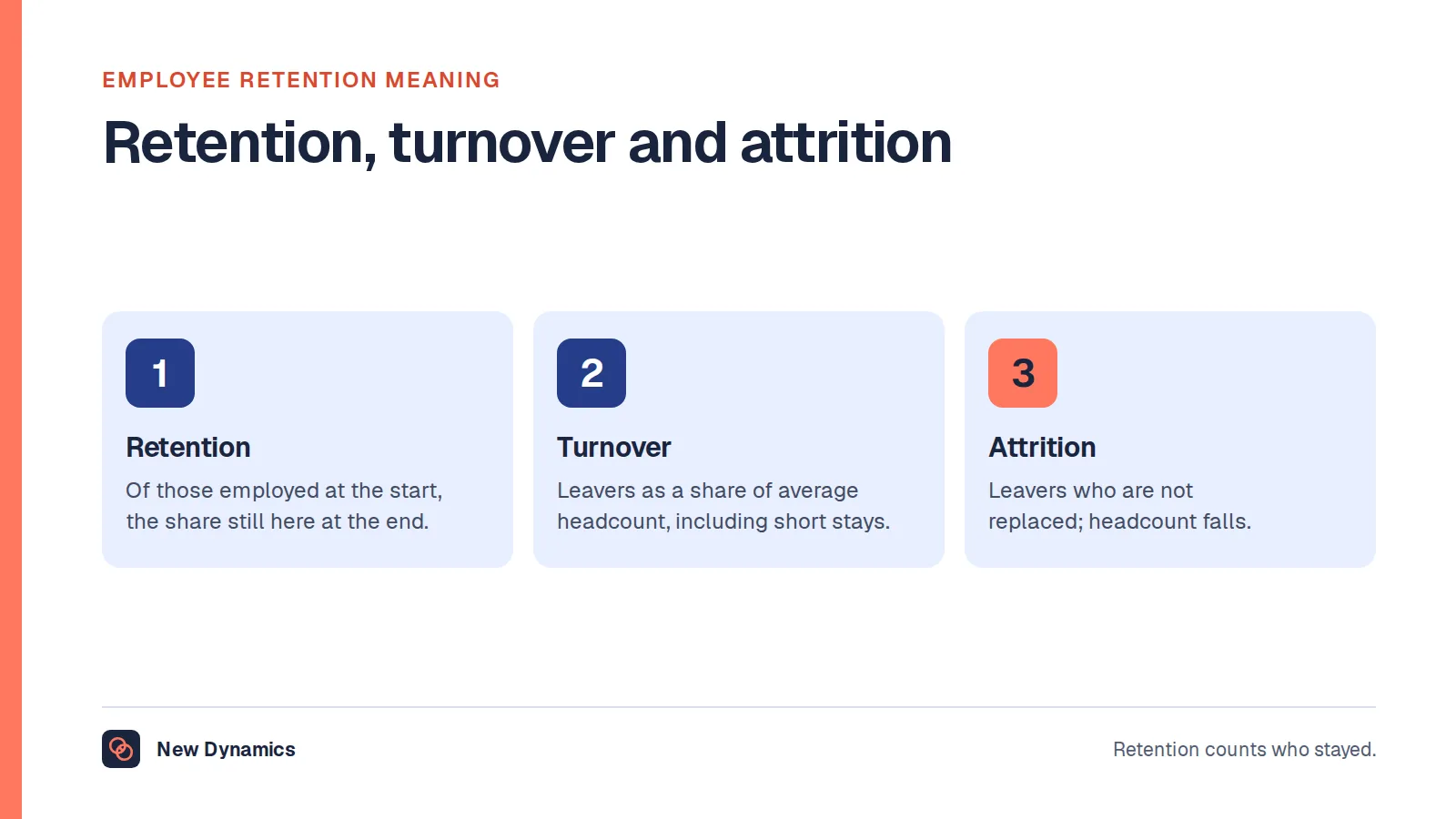
Then look at the answers across the team. One person mentioning the approval process is a nuisance; four mentioning it is a design fault, and it is the kind of thing our post on what employee retention means covers measuring.
Frequently asked questions
What is the difference between a stay interview and an exit interview?
An exit interview asks why someone is leaving after they have decided. A stay interview asks the same underlying questions while the person is still in the job, when the answers can still change something. Both are worth doing: the first gives patterns across leavers, the second gives the chance to act.
What questions should you ask in a stay interview?
Ask about workload and predictability, how much say they have, what support they get and need, working relationships, whether their role is clear, and how change has been handled. Then three direct ones: what keeps you here, what would make you take a recruiter's call, and what would you change tomorrow.
Who should run a stay interview?
Usually the line manager, because most of what comes up is theirs to act on. Where the manager may be part of the problem, or where the organisation wants an unfiltered view, HR or a skip-level manager should run some of them instead.
How often should stay interviews happen?
About once a year for everyone, held well away from review season, plus one after a significant change such as a reorganisation, a new manager or a return from long leave. Holding them only with people you fear losing distributes attention unevenly and sends its own message.
Are stay interviews confidential?
Treat them as private rather than secret. Say at the start what you will do with the notes, share them with the person afterwards, and ask before you repeat anything that identifies them. Aggregate themes can be reported upwards without names attached.
What should you do if you cannot act on the answers?
Say so, specifically, and explain why. A clear no is easier to live with than silence or a vague promise, and it keeps the next conversation honest. The practice collapses when people answer twice and see nothing change.
Your next step: run three and fix two things
- Pick three people whose answers you would actually act on, and book forty minutes each, away from review season.
- Use six questions, two from the areas you suspect matter most here.
- Within a fortnight, fix two things that are in your gift and tell the people what changed.
- Write down the themes, and check them against what your last five exit interviews said.
For the wider picture of why people stay and what moves the numbers, read and download our employee retention guide. The guide is free to read, and the PDF uses our short download form.
Want these conversations recorded where the actions do not get lost? Book a New Dynamics demo and bring last year's exit interview themes. You can also email contact@new-dynamics.com.