TL;DR
- An HR strategy is a decision document. It says what the people function will do in a period, what it will not do, who owns each part, and how anyone would know whether it worked. A list of eleven initiatives with no owner and nothing dropped is a wish list.
- It starts from the business plan, not from HR. If you cannot state the three or four things the organisation is trying to do and what each requires of its people, there is nothing for the strategy to be a strategy about.
- Diagnose with data you already hold: turnover by team, time to hire, review completion and absence. Then measure outcomes rather than activity, because training hours delivered tells you what HR did, not what changed.
Most HR strategies are a list. A heading each for wellbeing, inclusion, talent, technology and culture, eleven initiatives underneath, a page of ambition at the front, and nothing anywhere in the document that could be failed. It reads well in a board pack. It changes nothing about how the function spends next Tuesday.
An HR strategy is a decision document, not a statement of intent. It says what the people function will do over a defined period, what it will deliberately not do, who owns each part, and how anyone would know whether it worked. This article sets out how to write one of those, including a section-by-section outline you can copy, and it is deliberately sceptical, because most published advice on HR strategic plans describes the aspiration and skips the arithmetic.
Strategy only becomes real when it reaches the objectives people are actually measured on. See how New Dynamics Goals & OKRs hold organisational and individual targets in one place, so a priority in a strategy document has somewhere to land.
What an HR strategy is for
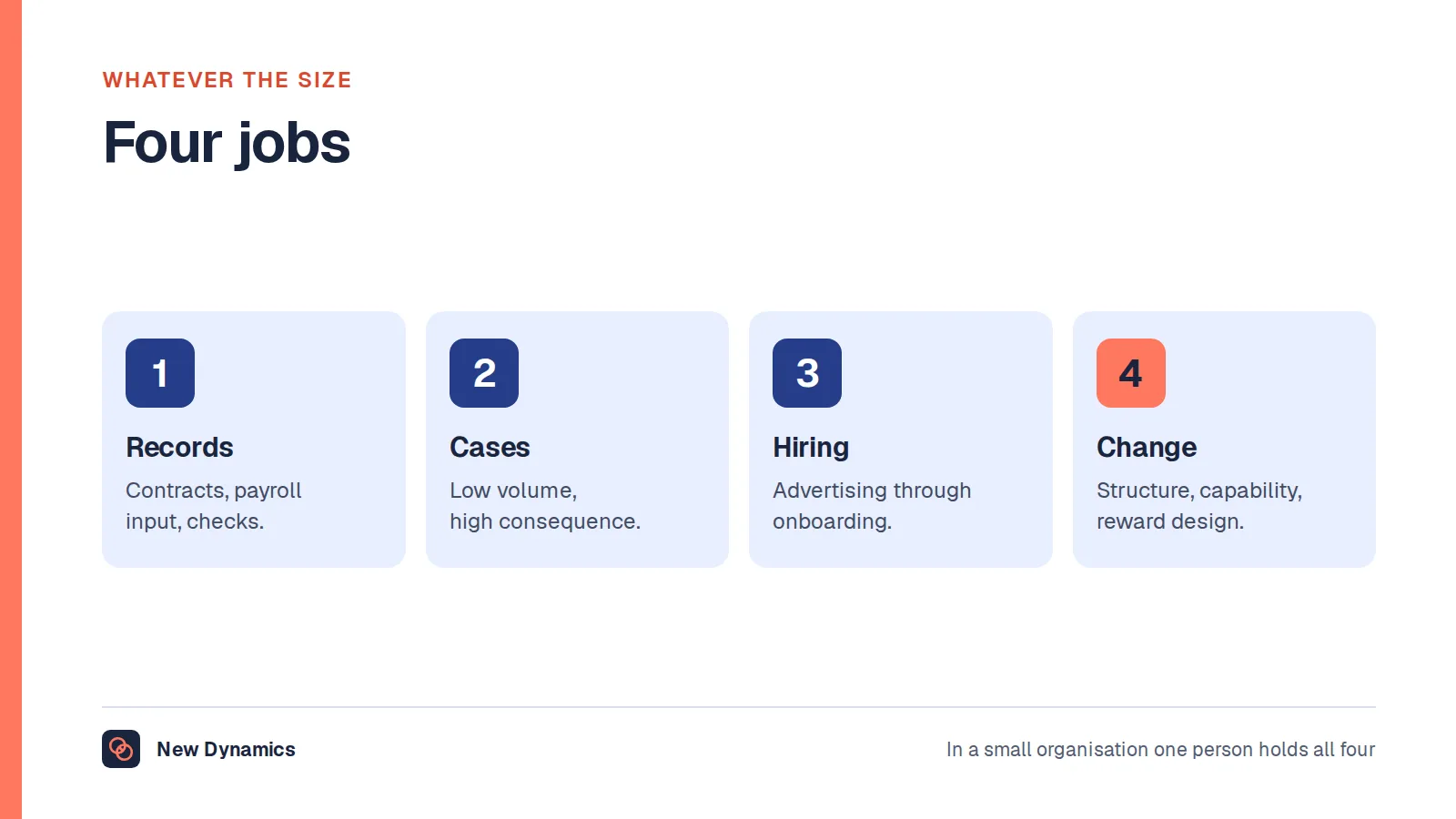
A strategy is a set of choices made under constraint. The constraint in HR is almost always the same one: a small number of people, most of whose time is already committed to work that cannot stop. Contracts still have to be issued, cases still have to be handled, payroll still has to be fed. Whatever the strategy promises comes out of the margin that remains.
That is why a list fails. A list assumes capacity. A strategy allocates it.
Four questions, answered in order, produce something usable.

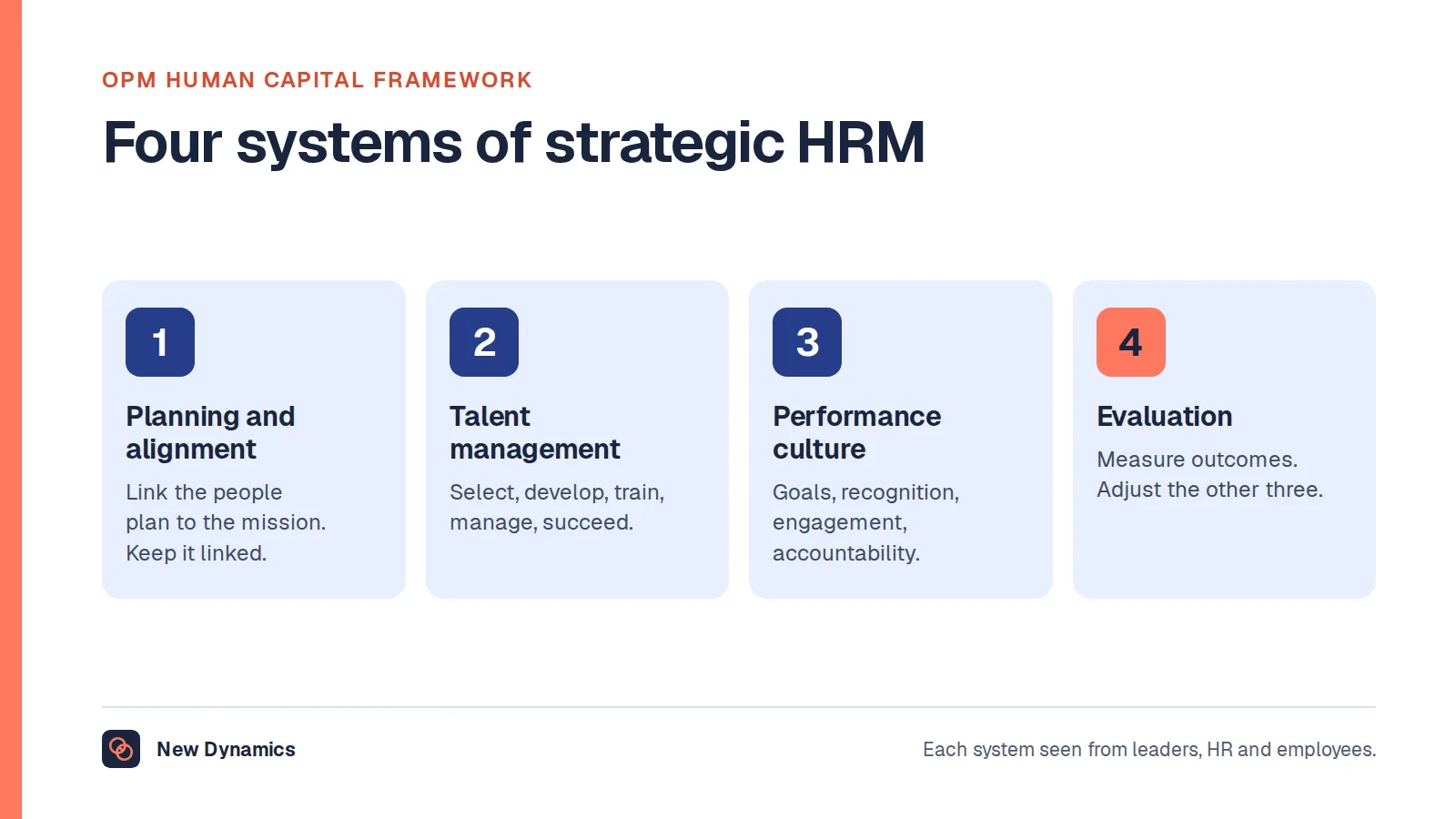
The wider discipline this sits inside is covered in our post on strategic human resource management, which deals with the concept. This article deals with the document.
Start from the business plan, not from HR
Write down the three or four things the organisation is trying to do in the period. Not its values, not its mission, the things it is trying to do: open two sites, move half of revenue onto subscriptions, hold margin while volumes fall, pass a regulatory inspection.
Then write what each one requires of people. Opening two sites requires recruitment capacity in places you have never hired before, and managers who have never opened anything. Moving to subscriptions requires a sales capability you probably do not have and may not be able to retrain into. Holding margin usually requires keeping experienced staff you are about to stop paying competitively.
If you cannot state those three or four items and their people consequences in a sentence each, stop. There is nothing yet for the strategy to be a strategy about, and what you will write instead is a list of things HR generally approves of. Go and get the plan, or go and ask the person who owns it what it actually commits to.
Turning those consequences into numbers, skills and dates is a separate discipline with its own method, and our guide to strategic workforce planning covers the six stages and the five ways to close a gap.
One input belongs here that HR strategies often leave to a compliance appendix: who is on the payroll and on what basis. Gov.uk notes that in employment law a person's employment status helps determine both “their rights” and “their employer's responsibilities”, as set out in its employment status guidance. A plan that leans on agency workers, contractors or fixed-term hires carries different duties from one that hires employees, and that difference is a strategic choice rather than an administrative detail.
Diagnose what is actually broken, with evidence
This is the step most HR strategic plans skip, and skipping it is why so many priorities turn out to be the previous year's priorities.
A diagnosis is a claim about the present that someone could disprove. "Our managers lack confidence" is not a diagnosis. "Sixty-one per cent of this year's leavers resigned within eighteen months of joining, and three quarters of those sat under four managers" is a diagnosis, because it points at a place.
You almost certainly already hold enough data to do this. Four sources do most of the work.

Turnover, split by team and by tenure. An organisation-wide turnover figure hides everything interesting. The same number can mean healthy churn in a seasonal function or a single team haemorrhaging its best people. Our post on the UK employee turnover rate sets out what is actually published nationally and how to calculate your own figure so that it compares with anything.
Time to hire, split by role family. An average across all vacancies is useless, because one hard-to-fill senior role drags it. Measure the roles you hire repeatedly, and measure from the point the vacancy was approved rather than from the day the advert went live, which is where most reported figures quietly start. Our UK recruitment statistics post covers which measures are published, what they cover and what to track instead.
Completion rates for anything you already mandate. Review completion, mandatory training, probation sign-off, right to work checks. A process with a 54 per cent completion rate is not a process, and that is a finding you can act on without any new data collection at all.
Absence, measured consistently. Acas notes that review point systems are usually based on either “the number of absences an employee has within a certain time period” or “the length of an employee's absence”, in its guidance on absence review points. The two measures answer different questions. Frequent short absences and one long absence are different problems, and a strategy that treats "absence" as one number will pick the wrong intervention.
Be honest about what you cannot evidence. No official body publishes a benchmark for a good HR strategy, and there is no national dataset that tells you whether your function is well run. Where a wider picture helps, our HR statistics hub collects the figures that are genuinely published, with their reference periods. Where no figure exists, say so in the document rather than reaching for a number from a vendor survey.
Choose, and write down what you are dropping
Three to five priorities. Each with a named owner, not a team name. Each with a stated end state and a date.
Then the section almost every HR strategy omits: what you are stopping, deferring or leaving alone. This is not a courtesy to the reader. It is the only thing that makes the priorities credible, because without it the strategy is asking the same people to do the same work plus five more things.
A dropped list might read: the engagement survey moves from annual to every eighteen months; the competency framework refresh waits a year; the learning catalogue is left exactly as it is; exit interviews stop being conducted by HR and become a manager's job with a one-page template. Some of those will be unpopular. That is what choosing feels like.
Two practical tests. First, if a priority has no owner who can be asked about it in a corridor, it is not a priority. Second, if nothing has come off the list since last year, you have not written a new strategy, you have reprinted one.
The operating model question
A strategy that ignores where HR work physically sits is a wish list with headings.
Most functions distribute work across three places, whether or not they use the language: partners who work with a business area on its plan, a service layer that handles transactions and queries, and expertise that designs frameworks in reward, resourcing and employee relations. Our post on the HR business partner role sets out what the partner half of that actually involves, and why it collapses first when the service layer is weak.
The arithmetic matters more than the model. Count the working days available to the people who will deliver each priority, subtract the recurring work they cannot put down, and see what is left. A four-person team delivering five change priorities alongside casework is a sentence that has not been checked. In smaller organisations the question is simpler and harsher: which of these does the one HR person stop doing in order to do this?
If the answer is that nobody has capacity, the strategy has one honest option, which is fewer priorities. Buying software, outsourcing a process or hiring are all legitimate answers, but each of them is itself a priority with a cost and an owner, and belongs on the list rather than assumed around it.
Measure outcomes, not activity
Two kinds of measure belong in the document, and they do different jobs.
Lagging measures tell you whether the thing you wanted happened: turnover in the three teams you targeted, vacancy fill time for the role family you focused on, the proportion of managers who have held a documented conversation with every report. They are honest and they are slow, often a year behind the work.
Leading measures tell you whether the work is happening at all, early enough to change course: the number of managers trained against the number who need it, the proportion of a new process actually adopted in month two, pipeline for the roles you know you will need.
The trap is mistaking activity for either. Training hours delivered, policies rewritten, surveys launched, workshops run: these are inputs. They measure effort, and they always look good, which is precisely why they end up in strategy documents. The question for every measure is whether a number moving would make anyone outside HR better off. If you cannot answer that, cut it. Our post on HR metrics goes further into which measures survive contact with a board.
Give each priority one lagging measure and no more than two leading ones. Longer measurement frameworks do not get read.
The annual rhythm, and where strategy becomes real
A strategy with no review points is an annual document that is read once. Put three or four in the calendar before you publish it, with a standing agenda of three questions: what moved, what is stuck, and what should now come off the list.
The connection that decides everything, though, is to individual objectives. A priority that does not appear in somebody's objectives is a priority nobody is accountable for. This is where most HR strategies die, quietly, in the gap between a document owned by the HR director and the review conversations managers hold in March.
Acas is clear about the conversation that gap depends on. Its guidance on performance management states that “Employers should conduct regular performance reviews for anyone with the legal status of employee. It's a good idea to do them at least once a year.” On the objectives themselves it adds that “Objectives should be fair and reflect the employee's usual tasks and workload. But they might also stretch them to develop in certain areas.”
That last line is the discipline for cascading a strategy. A strategic priority becomes one or two objectives for the people whose usual work it genuinely touches, not a line pasted into every objective set in the organisation. Our post on HR goals covers how to write objectives that can actually be failed, which is the test that separates a cascade from a copy and paste.
A worked outline you can copy
Nine sections. The word budgets are suggestions, and they matter, because a strategy nobody finishes reading is not operative.

- Context, 200 words. The three or four things the organisation is trying to do in the period, stated as commitments with dates, not as themes.
- What that requires of our people, 300 words. One short paragraph per business commitment: numbers, skills, structure, cost, by when.
- Where we are now, 500 words. The evidenced diagnosis. Turnover by team and tenure, time to hire by role family, completion rates, absence measured consistently. Name the data source and the period for every figure.
- Priorities, one page. Three to five. Each with an owner, an end state, a date and a sentence on why this rather than something else.
- What we are not doing, half a page. Stopped, deferred, left alone. Named, so it cannot be quietly reinstated.
- How the work gets done, half a page. Who delivers each priority, what capacity it needs, and what has been bought, outsourced or added to make room.
- Measures, one page. One lagging and up to two leading measures per priority, with the current value and the target.
- Review points, a short list. Dates, attendees, and the three standing questions.
- Risks and dependencies, half a page. The two or three things outside HR's control that would make this undeliverable, and who has been told.
That is a document of roughly eight pages. Anything much longer is usually hiding the absence of choices behind volume.
What goes wrong
It was written for the board, not for the function. The tell is the tone: polished, abstract, full of nouns like alignment and enablement. A strategy that nobody in the HR team could use to decide what to do on Monday is a communications artefact.
Nothing ever falls off the list. Priorities accumulate year on year because dropping one feels like admitting failure. The result is a function with fourteen live commitments, none resourced, and a team that quite reasonably prioritises whoever shouted most recently.
No connection to what managers do. The strategy says capability building; managers experience an extra form. Where a priority requires managers to behave differently, the document has to say what they will stop doing to make room, in the same way the HR capacity section does.
The diagnosis is asserted. Phrases like "we know engagement is a challenge" survive into final drafts because nobody wants to say the data was never pulled. A diagnosis with no number attached will not survive its first challenge in a board meeting, and the priority built on it will be the first cut.
It is dated rather than reviewed. A three-year people strategy with no review points is a prediction. Keep the horizon and add the checkpoints.
Frequently asked questions
What is an HR strategy?
An HR strategy is a document that decides what the people function will do over a defined period, given what the organisation is trying to achieve, and what it will not do. It contains a diagnosis of the current state, a small number of priorities with named owners, the measures that would show whether they worked, and the things being stopped or deferred to make room.
What is the difference between an HR strategy and an HR strategic plan?
In practice nothing, and the terms are used interchangeably. Where people do distinguish them, the strategy is the set of choices and the plan is the sequenced delivery of those choices: who does what, by when, with what resource. Both are useless without the other, so most organisations should write one document containing both.
How many priorities should an HR strategy have?
Three to five for most functions, and fewer if the team is small. The constraint is not ambition but working days. Count the capacity available after recurring work is subtracted, and if the arithmetic does not support five priorities, write three. A strategy that overcommits delivers fewer outcomes than one that commits honestly.
What should an HR strategy document contain?
Nine sections work well: business context, what it requires of people, an evidenced diagnosis of where you are now, the priorities with owners and dates, what you are not doing, how the work gets delivered and with what capacity, measures, review points, and risks. Around eight pages in total. The outline earlier in this article gives word budgets for each.
How often should an HR strategy be reviewed?
Set three or four review points in the year when you publish it, and ask the same three questions each time: what moved, what is stuck, and what should come off the list. Rewrite the strategy when the business plan changes, not on a fixed anniversary, because a strategy tied to a plan that has moved on is worse than no strategy.
What are examples of HR strategies that are too vague?
"Build a high performance culture", "become an employer of choice" and "embed our values" are the common ones. Each fails the same test: nothing could falsify it, so nobody can be accountable for it. The fix is to name the population, the change and the date, for example reducing first-year turnover in two named teams by a stated amount within twelve months.
Your next step: test the strategy you already have
- Read your current HR strategy and underline every claim about the present that has no number attached.
- Check whether anything has come off the list since last year. If not, the document is a reprint.
- Put a person's name next to each priority, and remove any that cannot take one.
- Count the working days each priority needs and compare the total with the capacity you actually have.
- Find each priority in somebody's individual objectives. Any that is not there is not happening.
For the wider function this strategy has to run, read and download our human resources management guide. The guide is free to read, and the PDF uses our short download form.
Want your strategic priorities visible in the objectives people are measured on, rather than in a document? Book a New Dynamics demo and bring your current strategy. You can also email contact@new-dynamics.com.