TL;DR
- Replacement planning names a person beside each senior job. Succession planning builds the capability the job will need. The second one is the only version worth the time it takes.
- Scope it honestly. A plan is justified where a sudden vacancy would cause real damage and the role is hard to fill, which is a much shorter list than most organisations attempt.
- Acas says discrimination can include excluding someone from opportunities or benefits, and that a performance discussion should be recorded and shared. A succession plan that quietly reproduces the current leadership team is a signal, not a coincidence.
Most organisations that say they run succession planning have a replacement chart. It carries a name beside each senior job, it is refreshed once a year by whoever owns the spreadsheet, and it has never been tested by anybody actually leaving.
A replacement chart names a substitute. A succession plan builds capability. That is the distinction that makes the exercise useful, and almost everything that goes wrong with succession planning in human resources comes from blurring it.
This article covers what succession planning is, which roles genuinely need a plan, the steps in order, readiness language that means something, the fairness problem at the centre of it, whether to tell people they are in the plan, and what usually goes wrong.
Development is where a succession plan either works or does not, and development runs on objectives somebody is actually tracking between reviews. See how New Dynamics goals and OKRs keep a development objective visible through the year rather than filed after one conversation.
What succession planning is, and how it differs from replacement planning

Succession planning is the work of making sure the organisation can still do its critical work when the people currently doing it stop doing it. That includes resignations, retirements, promotions, long-term illness and the ordinary fact that good people move on.
Replacement planning answers a narrower question: if this person went tomorrow, whose name goes in the box. It is a continuity list. It is not useless, and for a short-notice absence it is exactly what you want to have written down. But it ends at the name.
| Question | Replacement planning | Succession planning |
|---|---|---|
| What it produces | A name beside a job | A development plan with owners and dates |
| The role it describes | The job as the incumbent does it now | The job as the organisation will need it |
| Time horizon | Immediate cover | One to three years, reviewed |
| How success is judged | The box is filled in | Someone who was not ready becomes ready |
| What it costs | A meeting | Budget, management attention and real stretch work |
| The failure mode | The named person has also left | The plan is written once and filed |
The practical test is this. If your succession document would read identically whether or not anybody did any development this year, it is a replacement chart. A succession plan changes, because people move along it.
There is a second difference that gets missed. A replacement chart is built around individuals, so it tends to name the person who is most like the incumbent. A succession plan is built around the work, so it starts by asking what the work will actually require, which is often not what the current post-holder spends their time on.
Which roles actually need a succession plan
Most organisations attempt this for far too many roles, produce a document nobody can maintain, and conclude that succession planning does not work. The scoping decision is the one that determines whether anything else is worth doing.
Two tests, applied together:
- The damage a sudden vacancy would cause. Not seniority. Damage. What stops, what slips, what cannot be signed off, what customer or regulator notices, and how long the organisation can run without it. A job title is a poor proxy for this. A single systems administrator who is the only person with production access can be more critical than a director with a deputy.
- How hard the role is to fill. How long recruitment realistically takes, how specific the skills are, how scarce they are in your market, and how much of the job is organisational knowledge that cannot be bought in. A role you can fill in six weeks from an open market does not need a plan. A role requiring a qualification, a security clearance or five years of context does.
A role that scores high on both needs a succession plan. High damage but easy to fill is a recruitment and interim-cover problem, so write the emergency cover arrangement and move on. Low damage but hard to fill is a knowledge-capture problem: document what is in that person's head. Low on both needs nothing beyond ordinary resourcing.
Our view, from how these documents tend to survive contact with a real year, is that an organisation can genuinely maintain a plan for a single-figure number of roles, or a small number of role families. A list of forty critical roles is a list of none, because nobody will fund development against forty of them.
A note on evidence. No official United Kingdom source publishes a dependable figure for how many employers hold a succession plan, so we are not going to quote one. Where published figures do exist on the related questions of turnover, recruitment difficulty and training, our HR statistics hub collects them with their reference periods.
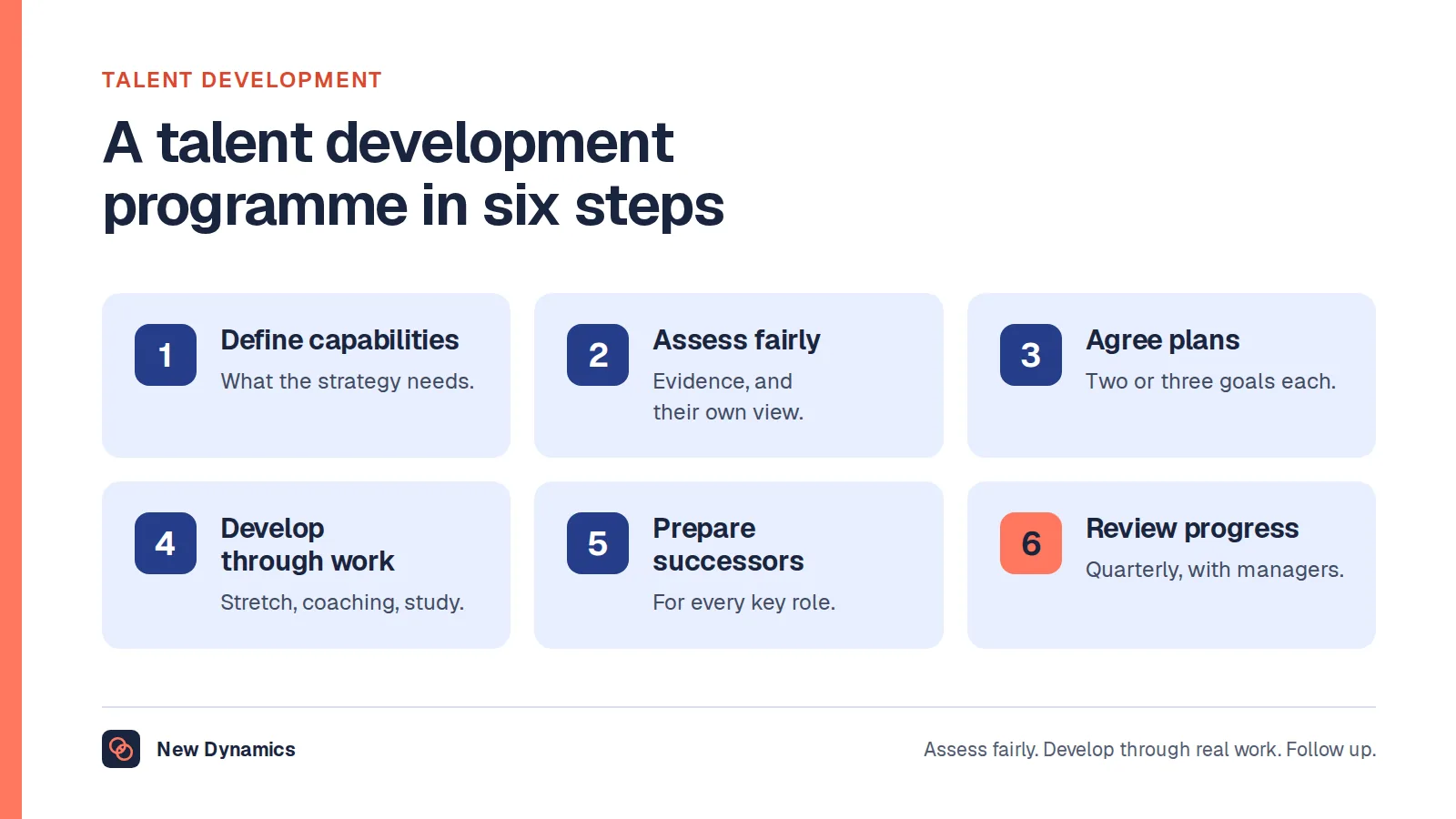
The succession planning process, step by step

The order matters more than the paperwork. Assessing people before you have defined the role is how a plan ends up describing the incumbent.
1. Identify the critical roles
Apply the two tests above, in a room with the people who would actually be left holding the work. Write down why each role made the list. A role on the list with no stated reason comes off the list next year, usually by accident.
2. Define what the role will need, not what the incumbent does today
This is the step that gets skipped, and skipping it is why management succession plans tend to clone the present. Write the requirement for the role as it will exist in two or three years: the decisions it will have to make, the scale it will operate at, the capabilities the strategy now needs from it, and the parts of the current job that will have gone.
Doing this properly often changes the shortlist. A role that is becoming more commercial and less technical has a different set of credible successors than the one you would have named from the organisation chart. A competency framework helps here, because it gives you shared language for the requirement rather than a description of one person.
3. Assess readiness against that requirement
Readiness is assessed against the defined role, not against the incumbent and not as a general ranking of people. For each candidate, record what they have already demonstrated, what is not yet evidenced, and what the evidence actually was. "Strong leader" is not evidence. "Ran the Northern integration for nine months, including the two redundancy consultations" is.
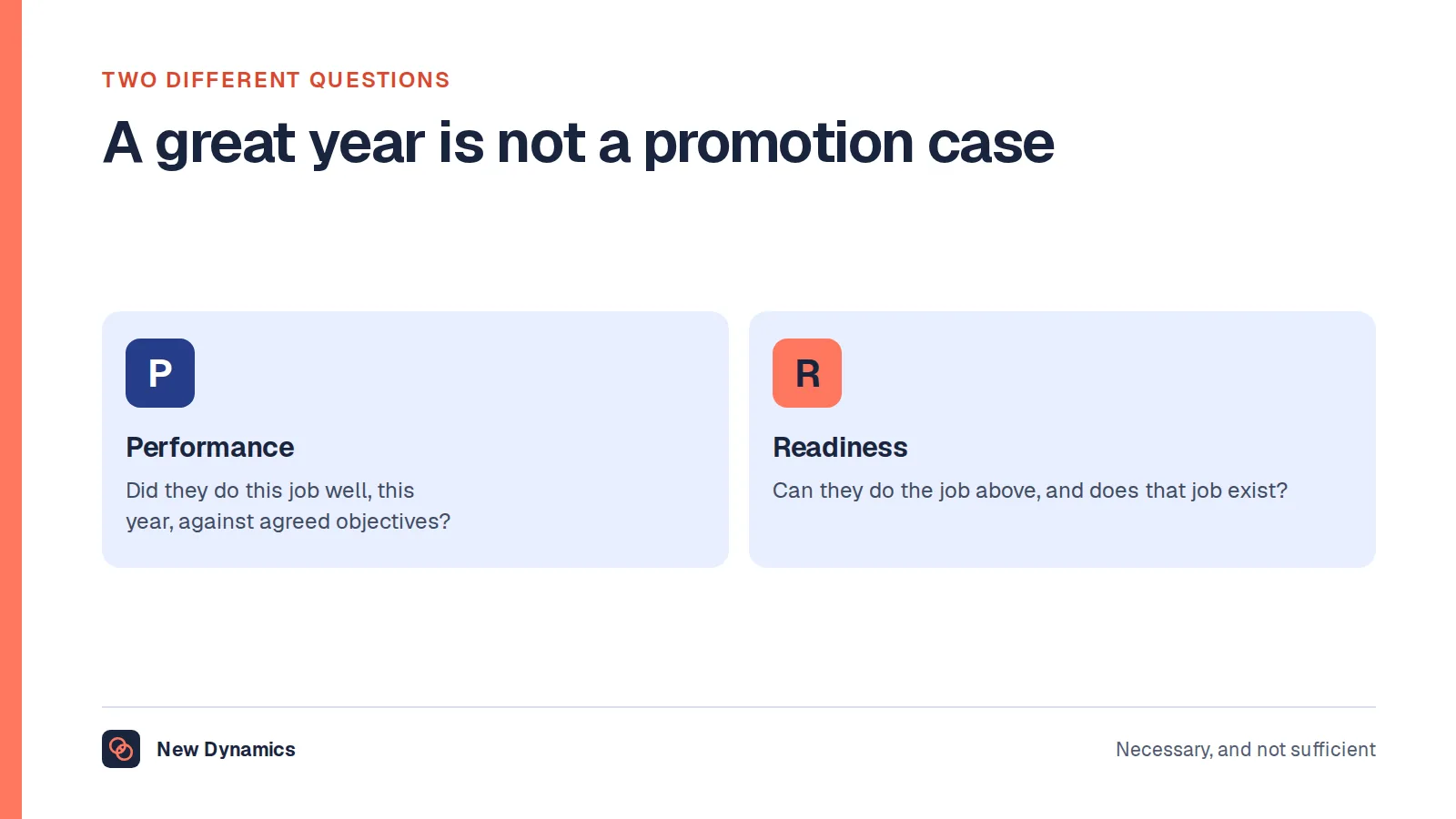
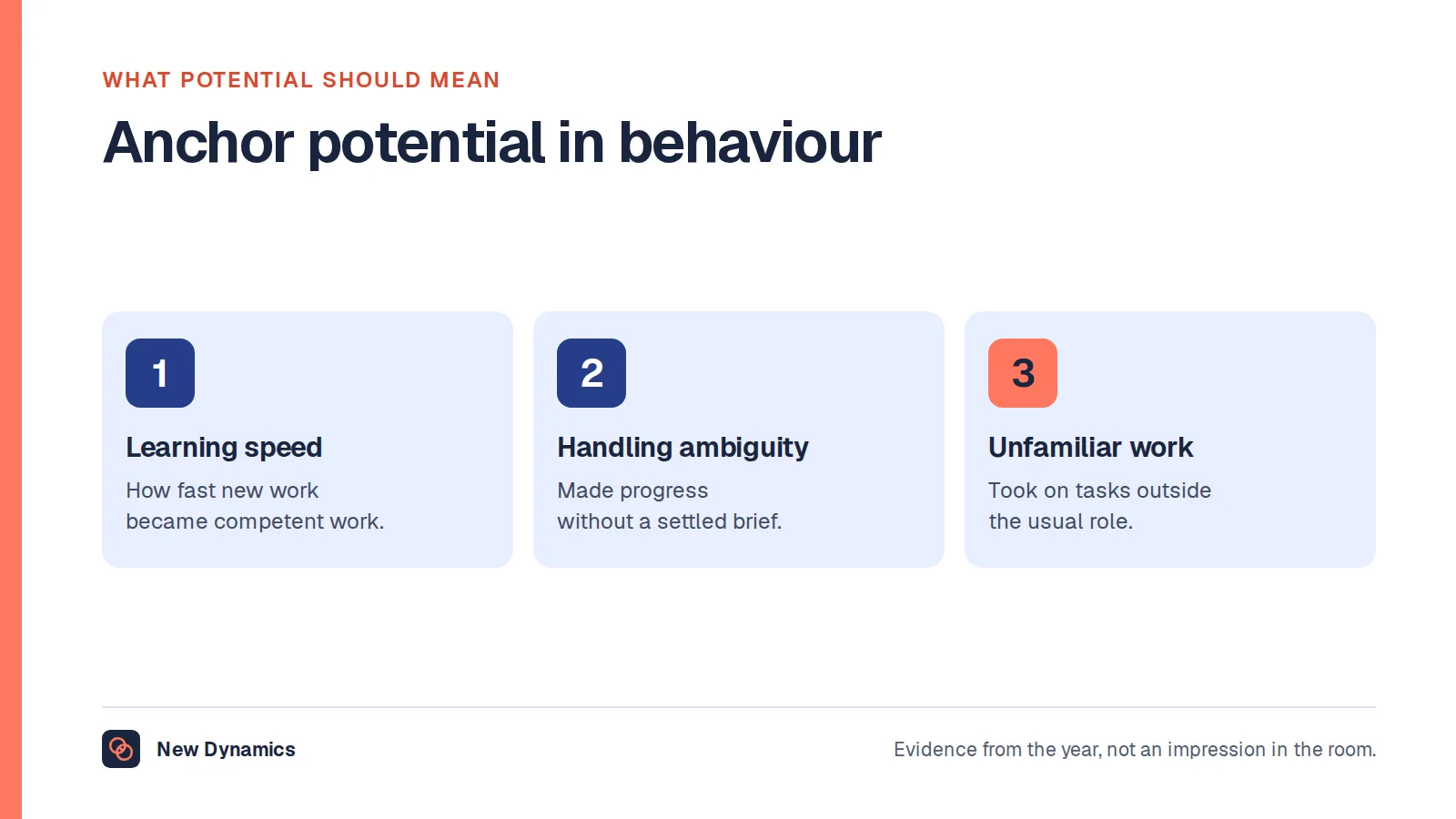
Keep performance and potential as separate judgements, and be careful with the second one. If you use a grid for this, our guide to the nine box grid sets out how to define potential as observed behaviour rather than impression.
4. Build development plans, and fund them
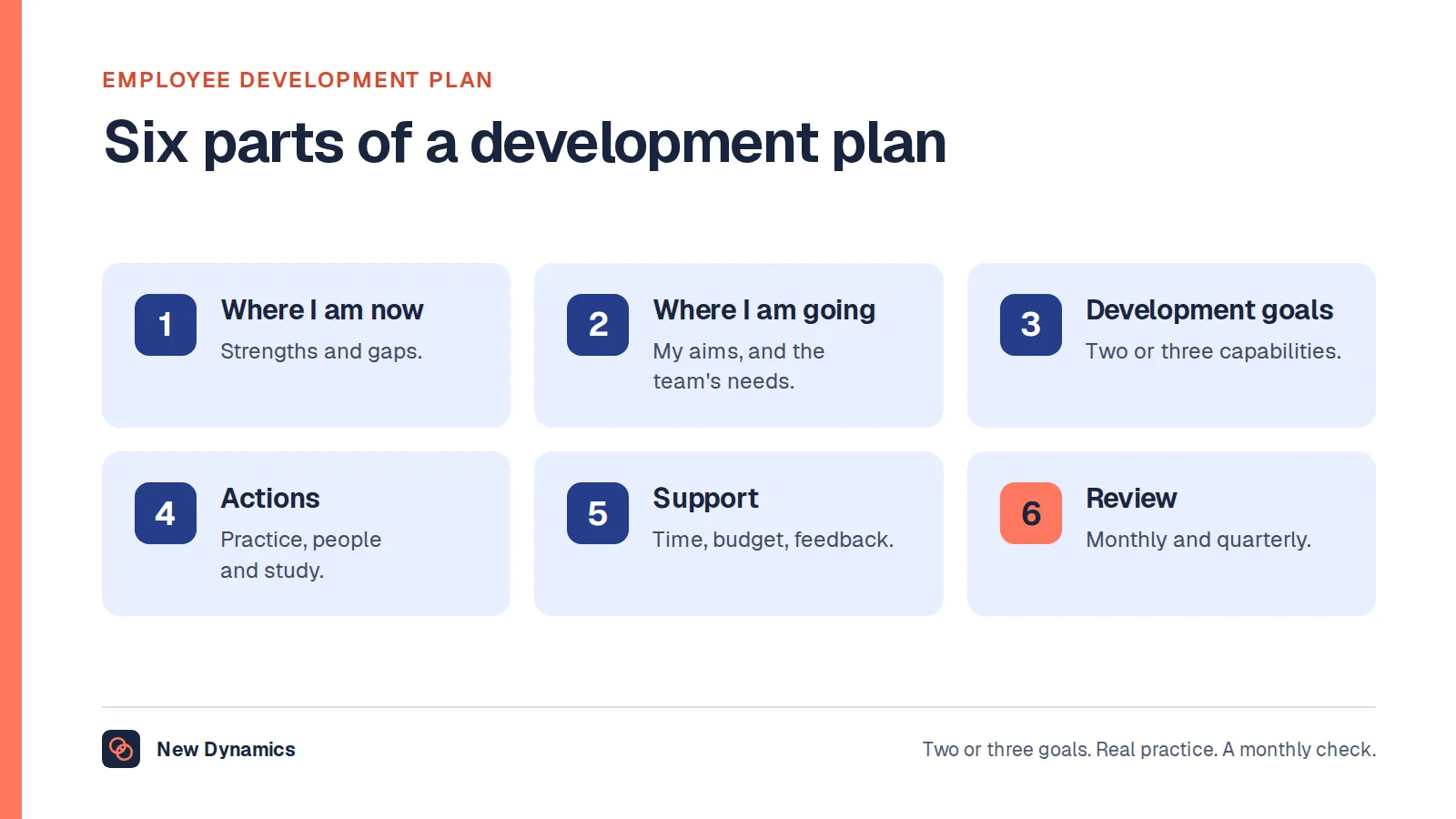
A readiness gap with no action against it is a note, not a plan. Each gap needs a named action, an owner, a date and, where it costs money, a budget line that exists.
The actions that move readiness are mostly work, not courses: a profit and loss to own, a board paper to write and present, a function to cover during a secondment, a project with real consequences. Courses support that. They do not substitute for it. See development plans for how to write one that survives a busy quarter.
5. Review, on a date already in the diary
Twice a year is a reasonable rhythm, plus a review after every unplanned exit, because an exit is the only real test the plan gets. At each review: did the development actions happen, did readiness move, has the role requirement changed, and who has joined or left the organisation since.
Readiness language that means something

Most succession plans use readiness labels. Most readiness labels mean nothing, because nobody wrote down what they require. Define them once, in your own words, and apply them the same way everywhere.
Ready now
This person could take the role on Monday with a structured handover and the normal support any new post-holder gets. They have demonstrated the core of the requirement somewhere, at something close to the scale. If you would not actually appoint them this month, they are not ready now, and recording them as ready now gives the board false comfort.
Ready in a year
Two or three specific gaps, each one named, each with an action underway and an owner. The gaps are closeable through work that exists or can be created inside the year. If you cannot name the gaps, the label is a guess.
Ready in three years
The person has the trajectory but needs breadth that only comes from a different kind of role: another function, another site, a bigger span, a turnaround, a regulated environment. Three years is a commitment to move somebody, not a polite way of saying no. If no move is planned, say so rather than parking them in the longest column.
Two things improve this language immediately. First, add "not a successor for this role" as a usable answer, so that the plan can be honest instead of complete. Second, record the date each judgement was made. A readiness label with no date is unverifiable within a year, and promotion readiness is exactly the kind of judgement that goes stale quietly.
The fairness problem, head on
This section describes the position in the United Kingdom and is general information rather than legal advice. Take advice on your own circumstances.
Succession planning is where informal favouritism hides. It is usually conducted in private, by a small group, about people who are not in the room, using a word (potential) that most organisations have never defined. That is close to a perfect set of conditions for bias, and the consequences are real: who gets the stretch project, the secondment, the budget and ultimately the job.
Acas states that "discrimination law (Equality Act 2010) protects people against discrimination at work", and that discrimination means treating someone "less favourably" than someone else because of a protected characteristic. It lists the protected characteristics as "age, disability, gender reassignment, marriage and civil partnership, pregnancy and maternity, race, religion or belief, sex, sexual orientation", and says less favourable treatment can include "excluding someone from opportunities or benefits". A succession plan is a mechanism for allocating opportunities, so that sentence is about this exercise directly.
Intention is not the test. GOV.UK tells employers that "you can discriminate against someone even if you do not intend to" and that "you can discriminate indirectly by offering working conditions or rules that disadvantage one group of people more than another". A readiness criterion built on availability for travel, long hours or relocation is exactly that kind of rule: it measures circumstance, and it filters out carers, disabled employees, part-time staff and people on a family-related leave pattern before capability is ever considered.
Three safeguards, all of them boring and all of them load-bearing:
- Written criteria, agreed before anyone is assessed. One wording for each readiness level and each capability in the role requirement, circulated in advance. Criteria invented during the meeting are criteria shaped by whoever is being discussed.
- Evidenced assessments. Every judgement carries what was observed and roughly when. Acas describes a performance review as a chance to discuss "what they are doing well, any areas for improvement, whether they need more support or training, their career and any development objectives", and says that "it's important to keep a written record of what is discussed" and that this "should be shared with the employee afterwards". A succession judgement that is never discussed with the person, and rests on no record, fails both halves of that.
- A reviewed pool. Look at who is in the plan and, more usefully, who is not. Count by sex, ethnicity, age, disability, working pattern and part-time status wherever the numbers are large enough to protect anonymity, and count by the manager who nominated. A manager whose nominations are all one profile is telling you about the manager.
And say the uncomfortable thing plainly. A succession plan that quietly reproduces the current composition of the leadership team is a signal, not a coincidence. It may be a signal about who has been given stretch work, about who is visible to the people in the room, or about how potential is being defined. It is not evidence that the pipeline simply came out that way. Treat it as a finding and go looking for who is being overlooked, including the people whose managers never put them forward. Acas guidance on performance management is a useful benchmark here, because it expects support, training and development objectives to be part of an ordinary conversation rather than a reward for already being on a list.
Whether to tell people they are in the plan
Both positions are defensible. The damage comes from not having decided.
The case for telling people. It is information about them, held by their employer, and they can ask for it. Development only works if the person is in on it, because the actions that move readiness need their consent, their effort and usually a change to their job. Transparency also disciplines the whole exercise: a judgement nobody is willing to say to someone's face is usually a judgement that was never properly evidenced. And secrecy is where unfairness survives, because a person who does not know they were considered cannot ask why they were passed over.
The case against telling people. A named successor can read it as a promise, and if the role never becomes vacant, or someone external is appointed, the organisation has created a grievance out of a good intention. Plans also change, and telling someone they have come off the list without being able to explain what changed does real damage. There is a retention argument on the other side too: the people not named may conclude there is no route and leave.
What usually works. Separate the plan from the conversation. Do not disclose the document, the rankings or who else is on it. Do discuss the substance with each person: what the organisation thinks they are strong at, which gaps are in the way of a bigger role, what is being funded to close them, and an honest statement of timing with no promise attached. "There is no guarantee of a specific role, and we are investing in you on that basis" is a sentence most people can hear.
What is not defensible is a secret plan with real consequences. If being on the list decides who gets the development budget and the visible projects, the people who have never been told are already being treated differently on the basis of a record they have not seen.
Emergency cover is not long-term succession
These are two different exercises and they are forever being collapsed into one document, which is how organisations end up with neither.
Emergency cover answers: if this person is unavailable from tomorrow, who holds the work, what can they authorise, what cannot wait, and who tells the bank, the regulator and the biggest customer. It is a short, practical document, it names people who are available now even if they are not the long-term answer, and it includes delegated authorities, system access and the one or two things only the absent person knows. It should be reviewed when people move, and it should be readable by somebody having a bad week.
Long-term succession answers: who could hold this role properly in one to three years, and what has to happen for that to be true. It is a development document, measured in years, and its success criterion is that somebody who was not ready becomes ready.
Write both. Keep them separate. The emergency plan is the one that will be used first, and the one most organisations have never written down.
What goes wrong
- Written once and filed. The most common outcome by a distance. A plan with no review date and no owner is a document that was produced for a board paper, not a process. Put the review in the diary before the first meeting ends.
- The same three names against every role. It looks like strength and it is a concentration risk. It usually means the group is nominating the people it can see rather than assessing against each role requirement separately. Test it by asking what each person would actually have to learn for each role: if the answer is the same, the roles were never defined.
- Confusing performance with potential. Excellent delivery in the current job is evidence about the current job. It predicts a different role only where the two jobs demand the same things, and senior roles usually demand different things. This is the mistake that produces a capable specialist promoted into a management job nobody has prepared them for.
- Development that is never funded. A plan whose actions are all courses that get cancelled, or secondments nobody will release anyone for, is not a plan. If no budget line and no real work changes hands, nothing moves, and next year's readiness labels will be last year's with the dates edited.
- No honest "no". A plan where every critical role has a ready successor is usually a plan where somebody rounded up. A named gap with a recruitment strategy against it is far more useful to a board than a reassuring name.
- Potential assessed without a definition. If nobody wrote down what potential means in your organisation, the room will fall back on who comes to mind, and that is not a neutral list.
- One plan for the whole organisation. Succession planning for managers at team level and succession for the executive are different conversations with different owners. Running them in one spreadsheet means neither gets attention.
Where New Dynamics fits
Plainly, because it matters when you are comparing software: New Dynamics does not sell a succession planning module, and we do not position succession management as a product. What the platform holds is the material a succession conversation needs, which is goals and how they moved, feedback from more than one manager, and the review record across the cycle rather than a recollection of the last few months.
That is usually the binding constraint. Most succession plans are not held back by the absence of a specialist tool. They are held back by the fact that nobody can say what a candidate has actually demonstrated, because the evidence was never captured in the first place. If succession software is your core requirement, say so early in any software conversation, including ours.
Frequently asked questions
What is succession planning?
It is the process of making sure the organisation can still do its critical work when the people currently doing it leave, retire, are promoted or become unavailable. It identifies the roles where a sudden vacancy would cause real damage, defines what each of those roles will need, assesses who could get there, and funds the development that closes the gap.
What is the difference between succession planning and replacement planning?
A replacement chart names a substitute for the job as it is done today. A succession plan builds the capability the job will need. The practical test is whether your document would read the same whether or not any development happened this year. If it would, it is a replacement chart.
Which roles need a succession plan?
Judge each role on two things: the damage a sudden vacancy would cause, and how hard the role is to fill. Roles scoring high on both need a plan. High damage but easy to fill needs an emergency cover arrangement instead, and a hard-to-fill role with low impact usually needs its knowledge documented rather than a successor named.
How many successors should a role have?
Enough that the plan does not depend on one person, and few enough that each of them gets real development. Naming the same two or three people against every senior role is a warning sign rather than a strength, because it almost always means candidates were nominated from visibility rather than assessed against each role requirement.
Should you tell someone they are in the succession plan?
Decide the position in advance and apply it consistently. A workable middle is to keep the document confidential while discussing the substance with each person: their strengths, the gaps in the way of a bigger role, what is being funded, and an honest statement about timing with no promise of a specific job. A secret plan that decides who gets development is the version that is hard to defend.
Is succession planning a legal requirement in the United Kingdom?
There is no general legal duty to hold a succession plan, though sector regulators and governance codes impose expectations on some organisations. Discrimination law does apply to the decisions a plan drives. Acas notes that less favourable treatment can include excluding someone from opportunities or benefits, so written criteria, evidenced assessments and a reviewed pool matter. Take advice on your own circumstances.
Your next steps
- List your critical roles using the two tests, damage and difficulty to fill, and write the reason beside each one. If the list runs past ten, you have listed seniority rather than criticality.
- For the top three, write the role requirement for two years' time before you look at a single candidate.
- Define your readiness labels in your own words, add "not a successor for this role" as a permitted answer, and date every judgement.
- Write the emergency cover arrangement separately, including delegated authorities and system access, and keep it somewhere findable.
- Check the pool for who is missing, count by manager as well as by group, and fund at least one development action per named gap.
For the full process, worksheets and the review rhythm, read and download our succession planning guide. The guide is free to read, and the PDF uses our short download form. For the individual half of the work, our career development guide covers the conversation itself.
Want the goals, feedback and review evidence in one place before your next succession discussion? Book a New Dynamics demo and bring the plan you wrote last year. You can also email contact@new-dynamics.com.