TL;DR
- SUTA and SUI are informal names for the same thing: the unemployment tax a state charges employers. Neither acronym appears on the IRS or Department of Labor pages that govern it, and the only federal statute carrying the letters SUTA is the SUTA Dumping Prevention Act of 2004.
- The employer pays it almost everywhere. The Department of Labor says benefit funding is based solely on a tax imposed on employers in the majority of states, and names Alaska, New Jersey and Pennsylvania as the three that also require contributions from workers.
- FUTA is the separate federal tax. IRS Publication 15 for 2026 gives the FUTA rate as 6.0% on the first $7,000 of each employee's wages, with a credit of up to 5.4% for state unemployment taxes paid, which takes the net rate to 0.6%.
Jurisdiction: United States. This article is about the unemployment tax that American states charge on wages, and the federal tax that sits beside it. It does not describe the United Kingdom, which funds its own system through National Insurance and has no state equivalent. Every figure below names the year it applies to and the page it came from. It is general information, not legal or tax advice.
Two acronyms cause most of the confusion. A new employer reads SUTA in one place, SUI in another, FUTA in a third, and reasonably assumes they are three different taxes. They are not. Two of them are the same tax under two names, and the third is a separate federal charge that interacts with it through a credit.
Getting a new hire onto the right state's payroll is an onboarding question before it is a tax question. See how New Dynamics onboarding keeps the tasks, owners and dates for a new employee in one place so nothing is discovered late.
SUTA and SUI are two names for the same tax
SUTA is read as State Unemployment Tax Act, by analogy with the Federal Unemployment Tax Act. SUI is read as state unemployment insurance. In practice, payroll software, accountants and payslips use them interchangeably to mean one thing: the contribution an employer pays to a state fund that pays unemployment benefits to people who lose their jobs.
Worth knowing before you go looking for an authority: neither acronym is used by the agencies that run the tax. The IRS writes about "state unemployment funds" and "state unemployment taxes". The Department of Labor's unemployment insurance tax topic page, updated on 11 September 2026, heads its section "State Unemployment Tax" and describes the arrangement like this: "Unemployment Insurance (UI) is a federal-state program jointly financed through Federal and state employer payroll taxes (federal/state UI tax)."
The letters SUTA do appear in one piece of federal law, and it is not a taxing statute. The Department of Labor's Comparison of State Unemployment Insurance Laws, whose most recent edition is for 2023, refers in its financing chapter to "The SUTA Dumping Prevention Act of 2004 (Public Law 108-295)", which deals with employers manipulating payrolls to dodge a high experience rate. That is the whole federal pedigree of the acronym.
So if a payslip, a rate notice or a ledger line says SUI, and a software field says SUTA, you are looking at the same liability. What matters is which state, which year and which rate.

How it differs from FUTA
FUTA is federal, flat and annual. State unemployment tax is state-set, varies by employer and is usually reported quarterly.
The Department of Labor describes the division of labour between them. FUTA "covers the costs of administering the UI and Job Service programs in all states", pays half the cost of extended benefits in high unemployment periods, and "provides for a fund from which states may borrow, if necessary, to pay benefits". The state tax does something narrower: "The state unemployment tax, paid to state workforce agencies, is used solely for the payment of benefits to eligible unemployed workers."
For the federal figures, IRS Publication 15 (2026), Circular E, Employer's Tax Guide, section 14, is the page to cite: "For 2026, the FUTA tax rate is 6.0%. The tax applies to the first $7,000 you pay to each employee as wages during the year. The $7,000 is the federal wage base. Your state wage base limit may be different." The same section is blunt about who pays: "Only the employer pays FUTA tax; it isn't withheld from the employee's wages."
Reporting is annual. IRS Topic no. 759, last reviewed on 24 September 2026, gives the deadline: "The due date for filing the Form 940 is January 31. However, if you deposited all FUTA tax when due, you have until February 10 to file." Publication 15 applies that rule to the current cycle: "File your 2025 Form 940 by February 2, 2026. However, if you deposited all FUTA tax when due, you may file on or before February 10, 2026." The shift to 2 February is because 31 January 2026 is a Saturday, and Topic no. 759 allows a return due on a weekend or legal holiday to be filed on the next business day. Deposits are quarterly only once the liability passes a threshold: "If your FUTA tax liability for any calendar quarter is $500 or less, you don't have to deposit the tax."
State filing is on the state's own schedule. New Jersey, for example, requires the NJ-927 and WR-30 by the 30th day of the month after the quarter closes, and states on its own page that no extension applies if that date falls on a weekend or holiday.
Who pays: the employer, in almost every state
This is the question behind most searches, and the general answer is clear. The Department of Labor's state unemployment insurance benefits fact sheet, updated on 11 September 2026, puts it in one line: "In the majority of States, benefit funding is based solely on a tax imposed on employers. (Three (3) States require minimal employee contributions.)"
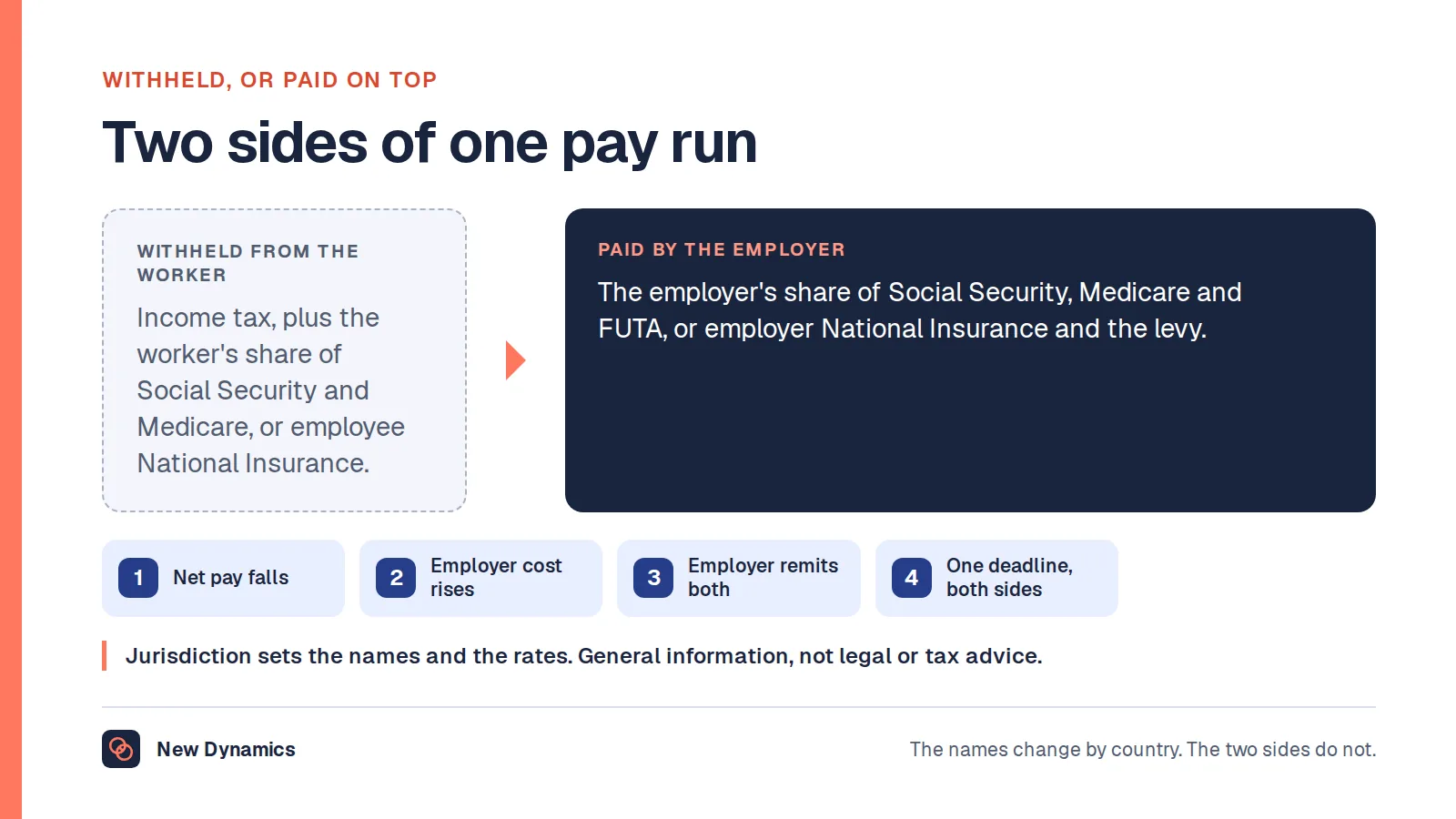
The Comparison of State Unemployment Insurance Laws names those three. Its financing chapter states: "Alaska, New Jersey, and Pennsylvania require payment of UI taxes by workers." It adds the mechanics, which are worth quoting because they explain what a worker sees: "Employee contributions are deducted by the employer from the employee's pay and forwarded with the employer's taxes to the state agency."
Everywhere else, the state unemployment tax is an employer cost that never touches net pay. If a payslip in one of the other states shows a deduction labelled SUI, that is worth querying, because it may be a state disability or paid family leave contribution travelling under a loose label rather than unemployment tax.

New Jersey, where the worker really does contribute
New Jersey is the state most often searched on this point, and its own figures are published. The New Jersey Department of Labor and Workforce Development rate information page sets out worker and employer rates side by side, and labels the wage base explicitly for both: "2026 Taxable Wage Base (UI and WF/SWF - workers and employers, TDI - employers): $44,800". The 2027 figure on the same page is $46,400.
For the period 1 January 2026 to 31 December 2026, the page gives the Worker rates as U.I. 0.003825, D.I. 0.0019, W.F./S.W.F. 0.000425 and F.L.I 0.0023. Read that carefully, because only the first of those is unemployment insurance. The worker's unemployment contribution is 0.3825% of wages up to the taxable wage base, with a further 0.0425% for the Workforce Development and Supplemental Workforce Funds. The disability and family leave lines are separate programmes with their own wage bases, and the family leave base for workers in 2026 is $171,100.
One discrepancy to be aware of, because two official sources word it differently. The Department of Labor's Comparison says "In New Jersey, the employee contribution rate is 0.425 percent." New Jersey's own table shows 0.3825% for U.I. plus 0.0425% for W.F./S.W.F., which adds up to exactly 0.425%. The federal publication is describing the combined worker deduction; the state is describing its components. The state's page is the one to work from, because it is the body that sets and collects the rates and it publishes a figure for each calendar year.
Alaska and Pennsylvania
Alaska's Department of Labor and Workforce Development publishes the employee rate alongside the wage base in its Employment Security Tax FAQ. For 2026 it gives a wage base of $54,200, a standard rate of 1.50%, an employee rate of 0.50%, and an employee total of $271.00 for the year. For 2025 the same table gives $51,700, 1.50% and 0.50%.
Pennsylvania works differently, and the difference matters. The Department of Labor and Industry page on calculating contributions, penalties and interest states: "Employers covered under the PA UC Law are responsible for withholding employee contributions from each employee's gross wages. The employee contribution rate is determined annually." It gives the rate as 0.07%, shown in its table as applying to "2023 and thereafter", and says the rate "has been set at 0.07 percent for the calendar year 2027". Note gross wages. The Department of Labor's Comparison confirms the point: the taxable wage base is the same one that applies to employers "except in Pennsylvania, where employee contributions are calculated on total gross covered wages earned in employment". Pennsylvania's employer wage base, by contrast, is $10,000, shown on the same state page as applying to "2018 and thereafter".
Experience rating, and why a new employer gets a standard rate
An employer's state rate is not a single national number. It is assigned, and it moves with the employer's own record.
The Department of Labor's Comparison states the principle: "Federal law requires that states use a system of experience rating by which individual employers' contribution rates vary on the basis of their 'experience' with the risk of unemployment." The purpose is stated too, which is useful when explaining a rate rise to a finance director: experience rating systems "are designed to encourage employers to stabilize employment, equitably allocate the costs of unemployment, and participate in the system by providing eligibility information".
A new employer has no record to rate, so states assign a standard or new employer rate instead. Federal law puts a floor under it. The Comparison explains that federal law "allows states to assign new employer rates on a 'reasonable basis,' but not less than 1.0 percent", and that "Typically, states assign either a flat rate to all new employers or a rate based on the new employer's industry type". So a new employer rate is not a penalty and not a discount. It is a placeholder until there is experience to measure.
New Jersey shows how long that takes in one state. Its rate page states: "All new employers (except successors) are assigned new employer rates for the first three calendar years, after which a calculated rate is assigned based on employment experience." It also explains the formula it then uses: "Contribution rates for the current fiscal year are based on an employer's reserve ratio and the Unemployment Trust Fund reserve ratio", with the employer reserve ratio being the reserve balance divided by average annual payroll. And its rate year is not the calendar year. The page says unemployment and temporary disability contribution rates in New Jersey "are assigned on a fiscal year basis", running from 1 July to 30 June. The Department of Labor confirms it in a footnote to its July 2026 table: "Rate year is July 1 through June 30. All other states have a rate year of January 1 through December 31."

The taxable wage base is set per state and per year
Unemployment tax is charged on a slice of each employee's pay, not on all of it. That slice is the taxable wage base, and it is one of the two numbers you need, the other being your assigned rate.
How much it varies is easy to underestimate. The Department of Labor's Significant Provisions of State Unemployment Insurance Laws, effective July 2026, publishes a "Wages Subject to Tax" column for every state. Six states sit at the federal $7,000 figure, California and Florida among them. Washington is the highest in the table at $78,200. New Jersey appears at $44,800, which matches the state's own published figure for 2026.
That is more than a ten-fold spread, so a per-employee cost calculated in one state tells you very little about another. Most states also move the figure every year, as New Jersey did from $43,300 in 2025 to $44,800 in 2026 and $46,400 in 2027. Pennsylvania is one of the exceptions, holding at $10,000 since 2018.
Rates vary too. The same July 2026 table gives California a minimum of 1.50%, a maximum of 6.20% and a new employer rate of 3.40%, Florida 0.10%, 5.40% and 2.70%, and New Jersey 0.5%, 5.8% and 2.8%. Two footnotes on that table are important: the rates shown "apply only to experience rated employers and do not include surtaxes, penalties, surcharges, or applicable non-UI taxes", and the new employer rate shown "is the base rate", with higher rates possible depending on industry classification. Your own rate comes from the rate notice your state issues, not from a summary table.
The FUTA credit for state unemployment taxes paid
The two taxes are linked by a credit, and it is the reason the headline federal rate of 6.0% is almost never what an employer actually pays.
Publication 15 for 2026 states it directly: "Generally, you can take a credit against your FUTA tax for amounts you paid into state unemployment funds. The credit may be as much as 5.4% of FUTA taxable wages. If you're entitled to the maximum 5.4% credit, the FUTA tax rate after credit is 0.6%." Topic no. 759 sets out the conditions: you get the maximum credit if you paid your state unemployment taxes "in full, by the due date of your Form 940, and on all the same wages as are subject to FUTA tax and the state isn't determined to be a credit reduction state".
The Department of Labor's tax topic page puts the resulting cost in dollars: at 0.6% on a $7,000 base, that is "a maximum FUTA tax of $42.00 per employee, per year".
Two things break the credit.
A credit reduction state. Topic no. 759 defines it as "a state that hasn't repaid money it borrowed from the federal government to pay unemployment benefits", and notes that the Department of Labor "determines the credit reduction states each year". Where it applies, the credit shrinks and more federal tax is due, reported on Schedule A of Form 940.
A mismatch in the wage base. Publication 15 warns that "certain states exclude some types of wages from state unemployment tax, even though they're subject to FUTA tax", giving wages paid to corporate officers and certain union sick pay as examples. On those wages "you may be required to deposit more than 0.6% FUTA tax".
Paying the state late is the cheapest mistake to avoid here, because the lost credit can cost more than the interest the state charges. For how unemployment tax sits inside everything else coming off and on top of a wage, see our posts on payroll tax against income tax and payroll deductions.
Frequently asked questions
What does SUTA stand for?
SUTA is read as State Unemployment Tax Act. It is industry shorthand rather than an official term: the IRS writes about "state unemployment funds" and the Department of Labor heads its section "State Unemployment Tax". The only federal statute carrying the letters is the SUTA Dumping Prevention Act of 2004, Public Law 108-295, which targets employers manipulating payrolls to avoid a high experience rate.
Is SUTA the same as SUI?
Yes. SUI stands for state unemployment insurance, and both acronyms describe the unemployment contribution a state charges on wages. Payroll systems, accountants and state agencies use different labels for the same liability. What changes the amount is the state, the year, your assigned rate and the state's taxable wage base.
What is the difference between SUTA and FUTA?
FUTA is the federal tax, at 6.0% on the first $7,000 of each employee's wages for 2026 according to IRS Publication 15, reported once a year on Form 940. State unemployment tax is set by each state, varies by employer through experience rating, uses the state's own wage base and is usually reported quarterly. Paying the state tax earns a credit of up to 5.4% against the federal one.
Is SUI paid by the employee or the employer?
The employer, in almost every state. The Department of Labor says benefit funding is "based solely on a tax imposed on employers" in the majority of states, and names Alaska, New Jersey and Pennsylvania as the three that also require contributions from workers. In those three, the employer withholds the worker's share and sends it with its own.
Is NJ SUI employee paid?
Partly. New Jersey charges both sides. For 1 January 2026 to 31 December 2026 the state's own rate table gives the Worker U.I. rate as 0.003825, meaning 0.3825% of wages up to the 2026 taxable wage base of $44,800, with a further 0.0425% for the Workforce Development and Supplemental Workforce Funds. The disability and family leave lines on a New Jersey payslip are separate programmes with their own rates and their own wage bases.
What is the SUTA wage base for this year?
There is no single figure, and any article printing one without naming a state is wrong. Each state sets its own and most change it annually. The Department of Labor's Significant Provisions of State Unemployment Insurance Laws, effective July 2026, shows six states at $7,000 and Washington at $78,200. Take your figure from your state agency for the year you are paying in.
Why is my new company's unemployment rate higher than a competitor's?
Because you have no experience record yet. Federal law requires states to vary rates with each employer's experience of unemployment risk, and lets them assign new employers a rate on a reasonable basis that cannot be below 1.0%. An established employer with few claims charged to its account can sit well under the new employer rate. New Jersey, for example, assigns new employer rates for the first three calendar years before calculating one from experience.
Do employees in other states ever pay unemployment tax?
Not for unemployment insurance. Only Alaska, New Jersey and Pennsylvania require worker contributions, on the Department of Labor's own list. Deductions elsewhere that look similar are usually state disability insurance or paid family and medical leave, which are different programmes with different rates and different wage bases, so check the label on the payslip against the state's own published rates.
Your next step: write down the three numbers per state
- For each state you have employees in, record the taxable wage base for the year, your assigned rate from the state's rate notice, and the quarterly filing deadline. Three numbers, per state, per year.
- Note whether the state requires employee contributions. Only Alaska, New Jersey and Pennsylvania do, and getting that wrong either shorts the fund or takes money from a worker who does not owe it.
- Diarise the rate notice. New Jersey issues rates on a July to June basis; Pennsylvania plans to issue the 2027 notice by 31 December 2026 and allows a rate appeal within 90 days of the mailing date.
- Pay the state tax in full and on time, so the FUTA credit of up to 5.4% survives intact.
- Check whether any of your states is a credit reduction state before you file Form 940, because that changes the federal amount due.
For setting pay in a way you can explain to the people it applies to, read and download our compensation policy guide. The guide is free to read, and the PDF uses our short download form.
Want employment admin to have an owner and a date rather than a good intention? Book a New Dynamics demo and bring your current process. You can also email contact@new-dynamics.com.