TL;DR
- Form W-2 is American. The IRS calls it the Wage and Tax Statement, and says that "Every employer engaged in a trade or business who pays remuneration, including noncash payments, for services performed by an employee must file Form W-2 for each employee." Copy A goes to the Social Security Administration with Form W-3, not to the IRS.
- Box 3 is capped and box 5 is not. The 2026 instructions say "The total of boxes 3 and 7 cannot exceed $184,500 (2026 maximum social security wage base)", while for box 5 "there is no wage base limit for Medicare tax". That single difference explains most of the questions people bring to payroll in February.
- There is no UK W-2. The nearest equivalents are the P60 at the end of the tax year and the P45 on leaving, sitting on top of Real Time Information reported to HMRC on or before every payday. General information only, not legal or tax advice.
Every January somebody in HR is handed a W-2 and asked why box 1, box 3 and box 5 are three different numbers for one person paid once. The employee is sure one is wrong. Usually none of them is.
It is worth saying plainly at the start: Form W-2 is American. It belongs to the United States federal tax system and there is no UK version of it. A British reader should skip to the final section, where the P60 and P45 do a narrower job.
Year end filing is a deadline problem before it is a tax problem. See how New Dynamics workflows give an annual task an owner and a due date.
This is general information about United States and United Kingdom reporting rules, not legal or tax advice. Every figure, deadline and box description below is quoted from the page that publishes it, with the tax year named, and all of them change.
What Form W-2 is, and who must get one

Jurisdiction: United States. Form W-2 is the annual statement an employer gives each employee, and files with the government, setting out what the person was paid and what was withheld. Its official title is the Wage and Tax Statement. The IRS About Form W-2 page, current revision 2026 and last reviewed on 11 September 2026, states the duty in one sentence: "Every employer engaged in a trade or business who pays remuneration ... for services performed by an employee must file Form W-2 for each employee."
So the W-2 reports; it does not calculate anybody's tax. The employer withheld through the year, and the form records what happened.
The General Instructions for Forms W-2 and W-3 (2026) set the test: "You must file Form(s) W-2 if you have one or more employees to whom you made payments ... for the employees' services in your trade or business during 2026." One trigger catches employers who assume a small payment does not count: "You paid $2,000 or more in wages even if you did not withhold any income, social security, or Medicare tax." That threshold replaced $600 for wages paid after 2025, and will be "adjusted for inflation" each year after 2026.
One thing the word "W-2" hides: the form has several copies going to different places. Copies B, C and 2 go to the employee. Copy A goes to the Social Security Administration, not the IRS, which surprises somebody every year.
When W-2s are due, and what Form W-3 is for
Jurisdiction: United States. The IRS page on depositing and reporting employment taxes, last reviewed on 29 June 2026, gives the general rule in one line: "Forms W-2 are required to be furnished to employees and filed with SSA by January 31."
For a given year the date can move, because a due date at a weekend rolls forward, so the 2026 instructions name the actual dates. On furnishing: "Generally, you must furnish Copies B, C, and 2 of Form W-2 to your employees by February 1, 2027." On filing: "The due date for filing 2026 Forms W-2 ... with the SSA is February 1, 2027, whether you file using paper forms or electronically." Unlike Form 1099-MISC, the W-2 deadline does not shift for electronic filers.
Form W-3 is the transmittal. The IRS About Form W-3 page, last reviewed on 25 June 2026, gives its purpose: "Use Form W-3 to transmit Copy A of Forms W-2." The instructions add that "Anyone required to file Form W-2 must file Form W-3".
Most employers must file electronically, and the threshold is aggregated. You must e-file "if you are required to file at least 10 information returns", adding information returns and Forms W-2 together: "If the total is at least 10 returns, you must e-file them all." Ten is not ten W-2s, so eight employees and three contractors puts you over.
Lateness is priced per form, from "$60 per Form W-2 if you correctly file within 30 days after the due date" to "$340 per Form W-2 if you file after August 1". Our post on payroll records covers how long to hold the detail underneath.

Box 1: wages, tips and other compensation
Jurisdiction: United States. Box 1 is where the employee's tax return starts, and on most forms it is the smallest of the three wage figures. The instruction: "Show the total taxable wages, tips, and other compensation that you paid to your employee during the year. However, do not include elective deferrals (such as employee contributions to a section 401(k) or 403(b) plan) except section 501(c)(18) contributions."
That exception is the whole reason box 1 and box 3 diverge. Money put into a retirement plan before tax is pay the employee received, but it is not taxable income this year, so it drops out of box 1 while staying in the social security and Medicare figures.
What box 1 includes is longer than people expect: wages, bonuses, prizes and awards, "Total tips reported by the employee to the employer (not allocated tips)", cafeteria plan benefits taken as cash, and the "Taxable cost of group-term life insurance in excess of $50,000". Designated Roth contributions are in box 1 too, because they are made after tax.
Box 3: social security wages, and why box 3 is not box 1
Jurisdiction: United States. This is the most asked W-2 question, and the instruction nearly answers it: "Show the total wages paid (before payroll deductions) subject to employee social security tax but not including social security tips and allocated tips."
Three phrases carry it. Before payroll deductions means box 3 is gross. Subject to employee social security tax means not all pay qualifies, which is the next section. Not including social security tips means tips have their own box, and the cap spans both.
The cap: "The total of boxes 3 and 7 cannot exceed $184,500 (2026 maximum social security wage base)." IRS Topic no. 751, last reviewed on 24 September 2026, gives the same figure from the tax side: "Only the Social Security tax has a wage base limit. ... For earnings in 2026, this base limit is $184,500." It moves annually, so check the current figure.
The cap gives a cross-check too, since box 4 holds the tax withheld and "For 2026, the amount should not exceed $11,439". Our post on payroll tax against income tax covers who pays which half, and the statistics hub the wider figures.
Where box 3 is higher than box 1, a deferral is usually why: "Report in box 3 elective deferrals to certain qualified cash or deferred compensation arrangements and to retirement plans described in box 12 (codes D, E, F, G, and S) even though the deferrals are not includible in box 1."
How social security wages are arrived at, and what is excluded
Jurisdiction: United States. No formula is published as a formula. Social security wages are arrived at by starting from everything you paid and taking out what the law says is not covered, which is why the question has no one line answer.
- Start with all pay for services, in cash or in kind. Publication 15 (2026) sets the default wide: pay "includes salaries, vacation allowances, bonuses, commissions, and taxable fringe benefits."
- Add back the pre-tax retirement deferrals that left box 1.
- Add the items the instructions name, among them signing bonuses and adoption benefits.
- Take out what is excluded, below.
- Stop at the cap. Boxes 3 and 7 together cannot exceed the wage base.
What is excluded. Publication 15 carries the long table, under special rules for various types of services and payments. The exclusions an ordinary employer meets are these.
- Cafeteria plan benefits taken as a nontaxable benefit. The footnote to the table is the clearest line: "Benefits provided under cafeteria plans may qualify for exclusion from wages for social security, Medicare, and FUTA taxes." Take the cash and it is "subject to all employment taxes".
- HSA contributions by salary reduction in a cafeteria plan, which "aren't wages and aren't subject to employment taxes or withholding".
- Dependent care assistance, "Exempt to the extent it is reasonable to believe amounts are excludable ... under section 129."
Note what is not excluded, because this is where assumptions cost money. Publication 15: "Severance payments are wages subject to social security and Medicare taxes, federal income tax withholding, and FUTA tax." Signing bonuses and overtime are in too. Our post on payroll deductions covers everything else that comes off gross pay.
Box 5 and box 7: Medicare wages and tips, and social security tips

Jurisdiction: United States. Box 5 is the easiest box to describe and the most often misread. The instruction does two jobs in one sentence: "The wages and tips subject to Medicare tax are the same as those subject to social security tax (boxes 3 and 7) except that there is no wage base limit for Medicare tax."
So box 5 is built from the same raw material as boxes 3 and 7 added together, and then keeps going. The IRS worked example is the clearest passage in the document: "You paid your employee $199,750 in wages. Enter in box 3 (social security wages) 184500.00, but enter in box 5 (Medicare wages and tips) 199750.00. ... If the amount of wages paid was $184,500 or less, the amounts entered in boxes 3 and 5 will be the same."
That last sentence settles the commonest version of the question. Most employees see the same figure in boxes 3 and 5, because most are paid below the wage base, so a difference means high pay, not an error. Box 6 holds Medicare tax withheld, and the surcharge on top falls on one side only. Per Topic no. 751, employers withhold "the 0.9% Additional Medicare tax on an individual's wages paid in excess of $200,000 in a calendar year", and "There's no employer match" for it.
Box 7, social security tips. The instruction: "Show the tips that the employee reported to you even if you did not have enough employee funds to collect the social security tax for the tips. The total of boxes 3 and 7 should not be more than $184,500 (the maximum social security wage base for 2026). ... Also include any tips reported in box 7 in box 5."
So box 7 holds tips the employee reported to the employer, not an estimate and not a card total. The same tips appear again in box 1 and box 5, so a tipped employee sees the same money three times without anything being double counted. And box 7 shares the cap with box 3, which is why a tipped high earner can see box 3 come in below their basic salary.
Allocated tips, in box 8, are a different thing: "Do not include this amount in box 1, 3, 5, or 7."
Box 10 and box 11: dependent care benefits and nonqualified plans
Jurisdiction: United States. Two boxes that confuse people because what is in them is not necessarily taxable.
Box 10, dependent care benefits. The instruction is to "Show the total dependent care benefits under a dependent care assistance program (section 129) paid or incurred by you for your employee", including employer provided daycare and cafeteria plan amounts. The reporting is gross: "Report all amounts paid or incurred ... including those in excess of the $5,000 exclusion." Anything above the exclusion also goes into boxes 1, 3 and 5.
Here the published instructions and the law disagree, and the IRS has said so in writing. A correction notice dated 11 September 2026 states that "P.L. 119-21, section 70404, increased the maximum amount of the exclusion to $7,500 beginning in 2026." Correct that figure by hand on any printed copy.
Box 11, nonqualified plans. This box exists for somebody else's benefit entirely: "The purpose of box 11 is for the SSA to determine if any part of the amount reported in box 1 or boxes 3 and/or 5 was earned in a prior year."
So box 11 is a timing signal, not a tax figure. The entry rule is to "Report distributions to an employee from a nonqualified plan or nongovernmental section 457(b) plan in box 11", also in box 1, and to "Make only one entry in this box." Then the caution that is a common filing error: "If you made distributions and are also reporting any deferrals in boxes 3 and/or 5, do not complete box 11." Accumulated sick pay and vacation pay do not belong here.
Box 12 codes, in full
Jurisdiction: United States. Box 12 is where the W-2 stops being a wage statement and becomes a list of footnotes. Four items is the ceiling on the filed copy: "On Copy A (Form W-2), do not enter more than four items in box 12", and extra items go on a separate Form W-2. The IRS reference guide for box 12 codes, in the 2026 instructions, lists them as follows.
| Code | What it reports |
|---|---|
| A | "Uncollected social security or RRTA tax on tips" |
| B | "Uncollected Medicare tax on tips (but not Additional Medicare Tax)" |
| C | "Taxable cost of group-term life insurance over $50,000" |
| D | "Elective deferrals under a section 401(k) cash or deferred arrangement plan" |
| E | "Elective deferrals under a section 403(b) salary reduction agreement" |
| F | "Elective deferrals under a section 408(k)(6) salary reduction SEP" |
| G | "Elective deferrals and employer contributions ... to a section 457(b) plan" |
| H | "Elective deferrals to a section 501(c)(18)(D) ... plan" |
| J | "Nontaxable sick pay" |
| K | "20% excise tax on excess golden parachute payments" |
| L | "Substantiated employee business expense reimbursements" |
| M | "Uncollected social security or RRTA tax on taxable cost of group-term life insurance over $50,000 ..." |
| N | "Uncollected Medicare tax on taxable cost of group-term life insurance over $50,000 ..." |
| P | "Excludable moving expense reimbursements paid directly to a member of the U.S. Armed Forces ..." |
| Q | "Nontaxable combat pay" |
| R | "Employer contributions to an Archer MSA" |
| S | "Employee salary reduction contributions under a section 408(p) SIMPLE plan" |
| T | "Adoption benefits" |
| V | "Income from exercise of nonstatutory stock option(s)" |
| W | "Employer contributions ... to an employee's health savings account (HSA)" |
| Y | "Deferrals under a section 409A nonqualified deferred compensation plan" |
| Z | "Income under a nonqualified deferred compensation plan that fails ... section 409A" |
| AA | "Designated Roth contributions under a section 401(k) plan" |
| BB | "Designated Roth contributions under a section 403(b) plan" |
| DD | "Cost of employer-sponsored health coverage" |
| EE | "Designated Roth contributions under a governmental section 457(b) plan" |
| FF | "Permitted benefits under a qualified small employer health reimbursement arrangement" |
| GG | "Income from qualified equity grants under section 83(i)" |
| HH | "Aggregate deferrals under section 83(i) elections ..." |
| II | "Medicaid waiver payments excluded from gross income under Notice 2014-7" |
| TA | "Employer contributions under a section 128 Trump account ... program" |
| TP | "Total amount of cash tips reported to the employer" |
| TT | "Total amount of qualified overtime compensation" |
Three are new for the 2026 forms: TA, TP and TT, the last two following the new deductions for qualified tips and qualified overtime. Code DD is informational and not taxable income, and code W bundles the employer's HSA contribution with the employee's own.
W-2 against W-4: one reports, one instructs
Jurisdiction: United States. These two are confused constantly, and the difference is simple once you notice which way each one travels.
The W-4 is an instruction from the employee to the employer, before the pay. The IRS About Form W-4 page, last reviewed on 10 September 2026, says: "Complete Form W-4 so that your employer can withhold the correct federal income tax from your pay. Consider completing a new Form W-4 each year and when your personal or financial situation changes." Its full title is the Employee's Withholding Certificate, and the certificate word is the clue.
The W-2 is a report from the employer, after the pay. Neither form replaces the other: an employee files a W-4 once and updates it when life changes, and receives a W-2 once a year. The W-4 shapes box 2 of the W-2 and nothing else.
Two practical differences follow, both from Publication 15. The W-4 touches income tax only, so claiming exemption does not remove social security or Medicare: "However, the wages are still subject to social security and Medicare taxes." And an exemption expires: "To continue to be exempt from withholding, an employee must give you a new Form W-4 by February 15." Our post on new employee forms sets the W-4 alongside the rest of the first day paperwork.
W-2 against 1099, briefly
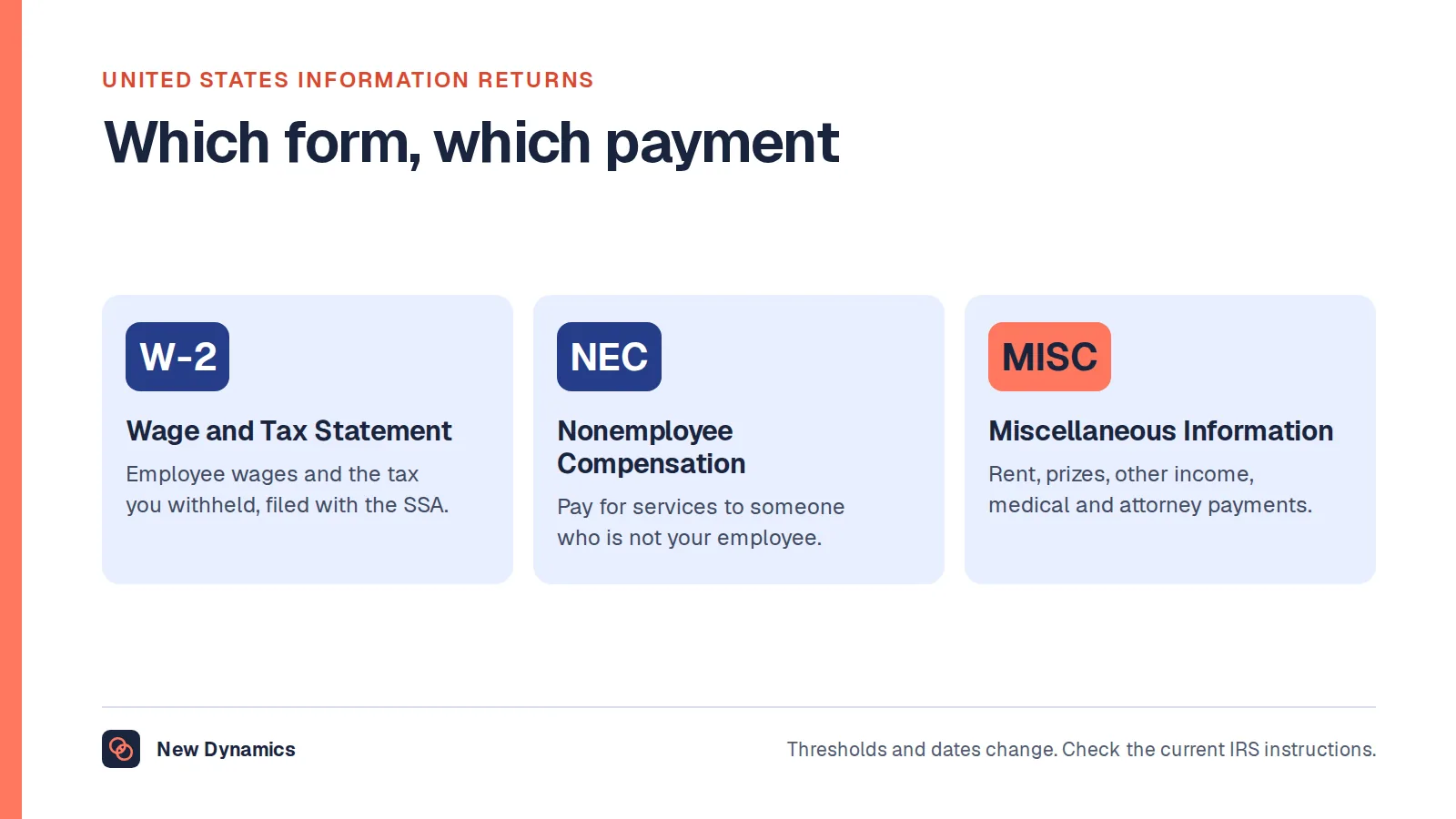
Jurisdiction: United States. The two forms are not two ways of paying the same person. They are the reporting consequence of two different legal relationships. A W-2 means the employer withheld tax and paid the matching employer share. A 1099-NEC means the payment went out gross to somebody who is not an employee.
So the useful question is never which form to use but which relationship this is, and the IRS decides that from behavioural control, financial control and the type of relationship. Read our post on IRS information returns for Form 1099 and Form 1096, including why "1099 employee" is a contradiction, and employment status for the British test.
A wrong W-2, and the corrected form
Jurisdiction: United States. Errors are common and the route to fixing one is well marked. The first step belongs to the employee, the second to the employer.
If you are the employee. IRS Topic no. 154, last reviewed on 24 September 2026, says to go to the employer first: if a form is unavailable "or if your information is incorrect on these forms, contact your employer/payer. If you have contacted them and still haven't received the missing or corrected form by the end of February, you may call the IRS". The IRS will then contact the employer for you and send Form 4852, a substitute statement.
Do not wait past the filing date: "If you don't receive the missing or corrected form in sufficient time to file your tax return, you may use Form 4852". If the real figure arrives later and differs, "you must file Form 1040-X".
If you are the employer. The corrected form is Form W-2c. The IRS About Form W-2 C page, last reviewed on 25 June 2026, gives its two uses: to correct errors on a Form W-2 "filed with the Social Security Administration (SSA)", and to "Provide corrected Form W-2 ... to employees." The instructions add: "Use the current version of Form W-2c to correct errors (such as incorrect name, SSN, or amount) on a previously filed Form W-2 ... File Copy A of Form W-2c with the SSA."
Two details. The correction follows the original's channel: "If you were required to e-file the original Form W-2, you must e-file any Form W-2c correcting that form", and electronic furnishing works the same way. And a small error may not need a W-2c, since a safe harbour applies where no single amount is out by more than $100, or $25 for tax withheld, unless the employee asks.
The British equivalent: no W-2, but a P60 and a P45
Jurisdiction: United Kingdom. The honest answer first: there is no UK W-2, and no British year end form carries anything like box 3 and box 5, because the United Kingdom does not summarise pay against a social security wage base. The American system reports the year once, in arrears, and leaves the employee to file a return against it. The UK system reports every pay run as it happens, so the annual document has far less to disclose.
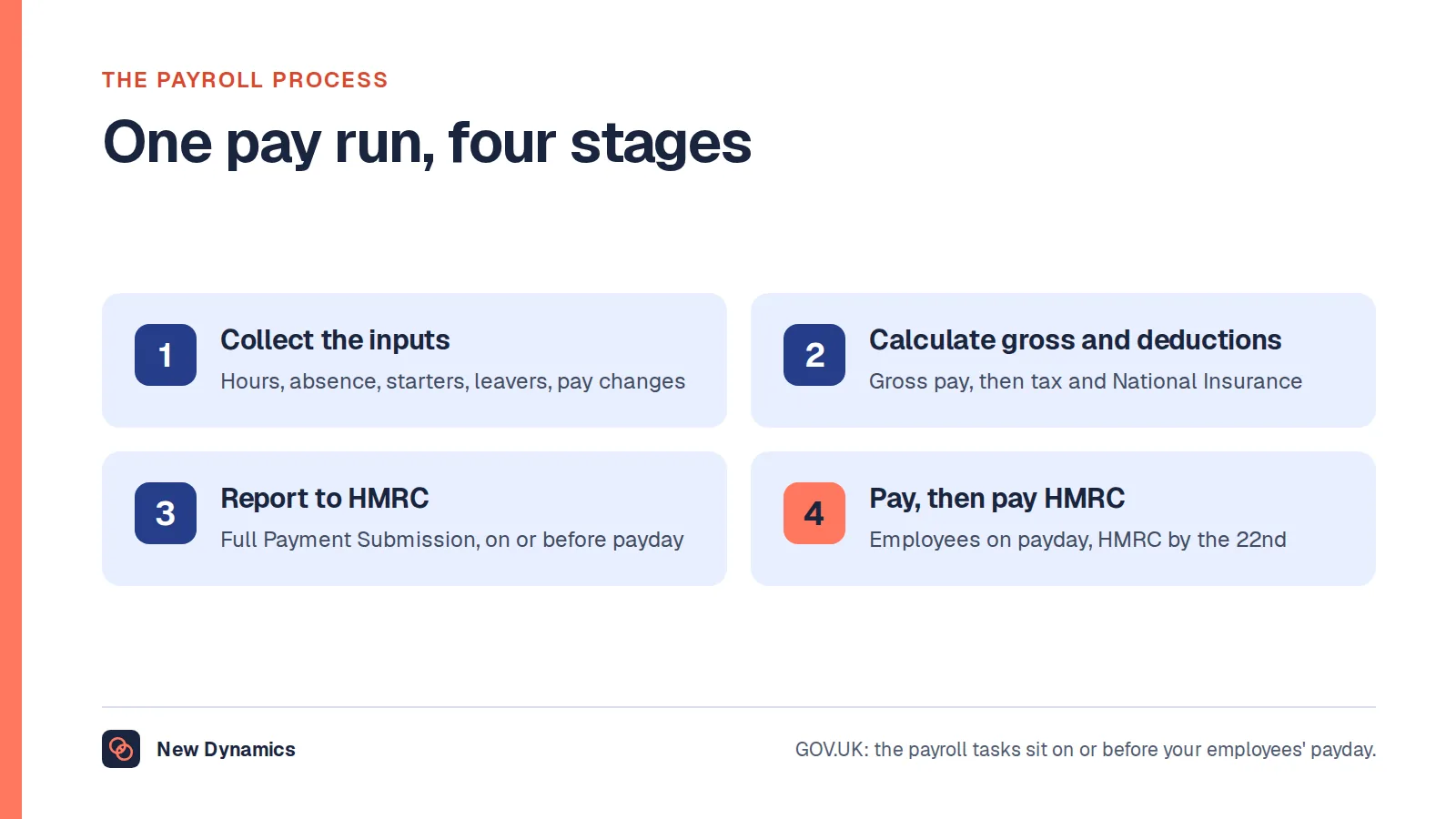
Real Time Information is the layer underneath. GOV.UK's guidance on running payroll says that on or before every payday an employer must "Record their pay", "Produce payslips for each employee", and "Report their pay and deductions to HMRC in a Full Payment Submission (FPS)." Every pay run, not once a year, which is why there is no British January scramble. Our post on the payroll process covers the run, and payroll records what to keep behind it.
The P60 is the nearest thing to a W-2. GOV.UK's guide to your P45, P60 and P11D says an employee gets a "P60 form if you're working for them at the end of the tax year", and that "Your employer also gives this information to HMRC." It shows less than a W-2: "Your P60 shows the tax you've paid on your salary in the tax year (6 April to 5 April)."
The timing differs too: "If you're working for an employer on 5 April they must give you a P60. They must provide this by 31 May, on paper or electronically." The British statement therefore arrives months after the American one, against a tax year ending 5 April. The payroll annual reporting and tasks guidance sets the rest of the calendar: the final payroll report "On or before your employees' payday", the P60 "By 31 May", and expenses and benefits "By 6 July".
The P45 is the leaving document, and the W-2 has no counterpart. GOV.UK says that "When you leave a job, your employer should give you a P45 form that tells you your: leaving date, total pay and tax from 6 April until the date you left, tax code", and it travels to the next employer. An American leaver gets nothing in the month they leave. A lost P60 is replaceable and a lost P45 is not: "If you've lost your P45 ... you cannot get a replacement."
So the W-2 maps loosely onto the P60, the P45 covers leavers, and the P11D, given "if you get company benefits", covers benefits in kind that the American form folds into boxes 1, 3 and 5. Box 3 and box 5 map onto nothing at all. None of this is legal or tax advice, and the UK rules reward reading the current GOV.UK page first.
Frequently asked questions
What is a W-2?
Form W-2 is the annual statement an American employer gives each employee, and files with the Social Security Administration, showing what the person was paid and what was withheld. Its official title is the Wage and Tax Statement, and the IRS says that "Every employer engaged in a trade or business who pays remuneration ... must file Form W-2 for each employee." It reports; it does not calculate tax. United States only.
What are social security wages on a W-2?
Box 3 holds them. The IRS instruction for 2026 is to "Show the total wages paid (before payroll deductions) subject to employee social security tax but not including social security tips and allocated tips." It is gross, tips go in box 7, and the two are capped together: "The total of boxes 3 and 7 cannot exceed $184,500 (2026 maximum social security wage base)." Box 3 is often higher than box 1, because pre-tax deferrals leave box 1 but stay in box 3.
What are social security tips on my W-2?
Box 7 holds the tips you reported to your employer. The instruction is to "Show the tips that the employee reported to you even if you did not have enough employee funds to collect the social security tax", and the same tips also appear in box 1 and box 5. Box 7 shares the cap with box 3. Box 8, allocated tips, is different: "Do not include this amount in box 1, 3, 5, or 7."
What is Medicare wages and tips on a W-2?
Box 5 is the pay subject to Medicare tax, and it has no ceiling. The IRS instruction for 2026 says "The wages and tips subject to Medicare tax are the same as those subject to social security tax (boxes 3 and 7) except that there is no wage base limit for Medicare tax." In its worked example, wages of $199,750 give a box 3 of 184500.00 and a box 5 of 199750.00. Below the wage base the two match.
What is the difference between a W-2 and a W-4?
Direction and timing. The W-4 is an instruction from the employee before the pay: "Complete Form W-4 so that your employer can withhold the correct federal income tax from your pay." The W-2 reports from the employer after the pay. The W-4 shapes box 2 of the W-2 and nothing else, and claiming exemption does not remove social security or Medicare tax.
When are W-2s due?
Both deadlines fall on the same day, and filing electronically does not buy extra time. The IRS gives the general rule as "Forms W-2 are required to be furnished to employees and filed with SSA by January 31." For the 2026 forms the instructions name the dates: furnish copies "by February 1, 2027", and file with the SSA by "February 1, 2027, whether you file using paper forms or electronically".
Your next step: name the owner, then check the three wage boxes
Jurisdiction: any. General information, not legal or tax advice.
- Put one date in the calendar with one owner. Furnishing and filing fall together, so there is no second chance in February.
- Count every information return you expect to file. Ten or more in the aggregate makes electronic filing compulsory, and W-2s count alongside 1099s.
- Reconcile box 1 against boxes 3 and 5 before the forms go out. A gap is usually a deferral or the wage base. One you cannot explain is the one to investigate.
- Re-read the box 12 list against your benefits. Health coverage, HSA and Roth contributions and, for 2026, tips and qualified overtime all have codes.
- If you operate in both countries, keep the two calendars apart in writing. A UK manager reading an American year end checklist is where the confusion begins.
For a way of setting pay that you can explain to the person affected, read and download our compensation policy guide. The guide is free to read, and the PDF uses our short download form.
Want every year end task to have an owner, a due date and a visible status rather than a reminder in an inbox? Book a New Dynamics demo and bring your filing calendar. You can also email contact@new-dynamics.com.