TL;DR
- It is a day-one right for employees, and section 57A of the Employment Rights Act 1996 sets no number of days. GOV.UK puts it plainly: “You're allowed a reasonable amount of time off to deal with the emergency, but there's no set amount of time as it depends on the situation.”
- It is unpaid unless the contract says otherwise. GOV.UK: “Your employer may pay you for time off to look after dependants but they do not have to.” There is also no cap on the number of occasions.
- The deadline for complaining about an unreasonable refusal doubled. For a refusal occurring on or after 1 October 2026, section 57B(2)(a) now reads six months, not three, following the Employment Rights Act 2025 and S.I. 2026/954.
A nursery rings at ten past nine. A parent has fallen at home. A childminder cancels on the morning of a shift. Somebody has to leave work now, and a manager has about ninety seconds to decide.
There is a statutory answer, and it is narrower than most handbooks suggest. This article sets out the right to time off for dependants as the legislation and GOV.UK word it: who counts as a dependant, the five situations covered, the notice required, why it is unpaid by default, and the line between this right and carer's leave. It is general information about the position in Great Britain and not legal advice.
A manager who already talks to their team regularly handles these calls better, because the context is not assembled from scratch. See how New Dynamics continuous feedback keeps those conversations in one place.
What time off for dependants is
The right sits in section 57A of the Employment Rights Act 1996, inserted on 15 December 1999 by the Employment Relations Act 1999. Legislation.gov.uk records that section 57A "is up to date with all changes known to be in force on or before 07 November 2026".
The core is one sentence. An employee "is entitled to be permitted by his employer to take a reasonable amount of time off during the employee's working hours in order to take action which is necessary" in one of five listed situations. Three things follow from it.
It is a right for employees, not every worker. Acas states that "anyone legally classed as an employee can take time off to help a dependant with an emergency", and GOV.UK's guide to time off for family and dependants points readers at its employment status guide. There is no qualifying period, because section 57A imposes no length of service. And the entitlement is to time off, not to pay: the section says nothing about remuneration.
Legislation.gov.uk marks section 57A as applying to England, Wales and Scotland. Northern Ireland has its own employment legislation, not covered here.
Who counts as a dependant
Section 57A(3) gives the base list: a spouse or civil partner, a child, a parent, or "a person who lives in the same household as the employee, otherwise than by reason of being his employee, tenant, lodger or boarder".
It then widens. Under section 57A(4), for illness, birth, injury, assault or arranging care, a dependant also includes "any person who reasonably relies on the employee" for assistance on such an occasion or to arrange care in the event of illness or injury. Section 57A(5) extends it, where care arrangements break down, to anyone who reasonably relies on the employee to arrange care.
So the household and reliance limbs do more work than the family limb. Acas gives the example of "a person who relies on them, such as an elderly neighbour". GOV.UK is looser: "A dependant could be a spouse, partner, child, grandchild, parent, or someone who depends on you for care." An unmarried partner and a grandchild are not named in section 57A(3), so in a contested case they come in through the household or reliance tests. A policy copying the GOV.UK list is copying a summary, not the statute.
One detail is often dropped. Section 57A(6) states that a reference to illness or injury "includes a reference to mental illness or injury", so a dependant's mental health crisis is covered on the same footing as a physical one.
The five situations the law covers
Section 57A(1) lists them, and the list is closed. Time off must be necessary to take action:
- "to provide assistance on an occasion when a dependant falls ill, gives birth or is injured or assaulted"
- "to make arrangements for the provision of care for a dependant who is ill or injured"
- "in consequence of the death of a dependant"
- "because of the unexpected disruption or termination of arrangements for the care of a dependant"
- "to deal with an incident which involves a child of the employee and which occurs unexpectedly in a period during which an educational establishment which the child attends is responsible for him"
Two points deserve a pause. "Gives birth" is in the statute and routinely left out of summaries, so a partner taking a dependant to hospital for an unexpected labour is within paragraph (a). Paragraph (e) covers the employee's own child during school or nursery hours, so an unexpected closure, an exclusion or a playground accident counts. A parents' evening is not an incident.

How much time, and whether it is paid
No official UK source publishes a number of days, because there is no number to publish. GOV.UK: "You're allowed a reasonable amount of time off to deal with the emergency, but there's no set amount of time as it depends on the situation." Acas is equally blunt: "The law does not say how much time an employee can take off, or how many occasions. It just says the amount should be 'reasonable'."
Nor is there a cap on frequency. GOV.UK states: "There are no limits on how many times you can take time off for dependants. Your employer may want to talk to you if they think time off is affecting your work." A pattern can be discussed under an attendance policy, but not answered by refusing a genuine emergency.
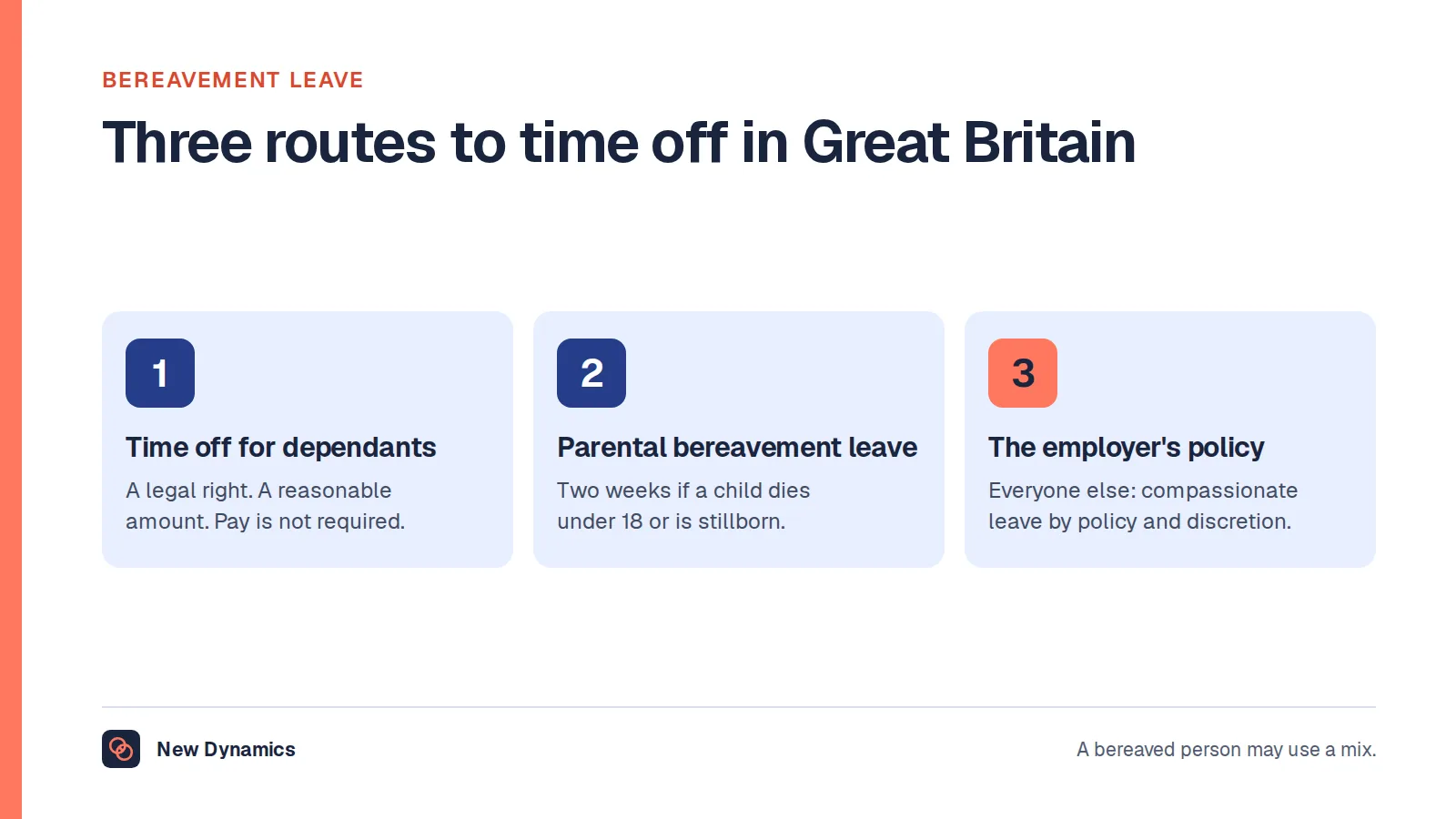
On pay, GOV.UK is direct: "Your employer may pay you for time off to look after dependants but they do not have to. Check your contract, company handbook or intranet site to see if there are rules about this." Acas agrees. The default is unpaid, and anything better is contractual or discretionary. GOV.UK also records what often happens next: "Your employer may then ask you to take annual leave or parental leave if you want to look after your child for longer." The statutory right covers the emergency; other forms of leave of absence cover the days after it, and where a dependant has died it overlaps with bereavement leave.
For scale, the Office for National Statistics reports in Unpaid care, England and Wales: Census 2021, released on 19 January 2023, that "In England and Wales an estimated 5.0 million usual residents aged 5 years and over provided unpaid care in 2021". No official source publishes how many employees use the section 57A right, so we give no figure for that. What is published is collected in our HR statistics hub.
What the employee has to tell the employer
Section 57A(2) is a condition, not a courtesy. The right "does not apply unless" the employee:
- "tells his employer the reason for his absence as soon as reasonably practicable", and
- "except where paragraph (a) cannot be complied with until after the employee has returned to work, tells his employer for how long he expects to be absent"
Two things are required, the reason and the expected length, and the second is excused only where the first could not be given until after the return to work. GOV.UK adds a point policies often get wrong: "You do not have to do this in writing or give written proof."
Acas adds advice that is not in the statute but prevents most disputes. The employee "should also let the employer know that the absence is covered by their statutory right to time off for dependants". An absence logged as unauthorised on the day is hard to reclassify later.

The limit: it has to be unexpected
This is where most refused requests sit. GOV.UK states the exception plainly: "You cannot have time off if you knew about a situation beforehand. For example you would not be covered if you wanted to take your child to hospital for an appointment. You might get parental leave instead."
So a booked appointment, a planned operation, a scheduled care assessment and a known school inset day fall outside section 57A, however genuine the need. The statute agrees, with "unexpected disruption or termination" in paragraph (d) and "occurs unexpectedly" in paragraph (e).
Acas fills the gap by naming other leave: an employer might offer compassionate leave or unpaid special leave instead, either because the right does not apply, for instance where the person is not a dependant, or because the alternative pays. Annual leave is the other route, covered in holiday entitlement.
Time off for dependants is not carer's leave
These two get merged constantly, and they do different jobs. Carer's leave is a separate entitlement created by the Carer's Leave Act 2023, which inserted section 80J into the Employment Rights Act 1996 with effect from 4 December 2023, with the detail in the Carer's Leave Regulations 2024.
The trigger differs. Carer's leave is for a dependant with a long-term care need, which section 80J(2)(b) defines as an illness or injury, physical or mental, "that requires, or is likely to require, care for more than three months", a disability for the purposes of the Equality Act 2010, or care needed "for a reason connected with their old age".
The amount differs. Where section 57A names no quantity, regulation 5 of the Carer's Leave Regulations 2024 states that a qualifying employee "is entitled one week of carer's leave during the relevant period", with a minimum of half a working day and a maximum of one continuous week. Regulation 3 defines the relevant period as "a period of 12 months which ends on the last day of the carer's leave the employee has requested".
The timing differs too. Carer's leave is planned and notified in advance; time off for dependants is for the thing you did not see coming. An afternoon because a parent fell today is section 57A. A day a month for a long course of treatment is carer's leave, annual leave or flexible working. Both are unpaid and both apply from day one, which is why they get confused.

If the time off is refused
Three protections apply, from three places.
Detriment. Section 47C of the Employment Rights Act 1996 gives an employee the right not to be subjected to a detriment for a prescribed reason, and section 47C(2)(d) names "time off under section 57A". The reason is prescribed by regulation 19(2)(e)(iii) of the Maternity and Parental Leave etc. Regulations 1999, which covers an employee who "took or sought to take" that time off. Note "sought to take": the protection does not depend on the leave being granted.
Dismissal. Section 99(3)(d) again names "time off under section 57A", and regulation 20(3)(e)(iii) of the same Regulations prescribes it, which makes a dismissal for taking or seeking that time off automatically unfair.
A complaint about the refusal. Section 57B lets an employee "present a complaint to an employment tribunal that his employer has unreasonably refused to permit him to take time off as required by section 57A". A tribunal that upholds it must make a declaration and may award compensation that is "just and equitable in all the circumstances".
That deadline has just changed, and much published guidance has not caught up. Section 57B(2)(a) used to give three months. It now reads six, substituted on 1 October 2026 by Schedule 12 to the Employment Rights Act 2025. The commencement instrument, S.I. 2026/954, brings Schedule 12 into force on that date "subject to the transitional provisions in regulation 4", and regulation 4(1) provides that the amendments "do not apply in any case where the relevant date occurs before 1st October 2026". Its Schedule sets the relevant date for a section 57B complaint as "The date when the refusal occurred". So a refusal from 1 October 2026 carries six months, and an earlier refusal keeps three.
What your policy should settle
The statute leaves four decisions to the employer, and a handbook that answers them stops the arguments.
- Pay. Paid, unpaid, or paid for a stated number of days a year. Say which, and apply it to everyone.
- Who decides. Name the manager, and say what happens when that manager is unreachable at nine in the morning.
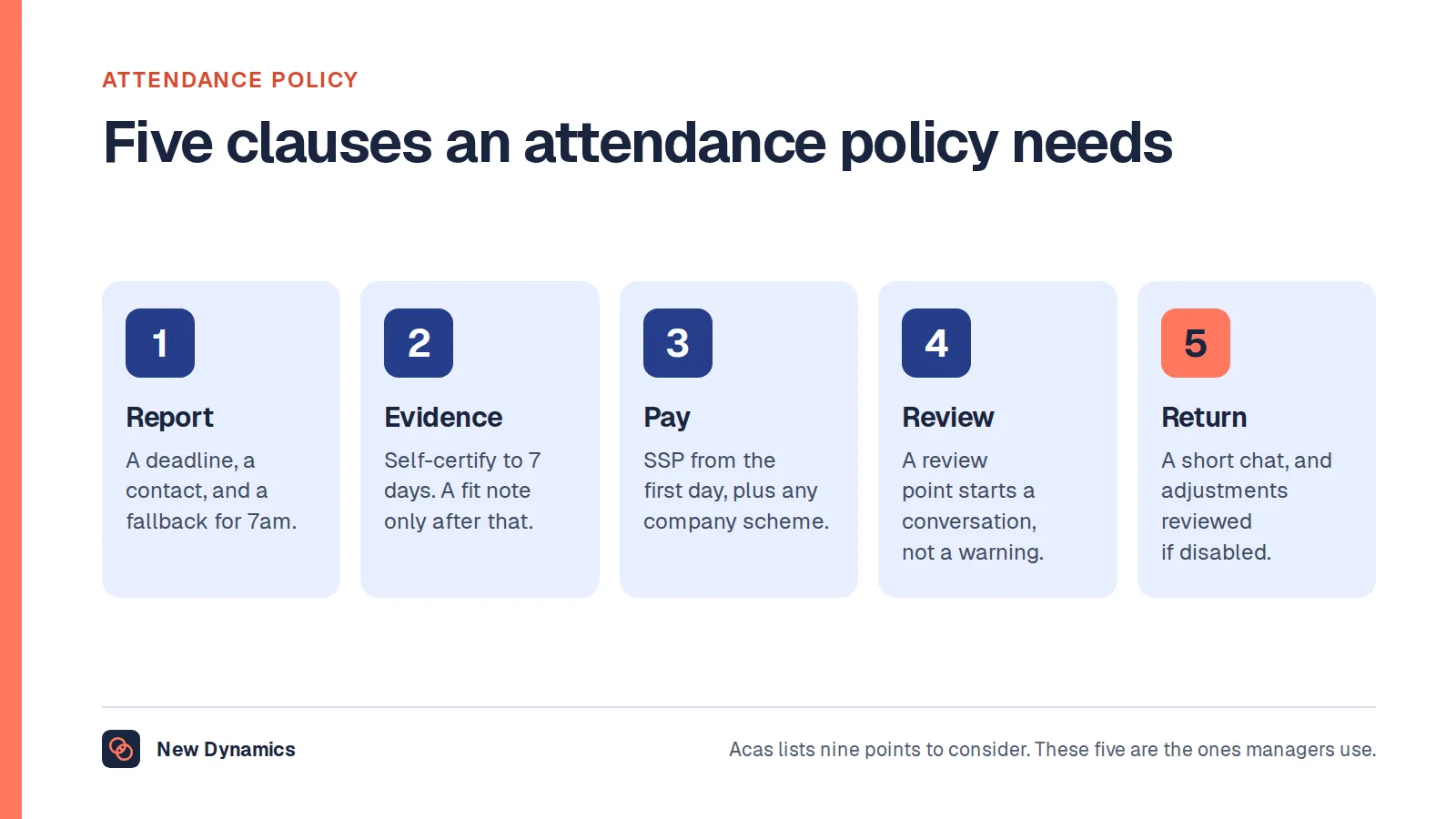
- How it is recorded. Log it as time off for dependants, separately from sickness and annual leave, or an emergency becomes an attendance trigger. Your policy can ask for a message, but written proof cannot be a condition of the right.
- What happens afterwards. Set out the route to annual leave, unpaid leave, carer's leave or flexible working.
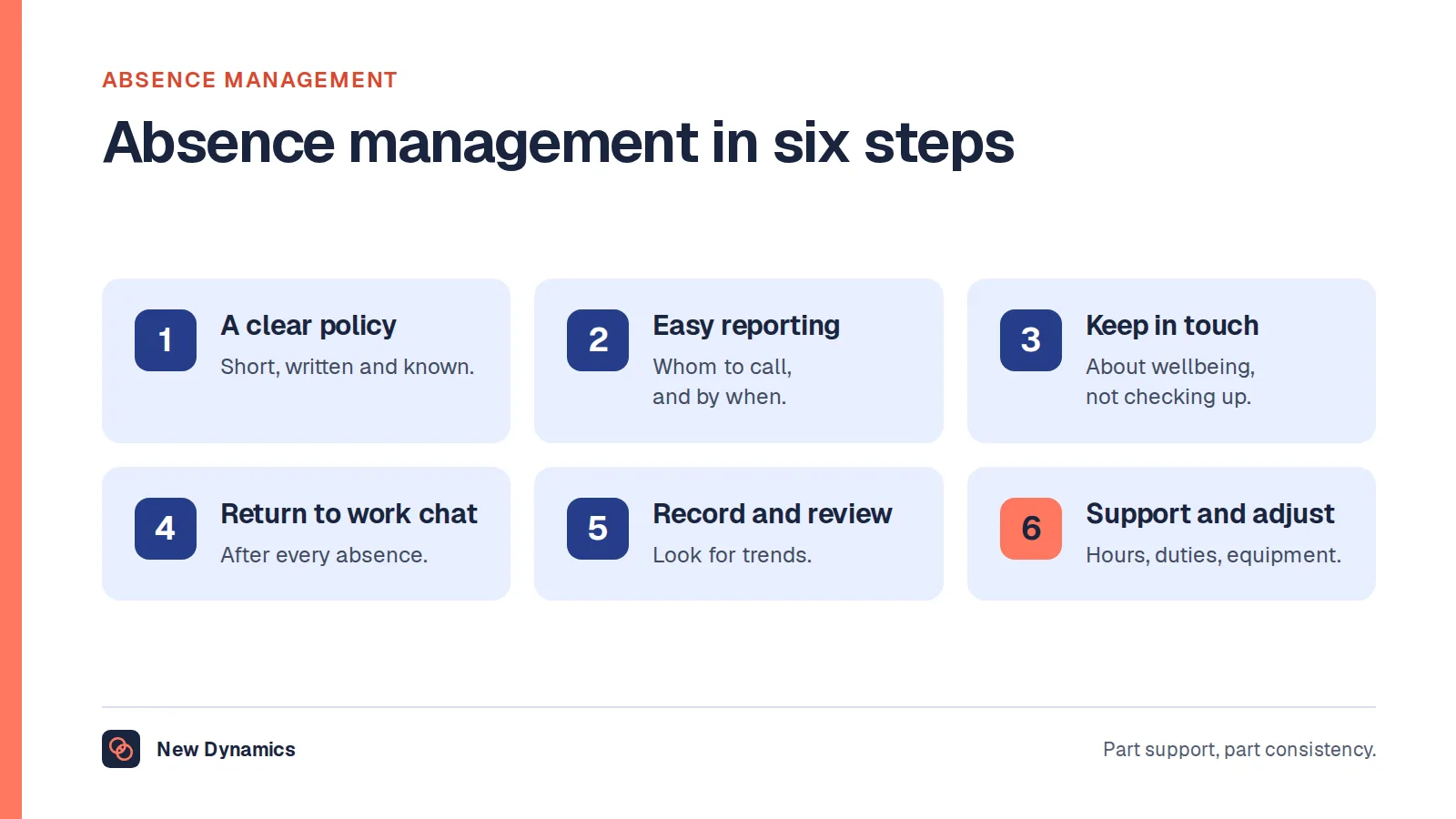
The wider process sits in absence management.
Frequently asked questions
How many days is time off for dependants?
There is no fixed number. GOV.UK says you are allowed a reasonable amount of time off to deal with the emergency, with no set amount because it depends on the situation. Section 57A of the Employment Rights Act 1996 says "a reasonable amount of time off" and names no figure.
Is time off for dependants paid?
Not by law. GOV.UK says your employer may pay you for time off to look after dependants but they do not have to, and advises checking the contract, handbook or intranet. Many employers pay for a few days, but that comes from the policy, not the statute.
Who counts as a dependant?
Section 57A(3) names a spouse or civil partner, a child, a parent, and a person who lives in the same household other than as an employee, tenant, lodger or boarder. Sections 57A(4) and 57A(5) extend it to anyone who reasonably relies on the employee for assistance in an emergency or to arrange care.
Do I have to give notice for time off for dependants?
Yes, and it is a condition of the right. Section 57A(2) requires the reason as soon as reasonably practicable, and how long the absence is expected to last, unless the reason could not be given until after returning to work. GOV.UK confirms it need not be in writing.
What is the difference between time off for dependants and carer's leave?
Time off for dependants covers an unexpected emergency, with no set amount of time. Carer's leave is planned time off for a dependant with a long-term care need, and regulation 5 of the Carer's Leave Regulations 2024 gives one week during a 12-month relevant period. Both are unpaid under the legislation.
Can my employer refuse time off for dependants?
Only where the right does not apply, for example a situation you knew about beforehand. Section 57B lets an employee complain to an employment tribunal that an employer has unreasonably refused the time off. For a refusal from 1 October 2026 the limit is six months from the refusal, following Schedule 12 to the Employment Rights Act 2025.
Your next step: three checks on your own clause
- Find it. If that takes you more than a minute, a manager will not find it at nine in the morning either.
- Check it against section 57A. Does it include birth, mental illness, a death and a care arrangement collapsing, and does it stop at family members?
- Check the deadline you quote. If a template still says three months for a section 57B complaint, update it to six for refusals from 1 October 2026.
For the handbook that holds the clause, read and download our employee handbook guide. The guide is free to read, and the PDF uses our short download form.
Want managers to handle the day after the emergency as well as the day itself, with the conversation already on record? Book a New Dynamics demo and bring your current leave policy. You can also email contact@new-dynamics.com.