TL;DR
- The ballot threshold changed on 6 April 2026. Paragraph 29(3) of Schedule A1 used to require a majority of the workers voting and “at least 40 per cent of the workers constituting the bargaining unit”. The substituted paragraph 29(3) requires only a majority of the workers voting.
- Two GOV.UK pages disagree on who can be taken to the CAC. The employer guidance says “more than 21 workers”; paragraph 7 of Schedule A1 says “at least 21 workers” on the day the request is received, or an average of at least 21 over the preceding 13 weeks. The statute governs.
- Of 743 bargaining units agreed or decided since June 2000, the CAC declared recognition without a ballot in 272 cases and held 333 ballots, of which 210 ended in recognition, on the CAC progress chart at 2 November 2026.
A letter arrives. It names a union, describes a group of workers and says the request is made under Schedule A1 to the Trade Union and Labour Relations (Consolidation) Act 1992. From that day the employer has 10 working days to reply, and most of what follows is shaped by the answer. This article follows the process, names the test at each gate, and flags two places where the official guidance and the statute no longer agree. It describes the law of Great Britain and is not legal advice.
Recognition changes how pay and terms get set, not the channel through which people raise everything else. See how New Dynamics continuous feedback keeps that open alongside formal bargaining. For what a union is and what an employer owes a recognised one, see our guide to the meaning of union.
What recognition means in law
Section 178(3) of the 1992 Act defines it narrowly: “recognition”, in relation to a trade union, means “the recognition of the union by an employer, or two or more associated employers, to any extent, for the purpose of collective bargaining”. “To any extent” means recognition can be partial, for one group or one subject.
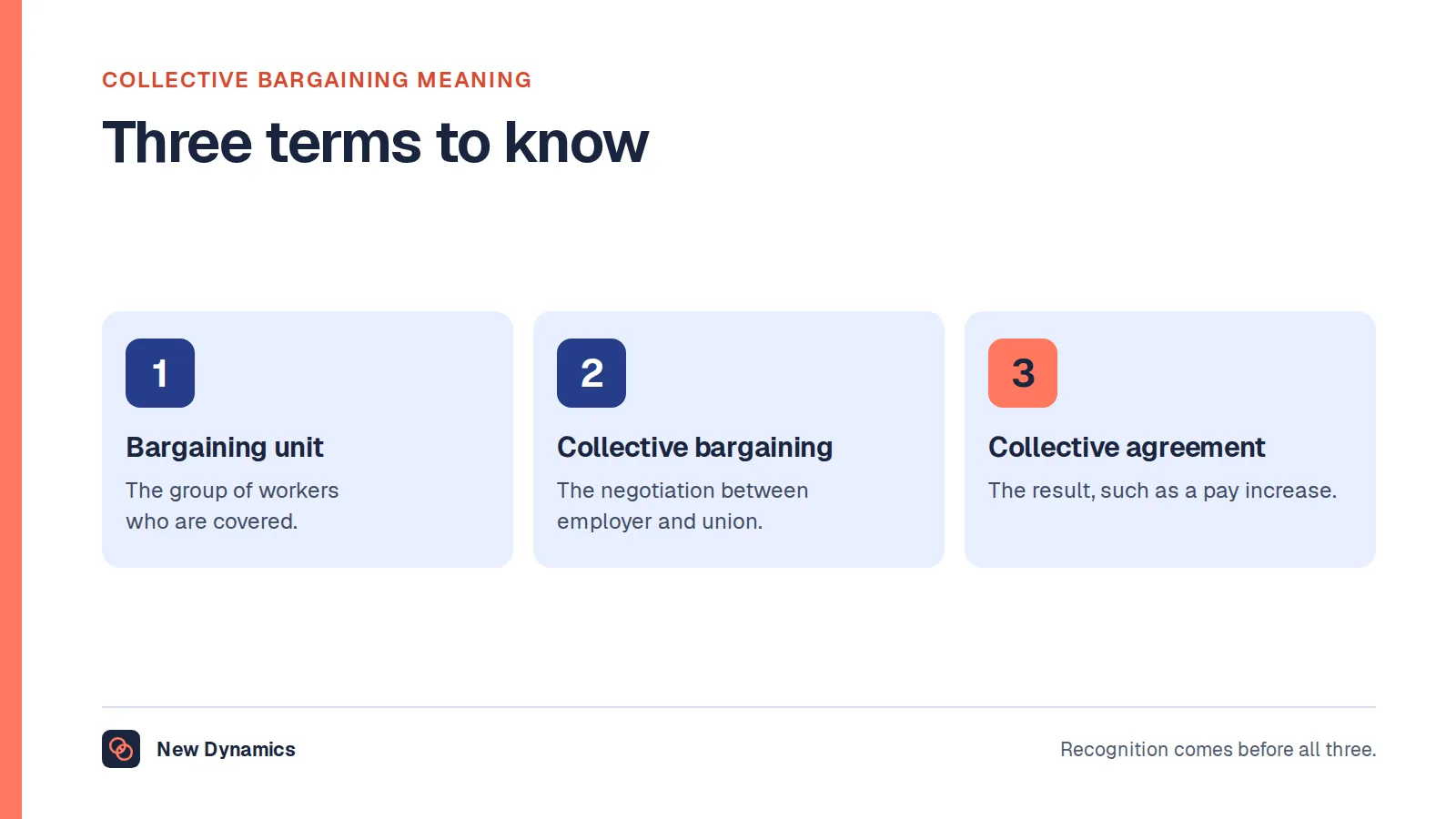
Schedule A1 then defines bargaining for itself. Paragraph 3(2) switches off the broad section 178(1) meaning, and paragraph 3(3) says “references to collective bargaining are to negotiations relating to pay, hours and holidays”: the core topics, as our guide to the meaning of collective bargaining explains.

The voluntary route, and the 10 working days
GOV.UK's guidance for employers on trade union recognition puts the voluntary route first: “The union must ask you to recognise them voluntarily - if you agree to the request then the union is recognised.” The request must name the union, identify the proposed bargaining unit and state that it is made under Schedule A1. A letter that does not invoke the Schedule has not started the statutory clock.
Paragraph 10(6) sets that clock: the first period is “the period of 10 working days starting with the day after that on which the employer receives the request for recognition”. Agree inside it and no further steps are taken. Refuse outright and the union may apply to the Central Arbitration Committee. Refuse but offer to negotiate, and paragraph 10(7) opens a second period of 20 working days, extendable by agreement. Voluntary recognition is not the lesser outcome. It is recognition on terms the parties wrote.
Who can be taken to the CAC
Here the official pages part company. The GOV.UK overview says a union can apply “if you do not want to recognise the union and have more than 21 workers”. The CAC's own guidance on how to apply says the process “is available to independent trade unions which want to be recognised by companies or organisations employing at least 21 workers”.
The statute settles it. Paragraph 7(1) provides that the request “is not valid unless the employer, taken with any associated employer or employers, employs (a) at least 21 workers on the day the employer receives the request, or (b) an average of at least 21 workers in the 13 weeks ending with that day”. At least 21, not more than 21, and either limb will do, so an employer with exactly 21 workers is inside the procedure.
The admissibility tests
GOV.UK's page on statutory recognition gives the practical form. A union can apply if it has copied the application to the employer and “they have at least 10% union membership within the proposed bargaining unit”. It cannot apply if it has “applied for recognition in the last 3 years”, if it is “not a certified independent union”, or if another union is already recognised for those workers.
The membership test now reads differently from how it read for 26 years. Paragraph 36(1) was substituted on 6 April 2026 and states no figure: an application “is not admissible unless the CAC decides that members of the union (or unions) constitute at least the required percentage (see paragraph 171B) of the workers constituting the relevant bargaining unit”. Paragraph 171B(1), inserted the same day by the Employment Rights Act 2025, says “the required percentage” means 10 per cent, and paragraph 171B(2) lets the Secretary of State move it by regulations to “not greater than 10%, and not less than 2%”. Ten per cent is current, but it is now a dial rather than a fixture.
The three year bar is paragraph 40(2): no application within three years of a declaration that the same union is not entitled to be recognised for the same or substantially the same unit.

Access to the workforce before a ballot
The bargaining unit comes first. The parties can agree it; if not, the CAC decides it at a hearing. Access is the newest part of the procedure, and where the guidance has not caught up. Paragraphs 19G to 19L, inserted by Schedule 6 to the Employment Rights Act 2025, came into force on 30 October 2026. The union has five working days from the CAC's acceptance notice to request access, and paragraph 19H(3)(a) sets the negotiation period at “20 working days starting with the day after the day on which the CAC gives the union (or unions) notice under paragraph 15(5) that the application is accepted”. The two windows overlap rather than queue.
GOV.UK's page on workplace access says “You and the union then have 15 working days to negotiate an access agreement.” The CAC's guidance says 20, and so does the statute. Work to 15 and you may think a window has closed that is still open. The sanction for breaking an access agreement is severe: under paragraph 19K(4), the CAC “may issue a declaration that the union is (or unions are) recognised” where the employer fails to comply with an order to remedy a breach.
Recognition without a ballot
If a majority of the workers in the unit are already members, no vote is normally needed. Paragraph 22(2) says the CAC “must issue a declaration” of recognition. Paragraph 22(3) creates the exception: if any of the three qualifying conditions in paragraph 22(4) is met, a secret ballot is held instead. Those are that a ballot “should be held in the interests of good industrial relations”, or that credible evidence or membership evidence raises doubts about whether a significant number of the members in the unit want the union to bargain for them.
One amendment is in force but not yet written into the text on legislation.gov.uk. Schedule 6, paragraph 11(3) to the 2025 Act inserts paragraph 22(1A) from 30 October 2026, so that for that test “any worker who joined the bargaining unit after the application day is to be disregarded”. Hiring after the application day cannot dilute the majority.
The ballot, and what now counts as a win
This is the change most summaries still get wrong, so take it from the provision. A ballot is run by a qualified independent person within 20 working days of appointment unless the CAC allows longer (paragraph 25(2) and (3)), and GOV.UK says the cost is “split equally between you and the union”.
The result turns on paragraph 29. In the version in force before 6 April 2026, sub-paragraph (3) set two hurdles: recognition followed only if the union was supported by “(a) a majority of the workers voting, and (b) at least 40 per cent of the workers constituting the bargaining unit”. A union could win the vote comfortably and still fail on turnout.
The substituted sub-paragraph (3), in force from 6 April 2026, keeps only the first: “If the result is that the union is (or unions are) supported by a majority of the workers voting, the CAC must issue a declaration that the union is (or unions are) recognised as entitled to conduct collective bargaining on behalf of the bargaining unit.” The same commencement removed the dial as well as the threshold: old sub-paragraphs (5) to (7), which let the Secretary of State specify “a different degree of support” by order, are recorded as “omitted (6.4.2026) by virtue of Employment Rights Act 2025 (c. 36), s. 159(3), Sch. 6 para. 19(4)”. GOV.UK's ballot page matches: the CAC “will declare the union is recognised if the majority of workers in the ballot vote to recognise the union”. If the ballot goes the other way, the CAC states the consequence: “you can't make another application to the CAC for 3 years”.
After the declaration: method, and the agreement
A declaration settles who bargains, not how. Paragraph 30 gives the parties 30 working days to agree a method, and paragraph 31(3) requires the CAC to specify one if they do not. Paragraph 31(4) is the sharp edge: a specified method “is to have effect as if it were contained in a legally enforceable contract made by the parties”, with specific performance the only remedy for breach.
The agreement that bargaining produces is treated the opposite way. Section 179(1) provides that a collective agreement “shall be conclusively presumed not to have been intended by the parties to be a legally enforceable contract” unless it is in writing and says the parties intend it to be one. Nor does anything in the 1992 Act make a collective agreement a term of anybody's contract of employment, so whether a negotiated rate reaches a particular person depends on what that person's own contract says. Our guide to the redundancy process covers the consultation duties that arrive alongside recognition when jobs are at risk.
What the CAC's own figures show
The CAC publishes a dated progress chart of every recognition application since the legislation came into force on 6 June 2000. On the chart at 2 November 2026, 1,621 applications had been received: 943 accepted, 181 not accepted and 481 withdrawn. Of 743 bargaining units agreed or decided, recognition was declared without a ballot in 272, and ballots took place in 333 cases, 210 ending in recognition.
Withdrawal, not refusal, is the commonest end for an application. For more official figures, see our HR statistics hub.
Frequently asked questions
What is trade union recognition?
Recognition is an employer's acceptance of a union as entitled to conduct collective bargaining for a group of workers. Section 178(3) of the 1992 Act defines it as recognition by an employer, or two or more associated employers, “to any extent, for the purpose of collective bargaining”. It can be given voluntarily or imposed by the CAC.
How many workers must an employer have before a union can apply to the CAC?
Paragraph 7(1) of Schedule A1 requires at least 21 workers on the day the request is received, or an average of at least 21 over the preceding 13 weeks, counting any associated employer. GOV.UK's overview says more than 21. The statute governs, and it says at least 21.
Does a recognition ballot still need 40 per cent of the bargaining unit?
No, not since 6 April 2026. Paragraph 29(3) used to require a majority of the workers voting and at least 40 per cent of the workers constituting the bargaining unit. Schedule 6 to the Employment Rights Act 2025 substituted that sub-paragraph, leaving only a majority of the workers voting.
Can the CAC recognise a union without holding a ballot?
Yes. Under paragraph 22(2), if a majority of the workers in the bargaining unit are union members, the CAC must declare recognition. It must order a ballot instead if one of the three qualifying conditions in paragraph 22(4) applies, such as credible evidence that a significant number of those members do not want the union to bargain for them.
Is a collective bargaining agreement legally binding?
Usually not, between the employer and the union. Section 179(1) conclusively presumes that a collective agreement was not intended to be a legally enforceable contract unless it is in writing and says the parties intend it to be one. A bargaining method specified by the CAC is different: paragraph 31(4) gives it effect as if it were one.
Your next step
- Diary the 10 working day reply window as soon as a Schedule A1 request arrives, and check the letter cites the Schedule.
- Count your workers on the day of the request and as a 13 week average, because paragraph 7 allows either route in.
- Choose deliberately between the two routes, because voluntary recognition means you help write the bargaining unit and the method.
- Work to the 20 working day access period in paragraph 19H(3), not the 15 in the GOV.UK summary, and read any collective agreement you have against individual contracts.
If changes to jobs are part of the picture, read and download our redundancy and workforce change guide. The guide is free to read, and the PDF uses our short download form.
Want the record of feedback, goals and one to ones to hold up when a bargaining conversation starts? Book a New Dynamics demo. You can also email contact@new-dynamics.com.