TL;DR
- The same words cover two different hearings. Rule 52 of the Employment Tribunal Procedure Rules 2024 lets a preliminary hearing either make case management orders or "determine any preliminary issue", which it defines as "any substantive issue which may determine the complaint or the Tribunal's jurisdiction (for example, an issue as to whether a complaint is brought in time)".
- The rules were remade. The Employment Tribunal Procedure Rules 2024 came into force on 6 January 2025, and the 2013 rules of procedure were removed outright: regulation 4(7) of the accompanying instrument says "Omit Schedules 1 to 3 (rules of procedure)".
- Case management is private, deciding something is not. Rule 54 says preliminary hearings "must be held in private" except that any part deciding a preliminary issue or a strike out "must be held in public". A deposit order is capped at "not exceeding £1,000" under rule 40(1).
A letter arrives listing a preliminary hearing in six weeks. Nothing in the letter says whether the tribunal intends to set a timetable or to decide whether the claim can proceed at all. Those are two very different mornings, and an employer who prepares for the wrong one either wastes a day or loses a point it could have won.
This article separates them. What a preliminary hearing is for, which rules now govern it and from when, who sits, the orders that come out of a case management hearing, what a preliminary issue hearing can finish off, deposit orders and strike out, whether the public can watch, and what to do in the weeks before. It is general information about England, Wales and Scotland, and it is not legal advice. Northern Ireland has its own tribunal system and its own rules, and none of this applies there.
Almost everything a preliminary hearing asks for is a record somebody should already hold. See how New Dynamics workflows keep the stages, approvals and dates of your own process in one place, so a disclosure order is a search rather than an archaeology project.

Check which rules you are reading, because they were remade
Guidance written before 2025 cites the Employment Tribunals Rules of Procedure 2013. Those rules are gone. The instrument in force is the Employment Tribunal Procedure Rules 2024, SI 2024/1155. Rule 1 provides that they "apply to all proceedings before the Tribunal" and "extend to England and Wales and Scotland", and the commencement note on every rule reads: "in force at 6.1.2025".
The old rules were not left sitting alongside them. Regulation 4 of the Employment Tribunals (Procedure Rules) (Consequential Amendments) Regulations 2024, SI 2024/1156, amends the 2013 Regulations and ends with a flat instruction at paragraph (7): "Omit Schedules 1 to 3 (rules of procedure)." The 2013 Regulations survive for things like the register of judgments, but the rules of procedure inside them were deleted.
That matters when you read guidance. The Presidents' page of practice directions and guidance for the Employment Tribunals in England and Wales states that "The Employment Tribunal Procedure Rules 2024 took effect on 6 January 2025", that the existing Presidential Guidance documents "were issued under previous iterations of our procedural rules" and "remain in effect", and that "references therein to the Employment Tribunals Rules of Procedure 2013 should be read as references to the Employment Tribunal Procedure Rules 2024". A conversion table is published with it. So the guidance is live, but its rule numbers are not. There has since been one amendment to the rules themselves: rule 52 was changed on 2 March 2026 by the Tribunal Procedure and Employment Tribunal Procedure (Amendment) Rules 2026, SI 2026/115, which added judicial assessment and the dispute resolution appointment.
Rule 52: the two jobs with one name
Rule 52 opens with the definition that explains the confusion: "A preliminary hearing is a hearing at which the Tribunal may do one or more of the following." It then lists five. The tribunal may:
- "conduct a preliminary consideration of the claim with the parties and make a case management order (including an order relating to the conduct of the final hearing)";
- "determine any preliminary issue";
- "consider whether a claim, response or reply, or any part, should be struck out under rule 38 (striking out)";
- "make a deposit order under rule 40 (deposit orders)";
- "explore the possibility of settlement or alternative dispute resolution (including judicial mediation, judicial assessment or dispute resolution appointment)".
Rule 52(3) defines the second of those: "Preliminary issue means any substantive issue which may determine the complaint or the Tribunal's jurisdiction (for example, an issue as to whether a complaint is brought in time)." Rule 52(2) adds that "There may be more than one preliminary hearing in any case", which is why a case management hearing often ends by listing a second hearing to decide a point.
The notice tells you which you are getting. Rule 53(2) requires reasonable notice of the date, and then sets a floor for the serious version: "In the case of a hearing involving any preliminary issue, this must not be less than 14 days' notice of the date of the preliminary hearing and the notice must specify the preliminary issues that are to be, or may be, decided at the hearing." If your notice names an issue, read it as a hearing that can end part of the case.
GOV.UK's employer booklet puts the same thing in two sentences. Respond to an employment tribunal claim (T422) says under the heading "Preliminary issues": "You will be notified if there are any preliminary issues which the tribunal will need to decide. For example, whether the claim has been submitted to the tribunal within the required time limit. Where such issues arise, they will usually be dealt with at a preliminary hearing."
Who hears it, and whether the judge sits alone
Composition is no longer set out in the rules themselves. Section 4 of the Employment Tribunals Act 1996 was substituted on 7 November 2023 by the Judicial Review and Courts Act 2022, and now says that a tribunal "is, for the purpose of deciding any given matter, to be composed of a member or members chosen by the Senior President of Tribunals". The numbers come from the Employment Tribunals and Employment Appeal Tribunal (Composition of Tribunal) Regulations 2024, SI 2024/94, whose regulation 5(1) fixes who a single member is: "Where a matter in the employment tribunal is to be decided by a single member, it must be decided by an Employment Judge."
The default for a preliminary hearing is stated in the joint Presidential Guidance on panel composition, published on 29 October 2024 and signed by the President of the Employment Tribunals (England and Wales) and the President of the Employment Tribunals (Scotland), which quotes the Senior President's Practice Direction: "In respect of matters that fall to be decided at a preliminary hearing, an Employment Tribunal is to consist of a judge sitting alone unless a judge decides that, having regard to the interests of justice and the overriding objective, it should consist of a judge, an employee member, and an employer member", or a leadership judge directs two judges for training. Expect a judge alone, and expect that to hold for the preliminary issue version too.
The hearing need not be in a room. Rule 46 allows a hearing to be conducted "in whole or in part, by use of electronic communication (including by telephone)" where the tribunal considers it just and equitable. GOV.UK's claimant booklet, what happens after you submit a claim (T421), says a preliminary hearing "may be held over the phone, by video link if that is appropriate or in person", and adds: "It is important that you carry out or comply with any order made by the tribunal."

What comes out of a case management preliminary hearing
The power is broad and deliberately unlisted. Rule 30(1) says the tribunal "may, on its own initiative or on the application of a party, make a case management order", and rule 30(2) adds that "The particular powers identified in these Rules do not restrict that general power." Since 2 March 2026 the tribunal may also "direct a party to provide a draft of a case management order".
In practice the orders follow the published Case Management Agenda, which the Presidents publish on the same page as the guidance. Its own instruction sets the deadline: "You must fill in the table below and send a copy to the other side and the Tribunal at least 7 days before the preliminary hearing. Try and agree the contents with the other side first if you can." Working through its sections tells you what to expect:
- The list of issues. The agenda asks what the tribunal will need to decide at the final hearing and says plainly: "A key purpose of case management is to finalise the list of issues to be decided." Everything later is measured against this list.
- Disclosure. The judge "will usually make orders for the claimant and respondent to send each other a list of all the relevant documents and other evidence they have, and copies of those things. This is called disclosure." The power is rule 33, which lets the tribunal "order any person in Great Britain to disclose documents or information to a party".
- The hearing bundle. The agenda continues: "The Judge will then make an order for a file of relevant documents to be prepared for the final hearing. That file is often called the hearing bundle." It asks who prepares it, by when, and whether it is paper or PDF.
- Witness statements. The judge "will usually make an order that each person who is going to give evidence at the final hearing must prepare a written witness statement and send it to the other side before the final hearing". Under rule 43(1) an ordered statement "must stand as that witness's evidence in chief unless the Tribunal orders otherwise".
- Length and listing. The agenda asks how long the final hearing will last, whether a separate remedy hearing is needed, and requires you to "list here any date in the next 12 months on which you, your representative or any witness you intend to call will not be available". It then warns: "The Judge at the preliminary hearing will fix the date for the final hearing or the next hearing." Rule 45 backs this with a power to "impose limits on the time that a party may take in presenting evidence, questioning witnesses or making submissions".
- A cast list and chronology. The agenda asks whether there should be "a list of names and roles of the people involved" and "a list of dates and key events (a chronology)", and who prepares each.
Every item there is a decision about your own paperwork. If the dated record of the decision under challenge already exists, the orders are administrative. If it does not, the orders are the moment you find out. Our posts on running a disciplinary procedure and on what a grievance is set out the records to keep at the time.
What a preliminary issue hearing can finish off
A preliminary issue is one that "may determine the complaint or the Tribunal's jurisdiction". The familiar ones are whether the claim was brought in time, whether the claimant was an employee, a worker or neither, whether a claimed condition met the statutory definition of disability, and whether the tribunal has jurisdiction at all. The published agenda gives the same examples when it asks whether any issue should go to a further preliminary hearing: "e.g. time limits, disability, whether the claimant was an employee".
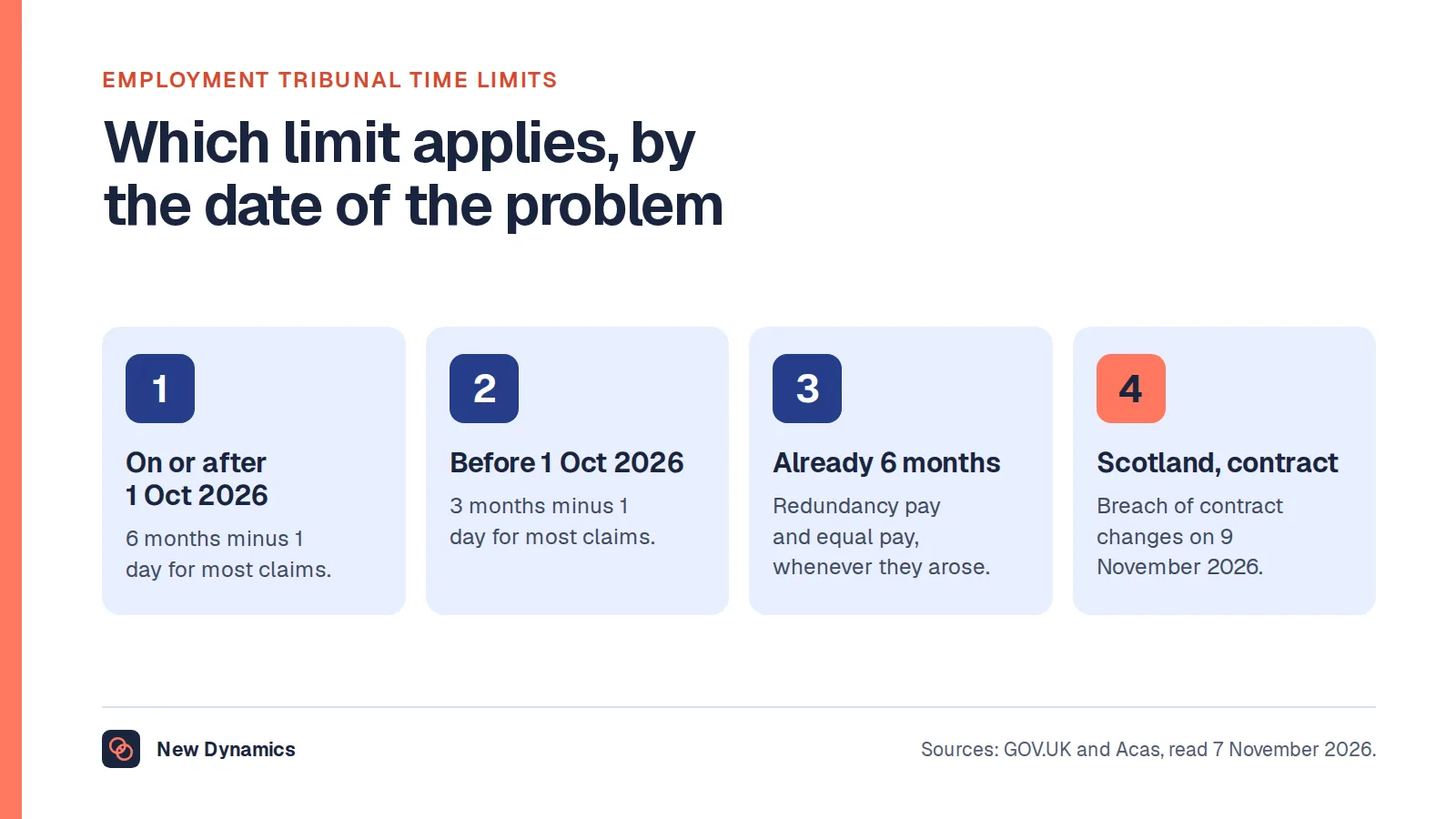
Time points are the most common. A preliminary hearing is often where a late claim is argued, and the limit depends on the date of the problem rather than the date of the claim form. Our post on employment tribunal time limits sets out the figures and how notifying Acas pauses the clock, so take the dates from there before the hearing rather than at it.
An amendment application with a time dimension belongs here too. The Presidential Guidance on general case management says that "An application for leave to amend when there is a time issue should be dealt with at a preliminary hearing to address a preliminary issue. This allows all parties to attend, to make representations and possibly even to give evidence."
One rule stops a hearing from being wasted. Rule 48 allows the tribunal conducting a preliminary hearing to "order that it be treated as a final hearing, or vice versa, if the Tribunal is properly constituted for the purpose and if it is satisfied that no party is materially prejudiced by the change". A hearing listed for one purpose can therefore turn into the other.
Deposit orders and strike out
Both can happen at a preliminary hearing, and they do different work.
A deposit order attaches a price to a weak point rather than removing it. Rule 40(1) provides that "Where at a preliminary hearing the Tribunal considers that any specific allegation or argument in a claim, response or reply has little reasonable prospect of success, it may make an order requiring a party ("the depositor") to pay a deposit not exceeding £1,000 as a condition of continuing to advance that allegation or argument". That £1,000 figure is the cap in the instrument in force, with no later amendment recorded against rule 40 on legislation.gov.uk as at 8 November 2026.
Three parts of rule 40 matter to whoever receives one. The tribunal "must make reasonable enquiries into the depositor's ability to pay the deposit". If the deposit is not paid by the date specified, the tribunal "must strike out the specific allegation or argument to which the deposit order relates". And if the tribunal later decides that point against the depositor "for substantially the reasons given in the deposit order", the depositor "must be treated as having acted unreasonably in pursuing that specific allegation or argument" for costs purposes unless the contrary is shown, and the deposit goes to the other side. Otherwise it is refunded. The agenda confirms the judge does not need an invitation: "The Judge may consider making a deposit order at the preliminary hearing even if nobody has asked for it. If so, the Judge will ask about ability to pay."
Strike out is the heavier power, and it cuts both ways. Rule 38(1) lets the tribunal strike out all or part of "a claim, response or reply" on five grounds: that it "is scandalous or vexatious or has no reasonable prospect of success"; that the manner of conducting the proceedings "has been scandalous, unreasonable or vexatious"; "for non-compliance with any of these Rules or with an order of the Tribunal"; "that it has not been actively pursued"; and that "it is no longer possible to have a fair hearing". Rule 38(2) protects the party first: nothing may be struck out "unless the party advancing it has been given a reasonable opportunity to make representations, either in writing or, if requested by the party, at a hearing". If a response is struck out, rule 38(3) says the effect is as if no response had been presented.
The Presidential Guidance is candid about how often this works. "The Tribunal does not use these powers lightly. It will often hold a preliminary hearing before taking this action." And on tit for tat applications: "Such applications are rarely successful."
The quieter risk is the unless order. Rule 39(1) allows an order specifying "that if it is not complied with by the date specified the claim, response or reply, or part of it, must be dismissed without further order". A missed disclosure deadline can therefore end a defence with no further hearing, and the only route back is an application within 14 days to set the order aside.

Is a preliminary hearing in public?
Mostly no, and then suddenly yes. Rule 54 sets the default at paragraph (1): "Preliminary hearings must be held in private, except where paragraph (2) applies." Paragraph (2) is the exception that matters: "If the preliminary hearing involves a determination under rule 52(1)(b) (preliminary issue) or (c) (strike out), any part of the hearing relating to such a determination must be held in public." Under paragraph (3) the tribunal "may direct that the entirety of the hearing is to be held in public".
So the hearing that sets a timetable is private. The hearing that decides whether the claim survives is public, and the evidence given in it, including evidence about your own process, is given in open tribunal. The agenda warns parties of this when it asks about further hearings: "If such a preliminary hearing is needed, the Judge will fix a date for it. It will be a public hearing."
The exceptions sit in rule 49, which lets the tribunal restrict public disclosure "so far as it considers necessary in the interests of justice or in order to protect the Convention rights of any person", including by holding a public hearing in private, by anonymising names, or by a restricted reporting order in a sexual misconduct or disability case. Rule 49(2) sets the bar: the tribunal "must give full weight to the principle of open justice and to the Convention right to freedom of expression". The agenda asks directly whether there is "any application for an anonymity or similar order under Employment Tribunal Rule 49", and requires supporting evidence beforehand. If you want anonymity, ask early and bring evidence.
Where Scotland differs
The rules themselves do not differ. Rule 1(4) extends them to England and Wales and Scotland, and the judiciary's own description confirms the arrangement: "There are two separate jurisdictions for Employment Tribunals in Great Britain: one for England and Wales and one for Scotland. Each is led by a senior judge (who has the statutory title of President) and each has its own independent judiciary. They have shared rules of procedure."
Four practical differences are worth knowing.
- The guidance is not shared. Rule 8(1) lets a President issue guidance "for the area for which they are responsible". The Case Management Agenda quoted above is an England and Wales document. Scotland publishes its own directions and guidance, and the panel composition guidance is one of the few issued jointly.
- Witness statements are not the norm. GOV.UK's T422 booklet says that in England and Wales case management orders "will probably require the parties to exchange witness statements by a set date", and then: "In Scotland witness statements are not normally used but they can be in some cases if ordered by a judge." That changes what a case management order is likely to ask of you.
- Costs are called expenses. T422 states it flatly: "Costs are known as expenses in Scotland."
- Judgments are announced less often. T422 says that in England and Wales the judge "will usually announce the judgment and the reasons for it" once the evidence is heard, and that "In Scotland the judgment is less frequently announced at the end of the hearing."
One date also differs. For breach of contract claims in Scotland the time limit changed later than in England and Wales, which our post on employment tribunal time limits sets out with the dates.
How to prepare
The agenda is the preparation. Fill it in, try to agree it with the other side, and send it at least seven days before. Answer the list of issues section in your own words rather than leaving the list to be drafted around the claimant's version, and check that the documents you are about to be ordered to disclose exist and can be produced by a date you can meet.
Rule 3 sets the standard everything is judged against: the overriding objective "is to enable the Tribunal to deal with cases fairly and justly", which includes "dealing with cases in ways which are proportionate to the complexity and importance of the issues", "avoiding delay" and "saving expense". Rule 3(4) puts a duty on you as well: parties and representatives "must assist the Tribunal to further the overriding objective, and co-operate generally with each other and with the Tribunal".
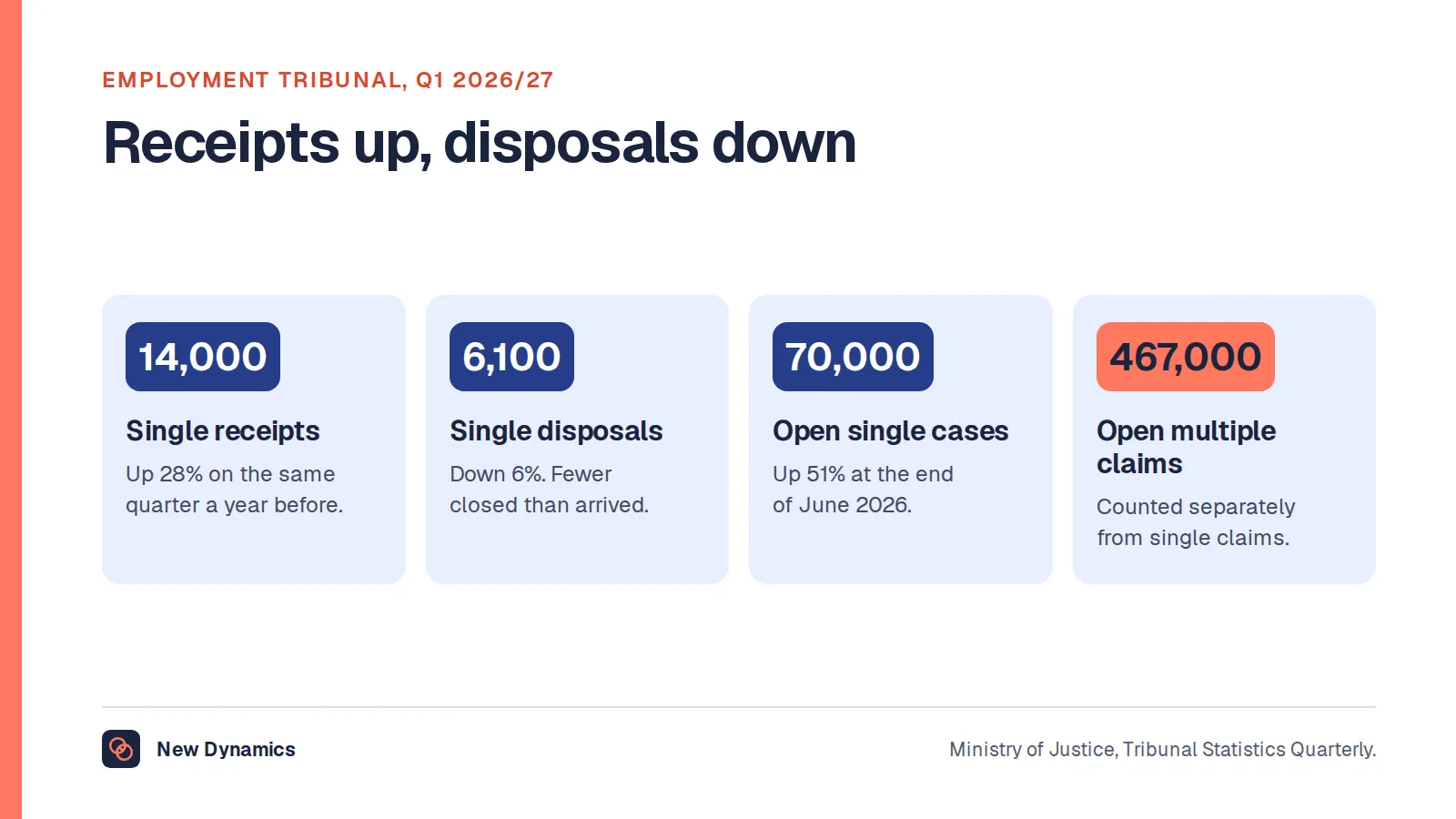
For the wider picture on volumes and how long claims are taking, our post on employment tribunal statistics UK quotes the Ministry of Justice release, and the statistics hub collects the rest.
Frequently asked questions
What is a tribunal preliminary hearing?
It is a hearing before the final hearing that can do several different things. Rule 52(1) of the Employment Tribunal Procedure Rules 2024 lets the tribunal make case management orders, determine a preliminary issue, consider strike out, make a deposit order, or explore settlement and alternative dispute resolution. More than one preliminary hearing is allowed in the same case.
What is the difference between case management and a preliminary issue?
Case management sets up the final hearing: the list of issues, disclosure, witness statements, the bundle and the hearing length. A preliminary issue is decided rather than organised. Rule 52(3) defines it as "any substantive issue which may determine the complaint or the Tribunal's jurisdiction (for example, an issue as to whether a complaint is brought in time)".
Does a judge sit alone at a preliminary hearing?
Usually yes. The joint Presidential Guidance on panel composition, issued on 29 October 2024, quotes the Senior President's Practice Direction: for matters decided at a preliminary hearing "an Employment Tribunal is to consist of a judge sitting alone" unless a judge decides it should sit with an employee member and an employer member, or a leadership judge directs two judges for training.
Is a preliminary hearing held in public?
Rule 54(1) says preliminary hearings "must be held in private", with one exception. Where the hearing involves deciding a preliminary issue or a strike out, rule 54(2) says any part relating to that determination "must be held in public", and the tribunal may direct that the whole hearing is public.
What is the maximum deposit order at an employment tribunal?
Rule 40(1) allows a deposit "not exceeding £1,000" where the tribunal considers that a specific allegation or argument has little reasonable prospect of success. The tribunal must make reasonable enquiries into ability to pay, and must strike out that allegation if the deposit is not paid by the date specified.
Can a claim be struck out at a preliminary hearing?
Yes. Rule 52(1)(c) lets a preliminary hearing consider strike out under rule 38, whose grounds include no reasonable prospect of success, scandalous or unreasonable conduct of the proceedings, non-compliance with the rules or an order, and that a fair hearing is no longer possible. Nothing is struck out until the party advancing it has had a reasonable opportunity to make representations.
Are the Employment Tribunals Rules of Procedure 2013 still in force?
No. The Employment Tribunal Procedure Rules 2024 came into force on 6 January 2025, and regulation 4(7) of the Employment Tribunals (Procedure Rules) (Consequential Amendments) Regulations 2024 removed the old rules with the words "Omit Schedules 1 to 3 (rules of procedure)". Older Presidential Guidance remains in effect, but its references to the 2013 rules must be read as references to the 2024 rules.
How much notice do you get of a preliminary hearing?
Rule 53(2) requires reasonable notice of the date. Where the hearing involves a preliminary issue the notice "must not be less than 14 days" and "must specify the preliminary issues that are to be, or may be, decided at the hearing". The England and Wales Case Management Agenda must be sent to the other side and the tribunal at least seven days before the hearing.
Your next step: four things to do before the hearing
- Read the notice and decide which hearing you have. If it names an issue to be decided, prepare evidence and submissions, not just a timetable.
- Collect twelve months of unavailable dates with named people and reasons, because the final hearing date is usually fixed at this hearing.
- Decide your position on a deposit order and on strike out before you arrive. The judge can raise either without an application, and will ask about ability to pay.
- If you want anonymity or any other order under rule 49, apply in writing beforehand and send the evidence that supports it.
To get the written procedures a defensible record depends on into one place, read and download our employee handbook guide. The guide is free to read, and the PDF uses our short download form.
Want the dated record of a decision to exist before a tribunal asks for it? Book a New Dynamics demo and bring one case you would struggle to reconstruct. You can also email contact@new-dynamics.com.