TL;DR
- The rule is short and it governs everything else. Rule 43(1) of the Employment Tribunal Procedure Rules 2024 provides that where a witness is called to give oral evidence, any witness statement of that person ordered by the Tribunal "must stand as that witness's evidence in chief unless the Tribunal orders otherwise".
- Scotland is not the same jurisdiction on this. The Employment Tribunals (Scotland) Practice Direction of 3 August 2022 states that "there is a presumption that such evidence will be given orally, without the use of a witness statement", and the matching Presidential Guidance says statements "are not routinely ordered" there.
- A statement of truth is compulsory in Scotland and optional in England and Wales. The Presidential Guidance on General Case Management says the Rules "do not require a witness statement to contain a 'statement of truth'", while the Scottish Practice Direction sets out wording the witness must sign and date.
A tribunal witness statement is not a letter to the judge and it is not the employer's case. In England and Wales it is the words the witness would otherwise have spoken from the witness table, written down in advance, and once the hearing starts the witness usually does not get to improve on it. That is why a statement drafted in a lawyer's voice, or packed with assertions no document supports, loses cases the facts would have won.
Below: what a statement is for, whose words it must be, how it is structured, the line between evidence and argument, exhibits and the bundle, exchange, the statement of truth, and the hearing. Rules are quoted from the instrument in force, with dates named. This is general information about Great Britain, with England and Wales and Scotland labelled separately, and it is not legal advice. Northern Ireland has its own tribunal system and none of this applies there.
Most of what a statement describes is a decision somebody made months earlier. See how New Dynamics workflows keep each stage, owner, date and attachment of your own process in one place, so a manager writing a statement reads a record instead of reconstructing one.

Which rules govern, and what rule 43 says
Most writing on this subject still cites the Employment Tribunals (Constitution and Rules of Procedure) Regulations 2013. Those rules of procedure are gone. The operative instrument is the Employment Tribunal Procedure Rules 2024 (S.I. 2024/1155), which came into force immediately after the consequential amendment Regulations (S.I. 2024/1156) on 6 January 2025. Regulation 4(7) of those Regulations omits "Schedules 1 to 3 (rules of procedure)" from the 2013 Regulations, which survive only for constitutional matters. Rule 1(4) extends the new Rules "to England and Wales and Scotland".
Rule 43 then sets the whole practice in three sentences. Rule 43(1): "Where a witness is called to give oral evidence, any witness statement of that person ordered by the Tribunal must stand as that witness's evidence in chief unless the Tribunal orders otherwise." Rule 43(2): "Witnesses are required to give their oral evidence on oath or affirmation."
Evidence in chief is the witness's own account, given before the other side asks anything, and normally drawn out by an advocate question by question. Rule 43(1) puts the written statement in that place. Rule 44 then makes it public: any statement standing as evidence in chief "must be available for inspection during the course of the hearing by those attending the hearing". A statement written for the employer's eyes is a statement written for the press bench.
One warning about reading guidance. The documents quoted below were written under the old numbering and have not been renumbered: rule 29 (case management orders) is now rule 30, rule 32 (witness orders) is now rule 34, rule 50 (privacy) is now rule 49. Rules 43 and 44 kept their numbers.
England and Wales: the statement replaces the oral account
The practice comes from the Presidential Guidance on General Case Management, issued on 13 March 2014 and reissued on 22 January 2018. Guidance Note 3, paragraph 10, gives the default: "Even if no formal order is made, the Tribunal generally prefers evidence to be presented by means of written statements. These are normally read in advance by the Tribunal so that they stand as the evidence in chief ... without being read out loud by the witness." Paragraph 14 says one is prepared for every witness, the claimant included.
The order itself comes out of the preliminary hearing. The Agenda for Case Management (England and Wales), the form parties complete beforehand, says at section 10: "The Judge at the preliminary hearing will usually make an order that each person who is going to give evidence at the final hearing must prepare a written witness statement and send it to the other side before the final hearing." The power behind it is rule 30, the general case management power.
Scotland presumes oral evidence instead
Do not carry that practice north. Scotland has its own President, and its own Practice Direction and Presidential Guidance, both dated 3 August 2022 and applying to hearings scheduled on or after 1 October 2022.
The Practice Direction on the use of witness statements, paragraph 6: "Where evidence in chief is to be given by a witness to an Employment Tribunal in Scotland there is a presumption that such evidence will be given orally, without the use of a witness statement." A tribunal may order otherwise, but only "following consultation with the parties in the case", only after considering whether an agreed statement of facts would serve justice equally well or better, and it must then give written reasons.
The matching Presidential Guidance says at paragraph 4 that statements "are not routinely ordered in Employment Tribunal proceedings in Scotland", one reason being a greater risk of collusion through drafts passing between witnesses. For an employer with sites either side of the border, the same dismissal may need two kinds of preparation.

Whose words it must be
This is where employer statements fail most often. The Scottish Practice Direction, paragraph 21: "A witness statement should be drafted in the first person and be written using the witness's own words."
A representative may still help. The Scottish Presidential Guidance, paragraph 11, accepts that representatives "may take primary responsibility for drafting it", then limits how the content is gathered: ask open questions rather than leading ones, which the guidance says put words into the witness's mouth, and separate what the witness saw from what the witness concluded. Its own example rewrites "Jean became very annoyed" as either "Jean told me at the time she was very annoyed" or "Jean became red in the face and started shouting. I formed the view from this that she was very annoyed." Paragraph 12 lets a representative clarify an ambiguous draft but says they "must be careful not to interfere with the evidence in any way".
Scotland also asks for provenance: paragraph 14 of the Practice Direction requires each statement to "describe in an introductory paragraph how it was taken". England and Wales has no such rule, but a set of statements in which four managers share one vocabulary invites the question anyway.
Evidence of fact, not argument
The clearest published account of what belongs in a statement is paragraph 19 of the Scottish Practice Direction, and the discipline reads well in England and Wales too:
"The purpose of a witness statement is to set out in writing the evidence in chief that a witness of fact would give, and would be allowed to give, if the witness had been called to give oral evidence at the hearing, without having provided the statement. It should not be used to comment upon the evidence it is thought another party or witness might give, the perceived weaknesses of a party's case, make generalised assertions designed to denigrate the other party/their witnesses, make submissions to the tribunal about the evidence it should or should not accept or refer to statutory or case law."
Paragraph 20 narrows it to facts that need to be proved and "evidence about matters of fact of which the witness has personal knowledge (which can include what they were told by another person)". Where a hearing deals only with a preliminary issue, the statement addresses only that. On employment tribunal time limits that point can end a case before anyone reaches the merits. Argument is not lost, it moves to submissions at the end of the evidence, which is where Guidance Note 5 says a party may highlight the weak parts of the other side's case and cite the law.
Structure, the bundle, and exhibits
Neither jurisdiction sets a length. If you are asked for a word count, say so plainly: no official source publishes a word or page limit for an employment tribunal witness statement.
Form is prescribed. Guidance Note 3, paragraph 16: "The witness statement should be in a logical order (ideally, chronological) and contain numbered paragraphs. It should cover all the issues in the case." Paragraph 17 explains why fullness beats brevity in England and Wales: "The statement should be as full as possible because the Tribunal might not allow the witness to add to it, unless there are exceptional circumstances and the additional evidence is obviously relevant." Scotland's Presidential Guidance, paragraph 7, is more exact, asking for numbered pages and paragraphs, 1.5 or double spacing, bold headings naming each stage, chronological order unless the witness genuinely recalls events another way, a list at the end describing every document referred to, and a right-hand margin of at least 3 cm so document numbers can be added once the statement is finalised.
That margin exists because statements and bundles are built together. Scottish Practice Direction paragraph 17 requires a statement mentioning a document to give its document number and page range, "normally in brackets at the relevant point" and in bold. Paragraph 17(4) bars exhibits: "no documents or exhibits of any kind should be appended to a witness statement, other than a list which describes the documents to which reference is made". The documents live in the bundle and the statement points at them.
What goes in the bundle is narrower than most employers assume. Guidance Note 2, paragraph 13: "The hearing bundle should contain only the documents that are to be mentioned in witness statements or to be the subject of cross-examination at the hearing, and which are relevant to the issues in the proceedings." One party paginates it, often the respondent, and paragraph 16 restricts what everyone may then do with it: "All documents and witness statements exchanged in the case are to be used only for the hearing."
Exchange, and the usual directions
Exchange is simultaneous by default and the deadline sits close to the hearing. Guidance Note 3, paragraph 22: "Exchange of witness statements at the same time is the norm, but it is not always appropriate." Paragraph 23 gives the fallback: "Unless there is a different date fixed, the exchange of witness statements should be completed by no later than 2 weeks before the hearing." If the other side's statements reveal a gap, paragraph 20 allows a supplementary statement sent immediately, without answering every point they made.
Scotland's sequencing is tighter, because contamination is the reason statements are rationed there. Practice Direction paragraph 24(2)(b): "The default position is that no witness can see the statement of any witness for the other party until they have finalised and signed their own witness statement." Paragraph 24(1) applies the same discipline within one party's own witnesses.
GOV.UK's employer guide, being taken to an employment tribunal, sets the surrounding timetable: "Usually the tribunal will issue an order setting out a timetable for when you should exchange documents", and "You'll be given at least 14 days' notice before the hearing".

The statement of truth, which only Scotland requires
People assume this one is universal. It is not. In England and Wales, Guidance Note 3, paragraph 18: "The Employment Tribunal Rules of Procedure do not require a witness statement to contain a 'statement of truth' ... There is no objection to a witness statement that does or does not contain such a statement of truth." Signing is called good practice, "particularly if the witness is unavailable to attend the hearing". The oath or affirmation under rule 43(2) is what puts the evidence under penalty of perjury.
In Scotland, where statements are ordered, Practice Direction paragraph 29 prescribes wording the witness must sign and date. It opens: "I understand that the purpose of this witness statement is to set out matters of fact of which I have personal knowledge. This witness statement does set out only my personal knowledge and recollection, in my own words." It goes on to confirm that nobody asked or encouraged the witness to include anything that is not their own account. Paragraph 30 then requires any professional representative involved in preparing it to certify by signature that the purpose and proper content of witness statements "have been discussed with and explained to" the named witness. Read both paragraphs before the first interview, not after the draft exists.
What happens at the hearing
Guidance Note 5 walks through a typical hearing in England and Wales. The tribunal checks that everyone understands the issues and has the documents. Then, at paragraph 10.2, "Often the Tribunal will then read the witness statements and any pages in the agreed bundle of documents to which they refer." At 10.3: "Each witness is then questioned on their own statement. This is called 'cross-examination'." Evidence is followed by submissions, then the decision, then remedy if the claim succeeds.
Attendance is not optional for a witness whose statement is in. Scottish Practice Direction paragraph 13 requires every such witness to attend so they may take the oath or affirm and be cross-examined, and if they do not attend "then that statement will normally be excluded from consideration". Worth knowing before relying on a statement from a manager who has since left. If a witness will not come voluntarily, rule 34(1) lets the tribunal "order any person in Great Britain to attend a hearing to give evidence, produce documents, or provide information", and GOV.UK adds that "You'll most likely be responsible for paying the witness's expenses".
One default differs. Rule 43(3) allows a tribunal to exclude a witness until they give evidence, and Guidance Note 3 records that in England and Wales "This is not the usual practice". Scottish Practice Direction paragraph 11 reverses it: witnesses other than parties stay outside the hearing room, actual or virtual, until they are called.
Where employer statements go wrong
- The lawyer's voice. Four managers, one register, sentences none of them has ever spoken. It is the opposite of what Practice Direction paragraph 21 requires. Read every draft aloud.
- Assertions with no document behind them. "The claimant was repeatedly warned about timekeeping" is worth nothing if no warning sits in the bundle, which holds only documents mentioned in statements or used in cross-examination. Our post on workplace investigations covers making the record at the time, the only point at which this is cheap to fix.
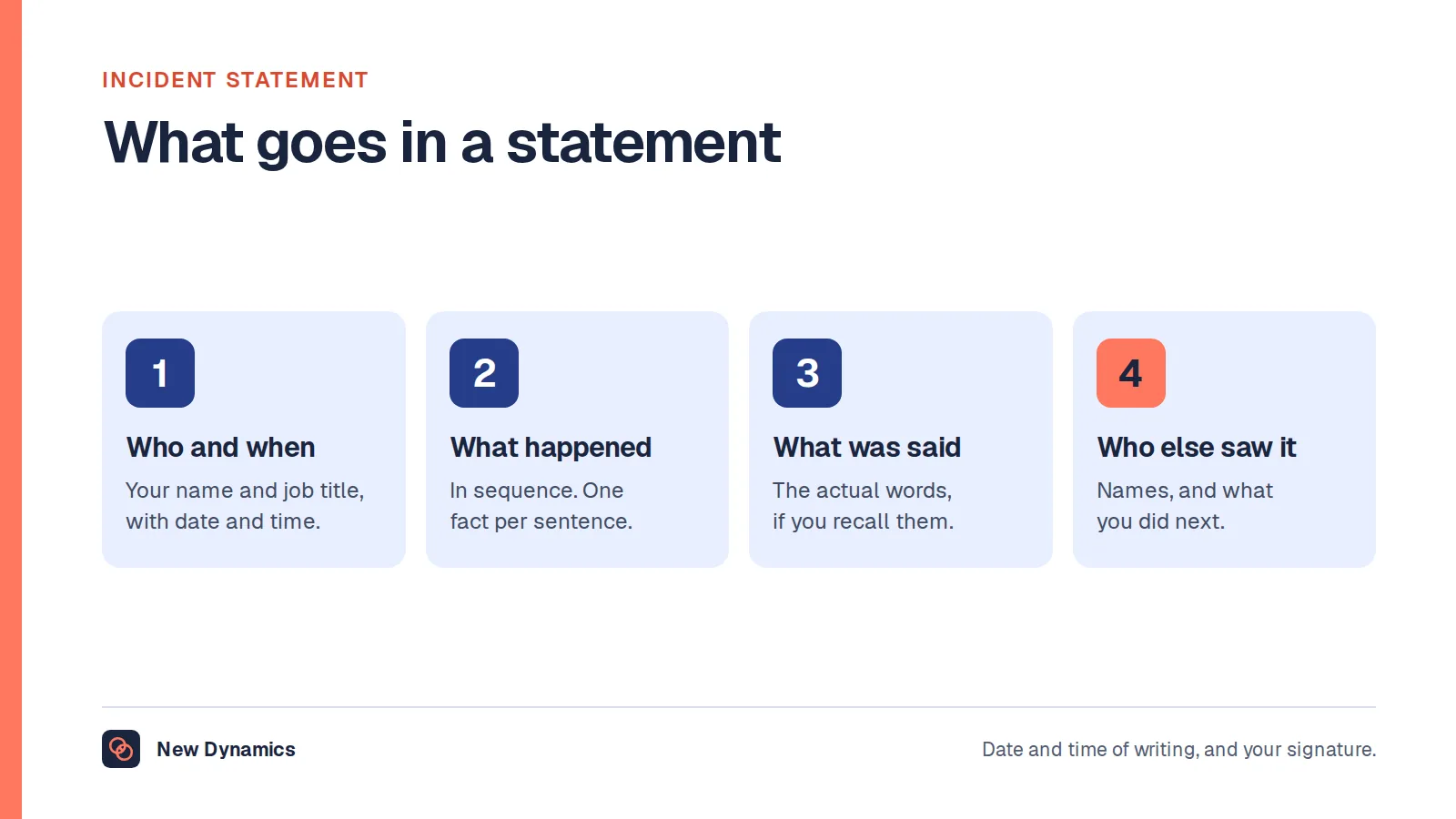
- Witnesses speaking to things they did not see. A manager restating the investigator's conclusions is not giving evidence of fact. Scottish Practice Direction paragraph 20(3) limits a statement to matters of personal knowledge, which may include what the witness was told, provided the statement says so. If the investigating officer saw it, the investigating officer gives the evidence. See also our guidance on writing an incident statement while it is fresh.
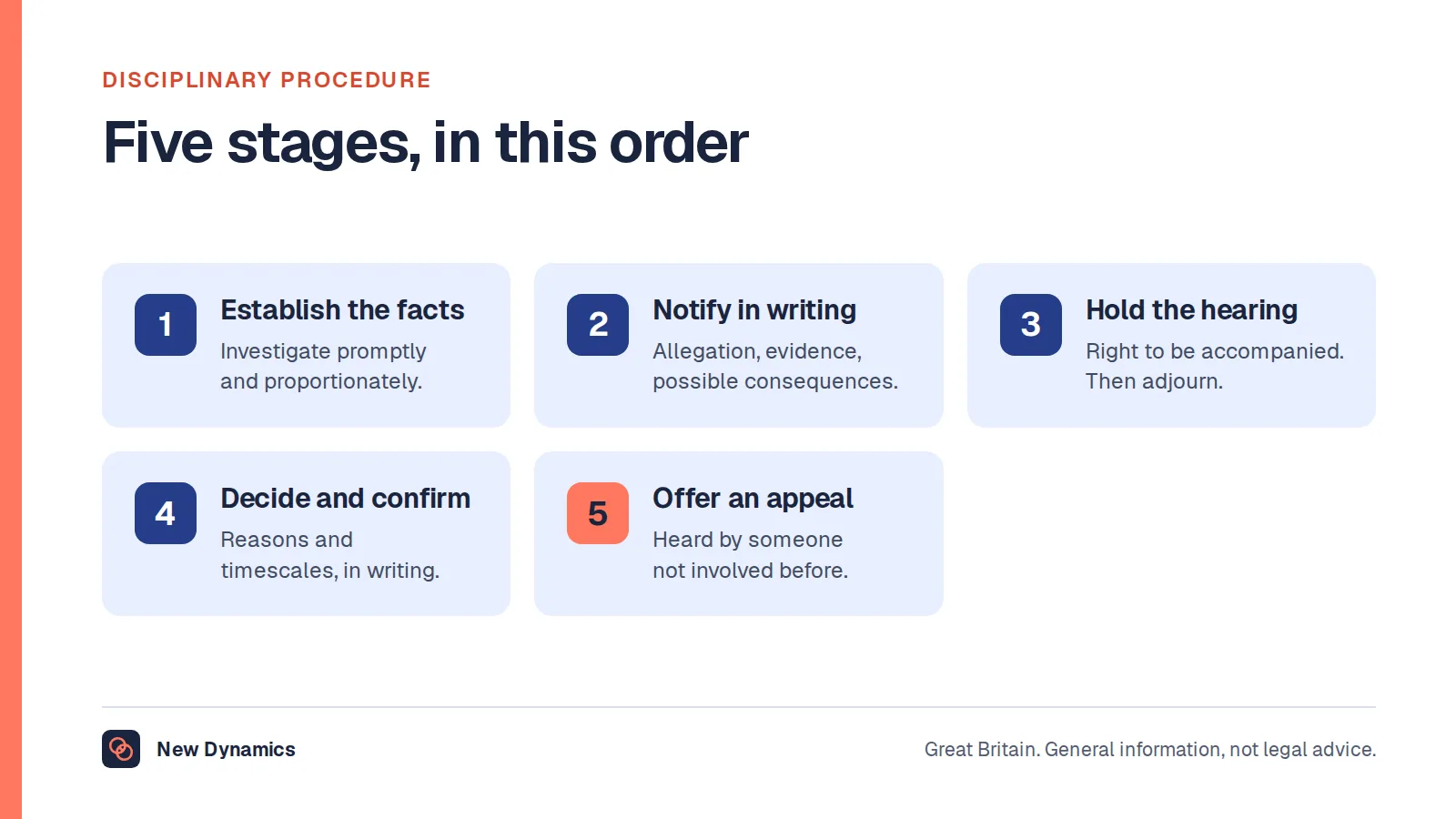
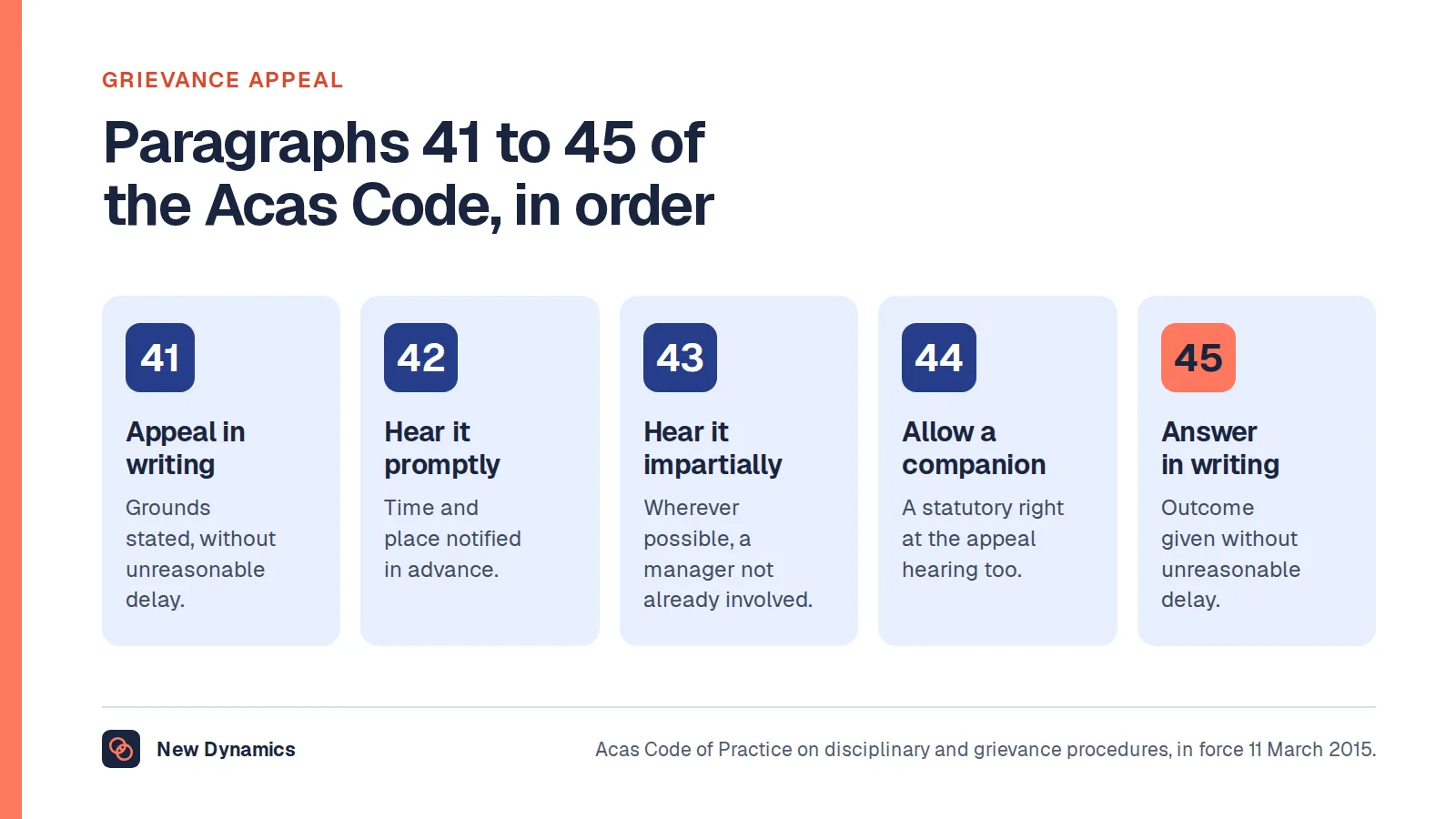
A fourth failure is quieter. A statement built on a process that was never properly recorded stays thin however well it is drafted, because there is nothing to point at. A clean trail through a disciplinary procedure or a grievance appeal is what makes a statement short, dated and specific.
Frequently asked questions
What is a tribunal witness statement?
It is a written account of what a witness would say in evidence, prepared before the hearing. Rule 43(1) of the Employment Tribunal Procedure Rules 2024 provides that any witness statement ordered by the tribunal must stand as that witness's evidence in chief unless the tribunal orders otherwise. In England and Wales it replaces the account the witness would otherwise have given out loud.
Who writes the witness statement, the witness or the solicitor?
The evidence must be the witness's own. The Employment Tribunals (Scotland) Practice Direction of 3 August 2022 requires a statement to be drafted in the first person using the witness's own words. The matching Presidential Guidance accepts that a representative may take primary responsibility for drafting, while warning them not to ask leading questions or interfere with the evidence in any way.
Does a witness statement need a statement of truth?
It depends on the jurisdiction. The Presidential Guidance on General Case Management for England and Wales says the Rules do not require one and there is no objection either way. In Scotland, paragraph 29 of the Practice Direction sets out a confirmation and statement of truth the witness must sign and date.
When are witness statements exchanged?
Guidance Note 3 of the Presidential Guidance on General Case Management says that unless a different date is fixed, exchange should be completed by no later than two weeks before the hearing, and that simultaneous exchange is the norm though not always appropriate. The case management order governs, so follow its dates.
How long should a tribunal witness statement be?
No official source publishes a word or page limit. The guidance pulls both ways: Guidance Note 3 says a statement "should be as full as possible" because the tribunal may not let a witness add to it, while the Scottish Practice Direction says one "should be as succinct as possible".
Are witness statements used in Scotland?
Not as a matter of course. The Scottish Practice Direction creates a presumption that evidence in chief is given orally without a statement, and a tribunal may order otherwise only after consulting the parties, after considering an agreed statement of facts, and with written reasons.
Your next step: get one statement into shape
- Check the jurisdiction. England and Wales means statements by default. Scotland means oral evidence unless an Employment Judge has ordered otherwise with written reasons.
- Read the case management order and put the exchange date, the bundle deadline and the hearing date on one page. The order governs, not the default in any guidance.
- List your witnesses against the issues. Anyone who cannot speak from personal knowledge to a disputed fact should not be given a statement.
- Interview with open questions, keep their words, and build the statement and the bundle together so every fact relied on has a page number.
- Delete every sentence that argues or quotes the law, then read the draft aloud in the witness's hearing.
To get the written procedures a defensible record depends on into one place, read and download our employee handbook guide. The guide is free to read, and the PDF uses our short download form.
Want the dated trail a witness statement is supposed to describe to exist before anyone needs it? Book a New Dynamics demo and bring one recent disciplinary or grievance file. You can also email contact@new-dynamics.com.