TL;DR
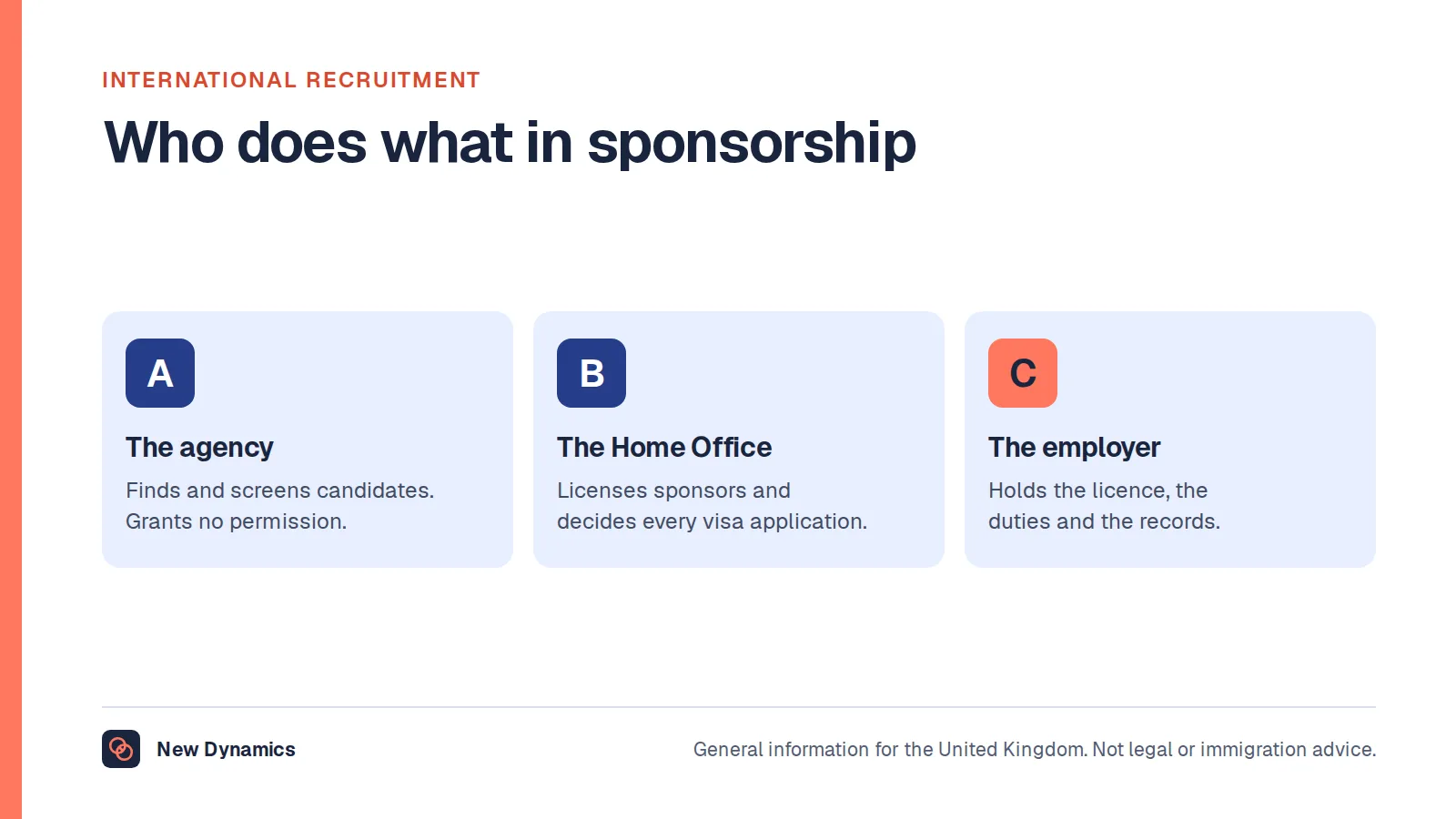
- Two permissions, not one. Your sponsor licence lets you issue certificates of sponsorship. The visa is the worker's permission to be here and do that job. GOV.UK is blunt about the gap: "Sponsoring someone does not guarantee that they'll get a visa to work for you in the UK."
- The Skilled Worker salary threshold is £41,700 a year or the going rate for the occupation code, whichever is higher. Statement of Changes HC 997 substituted £41,700 for £38,700 with effect from 22 July 2025, and the same date lifted the skill threshold back to RQF level 6.
- The Immigration Skills Charge rose by 32% on 16 December 2025. It is now £480 for the first 12 months for a small or charitable sponsor and £1,320 for a medium or large one, up to £2,400 or £6,600 over a five-year sponsorship.
A candidate is good, the offer is ready, and then somebody asks whether they have the right to work. If the answer is no, the question that follows is almost always the wrong one. People ask "which visa do we get them?" when the first question is whether your organisation can sponsor anyone at all, and the second is which route the job itself fits.
This article answers both for a UK employer. It sets out the work routes you are likely to meet, what a certificate of sponsorship actually is, where the Skilled Worker salary and skill thresholds currently sit and the date they took effect, what the Immigration Skills Charge costs you, how long each permission lasts, and why your licence and the worker's visa are two different things that fail in two different ways. It is general information about the position in the United Kingdom and not legal or immigration advice.
A sponsored hire has a start date fixed on a certificate before the person has permission to travel, so the first thirty days of the job are planned around a document nobody controls. Keeping that plan in one place helps: see how New Dynamics onboarding holds the tasks, owners and dates for a new starter so a moved start date moves one plan rather than six inboxes.
Two permissions, not one
The single most expensive misunderstanding in this area is treating sponsorship as one thing.
Your sponsor licence is permission for your organisation to sponsor. It lets you assign certificates of sponsorship on the routes your licence covers. GOV.UK puts the limit of it in one sentence on its sponsorship guidance for employers: "Sponsoring someone does not guarantee that they'll get a visa to work for you in the UK."
The worker's visa is their permission to be in the UK and to do that specific job for you. It is decided on their application, against the route's requirements, after you have assigned the certificate.
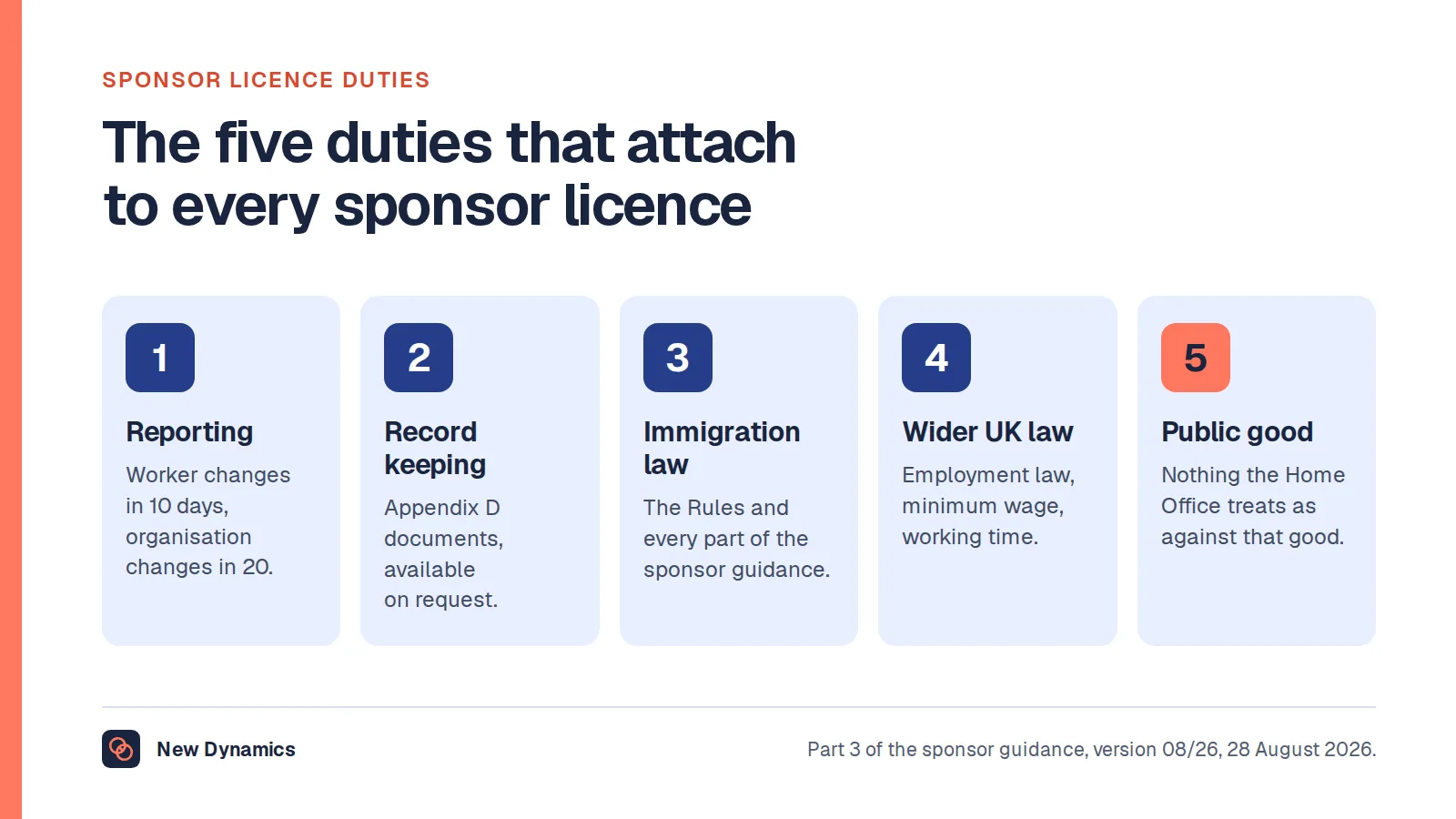
So there are two ways a hire fails. The Home Office can refuse the worker. Or your licence can be suspended or revoked, at which point certificates you have already assigned become invalid. The duties that keep a licence alive, the key personnel, the reporting deadlines and the records, are a separate subject, and we have covered them in detail in our post on sponsor licence duties. This article stays on the routes and the worker's permission.
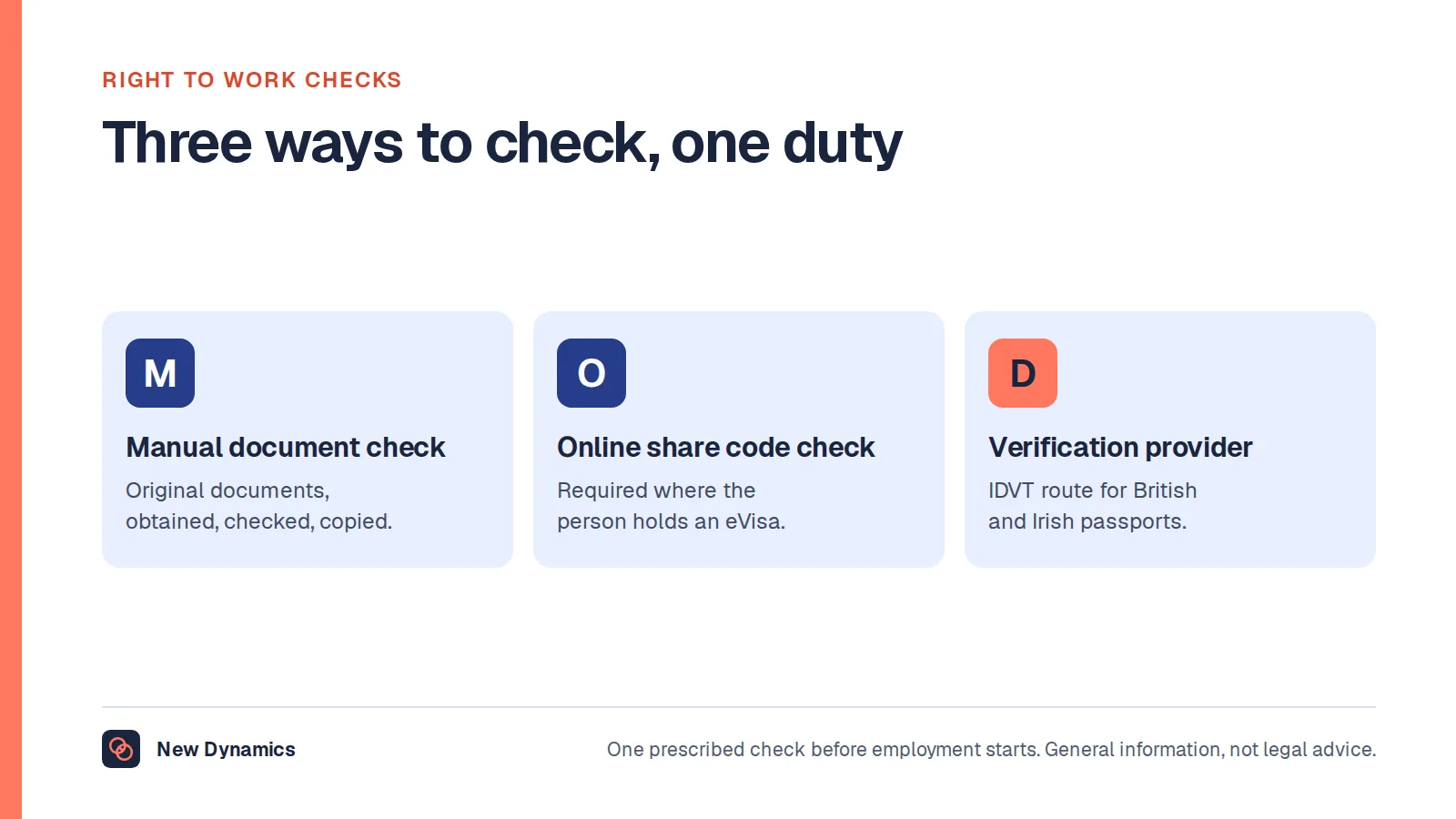
You also do not need a licence for everyone. The same GOV.UK page excludes Irish citizens, people with settled or pre-settled status under the EU Settlement Scheme, and people with indefinite leave to remain. Checking that first is cheaper than everything that follows, and our post on the share code right to work check covers how to do it and what it proves.
The UK work visa routes an employer meets
There are more work routes than any one employer will ever use. These are the families that come up in ordinary hiring.
Skilled Worker
The main route for a permanent UK job. GOV.UK describes it as allowing someone "to come to or stay in the UK to do an eligible job with an approved employer", and it replaced the Tier 2 (General) work visa. The job must be in an eligible occupation code, the salary must clear two tests, and the worker must prove their knowledge of English. The visa "can last for up to 5 years before you need to extend it", and after five years the worker may be able to apply for indefinite leave to remain.
Health and Care Worker
A cheaper version of the same idea for a defined set of health and adult social care roles, sponsored by the NHS, an NHS supplier or an adult social care employer. GOV.UK lists the eligible occupation codes explicitly, from generalist medical practitioners (2211) to nursing auxiliaries and assistants (6131). Two differences matter commercially. GOV.UK tells Skilled Worker applicants to check this route instead because "It's cheaper to apply for and you do not need to pay the annual immigration health surcharge", and the Health and Care Worker pages confirm that the worker and their partner or children "will not have to pay the healthcare surcharge". It also lasts up to five years.
Global Business Mobility
Five short-term routes for moving people who already work for your group or your contractual counterparty, not for hiring from the open market. None of them leads to settlement.
- Senior or Specialist Worker. An existing employee of a linked overseas business. Salary at least £52,500 a year or the going rate, whichever is higher. Stay is the shorter of the certificate period plus 14 days or five years, with an overall cap of "5 years in any 6 year period if you're paid less than £73,900 a year" and "9 years in any 10 year period if you're paid £73,900 a year or more".
- Graduate Trainee. An existing employee on a graduate training programme, with at least three months' service outside the UK. Salary at least £27,300 a year or 70% of the going rate. Maximum 12 months, no extension, and no switching from inside the UK.
- UK Expansion Worker. For setting up a UK branch or subsidiary. Salary at least £52,500 a year or the going rate. Twelve months, extendable by 12, maximum two years in total.
- Secondment Worker. For a secondee from an overseas business with a high value contract with your organisation. GOV.UK states the test plainly: "Your overseas employer must have an eligible contract with your UK sponsor that's worth at least £50 million." Maximum two years.
- Service Supplier. For a contractual service supplier or independent professional covered by a trade agreement. The length depends on the agreement, and GOV.UK says the stay is the shorter of "6 months or 12 months" under the relevant agreement or the certificate period plus 14 days.
Scale-up Worker
A route with an unusual shape. The worker must be sponsored for at least six months, and after that GOV.UK says they can "change or stop doing your job without telling the Home Office" and be self-employed, with no need to update the visa. The initial grant is two years, extendable by three years at a time, and extensions no longer need a sponsor at all, only an earnings record.
The salary test is £39,100 a year or the going rate for the occupation code, whichever is higher. The employer test is the hard part: in the three years immediately before approval the business must have "grown by 20% on average in each year in either employment or total sales (turnover)" and have "had at least 10 employees at the start of the 3 year period". A Scale-up Worker licence also lasts only four years, and GOV.UK warns that "You will not be able to apply for another licence to sponsor these types of workers."
Temporary Work
Six short routes for genuinely temporary activity, each with its own clock.
- Seasonal Worker, for horticulture "for up to 6 months" or poultry "from 2 October to 31 December, in the same year", with poultry applications due by 15 November each year.
- Creative Worker, a maximum of 12 months or the certificate period plus up to 28 days, whichever is shorter.
- Charity Worker, unpaid voluntary work, up to 12 months.
- Religious Worker, up to 24 months.
- Government Authorised Exchange, where GOV.UK says "Depending on the scheme you apply for, you'll get a visa for a maximum of 12 months or 24 months."
- International Agreement, up to two years for an overseas government or international organisation worker, and up to five years for a private servant in a diplomatic household.

What a certificate of sponsorship actually is
It is not a document you can post to anyone. GOV.UK describes it on the Skilled Worker pages as "an electronic record, not a physical document", carrying a reference number the worker uses in their application. You create it in the sponsorship management system, you certify what the job is, and the number is what the worker quotes.
Three timing facts are worth putting in your offer process:
- The worker "must apply for your visa within 3 months of getting your certificate of sponsorship". A certificate you assign and then sit on expires unused.
- They can apply "up to 3 months before the day you are due to start work in the UK", and GOV.UK notes that this date is the one on the certificate.
- Decisions usually take three weeks from outside the UK and eight weeks from inside it on the Skilled Worker route. Health and Care Worker decisions are usually three weeks.
The certificate also carries data that binds you afterwards. The occupation code, the salary, the work location and the start and end dates on it are what the Home Office will later compare with your payroll. There are two kinds of certificate, defined and undefined, and assigning the wrong one is a revocation ground; that mechanic belongs to the licence side and is covered in our sponsor licence duties post.
The Skilled Worker salary threshold, and the date it changed
This figure has moved more than once in three years, so quote it with a date or do not quote it at all.
As Appendix Skilled Worker of the Immigration Rules stands on the GOV.UK page updated on 29 October 2026, the main salary option (row A) requires a salary that "equals or exceeds both: £41,700 per year; and the going rate for the SOC 2020 occupation code".
That £41,700 is not a long-standing number. Statement of Changes to the Immigration Rules HC 997, published on 1 July 2025, contains the substitution in terms: "In row A of the table following SW 4.4, for '£38,700', substitute '£41,700'." The same statement sets the commencement: "All other changes in this Statement shall take effect on 22 July 2025." It also preserves the old position for work already in train, so that where an application was made using a certificate issued before 22 July 2025, it "will be decided in accordance with the Immigration Rules in force on 21 July 2025."
The lower options moved on the same date, and they are options rather than a general discount. HC 997 substituted £37,500 for £34,830 in row B and £33,400 for £30,960 in rows C, D and E. In the current Appendix that gives:
- £37,500 and 90% of the going rate where the applicant has a relevant PhD that is not in a STEM subject.
- £33,400 and 80% of the going rate where the applicant has a relevant STEM PhD.
- £33,400 and the full going rate where the job is on the Immigration Salary List.
- £33,400 and 70% of the going rate for a new entrant at the start of their career.
GOV.UK adds a limit worth knowing before you build a new entrant offer: for the under 26, student, graduate and professional training routes into that option, "Your total stay in the UK cannot be more than 4 years if you apply for one of these reasons."
Going rates are per occupation code, so there is no single number
The threshold above is a floor, not a target. Every eligible occupation has its own going rate, and the worker must clear both. GOV.UK says it in one line on the Skilled Worker pages: "Each occupation code has its own annual going rate." Its own worked example makes the trap concrete: "Your salary is £42,000 per year, but the annual going rate for the job you'll be doing is £45,000. You do not meet the usual salary requirements for this visa."
So "we pay above £41,700" is not an answer. The answer is the going rate for the four-digit code that genuinely describes the duties, read off the current going rates table for eligible occupations on the day you write the offer. That table was last updated on 22 July 2025, the same date the thresholds changed. Healthcare and education roles on national pay scales follow different rules again, because the going rate there comes from the pay scale.
One caution on code choice. Appendix Skilled Worker lets a decision maker reject the code you picked, including where "the most appropriate SOC 2020 occupation code has a higher going rate than the proposed salary". Choosing a cheaper neighbouring code is not a saving, it is a refusal risk.
The skill level requirement also changed on 22 July 2025
Salary is the half of this that gets quoted. The skill test is the half that removed jobs from the route altogether.
The explanatory memorandum to HC 997 explains what happened. Skilled Worker previously required an occupation skilled to Regulated Qualifications Framework level 3 or above, having been "lowered from RQF level 6 in Immigration Rules changes made in 2020 (HC 813)". Paragraph 5.1 states the reversal: "These changes therefore lift the threshold for Skilled Workers back to RQF level 6." Note what the threshold measures, in the memorandum's own words: "The threshold relates to the skill level of the occupation, rather than any qualifications held by an applicant."
On the practical side, GOV.UK now tells applicants that a code "listed as a 'higher skilled' job" qualifies, while a "medium skilled" code only works if the job is on the immigration salary list, on the temporary shortage list, or is a prison officer extension or switch. Workers already in the route when the change took effect are protected by the transitional arrangements.
Two official sources count the losses differently, and both are worth having. The explanatory memorandum, written before the change, estimated "a reduction of around 180 eligible occupations". The Home Office accredited official statistics published on 27 August 2026 describe the position afterwards: "Following increases to the skill level requirements, over 100 occupations are no longer eligible for the Skilled Worker visa route. Affected roles could no longer be sponsored on this route from 22 July 2025." If you are testing whether a role you used to sponsor is still sponsorable, check the current eligible occupations table rather than either figure.
The same release shows the effect on volumes. Skilled Worker visas "decreased by 26% to 61,120 in the YE June 2026, of which main applicants and dependants fell to 26,894 (-30%) and 34,226 (-23%) respectively", and IT professionals, at 4,674, "remains the most common occupation for Skilled Worker main applicants". More figures of this kind sit in our HR statistics hub.

The Immigration Skills Charge, and what it costs you
This is the employer's bill, not the worker's, and it went up less than a year ago. The increase was announced, then made, so there is no longer anything proposed about it. The immigration white paper Restoring control over the immigration system, published in March 2025, promised that "we will increase the Immigration Skills Charge for the first time since its introduction in 2017, by 32% in line with inflation". That is now law.
The Immigration Skills Charge (Amendment) Regulations 2025 were made on 15 December 2025 and came into force on 16 December 2025. The explanatory note states the effect in one line: "Regulation 2(3) of these Regulations increases the amounts of charges payable by sponsors by 32%."
As GOV.UK publishes the table on 7 November 2026, and as the Schedule to the regulations sets it out, the charge is:
- £480 for the first 12 months for a small or charitable sponsor, then £240 for each additional six months.
- £1,320 for the first 12 months for a medium or large sponsor, then £660 for each additional six months.
- A maximum, over the longest sponsorship of five years, of £2,400 for a small or charitable sponsor and £6,600 for a medium or large one.
You are "usually a small sponsor if at least 2 of the following apply: your annual turnover is £15 million or less, your total assets are worth £7.5 million or less, you have 50 employees or fewer", and charitable status is a matter of registration rather than self-description.
The charge applies on the Skilled Worker and Senior or Specialist Worker routes, when the worker is "applying for a visa from: outside the UK to work in the UK for 6 months or more" or "inside the UK for any length of time". It is not payable for dependants. If the worker will be here longer than six months but less than a year, you still pay for 12 months, in one go, when you assign the certificate. GOV.UK is firm about where the money comes from: "You must pay the immigration skills charge yourself. Your licence may be revoked if you ask the sponsored worker to pay the fee or any costs linked to your application."
There are exemptions by occupation code, and the regulations and the GOV.UK summary do not currently list the same ones. We set out that mismatch and which source governs in our sponsor licence duties post.
How long a UK work visa lasts
"Up to five years" is only true of two routes. Treating it as the general answer is how a project plan ends up a year longer than the permission behind it.
| Route | How long GOV.UK says it lasts |
|---|---|
| Skilled Worker | Up to 5 years before extension, extendable indefinitely if still eligible |
| Health and Care Worker | Up to 5 years before extension, extendable indefinitely if still eligible |
| Senior or Specialist Worker | Certificate period plus 14 days, or 5 years, whichever is shorter |
| Graduate Trainee | Certificate period plus 14 days, or 12 months, whichever is shorter |
| UK Expansion Worker | 12 months, extendable by 12, maximum 2 years |
| Secondment Worker | 12 months, extendable by 12, maximum 2 years |
| Service Supplier | 6 or 12 months depending on the trade agreement |
| Scale-up Worker | 2 years, then extensions of 3 years without a sponsor |
| Seasonal Worker | Up to 6 months for horticulture, fixed dates for poultry |
Two further points sit underneath that table. A worker cannot change job or employer on most of these routes without applying to update the visa, and on Skilled Worker GOV.UK lists it among the things they "cannot" do. And the Global Business Mobility routes carry cumulative caps across the whole family, so time on one counts against another.
What this means when you are building the offer
The rules reward doing four things before the offer letter, not after it.
Settle the occupation code first. It drives eligibility, the going rate, the certificate and later the Home Office's comparison with your payroll. Agree it with the hiring manager from the actual duties, and write down why.
Price the role against the going rate, not the headline threshold. The number that refuses applications is usually the going rate, not £41,700.
Budget the employer costs separately from the worker's. The Immigration Skills Charge, the licence fee and the certificate fee are yours and cannot be recovered from the worker. The application fee, the healthcare surcharge (usually £1,035 per year) and the £1,270 maintenance requirement are the worker's, unless your certificate certifies maintenance. The Home Office publishes each of these separately and does not publish a combined per hire figure, so if you want a total cost of sponsorship for your own budget you have to build it yourself from the published components.
Plan the start date as a range. Three weeks from outside the UK is usual, not guaranteed, and the certificate's start date is what the worker's application is measured against.
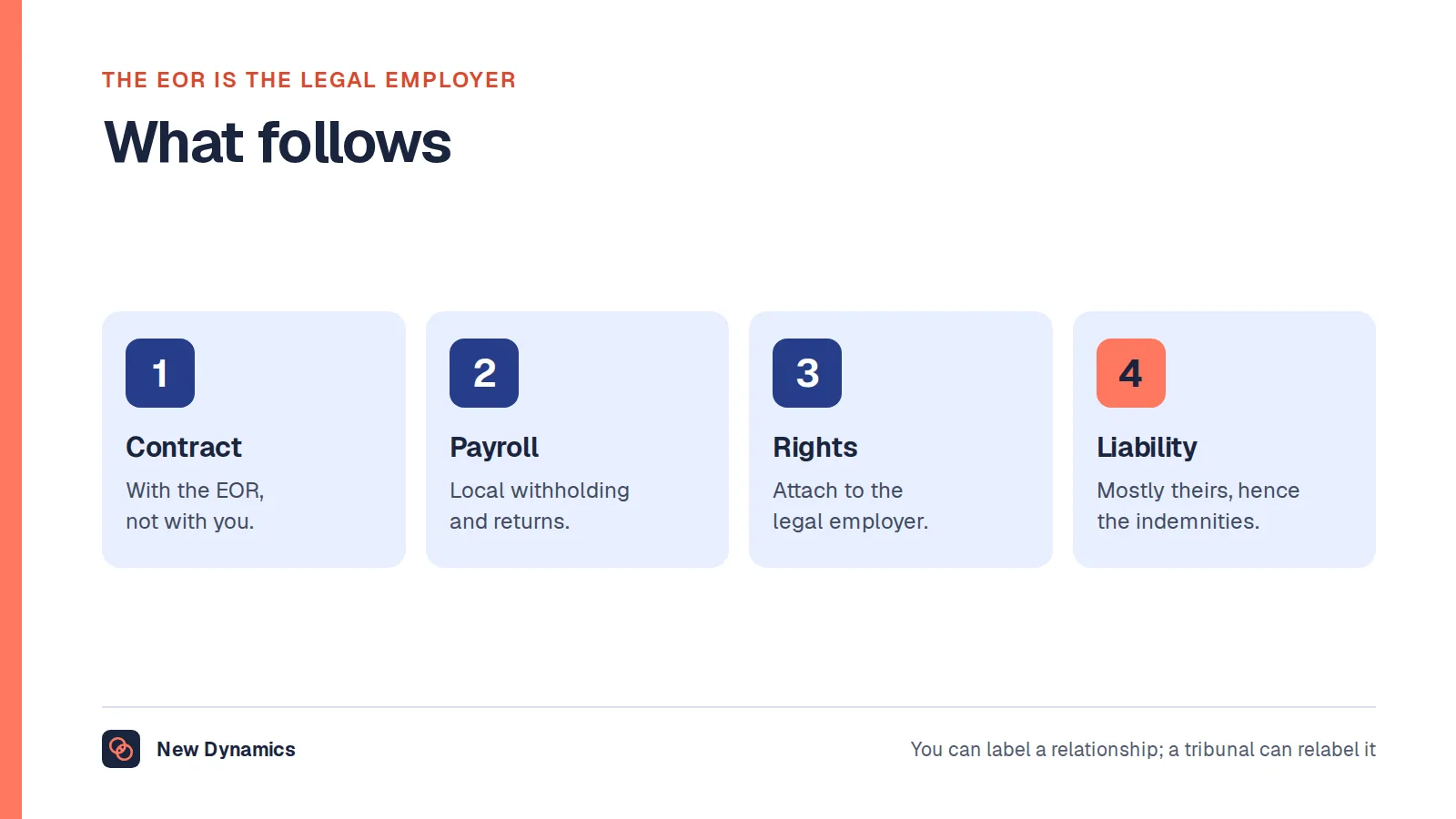
If sponsoring directly does not fit, the alternatives have their own trade-offs. Our posts on what an employer of record is and on international recruitment agencies cover where responsibility actually sits in those arrangements, and our post on the employment contract covers what still has to be written down whichever way the person is engaged.
Jurisdiction and limits
Immigration is not devolved, so these routes work the same way in England, Scotland, Wales and Northern Ireland. The Immigration Skills Charge (Amendment) Regulations 2025 say so in terms: "These Regulations extend to England and Wales, Scotland and Northern Ireland." The Immigration Salary List is the exception to watch, because GOV.UK tells applicants to "Make sure you check whether your job is listed in the part of the UK you'll be working in".
This article is general information about the position in the United Kingdom. It is not legal or immigration advice, it is not a substitute for the GOV.UK pages and Immigration Rules it quotes, and it does not advise any individual on their immigration position. Every figure here was read on a GOV.UK or legislation.gov.uk page on 7 November 2026. This area changes by statement of changes several times a year, so check the current page before you rely on a number, and take proper advice on your own circumstances.
Frequently asked questions
What is a UK work visa?
A UK work visa is permission for a named person to be in the UK and do a specific job. Most work routes are sponsored, which means a UK employer with a sponsor licence has assigned that person a certificate of sponsorship for the role before they apply. The main routes an employer meets are Skilled Worker, Health and Care Worker, the five Global Business Mobility routes, Scale-up Worker and the Temporary Work routes.
What salary do I need to pay for a Skilled Worker visa?
Whichever is higher of £41,700 a year and the going rate for the occupation code. Appendix Skilled Worker of the Immigration Rules requires a salary that equals or exceeds both. The £41,700 figure replaced £38,700 with effect from 22 July 2025 under Statement of Changes HC 997. Lower options exist at £37,500 and £33,400 for relevant PhD holders, jobs on the Immigration Salary List and new entrants, each with its own percentage of the going rate.
Is there one going rate for all jobs?
No. GOV.UK states that each occupation code has its own annual going rate, published in the going rates table for eligible occupations, which was last updated on 22 July 2025. Healthcare and education roles on national pay scales are calculated from those scales instead. Check the rate for your code on the day you build the offer.
How much is the Immigration Skills Charge?
For a certificate assigned on or after 16 December 2025 it is £480 for the first 12 months if you are a small or charitable sponsor and £1,320 if you are medium or large, plus £240 or £660 for each additional six months. Over a five-year maximum that is £2,400 or £6,600. The Immigration Skills Charge (Amendment) Regulations 2025 increased the previous amounts by 32%. You must pay it yourself and must not recover it from the worker.
What is the difference between a sponsor licence and a work visa?
The licence is your organisation's permission to sponsor and to assign certificates of sponsorship. The visa is the worker's permission to be in the UK and do that job for you. They are decided separately, and GOV.UK states that sponsoring someone does not guarantee they will get a visa. Certificates you have already assigned become invalid if your licence is revoked.
How long does a UK work visa last?
It depends entirely on the route. Skilled Worker and Health and Care Worker visas last up to five years before extension and can be extended as long as the worker remains eligible. Graduate Trainee is capped at 12 months, UK Expansion Worker and Secondment Worker at two years, Service Supplier at six or 12 months depending on the trade agreement, and Scale-up Worker starts at two years with later extensions of three years that need no sponsor.
Do I need a sponsor licence for every overseas hire?
No. GOV.UK lists Irish citizens, people with settled or pre-settled status under the EU Settlement Scheme and people with indefinite leave to remain among those who do not need sponsorship. Run a right to work check first, because it is quicker and cheaper than a licence application and it often answers the question.
Your next step: four checks before the offer goes out
- Run the right to work check before anything else, and record the result. If the person already has the right to work, the rest of this does not apply.
- Agree the four-digit occupation code from the real duties, confirm it is currently eligible, and read its going rate off the current GOV.UK table on the same day.
- Test the proposed salary against both the route threshold and that going rate, and keep the evidence with the vacancy file.
- Put the employer costs in the hiring budget as their own line, and the worker's costs in the offer conversation, so neither surprises anyone in week one.
For the first ninety days after the person lands, read and download our employee onboarding guide. The guide is free to read, and the PDF uses our short download form.
Want start dates, owners and the paperwork behind a sponsored hire to live on one visible track instead of in four inboxes? Book a New Dynamics demo and bring your current sponsorship checklist. You can also email contact@new-dynamics.com.