TL;DR
- A video application hands a shortlister age, race, visible disability, visible pregnancy and often religion before anyone has scored a criterion. Section 39(1)(a) of the Equality Act 2010 bars discrimination in "the arrangements A makes for deciding to whom to offer employment", and the EHRC statutory code calls interviewing "the stage at which it is easiest to make judgements about an applicant based on instant, subjective and sometimes wholly irrelevant impressions".
- The same code already answers the near question: "Applicants should not be asked to provide photographs, unless it is essential for selection purposes, for example for an acting job; or for security purposes." Requiring video can also put a disabled applicant at a substantial disadvantage, which engages the section 20 duty, so offer a written alternative to everyone.
- The ICO's draft recruitment guidance is blunt about volume: "You must not collect excessive information about candidates at interview. For example, it is not usually necessary to make a video recording of each candidate's interview performance." Automated analysis is a separate decision, and only becomes special category biometric data where the purpose is to uniquely identify someone.
A video resume, also called a video CV, is a short self-recorded clip in which a candidate introduces themselves and makes the case for a job. Most articles about them are written for the person holding the camera. This one is for the person at the other end, because the decision that matters is the employer's: do you ask for video, do you accept it, and what happens to the file once it lands.
A video is a rich document, and most of what it adds is information you are not permitted to decide on. That does not make video applications unlawful. It makes them a process you have to design rather than allow by default. This is general information about the position in the United Kingdom and not legal advice.
Selection is easier to defend when the stages, the participants and the scoring are the same for everyone. See how New Dynamics workflows let you fix the stages and the rules once and run every person through them the same way.
What a video resume actually is
Three different things travel under the name:
- A candidate-made clip, sixty to ninety seconds, recorded on a phone and sent beside a written CV. The candidate chooses what to say.
- A one-way video interview, where the employer sets the questions and the platform records answers against a timer. That is an interview stage with the interviewer removed, and should be designed like an interview.
- A video introduction on a profile, which you may meet without asking for it.
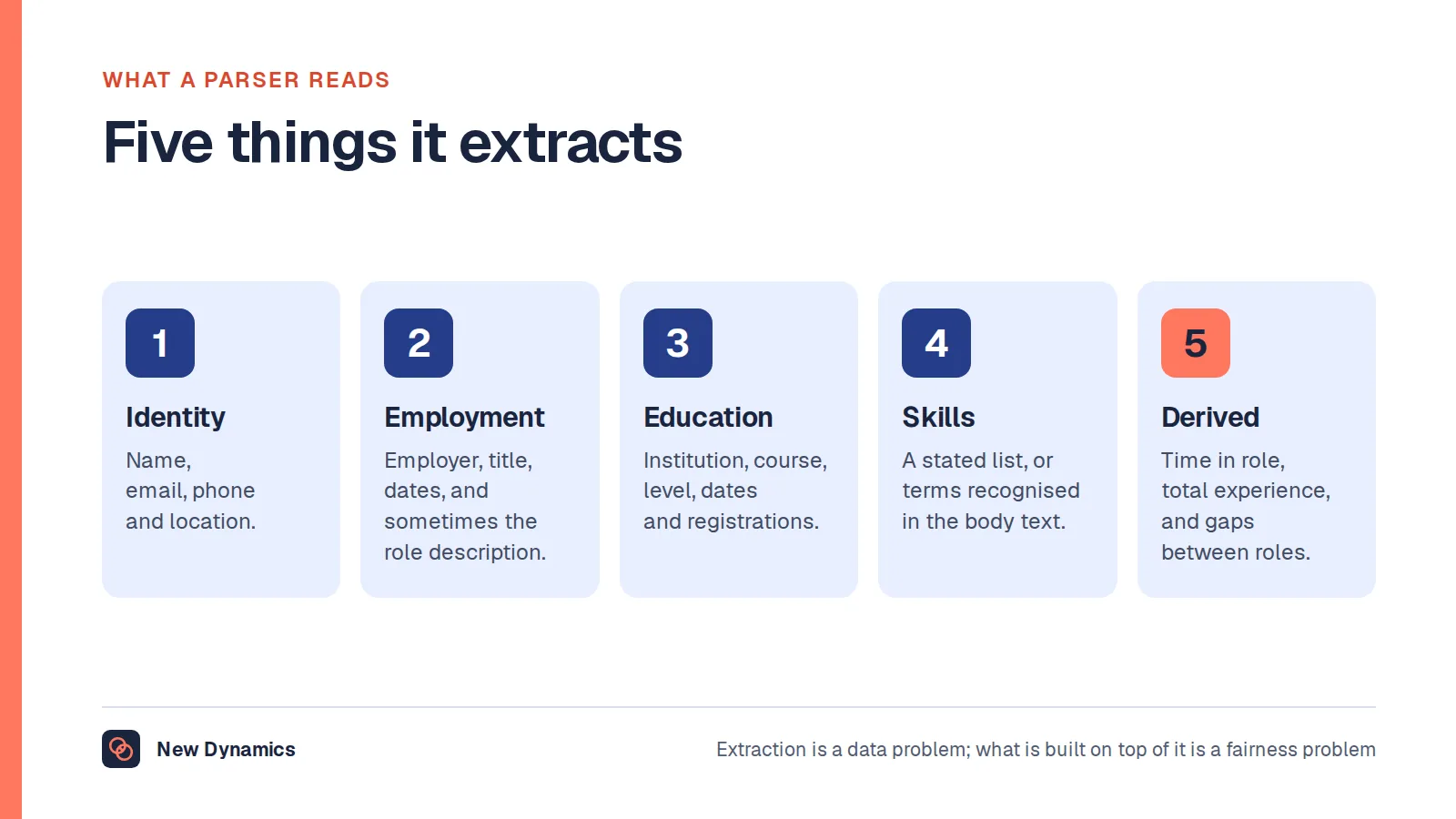
Candidates send video because they think the written CV is losing them something. Often they are right about the problem and wrong about the fix. Our post on resume parsing covers what the UK guidance says about software reading CVs and about bias in matching. A video does not get anyone past a parser. It arrives beside the CV the parser reads.
What a video reveals that a written CV does not

A sixty second clip typically discloses, without anyone asking: approximate age, race and ethnicity, any visible disability or audible speech difference, visible pregnancy at the time of recording, and religion or belief where dress or a visible symbol indicates it. That is five of the nine protected characteristics in the Equality Act 2010, handed to a shortlister before the first criterion is scored.
Section 13(1) defines direct discrimination plainly: "A person (A) discriminates against another (B) if, because of a protected characteristic, A treats B less favourably than A treats or would treat others." Section 39(1)(a) applies it to hiring, and reaches further than the final decision. An employer "must not discriminate against a person (B) in the arrangements A makes for deciding to whom to offer employment". The arrangements include how you collect applications and what the shortlister sees.
The Employment Statutory Code of Practice, issued by the Equality and Human Rights Commission in 2011, is the authority on running selection. It says at paragraph 1.13 that it "does not impose legal obligations" and is not "an authoritative statement of the law", but that it "can be used in evidence in legal proceedings brought under the Act". That is why it is the document to design against.
Two paragraphs decide this question. At 16.39, on application forms: "It is good practice for this information to be withheld from the people who are short-listing or interviewing because it could allow them to find out about a person's protected characteristics (such as age or sex)." A video does the opposite, deliberately. At 16.42: "Applicants should not be asked to provide photographs, unless it is essential for selection purposes, for example for an acting job; or for security purposes, such as to confirm that a person who attends for an assessment or interview is the applicant." A video is a photograph that moves and talks. If the still image needs a justification, so does the clip.
Should you ask for video applications?
For most roles, no. Three questions decide it.
Is the thing you want to see part of the job? The Code says at 16.15 that "As far as possible, all the criteria should be capable of being tested objectively". Presence and energy are not criteria. Delivering a two minute explanation to a customer is, if the job involves that.
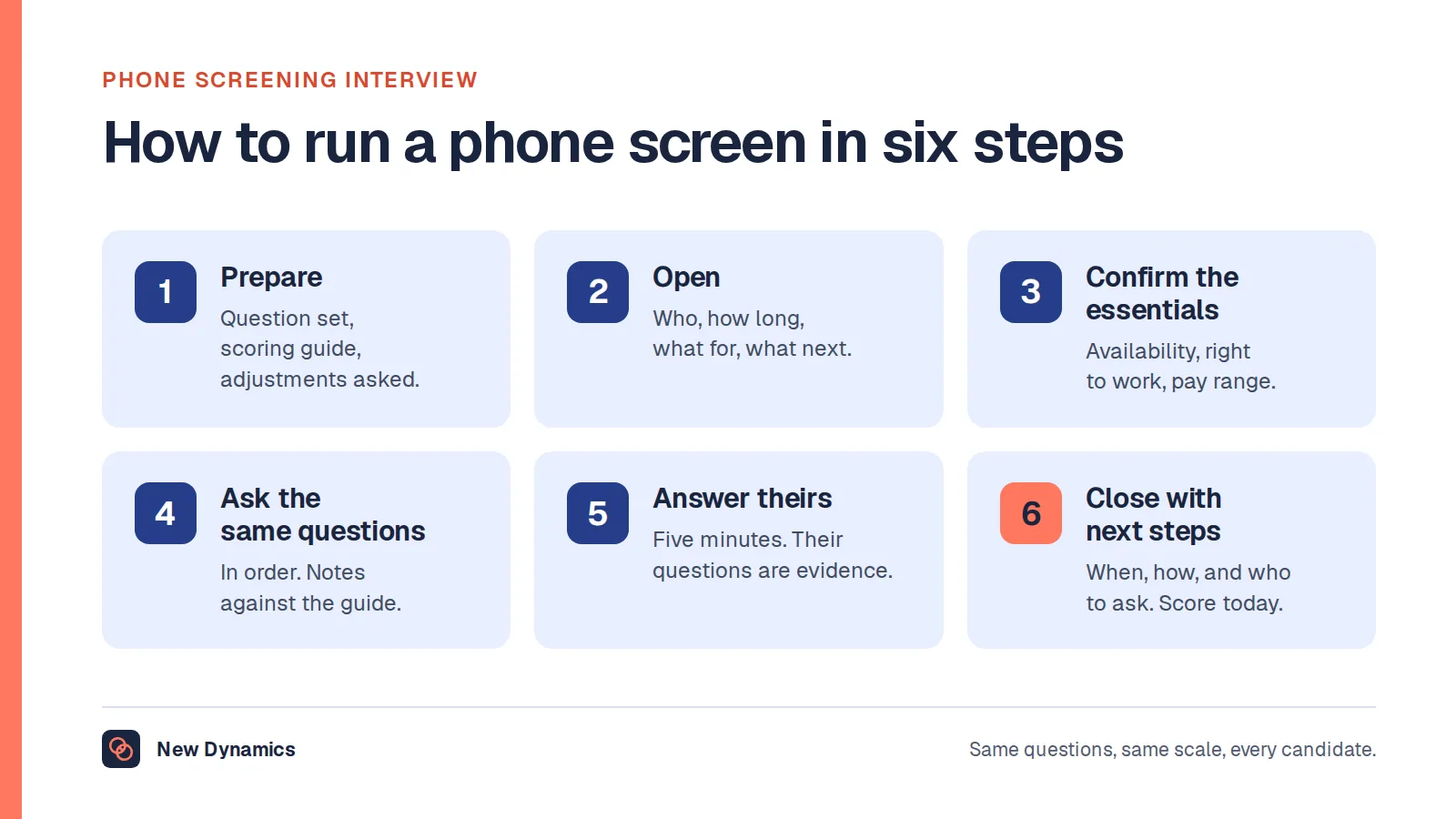
Could you test it later instead? If the real answer is a structured interview or a work sample at stage two, run it there. Our post on the phone screening interview covers the cheaper early stage most employers need.
Can every candidate do it? Video needs a camera, bandwidth, a quiet private space and fluency to a lens. Those are unevenly distributed, and not along lines that predict job performance.
No official UK source publishes a figure for how many employers ask for or accept video applications. We have not found one and will not borrow a vendor survey to fill the gap. For figures that are officially published about work, see our HR statistics hub.
What to do when an unsolicited video arrives
It will happen whether you invited it or not. Decide the rule once, write it down, apply it to everyone.
The defensible rule is that an unsolicited video is not part of the assessment. Score the written application against the published criteria, and do not open the video until the shortlist is fixed. If the candidate progresses you may watch it as context, but it still does not get scored, because nobody else sent one and there is nothing to compare it against.
Paragraph 16.50 of the Code supports that: "The marking system, including the cut-off score for selection, should be agreed before the applications are assessed, and applied consistently to all applications", and "Selection should be based only on information provided in the application form, CV or, in the case of internal applicants, any formal performance assessment reports."
Say so in the acknowledgement. A line confirming that applications are assessed on the written form saves candidates effort and saves you the appearance of having judged the video quietly.
If you do use video, run it like an assessment

- Write the criteria first and publish them. The ICO's draft guidance on shortlisting, testing and interviewing candidates makes the same point: "You should select candidates in a way that is fair and consistent. For example, you might assess each candidate against specific criteria as this can help to ensure transparency."
- Ask the same questions of everyone, in the same order, with the same time limit and the same number of attempts.
- Score before you discuss. The Code recommends at 16.50 that where more than one person is involved, "applications should be marked separately before a final mark is agreed between the people involved". Two assessors who talk first produce one opinion twice.
- Score only the criteria. Paragraph 16.63 belongs on the scoring sheet: "Questions should not be asked, nor should assumptions be made, about whether someone would fit in with the existing workforce."
- Keep the records. Paragraph 16.44 warns that if an employer does not keep records of their decisions, "in some circumstances, it could result in an Employment Tribunal drawing an adverse inference of discrimination".
Paragraph 16.57 explains why this matters more for video than for paper. The interview, says the Code, is "the stage at which it is easiest to make judgements about an applicant based on instant, subjective and sometimes wholly irrelevant impressions". A video resume is an interview impression without an interview's safeguards.
Reasonable adjustments, and the alternative format
Requiring video is a provision, criterion or practice. Section 20(3) of the Equality Act 2010 sets the first requirement in the duty to make adjustments: "where a provision, criterion or practice of A's puts a disabled person at a substantial disadvantage in relation to a relevant matter in comparison with persons who are not disabled, to take such steps as it is reasonable to have to take to avoid the disadvantage."
A video requirement can disadvantage an applicant with a stammer, a facial difference, a visual or hearing impairment, anxiety, autism, or a condition affecting stamina or speech. The Code says at 16.33 that an employer "must make reasonable adjustments for disabled applicants during the application process and must provide and accept information in accessible formats, where this would be a reasonable adjustment".
The practical answer is short. Offer a written alternative to every candidate, on the advert, without requiring anyone to ask or to explain why. An adjustment nobody has to request is one nobody has to disclose a disability to obtain, and section 60 of the Act restricts health and disability questions before an offer in any case. The Code adds at 16.49 that the duty bites once the employer "knows or could be reasonably expected to know" that a particular disabled person may be applying and may be disadvantaged. An unprompted alternative removes the question.
The data protection layer
A video of a candidate is personal data, and quite a lot of it. The ICO's draft guidance on recruitment and selection, whose consultation has closed and whose "final version will be published in due course", is direct on volume: "You must not collect excessive information about candidates at interview. For example, it is not usually necessary to make a video recording of each candidate's interview performance." That sentence addresses recorded interviews rather than candidate-made clips, but it sets the standard. If you keep video, be able to say why the written record would not do.
On retention: "Under data protection law, you must not keep information for longer than you need to. However, it does not specify timescales for keeping recruitment records. You should carefully consider how long you need to keep this information for and set clear retention periods." Its chapter on recruitment records adds that "In general, you should not keep information beyond the statutory period in which a legal claim can potentially be brought." Note that the EHRC Code, written in 2011, points at the Data Protection Act 1998 at paragraph 16.45. The current obligations sit in the UK GDPR and the Data Protection Act 2018, and the ICO guidance is the layer to read for them.
Automated analysis is a separate decision. The ICO's draft chapter on automated decision-making in recruitment states that "Data protection law restricts the use of solely automated decision-making and profiling that has legal or similarly significant effects on people. This includes a decision about whether to shortlist a candidate, recommend them for interview, reject them or promote them." Our post on AI recruiting tools covers what to ask a supplier.
On biometrics, be precise. Article 9(1) of the UK GDPR prohibits, subject to conditions, processing of "biometric data for the purpose of uniquely identifying a natural person". The purpose does the work. The ICO's biometric data guidance explains that "Biometric recognition describes when you use biometric data to uniquely identify someone", and that biometric recognition "encompasses all situations in which biometric data is special category biometric data". It also states that it "does not cover the use of biometric classification or categorisation systems". So verifying a candidate's identity from their face is squarely special category processing. A tool inferring confidence or enthusiasm from an expression is not automatically special category data, and anyone saying the ICO has ruled on expression analysis is going beyond what it has published. It is still personal data, still profiling, and still needs a lawful basis, an impact assessment and a bias answer.
For candidates: the short version

- Send one only where it is asked for, or where the role is obviously performance facing.
- Never send it instead of a CV. The written document is what gets read, parsed and compared.
- Ninety seconds. One role, two things you have actually done, one sentence on why this employer.
- Say the evidence, not the adjective. "I handled forty support tickets a day" beats "I am passionate about customer service".
- Plain background, daylight, phone propped up, sound tested. Audio matters more than picture.
- Caption it, so more people can use it.
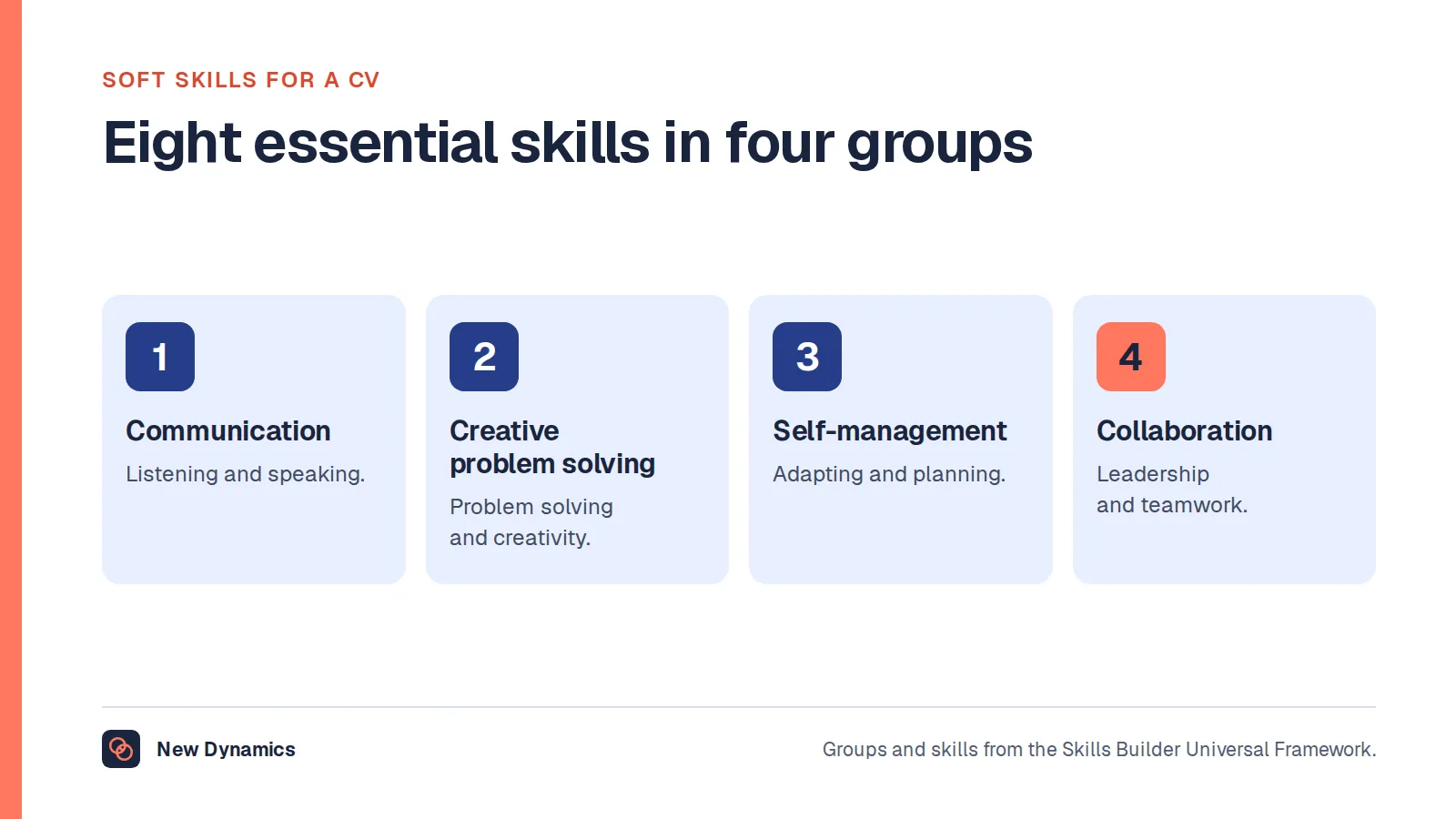
- Keep the written CV machine readable. Our post on soft skills on a CV covers how to evidence the qualities a video is trying to show.
Frequently asked questions
What is a video resume?
A short self-recorded video, usually sixty to ninety seconds, in which a job applicant introduces themselves and summarises why they suit a role. It is also called a video CV, is normally sent alongside a written CV rather than instead of one, and differs from a one-way video interview, where the employer sets the questions and a platform records the answers.
Should employers ask candidates for a video resume?
For most roles, no. A video discloses age, race, visible disability, visible pregnancy and often religion before any criterion has been scored, and the EHRC Employment Statutory Code of Practice advises that applicants should not be asked for photographs unless it is essential for selection, such as for an acting job, or for security. Ask for video only where what it shows is a genuine requirement of the job.
What should we do with an unsolicited video CV?
Decide the rule once and apply it to everyone. Assess the written application against the published criteria, do not open the video until the shortlist is fixed, and say in the acknowledgement that video is not required and is not scored. The statutory code recommends agreeing the marking system and cut-off before applications are assessed, then applying it consistently.
Does requiring a video application discriminate against disabled applicants?
It can. Requiring video is a provision, criterion or practice, and section 20 of the Equality Act 2010 requires reasonable steps where such a practice puts a disabled person at a substantial disadvantage compared with people who are not disabled. Offer a written or audio alternative openly on the advert, so nobody has to disclose a disability to request it.
How long can we keep a candidate's video?
The ICO says you must not keep information for longer than you need to, that the law does not specify timescales for recruitment records, that you should set clear retention periods, and that in general you should not keep information beyond the statutory period in which a legal claim can potentially be brought. Decide the period before you start collecting video.
Is analysing a candidate's face or voice biometric data?
The purpose decides. Article 9 of the UK GDPR covers biometric data processed "for the purpose of uniquely identifying a natural person", and the ICO's biometric data guidance explains that biometric recognition covers all the situations in which biometric data is special category data. That guidance does not cover biometric classification or categorisation systems, so a tool inferring a trait from an expression is not automatically special category data. It remains personal data and profiling.
Your next step
- Write down whether your organisation asks for, accepts or ignores video applications, and make sure every recruiter gives the same answer.
- If you accept them, say in the advert that video is optional and is not scored, and keep it out of the shortlisting pack.
- If you require one, publish the criteria, use the same questions for everyone, score before discussing, and offer a written alternative without asking why.
- Set the retention period for candidate video before the first file arrives.
For the wider question of using automated tools in hiring without losing fairness or defensibility, read and download our AI recruitment guide. The guide is free to read, and the PDF uses our short download form.
Want your selection stages, scoring and records to hold up when someone asks how a decision was made? Book a New Dynamics demo and bring your current selection criteria. You can also email contact@new-dynamics.com.