TL;DR
- The word trial decides nothing. GOV.UK's minimum wage manual states that where an employer asks someone to carry out a trial, a test or a recruitment exercise, "the individual may nevertheless be a 'worker' and entitled to the minimum wage".
- No statute sets a maximum trial length. The same manual says in terms that "Current law does not define a 'trial work period' or state precisely when at least the minimum wage must be paid", and that there are "currently no definitive rules or tests". The widely repeated one day figure is the government's stated view, not a legal limit.
- The only trial period the regulations exempt is six weeks or less under a government funded scheme (regulation 52 of the National Minimum Wage Regulations 2015). That is the Jobcentre Plus Work Trial, not an ordinary unpaid trial shift.
A candidate is asked to come in on Saturday to see how they get on, and nobody mentions pay, because it is a trial. That is sometimes lawful and often is not. The word on the invitation does not decide it. What decides it is whether the person spent the day working.
This article sets out the test, whether any official source publishes a maximum length for a work trial, the factors HM Revenue and Customs says decide it, the one exemption in the regulations, the separate government Work Trial scheme, and what an underpayment costs. It describes the United Kingdom, where minimum wage law applies in England, Scotland, Wales and Northern Ireland. It is general information rather than legal advice.
Whatever you decide, the decision has to survive the start date. See how New Dynamics onboarding keeps what you agreed with a candidate attached to their record, instead of leaving it in one manager's inbox.
The test is worker status, not the word trial
GOV.UK's minimum wage manual handles this in a section called "Unpaid work trial periods", inside its guidance on eligibility for the minimum wage (published 1 March 2021, updated 23 October 2026). It does not condemn the practice: "Often this will be a legitimate practice, but some employers may use unpaid trial work periods to obtain work or services for which at least the minimum wage should be paid."
Then it states the rule. "Where an employer asks an individual to carry out a 'trial', 'test' or 'recruitment exercise', the individual may nevertheless be a 'worker' and entitled to the minimum wage."
Worker is the word that matters. Section 54(3) of the National Minimum Wage Act 1998 covers a contract of employment and also "any other contract, whether express or implied and (if it is express) whether oral or in writing", under which the individual undertakes to perform work personally for someone who is not their client or customer. It can be oral. It can be implied. Nobody has to sign anything for it to exist.
GOV.UK's guidance on minimum wage, work experience and internships adds the line that settles most disputes: "If an unpaid person claims that they are owed minimum wage arrears, you must prove that they are not a worker or that no arrears are owed." The burden is the employer's, and the label the employer chose is not evidence. Our post on employment status covers the wider question.
Is there a time limit on an unpaid work trial?
Not in law, and this is where most advice goes wrong. The manual says it plainly: "Current law does not define a 'trial work period' or state precisely when at least the minimum wage must be paid." On how a tribunal would approach it, the same page says there are "currently no definitive rules or tests".
The figures in circulation are guidance, not statutory maximums. They still matter, because they show how the enforcing authority thinks. The manual states that "in the government's view an individual conducting work in a trial lasting longer than one day is likely to be entitled to the minimum wage in all but very exceptional circumstances", and that "the longer a trial period continues, the more likely it is that it results in a contract to provide work and that the minimum wage becomes due".
Acas guidance on interviewing job applicants (last updated 30 June 2026) puts the same thing as a rule of thumb: a trial "should be for a reasonable amount of time. For example, 2 hours or a shift", and "An unpaid work trial should not usually last longer than one day".
Treat one day as the point by which the guidance expects you to be paying, not an allowance you may spend. A two hour trial can still require pay if it is really unpaid labour.
The factors that decide it
The manual lists six factors a court or tribunal is, in the government's view, likely to take into account.

- Purpose. Whether the trial is "genuinely for recruitment purposes". If it is not, "it will generally be considered to be work".
- Length. Whether it "exceeds the time that the employer would reasonably need to test the individual's ability to carry out the job offered".
- Observation. "the extent to which the individual is observed while carrying out the tasks".
- Task match. How closely the tasks relate to the job offered. Where they differ, that may indicate the employer wants "to get the tasks carried out".
- Value to the employer. Whether the tasks "have a value to the employer beyond testing the individual". A simulated environment normally indicates they do not.
- Business reliance. Whether trials are used "as a means to reduce labour costs", which is likely to indicate the person is working.
A genuine assessment against unpaid work
The manual publishes six hypothetical scenarios and says which way each is likely to go. They are the clearest statement of the line in official guidance.

Likely to require pay. A warehouse applicant does an eight hour trial shift moving produce to the dispatch exit, before she is even considered for interview, alone, with the foreman returning at the end to check how much she moved. The manual's reading: the length is "excessive in time and too narrow in scope", she is not observed, and "the main purpose appears to be to help the supermarket dispatch its produce". A bar that puts eight people on trial shifts across a week without knowing how many it will hire lands the same way.
Likely not to require pay. A cafe applicant interviewed in the week returns on Saturday for two hours while the owner "will keep an eye on how she interacts with customers". A head chef candidate at an assessment day cooks dishes "used for tasting purposes only rather than being served to paying customers".
The pattern is consistent: short, observed, built from the job, and producing nothing the employer would otherwise have paid someone to produce. The moment the output has independent value, you are buying labour.
The one unpaid trial the regulations exempt
Regulation 52 of the National Minimum Wage Regulations 2015 exempts a person "participating in a trial period of work with an employer for a period of six weeks or less, as part of a scheme which meets the requirements in paragraph (2)". Paragraph (2) requires the scheme to be "designed to provide training, work experience or temporary work, or to assist in the seeking or obtaining of work", and to be "made or funded by" the Secretary of State, the Scottish or Welsh Ministers or another named public authority.
So the six weeks is not a general allowance. It exists only inside a government made or funded scheme. The manual confirms the scope: "NMW legislation permits a very limited number of exceptions for particular schemes which permit unpaid work trials", and names the government's Work Trial scheme as one.
The Jobcentre Plus Work Trial
That scheme is current. GOV.UK's guidance on back to work schemes (published 28 November 2024, updated 23 June 2026) describes it for claimants: "Work trials are a trial period for an actual job", during which "You'll keep getting your benefit and will not be paid a wage", and "you're the only person being considered for the vacancy." Taking part "is voluntary", and the vacancy must last 16 hours a week or more and be expected to last at least 13 weeks. The employer page, Jobcentre Plus help for recruiters, adds that "You need to agree a work trial with Jobcentre Plus before you offer it to a jobseeker."
The two pages state the length differently, and both are live. The employer page ties it to the job: no more than "5 days if the job is for less than 6 months", and no more than "30 days (and usually around 5 days) for jobs lasting 6 months or more". The claimant page says the initial period "should just be for a few days", and that "In exceptional circumstances, a trial can last up to 30 working days, over a period of no more than 6 weeks." The six week boundary is the one that matches regulation 52, so that is the limit that governs.
None of this is available off your own bat. Set up a trial yourself, call it a Work Trial, and regulation 52 does not apply, because your scheme is not made or funded by government.
What getting it wrong costs, and who enforces it
Arrears, recalculated upwards. GOV.UK's guidance on enforcing the minimum wage (updated 23 October 2026) states that "Arrears are calculated according to a formula using the current minimum wage rate", so where the current rate for the age band is higher, "the amount of the arrears due to the worker will be more than the amount of the original underpayment". GOV.UK's page on National Minimum Wage and National Living Wage rates notes that "The rates change on 1 April every year", and lists these as current from April 2026: £12.71 an hour for 21 and over, £10.85 for 18 to 20, £8 for under 18 and £8 for apprentices. An eight hour unpaid trial given to a 25 year old is £101.68 of arrears before anything is added. For wider pay figures, see our HR statistics hub.
A penalty of twice the arrears, and naming. The Fair Work Agency enforcement statement (published 7 April 2026, updated 26 August 2026) sets the basis: "The maximum penalty is £20,000 per worker. The penalty is calculated as 200% of the total underpayment for all of the workers specified in an NoU." The minimum is £100, and the penalty is halved "if all of the unpaid wages and 50% of the penalty are paid in full within 14 days". On publicity, the same statement says "DBT considers all cases for naming where the total arrears owed to workers was £500 or more", with a lower threshold of more than £100 for a repeat case.
Who enforces it now. This changed in 2026. The Fair Work Agency statement, published on 7 April 2026, explains the arrangement: "The Secretary of State has arranged with HM Revenue and Customs (HMRC) for its officers to act as FWA enforcement officers for the purposes of enforcing the minimum wage", and "HMRC operates the NoU model, on behalf of FWA." Notices are issued under the Employment Rights Act 2025. HMRC's own guidance, updated on 23 October 2026, still says the minimum wage "can be enforced by HM Revenue and Customs (HMRC) compliance officers or by a worker making a claim in an employment tribunal or court". Both hold: the officers are HMRC, the authority is the Fair Work Agency, and the worker keeps the tribunal route. The manual adds that officers "will take enforcement action where they consider workers are being exploited under the cover of recruitment".
We have found no official source that publishes a figure for how many UK job applicants are asked to work an unpaid trial, so we quote no number.
What to do instead
Pay the trial. If you want someone in a real environment doing real work for a real shift, pay at least the rate for their age and record the hours. That removes the question.
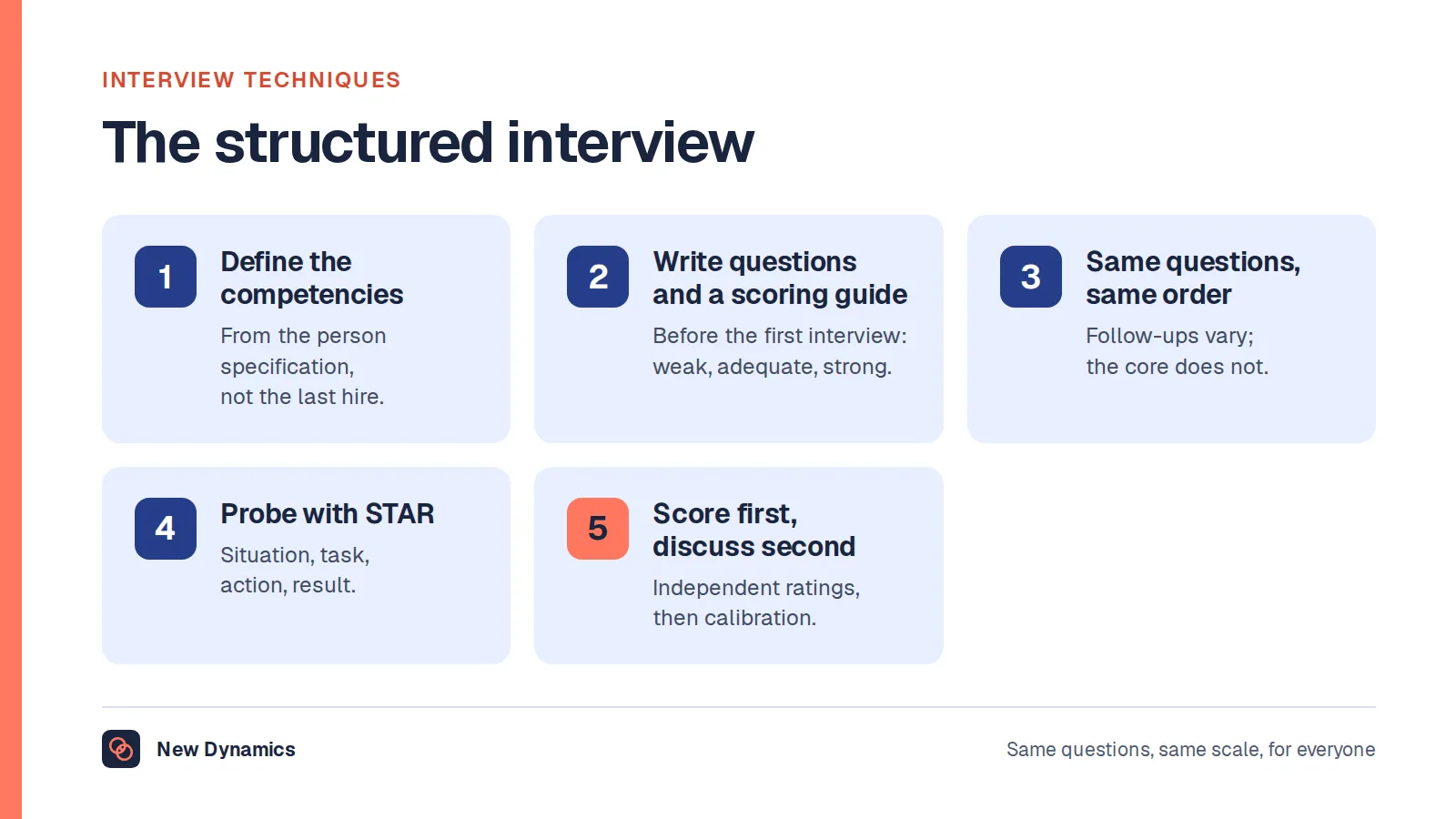
Or assess without productive work. Keep it short, keep it observed, build the task from the job description, score every candidate against the same guide, and make sure the output is not something you needed anyway. Do not ask for the trial before the person is a genuine candidate, and do not run trials with no defined number of roles to fill: the warehouse and bar scenarios turned on exactly those points. Our post on interview techniques covers the rest of the process.
Frequently asked questions
Are unpaid work trials legal in the UK?
An unpaid work trial is lawful only where the person is not a worker for minimum wage purposes. GOV.UK's minimum wage manual says the practice is often legitimate, but that where an employer asks someone to carry out a trial, test or recruitment exercise, the individual may nevertheless be a worker and entitled to the minimum wage.
How long can an unpaid trial shift legally last?
No statute or regulation sets a maximum for an ordinary recruitment trial, and GOV.UK's manual says current law does not define a trial work period or say precisely when the minimum wage must be paid. The government's stated view is that a trial longer than one day is likely to attract the minimum wage in all but very exceptional circumstances, and Acas says an unpaid trial should not usually last longer than one day. Both are guidance, not a legal allowance.
Do I have to pay for a two hour trial shift?
Usually not, if it is genuinely an assessment. GOV.UK's example of a two hour cafe trial, where the owner observes the applicant and guides her, is described as unlikely to attract the minimum wage. The same two hours would attract it if the applicant is left unobserved doing work the employer needed doing anyway.
Is a working interview the same as an unpaid work trial?
In minimum wage law the term makes no difference. The manual applies the same test to a trial, a test and a recruitment exercise. What matters is the purpose, the length, the observation, the match to the job and whether the output has value beyond testing the person.
What about the six week unpaid trial I have read about?
That is regulation 52 of the National Minimum Wage Regulations 2015, and it applies only to a trial period of six weeks or less forming part of a scheme made or funded by government, such as the Jobcentre Plus Work Trial. It is not available to an employer running its own trial.
Can a candidate agree in writing to an unpaid trial?
No. GOV.UK states that saying in a written agreement that a person is not a worker does not make it so for minimum wage purposes, and that a court or tribunal would look at the reality of the arrangement.
Your next step: write the trial down before you offer it
- Record the purpose, the length, who observes, the tasks and what happens to the output. If the output has value to you, pay for it.
- Cap the unpaid version well inside a single day, and put the length in the invitation so it is on record.
- Give every candidate the same trial, scored against the same guide, and only once they are a genuine candidate.
- For any trial you pay, set the rate from the person's age using the April 2026 bands and keep the hours like any other shift.
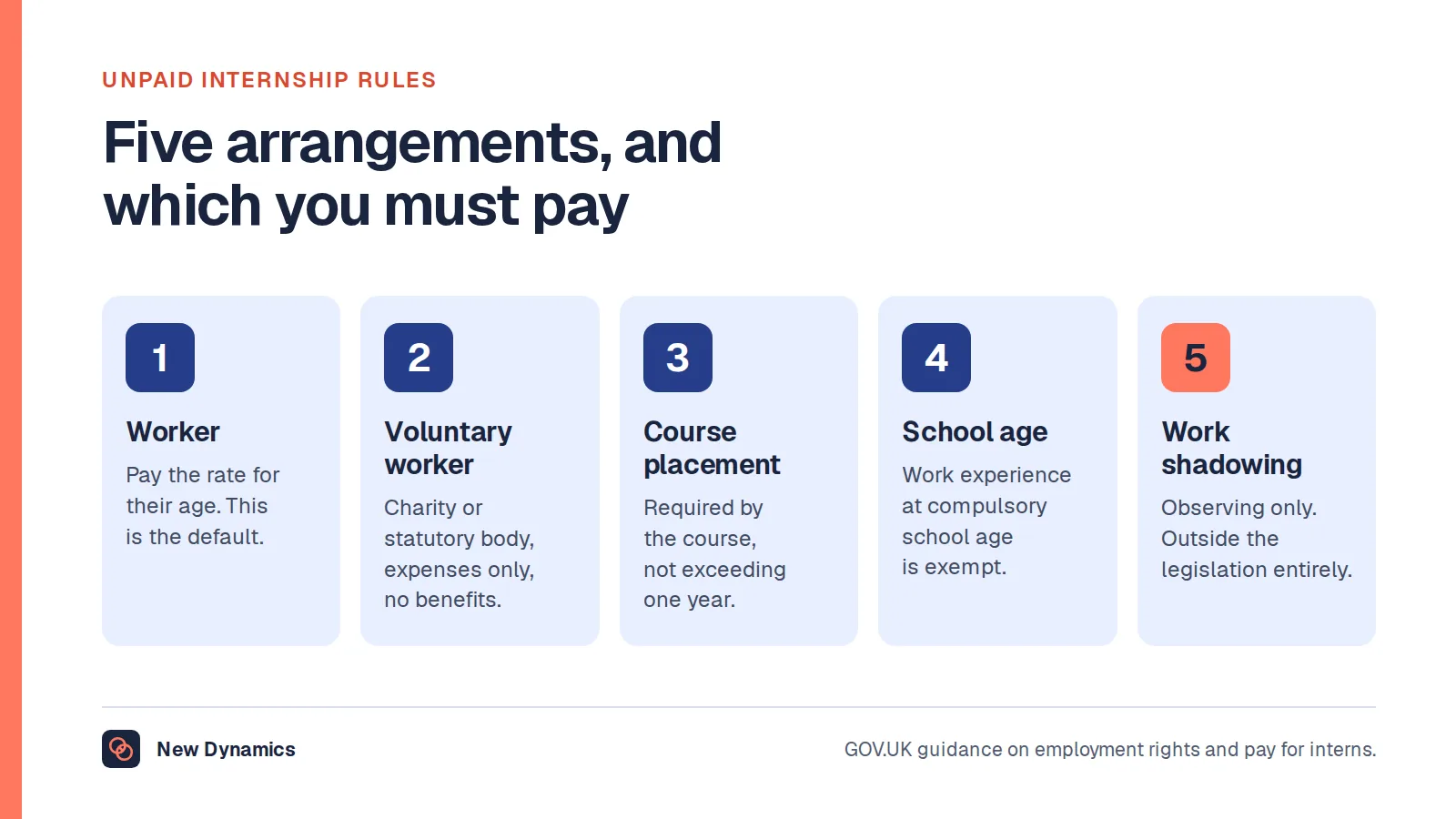
For the process around all of this, read and download our recruitment and selection guide. The guide is free to read, and the PDF uses our short download form. For the wider unpaid question, our post on unpaid internship rules sets out the worker test and the five arrangements the guidance separates.
Want the trial, the score and the decision attached to the candidate rather than reconstructed from a manager's memory? Book a New Dynamics demo and bring one trial you ran last month. You can also email contact@new-dynamics.com.